®
Topicality and Functional Voice
in Hebrew and Moronene,
with Application to Translation
Topicality and Functional Voice in Hebrew and
Moronene, with Application to Translation
T. David Andersen
56
2013 SIL International®
ISBN: 978-1-55671-349-1 ISSN: 1934-2470
Fair-Use Policy:
Books published in the SIL e-Books (SILEB) series are intended for scholarly research and educational use. You may make copies of these publications for research or instructional purposes free of charge (within fair-use guidelines) and without further permission. Republication or commercial use of SILEB or the documents contained therein is expressly prohibited without the written consent of the copyright holder(s).
Editor-in-Chief Mike Cahill
Managing Editor Bonnie Brown
TOPICALITY AND FUNCTIONAL VOICE IN HEBREW AND MORONENE, WITH APPLICATION TO TRANSLATION
By
T. David Andersen
A Dissertation Presented to the
Faculty of the School of Intercultural Studies
FULLER THEOLOGICAL SEMINARY
In Partial Fulfillment of the
Requirements for the Degree
Doctor of Philosophy in Intercultural Studies
iii ABSTRACT
Andersen, T. David
2006 “Topicality and Functional Voice in Hebrew and Moronene, with Application to Translation.” Fuller Theological Seminary, School of Intercultural Studies. Ph.D. in Intercultural Studies. 346 pp.
This dissertation aims to show that an analysis of Biblical Hebrew clause types in
terms of topicality and functional voice will make a contribution to the task of translating
Hebrew into other languages. Hebrew has only two syntactic voice categories. But many
other languages, including Austronesian languages, have a richer system of voice
distinctions, with perhaps four main voices. It will be helpful to translators to clarify
whether the topicality patterns behind such voice distinctions are signaled by Hebrew
syntax.
The analysis is carried out on a Hebrew corpus of 1917 semantically transitive
clauses, as well as 640 clauses from Moronene, an Austronesian language of Sulawesi,
Indonesia. These are categorized into clause types based on features including verb
conjugation, constituent order, and object marking. For each clause, the topicality of the
actor and undergoer is quantified by the variables anaphoric continuity and topic
persistence. After undergoing principal component analysis, common clause types are
plotted, clustered, and classified in terms of functional voice categories.
For Hebrew narrative and directive discourse, infrequent and common clause
types are grouped to form amalgamated clause types based on (1) type of object marking,
(2) constituent order, (3) verb conjugation. Their topicality patterns are described and
iv
Subsequently, common Hebrew narrative clause types are matched with
Moronene narrative clause types having similar functional voice categorization. Biblical
portions translated into Moronene are examined to see to what extent particular Hebrew
clause types have been translated by matching Moronene clause types. Non-matching
and rare clause types found in the Moronene translation were evaluated for naturalness,
and some of them were revised.
Some conclusions are:
Although Hebrew has only two syntactic voice categories, its clause types form a large set of functional voice categories, including antipassive, active, semi-active, inverse, passive, low topicality active, and low topicality passive.
Moronene clause types form a similar set of functional voice categories.
The topicality patterns of qatal match those of yiqtol, and those of wayyiqtol match those of weqatal.
Comparison of source language functional voice categories with those of the target language can increase the naturalness of a translation.
v DEDICATION
vi
ACKNOWLEDGEMENTS
I want to thank my mentor, Dan Shaw, for his patience, encouragement, and
concern. This dissertation has been a long journey, and at several points it required sharp
changes of direction to reach the destination. Dan was an excellent navigator to turn to
for advice at those crucial junctures.
I want to thank the other members of my committee: Frederic Bush for his
enthusiasm and encouragement, and Betty-Sue Brewster, whose LAMP method of
language acquisition inspired me to keep walking around the village talking with lots of
people when I was learning Moronene. I want to thank my other tutors: Ronald
Langacker, Charles Grimes, Francis Andersen, Thomas Payne, and Cynthia Miller. All
of them gave valuable feedback and suggestions. I want to thank my outside reader
Christo van der Merwe for his input, advice, and encouragement. I want to thank the
Director of Doctoral Studies of the School of Intercultural Studies, Betsy Glanville, for
her repeated help with the practicalities of distance learning over many years. I thank the
SIS research librarian, Oksana Bevz, who read through the whole manuscript with great
attention to detail, finding numerous errors.
I thank the friendly and helpful librarians at McAlister Library at Fuller and the
Graduate Institute of Applied Linguistics library in Dallas. With their help I was able to
vii
I want to thank those who have helped me with my study of Hebrew, especially
my father, Francis I. Andersen, Barnesh Barnea at UC Berkeley, Mr. Hallam at the
University of Melbourne, and Howard Peskett at the Discipleship Training Centre.
I want to thank the many many Moronene people who have helped me learn their
fascinating language. Thanks to those who welcomed me and my family to stay in their
homes, which was the ideal environment to hear Moronene spoken: Sudin and Sese in
Pusu‟ea; Amon Manguntu and Tinano Jee, as well as Saridi and Wa‟e in Taubonto;
Arsalam and Tinano Deo in Toburi; Luther and Tinano Rose, Wenas, and Soro Manguntu
in Kasipute; Gima and Tinano Lis in Rarowatu; Narson and Liana in Kendari. Thanks to
those who told me Moronene stories and gave me texts: Wede, Ndasi, Simon Karel,
Anton, Arsalam, Dengi, Estelita, Hasan, Heber, Heru, Jasman, Marii, Narson, Ndoke,
Nursalim, Ramli, Rela, Rusman, Saenuddin, Sudin, Syarmin R., Taincodo, Tipu, and
Yusuf Waate. Thanks to Sultan Wudhawie, Agus Poli, and Iwan, who gave a lot of input
into the lexicon. Thanks to many others who taught me Moronene words and sentences:
Silfen Periks, Nusa, Etu, Rekson, Aa, Ali, Andayana, Alex, Alwan, Anton, Arara, Aras,
Aswad, Azis, Baharuddin, Bastiaan, Bendi, Dadi S. Tomy, Darson, Dasi, Dawondu, Deo,
Dirhan, Dirman, Diro, Do‟a, Eka, Hada, Haidi, Hale, Halipu, Hati, Heles, Herices,
Herman, Hudin, Huse, Ibrahim, Irawati, Jasman, Jemi, Jus, Kalibu (Mincu), Kamlin,
Karya, Kasdin, Latief, Limo, Ludin, Lukman, Lutu, Mata, Mius, Mode (Ruth),
Mustamin, Namang, Narati, Nasrun, Ndina, Nego, Nelson, Nepo, Oti, Rango, Roni,
Ruben, Paima, Paua, Rahman, Ramang, Rango, Rina, Rode, Rudar, Rusdianto, Rustam,
Rusu, Rusumaa, Sabo, Saharuddin, M. Sainuddin, Saleh Samrut, Samsuddin, Sardi,
viii
Sudirman, Suhadi, Suri, Syukur, Thayeb, Tungge, Uda, Udin, Umbalo, Wastin, Yaso,
Yeti, Yoksan, Yudas, Yuliana, Yusuf. Thanks to Yustina Manukalo, Waris Pribadi, and
Indah Pribadi, who helped type up the lexicon and texts.
I want to thank the scholars who did important and high-quality research which
provides the basis for my dissertation. Among those whose work I found especially
helpful are: (1) On Hebrew: Francis Andersen, Dean Forbes, Randall Buth, Robert
Longacre, John Cook, Sebastiaan Floor, Andrew Fox, Jean-Marc Heimerdinger, Cynthia
Miller, Basil Rebera, and Christo van der Merwe. (2) On Austronesian languages: Suree
Andersen, Ann Cooreman, Nikolaus Himmelmann, David Mead, Phil Quick, Malcolm
Ross, and Fay Wouk. (3) On linguistic theory: Talmy Givón, Kathleen Callow, Joseph
Grimes, Knud Lambrecht, and Mildred Larson.
I want to thank Dean Forbes for introducing me to the R statistics program, and
Marie South for unstinted assistance with statistics, above and beyond the call of duty.
I want to thank the various branches of the government of Indonesia which
enabled me to work and study in the Moronene region of Southeast Sulawesi:
Hasanuddin University, the Department of Education and Culture, the Department of
Social Affairs, the Department of Home Affairs, the government of Southeast Sulawesi,
the governments of Buton district and Bombana district, the governments of Rumbia
subdistrict, Rarowatu subdistrict, and Poleang Timur subdistrict.
I want to thank my colleagues in the Summer Institute of Linguistics who
provided encouragement, advice, and direction: Ron Snell, Wyn Laidig, Jim
Swartzentruber, Larry Jones, Greg Gammon, Mark Taber, René van den Berg, Scott
ix
I want to thank those who gave financial support, especially Mickey Brussow,
Rolando González, and others who adminstered the SIL International's Corporation
Academic Scholarship Fund.
I want to thank many friends in Australia, Thailand, the USA, and elsewhere who
have given support, prayers, encouragement, communication, and many other types of
help so that we could work and do research in Indonesia, as well as study in the USA.
I thank my family, especially my father, Francis Andersen, whose example and
encouragement has always inspired me by his application of linguistics to biblical
languages, by his painstaking scientific approach to language, his perseverance, and his
appreciation and encouragement of other scholars. Thanks to my mother, Lois Andersen,
as well as to John, Deborah, Sean, Vivienne, and Erin, for the good times we had together
in Pasadena, and for so much else.
I give heartfelt thanks to my wife, Suree, and daughters Lalita and Tiria. Suree
has been patient and encouraging over many years, urging me to focus and get it finished.
She and the girls have usually been by my side as we have travelled to many places in the
process of working on this Ph.D. They have been uncomplaining about the hundreds of
hours I have spent in front of the computer, and the times I have left them behind as I
went off to villages or libraries in search of more information. This dissertation is their
achievement as well as mine.
x
Explanations of Variant Verb Forms ...2
Tense, Aspect, and Modality ...2
Foreground versus Background ...3
Continuity versus Discontinuity ...3
Tight Linkage versus Loose Linkage ...3
Explanations of Variant Word Orders ...4
Topicalization and Focus ...4
Foreground versus Background ...4
Explanations of Variant Coding of Subjects ...5
Continuity versus Discontinuity ...5
Contrast ...5
Explanations of Variant Coding of Objects ...5
Definite versus Indefinite ...6
Individuation and Affectedness ...6
Prose versus Poetry ...6
Emphasis ...6
Disambiguation ...6
Investigating Topicality as an Explanation ...7
xi
PART I THEORETICAL FRAMEWORK ...14
CHAPTER 1 APPROACHES TO TOPIC IN BIBLICAL HEBREW ...15
Approaches to Topic ...15
Topicality of Referents in Biblical Hebrew ...16
Heimerdinger on Topical Importance ...16
Fox on Coding of Participants ...18
Givón on Clause Types ...20
Myhill and Xing on Patient Fronting ...22
Sentence Topic and Focus ...22
Buth on Contextualization Constituents ...23
Lambrecht‟s Definitions ...24
Van der Merwe on Topic and Focus ...26
Floor on Primary and Secondary Topics ...27
Bailey and Levinsohn on Topicalization ...29
Reconciling the Approaches ...30
CHAPTER 2 METHODOLOGY ...32
Quantitative Measures of Topicality ...32
Selection of Clauses for Analysis ...35
Types of Transitive Clauses Selected ...37
Types of Intransitive Clauses Selected ...41
Features Defining Clause Types ...43
Nominal Constituents...44
Distinctions in Verb Morphology ...46
Person ...47
Combining the Features ...48
Determining Clause Units for Counting Purposes ...50
Identifying Clause Referents...54
Selected Features of Hebrew Directive Discourse ...64
Directive Discourse as Embedded Direct Speech ...65
xii
Selecting the Directive Corpus ...68
Quantitative and Statistical Procedures ...70
Relating Topicality Patterns to Functional Voice ...72
Syntactic Voice ...72
PART II ANALYSIS OF HEBREW CLAUSE TYPES ...84
CHAPTER 3 CLUSTERING OF HEBREW CLAUSE TYPES ...85
Principal Component Analysis ...90
Evaluating the Effect of Person ...93
Clustering Common Clause Types in Narrative ...98
Antipassive Functional Voice Cluster ...100
Active Functional Voice Cluster ...102
Semi-active Functional Voice Cluster ...104
Passive Functional Voice Cluster ...106
U,qatal-Pas Isolate ...108
Low Topicality Active Functional Voice Cluster ...109
Clustering Common Clause Types in Directive Discourse ...111
Antipassive Functional Voice Cluster ...113
Active Functional Voice Cluster ...115
Semi-active Functional Voice Cluster ...116
Passive Functional Voice Cluster ...119
Low Topicality Passive Functional Voice Cluster ...120
Low Topicality Active Functional Voice Cluster ...122
yiqtol,S,etO Isolate ...124
Comparing Functions of Similar Clause Types ...126
xiii
Clauses with Nominal Objects Marked with ...142
In Narrative ...143
In Directive Discourse ...144
Clauses with Pronominal Objects Marked with ...145
In Narrative ...146
CHAPTER 5 TOPICALITY PATTERNS OF VARIOUS CONSTITUENT ORDERS ...158
Alternate Constituent Orders in Active Clauses ...158
VO Clauses ...159
Nominal Objects in Narrative ...159
In Directive Discourse ...160
Pronominal Objects in Narrative ...161
Pronominal Objects in Directive Discourse ...163
OV Clauses ...165
Nominal Subjects and Objects in Narrative ...174
Nominal Subjects and Objects in Directive Discourse ...176
Pronominal Objects in Narrative ...177
Pronominal Objects in Directive Discourse ...178
Pronominal Subjects in Directive Discourse ...180
OVS Clauses ...181
Syntactically Passive Clauses ...182
Syntactically Passive Clauses in Narrative ...183
xiv
UV Passive Clauses ...185
Syntactically Passive Clauses in Directive Discourse ...186
VU Passive clauses ...186
UV Passive Clauses ...188
Qal Passive, Pu‘al and Hoph‘al Passive Clauses ...190
Functions of Fronted Constituents ...192
Fronted Subjects of Semantically Transitive Clauses ...196
Fronted Objects ...200
CHAPTER 6 TOPICALITY PATTERNS OF VERB CONJUGATIONS ...205
Topicality Patterns of Different Verb Conjugations ...205
Clauses with yiqtol ...206
Relative Topicality of Verb Conjugations ...222
Implications with Regard to Continuity ...224
Conclusion of Part II ...225
PART III ANALYSIS OF MORONENE CLAUSE TYPES ...227
CHAPTER 7 MORONENE SYNTAX AND THE ANALYSIS OF VOICE ...228
Moronene Syntax ...228
Clause Types with V-Opro Forms ...230
Clause Types with moN-V Forms ...231
Clause Types with me- or mo- Prefix ...233
Clause Types with ni- or te- Prefix ...234
Analysis of Voice in Moronene ...235
Passive and Inverse ...236
Antipassive and Active ...238
CHAPTER 8 ADJUSTMENTS TO THE METHODOLOGY FOR MORONENE ...242
Defining Moronene Clause Types ...242
Other Adjustments to Methodology...244
xv
CHAPTER 9 CLUSTERING OF MORONENE CLAUSE TYPES ...248
Principal Component Analysis ...249
Clustering Common Moronene Clause Types ...250
V,prepO Isolate ...252
Antipassive Functional Voice Cluster ...253
First Active Functional Voice Cluster ...256
Second Active Functional Voice Cluster ...257
High Topicality Active Functional Voice Cluster ...260
Inverse Functional Voice Cluster...261
NOM,UVV,U Isolate...263
NOM,UVV Isolate ...265
Theoretical Implications ...266
Conclusion of Part III...267
PART IV MATCHING CLAUSE TYPES IN TRANSLATION...269
CHAPTER 10 MATCHING HEBREW AND MORONENE CLAUSE TYPES ...270
Matching of Clause Types ...271
Comparison of Translation Equivalents...274
Similarity of Topicality Patterns ...276
Naturalness and Rare Clause Types ...279
Categorizing Clause Type Matches ...281
CHAPTER 11 USING FUNCTIONAL VOICE ANALYSIS TO IMPROVE TRANSLATION QUALITY ...288
Revising Non-matching Clause Types...288
Non-matching Clause Types that Were not Revised ...294
Implications for Translation ...297
Wide variety of clause types ...306
xvi
APPENDIX A DIRECTIVE SPEECH UNITS ...318
GLOSSARY ...322
REFERENCES CITED ...326
SCRIPTURE INDEX...339
INDEX ...341
xvii
LIST OF TABLES
TABLE 1 FUNCTIONS OF ANTERIOR PERFECT IN GENESIS AND 2
KINGS ...20
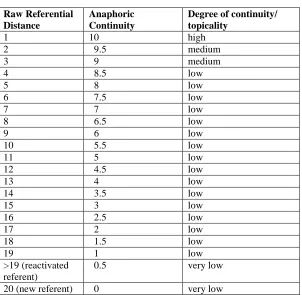
TABLE 2 ANAPHORIC CONTINUITY ...34
TABLE 3 REFERENTS OF 1 SAMUEL 17:13 ...54
TABLE 4 REFERENTS OF RUTH 1:4 ...55
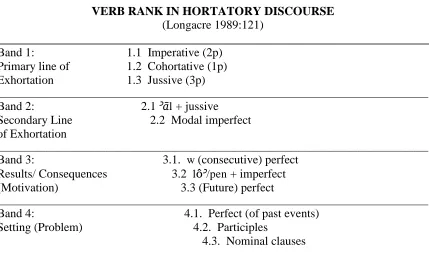
TABLE 5 VERB RANK IN HORTATORY DISCOURSE ...67
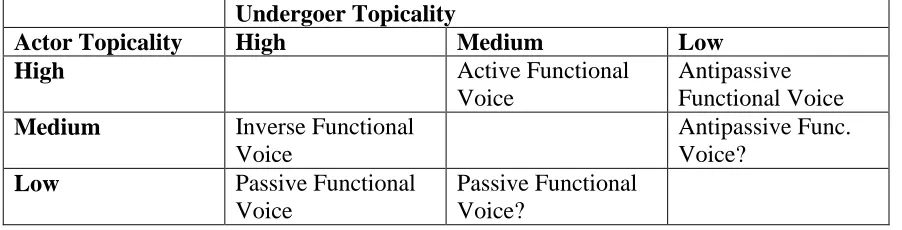
TABLE 6 RELATIVE TOPICALITY OF THE AGENT AND PATIENT IN THE FOUR MAIN FUNCTIONAL VOICES ...75
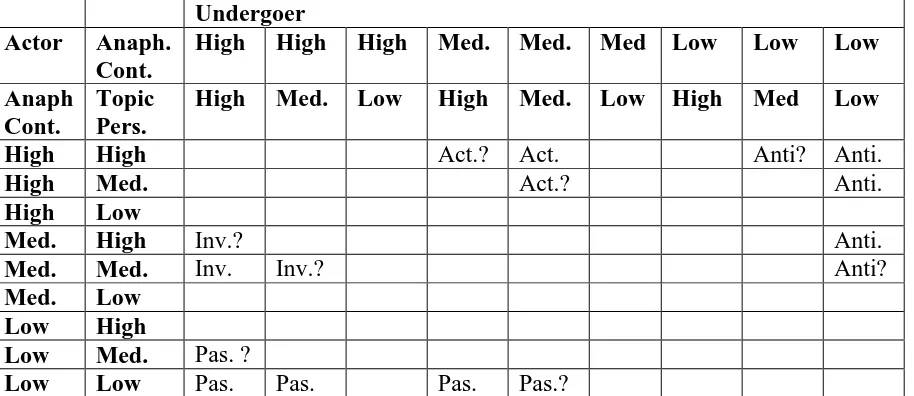
TABLE 7 POSSIBLE TOPICALITY VALUES FOR ACTOR AND UNDERGOER ...77
TABLE 8 POSSIBLE TOPICALITY PATTERNS FOR ACTOR AND UNDERGOER ...78
TABLE 9 TOPICALITY MEASURES FOR SEMANTICALLY TRANSITIVE CLAUSES IN NARRATIVE ...86
TABLE 10 TOPICALITY MEASURES FOR SEMANTICALLY TRANSITIVE CLAUSES IN DIRECTIVE DISCOURSE ...86
TABLE 11 PCA LOADINGS FOR FOUR VARIABLES IN NARRATIVE ...91
TABLE 12 PCA LOADINGS FOR FOUR VARIABLES IN DIRECTIVE DISCOURSE ...92
TABLE 13 PC1 AND PC2 AVERAGES FOR ANTIPASSIVE FUNCTIONAL VOICE CLUSTER IN NARRATIVE ...100
xviii
TABLE 15 PC1 AND PC2 AVERAGES FOR ACTIVE FUNCTIONAL
VOICE CLUSTER IN NARRATIVE ...102 TABLE 16 TOPICALITY MEASURES FOR ACTIVE FUNCTIONAL
VOICE CLUSTER IN NARRATIVE ...103 TABLE 17 PC1 AND PC2 AVERAGES FOR SEMI-ACTIVE
FUNCTIONAL VOICE CLUSTER IN NARRATIVE ...104 TABLE 18 TOPICALITY MEASURES FOR SEMI-ACTIVE FUNCTIONAL
VOICE CLUSTER IN NARRATIVE ...105 TABLE 19 PC1 AND PC2 AVERAGES FOR PASSIVE FUNCTIONAL
VOICE CLUSTER IN NARRATIVE ...106 TABLE 20 TOPICALITY MEASURES FOR PASSIVE FUNCTIONAL
VOICE CLUSTER IN NARRATIVE ...107 TABLE 21 TOPICALITY MEASURES FOR U,QATAL-PAS IN
NARRATIVE ...109 TABLE 22 PC1 AND PC2 AVERAGES FOR LOW TOPICALITY ACTIVE
FUNCTIONAL VOICE CLUSTER IN NARRATIVE ...110 TABLE 23 TOPICALITY MEASURES FOR LOW TOPICALITY ACTIVE
FUNCTIONAL VOICE CLUSTER IN NARRATIVE ...111 TABLE 24 PC1 AND PC2 AVERAGES FOR ANTIPASSIVE
FUNCTIONAL VOICE CLUSTER IN DIRECTIVE
DISCOURSE ...113 TABLE 25 TOPICALITY MEASURES FOR ANTIPASSIVE FUNCTIONAL
VOICE CLUSTER IN DIRECTIVE DISCOURSE ...114 TABLE 26 PC1 AND PC2 AVERAGES FOR ACTIVE FUNCTIONAL
VOICE CLUSTER IN DIRECTIVE DISCOURSE ...115 TABLE 27 TOPICALITY MEASURES FOR ACTIVE FUNCTIONAL
VOICE CLUSTER IN DIRECTIVE DISCOURSE ...116 TABLE 28 PC1 AND PC2 AVERAGES FOR SEMI-ACTIVE
FUNCTIONAL VOICE CLUSTER IN DIRECTIVE
DISCOURSE ...117 TABLE 29 TOPICALITY MEASURES FOR SEMI-ACTIVE FUNCTIONAL
xix
TABLE 30 PC1 AND PC2 AVERAGES FOR PASSIVE FUNCTIONAL
VOICE CLUSTER IN DIRECTIVE DISCOURSE ...119 TABLE 31 TOPICALITY MEASURES FOR PASSIVE FUNCTIONAL
VOICE CLUSTER IN DIRECTIVE DISCOURSE ...120 TABLE 32 PC1 AND PC2 AVERAGES FOR LOW TOPICALITY PASSIVE
FUNCTIONAL VOICE CLUSTER IN DIRECTIVE
DISCOURSE ...121 TABLE 33 TOPICALITY MEASURES FOR LOW TOPICALITY PASSIVE
FUNCTIONAL VOICE CLUSTER IN DIRECTIVE
DISCOURSE ...122 TABLE 34 PC1 AND PC2 AVERAGES FOR LOW TOPICALITY ACTIVE
FUNCTIONAL VOICE CLUSTER IN DIRECTIVE
DISCOURSE ...123 TABLE 35 TOPICALITY MEASURES FOR LOW TOPICALITY ACTIVE
FUNCTIONAL VOICE CLUSTER IN DIRECTIVE
DISCOURSE ...124 TABLE 36 TOPICALITY MEASURES FOR YIQTOL,S,ETO IN
DIRECTIVE DISCOURSE ...125 TABLE 37 CLASSIFICATION OF MATCHING PAIRS OF CLAUSE
TYPES ...127 TABLE 38 TOPICALITY MEASURES FOR IMPLICIT UNDERGOER
CLAUSES IN NARRATIVE ...131 TABLE 39 TOPICALITY MEASURES FOR IMPLICIT UNDERGOER
CLAUSES IN DIRECTIVE DISCOURSE ...133 TABLE 40 TOPICALITY MEASURES FOR OBLIQUE NOMINAL
UNDERGOER CLAUSES IN NARRATIVE ...134 TABLE 41 TOPICALITY MEASURES FOR OBLIQUE NOMINAL
UNDERGOER CLAUSES IN DIRECTIVE DISCOURSE ...136 TABLE 42 TOPICALITY MEASURES FOR OBLIQUE PRONOMINAL
UNDERGOER CLAUSES IN NARRATIVE ...137 TABLE 43 TOPICALITY MEASURES FOR OBLIQUE PRONOMINAL
xx
TABLE 44 TOPICALITY MEASURES FOR UNMARKED OBJECT
CLAUSES IN NARRATIVE ...140 TABLE 45 TOPICALITY MEASURES FOR UNMARKED OBJECT
CLAUSES IN DIRECTIVE DISCOURSE ...142 TABLE 46 TOPICALITY MEASURES FOR NOMINAL OBJECTS WITH
IN NARRATIVE ...143 TABLE 47 TOPICALITY MEASURES FOR NOMINAL OBJECTS WITH
IN DIRECTIVE DISCOURSE ...145 TABLE 48 TOPICALITY MEASURES FOR PRONOMINAL OBJECTS
WITH IN NARRATIVE ...146 TABLE 49 TOPICALITY MEASURES FOR PRONOMINAL OBJECTS
WITH IN DIRECTIVE DISCOURSE ...148 TABLE 50 TOPICALITY MEASURES FOR SUFFIXED OBJECT
CLAUSES IN NARRATIVE ...149 TABLE 51 TOPICALITY MEASURES FOR SUFFIXED OBJECT
CLAUSES IN DIRECTIVE DISCOURSE ...151 TABLE 52 OBJECT MARKING IN NARRATIVE RANKED BY
UNDERGOER MEAN ANAPHORIC CONTINUITY ...153 TABLE 53 OBJECT MARKING IN DIRECTIVE DISCOURSE RANKED
BY UNDERGOER MEAN ANAPHORIC CONTINUITY...153 TABLE 54 MARKING OF CLAUSES WITH NOMINAL OBJECTS IN
DIRECTIVE DISCOURSE ...156 TABLE 55 TOPICALITY MEASURES FOR VO CLAUSES WITH
NOMINAL OBJECTS IN NARRATIVE ...159 TABLE 56 TOPICALITY MEASURES FOR VO CLAUSES WITH
NOMINAL OBJECTS IN DIRECTIVE DISCOURSE ...161 TABLE 57 TOPICALITY MEASURES FOR VO CLAUSES WITH
PRONOMINAL OBJECTS IN NARRATIVE ...162 TABLE 58 TOPICALITY MEASURES FOR VO CLAUSES WITH
xxi
TABLE 59 TOPICALITY MEASURES FOR OV CLAUSES WITH
NOMINAL OBJECTS IN NARRATIVE ...165 TABLE 60 TOPICALITY MEASURES FOR OV CLAUSES WITH
NOMINAL OBJECTS IN DIRECTIVE DISCOURSE ...167 TABLE 61 TOPICALITY MEASURES FOR VSO CLAUSES IN
NARRATIVE ...169 TABLE 62 TOPICALITY MEASURES FOR VSO CLAUSES IN
DIRECTIVE DISCOURSE ...170 TABLE 63 TOPICALITY MEASURES FOR VOS CLAUSES WITH
PRONOMINAL OBJECTS IN NARRATIVE ...172 TABLE 64 TOPICALITY MEASURES FOR VOS CLAUSES WITH
PRONOMINAL OBJECTS IN DIRECTIVE DISCOURSE ...173 TABLE 65 TOPICALITY MEASURES FOR SVO CLAUSES WITH
NOMINAL SUBJECTS AND OBJECTS IN NARRATIVE ...175 TABLE 66 TOPICALITY MEASURES FOR SVO CLAUSES WITH
NOMINAL SUBJECTS AND OBJECTS IN DIRECTIVE
DISCOURSE ...176 TABLE 67 TOPICALITY MEASURES FOR SVO CLAUSES WITH
PRONOMINAL OBJECTS IN NARRATIVE ...178 TABLE 68 TOPICALITY MEASURES FOR SVO CLAUSES WITH
PRONOMINAL OBJECTS IN DIRECTIVE DISCOURSE ...179 TABLE 69 TOPICALITY MEASURES FOR SVO CLAUSES WITH
PRONOMINAL SUBJECTS IN DIRECTIVE DISCOURSE ...180 TABLE 70 TOPICALITY MEASURES FOR OVS CLAUSES IN
NARRATIVE ...182 TABLE 71 TOPICALITY MEASURES FOR VU PASSIVE CLAUSES IN
NARRATIVE ...184 TABLE 72 TOPICALITY MEASURES FOR UV PASSIVE CLAUSES IN
NARRATIVE ...185 TABLE 73 TOPICALITY MEASURES FOR VU PASSIVE CLAUSES IN
xxii
TABLE 74 TOPICALITY MEASURES FOR UV PASSIVE CLAUSES IN
DIRECTIVE DISCOURSE ...189 TABLE 75 TOPICALITY MEASURES FOR QAL PASSIVE, PU‘AL AND
HOPH‘AL PASSIVE CLAUSES IN DIRECTIVE DISCOURSE ...191 TABLE 76 TOPICALITY MEASURES FOR NIPH‘AL PASSIVE CLAUSES
IN DIRECTIVE DISCOURSE ...191 TABLE 77 ANAPHORIC CONTINUITY OF NOMINAL SUBJECTS IN
NARRATIVE ...198 TABLE 78 ANAPHORIC CONTINUITY OF NOMINAL SUBJECTS IN
DIRECTIVE DISCOURSE ...198 TABLE 79 ANAPHORIC CONTINUITY OF NOMINAL OBJECTS IN
NARRATIVE ...201 TABLE 80 ANAPHORIC CONTINUITY OF NOMINAL OBJECTS IN
DIRECTIVE DISCOURSE ...201 TABLE 81 MEAN REFERENTIAL DISTANCE OF NOMINAL OBJECTS ...203 TABLE 82 TOPICALITY MEASURES FOR YIQTOL CLAUSES IN
NARRATIVE ...206 TABLE 83 TOPICALITY MEASURES FOR YIQTOL CLAUSES IN
DIRECTIVE DISCOURSE ...208 TABLE 84 TOPICALITY MEASURES FOR QATAL CLAUSES IN
NARRATIVE ...210 TABLE 85 TOPICALITY MEASURES FOR QATAL CLAUSES IN
DIRECTIVE DISCOURSE ...212 TABLE 86 TOPICALITY MEASURES FOR WAYYIQTOL CLAUSES IN
NARRATIVE ...213 TABLE 87 TOPICALITY MEASURES FOR WEQATAL CLAUSES IN
DIRECTIVE DISCOURSE ...215 TABLE 88 TOPICALITY MEASURES FOR IMPERATIVE CLAUSES IN
DIRECTIVE DISCOURSE ...216 TABLE 89 TOPICALITY MEASURES FOR PASSIVE YIQTOL CLAUSES
xxiii
TABLE 90 TOPICALITY MEASURES FOR PASSIVE QATAL CLAUSES
IN NARRATIVE ...219 TABLE 91 TOPICALITY MEASURES FOR PASSIVE WAYYIQTOL
CLAUSES IN NARRATIVE ...220 TABLE 92 TOPICALITY MEASURES FOR PASSIVE WEQATAL
CLAUSES IN DIRECTIVE DISCOURSE ...222 TABLE 93 VERB CONJUGATIONS RANKED BY MEAN ANAPHORIC
CONTINUITY DIFFERENCE ...223 TABLE 95 TOPICALITY VALUES FOR MON-V/PON-V CLAUSES ...240 TABLE 96 TOPICALITY MEASURES FOR MORONENE
SEMANTICALLY TRANSITIVE CLAUSES ...248 TABLE 97 PCA LOADINGS FOR FOUR VARIABLES IN MORONENE
CORPUS ...250 TABLE 98 TOPICALITY MEASURES FOR V,PREPO IN MORONENE ...253 TABLE 99 PC1 AND PC2 AVERAGES FOR ANTIPASSIVE
FUNCTIONAL VOICE CLUSTER IN MORONENE ...254 TABLE 100 TOPICALITY MEASURES FOR ANTIPASSIVE FUNCTIONAL
VOICE CLUSTER IN MORONENE ...255 TABLE 101 PC1 AND PC2 AVERAGES FOR FIRST ACTIVE
FUNCTIONAL VOICE CLUSTER IN MORONENE ...256 TABLE 102 TOPICALITY MEASURES FOR FIRST ACTIVE
FUNCTIONAL VOICE CLUSTER IN MORONENE ...257 TABLE 103 PC1 AND PC2 AVERAGES FOR SECOND ACTIVE
FUNCTIONAL VOICE CLUSTER IN MORONENE ...258 TABLE 104 TOPICALITY MEASURES FOR SECOND ACTIVE
FUNCTIONAL VOICE CLUSTER IN MORONENE ...259 TABLE 105 PC1 AND PC2 AVERAGES FOR HIGH TOPICALITY ACTIVE
FUNCTIONAL VOICE CLUSTER IN MORONENE ...260 TABLE 106 TOPICALITY MEASURES FOR HIGH TOPICALITY ACTIVE
xxiv
TABLE 107 PC1 AND PC2 AVERAGES FOR INVERSE FUNCTIONAL
VOICE CLUSTER IN MORONENE ...262 TABLE 108 TOPICALITY MEASURES FOR INVERSE FUNCTIONAL
VOICE CLUSTER IN MORONENE ...263 TABLE 109 TOPICALITY MEASURES FOR NOM,UVV,U IN MORONENE ...264 TABLE 110 TOPICALITY MEASURES FOR NOM,UVV IN MORONENE ...265 TABLE 111 MATCHING HEBREW AND MORONENE CLAUSE TYPE
CLUSTERS...273 TABLE 112 MORONENE CLAUSE TYPE USED TO TRANSLATE
COMMON HEBREW CLAUSE TYPES ...284 TABLE 113 NUMBER OF MORONENE CLAUSES REVISED ...289 TABLE 114 NUMBER OF AMALGAMATED CLAUSE TYPES IN EACH
FUNCTIONAL VOICE CATEGORY ...302 TABLE 115 CLAUSE TYPES MATCHING GIVÓN’S FUNCTIONAL
VOICE CATEGORIES ...310 TABLE 116 CLAUSE TYPES MATCHING GIVÓN’S FUNCTIONAL
xxv
LIST OF FIGURES
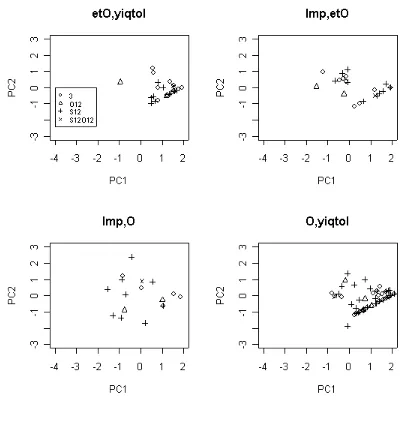
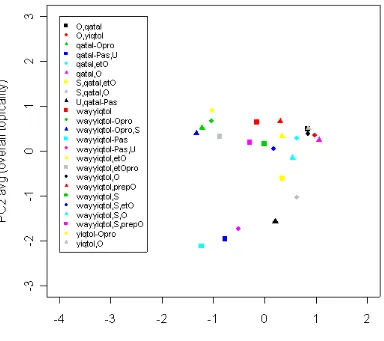
FIGURE 1 PC1 AND PC2 PLOTTED FOR FOUR BASIC CLAUSE TYPES
IN DIRECTIVE DISCOURSE ...94 FIGURE 2 PC1 AND PC2 PLOTTED FOR FOUR BASIC CLAUSE TYPES
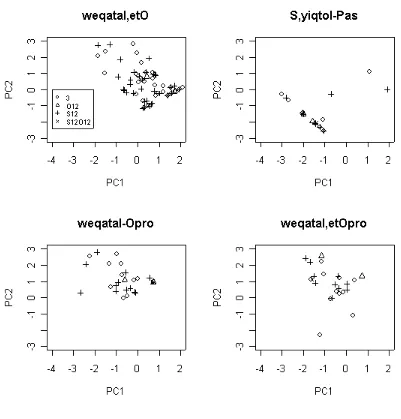
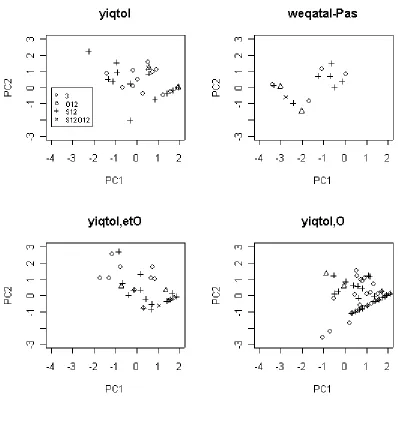
IN DIRECTIVE DISCOURSE ...95 FIGURE 3 PC1 AND PC2 PLOTTED FOR FOUR BASIC CLAUSE TYPES
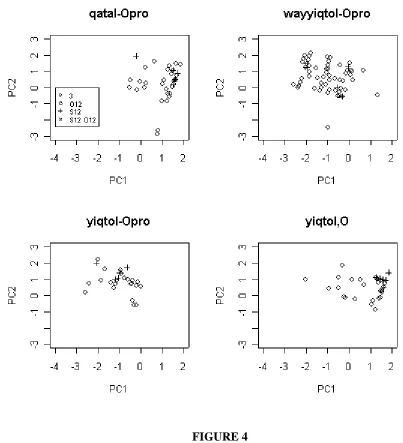
IN DIRECTIVE DISCOURSE ...96 FIGURE 4 PC1 AND PC2 PLOTTED FOR FOUR BASIC CLAUSE TYPES
IN NARRATIVE ...97 FIGURE 5 MEANS OF PC1 AND PC2 FOR BASIC CLAUSE TYPES IN
NARRATIVE WITH 10+ EXAMPLES ...99 FIGURE 6 MEANS OF PC1 AND PC2 FOR BASIC CLAUSE TYPES IN
DIRECTIVE DISCOURSE WITH 10+ EXAMPLES ...112 FIGURE 7 MEANS OF PC1 AND PC2 FOR BASIC CLAUSE TYPES IN
xxvi LIST OF MAPS
xxvii
LIST OF ABBREVIATIONS
A Actor
ABS Absolutive
AC Anaphoric continuity
Act. Active
ADV Adverbial
AF Action focus
AGT Agent
Anaph. Anaphoric
Anti. Antipassive
APPL Applicative
ART Article
Aux Auxiliary
avg Average
BEN Benefactive
BH Biblical Hebrew
CAUS Causative
CL Clause
CMS Commiserative
Coh Cohortative
xxviii COMPL Complementizer
Cont. Continuity
CTR Contra-expectation
DEF Definite
Dev. Deviation
Dif. Difference
Diff Different
DO Direct object
e Exclusive
EBH Early Biblical Hebrew
et
Func. Functional
FUT Future
GE Genitive
i Inclusive
IMPV Imperative
IN Initial
Infa Infinitive absolute
INT Intransitive
Inv. Inverse
INST Instrumental
IV Inverse
KITLV Koninklijk Instituut voor Taal-Lande en Volkenkude
xxix
L Left
LG Ligature
LOC Locative
m Masculine
Med. Medium
n Number
NASB New American Standard Bible
NEG Negative
NF Nonfinite
NIV New International Version
NOM Nominative
nomin. Nominal
NP Noun phrase
NT New Testament
O Object
OBJ Object
ORD Ordinal
O12 First or second person object
O2 Second object
p Plural
Pas Passive
PAT Patient
Pers. Persistence
xxx PCA Principal component analysis
PI Person indicator
PL Plural
PN Proper noun
POS Possessive
prep Preposition
PRF Perfective
pro Pronominal
R Right
RD Referential distance
RE Realis
Reactiv. Reactivated
REC Reciprocal
RED Reduplication
REL Relativizer
RES Resultative
RRD Raw referential distance
RV Revised
S Subject
s Singular
STV Stative
SUB Subordinate
SUBJ Subject
xxxi Tab. Table
TCA Topic-comment articulation
TOP Topic
TP Topic persistence
U Undergoer
Und. Undergoer
UV Undergoer voice
UVV Undergoer voice verb
V Verb
vs versus
V. Low Very Low
w. with
1 1st person
2 2nd person
1
INTRODUCTION
In this introductory chapter, I will present the research problem in terms of how it
relates to some unsolved problems in the study of Biblical Hebrew. I will state briefly
the purpose, goal, and significance of this study, the central research issue, the research
questions, and other related information.
Explanation of Syntactic Variants
In every language, there are many different ways of saying the same thing. For
one particular event in the real world, there are many different choices of clauses to
describe it. Even if we disregard possible different choices of vocabulary, there are many
purely syntactic choices that give rise to a variety of clauses that mean virtually the same
thing. Such clauses have the same truth conditions, the same propositional semantics, but
there are other aspects of meaning in which they differ.
Much research has been devoted to analyzing what aspects of meaning are coded
by alternative clause types that have the same truth conditions. One approach to such
questions is that of discourse pragmatics.1 In the words of Knud Lambrecht, “discourse
pragmatics is concerned with the question of why one and the same meaning may be
expressed by two or more sentence forms” (1994:5). Such differences may be used by
the author to send signals to the receptor to aid him or her in drawing appropriate
inferences concerning the author‟s intent. In Biblical Hebrew, such clause variants can
be caused by a number of syntactic factors including choice of verb conjugation, choice
of word order, and different ways of coding the subject and object. A brief selection of
the explanations for these choices that have been put forward in the literature is presented
below.
Explanations of Variant Verb Forms
Much effort has been devoted to explaining the difference between the wayyiqtol
and qatal verb forms in Hebrew. In some contexts, they seem to have distinct meanings,
but in other contexts, their meanings seem to overlap, as each of them can be translated as
past tense. Similar efforts have been made to clarify the difference between yiqtol and
weqatal, both of which can often be translated as future tense. A number of different
approaches have been taken to attempt to clarify the semantic or pragmatic difference
between the two pairs of forms and what they may signal concerning the author‟s
intention.
Tense, Aspect, and Modality
Many scholars have used concepts of tense or aspect to explain the difference.
Some maintain that the difference between the two pairs of forms is primarily an aspect
distinction (Driver 1892; Endo 1996:296, 320-322; Eskhult 1990; Isaksson 1987).
Other scholars maintain that each form conveys a combination of tense and
aspectual meanings (Rogland 2003:8-14) or a combination of tense, aspect, and modality
(Cook 2001; Gentry 1998:39; Waltke and O‟Connor 1990:476-562; Warren
F oreground versus Background
Robert Longacre maintains that wayyiqtol is used for foreground in narrative,
whereas qatal is used for background (1989:65-82). Similarly, in predictive discourse,
weqatal is used for foreground and yiqtol is used for background (1989:106-107).
A number of other scholars have adopted this view, for example, Alviero Niccacci
(1990; 1997). But some have objected that Longacre‟s classification is too clear-cut,
since qatal can be used for both foreground and background (Bailey and Levinsohn
1992:200-204; Heimerdinger 1999:221-240). John Cook (2004) presents evidence
supporting the claim that wayyiqtol is semantically marked as foreground, but with regard
to weqatal he claims, “its utilization for backgrounded clauses…alongside its appearance
in foregrounded expressions precludes an identification of foregrounding as a
discourse-pragmatic property of the form” (2004:269).
Continuity versus Discontinuity
According to Talmy Givón, in Early Biblical Hebrew wayyiqtol is used with the
function of topic continuity, whereas qatal is used for topic-shifting (1977:198-218).2
According to Randall Buth (1992), a key distinction in the Hebrew verbal system is that
wayyiqtol signals thematic continuity, whereas qatal signals discontinuity. Some
researchers express a similar idea in terms of paragraph boundaries, namely that qatal is
used to signal paragraph onset or paragraph close, both of which are points of
discontinuity in the text (e.g. Heller 2004).
Tight Linkage versus Loose Linkage
According to Harald Baayen (1997), a key distinction in the Hebrew verbal
system is that wayyiqtol signals tight linkage, whereas qatal signals loose linkage. Tight
linkage means that the new information in a clause “is relevant to the currently most
salient knowledge in the common ground established by the participants in a
communicative event” (1997:249). Loose linkage indicates that new information “is not
intended to be tightly linked to the current topic” (1997:249).
Explanations of Variant Word Orders
Different suggestions have been made to explain variant word orders. Much of
the attention has been on the function of clauses with fronted nominal subjects or other
fronted constituents (e.g. X-qatal), in contrast to those with postverbal subjects.
Topicalization and F ocus
Katsuomi Shimasaki claims that the fronted position signals focus (2002:42).3
Others claim that fronting has two possible functions: to signal either topicalization or
focus (Bailey and Levinsohn 1992:188; Buth 1990:15-16; Floor 2004:187; van der
Merwe, Naudé, and Kroeze 1999:345-347).
F oreground versus Background
According to Buth, “The characteristics of Foreground and Background in
narrative directly affect the parameters of word order” (1990:10). In particular, he claims
that “vav hahipuk [i.e. wayyiqtol] clauses and VS order mark the Foreground…in Biblical
narrative” (1990:12). His complementary claim is that “clauses where a non-verb begins
a narrative clause…mark the clause category of Background” (1990:12). The more
traditional category of “circumstantial clause,” which also involves the insertion of a
clause-level constituent before the verb, is described by Francis Andersen as a clause
which “interrupts the sequence of events, and generally reports an event contemporaneous, concomitant, or „circumstantial‟ to the main stream” (1974:77). This
can be regarded as a type of background clause.
Explanations of Variant Coding of Subjects
The clause subject can be coded as a noun or noun phrase, as a free pronoun, or
by the affixation of the verb. A number of suggestions have been made with regard to
possible functions of some of these alternatives.
Continuity versus Discontinuity
Some scholars suggest that nominal coding of the subject can mark discourse
discontinuity. In the words of L. J. de Regt, “overspecifications of previously-mentioned
participants…mark the shift to a new paragraph” (1999:59).
Contrast
Some scholars suggest that coding of the subject by an independent pronoun can
signal contrast or antithesis (de Regt 1999:57-58; Waltke and O‟Connor 1990:295).
Explanations of Variant Coding of Objects
Objects can be unmarked, marked with the particle , or suffixed on the
verb. The main effort of scholars has been to try to explain the factors determining the
Definite versus Indefinite
It is observed that indefinite nouns do not occur with the particle , whereas
with definite nouns, “ is very common, but seldom necessary” (Joüon and Muraoka
1991:445; cf. Waltke and O‟Connor 1990:162).
Individuation and Affectedness
According to Randall Garr, “the grammatical definiteness of the object does not
fully account for et…Rather, et is sensitive to the individuation of the object”
(1991:119n3). Besides this “et may also signal the extent to which the object is
affected” (1991:124).
Prose versus Poetry
The frequency of occurrence of definite nominal objects without is explained
in relation to genre; the more poetic a text is, the lower the frequency of (Andersen
and Forbes 1983).
Emphasis
It is suggested that objects marked with have more emphasis than those that
are unmarked (Muraoka 1985:146-158; Waltke and O‟Connor 1990:178).
Disambiguation
According to Michael Malessa, is used relatively frequently in clauses which
have nominal subjects with VSO order. He suggests that its function in such contexts is
to indicate and distinguish between the syntactic functions of subject and object
Investigating Topicality as an Explanation
I have based the present study on the assumption that for most syntactic variants,
no one factor determines the choice. Each variant will exemplify a complicated
combination of semantic and discourse-pragmatic features. In the present study, I will
investigate one feature that has not received much attention thus far, namely the relative
topicality of clause referents. Any results discovered are not intended to diminish the
validity of all the insights listed above, but rather to complement them.
In the present study, I assume that one particular discourse function of clauses is
to help indicate relative topicality of the referents found in that clause. One particular
syntactic feature that signals relative topicality of the actor and undergoer of a clause is
voice. I will use an approach to voice that is broader than the traditional distinction
between active and passive voice, but will also include antipassive and inverse voices.4 I
will not limit the investigation to syntactic or morphological voice, but will utilize the
concept of functional voice. This entails recognizing that certain topicality patterns are
prototypically associated with each of the syntactic voices, and other clause types with
similar topicality profiles can be categorized as belonging to the respective functional
voice.
I hope to show that an analysis of the functions of Biblical Hebrew clause types in
terms of topicality and functional voice will be of benefit in relation to the challenges
faced in translating Biblical Hebrew into a wide variety of languages. Hebrew has
relatively few morphological distinctions coding tense and aspect. This presents
difficulties to those endeavoring to translate from Hebrew into languages with a rich
system of tense and aspect distinctions, such as are found in many European languages.
This is one reason scholars speaking those languages have done a great deal of research
attempting to clarify how such distinctions are coded in Hebrew syntax.
In a similar way, Hebrew has only two voice categories that are coded by the verb
morphology. But many other languages, such as many Austronesian languages, have a
richer system of voice distinctions, with perhaps four main voices. It will be helpful to
those translating from Hebrew into such languages to clarify whether or not the topicality
patterns behind such voice distinctions are signaled by Hebrew syntax.
In order to lay the groundwork for the possible contribution of this approach to
translation, the present study applies the research methodology not only to Biblical
Hebrew, but also to Moronene, an Austronesian language spoken in Southeast Sulawesi,
Indonesia.
Purpose of Study
The purpose of this study is to use measures of topicality to test various
hypotheses about the functions of clause types in Biblical Hebrew and Moronene as well
as to propose new hypotheses arising from the analysis.
Goal of Study
The goal is to identify factors relating to topicality and functional voice that help
determine the choice between different clause types in Biblical Hebrew and Moronene,
and hence give a better understanding of which Moronene clause types may be
appropriate equivalents for which Hebrew clause types in translation.
Significance of Study
The results of this study will have applications to the development of linguistic
theory in relation to discourse analysis. It will also have practical applications in relation
to translation theory, and the task of Bible translation. Furthermore, I hope that ongoing
dissertation will lead to a better understanding of how topicality and functional voice
influence clause structure in source and target languages, and thereby improve the quality
of translations.
Central Research Issue
The problem to be addressed in this dissertation is the classification of Biblical
Hebrew and Moronene clause types in terms of topicality patterns and functional voice
categories.
Research Questions5
1. What is the relative topicality of the core arguments of Biblical Hebrew semantically transitive clause types, as measured by referential distance and topic persistence?
2. How do semantically transitive clause types in Hebrew cluster statistically in terms of topicality patterns and functional voice categories?
3. How do features of constituent order, object marking, and verb conjugation correlate with topicality patterns in Hebrew?
4. What is the relative topicality of the core arguments of Moronene semantically transitive clause types, as measured by referential distance and topic persistence?
5. How do semantically transitive clause types in Moronene cluster statistically in terms of topicality patterns and functional voice categories?
6. How does an understanding of Hebrew and Moronene topicality patterns affect translation from Hebrew to Moronene?
Scope and Delimitations
In this dissertation, I limit the analysis of Biblical Hebrew to two discourse types,
narrative and directive discourse. For each of these I have selected from the Hebrew
Bible a reasonably extensive corpus for analysis. Narrative has two subtypes, narrative
prose and narrative poetry. The narrative prose corpus I analyzed comprises Exodus
1-19, 1 Samuel 16-31, and Ruth. The narrative poetry corpus I analyzed comprises Psalms
77, 78, 105, 106, 107, Exodus 15:1-18 (Song of Moses and Miriam), Deuteronomy 32
(Song of Moses), Judges 5 (Song of Deborah), 2 Samuel 22, and Habakkuk 3.
The directive discourse corpus I analyzed comprises selections from the books of
Genesis, Exodus, Leviticus, Numbers, Joshua, Judges, Ruth, 1 & 2 Samuel, 1 & 2 Kings.
Based on criteria of genre and minimum length, I identify sixty-one separate directive
speech units in these books (see Appendix A).
I restrict the analysis of Moronene to narrative prose and poetry. The corpus
consists of two poetic narrative texts and four prose folk tales.
I focused the analysis on semantically or syntactically transitive clauses. Some
parts of the analysis are restricted to more frequently occurring clause types, those
occurring at least nine or ten times in the corpus.
My main line of investigation in this dissertation is defined by the central research
issue and research questions above. This investigation will involve detailed statistical
analysis of Hebrew clause types in narrative and directive discourse, and somewhat less
detailed statistical analysis of Moronene clause types in narrative. In addition to this, at a
number of points in the dissertation I will include supplementary investigations of issues
that arise out of the results of the main investigation. These supplementary investigations
are sometimes motivated by the need to explore further some results that are difficult to
explain, or else to apply some results to the issues that have been discussed in the work of
applications of the present study to various issues. As such, they are not as detailed or
comprehensive in scope as the main investigation.
Summary of Dissertation
This dissertation is divided into four parts. Part I deals with the theoretical
framework. In Chapter 1, I review the literature most relevant to the investigation of
topicality in Biblical Hebrew. In Chapter 2, I outline the methodology used in the
research, focusing on how the methodology is applied to Biblical Hebrew narrative and
directive discourse. I present several hypotheses relating to the adequacy of the
theoretical categories used.
Part II consists of the analysis of Hebrew clause types. In Chapter 3, I analyze the
topicality patterns of frequently occurring Hebrew clause types by using principal
component analysis. I present the results in charts, which show how clause types with
similar topicality patterns cluster together. For each cluster of clause types, the statistics
showing the topicality patterns are presented and discussed. This is done separately for
clause types found in the narrative corpus and those found in the directive discourse
corpus.
In Chapters 4, 5, and 6, I analyze topicality patterns of Hebrew clause types by
using a slightly different approach. Instead of restricting the analysis to clause types
occurring ten times or more, as was done in Chapter 3, I group together both frequent and
infrequent clause types sharing particular syntactic features to form amalgamated clause
types. For each amalgamated clause type, I present and discuss the statistics showing the
topicality patterns. In Chapter 4, the amalgamated clause types are based on different
ways of marking the object. In Chapter 5, the amalgamated clause types are based on
different constituent orders, combined with the feature of whether the subject and object
subject fronting and object fronting. In Chapter 6, the amalgamated clause types are
based on the verb conjugation, combined with the feature of whether the verb is
morphologically active or passive.
Part III consists of the analysis of Moronene clause types. In Chapter 7, I give a
brief introduction to Moronene syntax, and discuss various suggestions in the literature as
to how to analyze voice and topicality in Moronene. In Chapter 8, I spell out adjustments
to the methodology needed to make it appropriate for Moronene clause types. Then in
Chapter 9, I apply the procedures used in Chapter 3 to frequently occurring Moronene
clause types. I analyze the clause types using principal component analysis, I generate a
chart showing clusters of clause types, and I present and discuss the statistics showing the
topicality patterns for each cluster.
In Part IV, I compare the results of the separate analyses of Hebrew and
Moronene. In Chapter 10, I match the clause type clusters identified for Hebrew in
Chapter 3 with those identified for Moronene in Chapter 9. For each Hebrew clause type
cluster, I identify the Moronene clause types that are most similar to it in their topicality
patterns. These are given the label “matching clause types.” Other Moronene clause
types are referred to as “non-matching clause types.” A comparison is then made of a
Biblical Hebrew text and its translation into Moronene to see to what extent particular
Hebrew clause types are translated by Moronene matching clause types. This
comparison is used to identify clauses already translated into Moronene that may need
revision. In Chapter 11, I describe how Moronene translators were asked to evaluate the
naturalness of clauses in which non-matching clause types and rare clause types were
used in the Moronene translation. Those that were felt to be unnatural were revised. I
discuss various categories of clauses that needed to be revised and those that were not
In the Conclusion, I summarize the results of the analysis of Hebrew in Part II, the
analysis of Moronene in Part III, and the comparison of Hebrew and Moronene in Part
PART I
THEORETICAL FRAMEWORK
In Part I, I present the theoretical framework for the present research. Chapter 1
reviews the literature most relevant to the investigation of topicality in Biblical Hebrew.
In Chapter 2, I lay out the methodology used in the dissertation, focusing on how the
methodology is applied to a classification of clause types in terms of topicality and
functional voice in Biblical Hebrew narrative and directive discourse. I present several
15 CHAPTER 1
APPROACHES TO TOPIC IN BIBLICAL HEBREW
In this chapter I will briefly introduce the concepts of topic and topicality. The
main focus will be to review previous research that has applied these concepts to Biblical
Hebrew.
Approaches to Topic
There are three common approaches to topic and topicality in the linguistic
literature. The first is concerned with clause or sentence topic. This involves the
identification of one or more entities or expressions as the topic of a clause or sentence.
Some representatives of this approach include Knud Lambrecht (1994) and Sebastiaan
Floor (2004).
A second approach is concerned with the discourse topicality of referents.
Topicality in this sense is understood in terms of frequency of mention. A referent of
high topicality is one that is mentioned very frequently with minimal gaps between one
mention and the next. A referent of low topicality is one that is mentioned infrequently,
with large gaps between each mention. The highest topicality would be if a referent were
mentioned in every single clause over a particular stretch of discourse. The lowest
topicality would be if a referent were mentioned only once in the discourse. Some
representatives of this approach include Russell Tomlin (1986) and Talmy Givón (1983,
A third approach focuses on discourse topic. This involves the identification of
one or more topics, often expressed as propositions, in relation to a larger stretch of
discourse. Some representatives of this approach include Gillian Brown and George
Yule (1983:68-124) and Kathleen Callow (1998:217-228). This third approach is not as
relevant to the present study as the first two approaches.1
Topicality of Referents in Biblical Hebrew
In the following sections, I will review a number of studies that have investigated
discourse topicality of referents in Biblical Hebrew. I will also evaluate the
appropriateness of each approach as a model to be adapted in the present research.
Heimerdinger on Topical Importance
Jean-Marc Heimerdinger (1999) studies topic in ancient Hebrew narratives, along
with a parallel interest in focus and foregrounding. His main concern with regard to topic
is to determine the relative topical importance of topical elements in a story. He uses two
main techniques to discern this. First is the identification of a story title. Heimerdinger
states, “The „title‟ establishes the participants mentioned as the topical participants and
the action as the topical action.…At discourse level a discourse topic which refers to
specific topical entities must be identified” (1999:106).
The second technique involves the computation of cumulative referential density,
which involves counting the number of mentions of topical entities in each paragraph.
This method is adopted from Tomlin (1986:42-44). Heimerdinger describes the method
as follows:
1 For a survey of various approaches to topic in relation to the analysis of topic in Biblical
The text is divided into paragraph units and the topical entities are identified in each clause. For every clause, the number of references to the entity at a given point of the paragraph is worked out. This number is divided by the number of clauses up to that point in the paragraph. A ranking of each topical entity in each clause is established as well as a global ranking of all the entities (1999:108).
The results of the counts are presented in cumulative frequency tables. In
addition, he gives tables listing the syntactic realization of the topic entities, how many
times each one is realized as subject, object, or adjunct.
Heimerdinger illustrates his approach by an analysis of Genesis 22. Some of his
conclusions are as follows:
A main topical participant will persist throughout the story and will be found mostly in the grammatical function of S, which corresponds to the main topic having the case role of agent. The repeated occurrence of an entity in a clause with a DO or A [adjunct] function indicates that the entity is a secondary topical entity, either a secondary participant or a prop.…
When a predication merges the main topical participant and another topical entity into one centre of attention, the main topical participant increases in topicality. This is usually happening in transitive clauses with the main topical participants as Actor and the other topical entity as Undergoer (1999:126).
If Heimerdinger‟s method were applied to investigate the questions relevant to the
present research, a number of problems would arise. Heimerdinger does not spell out a
procedure for identifying titles in stories, nor does he spell out a clear procedure for
identifying paragraph boundaries. He acknowledges that the “identification of
paragraphs may present difficulties in some written stories” (1999:108). It happens that
the text he chose to analyze, Genesis 22, has a clear title and clear paragraph boundaries.
Application of the method to larger stretches of discourse without clear guidelines would
likely result in arbitrary or inconsistent analytical decisions.
Another problem with the method relates to the units used for quantifying
and clause types, whereas Heimerdinger‟s method measures topicality at paragraph level.
The cumulative frequency measures for clauses are likely to pattern differently depending
on whether a clause is near the beginning or end of a paragraph. This factor would
complicate the analysis.
Fox on Coding of Participants
Andrew Fox (1983) represents a quantified study of topicality in Biblical Hebrew
focused on the coding of participants by various nominal and pronominal syntactic
devices. He assumes that “these devices hierarchize along a continuity/predictability
scale”2 as set out below:
MOST CONTINUOUS zero anaphora
unstressed/clitic pronouns (verb agreement) independent/stressed pronouns
R-dislocated DEF-NP DEF-NP
L-dislocated DEF-NP passivized (subject) NP Y-movement
indefinite NP
cleft/focused/contrasted NP
LEAST CONTINUOUS (1983:219).
Fox uses three measures of topicality: (1) referential distance, which is defined as:
“The distance, in number of clauses, between the last prior mention of a referent in the
register and the current appearance that is being counted.” (2) decay (persistence), which
is defined as: “The length of the unbroken chain, in terms of number of clauses, through
which the referent remains an argument of the clause after the instance being counted.”
(3) potential interference, defined as: “The “presence vs. absence of other referents in the
immediately preceding discourse, if they are referents that are compatible with the
predicate in terms of selectional restrictions” (1983:220).
Fox‟s research is quite relevant to the questions addressed in the present
dissertation. His focus, however, is slightly different: he is focusing on the
nominal/pronominal coding of topical entities, whereas I am focusing on clause types as a
whole, in which the nominal/pronominal coding is only one element.
Fox‟s paper has many tables and graphs giving the values of these variables for
each of the devices on the continuity scale. It would be difficult to summarize his
findings as a whole. Since his referential distance variable is defined the same way as in
the present study, it is the most useful basis of comparison. Because the way he defines
his syntactic devices is quite different from the way I have defined my clause types, most
of our measures are not comparable. Some similar devices are defined differently. For
example, Fox‟s zero anaphora of direct object (1983:229) is equivalent to my implicit
undergoer clauses (see Chapter 4), but he excludes unidentifiable undergoers and this
affects the results. Fox identifies fronting of objects with Y-movement (contrastive
topicalization), stating, “the OV word-order for objects in EBH is always a contrastive,
localized referential device, and thus fully equivalent with Y-movement” (1983:226).
This ought to be equivalent to my OV clauses (see Chapter 5), but the actual example he
gives of OV word order is as follows:
me-’eleh nifridu ‟iyey hagoyim…[Gen. 10:5] from-those split-they islands-of the-gentiles
and from those islands of the gentiles separated (1983:226).
The fronted constituent in this clause is not an object but rather a prepositional phrase.
This suggests that Fox may be defining so-called OV word order to include the fronting
of other non-subject constituents besides objects. Such constituents may well have
different patterns than objects. This means that our results are not comparable for this
Fox based his analysis on the clauses in Genesis 1-41, which is predominantly
narrative. In Chapters 4 and 5, some of Fox‟s results are compared with the results of the
present methodology applied to Biblical Hebrew narrative.
Givón on Clause Types
Talmy Givón is the originator of the methodology used in the present study and in
a number of works he has applied the concepts involved to Hebrew. In Givón (1977), he
investigated SV versus VS clauses in different parts of the Hebrew Bible. He showed
that SV syntax is associated with topic-shift. He calculated the percentages of various
clause types that were used for continuity functions (no change of topic) and various
other functions such as topic-shift. Some of the results he found in relation to the anterior
use of the perfect (qatal in my terminology) are summarized in Table 1.
TABLE 1
FUNCTIONS OF ANTERIOR PERFECT IN GENESIS AND 2 KINGS
(Adapted from Givón 1977:206, 214)
Function Genesis 2 Kings
Score % of ANTERIOR Score % of ANTERIOR
ANTERIOR alone - - 17 9.8%
TOP-shift-SUBJ 40 27.2% 66 38.4%
TOP-shift-OBJ 38 25.6% 16 9.2%
RELATIVE CL. 38 25.6% 49 28.5%
ADV-CL/V-COMP 24 16.2% 20 11.6%
WH-QUESTIONS 9 6.6% 4 2.5%
total ANTERIOR 149 100% 172 100%
The high proportion of perfect verbs used for topic-shift is in sharp contrast with
not used for topic shift, but rather a high proportion of use was for the continuity function
(79% in Genesis and 82.6% in 2 Kings (Givón 1977:204,214)).
In later works Givón suggests (1994a:18-19, 1995:88-89) that the object-fronting
clause in Early Biblical Hebrew is a typical word-order inverse construction. He
explains:
As in all other object-topicalizing clauses in the language, the subject in this clause is post-posed, precipitating the characteristic OVS order of the inverse. The variant word-order never occurs in the unmarked preterit clause, the most common direct-active clause type in narrative. Word-order in preterit clauses is invariably VS(O)(1994a:18, emphasis original).
Givón uses the term “proximate,” which is associated with syntactic inverses, to explain
the contrast between these constructions. In the preterit VSO clause, he states that “the
subject-agent is topical („proximate‟)” (1994a:19). In contrast to this, “In the perfect
-marked active-direct clause with a topical („proximate‟) agent/subject, the unmarked
word-order is SVO. The OVS-ordered inverse now contrasts with that unmarked order”
(1994a:19). He makes an additional observation with regard to the four examples he
cites: “Characteristically, the SVO-ordered active-direct…is paragraph initial, while all
the topic-switching OV(S) inverses…are paragraph medial” (1994a:19, emphasis
original).
Givón (1994b) represents a collection of studies of various languages using
measures of referential distance and topic persistence to classify different clause types
using functional voice categories (these concepts are explained in detail in Chapter 2).
Because Givón (1994b) represents a tested methodology focusing on measuring topicality
in relation to clause types, it represents the approach that best suits the needs of the
present study. A detailed description of how Givón‟s methodology has been adapted to
Myhill and Xing on Patient Fronting
John Myhill and Zhiqun Xing (1993) take issue with Sun and Givón‟s (1985)
interpretation of Fox‟s (1983) results with regard to object fronting in Hebrew. Besides reinterpreting Fox‟s results, they also examine object-fronting clauses in Genesis. They
make the following claim:
It is also not the case that Patient verb constructions…can generally be characterized as “a mere localized topic-switching device, commonly bringing back into the register a topic that was mentioned only 2-3 clauses before,” as Fox claims. Our own count of all 116 OV constructions in Genesis show that the objects have an average RD of 12.45; Sun and Givón‟s RD figure of 2.50…is based on only six tokens (1993:32).
In contrast to Sun and Givón‟s claim that Patient verb constructions in Hebrew
are always contrastive, Myhill and Xing state, “HALF of the Hebrew Patient-verb
constructions do not have a „contrastive/emphatic‟ function by any reasonable
understanding of this term” (1993:33). With regard to topicality, Myhill and Xing claim
that,
topicality, as measured by RD, is not relevant to the position of the object in Hebrew. A text count of the entire book of Genesis found that preverbal objects have an average RD of 12.45 (N=116), while postverbal objects have an average RD of 12.46 (N=1094) (1993:44).
Myhill and Xing claim that the function of patient fronting in Hebrew is to move
the verb into second position. In Chapter 5, I will discuss how the results of my study
relate to the conflicting claims of these scholars.
Sentence Topic and F ocus
A number of scholars have analyzed Biblical Hebrew in terms of clause or
sentence topic. A number of theoretical approaches have been used. Randall Buth uses
the theoretical framework of functional grammar. Others have adopted Lambrecht‟s