®
Phonology and Morphology
of Mori
Phonology and Morphology of Mori
By Samuel J. Esser
Translated and updated by David Mead
2011 SIL International®
ISBN: 978-1-55671-271-5 ISSN: 1934-2470
! " "
# $ # $ "
% "" "
& $ $ #
' # ( )*+,-)*..
/ )*+, ) # 0 & )*.. +
Editor-in-Chief
Mike Cahill
Volume Editor
Mary Huttar
Managing Editor
Bonnie Brown
Compositor
ABSTRACT
The Mori language is spoken in eastern central Sulawesi, Indonesia. This book is a translation of Samuel J. Esser’s Klank- en Vormleer van het Morisch, a Dutch grammar published in two parts (1927 and 1933). Apart from changes in terminology which have overtaken the field of linguistics in the intervening years (e.g. the terms ‘ergative’ and ‘applicative’ were unknown to Esser), his description has aged well, such that even today it must be regarded as the principal description of this language, indeed in a number of areas it remains our sole source of information concerning the lesser known dialects. Having conducted his own research on Mori, the translator has found Esser to be practically faultless in both his transcriptions and his presentations, copiously illustrated, of the basic structure of the Mori language.
In keeping with grammars of his day, Esser’s emphasis was on phonology, morphology, and parts of speech, with syntax treated only incidentally. Thus, following a sizable chapter on phonology (which also touches on historical sound change), there are separate chapters devoted to reduplication, compounding (both noun and verb compounds), pronouns, basic verbal morphology, deverbal nouns (gerunds), the expression of tense and mood, nouns, adjectives, miscellaneous particles, and numerals (both basic and derived). The final and longest chapter concerns affixation, in which each affix or affix combination is treated in turn.
In the process of translating Esser's grammar of Mori, Mead has made several 'updates' with the aim of making it more accessible to a modern-day audience. The most significant of these updates was to interlinearize a significant portion of Esser’s examples. That is to say, Mead has supplied morpheme breaks and morpheme-by-morpheme glossing where Esser presented only Mori sentences with Dutch free translation.
i
CONTENTS
Translator’s Preface.
Foreword. [to Part I, 1927, p. iii]
[Introduction to the] Postscript (addenda and corrections). [Part II, 1933, pp. 392-393]
Map. [Part I, 1927, p. x]
Map [Addenda]. [from Part II, 1933, p. 394]
Introduction.
Chapter One. Phonology. Orthography and pronunciation. Sound phenomena of various types. Sound change.
Chapter Two. Reduplication. Reduplication with nouns. Reduplication with verbs. Reduplication with adjectives.
Reduplication with other word classes. Chapter Three. Compounds.
Copulative compounds. Determinative compounds.
Chapter Four. The Pronouns. Personal pronouns.
Deictic pronouns.
Interrogative, indefinite and relative pronouns.
Chapter Five. Substantive Constructions and Conjugation of Intransitives, etc.
Chapter Six. Active Participle Forms. Indication of the Plural with Verbs and Adjectives.
Chapter Seven. The Verbal Noun.
Forms which are derived from the verbal noun (or from that which corresponds to it).
Chapter Eight. Tense and Mood. Future tense.
Imperative. Modal particles.
Chapter Nine. Nouns and Adjectives. Adjectives.
Nouns.
Chapter Ten. Particles. Adverbs.
Negative words.
Articles and prepositions. Conjunctions.
Chapter Eleven. The Numerals. Cardinal numbers.
Ordinal numbers. Iterative numerals.
Distributive numerals and the like. Interrogative and indefinite numerals.
Chapter Twelve. Prefixes, Infixes, and Suffixes. The prefixes.
The infixes. The suffixes.
iii
TRANSLATOR’S PREFACE.
———————
This translation began as a side project while I was doing research for my dissertation at Rice University. For this dissertation, I was comparing words and sentence patterns from fifteen lesser known languages of southeastern Sulawesi, Indonesia, and Esser’s grammar promised to provide me with a wealth of data for one of these languages, Mori. In the beginning, I simply translated small portions as I had need, and kept the material in handwritten notes. After a while, I decided to take on more sizeable chunks, say, the translation of an entire (but relatively short) chapter. As it became harder to find information in my crisscrossed, handwritten notes, eventually I decided to keyboard and organize the material. On a fateful day in May, 1997, I prepared a chart. The first column was broken down by chapter and page number, the other columns let me keep track of my progress. It had occurred to me that maybe—just maybe—I would attempt to translate Esser’s Klank- en Vormleer van het Morisch in its entirety.
From those humble beginnings has emerged this ‘updated’ translation. By the time I graduated in May, 1998, I had translated well over half of Esser’s grammar. The translation got a further boost in the following months. My wife and I were expecting to take up an assignment in the Philippines to do language development work, but owing to a difficult pregnancy we decided to spend an extra year in the states. The Linguistics Department at Rice University graciously provided me with a cubicle, and many an hour was spent there continuing to work on this translation.
Very early on I had decided to make certain ‘updates’ to Esser’s grammar. The most important updates include the treatment of vernacular examples, and the weaving in of Esser’s nearly forty pages of corrections and additions to the first volume. I have also made other updates such as to the formatting of headings and in the way Esser’s references to outside works are cited. As I have grown in experience, and have looked at how professional translators do their work, I realize that translation purists are likely to be unhappy with my decisions on certain of these points. And yes, were it possible to do it over again, there are things I would choose to do differently in order to keep the translation a bit ‘closer’ to the original. All in all, however, it seems to me the shortcomings (which some may find) are unlikely to outweigh the benefits of making this work publicly available. Therefore I have gone ahead and sought publication. My audience can rest assured that all my work has been done with a deep respect for the author, Samuel Jonathan Esser, and with a desire to present his work faithfully to the English reader in an accessible and user-friendly way.
In order for everything to be aboveboard, here is how I have treated the original text.
HEADINGS AND FONTS.
Consistent heading styles have been applied throughout the document. Apart from the Introduction, every chapter has at least first-level headings, and many chapters also have second-level headings. Chapter 12 has third-level headings. All headings appear centered and with white space separating them from the preceding and following text. In this way, major breaks in the text are made more visible to the reader. In the original, some section breaks were indicated preceding or following the section number, and in various ways. For example, we find in the original (p. 83):
De samenstellingen kunnen verdeeld worden in copulatieve en
determinatieve.
121. I. Copulatieve samenstellingen spelen in ’t M. een niet zeer belangrijke rol. Eenige voorbeelden zijn:
In this translation, this now appears as:
COPULATIVE COMPOUNDS.
121. Copulative compounds do not play a very large role in Mori. Some examples are:
The original section numbering has been maintained, beginning with § 1 in the Introduction and culminating with § 400 at the end of Chapter 12. In cases where a section was given a title, and the title applies to that section alone, the section title has been placed in small caps, for example (from p. 201):
237.Futurum-partikels. In § 150 is reeds opgemerkt dat…
now appears as:
237. FUTURE PARTICLES. In § 150 it was already remarked that…
Indication of subsections within sections follows the original. In a very few cases (a), (b), (c), (d), etc. have been added to make the organization more apparent to the reader, see for example § 21 in Chapter 1 and § 280 in Chapter 11. This convention was also used at times by Esser himself (e.g. § 220 in Chapter 6).
Other font styles have also been applied consistently throughout the document. Italics are used for vernacular Mori words and expressions. Italics are also used for English, Dutch, French, etc. words used as examples. Certain German and Latin words and phrases such as Neubildung and mutatis mutandis also appear in italics.
Emphasized words appear in small caps, regardless of whether the original used italics or wide spacing between characters. Small caps, in addition to being used for section titles, are also used for glossing grammatical morphemes in examples with morpheme-by-morpheme glossing (see below).
Bold typeface is used for chapter titles, for first and second level headings, and for section numbers. On rare occasions, bolding has been used within examples to draw the reader’s eye to the morpheme or morphemes under consideration. Esser did NOT use bolding in this fashion in the original. Compare (from p. 97):
The pronouns aku, ko, etc. occur as object in the following sentences:
po-tuwu aku
CAUS-live 1SG ‘let me live!’
borono i-potae i Bange: aku n[um]ahu-ko, Bibiundi! then 3SG-say PN Monkey 1SG.FUT PART:cook-2SG Wild.Duck ‘then Monkey said: I’m going to cook you, Wild Duck!’
In the original, some paragraphs or sometimes entire sections were set in small font size, as a way of indicating that the material was being presented as an aside or as subsidiary information. Small font size has been retained in this translation.
SPELLING AND HYPHEN.
Spelling of Malay and native words has been updated to reflect current orthographic practice in Indonesia, i.e. c
Similarly, Esser’s use of a superscripted 2, in Malay the so-called angka dua, to indicate reduplication has been dropped, as this is no longer the current practice in Indonesian spelling (except in informal handwriting). In Mori orthography, the angka dua was in fact used only for two syllable reduplication, but has been replaced in the current work by full spelling with hyphenation, e.g. kolambe-lambe for kolambe2 ‘naked’, memee-meene for memee2ne
‘don’t go to sleep, stay up until the day (meene) dawns’. The hyphen used in this way should be viewed primarily as an orthographic aid to the reader, as analytically it is superfluous.
Although one could assume a glottal stop when two vowels are separated by a hyphen in this way—see § 11— nonetheless such a glottal stop has always been made explicit, e.g. enu-’enu ‘necklace of beads’ (for enu2), mapa’angga-’angga ‘worked repeatedly’ (for mapa’angga2).
In examples with morpheme-by-morpheme glossing, the hyphen has a second function, namely it is used at morpheme boundaries. In this case the hyphen plays an important role in alignment between text and gloss, namely in nearly all cases a hyphen in the text line corresponds with a hyphen in the gloss line. An exception occurs, however, when a stem with two-syllable reduplication is given a single gloss. In this case, an ‘extra’ hyphen may be found in the text line, that is to say, it is unmatched by a hyphen in the gloss line. Note in the following example how the hyphen which separates the reduplicated form balu-balu (as Esser wrote it, simply balu2) has no corresponding
hyphen in the gloss line.
mopa-bangka-bangka balu-balu me-w[in]awa-do
MULTIPLE-REDP-boat merchandise PL-PASS:bring-3PL.POS
‘many boats full (many boatfuls) was the merchandise which they brought with them’
Whenever an unmatched, ‘extra’ hyphen is encountered in the text line, the reader can always expect two-syllable reduplication to be involved. See further below concerning the treatment of examples.
Finally, in running text have I eschewed beginning a new sentence with a vernacular word. Occasionally this has necessitated inserting the words “The stem…”, “The particle…”, “The verb…”, “The expression…”, etc. For example footnote 1, p. 59 in the original begins:
wea komt ook in ’t T. voor als adj.: weaomo, „(de rijst) is al b ras, is al ontbolsterd”. …
In this translation it reads:
The stem wea also occurs in Tinompo as an adjective, e.g. weaomo ‘(the rice) is already b ras, has already been pestled’. …
NAMES OF LANGUAGES.
Abbreviations for language and dialect names have been summarily dropped in favor of the full form of the name. Sometimes slightly more familiar names have been employed, e.g. Sa’dan Toraja for Sa’dansch, Tolaki for Lalakisch, Roti for Rottineesch, Mentawai for M ntawei. This is not to say that all language names have been brought up to currency, but at any rate language names used in this translation can all be found listed in the language name index of the Ethnologue (Lewis 2009). A secondary effect of this change was to render superfluous Esser’s list of abbreviations, which for that matter omitted some abbreviations used in the text.
The language known in Esser’s day as Bare’e presents a special case. This name derives from the practice sometimes followed by the Dutch of designating languages and dialects by their respective negative terms (the word
bare’e in this language is actually their word for ‘no, not’). Within Indonesia, this practice has generally fallen into disfavor, and the preferred endonym at present is clearly Pamona. In deference to these concerns, I have (anachronistically) used the term Pamona in favor over the older term Bare’e, even though due to the writings of Albertus C. Kruyt and Nicolaus Adriani the term Bare’e is widely known and recognized (see Noorduyn 1991:88 ff.).
should be interpreted broadly to include other Austronesian languages spoken outside the territorial boundaries of Indonesia proper. In other contexts the abbreviation IN has been retained, lest it give the reader the wrong impression of referring to the Indonesian language (the national language of Indonesia, based on Malay). Thus for example “van den IN wortel poe-” (p. 41) becomes “from the IN root pu-”, and “het algemeen IN causatieve prefix
po-” (p. 185) becomes “the general IN causative prefix po-”.
REFERENCES TO OUTSIDE WORKS.
I have provided full bibliographic citations in a references section, and within the text have used standard citations as would be appropriate for any linguistic work produced today. The following, taken from footnote 4, p. 50, is exemplary of the kinds of changes made. In the original we find:
Vgl. ook Brandes, Proefschrift, p. 135 en 136, en Conant, J. Am. O.S., XXXV, p. 9 en 10 (als representant van den R-G-H- en den R-L-D-regel is s echter niet oorspronkelijk). Bg. sĕbbu wordt door Brandes (l.c. p. 51) ten onrechte met Ml.
ribu etc. geidentificeerd, vgl. M. sowoe (duizental) naast riwu (tienduizental) (in ’t B. en zijn naaste verwanten evenzoo).
In this translation it reads:
Compare also Brandes (1884:135–136) and Conant (1915:9–10) (though s as reflex of the R-G-H and R-L-D laws is not original). Brandes (1884:51) incorrectly identifies Bugis sĕbbu with Malay ribu, etc., compare Mori sowu
‘thousand’ next to riwu ‘ten thousand’ (likewise in Pamona and its close relations).
When one of Esser’s original footnotes consisted solely of a reference to an outside work, this reference has been moved into the main text. For example, in his discussion of the voicing of ngk to ngg, Esser stated (p. 40), “Deze verzwakking is in ’t M. zeer gewoon, vooral in ’t BM.,” for which he provides in a footnote, “Zie MZG 44, p. 289 v., en § 26.” In the translation, the reference has been incorporated into the text, and so this sentence runs “This weakening is very usual in Mori, especially in Upper Mori (see Adriani 1900:289–290 and § 26).” This practice of mine is alone to account for most ‘missing’ footnotes if one compares this translation with the original.
Because of Esser’s considerable familiarity with Adriani’s material—he assisted in preparing both Adriani’s (1928) Bare’e-Nederlandsch Woordenboek and his (1931) Spraakkunst der Bare’e-Taal for posthumous publication (Adriani died in 1926)—Esser occasionally left references to these works implicit, sometimes even when quoting Adriani directly. In other cases Esser cited one of these other works but only in a general way without page number. By my own hand, I have added in references to these two works, often including page numbers, in order to assist the reader who may be drawn to consult further the Pamona (Bare’e) material. Thus where we find in the original:
Als verklaring van bepaalde gevallen van overgang van a in e wordt in de BS nog de invloed van een oe in de volgende syllabe genoemd.
(here BS stands for Bare’e Spraakkunst), in this translation it reads:
Adriani (1931:55) mentions that certain cases of the change a to e in Pamona may be explained from the influence of a u in the following syllable.
CROSS-REFERENCES.
Al ontbreekt ’t niet geheel, b.v. ngasa (hijgen), Ml. kĕsah. Zie ook de prefixen
ngka- en mpa- in het tweede deel.
With the second volume already published, however, it has become possible to direct the reader to the specific, intended sections:
It is, however, not entirely absent, e.g. ngasa ‘pant, gasp’, Malay kĕsah. See also the prefixes mpa- and ngka- (respectively §§ 307 and 347).
In some cases I have even made explicit the reason WHY Esser was directing the reader to look elsewhere. For example, footnote 2 on p. 17 in the original reads simply “Zie § 183,” but in this translation reads, “Regarding the meaning of ndio, see § 183.” Likewise, footnote 3 on p. 147 says “Zie p. 27,” but here reads “From ira’ai via apheresis; see § 31.”
The last example above illustrates one further change made to cross-references. Original cross-references usually directed the reader to a certain section, but on occasion directed the reader to a page number instead. The latter have all been changed to refer to a section number rather than a page number. As Esser’s original work comprised 400 sections spread across 392 pages, this change has, on average, not resulted in any loss of specificity. I instituted this change under the belief that referring to section numbers was simply ‘safer’ than referring to page numbers, which could change in a printed version.
PAGINATION AND FOOTNOTES.
Page numbering of the original is indicated in brackets, e.g. an indication such as [p. 73] (in blue font) indicates the start of page 73 in the original. Owing to various factors, such as changes in word order between Dutch and English, as well as incorporation of Postscript material into the main text, sometimes original page breaks could only be approximately (but not exactly) indicated. In addition, when I have interlinearized an example sentence which in the original happened to be broken across two pages (see below concerning the treatment of examples), I have marked the page break at the end of the entire example rather than in the middle, where its indication would have been disruptive.
In the original, footnotes were numbered sequentially on each page, and a new page meant that footnote numbering started over again. In this translation, footnotes are numbered sequentially throughout the chapter. In order to match a footnote with its original location, every footnote is given its original location in brackets preceding the footnote text. Thus for example we know that current footnote 8 in chapter 1 originally appeared at the bottom of page 13, as the second footnote on that page.
8
[footnote 2, p. 13] The two sounds are probably identical or at least varieties of the same sound.
There are two cases where an original footnote has not been retained in the translation. First, where the SOLE purpose of the footnote was to give a citation to an outside work, without any accompanying text or explanation, then in such cases the reference has simply been abbreviated and moved ‘up’ into the main text (see above regarding the treatment of citations to outside works). Second, when Esser indicated in his Postscript that a particular stretch of the main text should be scrapped, in very rare cases this also necessitated that an accompanying footnote also be scrapped. For example, this is the fate which befell original footnote 1 on page 30, which thus appears nowhere in the present translation. (In this particular case, Esser in fact specifically indicated that the footnote should also be dropped.) The same fate also befell footnote 3, page 168.
14
[Postscript, p. 16] The syllable wa of aiwa is perhaps instead to be equated with pa, po (see § 267), compare Impo maito, the same as Tinompo aiwa used imperatively, in which to has become a fixed element (Impo maitoto = Tinompo
aiwamo).
Finally, some information has been moved down into footnotes, where it would have been disruptive to the main text to have kept the information in its original position. Principally, this occurs where Esser gave an example to (or within) another example, or where he gave an alternate way that the Mori Bawah could be worded (such that it was not easily captured in one interlinear example). Occasionally an interlinear example has been placed in a footnote, sometimes with a small amount of accompanying text, when it would have been disruptive to the main text to insert an interlinear example. Whenever material has been dropped from the main text down into a footnote, this is always indicated with the words ‘from main text’ followed by the page number where the material originally appeared. Thus for example:
11
[from main text, p. 15] Except when the vowel is lengthened, e.g.:
nahi to-po’uu-ako-no, ndi kita koa mo’oo-ako-no.
NEG 1PLN-say.‘u’-APPL-3SG be.here 1PLN just PART:say.‘o’-APPL-3SG ‘one doesn’t say the word (oluti ‘bead’) with u, but rather with o.’
Where the material originally appeared on that page is not further indicated, but in almost all cases it is near or at the place where the footnote now occurs in the main text.
A very few footnotes are by my own hand, and are clearly marked as “Translator’s note: …”. In such cases the entire note appears within square brackets.
TABLES.
In this translation tables have been numbered consecutively throughout the document. Notes to Tables are not numbered, but rather are indicated by superscripted letter enclosed in parentheses, thus(a),(b),(c), etc. These notes are given directly below each Table, and not as footnotes. The source of these notes is not given, but in general were either original Table (foot)notes or have been added based on Esser’s additional commentary in his Postscript.
POSTSCRIPT.
When Esser published volume two of his Klank- en Vormleer van het Morisch in 1933, six years after the publication of the first volume, he had by then accumulated a large number of additions and corrections to this first volume. These he published in a Postscript to the second volume, which ran from page 392 to 430. All but four of the suggested corrections or additions concerned material in the first volume.
These extensive corrections and additions do not appear separately, but rather have been incorporated into the text. Minor corrections, such as instructions to change the wording or scrap certain words, were easily incorporated. Some material was incorporated as footnotes. Some of the material, however, seemed more than just parenthetical, and was therefore inserted into the text body itself. This sometimes called for a slight rearrangement of material to allow for a more seamless insertion.
EXAMPLES.
Esser’s grammar was, it appears to me, written with an expectation that it would be read from start to finish, perhaps indicative of a day when life was more leisurely, or at least there were fewer relevant grammars around to consult. Sentence examples were given with sentence translations, with no or little indication of what the individual words meant. Individual words were never broken down into their constituent morphemes. The reader, moving through the text with an ever increasing understanding of Mori vocabulary and grammatical patterns, had to piece these things together for himself or herself.
In order to supply the market with a more ‘consumable’ grammar, I have instituted several changes to the way in which vernacular examples are presented in this translation. Here follows a listing of these changes.
English gloss / free translation.
Esser gave glosses to Mori words and expressions in three different formats: in double quotes, in parentheses, and by using an equals sign. Thus for example on p. 46 in the original we find variously:
binai „gedroogd vleesch”
tededengke (opschrikken)
osole = mais
In this translation I follow the current standard for linguistics, which is to give vernacular words, phrases and sentences in italics and their meanings within single quotes following. Thus the above have been translated and formatted as follows:
binai ‘dried meat’
tededengke ‘start, be startled’
osole ‘maize’
Where context merits, an implied ‘which means’, ‘has the meaning’ etc. has sometimes also been supplied.
Diamond and white space.
In grammars or linguistic treatises published today, it is usual for examples to be consecutively numbered. The numbering not only highlights the example from the surrounding text, but also provides an easy way for referring to that example from elsewhere in the text.
In this translation, I have not gone so far as to number examples. However, one change which I have instituted is to highlight examples by preceding them with a diamond () and surrounding them with white space. The following examples (from p. 29) were indicated in the original only by paragraph indentation.
araha next to ahara ‘whetstone’, stem aha, Malay asah
kotoa next to tokoa ‘thus, in reality’
lo’ia ‘ginger’, Malay halia, Sangirese, Tontemboan lia
mo’emo ‘immerse’, if at any rate this is cognate with Pamona ome ‘moisten throughout, soak’, Loinan mohome ‘wet’
Een bijzondere categorie vormen de adjectiva die door voorvoeging van
me- of mo- zijn afgeleid van zelfstandige naamwoorden. De beteekenis van deze afleidingen is in het algemeen „het karakter hebbende van, gekenmerkt door hetgeen het GW aanduidt”. Voorbeelden zijn: morini, „koud” (van voorwerpen), st. rini, in ’t I. Molo. „zweet” (B. ini), in ’t B. „dauw”, vgl. Tog.
maringi, „vochtig, nat”, Mal. dingin; mota’oe, „oud, bejaard”, st. ta’u, „jaar”;
mahaki, „ziek”, st. haki „ziekte”; moseko, „met onkruid (seko) begroeid”.
Compare this with the look and feel of this same paragraph, presented here in its English translation:
The adjectives which are derived by prefixing ma- or mo- to independent nouns constitute a special category. In general the meaning of these derivations is ‘have the character of, typified by that which is denoted by the stem’. Examples are:
morini ‘cold (of objects)’, stem rini which in Impo and Molongkuni means ‘perspiration’ (Pamona ini). Compare also Pamona rini ‘dew’, Togian maringi ‘moist, wet’, Malay dingin
mota’u ‘old, aged’, stem ta’u ‘year’ mahaki ‘sick’, stem haki ‘illness’ moseko ‘overgrown with weeds (seko)’
When an example has been set off with a diamond, sentence and paragraph punctuation has been dropped.
Morpheme breaks and morpheme-by-morpheme glossing.
Esser presented Mori words without morpheme breaks. Some, particularly those who adopt what has come to be called a ‘Word and Paradigm’ model of grammatical structure, might even see this as an advantage. In this translation, however, I have often resorted to indicating morpheme breaks, on the assumption that making this information explicit will aid most readers. Fortunately, Mori is a language which has very little in the way of morphophonemic processes which might otherwise obscure morpheme boundaries, and thus lends itself well to this practice.
In the simplest case, I have simply added a hyphen to indicate the position of a morpheme boundary, or to highlight a certain morpheme. This is exemplified by the following excerpt from p. 99; note that no hyphens appeared in the original text.
The third person singular o does occur in certain circumstances without mo
or po following. Prime examples are the words used to denote ‘there is, there are…’, namely hina-o ‘there is, there are’, ndio-o ‘id., namely here’, rau-o ‘id., namely yonder on the same level’, lou-o ‘id., namely lower’, tahu-o ‘id., higher’ (for the last four expressions, see § 178).
A second, less commonly employed strategy is to add information about morpheme boundaries parenthetically following the word in question, as in “Upper Mori monggaa ‘eat’ next to kukaango (ku + kaa + ngo) ‘I eat it’, Upper Mori monggito ‘see’ next to kukiteo (ku + kite + o) ‘I see it’, etc.” (from p. 20).
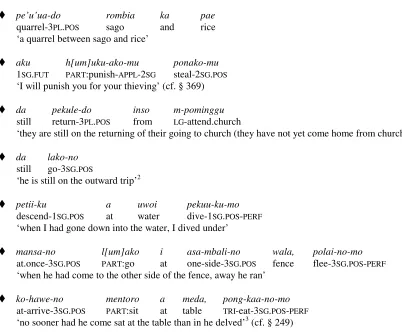
ku-popo-naa-o a ng-kadu-ku
1SG-ACCID-store-3SG at LKR-betel.pouch-1SG.POS ‘I placed it unintentionally, by accident in my betel pouch’
In the original this example appeared simply as koepoponaao a ngkadoekoe „ik heb ’t onopzettelijk, bij ongeluk in mijn sirihzak gedaan”. Usually examples with morpheme-by-morpheme glossing are extracted and highlighted as above using a diamond. There are, however, a few times when such examples have been left intact in their original position within the paragraph. In this case morpheme boundaries are indicated by hyphen, with the morpheme-by-morpheme glossing added within solidi (slant lines), e.g. (from p. 20):
Thus the original stem of mombio ‘do what?’ is pio (compare § 210), but the secondary stem mbio, e.g. aku mbio-o? /1SG.FUT do.what-3SG/ ‘what shall I do to it?, as object of what action shall I make it?’; of mombalo ‘repay, take revenge’ (Malay balas) the stem is mbalo (see § 19); and of mondoe ‘hang up’ it is ndoe (compare §§ 64, 67).
Esser of course was certainly well aware that many Mori words were composed of smaller elements of meaning, therefore making morpheme breaks per se is simply making information explicit which Esser himself knew—and frequently expanded upon in prose—but left implicit in his cited examples. Supplying glosses to individual morphemes, however, admittedly goes beyond what might be considered a faithful translation, therefore this practice bears some explanation.
As any linguistic researcher knows who has assembled a text collection, morpheme-by-morpheme glossing is not an easy task. Indeed, this aspect of the translation called time and again for decisions to be made, along the following lines.
(a) To what morphological level are words to be parsed?
For example, kupoponaao of the example cited above could not only be parsed as ku-popo-naa-o
/1SG-ACCID-store-3SG/ as above, but it could also have been parsed ku-poponaa-o and correspondingly glossed as /1SG-store.accidentally-3SG/. Although I have attempted to identify all inflectional morphemes, in many cases stems plus their respective derivational affixes were treated as single units for the purposes of glossing. This is particularly true of adjectives derived with mo- and ma-, which according the grammar are usually (but not always) treated as single units anyway, thus ku-mahaki /1SG-sick/ rather than ku-ma-haki /1SG-ADJ-sick/. In some cases the derived stem is glossed as a unit because the whole has a particular meaning which would not be immediately deducible as a sum of the parts, or the meaning of the root is opaque, as in te’ahu ‘sufficient in measure’ (from prefix te- plus stem
ahu, meaning unknown). In other cases, a further breakdown is simply irrelevant to the example at hand, e.g. pepate
is consistently glossed as ‘kill’, even though it consists of a causative prefix plus a stem meaning ‘die’; likewise
pinotuwu is glossed as ‘domesticated animal’, even though it consists of the passive infix -in-, the causative prefix
po-, and the root tuwu ‘live’ (thus literally ‘that which is caused to live’).
(b) To what extent is a unitary gloss maintained for any particular morpheme or unit?
Morpheme meanings are often highly dependent on context. Nonetheless, I have aimed toward an ideal (not always realized) that one morpheme should be given only one gloss. Glosses are, after all, attempts at abstraction, and certainly do not carry the full amount of information as one would find in a dictionary entry; they merely indicate to the reader which part of an utterance carries which part of the meaning that is assigned to the whole. Nonetheless, this practice is probably at odds with Esser’s own view, wherein the meaning of a morpheme could range across several related senses or functions. In fact his descriptions, particularly of affixes (Chapter 12), accord well with current notions of polysemy networks of modern-day Cognitive Grammar.
In some cases—such as with nae (shortened form of the third person singular independent pronoun) and ndio
(c) Is reduplication to be given a formal or a semantic label?
Reduplication, whether of one- or two-syllables, is consistently glossed as REDP. In this case a purely formal label proved advantageous, as it meant not having to decide which of various semantic functions the reduplication was serving in any particular context.
(d) What happens in cases where morphemes are not linearly separable?
When two morphemes are not linearly separable, this is indicated by using a colon in the gloss line rather than a hyphen. The most common case of ‘fusion’ are verbs which begin with p-initial prefixes, and which form their participle form by replacing the p with m. Thus for example (from p. 102):
kontongaa-ku mong-kaa while-1SG.POS PART:TRI-eat ‘I was eating…’
The infixes -um- (allomorph of the participle marker) and -in- (passive marker) are also handled by enclosing them in square brackets in the text line, again using a colon in the gloss line, compare (from p. 98):
nahi ku-buku l[um]ako NEG 1SG-will PART:go ‘I will not go’
The negator nahi presented a special case. The form nahi is not only the base form of the negator, but in some contexts can also be interpreted as ‘containing’ a third person singular element (viz. ‘surface’ nahi underlyingly consists of nahi + third person singular pronoun i). In general I have eschewed abstract analyses, thus nahi moiko ‘it is not good’ is glossed simply as /NEG good/. Only occasionally is nahi glossed as NEG:(3SG). See § 31 for some further examples of this nature.
(e) To what extent does a gloss reflect Esser’s understanding of a morpheme’s function or meaning?
In some cases this question is impossible to answer. However, it should be noted that I have glossed mo- as ADJ (adjective), poN- as TRI (transitive indefinite object), and pe- as INT (intransitive), all in keeping with Esser’s descriptions of these morphemes, even though elsewhere I regard these instead as respectively stative, antipassive and middle markers (Mead 2005). On the other hand, I have glossed I-ako, described in §§ 389-395, as APPL (applicative suffix), even though the word ‘applicative’ appears nowhere in the related prose description. This morpheme is so wide-ranging in function, that choosing a less-generic label would have been risky. Likewise the glossing of te- as NON.AG (non-agentive) and of –a as NZR (locative nominalizer) also deviate from how Esser described the affixes in the accompanying prose. See below for a complete listing of glosses for grammatical morphemes, and where these morphemes are discussed in Esser’s grammar.
At any rate, the reader should bear in mind that all morpheme-by-morpheme glosses are to be regarded as my own additions, and do not constitute part of the original text.
Examples from other dialects.
la no-’olo l[um]eko NEG 3SG-FUT PART:go
‘he will not go’ [Padoe]
ku-’olo leu mong-kaa 1SG-FUT NEG PART:TRI-eat ‘I shall not eat’ [Karunsi’e]
The converse is not necessarily true, that is, when no dialect name appears after the free translation it is not perforce from the Tinompo dialect. It is not impossible that some cases have simply been missed. In a few cases an extracted portion of speech can be recognized as non-Tinompo, but without being able to identify the source dialect.
MINOR TRANSLATION ISSUES.
In a number of cases, Esser referred to Dutch words and expressions as examples. Wherever practical, the Dutch word or expression has been ‘converted’ into an English example. Compare (from p. 174):
…evenals men in het Ned. ook kan zeggen „dáár doodden zij haar” zonder „dat”…
In the present translation this reads:
…just as in English one can say ‘there they killed her’ without ‘that’…
As above, this has sometimes necessitated translating “Nederlandsch” (or its abbreviation “Ned.”) with the word “English”. Likewise when Esser used the expression “in onze taal” (= “in our language”) he was, of course, referring to Dutch. However, because Dutch and English share a common Germanic heritage, what he says about Dutch in such cases often also rings true of English.
The title of Chapter 2 in the original reads “Woordherhaling en Reduplicatie”, literally “Word Repetition and Reduplication”. However, in informal tests with linguistic colleagues, the expression ‘word repetition’ resulted in wrong understanding. Therefore I have chosen to translate these terms as:
(woord)herhaling → two-syllable reduplication
reduplicatie → one-syllable reduplication
which is precisely the way in which Esser himself (p. 71) defined these terms for Mori. Where Esser referred to both together as in “met reduplicatie of herhaling van den stam …” (p. 313), then this could be simply translated as “with reduplication of the stem…”. Compare also the title of present Chapter 2, which is simply “Reduplication”.
In Chapter 4, the same Dutch word “serie” has been translated as “set” when referring to personal pronouns, but as “series” when referring to demonstrative pronouns. Thus “Evenals bij de gesuffigeerde vormen van serie I, …” (p. 104) is translated “Just as with the suffixed forms of Set I, …”. But “De aandacht worde nog gevestigd op het spraakgebruik van de demonstrativa van serie II tegenover die van serie I in zinnen als…” (p. 135) is translated “Attention must still be drawn to the usage of the demonstratives of Series II versus those of Series I in sentences such as…”.
LIST OF ABBREVIATIONS.
The list of abbreviations has been divided into two parts. The first (and smaller) list gives abbreviations which are found in running text. These include:
k.o. kind of
cf. compare
id. identical (usually: the present word has the same meaning as the previously given word)
i.e. that is
IN Indonesian
lit. literally
s.o. someone
s.th. something
s.v. sub voce (under the specified entry)
The following table lists all grammatical abbreviations used in morpheme-by-morpheme glossing. The first column gives the abbreviation. The second column gives what the abbreviation stands for. The third column indicates which forms in the Mori language have been given that gloss, and, following in parentheses, where the reader can find specific discussions of that particular morpheme.
ACCID accidental popo- (§ 309)
pasi- (§ 344)
ADD additive (pronoun) ngkuda(’a), muda(’a), etc. (§ 156)
ADJ adjective mo-, ma- (§§ 298-300)
meN- (§ 325)
AFFIRM affirming particle kada, kada’a (§ 261c)
APPL applicative -ako (§ 388 ff.)
ATTEMPT attemptive pe- (§ 334)
CAUS causative pa- (§ 302)
po- (§ 303) poko- (§ 304) popo- (§ 305)
CN common noun marker io, o (§ 272) ina, na, a (§ 272)
COP copula ia (§ 268)
DIFFUSE diffuse action ko-, ngko-, ka-, ngka- (§ 347)
DISPLEAS displeasure -ki, -si (§ 374)
DISTR distributive (n)te- (§ 288)
EMPH emphatic particle namia (§ 163)
EXHORT exhortative particle ma, mada, mada’a (§ 247)
FUT future (pronoun) (a)ku, (i)ko, etc. (§§ 150, 236-237)
HABIT habitual ba-, mara- (§ 355)
INCL including ke- (§ 353)
INCOMP incompletive po (§§ 244, 246, 261b)
INDEF indefinite ba (§ 201 ff.)
INDEP independent (pronoun) ongkue, omue, etc. (§§ 152-155)
INTENS intensifying particle da, da’a (§§ 162, 261c)
INTERROG interrogative ke (§ 201 ff.)
INTR intransitive pe-, peN- (§ 311 ff., 326)
LG nasal ligature (prenasalization)
N (§§ 19 ff., 120, 124 ff., 272, 274)
LOC locative -ari (§ 379)
MULTIPLE multiple mopa-, mapa- (§ 306)
NEG negative nahi, na, etc. (§ 262 ff.)
NEG.IMPV negative imperative (= vetitive)
osi’i, si’i, si, etc. (§ 240)
NON.AG non-agentive te- (§ 338-340)
NZR (locative) nominalizer -a (§§ 380-386)
ORD ordinal ko- (§ 285)
PART participle -um- and its nasal replacement allomorph (Chapter 6 and § 365)
PASS passive -in- (§§ 368-370)
PERF perfective mo (§§ 238, 244, 246, 247, 261b, 143, 178)
PL plural (subject) meN-, N- (§§ 222-225, 256, 326)
PLURAL plurality mpe- (§ 327)
POS possessive (pronoun) -ku, -mu, -no, etc. (§§ 147-149)
PN personal name marker i (§ 272)
POTENT potential pokoN- (§ 352)
PRETENSE pretense pompe- (§ 335)
PROPORTN proportionality ko- (§ 348)
PTCL (discourse) particle nde, nde’e (§§ 168, 183, 203, 238, 261c)
RECIP reciprocal tepo- (§ 341)
pepo- (§ 342) po- (§ 342)
mape-, mambe-, mombe- (§ 343)
REDP reduplication Chapter 2; see also §§ 28, 81, 154, 184. 202. 240, 256, 265, 277, 283, 288, 289, 291d, 297, 306-308, 315-316, 327, 334-335, 345-348
REL relative clause marker anu (§ 207)
REPT repetitive popo- (§ 308)
REQUEST requestive pepe- (§ 337)
RESEMB resemblance mpe- (§ 327)
TRI transitive indefinite object poN- (§ 221)
1PLN first person plural inclusive
see Chapter 4 1PLX first person plural
exclusive
1SG first person singular
2PL second person plural
2SG second person singular
3PL third person plural
3SG third person singular
OTHER RESOURCES.
In addition to this complete translation of Esser’s grammar of Mori, I have also attempted my own summaries of some of the principle patterns of Mori grammar. My article “Mori Bawah” in The Austronesian languages of Asia and Madagascar (Mead 2005) is an overview of Mori grammar in twenty-five pages, including a review of the available literature. Anyone who would appreciate having the ‘big picture’ before launching into Esser’s grammar would do well to start with this article. My paper “When to Use a Genitive Pronoun in Mori Bawah” (Mead 2008a) picks up on some further topics which I had wanted to cover in greater depth in the overview, but was prevented due to limitations on length imposed by the editors. Finally I have written a third article concerning Mori grammar, but on a much narrower topic: the indefinite particle ba (Mead 2008b).
REFERENCES.
Lewis, M. Paul (ed.) 2009. Ethnologue: Languages of the world, 16th edition. Dallas: SIL International. Online version available at http://www.ethnologue.com/.
Mead, David. 1998. Proto–Bungku-Tolaki: Reconstruction of its phonology and aspects of its morphosyntax. Ph.D. dissertation. Rice University, Houston, TX.
Mead, David. 2005. Mori Bawah. The Austronesian languages of Asia and Madagascar, edited by Nikolaus Himmelmann and Sander Adelaar, 683-708. London: Routledge.
Mead, David. 2008a. When to use a genitive pronoun in Mori Bawah (Sulawesi, Indonesia). 10-ICAL pronoun papers, edited by Sue McQuay, special issue. Studies in Philippine Languages and Cultures 17:137-178.
Mead, David. 2008b. Functions of the Mori Bawah indefinite particle ba: Towards a comparative study. Language and text in the Austronesian world: Studies in honour of Ülo Sirk (LINCOM Studies in Austronesian Linguistics, 6), edited by Yury A. Lander and Alexander K. Ogloblin, 209-232. Muenchen: LINCOM.
xvii
FOREWORD.
[to Part I, 1927, p. iii]
———————
With the appearance of the first part of this book, I would like not to omit a word of thanks to all who have contributed to this accomplishment. In the very first place, gratitude goes out to my lamented teacher, the late Dr. N. Adriani,1 who through his excellent instruction—which does not remain limited to Pamona—opened up the study of Mori to me; who always in his well-known, unsparing manner caused me to profit from the treasures of knowledge and experience over which he had command; and finally, who passed his judgment over the manuscript, and improved and amplified it in a number of places. Without his help, this book could not have been written.
Especially to be mentioned among those who worked in Mori under the Dutch Missionary Society are Messrs. J. Ritsema and J. Kruyt, who freely made available the material which they had collected, and in numerous ways helped smooth the way for me. The latter has, moreover, placed me in his debt by drawing the map of the language area which is incorporated in this book. It is my pleasant duty to take this opportunity to express my heartfelt thanks to these two sirs.
xviii
[Introduction to the]
POSTSCRIPT (ADDENDA AND CORRECTIONS).
[Part II, 1933, pp. 392-393]
———————
A long time has elapsed between the appearance of the first and second parts of this book. This has had the advantage, at any rate, that I am now in the position to append a list of supplements and corrections to part I, and thus cause it to better fulfill its intention. By the nature of things, complete harmony with part II in design and method of treatment remains not to be achieved. Indeed there would be much to accomplish in external conformity between the two volumes so that together they would constitute one book; some small differences in typographical execution which inevitably arise are too insignificant to thereby constitute an impediment. Less important alterations in nomenclature and orthography (for example, in part II Lalaki and Loinan are no longer spoken of, but rather Laki and Loinang, and in Sangir the marked l is replaced by ḷ, and ĕ followed by a glottal stop is indicated
by ĕ’, and no longer by ĕ alone) are introduced silently (thus not mentioned in the Errata to part I).
Because a grammar is no dictionary, there is thus not very much to be done when the meaning of a word is rendered somewhat narrowly or widely, or incompletely (especially in the Phonology, where mostly only the general meaning, alternatively the original meaning, of a stem is given). In the following notes, in general I have corrected only that which either was definitely incorrect, or was so incompletely stated that it would have led to misunderstanding. With the translation of example sentences, on the whole little consideration was given in part I to the meaning of the modal particles (to which, correctly, rather much attention is given in part II). The same principle is followed here with the corrections to part I. On the other hand, I have not economized with amplifications and explanatory observations, because with the dimension to which this book has swelled, it appeared to me to be advisable to also describe as completely as possible, within certain boundaries of importance, the phenomena which belong at home in part I. Nevertheless, with the revision of the first part I have primarily limited myself to that which pertains to the language itself. Thus theories and hypotheses of an etymological, historical or comparative nature—assuming not clearly untenable—are here left out of discussion.
For all that, the reader should not think that the ideal of precision and relative completeness should have now been attained. Practice teaches us that mistakes and omissions are unavoidable, even when one has been able to apply oneself to a language for long years in the land itself—and how much more so when one must borrow a portion of his subject matter from informants without having the opportunity to verify their statements in actual practice or from the literature (which, as can be assumed to be known, is very time-consuming). This especially applies of the dialects, and the reservations made in part I (in regard to statements concerning the dialects) remain in full force. On the other hand, missionaries, civil servants, etc. appointed to work in the region will find in this book a useful basis to build upon, and may I hereby make a pressing appeal to all who have the opportunity to do so, that they would indeed do just that, and especially to undertake a dialect study, and not keep the results thereof filed away.
xix
MAP.
[Part I, 1927, p. x]
xx
MAP [ADDENDA].
1[from Part II, 1933, p. 394]
———————
The section of road going from Tomata in a northwest direction should come out at Mayumba, not Tamonjengi.
Apart from the To Padoe, in Angkona also live the remnants of the traditional enemies of the Pamona people, the To Kinadu, whose language belongs to the Upper Mori group.
Furthermore since 1926 various movements of the Mori people have taken place. Thus the villages Korosule and Kororempeti are at present located near the new road from Tompira to Korowou.
1 [Translator’s note: Spelling corrections and most other addenda have already been incorporated into the revised map. I
1
[p. 1]
INTRODUCTION.
———————
1. The first to have written about Mori was Dr. Adriani, who in 1900 as the fruit of a trip to the Mori region the previous year, published an article, titled De Talen der To Boengkoe en To Mori (The Languages of the Bungku and Mori Peoples). The first part of this article deals with Bungku, a sister language of Mori, while the second part (from page 284 on) treats the two Mori dialects which were then known to Adriani, Petasia and Mori (in a narrower sense than used in the present work). In the third volume of their De Bare’e-sprekende Toradja’s van Midden-Celebes, beginning on page 217, Adriani and Albert C. Kruyt discussed the languages of the Bungku-Mori group and increased the number of Mori dialects to five (Adriani & Kruyt 1914:352 ff.). This was done on the basis of data—Holle wordlists filled out by government officers and the like (Adriani & Kruyt 1914:vi)—which by their very nature were somewhat defective. The classification of Mori into dialects given there is then not to be preserved in all parts, but in spite of the unreliability of the utilized sources the most principle results still stand: the prescribing of the limits of the Mori language area, and the determining of the relationship of Mori to the surrounding languages.
Principal after the appearance of the above-named work is the study of Mori undertaken first-hand by missionaries of the Dutch Missionary Society who were established in Mori, under which the names of J. Ritsema and J. Kruyt must be cited with honor. Their research touched on both ethnographic and linguistic domains, though little of their linguistic results has yet to be published (but see Van Eelen & Ritsema 1918–1919 and J. Kruyt 1919b).1 Kruyt’s (1924) ethnographic article, De Moriërs van Tinompo (The Mori of Tinompo) can, however, at the same time [p. 2] be considered a source of information about the language, as it contains among other things a number of songs and proverbs in text and translation.
2. On the basis of Ritsema’s and Kruyt’s data, which they relinquished most obligingly, and completed by my own research, the classification of Mori dialects given by Dr. Adriani could in part be verified, in part completed, and in part amended.2 The names by which the various dialects are indicated in this book deviate somewhat from the ones which have customarily been used up until now. The designations ‘Petasia’ and ‘Mori’ (in the narrow sense) had already been replaced by ‘East Mori’ and ‘West Mori’ in Adriani and Kruyt (1914). Alongside East Mori such as is spoken in Sampalowo, Tinompo, etc., however, is the dialect of the To Watu,3 who also live in the eastern part of the land, so that it is better to drop the name East Mori altogether. The West Mori I name ‘Upper Mori’, because tribes speaking that dialect also live in the south (Malili subdistrict). If one takes a look at the language map included with this book,4 however, then one sees that many Upper Mori peoples also live in the lowlands (the east), a consequence of migration which, though sometimes voluntary, mostly took place by high command. The term Upper Mori is thus also not entirely indisputable. The name ‘Mori’, which Dr. Adriani had originally given to this dialect, had the advantage that it conformed with the usage prevailing in the region itself. People in the lowland did not denote themselves by this name, but applied it only to the Upper Mori,5 and when one inquires in Tinompo as to the ‘Mori’ equivalent of some expression, one always gets in response the Upper Mori word. To return to the old designations, however, would bring about nothing other than confusion. Today people are as much apt to designate the To Watu, the To Tinompo, etc. as ‘Mori’ as they are the To Doule and the To Molio’a. In this book then by ‘Mori’ I mean the language of which each of the small tribes speaks a dialect, and rightly in the first place the justifiably promoted, head Tinompo dialect (J. Kruyt 1919b:328–329). [p. 3]
1 [footnote 4, p. 1] These publications must be used with caution, on account of the misprints. J. Kruyt has also produced a
spelling book and reader (1919a), a New Testament reader (1928a) and an Old Testament reader (1928b), all in the Tinompo dialect, and more recently a book of songs, etc. (for church use) has appeared.
2 [footnote 1, p. 2] This was already partially carried out by J. Kruyt in the introduction to his two articles (1919b, 1924). 3 [footnote 2, p. 2] This is not to be confused with a people-group of that name in the Bungku area (Adriani & Kruyt
1914:218, 352). There is also a small group of Pamona speakers who are named the To Watu, who by coincidence live in the Upper Mori area (Adriani & Kruyt 1912a:63).
4 [footnote 3, p. 2] I have the helpfulness and competence of Mr. J. Kruyt to thank that the book could be enriched with this
fine map. It gives all the villages in the actual Mori language area, not the settlements outside of it, especially in Bungku, about which something shall be mentioned below. The area to the north of Kolono Dale also belongs to the Mori region, but cannot be considered part of the Mori language area, as a very mixed population of peoples live there originating from elsewhere (including a number of Mori people).
5 [Postscript, p. 2] There have also been ‘Upper Mori’ people who from of old have been living in the lowlands, namely the
To name the dialects after the negative word is a practice which merits no recommendation, in the first place because throughout Mori it is not customary to designate discernable languages or dialects, and in the second place because various negative words and variations of negative words are in use, so that often in this respect a contrast exists between idioms which must otherwise be considered the same dialect, while conversely different languages share the same negative word. So not only is the Tinompo isolect named ‘Nahina’ or the Nahina dialect, but the Bungku language is also called ‘Nahina’ (Adriani & Kruyt 1914:352). For that matter, the Mori word nahina doesn’t mean ‘no, not’, but rather ‘there is not’. The same holds true for Upper Mori. The term aikoa (the name for ‘West Mori’ in Adriani & Kruyt 1914:218, 352), moreover, is little encountered in the various Upper Mori subdialects (e.g. not in Molongkuni or Impo); the To Tambee and To Ulu Uwoi as well as other Upper Mori tribes say aakoa (the To Ulu Uwoi at any rate also use aikoa). Also the Padoe alalau (the spelling alalao in Adriani & Kruyt 1914:231 ff., 353 is incorrect) properly means ‘there is not’, as was also remarked elsewhere by these authors (1914:235). The word for ‘no’ in Upper Mori is aio, and this is the name of the Tambee6 in Adriani and Kruyt (1914:244 ff.).7 In Tinompo one uses for ‘not’ nahi or tai (tei), for ‘no’ naahi or uuhu, in Padoe for ‘no’
uuhu or ilau. Whoever would be willing to name the Mori dialects after the negative words will not be able to avoid a certain arbitrariness.
3. As is evident from the map included in this book, I distinguish three or four dialects in Mori (each of which in turn comprises a number of subdialects), which are as follows. The last, Padoe, can be considered an Upper Mori dialect; see § 7 below.
I. Watu-Karunsi’e
II. The mokole dialect8 (Tinompo, etc.) (the term mokole means ‘ruler, member of a royal lineage’) III. Upper Mori
IV. Padoe
4. I.WATU-KARUNSI’E. The dialect of the To Karunsi’e is in some respects somewhat more old-fashioned than Watu, but otherwise they differ little. Geographically, however, Karunsi’e lies far away from Watu (it is only spoken in a few villages in the Malili subdistrict), so that it has been exposed to influences which have not affected Watu. The inhabitants of the villages which are indicated as ‘Watu’ on the map do not all call themselves To Watu. In Kumpi and Ulu Anso, for example, live the To Mobahono (whose dialect deviates somewhat from Watu), in Lintu Mewure the To Ture’a, who evidently are very closely connected with the To Mobahono. All of these distinctions are of not much interest. There is no small tribe in Mori today whose dialect doesn’t exhibit some local peculiarities, and what applies to every small tribe probably also applies to every or nearly every village. In any case dialectal differences among the To Watu have been established. At present it is quite possible that the To Watu, who are a rather large people group for Mori, [p. 4] have been melded from various smaller ones.9 But it is also entirely possible, for example, that the To Mobahono and the To Ture’a formed a part of the To Watu, but over the course of time began to take on an independent position, and began to designate themselves with a separate name. Convergence as well as divergence must have played a great role in Mori.10
There are some Watu-speaking villages found the Bungku region, Solonsa among others.
5. II.THE MOKOLE DIALECT. Concerning the history of the Mori royal lineage we can form some idea from tradition.11 It tells among other things of many journeys and treks, of movements inside and outside of Mori, and of people of all sorts of social standing, who in the course of time became joined with the royal lineage. The population of villages such as Tinompo and Sampalowo is then also made up of very heterogeneous elements. In the ethnography Upper Mori has had a very great influence (J. Kruyt 1924:195, 208, etc.) (somewhat also brought out by the terminology)12 but this need not necessarily hang together with the composition of the population in the
mokole villages. But the foreign elements must have had an influence on the culture as well as the language, although this cannot yet be proven given our present state of knowledge.13
6 [footnote 1, p. 3] Dr. Adriani spoke of Tambe’e and Tambe’eish. The Mori do not articulate any glottal stop in the word. 7 [footnote 2, p. 3] Concerning the spelling ayo, Adriani and Kruyt (1914:236) had already hypothesized that it should be
replaced by aio.
8 [footnote 3, p. 3] Cf. J. Kruyt (1919b:328 ff.).
9 [footnote 1, p. 4] J. Kruyt speaks about the To Meruruno, “an entirely dissolved division of the To Watu” (1924:58). 10 [footnote 2, p. 4] Compare also among others J. Kruyt (1924:64, 66–68), and below.
11 [footnote 3, p. 4] See J. Kruyt (1924:39 ff.).
12 [footnote 6, p. 4] Wasu in pu’u wasu (J. Kruyt 1924:196) is the Upper Mori word for watu (stone); the word for a small
death feast, tewusu (J. Kruyt 1924:194), must be derived from the Upper Mori stem wusu, ‘to seek’, etc.
13 [footnote 7, p. 4] When a Watu or Upper Mori expression is used in Tinompo, this can very naturally be ascribed to
In the mokole dialect there are again various subdialects to be differentiated, of which especially those of the To Moiki (Koro Wou)14 and of Tiu (To Kangua) have taken on a separate position. These two dialects hang very closely together, but have come under different influences (Tiu is very strongly mixed with Upper Mori; Moiki has been exposed to influence from Watu), so that they now fairly noticeably differ. In some respects these dialects exhibit a more old-fashioned type than Tinompo.
Also Nuha must be separately mentioned, but still is [p. 5] probably closer to Tinompo than Moiki or Tiu. Nuha is spoken in the Malili subdistrict in the villages of Sorowako and Nuha (To Nuha), Matano (To Rahampu’u) and Bure (To Taipa).15 I only know a little about Nuha, and entirely nothing about the dialectal differences between the villages where it is spoken (strictly speaking, only Sorowako and Nuha are to be viewed as the language area of the Nuha dialect). A striking point of difference with Tinompo comes up for discussion in the treatment of the demonstratives (§ 199).
The dialect of Sampalowo grammatically differs little or not at all from Tinompo, but the vocabulary exhibits quite a number of differences. Koro Lolaki is primarily inhabited by To Ngusumbatu (To Tinompo) and To Moiki. Also the Mori who live in Tompira originate from Tinompo. The To Roda (Beteleme) as well speak Tinompo.16 Concerning the dialect of the hamlet Karunsi’e (not to be confused with the To Karunsi’e mentioned in § 4) I know nothing other than that it belongs to the mokole dialect.
6. III. UPPER MORI. The most important subdialects of Upper Mori are: Molio’a (spoken in Korokonta, Tanasumpu, Topaku, Tomata and Ta’endelipu),17 the dialect of the To Ulu Uwoi (Undoro, Dolupo)18 and the To Tambee in the Malili subdistrict (not very long ago these two peoples were a unit (J. Kruyt 1924:35) and thus speak approximately the same dialect), Molongkuni (Lembombelala, Tambalako, Wawopada, Tingkea’o, Lahumbala) and Impo (Korowalelo, Korompeeli, Koromatantu). The last two are closely related, but still exhibit not insignificant points of difference.
Besides these five people groups one finds in Mori a great number of miniature sub-tribes, for which it makes little sense to enumerate them all, as they tend (just as is the case with other small tribes, for that matter) to designate themselves with the names of former settlements (J. Kruyt 1924:34). One can be certain of them that each of these small tribes exhibits peculiarities in the area of the language, but it is very improbable that there are to be found among these dialects any which cannot be closely connected up to one of the above-named five. The language of Mondowe, perhaps, constitutes an exception. Of the people who live in this village (the To Pomuaia), their nearest relations (the To Mbelala) have settled [p. 6] in Labua village in the Bungku area (also Lambere’a and Pekampua were reported to me as villages of the same tribe, at least of the same language). It is very possible, however, that here one must be mindful of the dispersal of the Mori; what I know about the language spoken in Mondowe19 makes it very improbable that it should be something other than simply an Upper Mori dialect. Perhaps it has been refurbished by some unique foreign influences.
7. IV.PADOE. The basis of Padoe (especially in respect to the grammar) is Upper Mori. One could thus view it as an Upper Mori dialect.20 In addition, though, Padoe exhibits phenomena which indicate that another language must have contributed to the development of this dialect. Thus the sound system of Padoe is distinguished from all the other Mori dialects in that the sound combination ns does not occur in it. The Padoe say, for example, for ‘banana’ pusi, Upper Mori punsi, Tinompo punti, for ‘langsat’ lasa, Mori lansa, Malay lansat. That differences in pronouns should be found in a Mori dialect of the Upper Mori area is not surprising (cf. below §§ 164 and 192). But when one encounters a great number of general IN words in Padoe in another form than which they appear in all the other Mori dialects, without a doubt this points to a foreign language element which has blended itself with the pure Mori element. One can cite as examples of such Padoe olo ‘day, sun’, Mori oleo, Ngaju andau, Napu alo, etc. and the Padoe forms cited in §§ 90–103. Perhaps the To Padoe entered the Malili area from elsewhere and there met
14 [footnote 8, p. 4] After an expedition of Dutchmen and Ternateans against Mori in 1856 defeated Ensa Ondau, the fortress
of the To Moiki, a number of members of this tribe were transported to Bacan. According to reports, these people (or their descendants) still speak Mori. That at present the To Moiki form such an insignificant people is probably a consequence of this bloodletting.
15 [footnote 1, p. 5] J. Kruyt (1919b:328) also describes some movements which, according to tradition, took place from
Matano to Bungku and to Rauta (to the southeast of Lake Matano). Of these colonies I know nothing further. In Bungku there are various villages of Mori speakers; see §§ 4 and 6.
16 [footnote 2, p. 5] Some influence from the Watu dialect is evident. The To Roda are not the sole inhabitants of Beteleme. 17 [footnote 3, p. 5] These villages partly have a mixed population.
18 [footnote 4, p. 5] The inhabitants of Balongkere have almost all moved to Malili (To Tambee).
19 [Postscript, p. 6] Concerning the To Pomuaia, the inhabitants of Mondowe, it can further be informed that it was not long
ago that they moved from Bungku to Mori. The language however is Upper Mori (saving certain Bungku elements such as inai
‘who’, which can be attributed to borrowing), and so these people must have originally come from the Mori area.
20 [footnote 1, p. 6] That Dr. Adriani had classified it with East Mori (Adriani & Kruyt 1914:231 ff.) must be blamed on the
with an Upper Mori population,21 whom they superseded and in whose land they themselves settled, but with whom at the same time they themselves intermingled by adopting their language. What their original language might have been must constitute a further investigation. Probably they used to speak a Lalaki or Mekongga dialect, or a closely related idiom, because these (mutually very closely related) languages likewise belong to the Bungku-Mori group, lying geographically closest in the neighborhood and (to name just one point of similarity) are likewise missing the prenasalized s (cf. also § 26).
8. The grammatical differences between the dialects are especially to be found in the area of the pronouns. This subject is treated at very great length in Chapter 4. Also a few things shall be added concerning the other points of difference in the area of grammar.22 Nevertheless, as for what shall be said in this book about the dialects, I make the least possible claim to completeness, and it must entirely be considered an ‘extra’. I very much hope that it shall be, in combination [p. 7] with that which shall be said below about the sound system, sufficient to justify the proposed classification.
Speaking generally, Upper Mori has been affected by sound change in stronger measure than the other dialects. To name just the principle points of difference: the tendency toward voicing of prenasalized stops is very much stronger in Upper Mori, in more cases a has changed into o or e, and the t into s than in Tinompo, Watu-Karunsi’e and the other Lower Mori dialects.23
Some verb stems in Upper Mori even have different forms when they are combined with certain affixes, something which is not encountered in Tinompo. So one can be certain that he is dealing with an Upper Mori dialect when one encounters next to each other the forms monggaa ‘eat’, kumaango ‘eat it’, mo’alo ‘take’, umaleo ‘take it’,
mowawo ‘bring’, waweo ‘bring it’, monggito ‘see’, kumiteo ‘see it’ from the stems which in Tinompo are respectively kaa, ala, wawa and kita.24
Some words in Upper Mori have a more old-fashioned form than in the other dialects, e.g. mosa’a ‘ugly, bad’, Tinompo mosa’o, Malay jahat; monta’a ‘set (traps and the such), Tinompo monta’o, Malay tahan, and the words which in Upper Mori end in -ui but in Tinompo and elsewhere end in -i (see § 41), but these cases are to be considered the exceptions which prove the given rule.
On the whole the words in Watu and Karunsi’e have the same form as in the mokole dialect. The latter however is more conservative than the former two and thus is the least decayed of all Mori dialects. The difference concerns primarily the vowel a, which has become o (less often e) in a greater number of cases in Watu-Karunsi’e than in Tinompo, etc., for example Watu, Karunsi’e, Upper Mori aaso<