PATTERN OF SELF-MEDICATION WITH ANTIBIOTICS
IN DENPASAR CITY, INDONESIA
Jesika Ginotodihardjo1, I Gusti Ayu Artini2
1Student of Faculty of Medicine, Udayana University, Bali, Indonesia
2Departement of Pharmacology, Faculty of Medicine, Udayana University, Bali, Indonesia
Abstract
Introduction: Self-medication with antibiotics that commonly related to misperception and lack of knowledge make antibiotic resistance become hard to control. This study aimed to investigate the prevalence of self-medication with antibiotic as well as knowledge regarding antibiotic usage in Denpasar City, Indonesia. Methods: This cross sectional population based survey directly interviewed respondents using structured questionnaire in Bahasa. A hundred respondents were selected using non probability-convenience sampling method in November-December 2013. The data were analyzed descriptively, and then the proportion data were analyzed using Chi Square. Results:
Forty three percent of respondents did self-medication with antibiotic, and simplicity (43%) is the most popular reason, beside feel confident, cost saving, inaccessibility from health care, time saving, and recommended by others. Pharmacists were the most common source of drug (91%). Gender was found to be statistically significant with p<0.05, whereas age and education level were not significant (p>0.05). Conclusions:
The prevalence of self-medication with antibiotics in this study is quite high, but it needs further investigation to generalize this result to Denpasar population.
Keywords: Antibiotics, Resistance, Self-medication
Abstrak
Pendahuluan: Pengobatan mandiri menggunakan antibiotik yang pada umumnya berkaitan dengan persepsi yang salah dan kurangnya pengetahuan menyebabkan masalah resistensi antibiotik menjadi sulit dikendalikan. Studi ini bertujuan untuk mengetahui prevalensi pengobatan mandiri menggunakan antibiotik dan pengetahuan masyarakat mengenai penggunaan antibiotik di Kota Denpasar, Indonesia. Metode:
Penelitian ini menggunakan metode cross sectional. Responden diwawancara secara langsung menggunakan kuisioner dalam bahasa Indonesia. Seratus responden dipilih menggunakan metode pengambilan sampel non probabilitas-kenyamanan pada bulan November-Desember 2013. Data yang terkumpul dianalis secara deskriptif, dan data proporsi dianalisis menggunakan Chi Square. Hasil: Empat puluh tiga persen dari responden pernah melakukan pengobatan mandiri dengan antibiotik, dan praktis (43%) menjadi alasan terbanyak disamping merasa paham, hemat biaya, kesulitan mengakses layanan kesehatan, hemat waktu, dan direkomendasi oleh oranglain. Apotek menjadi sumber obat-obatan paling umum (91%). Jenis kelamin menunjukkan signifikansi secara statistik dengan p<0.05, sedangkan usia dan tingkat pendidikan tidak signifikan (p>0.05). Kesimpulan: Prevalensi pengobatan mandiri dengan antibiotik pada studi ini cukup tinggi, namun dibutuhkan penelitian lebih lanjut untuk dapat menggambarkan penduduk Denpasar secara umum.
1
PATTERN OF SELF-MEDICATION WITH ANTIBIOTICS
IN DENPASAR CITY, INDONESIA
Jesika Ginotodihardjo1, I Gusti Ayu Artini2 1Student of Faculty of Medicine, Udayana University, Bali, Indonesia 2
Departement of Pharmacology, Faculty of Medicine, Udayana University, Bali, Indonesia
Abstract
Introduction: Self-medication with antibiotics that commonly related to misperception and lack of knowledge make antibiotic resistance become hard to control. This study aimed to investigate the prevalence of self-medication with antibiotic as well as knowledge regarding antibiotic usage in Denpasar City, Indonesia. Methods: This cross sectional population based survey directly interviewed respondents using structured questionnaire in Bahasa. A hundred respondents were selected using non probability-convenience sampling method in November-December 2013. The data were analyzed descriptively, and then the proportion data were analyzed using Chi Square. Results:
Forty three percent of respondents did self-medication with antibiotic, and simplicity (43%) is the most popular reason, beside feel confident, cost saving, inaccessibility from health care, time saving, and recommended by others. Pharmacists were the most common source of drug (91%). Gender was found to be statistically significant with p<0.05, whereas age and education level were not significant (p>0.05). Conclusions:
The prevalence of self-medication with antibiotics in this study is quite high, but it needs further investigation to generalize this result to Denpasar population.
Keywords: Antibiotics, Resistance, Self-medication
Abstrak
Pendahuluan: Pengobatan mandiri menggunakan antibiotik yang pada umumnya berkaitan dengan persepsi yang salah dan kurangnya pengetahuan menyebabkan masalah resistensi antibiotik menjadi sulit dikendalikan. Studi ini bertujuan untuk mengetahui prevalensi pengobatan mandiri menggunakan antibiotik dan pengetahuan masyarakat mengenai penggunaan antibiotik di Kota Denpasar, Indonesia. Metode:
Penelitian ini menggunakan metode cross sectional. Responden diwawancara secara langsung menggunakan kuisioner dalam bahasa Indonesia. Seratus responden dipilih menggunakan metode pengambilan sampel non probabilitas-kenyamanan pada bulan November-Desember 2013. Data yang terkumpul dianalis secara deskriptif, dan data proporsi dianalisis menggunakan Chi Square. Hasil: Empat puluh tiga persen dari responden pernah melakukan pengobatan mandiri dengan antibiotik, dan praktis (43%) menjadi alasan terbanyak disamping merasa paham, hemat biaya, kesulitan mengakses layanan kesehatan, hemat waktu, dan direkomendasi oleh oranglain. Apotek menjadi sumber obat-obatan paling umum (91%). Jenis kelamin menunjukkan signifikansi secara statistik dengan p<0.05, sedangkan usia dan tingkat pendidikan tidak signifikan (p>0.05). Kesimpulan: Prevalensi pengobatan mandiri dengan antibiotik pada studi ini cukup tinggi, namun dibutuhkan penelitian lebih lanjut untuk dapat menggambarkan penduduk Denpasar secara umum.
2 Introduction
The antibiotic resistance has already
become a global problem and therefore
WHO has stated “Antibiotic
Resistance” as the topic in World Health Day on April 7th, 2011. WHO
defines the appropriate use of antibiotic
as cost effective use which can
maximizes clinical therapeutic effect
while minimizing both drug related
toxicity and the development of
antibiotic resistance.1
Many researches have been conducted
to identify the prevalence of antibiotic
resistance; one of them is
penicilin-non-susceptible Streptococcus pneumoniae
(PNSP) in Southeast Asian.
S.pneumoniae as the major pathogen of
pneumonia, meningitis, and otitis media
in children and adult, had been altered
to be penicillin resistance more than
40% PNSP in Singapore (2000), and
21% in Jakarta (1996).2
Many factors contribute to
inappropriate use of antibiotics that
subsequently lead to resistance; one of
them is a patient-related factor
including self-medication and poor
adherence to dosage regiment.1
Self-medication with antibiotics (SMA) that
commonly related to misperception and
lack of knowledge make this resistance
become hard to control. The habit of
community to use antibiotic
inappropriately makes this topic
become interesting to be explored
further. This study aimed to investigate
the prevalence of SMA as well as people’s knowledge regarding their antibiotic usage.
Methods
This descriptive cross sectional study
was conducted in Denpasar City on
November until December 2013 to
assess self-medication with antibiotic as
well as respondents’ knowledge about
antibiotic. The respondents were
selected using non
probability-convenient sampling. Respondents
included in this study were non-health
care provider, age over 17 years old,
lived at Denpasar area, and had history of antibiotic usage. Respondents’ habit and knowledge related to antibiotic
were directly interviewed using
structured questionnaire in Bahasa. The
questionnaire was pre-tested to a
number of respondents, and resulted in
some revisions.
There were 14 questions related to last
antibiotic usage, conditions of usage,
3
antibiotic, and respondents’ knowledge including antibiotic function and target,
antibiotic usage immediately after fever,
and antibiotic resistance. Demographic
information such as date of birth,
gender, address, last education
achievement, and job were also
recorded.
The collected data were stored and
analyzed descriptively. Proportion data
were analyzed using Chi Square.
Results
Demographic characteristic
Data from 100 respondents who have
past history of using antibiotics was
successfully collected. Respondents’
age ranged from 18 to 62 years old.
Most respondents were female and
already passed the senior high school.
The complete demographic data were
presented in Table 1.
There was no significant difference
(p>0.05) in self-medication pattern
between younger respondents (<33
years old) with the older ones (≥33
years old), and also between lower
education level (elementary, junior high
school) with the higher (senior high
school and collage). Statistically
significant data was found in gender
with p<0.05.
Pattern of antibiotic usage
Almost half of respondents were found
to do self-medication for their last
antibiotic usage with various reasons.
As shown in Table 2, most of
respondents who did SMA, obtained
antibiotic from pharmacy, and the rest
got from remaining drugs of past
treatment. The types of antibiotic used
by respondents were presented in Table
3.
Knowledge of antibiotic
Some figures were presented below
regarding respondents’ knowledge
about antibiotic usage. Figure 1 shows
the respondents’ knowledge about
antibiotic function. Most of respondents
agreed that antibiotic was used to
eradicate the infection. The target of
antibiotic also was recorded and
presented in Figure 2.
Knowledge about antibiotic resistance
and immediate antibiotic usage in fever
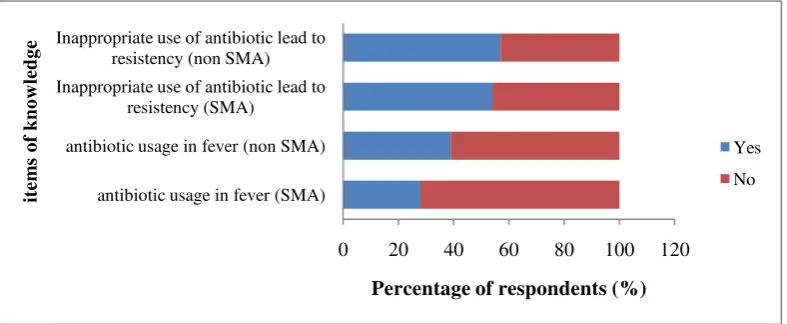
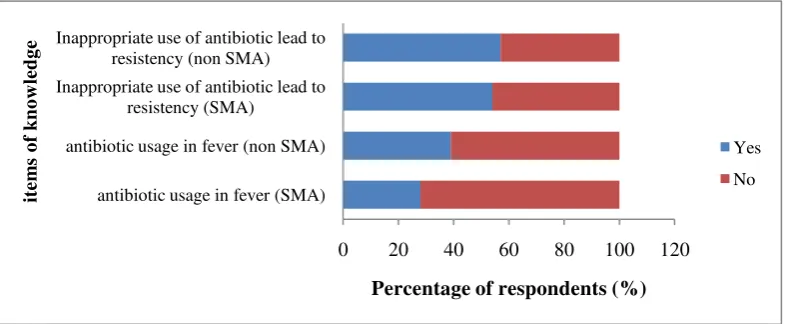
are presented in Figure 3. Both SMA
and non-SMA respondents stated that
they have already known that
inappropriate use of antibiotic would
lead to bacterial resistance. More than
half of respondents agreed not to use
antibiotic immediately after getting
4
Table 1. Demographic characteristics of respondents
Demographic characteristics SMA
n(%)
Non SMA n(%) Gender
Female 15 (33) 38 (70)
Male 31 (67) 16 (30)
Age in years
< 20 3 (7) 5 (9)
20 – 29 26 (56) 24 (44)
30 – 39 8 (17) 16 (30)
40 – 49 6 (13) 5 (9)
50 – 59 3 (7) 3 (6)
≥ 60 0 (0) 1 (2)
Highest education achievement
Elementary school 2 (4) 5 (9)
Junior high school 3 (7) 5 (9)
Senior high school 30 (65) 36 (67)
Collage 11 (24) 8 (15)
Table 2. Pattern of SMA in respondents
Pattern of SMA n (%)
Reasons
Simplicity 20 (43)
Feel confident 12 (26)
Cost saving 9 (20)
Inaccessibility from health care 3 (7)
Time saving 1 (2)
Recommended by others 1 (2)
Source of antibiotics
Last medication 4 (7)
Pharmacy 42 (91)
Table 3. Type of antibiotic, which were used in SMA
Types of Antibiotic n (%)
Amoxicillin 60 (60)
Unknown 36 (36)
Ciprofloxacin 2 (2)
Cefadroxil 1 (1)
5
Figure 1. Knowledge about antibiotic function among respondents
Figure 2. Knowledge about antibiotic target among respondents
Figure 3. Knowledge about resistance and immediate antibiotic usage in fever
Discussion
Almost half of respondents did
self-medication with antibiotics, which most
of them bought it in pharmacy without
doctor’s prescription or prior
consultation. Unfortunately, this habit
was not supported with appropriate
knowledge.
0 20 40 60
SMA non SMA
Percentage of respondents (%)
Ant
ibi
o
tic
fun
ct
io
ns
others
pain relieve
increase immunity
decrease fever
eradicate infection
0 20 40 60
SMA non SMA
Percentage of respondents (%)
Ant
ibi
o
tic
ta
rg
et
both
viral
bacteria
0 20 40 60 80 100 120
antibiotic usage in fever (SMA) antibiotic usage in fever (non SMA) Inappropriate use of antibiotic lead to
resistency (SMA)
Inappropriate use of antibiotic lead to resistency (non SMA)
Percentage of respondents (%)
it
em
s
o
f
k
no
w
ledg
e
Yes
6
Many studies have been done to
evaluate SMA pattern in Indonesia and
also in other countries, like China and
Sudan.3,4,5 Poverty, lack of information,
and poor regulation that related to drug
distribution may contribute to self-
medication with antibiotics.3 Female,
older age, and having higher education
were also stated as risk factors.4,5
Actually, antibiotic in Indonesia is
categorized as “obat keras” which
means it could not be accessed easily
without doctor’s prescription.3,6,7 The
commonly used antibiotics like
amoxicillin in developing countries are
10- to 30-folds cheaper than that in the
developed countries.8,9 That condition
makes antibiotics become more
reachable.
Respondents’ previous experiences regarding similar illness increase their
confident to do self-medication, and
start to ignore the role of doctors.7
Inappropriate use of antibiotic for
viral-related illness eradication especially for
common cold, which is a self limiting
disease, contribute in antibiotic
resistance related to self-medication. 6,10-14
Adequate information, expert
explanation, and better regulation in
drug distribution should be done to
prevent further misperception and
inappropriate self-medication especially
with antibiotics.
However, this study has some
limitations, including inadequate
number of respondents and the
sampling technique. These would limit
the generalization of the study results to
Denpasar population. The information
given by respondents might potentially
result in bias. Further studies with larger
number of respondents are suggested to
determine the prevalence and factors
that potentially affect self-medication
with antibiotic in Denpasar, especially
for rural area.
Conclusion
The prevalence of self-medication with
antibiotic is quite high in Denpasar.
Misperception and lack of knowledge
appear and result in inappropriate use of
antibiotic. Gender as one of
demographic characteristics is
statistically significant in this study.
Further education about antibiotic as
well as correction of drug regulation
should be done to prevent further
7 References
1. WHO. WHO Global Strategy for
Containment of Antimicrobial
Resistance. 2001. Available at:
http://whqlibdoc.who.int/hq/2001/W
HO_CDS_CSR_DRS_2001.2.pdf.
Cited in November,21 2013.
2. Lestari ES, Severin JA, Verbrugh
HA, Antimicrobial Resistance
Among Pathogenic Bacteria in
Southeast Asia. Southeast Asian
Journal of Tropical Medicine and
Public Health. 2012; 43(2):
385-423.
3. Widayati A, Suryawati S, Crespigny
C, Hiller JE. Self Medication with
Antibiotics in Yogyakarta City
Indonesia: A Cross Sectional
Population-based Survey. BMC
Research Notes. 2011; 4: 491.
4. Pan H, Cui B, Zhang D, Farrar J,
Law F, Thein WB. Prior
Knowledge, Older Age, and Higher
Allowance are Risk Factors for
Self-Medication with Antibiotics among
University Students in Southern
China. Plos ONE. 2012; 7(7).
5. Awad A. Self-Medication with
Antibiotics and Antimalarials in the
Community of Khartoum State,
Sudan. Journal of Pharmacy
&Pharmaceutical Sciences. 2005;
8(2): 326-331.
6. Undang-Undang Obat Keras.
Direktorat Jendral Pelayanan
Kefarmasian dan Alat Kesehatan.
1949. Available at:
http://www.dikti.go.id/files/atur/seh
at/UU-419-1949OrdonansiObat
Keras.pdf. Cited in November,22
2013.
7. Shojania KG, McDonald KM,
Wachter RM, Owens DK. Closing
the Quality Gap: A Critical Analysis
of Quality Improvement Strategies:
Antibiotic Prescribing Behavior.
2006; 4(9): 45-48.
8. Abdulah R. Antibitoic Abuse in
Developing Countries.
Pharma-ceutical Regulatory Affairs. 2012;
1(2).
9. Hadi U, Duerink DO, Lestari ES,
Nagelkerke NJ, Werter S, Keuter M,
Suswandojo E, Rahardjo E, Broek
P, Gyssens IC. Survey of Antibiotic
Use of Individuals Visiting Public
Healthcare Facilities in Indonesia.
International Journal of Infectious
Diseases. 2008; 12: 622-629.
10.Widayati A, Suryawati S, Crespigny
C, Hiller JE. Knowledge and Beliefs
about Antibiotics among People in
8
Sectional Population-based Survey.
Antimicrobial Resistance and
Infection Control. 2012; 1:38.
11.Mohanna M. Self-Medication with Antibiotic in Children in Sana’a City, Yemen. Oman Medical
Journal. 2010; 25: 41-43.
12.Aditya S, Rattan A. Self-Medication
among Dental Undergraduate
Students with Antibiotics: Looking
beyond The Known. Asian Journal
of Pharmaceutical and Clinical
Research. 2013; 6(4).
13.Osemene KP, Lamikanra A. A
Study of The Prevalence of
Self-Medication Practice among
University Students in
South-western Nigeria. Tropical Journal of
Pharmaceutical Research. 2012; 11:
683-689.
14.Grigoryan L, Ruskamp FMH,
Burgerhof JGM, Mechtler R,
Deschepper R, Andrasevic AT,
Andrahati R, Monnet DL, Cunney
R, Matteo AD, Edelstein H,
Valinteliene R, Alkerwi A, Scicluna
EA, Grzesiowski P, Bara AC, Tesar
T, Cizman M, Campos J, Lundborg
CS, Birkin J. Self-Medication with
Anti-microbial Drugs in Europe.
Emerging Infectious Diseases.
1
PATTERN OF SELF-MEDICATION WITH ANTIBIOTICS
IN DENPASAR CITY, INDONESIA
Jesika Ginotodihardjo1, I Gusti Ayu Artini2 1Student of Faculty of Medicine, Udayana University, Bali, Indonesia 2
Departement of Pharmacology, Faculty of Medicine, Udayana University, Bali, Indonesia
Abstract
Introduction: Self-medication with antibiotics that commonly related to misperception and lack of knowledge make antibiotic resistance become hard to control. This study aimed to investigate the prevalence of self-medication with antibiotic as well as knowledge regarding antibiotic usage in Denpasar City, Indonesia. Methods: This cross sectional population based survey directly interviewed respondents using structured questionnaire in Bahasa. A hundred respondents were selected using non probability-convenience sampling method in November-December 2013. The data were analyzed descriptively, and then the proportion data were analyzed using Chi Square. Results:
Forty three percent of respondents did self-medication with antibiotic, and simplicity (43%) is the most popular reason, beside feel confident, cost saving, inaccessibility from health care, time saving, and recommended by others. Pharmacists were the most common source of drug (91%). Gender was found to be statistically significant with p<0.05, whereas age and education level were not significant (p>0.05). Conclusions:
The prevalence of self-medication with antibiotics in this study is quite high, but it needs further investigation to generalize this result to Denpasar population.
Keywords: Antibiotics, Resistance, Self-medication
Abstrak
Pendahuluan: Pengobatan mandiri menggunakan antibiotik yang pada umumnya berkaitan dengan persepsi yang salah dan kurangnya pengetahuan menyebabkan masalah resistensi antibiotik menjadi sulit dikendalikan. Studi ini bertujuan untuk mengetahui prevalensi pengobatan mandiri menggunakan antibiotik dan pengetahuan masyarakat mengenai penggunaan antibiotik di Kota Denpasar, Indonesia. Metode:
Penelitian ini menggunakan metode cross sectional. Responden diwawancara secara langsung menggunakan kuisioner dalam bahasa Indonesia. Seratus responden dipilih menggunakan metode pengambilan sampel non probabilitas-kenyamanan pada bulan November-Desember 2013. Data yang terkumpul dianalis secara deskriptif, dan data proporsi dianalisis menggunakan Chi Square. Hasil: Empat puluh tiga persen dari responden pernah melakukan pengobatan mandiri dengan antibiotik, dan praktis (43%) menjadi alasan terbanyak disamping merasa paham, hemat biaya, kesulitan mengakses layanan kesehatan, hemat waktu, dan direkomendasi oleh oranglain. Apotek menjadi sumber obat-obatan paling umum (91%). Jenis kelamin menunjukkan signifikansi secara statistik dengan p<0.05, sedangkan usia dan tingkat pendidikan tidak signifikan (p>0.05). Kesimpulan: Prevalensi pengobatan mandiri dengan antibiotik pada studi ini cukup tinggi, namun dibutuhkan penelitian lebih lanjut untuk dapat menggambarkan penduduk Denpasar secara umum.
2 Introduction
The antibiotic resistance has already
become a global problem and therefore
WHO has stated “Antibiotic
Resistance” as the topic in World Health Day on April 7th, 2011. WHO
defines the appropriate use of antibiotic
as cost effective use which can
maximizes clinical therapeutic effect
while minimizing both drug related
toxicity and the development of
antibiotic resistance.1
Many researches have been conducted
to identify the prevalence of antibiotic
resistance; one of them is
penicilin-non-susceptible Streptococcus pneumoniae
(PNSP) in Southeast Asian.
S.pneumoniae as the major pathogen of
pneumonia, meningitis, and otitis media
in children and adult, had been altered
to be penicillin resistance more than
40% PNSP in Singapore (2000), and
21% in Jakarta (1996).2
Many factors contribute to
inappropriate use of antibiotics that
subsequently lead to resistance; one of
them is a patient-related factor
including self-medication and poor
adherence to dosage regiment.1
Self-medication with antibiotics (SMA) that
commonly related to misperception and
lack of knowledge make this resistance
become hard to control. The habit of
community to use antibiotic
inappropriately makes this topic
become interesting to be explored
further. This study aimed to investigate
the prevalence of SMA as well as people’s knowledge regarding their antibiotic usage.
Methods
This descriptive cross sectional study
was conducted in Denpasar City on
November until December 2013 to
assess self-medication with antibiotic as
well as respondents’ knowledge about
antibiotic. The respondents were
selected using non
probability-convenient sampling. Respondents
included in this study were non-health
care provider, age over 17 years old,
lived at Denpasar area, and had history of antibiotic usage. Respondents’ habit and knowledge related to antibiotic
were directly interviewed using
structured questionnaire in Bahasa. The
questionnaire was pre-tested to a
number of respondents, and resulted in
some revisions.
There were 14 questions related to last
antibiotic usage, conditions of usage,
3
antibiotic, and respondents’ knowledge including antibiotic function and target,
antibiotic usage immediately after fever,
and antibiotic resistance. Demographic
information such as date of birth,
gender, address, last education
achievement, and job were also
recorded.
The collected data were stored and
analyzed descriptively. Proportion data
were analyzed using Chi Square.
Results
Demographic characteristic
Data from 100 respondents who have
past history of using antibiotics was
successfully collected. Respondents’
age ranged from 18 to 62 years old.
Most respondents were female and
already passed the senior high school.
The complete demographic data were
presented in Table 1.
There was no significant difference
(p>0.05) in self-medication pattern
between younger respondents (<33
years old) with the older ones (≥33
years old), and also between lower
education level (elementary, junior high
school) with the higher (senior high
school and collage). Statistically
significant data was found in gender
with p<0.05.
Pattern of antibiotic usage
Almost half of respondents were found
to do self-medication for their last
antibiotic usage with various reasons.
As shown in Table 2, most of
respondents who did SMA, obtained
antibiotic from pharmacy, and the rest
got from remaining drugs of past
treatment. The types of antibiotic used
by respondents were presented in Table
3.
Knowledge of antibiotic
Some figures were presented below
regarding respondents’ knowledge
about antibiotic usage. Figure 1 shows
the respondents’ knowledge about
antibiotic function. Most of respondents
agreed that antibiotic was used to
eradicate the infection. The target of
antibiotic also was recorded and
presented in Figure 2.
Knowledge about antibiotic resistance
and immediate antibiotic usage in fever
are presented in Figure 3. Both SMA
and non-SMA respondents stated that
they have already known that
inappropriate use of antibiotic would
lead to bacterial resistance. More than
half of respondents agreed not to use
antibiotic immediately after getting
4
Table 1. Demographic characteristics of respondents
Demographic characteristics SMA
n(%)
Non SMA n(%) Gender
Female 15 (33) 38 (70)
Male 31 (67) 16 (30)
Age in years
< 20 3 (7) 5 (9)
20 – 29 26 (56) 24 (44)
30 – 39 8 (17) 16 (30)
40 – 49 6 (13) 5 (9)
50 – 59 3 (7) 3 (6)
≥ 60 0 (0) 1 (2)
Highest education achievement
Elementary school 2 (4) 5 (9)
Junior high school 3 (7) 5 (9)
Senior high school 30 (65) 36 (67)
Collage 11 (24) 8 (15)
Table 2. Pattern of SMA in respondents
Pattern of SMA n (%)
Reasons
Simplicity 20 (43)
Feel confident 12 (26)
Cost saving 9 (20)
Inaccessibility from health care 3 (7)
Time saving 1 (2)
Recommended by others 1 (2)
Source of antibiotics
Last medication 4 (7)
Pharmacy 42 (91)
Table 3. Type of antibiotic, which were used in SMA
Types of Antibiotic n (%)
Amoxicillin 60 (60)
Unknown 36 (36)
Ciprofloxacin 2 (2)
Cefadroxil 1 (1)
5
Figure 1. Knowledge about antibiotic function among respondents
Figure 2. Knowledge about antibiotic target among respondents
Figure 3. Knowledge about resistance and immediate antibiotic usage in fever
Discussion
Almost half of respondents did
self-medication with antibiotics, which most
of them bought it in pharmacy without
doctor’s prescription or prior
consultation. Unfortunately, this habit
was not supported with appropriate
knowledge.
0 20 40 60
SMA non SMA
Percentage of respondents (%)
Ant
ibi
o
tic
fun
ct
io
ns
others
pain relieve
increase immunity
decrease fever
eradicate infection
0 20 40 60
SMA non SMA
Percentage of respondents (%)
Ant
ibi
o
tic
ta
rg
et
both
viral
bacteria
0 20 40 60 80 100 120
antibiotic usage in fever (SMA) antibiotic usage in fever (non SMA) Inappropriate use of antibiotic lead to
resistency (SMA)
Inappropriate use of antibiotic lead to resistency (non SMA)
Percentage of respondents (%)
it
em
s
o
f
k
no
w
ledg
e
Yes
6
Many studies have been done to
evaluate SMA pattern in Indonesia and
also in other countries, like China and
Sudan.3,4,5 Poverty, lack of information,
and poor regulation that related to drug
distribution may contribute to self-
medication with antibiotics.3 Female,
older age, and having higher education
were also stated as risk factors.4,5
Actually, antibiotic in Indonesia is
categorized as “obat keras” which
means it could not be accessed easily
without doctor’s prescription.3,6,7 The
commonly used antibiotics like
amoxicillin in developing countries are
10- to 30-folds cheaper than that in the
developed countries.8,9 That condition
makes antibiotics become more
reachable.
Respondents’ previous experiences regarding similar illness increase their
confident to do self-medication, and
start to ignore the role of doctors.7
Inappropriate use of antibiotic for
viral-related illness eradication especially for
common cold, which is a self limiting
disease, contribute in antibiotic
resistance related to self-medication. 6,10-14
Adequate information, expert
explanation, and better regulation in
drug distribution should be done to
prevent further misperception and
inappropriate self-medication especially
with antibiotics.
However, this study has some
limitations, including inadequate
number of respondents and the
sampling technique. These would limit
the generalization of the study results to
Denpasar population. The information
given by respondents might potentially
result in bias. Further studies with larger
number of respondents are suggested to
determine the prevalence and factors
that potentially affect self-medication
with antibiotic in Denpasar, especially
for rural area.
Conclusion
The prevalence of self-medication with
antibiotic is quite high in Denpasar.
Misperception and lack of knowledge
appear and result in inappropriate use of
antibiotic. Gender as one of
demographic characteristics is
statistically significant in this study.
Further education about antibiotic as
well as correction of drug regulation
should be done to prevent further
7 References
1. WHO. WHO Global Strategy for
Containment of Antimicrobial
Resistance. 2001. Available at:
http://whqlibdoc.who.int/hq/2001/W
HO_CDS_CSR_DRS_2001.2.pdf.
Cited in November,21 2013.
2. Lestari ES, Severin JA, Verbrugh
HA, Antimicrobial Resistance
Among Pathogenic Bacteria in
Southeast Asia. Southeast Asian
Journal of Tropical Medicine and
Public Health. 2012; 43(2):
385-423.
3. Widayati A, Suryawati S, Crespigny
C, Hiller JE. Self Medication with
Antibiotics in Yogyakarta City
Indonesia: A Cross Sectional
Population-based Survey. BMC
Research Notes. 2011; 4: 491.
4. Pan H, Cui B, Zhang D, Farrar J,
Law F, Thein WB. Prior
Knowledge, Older Age, and Higher
Allowance are Risk Factors for
Self-Medication with Antibiotics among
University Students in Southern
China. Plos ONE. 2012; 7(7).
5. Awad A. Self-Medication with
Antibiotics and Antimalarials in the
Community of Khartoum State,
Sudan. Journal of Pharmacy
&Pharmaceutical Sciences. 2005;
8(2): 326-331.
6. Undang-Undang Obat Keras.
Direktorat Jendral Pelayanan
Kefarmasian dan Alat Kesehatan.
1949. Available at:
http://www.dikti.go.id/files/atur/seh
at/UU-419-1949OrdonansiObat
Keras.pdf. Cited in November,22
2013.
7. Shojania KG, McDonald KM,
Wachter RM, Owens DK. Closing
the Quality Gap: A Critical Analysis
of Quality Improvement Strategies:
Antibiotic Prescribing Behavior.
2006; 4(9): 45-48.
8. Abdulah R. Antibitoic Abuse in
Developing Countries.
Pharma-ceutical Regulatory Affairs. 2012;
1(2).
9. Hadi U, Duerink DO, Lestari ES,
Nagelkerke NJ, Werter S, Keuter M,
Suswandojo E, Rahardjo E, Broek
P, Gyssens IC. Survey of Antibiotic
Use of Individuals Visiting Public
Healthcare Facilities in Indonesia.
International Journal of Infectious
Diseases. 2008; 12: 622-629.
10.Widayati A, Suryawati S, Crespigny
C, Hiller JE. Knowledge and Beliefs
about Antibiotics among People in
8
Sectional Population-based Survey.
Antimicrobial Resistance and
Infection Control. 2012; 1:38.
11.Mohanna M. Self-Medication with Antibiotic in Children in Sana’a City, Yemen. Oman Medical
Journal. 2010; 25: 41-43.
12.Aditya S, Rattan A. Self-Medication
among Dental Undergraduate
Students with Antibiotics: Looking
beyond The Known. Asian Journal
of Pharmaceutical and Clinical
Research. 2013; 6(4).
13.Osemene KP, Lamikanra A. A
Study of The Prevalence of
Self-Medication Practice among
University Students in
South-western Nigeria. Tropical Journal of
Pharmaceutical Research. 2012; 11:
683-689.
14.Grigoryan L, Ruskamp FMH,
Burgerhof JGM, Mechtler R,
Deschepper R, Andrasevic AT,
Andrahati R, Monnet DL, Cunney
R, Matteo AD, Edelstein H,
Valinteliene R, Alkerwi A, Scicluna
EA, Grzesiowski P, Bara AC, Tesar
T, Cizman M, Campos J, Lundborg
CS, Birkin J. Self-Medication with
Anti-microbial Drugs in Europe.
Emerging Infectious Diseases.