Frequently Asked Questions
about Multi-Stakeholder Partnerships
in ICTs for Development
A guide for national ICT policy animators
Lishan Adam
Tina James
Alice munyua wanjira
Frequently Asked Questions about Multi-Stakeholder Partnerships in ICTs for Development
A guide for national ICT policy animators
Published by the Association for Progressive Communications (APC) © 2007
ISBN: 92-95049-42-X APC-200710-CIPP-T-EN-P-0040
Creative Commons Licence: Attribution-NonCommercial-NoDerivs 3.0 http://creativecommons.org/licenses/by-nc-nd/2.5/
Graphic Design:moNoCromo [email protected]
APC dedicates this guide to the people with whom we worked on national ICT policy advocacy in Africa from 2004 to 2006. Most of them are still contributing to national policy change.
Lishan Adam Goretti Z. Amuriat Dawit Bekele Fatima Bhyat Abebe Chekol Willie Currie John Dada
Anriette Esterhuysen Coura Fall
1.
About this guide / 4
2.
Background / 4
3.
What are multi-stakeholder partnerships for ICT policy? / 5
4.
What are the goals of a multi-stakeholder partnership? / 7
5.
What are the beneits of multi-stakeholder partnerships? / 8
6.
How do you deal with the challenges of multi-stakeholder partnerships? / 10
7.
What are the roles of stakeholders in a multi-stakeholder process? / 11
8.
What are the guiding principles for multi-stakeholder partnerships? / 14
9.
How do you drive a multi-stakeholder process? / 16
10.
What communications and advocacy activities are needed? / 19
11.
How do you monitor and evaluate your ICT policy process? / 21
SeleCTed uSeful reAdIng mATerIAlS / 22
CASe STudy
The multi-stakeholder process for ICT policy in the democratic republic
of the Congo / 23
CASe STudy
KICTAnet: A multi-stakeholder process for ICT policy in Kenya / 26
1.
About this guide
recent years have seen signiicant interest in the development of multi-stakeholder partnerships and multi-stakeholder processes that aim to address vari-ous developmental challenges. These have spanned a range of application areas, from environmental protec-tion to social inclusion; from global initiatives to local and national partnerships; from alliances between the private and public sectors to the inclusion of a broader range of partners from civil society, grassroots organisations and the media; in policy development but also implementation and service delivery.
Partnerships between the public sector, the private sector and particularly civil society in promoting in-formation and communication technology (ICT) policy are a relatively new venture. The mechanisms, man-agement and governance of such partnerships, from loose arrangements to more formal mechanisms, are still relatively new and not always fully understood. This guide is an attempt to add to the growing body of knowledge and experience on multi-stakeholder processes and partnerships, based on the practical experiences encountered during the three-year CATIA programme1 on ICT policy advocacy. It presents guide-lines that may assist national ICT policy facilitators in coming to grips with the complexities of multi-stake-holder relationships and the attainment of common goals and objectives. It considers practical issues for the establishment of a multi-stakeholder process for ICT policy and looks at how multi-stakeholder partner-ships work, what has been successful and what has not, and offers some practical suggestions on how to make them more effective. Practical experiences from two African countries – the Democratic republic of the Congo (DrC) and Kenya – are used to illustrate two possible approaches.
1 The CATIA (Catalysing Access to ICTs in Africa) programme ran from 2003 to 2006, supported by the UK Department for International Development (DFID), with additional support from the International Development research Centre (IDrC) and the Swedish International Development Agency (Sida). The experiences in this handbook are based on the ICT policy advocacy component, which was implemented by the Association for Progressive Communications (APC) in ive countries (Kenya, Ethiopia, Senegal, Nigeria and the Democratic republic of the Congo).
2.
Background
The public sector has been the major force behind most ICT policy and national ICT strategy initiatives in Africa over the last decade. However, it is becoming increasingly clear that the success of ICT in develop-ment cannot be met without the active participation of civil society, the media and the private sector.
3.
What are multi-stakeholder partnerships
for ICT policy?
multi-stakeholder partnership is a very broad term that describes groupings of civil society, the private sector, the public sector, the media and other stake-holders that come together for a common purpose, which here refers to the intent to drive changes in ICT policy development and ensuing implementa-tion. In such partnerships the partners have a shared understanding that they
play different roles and have different purposes, but that they can pursue collective goals through collaboration and common activities to achieve such goals. These partnerships are voluntary, with par-ticipation driven by the per-ceived beneits they may
see emerging from the process. Such partnerships are increasingly being used to challenge and lobby for change in policy processes. This is, in a number of cases, underpinned by collective research funding to support a particular position in the policy process and to raise general levels of awareness and knowledge about the issues under consideration.
multi-stakeholder partnerships show a range of modalities – from loose forum-like structures allow-ing for active debate and the exchange of knowledge
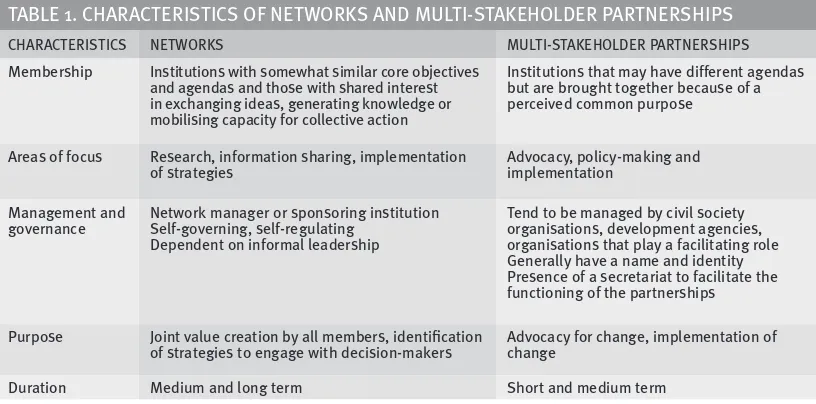
and experience, to more formalised structures based on the creation of a legal entity with appropriate governance structures to ensure transparency and accountability. The multi-stakeholder partnership is often viewed as a network approach. However there is a substantial difference between networks and multi-stakeholder partnerships. Networks rely on the membership of like-minded institutions that share a common purpose for core activities, while multi-stakeholder partnerships aim to band institutions with different agendas to-gether to address com-mon issues that may affect them or their stakehold-ers. Networks tend to be self-organising, evolving in response to complex realities facing them or their constituents. They are highly dependent on infor-mal leadership to achieve their purpose. multi-stakeholder partnerships can be regarded as networks with some formal element (e.g. a name or collective identity, guiding principle and small secretariat). multi-stakeholder partnerships are often created by agents (champions, external donors, etc.) to address speciic policy challenges.
Table 1 shows some of the similarities and differences between networks and multi-stakeholder partner-ships.
Partnerships are deined as voluntary and collaborative relationships between various parties, both state and non-state, in which all participants agree to work together to achieve a common purpose or undertake a speciic task and to share risks and responsibilities, resources and beneits.
UN General Assembly, 60th session, Report of the
Secretary General. UN Doc A/60/214.
TABLE 1. CHArACTErISTICS oF NETworKS AND mULTI-STAKEHoLDEr PArTNErSHIPS
CHArACTErISTICS NETworKS mULTI-STAKEHoLDEr PArTNErSHIPS
membership Institutions with somewhat similar core objectives and agendas and those with shared interest in exchanging ideas, generating knowledge or mobilising capacity for collective action
Institutions that may have different agendas but are brought together because of a perceived common purpose
Areas of focus research, information sharing, implementation
of strategies Advocacy, policy-making and implementation
management and
governance Network manager or sponsoring institutionSelf-governing, self-regulating Dependent on informal leadership
Tend to be managed by civil society organisations, development agencies, organisations that play a facilitating role Generally have a name and identity Presence of a secretariat to facilitate the functioning of the partnerships
Purpose Joint value creation by all members, identiication
of strategies to engage with decision-makers Advocacy for change, implementation of change
There is some overlap between what are deined as multi-stakeholder partnerships and those that are networks and the boundaries can be blurred. multi-stakeholder partnerships often give rise to long-term networks, which play an ongoing role in policy formulation, critique, debate, dialogue, monitoring and implementation. multi-stakeholder partnerships could lead to:
• A further voluntary association of like-minded or-ganisations that form their own network to pursue speciic goals such as exchanging knowledge or practices, and/or
• more luid, less formal and organic structures that emerge and grow out of multi-stakeholder groups and adapt to achieve speciic outcomes.
Likewise, loosely coupled networks can in turn lead to the creation of more formalised multi-stakeholder partnerships, policy spaces and a means of negotiat-ing with state and international institutions. A good example can be seen in the case of Kenya, where KICTANet started out as a loose association of in-terested individuals but eventually became a more formalised institution, as this was felt to be a more appropriate mechanism to gain legitimacy and cred-ibility in ICT policy negotiations.
In the ICT sector, the multi-stakeholder partnership approach has been used by donor agencies to work together in promoting policy changes or ICT appropri-ation for social and economic development. one such arrangement is the Global Knowledge Partnership (GKP),2 which brings together public sector, private sector and civil society organisations with the goal of sharing knowledge, expertise, experiences and re-sources. members of the GKP comprise governments, bilateral donor agencies, private sector companies, networks and multilateral/international institutions that are committed to harnessing the potential of ICT for equitable and sustainable development. However, the key impact of multi-stakeholder proc-esses is largely at the national level where the centre of gravity lies for ICT policy support. National ICT for development challenges that demand multi-stake-holder partnerships are numerous. They range from a lack of enabling policy and regulatory environments that promote investment, inadequate content and applications that meet key development challenges, particularly the livelihoods of the poor, limited re-search capacity in the ICT sector, limited skills bases, inadequate national backbones and limited access to rural and remote areas.
The world Summit on the Information Society (wSIS) has been influential in stimulating national multi-stakeholder approaches to ICT policy development and application. The Geneva Phase of wSIS in 2003, among others, recommended that all countries implement the Plans of Action emerging from the Summit through a network approach and report back to the Tunis Phase in 2005. WSIS did not only prompt governments to reach out to the private sector and civil society but also, in some cases, enabled civil society to assume leadership roles in ICT policy development.
2 www.globalknowledge.org
The Kenya ICT Action Network
(KICTANet)
The impetus for a multi-stakeholder process in Kenya arose from a recommendation of the world Summit on the Information Society and long-standing collaboration between civil society and the private sector in advocating for different ICT policy changes in Kenya over the last two decades. KICTANet was initiated by civil society organisations in october 2004 during a meeting organised by the media Council, APC, the DFID-supported CATIA programme, TESPoK (Telecommunications Service Providers Association of Kenya), Summit Strategies and the Kenya wSIS Civil Society Caucus. These organisations together with the Kenya ICT Federation (KIF) formed the initial members of KICTANet.
The creation of the DmTIC, a multi-stakeholder ICT policy advocacy group in the Democratic republic of the Congo, was facilitated through the DFID-supported CATIA programme. In 2004, based on the experience of other countries, the CATIA programme on policy and advocacy, implemented by APC, identiied Alternatives as national facilitator for policy advocacy work in the DrC.
In February 2005, Alternatives brought key stakeholders from civil society and the private and public sectors together to articulate national ICT challenges and embark on research and advocacy work. The major ICT issues identiied by the DmTIC were:
• Development of a national backbone infrastructure
• Development of a national ICT policy and strategy
• Fostering ICT regulation and legislation
• Promotion of content and applications to advance post-conlict social and economic development
• Distribution of ICT equipment and resources to improve access to computers and the internet.
The DmTIC began its policy advocacy work by conducting research on a national backbone network through funding from the IDrC. The study is expected to create the basis for lobbying decision-makers for policy changes, and for the private and public sectors to roll out the urgently needed broadband backbone infrastructure in the Democratic republic of the Congo.
multi-stakeholder partnerships can be sponsored by the public sector, civil society or the private sector, or a combined effort from all of them. Networks can and have been started by civil society organisations, government, the private sector and individuals. They can be global, regional, national or local, or can operate at different geographical levels at the same time. The question of who should initiate or drive a multi-stakeholder process is dependent on the local setting and context; but it has become clear that civil society-driven partnership models fare better than the public sector models. The multi-stakeholder partnerships in Kenya and the Democratic republic of the Congo were both sponsored by civil society organisations; but the public sector and the private sector were involved, to varying degrees, from the early stages of their formation.
4.
What are the goals of a multi-stakeholder
partnership?
The core theme of multi-stakeholder partnerships is joint value creation by all the participating mem-bers. multi-stakeholder partnerships are important to bring about policy change, share risks, and ind innovative and synergistic ways to pool resources and talents, based on each participant’s strengths. multi-stakeholder processes are longitudinal and iterative initiatives that are developed to deliver
mu-tual beneits for all that are engaged in the process on a long-term basis. The purpose is to pursue a shared vision, maintain a belief in favour of joint problem solving, and add value to the challenge under consid-eration beyond that which can be achieved through the efforts of individual initiatives. The main goal of a multi-stakeholder ICT process is to see change in policy and implementation. A good example can be found in the Kenya ICT policy process where the join-ing of forces from the private sector and civil society resulted in a combined effort that surpassed any change that could be effected by either of the sectors on their own.
The speciic goals of multi-stakeholder partnerships in ICT policy development are to:
• Identify speciic ICT issues that affect social and economic progress and which need priority atten-tion
• Carry out joint analysis and research which will better inform the policy formulation process and subsequent implementation
• Pool resources, talents and other capabilities of a diverse range of stakeholders, thereby strengthen-ing the capacity to effect change
• Share information on problems and solutions, and promote greater levels of understanding and trust between the various stakeholders
• Develop guidelines for best practices, written inputs into policy processes or action plans for the implementation of ICT policy changes
• Build the capacity of citizens to gain conidence, knowledge and skills, which in turn will enable them to participate more fully in the policy devel-opment process
• Lobby policy- and decision-makers for change
• raise the level of awareness of ICTs through col-laborating with the media
• Evaluate and monitor progress of change and subsequent policy implementation
• Address other ICT issues that are relevant to socio-economic progress.
5.
What are the beneits of multi-stakeholder
partnerships?
multi-stakeholder partnerships do not only bring key stakeholders together to discuss policy issues, build consensus and implement solutions, but also help to improve equity between players, and promote transparency and participation of the public in the ICT policy process. The multi-stakeholder process uses a wide range of methods and tools of engagement including face-to-face meetings, online discussions, training workshops and the formation of working groups to prepare brieing papers, inputs into policy processes and background research on priority ICT topics. In general:
• Multi-stakeholder partnerships promote inclusiv-ity and equinclusiv-ity in ICT policy and implementation.
The approach facilitates the participation of all interested parties in the process in an equitable manner – from issue identiication, preparation of supporting research, knowledge sharing, de-velopment of action plans and assigning tasks to monitoring the progress of policy changes. Both the DmTIC and KICTANet promote equal participation of the private sector, the media, researchers, civil society and the public sector in the discussion of ICT policy issues and implementation of solutions.
• Multi-stakeholder partnerships expand the analytical capability to address ICT policy issues. The involvement of a wide range of
stakeholder groups enables the development of a more comprehensive analysis of policy issues than any single stakeholder group can achieve. For example, the involvement of the Post and Telecommunications Corporation of the DrC in the DmTIC was useful in bringing out the chal-lenges that the government faces in rolling out broadband infrastructure and discussing projects that were in the pipeline. In the case of KICTANet, the collaboration of civil society and the private sector resulted in better understanding of the issues regarding universal access. Similarly the collaboration with media decision-makers has resulted in a better understanding of areas of mutual concern in the media Bill and the ICT Policy Bill.
• Multi-stakeholder partnerships promote grass-roots mobilisation and participation. Their simple existence encourages the participation of civil society and community-based organisations in the policy debate. multi-stakeholder partnerships also help in raising the awareness of the key actors and their constituencies.
• Multi-stakeholder partnerships promote the de-velopment of focused and holistic action plans.
Both KICTANet and the DmTIC focused on only a few issues at a time. In the case of KICTANet, one of the irst activities undertaken was to prioritise the areas on which it would focus. In the early days, this was aimed primarily at moving the ICT policy process forward, but after the ICT policy was drafted, the focus moved onto other areas such as voice over internet protocol (VoIP) and more recently the media Bill.
• Multi-stakeholder partnerships provide an impor-tant platform for training a new crop of experts
who help to sustain the partnership and animate the policy debates on an ongoing basis. This can take place either within the partnership or outside it, when these experts move on to new positions in the ICT arena. Capacity-building is therefore a very important outcome of the multi-stakeholder process, even when this is not explicitly built into the process. This was particularly evident in the CATIA policy advocacy process. without exception, each of the animators involved at the national level in these processes emerged with a deeper and more extensive knowledge of ICT policy processes and the key issues. All have subsequently been able to participate at a more sophisticated level in national (and international) debates and some have moved on to more senior positions since the CATIA programme ended in 2006.
• Multi-stakeholder partnerships create a balance between market orientation and development orientation. The participation of civil society and the public and private sector helps to maintain a strong balance between commercial and public interests, ensuring that delivery genuinely focuses on sustainable outcomes. KICTANet was able to bring out the social and public dimensions through its focus on universal access in the Kenyan ICT policy process. The fact that the commentary on the initial ICT policy document was drafted by a multi-stakeholder group carried more weight with government decision-makers because it was seen as coming from a representative body. many of the recommendations made by KICTANet were eventu-ally incorporated into the inal policy document.
• Multi-stakeholder partnerships encourage good governance. Partnerships provide an opportunity for different groups to identify conlicts, gaps or overlaps between their respective policies and programmes, and to better coordinate their work going forward. The inherent tension created through the coming together of partners with dif-ferent goals and purposes can be used to good effect to ensure greater levels of transparency and accountability.
• Multi-stakeholder partnerships enable par-ticipants to leverage their inancial resources.
Theyare useful on a number of levels during the
policy formulation process: a) for pooling inancial resources during ICT policy processes to ensure that policy recommendations are backed up by solid background research to support particular approaches in the development of an ICT policy; and b) for the combined undertaking of participa-tive processes such as workshops and think tanks, awareness raising campaigns through the media, the creation of online discussion lists, and the preparation of brieing papers.
once the ICT policy has been formulated and validated, multi-stakeholder partnerships be-come important for developing public-private partnerships, especially in the implementation of sustainable ICT projects. They can help to identify how public money can best be used to leverage private investments.
• Multi-stakeholder partnerships motivate both leaders and laggards. They create platforms for encouraging those with limited commitment and for bringing progressive actors together. Success tends to breed success. In the case of KICTANet fewer than ten organisations participated in the original start-up of the network in 2004. The numbers have increased two-fold and since 2006 include increased participation from a broader range of players, including media owners.
• Multi-stakeholder partnerships promote owner-ship and commitment for action. They enable participants to gain a better understanding of the need for change, feel ownership for a proposed plan of action and create a platform for peer pres-sure to enpres-sure delivery of outcomes.
media editors and owners to raise understanding of the importance of emerging ICT policy issues relating to technology convergence; and c) cre-ating opportunities for close collaboration with journalists to raise the proile of ICT reporting in the national media.
However the multi-stakeholder process is not always straightforward. It could fall into the trap of too much talk and no action, with continual meetings and discussions and no recognisable and tangible result being achieved. This is a particular risk if there is no political will to change and no widespread support from key players. Enlisting all key stakeholders, reach-ing agreement on a shared vision and establishreach-ing procedures for accountability and measuring progress (checks and balances) are all important for the multi-stakeholder process to succeed.
6.
How do you deal with the challenges
of multi-stakeholder partnerships?
multi-stakeholder processes are not easy to manage. They face a number of challenges which could result in failure to reach their hoped-for outcomes. Below are some of the problems that are likely to be encountered and which will require extraordinary efforts at times to ensure that they do not derail the process:
• Different groups of stakeholders are likely to compete with each other. This can be due to self-interest, or they may be competitors in their respective ICT activities, for instance, mobile oper-ators competing for the same customers or for the attention of the regulator; NGos competing for the same limited pool of funding; national government departments with overlapping mandates who want to look credible and compete for the right to own the process, particularly if it is a successful one; consultants competing for possible research as-signments; donors who wish to be associated with the process, a particular problem when several sources of funding have been provided.
• External funding resources may be limited and not always easy to identify and access. This has proved to be a dificult problem for many multi-stakeholder processes. Good practice learnt from the Kenya experience is that a) success breeds success – once the process was seen as legitimate and producing visible outcomes, it
became much easier to ind funding sources; and b) multiple funding sources, particularly where there is an active private sector, create a more sustainable revenue low. For example, in the case of Kenya, most of the meetings, workshops, background research, etc. were funded either through in-kind contributions from numerous businesses (one providing the venue, another the catering, internet costs, ofice space, and so on) or funding for operating costs and background research which was provided by various donors (e.g. the IDrC, DFID). Lack of sustainable funding resources could jeopardise the completion of the process.
• Finding common ground between various stakeholders requires strong negotiation and facilitation skills. Due to the fact that the pro-cess works with a wide variety of stakeholders, it may be dificult to identify common objectives and outcomes. Different parties may have a history of antagonism due to opposing ideolo-gies and approaches, or in some cases, never having worked together before. This may make it dificult for the partners to “ind” each other; for example, the private sector is generally seen as driven only by proit motives, which in turn is seen as negative by those more interested in seeing developments for the public good. once again, the Kenya case illustrates that there are possibilities for inding common ground; in this case, most of the stakeholders wanted to see a comprehensive ICT policy on the table.
• The existence of many initiatives will result in a fragmented process. recent interest in multi-stakeholder processes by government, the private sector and civil society has resulted in competing initiatives. For example, there are three different initiatives in the Democratic republic of the Congo to bring together key actors, namely the ComESA (Common market for Eastern and Southern Africa) regional ICT Support Programme, the UNECA (United Nations Economic Commission for Africa) national ICT policy project and the APC/CATIA and Alternatives DmTIC. This often leads to confusion and dissipation of energies and resources. where possible, synergies should be found so that these processes can support each other or eventually merge into a single process.
• Multi-stakeholder partnerships rely heavily on the presence of a visible and active champion. when champions leave – and they are often highly in demand due to their visible roles and knowledge of ICT policy – the multi-stakeholder process may lounder. This can be counteracted through ensur-ing that there is a succession plan in place.
• Volunteerism is not sustainable. It is dificult to keep multi-stakeholder partnerships going without a continuous low of resources. running a multi-stakeholder process based on the voluntary efforts of a few core animators is unlikely to be sustainable.
7.
What are the roles of stakeholders
in a multi-stakeholder process?
multi-stakeholder partnerships engage many play-ers in policy-making and implementation. These include:
• Policy- and decision-makers at various levels of government
• Public representatives (parliamentarians)
• Civil servants (municipal, rural and zonal)
• Civil society organisations (regional, national and international)
• Grassroots organisations
• Consumers and consumer groups
• End-user beneiciaries
• The media – print, radio and TV (regional and national) on various levels e.g. owners, editors, journalists
• Academics and researchers
• Consultants
• Private sector (small and medium enterprises, service providers, national and multinational companies)
• Industry associations
• Public service providers including incumbent telecommunications operators and regulators
• Development aid agencies and other supporters. Each of these stakeholders will play, to a greater or lesser extent, a different role in the ICT policy process.
It is useful to carry out a stakeholder analysis at the beginning of a multi-stakeholder process to ensure that there is a clear understanding of who should be involved in the process, to what extent, and at what time during the process.
Generally government leads the policy process but it is likely that during the process champions may emerge from the ranks of any of these stakeholder groups. Leadership may also change during the course of the process. Flexibility and adaptability are key features of such processes.
Policy- and decision-makers: The participation of policy- and decision-makers is critical for successful ICT policy outcomes. Policy-makers could play the following major roles in the multi-stakeholder process:
• Sponsor the ICT policy process as in the case of Kenya where this was done in partnership with donor agencies and the private sector
• Provide resources including funding and documen-tation
• Create mechanisms for follow up and implementa-tion of the policy
Policy-makers can beneit from the capacities of the private sector in administering projects and those of civil society organisations in promoting social and economic agendas targeted at the poor.
Experiences in the DrC and Kenya show that key deci-sion-makers can be brought on board in various ways:
• The civil society or sponsoring institutions could meet with the responsible senior minister or permanent secretary to secure their support. Experience suggests that a face-to-face meeting with policy-makers is essential to generate buy-in to the overall process and for follow-up activities. KICTANet members were able to meet the minister of communications and information and secure the full support of the minister and the permanent secretary in the development and implementation of the Kenyan ICT policy.
• regulators and policy advisors could be ap-proached as an entry point to secure senior policy-makers’ commitment. It is dificult to meet with senior ministers in some countries. In such cases, policy advisors or communications regulators could be used as a channel to approach ministers and prime ministers.
Development agencies could be used to bring the policy-makers and local stakeholders together. De-velopment agencies that enjoy good relationships with senior policy-makers could be used as an entry point. In the case of KICTANet and the DmTIC, the IDrC and DFID, through its CATIA programme, played this role.
Parliamentarians: Parliamentarians are essential to provide high-level leadership and pass any legislation arising from an ICT policy process. Their involvement and commitment is essential to provide vision and to lobby their colleagues during the parliamentary debates likely to ensue after a policy has been drafted and tabled in parliament. Parliamentarians have the following key roles in ICT policy development and implementation:
• Providing vision and leadership on what constitu-encies need and how technologies are applied to resolve local development challenges
• Supporting the evolution of laws and legislation that stimulate ICT sector development and its ap-plication
• monitoring the implementation of policies and regulation including scrutinising policy-makers and making them accountable for follow-up ac-tions.
Civil servants (municipal, rural and zonal): The par-ticipation of civil servants at various levels in the ICT policy development and implementation process is critical due to their proximity to service delivery. They are however often left out of national processes, leading to lack of commitment to proposed actions. Civil servants at the district and municipal levels often act as a gateway between government poli-cies and local initiatives. As gatekeepers, they have a unique position in unlocking (or stalling) access to information and communication services. Their participation in ICT policy deliberations is therefore important.
Civil society organisations (CSOs): Civil society or-ganisations have become pivotal for promoting ICT policies in recent years. CSos have shown substantial successes in agenda setting, building momentum behind a policy issue and inluencing the formula-tion, implementaformula-tion, monitoring and evaluation of policies. Civil society has not only been playing a key role in advocacy of pro-poor ICT policies but has also been instrumental in creating an informed network of local organisations including women’s groups, the media and others interested in ICT policy issues. Drawing on local knowledge and capacity for inno-vation, and carrying the trust of the general public, CSos can contribute enormously to the development of ICTs. They play the following roles during a multi-stakeholder process:
• They are increasingly becoming a major initiator and coordinator of multi-stakeholder platforms particularly in the ICT area.
• They play a key role as watchdogs to ensure that government commitments are adhered to and that processes deliver on agreed-upon outcomes.
• They play a key role in analysing issues and providing suggestions on possible actions. This includes raising awareness and general levels of understanding of the issues and processes.
• Think tanks and research-oriented organisations could analyse issues and provide background knowledge to all stakeholders in the multi-stake-holder process.
Grassroots organisations: Community-based or-ganisations such as women’s groups, cooperatives, and faith-based organisations need to be involved in ICT policy deliberations in order to ensure that local challenges and equity issues are factored into ICT policy-making. Their voices are more likely to address immediate needs relating to poverty alleviation.
Consumers: Consumers and consumer groups, where these exist, are often overlooked in ICT policy discussions. Increasingly there is awareness that consumer rights need to be put on the table in a more visible manner,
particularly regarding afford-able pricing and levels and reach of service provision in underserved areas.
End-user beneiciaries: ICT policies have a wide range of end-users and beneiciaries who are not apparent (or generally included) in the policy formulation process. These range from academic institutions (e.g. schools and teachers), small and medium enterprises, extension work-ers that may benefit from access to ICTs, farmers, the youth and the disabled. while policies often involve the supply side institutions and businesses such as tele-communications and ICT companies, the demand side institutions and beneiciaries are not involved on equal
terms, if at all. Limited involvement of development professionals in the ICT policy and regulatory dis-cussion means the outcomes are often skewed to infrastructure and access rather than the content and applications that underpin pro-poor interventions and the delivery of social services.
Media: The media is increasingly becoming involved in ICT policy issues. The media plays a major role in improving public awareness and disseminating research results to their audiences. It is instrumental in producing easy to understand articles on different policy issues and making technical issues accessible to a wider public. Unfortunately, the use of the media in ICT policy promotion is far from developed in Africa. The participation of the media and media associations in ICT policy formulation will not only improve the abil-ity to inform the population about opportunities and challenges of ICTs but also increase the integration of the media in the delivery of broadcasting, print and other modern media services.
Private sector: The private sector’s contribution is critical to the development of policy and implement-ing long-term solutions. The private sector brings to the table a culture of initiative, innovation, implementation and risk-taking that is critical for implementing successful policy outcomes. The pri-vate sector could also help in financing a multi-stake-holder process, but caution is needed to ensure that the process is not hijacked by vested interests and private sector agendas. By partner-ing with civil society and the public sector, the private sector could learn and pro-mote the social agenda of ICT development as part of their core activities. Industry associations, where they exist, can play a useful role in consolidating private sec-tor points of view. This has been very much the case in KICTANet where TESPoK, the telecommunications and internet service providers association, has played a key role.
Incumbent telecommunications operators: Telecom-munications operators are among the most powerful players in the ICT industry in Africa. while recent liber-alisation of the sector has improved competition, the
Multi-stakeholder partnership
around ICT policy development
and approval in Kenya
majority of countries still run monopoly incumbents that often work against all the initiatives intended to open up the ICT sector to competition and affordable pricing. The involvement of incumbent operators in ICT policy is important to improve their contribution to social objectives of ICT policies such as universal access.
Telecommunications regulators: Telecommunications and broadcasting sector regulators, including their regional associations such as the Communications regulators Association of Southern Africa (CrASA) and the west Africa Telecommunications regulators Assembly (wATrA), play a key role in ICT policy and regulation. regulators are essential to:
• Play a referee role in balancing public access objectives with proitability of the private sector
• Provide a platform and technical expertise during the discussions of various policy and regulatory issues
• Develop regulations that translate policies into actions.
Academics, researchers and consultants: This group plays a key role in many African ICT policy processes – as facilitators, advisors and researchers during policy-making and implementation. In many cases, their knowledge and expertise is needed to gather evidence in support of speciic key ICT policy issues. In some countries they also form a “core” of second-level players who remain present when politicians and key government decision-makers are replaced due to changing political situations.
Development agencies: most of the financial re-sources to support multi-stakeholder processes come from donor agencies. These agencies have realised that association with local stakeholders is one of the most effective ways to ensure commitment to the development and implementation of appropriate ICT policies. Creating perpetual dependency is a danger and needs to be avoided. All stakeholders should contribute towards a multi-stakeholder process. In the case of KICTANet, resources were provided by several donor agencies, but in addition the private sector made substantive contributions to workshops, support for a secretariat and sharing the costs of public events.
8.
What are the guiding principles
for multi-stakeholder partnerships?
The evolution and sustainability of a multi-stake-holder process for ICT policy depends on individual country settings. The two case studies included at the end of this handbook illustrate how important an understanding of local contexts is to the successful implementation of such a process. However, there are a number of principles that apply across all multi-stakeholder processes. These are listed below.
• The multi-stakeholder process needs to deal with inclusive or cross-cutting issues. The process can be costly in terms of resources and time. As a result, consistent participation of stakeholders could be a problem. The higher the incentives for all and the more timely the delivery of outcomes, the better the levels of participation. The Kenyan case provides an interesting example – the key incentive for Kenyan stakeholders was the lack of a national ICT policy and the fact that the existing process had been dragging on for a number of years. There was therefore a strong incentive for various stakeholders to get the process acceler-ated. The formation of KICTANet proved to be a timely intervention as it provided a credible multi-stakeholder platform for advocating ICT policy de-velopment. Similarly stakeholders in the DrC were interested in resolving infrastructure challenges – the DrC does not have a backbone infrastructure that supports its social and economic develop-ment. Agreements on a shared vision and objective at the beginning of their multi-stakeholder process took the process forward more speedily.
has to be given to the following issues, to name but a few: 1) when, where and at what time meet-ings will be held; 2) the creation of a space for all stakeholders to contribute to the setting of the agendas; 3) the style and level of formality of the meetings (e.g. presentations, participative ap-proaches for increased dialogue between various stakeholders, facilitated group sessions, etc.); 4) who chairs the meetings; 5) the type and level of communication (technical or not, use of local languages, translation facilities); 6) the manner in which presentations are made and interaction is encouraged; 7) the use of online discussion lists versus face-to-face interactions, since many CSos may not have access to the internet due to high costs or unavailability in rural areas and this would mean that an online process could exclude their voices from being heard. The process should continually be monitored and adjustments made to ensure the appropriate level of inclusiveness is maintained.
• The multi-stakeholder process has to be seen as legitimate and credible in the eyes of key stake-holders. much of this legitimacy will depend on the manner in which the facilitator(s)/champion(s) of the process are viewed: they have to be re-garded as neutral and objective, and therefore able to involve many groups of stakeholders in an equitable manner, without being seen to favour one over the other. This can be particularly chal-lenging, as has already been pointed out in Sec-tion 5. In the case of KICTANet, for example, the national animator was well regarded by a broad spectrum of stakeholders and, as ongoing evalu-ations revealed, each group viewed her as being “one of us”. This, together with support from APC, made it possible to negotiate and ind common ground more easily.
• Building trust with all partners is an important component of a multi-stakeholder process. multi-stakeholder partnerships work well when there is trust and cordiality among the stakeholders. This is not without its challenges as the nature of a multi-stakeholder partnership is about people from different environments, motives and interests coming together to resolve an ICT policy challenge. Feelings of commonality of purpose increase as participants continue to engage in the interactive
multi-stakeholder process. Trust comes when all parties are heard and recognised for what they bring to the table.
• Multi-stakeholder partnerships thrive on ongoing interaction. Creating spaces for informal interac-tion, coffees, after-meeting drinks, spontaneous exchanges, “off-topic” online discussions, etc. play a vital role in stimulating partnerships. A formal and rigid meeting procedure can stile the formation of strong relationships. over time, the less formal interactions can build camaraderie, common understanding, friendships and a com-munity of purpose across different organisations and individuals.
• Multi-stakeholder processes require champions or sponsoring institutions. Champions and spon-soring institutions are important to pull everyone together. In the case of KICTANet, a small group of enthusiastic individuals championed the process – the CATIA-appointed national animator (who had been predominantly involved in civil society activism), and two private sector representatives who were supported by a small body of ICT experts drawn from the local ICT community. The IDrC played a signiicant role in promoting trust among key players, particularly between government and the private sector. Likewise, Alternatives was instrumental in ensuring that the DmTIC carried out its objectives and built relationships with key partners in the DrC.
• Strong political support is essential for a success-ful outcome. multi-stakeholder partnerships in both the DrC and Kenya were driven by the need to bring about changes – in infrastructure roll-out in the former and in ICT policy for the latter. In both cases strong political support was necessary. without solid, supportive policy frameworks and basic good governance, the effectiveness of multi-stakeholder processes will inevitably be limited.
multi-stakeholder process needs some level of transparency and accountability to succeed. Par-ticipant institutions should establish and agree on key performance targets and encourage or challenge one another to deliver on stated goals and objectives.
• Key people should be involved. The most success-ful partnerships are those that have included one or more players from each of the key stakeholder groups. A multi-stakeholder process should not be seen as a representation but as a tool for ensuring the effectiveness of the partnership by bringing to the table those who have the vision, expertise and experience to make the goals of the partnership happen. Engagement of senior champions that advocate for the common goals set up as part of the multi-stakeholder process is far more essential than the partnership itself.
• Funding is needed. Partnerships need to estab-lish special trust funds to function, particularly to implement medium-term programmes such as research and continued lobbying and awareness raising. without adequate funding and support for the implementation of its programmes, and for coordinating activities, it is unlikely that the necessary driving force can be maintained.
9.
How do you drive a multi-stakeholder
process?
A multi-stakeholder process for ICT policy begins with a champion organisation identifying a policy issue. A process or partnership may already exist and this should be used as a basis for future activities. Build-ing on existBuild-ing processes or extendBuild-ing the number of players is an important step in the development of a multi-stakeholder process. In the case of Kenya, TESPoK had been working with key champions on ICT
Global Knowledge Partnership - Principles of multi-stakeholder partnership
PRINCIPLE 1 Know when to apply a multi-sector ICT partnership.
PRINCIPLE 2 Before agreeing to enter into partnership weigh its merits against the alternatives and risks.
PRINCIPLE 3 multi-stakeholder ICT partnerships work best when they mutually reinforce the interests of all partners.
PRINCIPLE 4 Successful partnerships are built on complementary competencies and resources that in combination meet the parameters of some strategic design.
PRINCIPLE 5 The resources and competencies contributed to the partnership should be drawn from as close as possible to the core “business” of the partner organisations.
PRINCIPLE 6 Consensus should be sought for a written document identifying at a minimum: the shared vision of the partnership, the objectives of each partner for the partnership, and the division of roles and responsibilities.
PRINCIPLE 7 when evaluating the outcomes of multi-stakeholder ICT partnerships care should be taken to identify the incremental contribution of the partnership activities over and above external factors and the next most likely alternative.
Source: Global Knowledge Partnership, multi-stakeholder Partnerships: Issue Paper.
Raising funds to foster a multi-stakeholder process in the Democratic Republic of the Congo and Kenya
policy issues for a decade, but did not appear to be making suficient progress. once more stakeholders were brought into the process, and KICTANet was es-tablished, a more credible partnership was created. In order to be effective, ICT policy partnerships need to have clear objectives, shared by all participating stakeholders. These objectives and issues vary from one country to the other. Examples of the issues that are often addressed include:
• Development and implementation of a broad-based national ICT policy and strategy
• Participation in international regimes and policy processes for infrastructure (e.g. regional broadband policies, internet addressing, radio frequency spec-trum management, standardisation, etc.) and con-tent and applications issues (e.g. privacy, security, taxation, authentication, pornography and spam)
• Infrastructure development issues = rural and remote access
= National backbone and broadband infrastruc-ture
= open access and cross-border connectivity
• Speciic regulatory issues = Interconnection of services = Voice over internet protocol (VoIP) = Licensing fees or procedures = radio frequency spectrum allocation = Tariff issues
= Quality of services and attending to consumer complaints
= Customs clearance and tax exemption issues = Universal access strategies
• Application of ICT for social and economic develop-ment
= Applications for health, education, agriculture, management and monitoring of the environ-ment, etc.
= ICT sector development
= Use of ICTs by business and services = Use of ICTs by civil society
= Access to computers and other gadgets by those who need them most including people who are physically challenged (disabled)
= ICT and different groups such as women, youth and the disabled
= Competitiveness issues including ICT-enabled services such as business process outsourcing and call centres
• research and development
= National capacity in ICT innovation = research and development in universities = Teaching, training, certiication of engineers = National and regional research network
• Training and capacity-building = Awareness raising
= Building capacities for development profes-sionals and policy-makers
= Building capacities in the wider population for basic ICT skills
• Culture and tools
= ICTs and local culture, indigenous knowledge = Free and open source software
= open content.
These issues are important for many countries. How-ever, it is essential for a multi-stakeholder process to focus on only a few challenges at a time. Experience in the DrC and Kenya shows that preferably two to three issues should be addressed at a time.
Champions: once the process is underway, it is im-portant to identify a champion or allow volunteers to put themselves forward for this task. A champion in this case would be an individual or organisation that is trusted and respected by all stakeholders and plays a catalytic role throughout the engagement process. The champion identiies potential participants, and sets the multi-stakeholder process in motion. membership size is dependent on the issue under discussion. To enable full transparency it is important that the membership be inclusive but focused on the issue under consideration. Too large or too small a membership base should be avoided.
on the goals and objectives of the multi-stakeholder partnerships, designing the process and building a joint analysis of the problems that the process is trying to tackle. At this point participants may need to make public commitments to meeting the shared objectives.
once shared objectives have been agreed upon, the process moves on to identifying a research agenda and joint action to tackle the ICT policy problem under consideration. These may be developed into an action plan with targets and timetables. Participants could also discuss the division of labour and mechanisms for communication including the use of mailing lists and regular face-to-face meetings, training workshops, think tanks, etc.
Electronic communications are important for multi-stakeholder processes. mailing lists and email en-able stakeholders to work together in developing ideas and keeping less-engaged stakeholders up-to-date with progress. This was particularly effective
in KICTANet, where a large proportion of the inputs into the draft ICT policy were dealt with electroni-cally. websites enable processes to be transparent, and enable outreach to potential participants and the general public. Video-conferencing has also been used very successfully in some cases, par-ticularly when the members operate from different geographic locations. However, given the impor-tance of building strong trust-based relationships, multi-stakeholder partnerships do beneit strongly from having some opportunities for face-to-face interaction, both formal and informal. This is also particularly important where CSos may not always have access to the internet.
Securing high-level commitment: High-level commit-ment is essential for the multi-stakeholder process to deliver real policy change and needs to include deci-sion-makers in government and other communities.
Governance structures need to be established and may include the following:
Setting the direction
• what will be the goals and objectives?
• what are the proposed outcomes of the partner-ship?
• on which activities should the partnership focus?
Leadership and coordination
• who will lead the process? (the champion)
• who will take the partnership process forward? (the facilitator/s)
• who is going to participate in the multi-stakeholder process? (stakeholder analysis/the partners)
• what governance structures need to be put in place to ensure a transparent and accountable process? The process
• How is the partnership process going to be taken forward? (the action plan)
• How long will it take to develop and agree on a detailed action plan for implementation?
• what division of labour is possible for delivering on the outputs of the action plans?
• what research and baseline studies should the partnership undertake to substantiate its case?
• what capacity-building activities need to be under-taken to ensure that all partners/key players can participate actively in the process?
Communications and information dissemination
• who will take responsibility for developing a com-munications plan?
• what activities will you undertake to support aware-ness raising and advocacy activities?
Funding
• How will the partnership process be funded?
• Are there opportunities for multi-funding between the partners?
• who will take responsibility for fundraising?
monitoring and evaluation
• what monitoring and evaluation process should be put in place to gauge the success of the multi-stakeholder process?
• Steering committee: These generally include representatives of all the stakeholder groups involved in the multi-stakeholder process. The steering committee/group is useful to oversee the general progress of the multi-stakeholder partnership in delivering on its action plans. It is beneicial to identify high-level stakeholders (e.g. ministers, regulators, directors and heads of other major group organisations in the partnership) to be members of the steering group to ensure their continuing commitment and engagement.
• Working groups: once a multi-stakeholder part-nership has agreed on its general objectives, it becomes necessary to create smaller groups of stakeholders to do detailed work on speciic ICT issues. working groups are effective in developing action plans, carrying out studies and in imple-mentation and evaluation of the process.
• A facilitating institution or a secretariat: This is important to kick-start a multi-stakeholder process. The process needs to be managed and facilitated by a secretariat based in an organisation that is trusted by all parties, and that is perceived to be relatively neutral in its position on the ICT policy issues. The organisation should have some prior experience and reputation in the area to be ad-dressed. The facilitator also takes responsibility for operational aspects such as organising meetings and workshops, liaison with partners, preparation of documentation, writing of proposals, etc. For example, the champion institution in the DrC, Alter-natives, already had some experience in ICT policy and infrastructure in the country prior to the forma-tion of a local multi-stakeholder network (DmTIC). Alternatives has been promoting ICTs through the public media and contributing to the APC ICT policy monitor website for the DrC. Similarly, KICTANet brings key champions that have had experience in ICT policy processes together. The secretariat, and particularly the champions who drive the proc-ess, are central igures in providing the energy to facilitate the mineield of diverse interests among partners.
Action plans: The development of action plans is an im-portant step in the consultation and iteration process. However it is generally easier to develop action plans than it is to implement them.The action plans that are developed by members of the network need to:
• respond to challenges on the ground
• Be pragmatic and take the capabilities of stake-holders into account. Partners should sign up to action plans on which they can deliver
• Limit the number and focus to reduce dissipation of resources on too many unproductive issues.
Funding: Funding is important to take the action plans forward and to nurture the multi-stakeholder process. Funding is needed for initiating a multi-stakeholder process, for running a secretariat, developing a communications campaign, setting up mailing lists, organising meetings and at later stages for the implementation of action plans. once the key partners have agreed on the options for joint action, participants need to make a further public commitment to implementation including announcing funding commitments. If external funding is needed to implement the action plans, participants will need to work to identify sources of funding.
Implementation of action plans: Implementation starts with the development of a matrix of commit-ments from all the stakeholders. It may be useful to re-establish a network for implementation of action plans or appoint a new champion to deliver the ac-tion plans. Demonstraac-tion of results is essential for stakeholders to see that commitments have become reality. Demonstration of actual results is a key step in the multi-stakeholder process.
10.
What communications and advocacy
activities are needed?
As discussed above, a multi-stakeholder process in ICT policy involves agenda setting, carrying out research on speciic policy issues, development of action plans, implementation and monitoring the outcomes. Communication and advocacy are central to a multi-stakeholder process. Three types of com-munication activity should be considered:
• Communicating research results and studies on speciic ICT policy issues
• Disseminating materials that will raise awareness of the issues with a broader audience and result in a better knowledge and understanding of ICT issues
Communicating research indings
multi-stakeholder partnerships are not generally well suited to producing detailed academic research work. However the partners need to provide policy-makers and the public with evidence in support of (or against) a particular position. This allows the partnership to build their case from a position of strength. This involves identifying the issues to be analysed, desk research to identify local and international experience on the issue, designing survey instruments, collection of both qualitative and quantitative data, and writing up the indings. Dissemination of the results and communicating the outcome is an essential part of ICT policy advocacy. The results of the study should be written in a way that is appropriate for a speciic target audience. Some options may include:
• A detailed version of the study which will be of interest to technical advisors, technical experts and the broader research community. This should include the rationale for the exercise, introduction to the methodology, demographic proiles, key indings and policy recommendations.
• A shorter popular version highlighting the ratio-nale for the exercise and key indings with policy pointers.
• A media brieing note that can be used by journal-ists to report on the indings in an easily under-stood style, with little use of jargon.
• A short summary of policy recommendations, prepared in a glossy format that can be used to lobby with senior decision-makers and parliamen-tarians.
Dissemination of the results could take place in vari-ous settings including a pre-launch presentation to the members of the multi-stakeholder partnership, media conferences and press notes for journalists, a post-launch conference for a wider audience and cre-ative opportunities that enable the multi-stakeholder partnership to reach out to senior policy-makers as well as to a broader group of interested parties.
Advocating for policy change or implementation of a speciic ICT programme for social
and economic impact
A focused advocacy campaign targeting particular decision-making bodies is essential in order to get changes in oficial policies or legislation. Advocacy for changes in legislation is an important part of the ICT policy partnership. The goal of advocacy campaigns is not just to change legislation and policies, but also attitudes and behaviour, and make sustainable changes in decision-making processes. The strength of the campaign therefore is dependent on the interac-tion and the diversity of instituinterac-tions forming a strong partnership and cohesive front to push the policy issues forward.
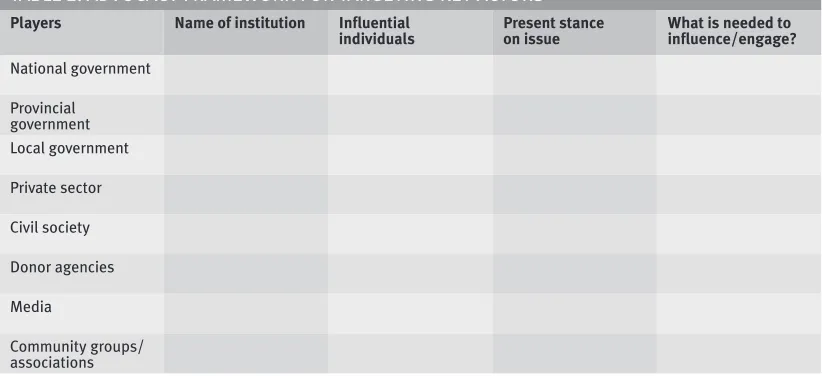
TABLE 2. ADVoCACy FrAmEworK For TArGETING KEy ACTorS
Players Name of institution Inluential
individuals Present stance on issue What is needed to inluence/engage?
National government
Provincial government Local government
Private sector
Civil society
Donor agencies
media
Advocacy for ICT policy changes involves a number of steps:
a. Who are your target audiences/stakeholders?
multi-stakeholder policy processes need to map out the key actors and their level of inluence/power, both positive and negative, and their stake in the policy-making process. Classifying the various actors in each institution or organisation as allies, opponents or undecided, and according to their levels of inter-est and inluence, is essential to carry out targeted advocacy. Inluential individuals in key institutions should be identiied and targeted. Table 2 provides a framework for identifying individuals and institutions that inluence ICT policy.
once the individuals and institutions are mapped out, advocacy should target those individuals that are most likely to respond to the demand and look for so-lutions. This includes people who have power to effect the policy change, most likely senior policy-makers such as heads of states, ministers of communica-tions, chief executive oficers of regulatory agencies and incumbent operators. People who can inluence senior policy-makers could include, for example, prominent journalists, businesspeople, key advisors and academics, including university vice chancellors. Their involvement will be important to move the policy agenda forward when the inluencing of the primary targets becomes dificult.
b. Capacity-building
Capacity-building and institutional development is an important aspect of ICT policy partnerships. Capacity-building improves better understanding of the issues and creates a sustainable and broader lobbying force. Partner institutions do not only need a deeper under-standing of the policy issues under consideration but should also have advocacy, negotiation and resource mobilisation skills to move the policy agenda forward. Practical training on policy advocacy, research meth-odology, strategy development, policy analysis and communication should be an integral component of the multi-stakeholder process.
c. deciding on the channels and activities to reach out to different audiences
In developing a communications plan for the ICT policy process, different channels for increasing the aware-ness of the ICT policy issue should be considered. Some possible communications tools include:
• Production of specific policy briefs for senior policy-makers
• Thematic papers for a wider audience that is interested in ICT policy issues
• Production of promotional products and informa-tion packages such as brochures, audiovisual tools, media briefs, case studies and PowerPoint presentations
• Training workshops for speciic groups to improve their knowledge of ICTs (e.g. journalists, commu-nity-based organisations, etc.)
• workshops to bring key stakeholders interested in ICT policy together or to brief institutions and individuals that have a stake and are likely to inluence the policy process.
11.
How do you monitor and evaluate your ICT
policy process?
Selected useful reading materials
Africa media Development Initiative (2006). Democratic Republic of the Congo Case Study. London: BBC world Service Trust. Available from:
downloads.bbc.co.uk/worldservice/trust/pdf/AmDI/drc/amdi_drc19_case.pdf
Association for Progressive Communications (2005). Resources on multi-stakeholder participation in UN processes [online].Compiled by Karen Banks. Available from:
www.apc.org/english/news/index.shtml?x=3149
Batliwala, S. (2002). “Grassroots movements as Transnational Actors: Implications for Global Civil Society”. Voluntas: International Journal of Voluntary and Non-Proit Organizations, 13(4), December 2002. Available from:
www.justassociates.org/associates_iles/Sri_rise_of_Global_Civil_Society.pdf
Creech, H. and willard, T. (2001). Strategic Intentions: Managing knowledge networks for sustainable development. winnipeg: International Institute for Sustainable Development. Available from: www.iisd.org/pdf/2001/networks_strategic_intentions.pdf
Esterhuysen, A. (2005a). Multi-stakeholder participation and ICT policy processes [online]. Available from: www.apc.org/english/news/index.shtml?x=31497
Esterhuysen, A. (2005b). “Participation in development processes: can ICT make a difference?” In: r. Abdul rahim, D. waldburger and G. Siegenthaler muinde (Eds.), Access, Empowerment and Governance. Creating a World of Equal Opportunities with ICT. Kuala Lumpur: Global Knowledge Partnership (pp. 65-2). Available from:
www.globalknowledge.org/gkps_portal/view_ile.cfm?ileid=3502
Finlay, A. (2006). Breaking new ground towards each other: Working in multi-stakeholder environments in ICT policy development in Africa – the CATIA experience. Available from:
www.cipaco.org/sources/Engaging_multi_Stakeholders_Final.doc
Global Knowledge Partnership (2003). Multi-stakeholder Partnerships: Issue Paper. Knowledge for Development Series. ISBN 93 25 04 9. Available from:
www.fdc.org.au/Files/Information/4.2%20mSP.pdf
mureithi, m. (2007). ICT development in Kenya: Strategic positioning to catalyse growth. Kenya ICT Action Network Study report.
Nelson, J. and Vadek, S. (n.d.). Partnership Alchemy: New social partnerships in Europe. ISBN 7-97643-1-4. Copenhagen: The Copenhagen Centre. Available from:
www.copenhagencentre.org/graphics/CopenhagenCentre/Publications/Partnership_Alchemy.pdf United Nations (2004). Strategic Partnership: Challenges and Best Practices in the Management and
Governance of Multi-Stakeholder Partnerships Involving UN and Civil Society Actors. Background paper prepared by Carmen malena for the multi-Stakeholder workshop on Partnerships and UN-Civil Society relations. Pocantico, New york, February 2004. Available from:
www.un-ngls.org/partnership-carmen-malena.doc
United Nations General Assembly (2005). Towards Global Partnerships. Enhanced cooperation between the United Nations and all relevant partners, in particular the private sector:Report of the Secretary General. 60th session, UN Doc A/60/214, Paragraph . Available from:
www.globalpublicpolicy.net/ileadmin/gppi/GAreport05.pdf
United Nations Development Programme (2006). UNDP and Civil Society Organizations: A Toolkit for Strengthening Partnerships. New york: UNDP. Available from:
I. The multi-stakeholder process in the DRC
and its governance framework
The multi-stakeholder process for ICT policy in the Democratic republic of the Congo (DrC) began with assistance from APC through funding from the Catalys-ing Access to ICT in Africa (CATIA) programme of the Department for International Development (DFID) that ran between 2003 and 2006. The process began with identiication of a local ICT policy animator.
APC selected Alternatives, a Canadian non-govern-mental organisation with a branch in the DrC. The selection of Alternatives as a national animator was not accidental. Alternatives showed a signiicant inter-est in the ICT ield and played a key role in increasing awareness of ICT policy and infrastructure in the DrC. It contributed to the APC ICT policy monitor website that provides up to date information on ICT policy and infrastructure in the DrC (africa.rights.apc.org). It has established a website for civil society (www. societecivile.cd) to increase awareness of their activi-ties in the country.