i
LIST OF CONTENTS
APPROVAL SHEET
... Error! Bookmark not defined.DECLARATION
... Error! Bookmark not defined.ACKNOWLEDGEMENT
... Error! Bookmark not defined.ABSTRACT
... Error! Bookmark not defined.LIST OF CONTENTS
... iLIST OF TABLES
... iiiCHAPTER I
INTRODUCTION
... Error! Bookmark not defined. 1.1 Background of the Study ... Error! Bookmark not defined. 1.2 Research Questions ... Error! Bookmark not defined. 1.3 The Scope of the Study ... Error! Bookmark not defined. 1.4 The Purposes of the Study... Error! Bookmark not defined. 1.5 Significance of the Study ... Error! Bookmark not defined. 1.6 Definitions of Key Terms... Error! Bookmark not defined. 1.7 Organization of the Thesis ... Error! Bookmark not defined.CHAPTER II
REVIEW OF LITERATUREError! Bookmark not defined.
2.1 Professional Teacher ... Error! Bookmark not defined. 2.1.1 Professional Teacher Development... Error! Bookmark not defined. 2.1.2 Professional English Teacher ... Error! Bookmark not defined. 2.2 Teacher Certification Program (TCP) ... Error! Bookmark not defined.
2.2.1 Teachers’ Competences ... Error! Bookmark not defined. 2.2.1.1 Pedagogical Competence ... Error! Bookmark not defined. 2.2.1.2 Personal Competence ... Error! Bookmark not defined. 2.2.1.3 Professional Competence ... Error! Bookmark not defined. 2.2.1.4 Social Competence ... Error! Bookmark not defined. 2.2.2 The Purposes of the TCP... Error! Bookmark not defined. 2.2.3 Process of TCP ... Error! Bookmark not defined. 2.2.3.1 Portfolio Assessment ... Error! Bookmark not defined. 2.2.3.1.1 Academic Qualification ... Error! Bookmark not defined. 2.2.3.1.2 Training and Education ... Error! Bookmark not defined. 2.2.3.1.3 Teaching Experience ... Error! Bookmark not defined.
2.2.3.1.4 The Lesson Plan and the ImplementationError! Bookmark not defined.
2.2.3.1.5 The Assessment from Headmaster and SupervisorError! Bookmark not defined 2.2.3.1.6 Academic Achievement ... Error! Bookmark not defined.
2.2.3.1.7 Profession Development Work Error! Bookmark not defined. 2.2.3.1.8 Participation in Scientific ForumError! Bookmark not defined.
2.2.3.1.9 Experiences in Social and Education OrganizationError! Bookmark not defined 2.2.3.1.10 Reward in Education ... Error! Bookmark not defined.
2.2.3.2 Teacher Training and Education or Pendidikan dan Latihan Profesi
Guru (PLPG) ... Error! Bookmark not defined.
ii 2.3 Perception ... Error! Bookmark not defined.
CHAPTER III
METHODOLOGY
... Error! Bookmark not defined. 3.1 Research Design ... Error! Bookmark not defined. 3.2 Research Site ... Error! Bookmark not defined. 3.3 Population and Sample ... Error! Bookmark not defined. 3.4 Data Collection Methods ... Error! Bookmark not defined. 3.4.1 Questionnaire ... Error! Bookmark not defined. 3.4.2 Interview ... Error! Bookmark not defined. 3.5 Procedures ... Error! Bookmark not defined. 3.6 Data analysis ... Error! Bookmark not defined.CHAPTER IV
DATA PRESENTATION
... Error! Bookmark not defined. 4.1 EFL Teachers’ knowledge about TCP ... Error! Bookmark not defined.4.2 EFL Teachers’ Perceptions towards certification ProgramError! Bookmark not defined. 4.3 EFL Teachers’ Efforts to Face TCP ... Error! Bookmark not defined.
CHAPTER V
FINDINGS AND DISCUSSIONSError! Bookmark not defined.
5.1 EFL teachers’ knowledge about teacher certification programError! Bookmark not defined. 5.2 EFL Teachers’ Perceptions towards TCP ... Error! Bookmark not defined.
5.3 EFL Teachers’ Efforts to Face TCP ... Error! Bookmark not defined.
CHAPTER VI
CONCLUSION AND SUGGESTIONSError! Bookmark not defined.
5.1 Conclusion ... Error! Bookmark not defined. 5.2 Suggestions ... Error! Bookmark not defined. 5.2.1 The government ... Error! Bookmark not defined. 5.2.2 Teachers ... Error! Bookmark not defined. 5.3.3 Further Research ... Error! Bookmark not defined.
REFERENCES
... 84iii
LIST OF TABLES
Table 3.1 Sample of Study ... Error! Bookmark not defined. Table 4.1 Frequency and percentage of EFL teachers’ knowledge about teacher
competences... Error! Bookmark not defined. Table 4.3 Frequency and percentage of EFL teachers’ knowledge about the
process of TCP ... Error! Bookmark not defined. Table 4.4 Frequency and percentage of EFL teachers’ knowledge about
requirements of TCP ... Error! Bookmark not defined. Table 4.5 Frequency and percentage of EFL teachers’ knowledge about the
components of portfolio assessment in TCPError! Bookmark not defined. Table 4.6 Frequency and percentage of EFL teachers’ perception towards
teachers’ competences ... Error! Bookmark not defined. Table 4.7 Frequency and percentage of EFL teachers’ perception towards the
purposes of TCP ... Error! Bookmark not defined. Table 4.8 Frequency and percentage of EFL teachers’ perception on the process of
teacher certification program ... Error! Bookmark not defined. Table 4.9 Frequency and percentage of EFL teachers’ perception towards the
requirements of TCP ... Error! Bookmark not defined. Table 4.10 Frequency and percentage of EFL teachers’ perception towards the
components of portfolio of TCP ... Error! Bookmark not defined. Table 4.11 Frequency and percentage of EFL teachers’ perception on the EFL
teachers’ language skills in TCP ... Error! Bookmark not defined. Table 4.12 Frequency and percentage of EFL teachers’ perception on the EFL
teachers’ language aspects in TCP ... Error! Bookmark not defined. Table 4.13 Frequency and percentage of EFL teachers’ perception on the teachers’
1
CHAPTER I
INTRODUCTION
This chapter comprises background of the study, research questions, scope of the study, purposes of the study, significances of the study, definitions of key terms, and the organization of the thesis.
1.1 Background of the Study
Today, certification program for teachers becomes an actual issue in Indonesia educational system. In this program, the government issues a policy for teachers to increase their competences. By these competences, it is expected that the teachers become professional. As a result, the education in Indonesia will develop and be able to compete with other countries in the world.
In this global era, education is an important sector in social life. It needs serious attention because one’s educational qualification determines his/her opportunity in getting a job. Therefore, teachers are demanded to enhance their educational quality by playing the important roles both as educators and teachers. In this regard, teachers are supposed to have certain competencies related to their profession.
2 enhancing the pedagogical practices. This is mentioned by Mulyasa (2008:9) when points out that there are seven indicators that show low quality of the teachers in committing their main job. They involve lack of teacher’s understanding and ability concerning teaching strategies, classroom management, classroom action research, motivation achievement, discipline, professional commitment, and time management.
It is stated in Republic Indonesia Regulation number 14/2005 for lecturer and teacher that teachers must have academic qualification, competence, and certification (article 8). It serves as an endeavor to increase teachers’ professionalism. This regulation leads all teachers to be more professional in committing their profession as teachers and educators. Furthermore, it is also stated in Indonesia Government Regulation number 19/2005 that educators or teachers must have some competencies which involve pedagogical, personality, professional, and social competence (article 28). It can be inferred that the qualification of teachers is measured based on the criteria of those competences.
The purpose of the certification program is to ensure that someone is professional enough to be a teacher. Being professional means that someone has a job or an activity as the source of living cost that requires skills, competences or ability to fulfill standard quality and it also needs certain professional education as stated in Republic Indonesia Regulation number 14/ 2005 for lecturer and teacher (article 1).
3 as a profession. It is called as National Board for Professional Teaching Standards (NBPTS). The purpose of this institution as quoted by Lengkanawati (2007) is to increase learning and teaching quality by maintaining high and rigorous standards for what accomplished teachers should know and be able to do, providing a national voluntary system certifying teachers who meet these standards, and advocating related education reforms to integrate National Board Certification in American education and to capitalize on the expertise of National Board Certified Teachers.
To take teacher certification program through portfolio assessment, there are some components that should be fulfilled by teachers. Those components are assessed by assessors from university. The components consist of ten items which involve academic qualification, training and education, teaching experience, lesson plan, academic achievement, assessment from principals and supervisors, the work of profession development, role in scientific forum, experience in education and social organization, and reward in education field. To succeed in portfolio assessment, it is required that the teachers have to reach minimum sore of 850. If the score is under 850, then it is recommended for them to take teachers training and education (PLPG).
4 from 1600 teachers from Department of Religious Affairs who took certification process, less than 50% passing the portfolio assessment (http://www.klubguru.com/view). In line with that, Basyuni, Islamic school education director of Religious Affairs Department, says that from 21.000
madrasah teachers who took teacher certification program, 60% of them failed in
portfolio assessment in 2007. He adds that most of them failed because they did not fulfill the terms of conditions in portfolio assessment (http://www. acehtengahkab.go.id/rf1/index2.php?do_pdf=1&id=338).
Basically, the Indonesia Government highly expects that teacher certification program will increase education quality and teachers’ prosperity as explained in the Guideline of Teacher Certification Program (2009) that teacher certification program is the government effort which is intended to increase the teachers’ quality as well as their prosperity. Clearly, this program is designed for teachers in order to be professional ones.
Based on the considerations above, this study was conducted to find out EFL teachers’ perception towards teacher certification program.
1.2 Research Questions
5
1.3 The Scope of the Study
This study focuses on investigating the EFL teachers’ knowledge about certification program, the EFL teachers’ perceptions towards certification program, and the EFL teachers’ efforts to face certification program.
1.4 The Purposes of the Study
Based on the formulated research questions, this study is aimed at finding out the EFL teachers’ knowledge about certification program, the EFL teachers’ perceptions towards certification program, and the EFL teachers’ efforts to face certification program.
1.5 Significance of the Study
This study is expected to give information about EFL teachers’ knowledge about teacher certification program, EFL teachers’ perceptions towards teacher certification program, and EFL teachers’ efforts to face teacher certification program.
1.5
Definitions of Key Terms
1. EFL Teachers are the teachers who teach English at Madrasah
Tsanawiyah (MTs) in Palu, Central Sulawesi.
6 3. Perception is process by which we become aware of changes (through the senses of sight, hearing, etc). (Oxford Advanced Learners’ Dictionary of Current English). Through perception one can see his or her inner capacity (which is the result of the internal process) such as attitude, feeling, point of view (Harvey and Smith, 1977 cited in Yunandami, 2007).
4. Professional English teacher refers to the English teacher who has pedagogical competence, personal competence, professional competence, and social competence.
5. Teacher’s competencies refer to pedagogical competence, personal competence, professional competence, and social competence.
1.7 Organization of the Thesis
30
CHAPTER III
METHODOLOGY
This chapter comprises some important elements related to research methodology. The first section of this chapter discusses how this study was designed. The second and the third section describe the site where this study took place and the people who were involved as the population and the sample in this study. The fourth section explains how data were collected using questionnaires and interview. The last section elaborates how the data were analyzed.
3.1 Research Design
This study uses descriptive research design to find out the EFL teachers’ perception towards certification program. Gall, Gall & Borg (2003:290) states that “descriptive research has yielded much valuable knowledge about opinions, attitudes, and practices.” (See also Gall and Borg, 1979).
3.2 Research Site
31
3.3 Population and Sample
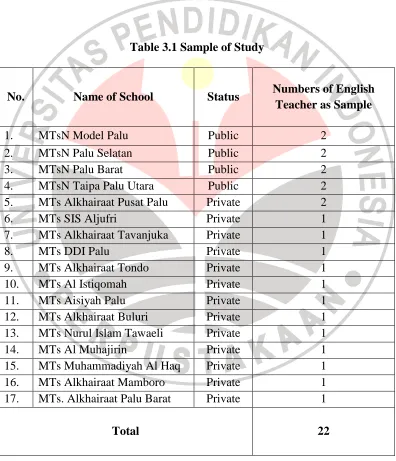
The target population of this study is all EFL teachers at Madrasah Tsanawiyah (MTs) in Palu, Central Sulawesi. To select sample from the population, this study used proportional sampling. There were 22 English teachers involved as respondents in this study.
Table 3.1 Sample of Study
No. Name of School Status Numbers of English Teacher as Sample
1. MTsN Model Palu Public 2
2. MTsN Palu Selatan Public 2
3. MTsN Palu Barat Public 2
4. MTsN Taipa Palu Utara Public 2
5. MTs Alkhairaat Pusat Palu Private 2
6. MTs SIS Aljufri Private 1
7. MTs Alkhairaat Tavanjuka Private 1
8. MTs DDI Palu Private 1
9. MTs Alkhairaat Tondo Private 1
10. MTs Al Istiqomah Private 1
11. MTs Aisiyah Palu Private 1
12. MTs Alkhairaat Buluri Private 1
13. MTs Nurul Islam Tawaeli Private 1
14. MTs Al Muhajirin Private 1
15. MTs Muhammadiyah Al Haq Private 1
16. MTs Alkhairaat Mamboro Private 1
17. MTs. Alkhairaat Palu Barat Private 1
32
3.4 Data Collection Methods
As this study is a descriptive method, the researcher used two data collection techniques: questionnaire and interview. The questionnaires were employed to collect basic descriptive information from a broad sample, and the interviews were used to follow up the questionnaire responses in depth for a smaller sample (Gall and Borg, 1979).
3.4.1 Questionnaire
33 TCP. Opened questionnaire (item no. 43) was the third one of this study to investigate English teachers’ efforts to face TCP.
Prior to distributing, the researcher tried the questionnaires out to ten English teachers to measure the validity and reliability of the instrument by using
Anates software. From 41 of questionnaire items, it was found that fourteen of them were insignificant. As a consequence, the insignificant items were revised.
The questions in the questionnaire involve three categories based on research questions. The first one is to find out the EFL teachers’ knowledge about TCP. It involves EFL teachers’ knowledge about teachers’ competences (Item no. 1 to no. 4), EFL teachers’ knowledge about the purpose of TCP (Item no. 5 and no. 6), EFL teachers’ knowledge about the process of TCP (Item no. 7 to no. 10), EFL teachers’ knowledge about the requirements of TCP (Item no. 11 to no. 14), and EFL teachers’ knowledge of the components of portfolio assessment (Item no. 15 to no. 21).
34 perceptions towards the assessment of teachers’ methods and media used in the teaching process (Item no. 40 to 41). The third one is to find out the EFL teachers’ efforts to face teacher certification program (Item no. 42).
3.4.2 Interview
Interviews consist of oral questions asked by the interviewer and oral responses by the research respondents (Gall, Gall, and Borg, 2003:222). Semistructured interview was used in this study because this type of interview is flexible as Merriam (1998:74) says that “The semistructured interview either all of the questions are more flexibly worded, or the interview is a mix of more and less structured questions.” In line with that, Gall, Gall and Borg (2003:240) states that “The semistructured interview involves asking a series of structured questions and then probing more deeply using open-form questions to obtain additional information.”
35
3.5 Procedures
There are some steps as procedure in distributing the questionnaire sheet to the respondents that the researcher conducted in this study. At first, the researcher visited the principals of each school. At that time the researcher asked permission of them to conduct the research. After getting permission, the principal called the English teachers and introduced the researcher to them. After that, the researcher talked with the English teachers about the research in teachers’ room. Then, the researcher distributed the questionnaires sheet to the English teachers. Since meeting with them, the researcher explained what the respondents didn’t understand related to the questionnaires of this study. Before going home, the researcher made appointment about the time of returning the questionnaires. Several days later, the researcher came to the school to take the result of questionnaires based on the appointment. From 18 schools that the researcher visited, he successfully got the data from 17 schools. One of the schools did not have English teacher because moving to another school.
36 agreement, researcher and respondents made an appointment about the time of interview.
As mentioned early, there were five respondents as the interviewees. R#1 is the first interviewee. She is certified English teacher and has 12 years of teaching experience. R#2 is the second interviewee. He has been teaching English for five years. R#3 is the third interviewee. She has been teaching English for ten years. R#4 is the fourth interviewee with seven years of teaching experience. The last respondent, R#5, is the fifth interviewee. He has been teaching English for eight years. R#2, R#3, R#4, and R#5 have not been certified yet in TCP. The interview session with R#1, R#2, and R#4 took place in the school, while R#3 and R#5 were in their home.
3.6 Data analysis
65
CHAPTER V
FINDINGS AND DISCUSSIONS
The data that have been presented in Chapter Four will be analyzed and discussed in this chapter. In this respect, the sections presented in this chapter are arranged based on the three research questions stated in Chapter One. They involve 1) What is EFL teachers’ knowledge about teacher certification program? 2) What are EFL teachers’ perceptions towards teacher certification program? 3) What are EFL teachers’ efforts to face teacher certification program?
5.1 EFL teachers’ knowledge about teacher certification program
This section presents findings and discussions of EFL teachers’ knowledge about Teacher Certification Program (TCP). It involves EFL teachers’ knowledge about teacher competences, EFL teachers’ knowledge about the purposes of TCP, EFL teachers’ knowledge about the process of TCP, EFL teachers’ knowledge about requirements of TCP, and EFL teachers’ knowledge about the components of portfolio assessment in TCP.
66 Republic Indonesia Regulation number 14/2005 for lecturer and teacher states that teacher must have competencies involving pedagogical, personal, social, and professional competence that obtained through profession education. Those competences are assessed in TCP so that those competences should be known by the teachers as the target of TCP. This finding shows that all respondents have known that pedagogical and professional competences are assessed in TCP. Regarding personal competence and social competence, this finding shows that not all teachers know that those two competences are assessed in TCP.
Finding #2: All respondents (100%) know that the purpose of TCP is to increase teachers’ professionalism and prosperity.
In the Guideline of Teacher Certification Program (2009), two of the purposes of TCP are to increase teachers’ professionalism and to increase teachers’ prosperity. This finding shows that all respondents have already known that the purposes of TCP are to enhance teacher’s professionalism and prosperity.
Finding #3: All of respondents (100%) know that TCP is conducted through portfolio assessment and teacher training and education. Nevertheless, some of them (22.73%) do not know that the assessors are from LPTK/university. Further, some of them (22.73%) also do not know that teachers have to have minimum score 850 to succeed in portfolio assessment.
67 of teachers’ document (Minister of National Education Regulation Number 18/2007 for Teacher Certification Program through Portfolio Assessment). It was found that all respondents know that TCP is conducted through portfolio and teacher training. This process is held by assessor from university (Minister of National Education Decree Number 057/0/2007). It was also found that there are still some of them do not know that the assessors of TCP are from LPTK/university. Further, to succeed in portfolio assessment, the teachers have to have minimum score 850. It was also found that some of them do not know that the passing grade in portfolio assessment is 850. If they fail in portfolio assessment, then they are recommended to take teacher training and education or PLPG.
Finding #4: Majority of respondents know the requirements of TCP excepting
Nomor Unik Pendidik dan Tenaga Kependidikan (NUPTK) in which
six (27.27%) answer incorrectly.
68 However, there are still some of them do not know that NPTK is one of the requirements of TCP.
Finding #5: Majority of respondents do not know that teaching activities in the classroom and personal competence in portfolio assessment are assessed by principal and/or supervisor.
Portfolio assessment is one of the processes in TCP. To take on this process, there are 10 components as requirements that should be fulfilled by the teachers. Those components are academic qualification, the training and education, teaching experience, lesson plan and its implementation, the assessment from headmaster and supervisor, academic achievement, profession development work, participation in scientific forum, experiences in social and education organization, and reward in education.
69
5.2 EFL Teachers’ Perceptions towards TCP
This section presents the findings and discussions related to EFL teachers’ perceptions towards TCP. It involves EFL teachers’ perceptions towards teachers’ competencies, EFL teachers’ perceptions towards the purposes of TCP, EFL teachers’ perceptions on the process of TCP, EFL teachers’ perceptions towards the components of portfolio of TCP, EFL teachers’ perceptions on the EFL teachers’ language skills in TCP, EFL teachers’ perceptions on the EFL teachers’ language aspects in TCP, and EFL teachers’ perceptions on the EFL teachers’ strategies in teaching English in the classroom in TCP.
Finding #6: All respondents agree that pedagogical, professional, personal, and social competences are assessed on TCP.
70 confidence and skill to alter your teaching techniques as needed, practical experience with different teaching techniques, informed knowledge of yourself and your students, and interpersonal communication skills, and attitudes of flexibility and openness to change.
Regarding personal competence, although some respondents have not known that personality is assessed in TCP, they agree that this competence is important to be assessed in TCP. It is in line with what Brown (2001:430) states that a good language teacher enjoys people, shows enthusiasm, warmth, rapport, and appropriate humor, is patient in working with students of lesser ability, cooperate harmoniously and candidly with colleagues (fellow teachers), and seeks opportunities to share thoughts, ideas, and technique with colleagues.
Then, based on the data presentation, there are also some respondents do not know that social competence is assessed on TCP. However, they also agree when social competence is assessed in TCP because it is able to support teachers’ professionalism. According to Sanjaya (2005:146), social competence is related to teachers’ ability as parts of society and as social creature involving: competence to interact and communicate to fellow teachers to increase professional competence, competence to know and understand functions of all society institution, and competence to cooperate either individually or in groups.
71 Increasing teachers’ professionalism and prosperity are the purposes of TCP. To increase teachers’ professionalism, then teachers’ prosperity should be taken into account. Many teachers look for other additional jobs to add their income. Hence, this program is expected to increase teachers’ prosperity so that they really focus on their teaching.
This finding shows that all respondents agree with the purposes of TCP. R#1 believes that TCP will increase educational quality because teachers will focus on teaching. Meanwhile, R#4 also agrees with TCP’s purposes, yet he expects well-system of TCP. He said the certified teachers should be constantly monitored to know whether they are really qualified or not, particularly their discipline in conducting their job. He expect to the educational supervisor and the principal to play their role as supervision.
Regarding to teachers’ prosperity, all respondents agree that TCP will increase teachers’ prosperity. R#1 said that teachers’ prosperity will increase because teacher will get additional income. Meanwhile, R#3 said that TCP will increase teachers’ prosperity if the government’s promise is realized to give fee as much as salary for certified teachers. It is apparent that teachers expect to the government to increase their prosperity and educational quality.
Finding #8: Majority of respondents agree that TCP has been socialized.
72 said that before taking TCP, we have already been informed about TCP. Meanwhile, although R#2 said that he never gets socialization from municipal department of education, he still got information through his peer teachers and from his reading in media.
This finding shows that majority of respondents agree that TCP has been socialized. However, it is contrast when compared to finding #1 in which majority of respondents do not know that personal competence is assessed in TCP. This finding is also contrast when compared to finding #5 in which majority of respondents do not know that teaching activities in the classroom and personal competence in portfolio assessment are assessed by principal and/or supervisor.
Based on those finding, associated authorities should constantly socialize about TCP. Socialization of TCP also is intended to facilitate teachers in preparing themselves to take TCP successfully.
Finding #9: Although majority of respondents agree to the portfolio assessment in TCP, they expressed their opinion about portfolio assessment.
73 when she took PLPG than when she took portfolio assessment. Meanwhile, R#2 also argued that teacher training and education (PLPG) is better than portfolio assessment because in this process, teachers are guided to be professional teachers. In addition, although R#4 and R#5 agree with the portfolio assessment, they suggested that there should be controlling team for certified teacher. They regard that there are some teachers that have been certified, yet there is no change of teaching ways. It means that their teaching ways are the same before being certified teachers.
Finding #10: There are several respondents do not agree with the requirement that teachers must have passing grade of 850 in portfolio assessment.
74 activities contribute higher score rather than merely attending like seminar, etc. He thought that if the teachers do those activities, then passing grade of 850 can be reached.
Finding #11: All respondents agree that EFL teachers’ language skills should also be assessed in TCP.
All respondents agree if EFL teachers’ language skills are also assessed in TCP because they assumed that those skills are important for English teachers as basic skills to teach language. R#2, for example, said that English teachers must be competence in listening, reading, speaking, and writing because those competences are the portrait of professional English teachers. R#5 also agrees with the assessment of the language skills in TCP. He, even, prefers all English teachers take teacher training and education (PLPG) or profession education to assessing the teachers’ score through documents (portfolio). It is in line with what Brown (2001:430) says that a good language teacher has fluent competence in speaking, writing, listening to, and reading English.
75 Finding #12: Majority of the respondents agree that EFL teachers’ language aspects which involve grammar, pronunciation, and vocabulary should also be assessed in TCP.
Beside language skills, language aspects also are very important things to be belonged to English teachers because those support the four language skills. It was found that majority of respondents agree when EFL teachers’ language aspects are also assessed in TCP. It is in line with what Brown (2001:430) states that the good language teacher understands the linguistic systems of English phonology, grammar, and discourse. Furthermore, Content knowledge is the teachers’ understanding of the subject of TESOL, e.g. pedagogical grammar, phonology, teaching theories, second language acquisition, as well as the specialized discourse and terminology of language teaching (Richard, 2001:210). In addition Mohideen (1995) gives some suggestions to language teachers namely language teachers should make an effort to linguistically competent, to be able to produce grammatically acceptable sentences.
Finding #13: All respondents agree that EFL teachers’ strategy in applying teaching methods and using teaching aids are assessed on TCP.
76 why teaching strategy must be possessed by teachers and assessed in teacher certification program. This finding is in line with Brown (2001:430) that states that a good language teacher understands and uses a wide variety of techniques. In line with that, Mohideen (1995) states that teachers must be familiar with the methods in vogue as well as those which have been around for a long time.
Respondents also agree with the assessment of English teachers’ strategies of the use of teaching aids in TCP. This finding is in line with what Mulyasa (2007:135) states that one of the competences of professional teacher is to understand and be able to use media and learning resources. Mohideen (1995) also states that “when we introduce the various techniques, there is variety in the classroom - the use of videos, tape recorders, language games and communicative tasks will certainly make learning much more enjoyable and less boring for the students.”
5.3 EFL Teachers’ Efforts to Face TCP
This part presents the efforts of EFL teachers to enhance their professionalism to face TCP.
77 Teachers should develop their professionalism continuously. Blair (1954:536) states that as professional person, a teachers’ learning should continue throughout his professional life. And then, he also says that a modern teacher is one who looks upon his teacher training as preparation to start teaching and preparation to continue systematic learning after his formal course work is over. The professionalism must be supported with skills, commitments, and other relevant competencies and all of these supports can be developed through pre and in-service training (Lengkanawati, 2007).
Many activities to develop teachers’ professionalism can be undertaken. Those activities may involve attending seminar and workshop, preparing good lesson plan, developing teaching module/materials, making teaching media/aids, conducting classroom action research, attending English teaching forum, doing peer observation, writing article about education, and taking part in social and educational organization, etc.
78 planning is the art of combining a number of different elements into a coherent whole so that a lesson has an identity which students can recognize. Work within, and react to – whatever metaphor teachers may use to visualize and create identity.” Indeed, teachers should have good lesson plans in order the purposes of learning can run well.
Classroom action research is an activity to evaluate or to develop teaching methods. Harmer (2001:344) states that “Action research is the name given to a series of procedures teachers can engage in, either because they wish to improve aspect of their teaching, or because they wish to evaluate the success and/or appropriacy of certain activities and procedure.”In line with that, Wallace (1998:1) suggests that one of the most effective ways of solving professional problems, and of continuing to improve and develop as teacher or teacher-trainer is through reflection o our professional practice. He then says that reflection on practice can be managed in many different ways. One of them is conducting action research. Furthermore Richard and Lockhart (1994) in Richard (2001:207) suggest the teachers to conduct small-scale classroom research on their teaching to enhance their professionalism. Based on the data presentation, however, it is interesting to note that only three from 22 respondents conducted classroom action research to develop their professionalism to face TCP.
79 most language program. Whether the teacher uses a text book, institutionally prepared materials, or his or her own materials…” However, the data from questionnaires shows that only seven respondents made teaching module.
Beside teaching module/material, the use of media is also able to help teachers to explain the relevant materials as Gebhard (1996) states that media can reinforce for students the direct relation between the language classroom and the outside world. He then says that media offer a way to contextualize language learning. Teaching media or teaching aids can be pictures, video, etc. Again, only eight respondents used teaching aids in their teaching.
English teachers’ forum (MGMP) is a forum for English teachers to share idea related to teaching English. Unfortunately, only small numbers of them attend in this forum. Furthermore, becoming organizer in both educational and social organization are assessed in TCP, however, small number of them are involved on these activities.
80 others’ classes as a basis for critical reflection and discussion about teaching approaches.
To develop their professionalism, teachers also can write about teaching in a journal (Gebhard, 2000:16; Richard and Lockhart, 1994 in Richard, 2001:207). Nevertheless, it was found that no respondents write article to promote their professionalism to face TCP.
A good language teacher has fluent competence in speaking, writing, listening to, and reading English (Brown, 2001:430). Therefore, English teachers should constantly develop their language skills. However, it was found that only one respondent stated that she tries to constantly enhance her language skills.
85
REFERENCES
Alwasilah, A.C. (2008). Pokoknya Kualitatif: Dasar-dasar Merancang dan
Melakukan Penelitian Kualitatif. Jakarta. PT Dunia Pustaka Jaya.
Brown, H.D. (2001). Teaching by Principles: An Interactive Approach to
Language Pedagogy. San Fransisco. Longman.
Blair, Glenn. M, Jones, R Stewart & Simpson, Ray. H. (1954). Educational
Psychology. The Macmillan Company. Newyork.
Blake, Robert. R & Ramsey, Glenn. V. (1951). Perception-An Approach to
Personality. Newyork. The Ronald Press Company.
California Department of Eduation. (1997). California Standards for the Teaching
Profession. California. Retrieved March 3, 2009 on the World Wide Web:
http://education.csufresno.edu/cst_ mat new/ pdf files/CSTPstndrd MAT. pdf.
Departemen Pendidikan Nasional. (2007). Peraturan Menteri Pendidikan
Nasional Nomor 18 Tahun 2007 tentang Sertifikasi bagi Guru dalam Jabatan melalui Penilaian Portofolio. Jakarta. Depdiknas.
Departemen Pendidikan Nasional. (2007). Keputusan Mendiknas Nomor
057/O/2007 Tahun 2007 tentang Penetapan Perguruan Tinggi Penyelenggara Sertifikasi Guru Dalam Jabatan melalu Jalur Penilaian Portofolio. Jakarta. Depdiknas.
Departemen Pendidikan Nasional. (2007). Keputusan Mendiknas Nomor
122/P/2007 Tahun 2007 tentang Penetapan Perguruan Tinggi Penyelenggara Sertifikasi Guru Dalam Jabatan melalui Jalur Pendidikan.
86 Departemen Pendidikan Nasional. (2009). Sertifikasi Guru dalam Jabatan Tahun
2009. Buku 1 Pedoman Penetapan Peserta. Jakarta. Depdiknas.Retrieved
July 2, 2009 on the World Wide Web: http://www. sertifikasi guru.org./download.php.
Departemen Pendidikan Nasional. (2009). Sertifikasi Guru dalam Jabatan Tahun
2009. Buku 2 Petunjuk Teknis Pelaksanaan Sertifikasi Guru. Jakarta.
Depdiknas. Retrieved July 2, 2009 on the World Wide Web: http://www. sertifikasi guru.org./download.php.
Departemen Pendidikan Nasional. (2009). Sertifikasi Guru dalam Jabatan Tahun
2009. Buku 3 Pedoman Penyusunan Portofolio. Jakarta. Depdiknas.
Retrieved July 2, 2009 on the World Wide Web: http://www. sertifikasi guru.org./download.php.
Departemen Pendidikan Nasional. (2009). Sertifikasi Guru dalam Jabatan Tahun
2009. Buku 4 Petunjuk Teknis Pelaksanaan Sertifikasi Guru untuk Guru.
Jakarta. Depdiknas. Retrieved July 2, 2009 on the World Wide Web: http://www. sertifikasi guru.org./download.php.
Departemen Pendidikan Nasional. (2009). Sertifikasi Guru dalam Jabatan Tahun
2009. Buku 5 Rambu-Rambu Pelaksanaa Pendidikan dan Latihan Profesi Guru. Jakarta. Depdiknas. Retrieved July 2, 2009 on the World Wide
Web: http://www. sertifikasi guru.org./download.php.
Departemen Pendidikan Nasional. (2009). Peraturan Menteri Pendidikan
Nasional Republik Indonesia Nomor 10 Tahun 2009 tentang Sertifikasi
Guru dalam Jabatan. Jakarta. Depdiknas. Retrieved July 2, 2009 on the World Wide Web: http://www. sertifikasi guru.org./download.php.
Diller, K.C. (1971). Generative Grammar, Structural Linguistics, and Language Teaching. Rowley, MA: Newbury House. In Richard, Jack. (1998).
Beyond Training. Cambridge. Cambridge University Press.
Drever, J. (1977). A Dictionary of Psychology. London. Penguin Book Ltd.
Forgus, Ronald. H. (1966). Perception the Basic Process in Cognitive
87 Emilia, E. (2007). In Emilia, E. (2008). Menulis Tesis dan Disertasi. Bandung.
Alfabeta, CV.
Gall, Gall & Borg. (2003). Educational Research: An Introduction. Seventh Edition. Oregon. Pearson Education, Ltd.
Gall & Borg. (1979). Educational Research: An Introduction. Third Edition. Newyork. Longman. Inc.
Gebhard, J. G. (1996). Teaching English as a Foreign or Second Language. Michigan. The University of Michigan.
Harmer, J. (2001). The Practice of English Language Teaching. London. Pearson Education Limited.
Harvey, J. H and Smith, W.P. (1977) Social Psychology: An Attributional Approach. Saint Louis CV Mosbo.Co. In Yunandami, A. K. (2007). The
Students’ and Teachers’ Perception on the Use of Computer in EFL Classrooms. Indonesia University of Education. Bandung. Unpublished.
Hornby, A.S, Cowie, A.P, and Gimson. (1974). Oxford Advanced Learners’
Dictionary of Current English. Oxford University Press. Oxford.
Hybels, S. and Richard L. Weaver. (2004). Self, Perception, and Communication. http://highered.mcgraw-hill.com/sites/html. In Haris Hermiadi. (2007).
Students’ perception on the Use of English as a Medium of Instruction: A Case Study at One Public Senior High School in Tanjungpandan Belitung. Indonesia University of Education. Bandung. Unpublished.
Kemp, Judy and Toperoff, Debby. (1998). Guidelines for Portfolio assessment in Teaching English. http://www.etni.org.il/ministry/portfolio. In Pertiwi, U.G. (2005). The Implementation of Portfolio Assessment. Indonesia University of Education. Bandung. Unpublished.
88 Lengkanawati, Nenden S. (2007). Sistem Pendidikan dan Pengembangan
Profesionalisme Guru. Bandung. Unpublished.
Longman Dictionary of Contemporary English. (1998). London. Longman Group UK Limited.
Merriam S.B (1998). Qualitative Research and Case Study Application in
Education: Revisited and Expanded from Study Research in Education.
San Francisco. Jossey-Bass Publisher.
Mohideen, Haja bin Mohamed Ali. (1995). Becoming Professionally Competent
Language Teachers- Some Suggestions. Retrieved April 13, 2009 on the
World Wide Web: http://www.mwlta. org.my/ET/1995/main.html.
Mulyasa, E. (2008). Standar Kompetensi dan Sertifikasi Guru. Bandung. PT Remaja Rosda Karya.
National Board for Professional Teaching Standards. (2009). News Voices, News
Visions: Teaching for tomorrow, today. Retrieved March 27, 2009 on the
World Wide Web: http/www. nbpts. org/ about_us/2009_ national _ confrence1.
Nunan, D. (1991). Language Teaching methodology. London. Prentice Hall International. Ltd.
Nunan, D. (1992). Research Methods in Language Learning. Cambridge. Cambridge University Press.
Oppenheim, A. N. (1982). Questionnaire Design and Attitude Measurement. London. Heinemann Educational Books. Ltd.
Pennington, Martha C. (1990). A Professional Development Focus for the Language Teaching Practicum. In Brown, H.D. (2001). Teaching by
Principles: An Interactive Approach to Language Pedagogy. San
89 Peraturan Pemerintah Nomor 19 Tahun 2005 tentang Standar Nasional
Pendidikan. Jakarta. Visimedia.
Peraturan Pemerintah Republik Indonesia Nomor 74 Tahun 2008 Tentang Guru. Retrieved July 4, 2009 on the World Wide Web: http://www. sertifikasi guru.org./download.php.
Republika Online. (2007). 60 Persen Guru Madrasah tak Lulus Sertifikasi. Retrieved March 7, 2009 on the World Wide Web: http:// www. acehtengahkab.go.id/rf1/index2.php?option=com_ content&do_ pdf= 1 & id=338.
Richard, Jack. (1998). Beyond Training. Cambridge. Cambridge University Press.
Richard, Jack. (2001). Curriculum Development in Language Teaching. Cambridge. Cambridge University Press.
Richard, J.C., and C. Lockhart. (1994). Reflective Teaching in Second Language Classroom. New York: Cambridge University Press. In Richard, Jack. (2001). Curriculum Development in Language Teaching. Cambridge. Cambridge University Press.
Sanjaya, W. (2005). Pembelajaran dalam Implementasi Kurikulum Berbasis
Komptensi. Jakarta. Kencana Perdana Media Group.
Silverman, David. 2005. Doing Qualitative Research. London: SAGE Publications ltd.
Tagiuri, Renato & Petrullo, Luigi. (1958). Person Perception and Interpersonal
Behaviour. California. Stanford University Press.
The Profesional Portofolio. Retrieved July 2, 2009 on the World Wide Web: http://www2.scholastic.com/browse/ article. jsp?id=4148.
90 Undang-Undang Nomor 14 Tahun 2005 tentang Guru dan Dosen. Jakarta.
Visimedia.
Wallace, M.J. (1998). Action Research for Language Teachers. Cambridge. Cambridge University Press.
Wibowo. Mungin Eddy. (2004). Standarisasi, Sertifikasi, dan Lisensi Profesi
Pendidik dan Tenaga Kependidikan. Surabaya: Seminar Nasional
Pendidikan. In Mulyasa, E. 2008. Standar Kompetensi dan Sertifikasi
Guru. Bandung. PT Remaja Rosda Karya.
Vélez-Rendón, G. (2002). Second language teacher education: A review of the literature. Foreign Language Annals, 35, 457-467.In Park, Gi-Pyo and Lee, Hyo-Wong. Characteristics of Effective English Teachers Perceived
by High School Teachers and Students in Korea. Soonchunhyang