Membrane bioreactor for domestic wastewater treatment:
principles, challanges and future research directions
Muhammad Roil Bilad
Department of Chemical Engineering, Universiti Teknologi Petronas, Bandar Seri Iskandar, Perak 32610, Malaysia
* Correspondence: Email: [email protected] ; Tel.: +605368 7579
A B S T R A C T S A R T I C L E I N F O
Membrane bioreactors (MBRs) have recently become widely accepted as an advanced technology for treatment of domestic and industrial wastewaters. The objective of this review is to provide overview on MBR technology for wastewater treatment application. It includes discussions on the fundamental, core problems (membrane fouling), recent effective development approach (dynamic filtration systems) and future research direction of MBRs. Since MBRs integrate a conventional activated sludge process with membrane filtration, and both fundamental aspects are discussed first. Later, a comprehensive discussion about membrane fouling, the main problems in MBR, is provided, including fouling control strategies. The discussion on the MBR membranes and relation between membrane properties and MBR performance is also provided. This review also includes one of the most promising MBR technologies that specifically design to manage membrane fouling: dynamic filtration systems. Lastly, insight into an approach to address MBRs challenges and recent research and developments are provided.
© 2017 Tim Pengembang Jurnal UPI
Article History:
Received 03 December 2016 Revised 01 January 2016 Accepted 20 January 2016 Available online 01 April 2017 ____________________
Keyword:
Membrane bioreactor, Membrane fouling, Wastewater treatment, Dynamic membrane system.
Indonesian Journal of Science & Technology
DOI: http://dx.doi.org/10.17509/ijost.v2i1
p- ISSN 2528-1410 e- ISSN 2527-8045
1. INTRODUCTION
Membrane bioreactors (MBRs)
integrate an activated sludge bioreactor with membrane filtration. They offer a better effluent quality and a more robust technology in treating wastewater. Because of stricter effluent standards and high water reuse demands, MBRs have recently become widely accepted as an advanced option for treatment of domestic and industrial wastewaters. Recently, MBRs have growing number of installations and capacities, as well as providers. The global MBR market had a value of ≈ $10 million in 1995, which increased to ≈ $217 million in 2005. The annual average market growth rate is 9.5 which is 12%, faster than any of other advanced wastewater treatment processes.
MBR has many advantages over the conventional activated sludge process (ASP).
They include a higher biomass
concentration, smaller footprint, less sludge production, decoupled sludge (SRT) and hydraulic retention time (HRT), and highly-improved and constant effluent quality. However, MBRs widespread installations is restricted by membrane fouling problems, which limit the achievable permeate flux, reduce the sustainability of operation, increase the cleaning frequency, reduce the lifetime of the membrane, etc. This drawback leads to a high capital expenditure (capex) and operational expenditure (opex), and thus lowers its competitiveness (Drews, 2010; Le-Clech et al., 2006; Meng et al., 2009).
Extensive studies have been reported regarding MBRs, mostly in order to understand and provide solution to manage membrane fouling. In many cases, contradictions were found because of the following reasons (Drews, 2010):
1. The complexity and inter-relationship of multi-parameters of the system is sometimes denied and researchers jump to conclusions.
2. A wide variety exists of experimental conditions, feed composition, biological parameters, filtration parameters, sample preparations and evaluation methods.
3. Often, terminology is established without clear definition.
Therefore, additional care is required when addressing published data. Developing MBR technology requires an inter-disciplinary approach and the study of MBR fouling requires an integrated knowledge of not only biological wastewater treatment technology and membrane technology, but also engineering background.
Based on previous works (Bilad et al., 2014; Bilad, et al., 2015; Bilad et al., 2012a;
Bilad et al., 2012b; Bilad et al., 2011; Bilad, 2016), this review provides overview on MBR technology for wastewater treatment application. It includes discussions on MBRs fundamental, core problems and future research. Since MBRs integrate a conventional ASP with membrane filtration, both aspects will be discussed thoroughly. Later, a comprehensive discussion about membrane fouling, the main problems in MBR, including fouling control strategies is provided. The discussion on the MBR
membranes and relation between
membrane properties and MBR
DOI: http://dx.doi.org/10.17509/ijost.v2i1
2. MEMBRANE TECHNOLOGY
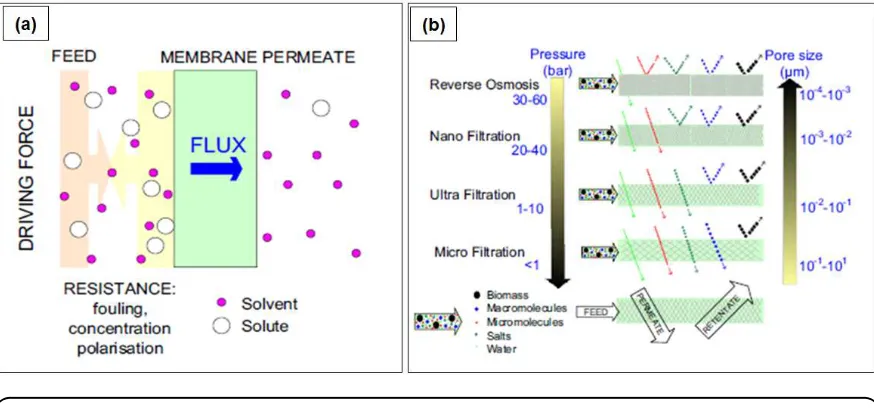
Membrane processes are currently being used in many industrial sectors. In some applications, (such as in desalination, water and wastewater treatment), they have a high industrial relevance and have become a standard technological solution (Shannon et al., 2008). In water and wastewater treatment, the growth of
membrane applications has been
exponential over the last two decades. This is due to the drivers of tighter regulations, water scarcity, and significant advances in membrane process performances (Fane, 2011). The market of membranes for
common pressure driven membrane
filtration is shown in Figure 1(a). Depending on the ability to reject certain compound(s), common pressure driven membranes and their specifications can be divided into reverse osmosis (RO), nanofiltration (NF) ultrafiltration (UF) and microfiltration (MF) (Figure 1(b)). how good a membrane allows the permeate to pass; rejection measures how good a membrane retains a certain compound.
is the solute concentration in the permeate, and Cf is the solute concentration in the feed.
DOI: http://dx.doi.org/10.17509/ijost.v2i1
p- ISSN 2528-1410 e- ISSN 2527-8045
2.2. Operation and filtration process
There are two common ways to perform a filtration: dead-end or cross-flow. In the dead-end, the permeation is driven by pressure different, with no concentrate stream. In the cross-flow, feed is pumped tangentially along the membrane surface and is split into permeate and retentate (concentrate) streams. The feed is introduced in the first end of the membrane module and the retentate exits at the other end. The pressure is generated by restricting the flow at the other end. Both systems can be operated at a constant flux or at a constant TMP. In practice for an MBR application, filtration is performed under a constant flux operation And because of occurrence of membrane fouling, TMP increases over time.
Fouling can occur in many forms. Foulants can be adsorbed in the pore
structures, foulants can block the membrane pores, foulants can accumulate and form a cake layer, etc. By incorporating the occurrence of fouling, the filtration resistance can be calculated as in Equations (4) and (5). This resistance in series model helps to identify the contribution of each fouling components.
T R TMP J
(4)
c b p i m
T R R R R
R (1/m) (5)
where η is the dynamic viscosity of
permeate (Pa s), RT the total filtration
resistance, and Rm, Ri, Rpb, Rc the filtration
resistance originating from membrane, internal fouling, pore blocking and cake layer, respectively.
DOI: http://dx.doi.org/10.17509/ijost.v2i1
To maintain the long-term membrane performances and managing membrane fouling, the filtration is normally done in cycles, which involve relaxation or backwash (known as physical cleaning methods), as well as maintenance and intensive chemical cleanings. Another method to control fouling is by interrupting or disturbing the fouling development using the shear-rate induced from the relative movement of fluid to membrane, or movements of the
membrane itself (Jaffrin, 2008). The former is done by applying high cross-flow velocities in a cross-flow system or by introducing a secondary flow in a dead-end system (Section 3), while the latter is done by shaking or vibrating the membranes in dynamic filtration systems.
DOI: http://dx.doi.org/10.17509/ijost.v2i1
p- ISSN 2528-1410 e- ISSN 2527-8045
3. Membrane Bioreactors (MBRs) 3.1. Definition, process and operation
In MBRs, organic constituents in wastewater are consumed as a substrate for microorganisms, and the treated water is separated by a membrane filtration. In the bioreactor, microorganisms are present in the form of microbiological flocs together with their metabolic products. They convert the organic pollutants present in the wastewater into biomass and metabolic products, mainly CO2 and H2O (under oxic
conditions). The effluent quality parameters are normally determined using standard methods, such as chemical oxygen demand (COD), biochemical oxigen demand (BOD), total nitrogen (TN), etc. Three basic operational parameters are used to control the biological performance: SRT, HRT and substrate concentration (g/L) represented as COD, and X is the mixed liquor suspended solid (MLSS) (g/L).
The feed properties significantly influence the mixed liquor properties. (Drews, 2010; Le-Clech et al., 2006; Meng et al., 2009) The dynamic diversity of microorganisms in the sludge also differs as well as their metabolite products. The MBRs fed with highly biodegradable substrates
may experience less fouling, or vice versa. Therefore, the effectiveness and the efficiency of an MBR performance may also differ.
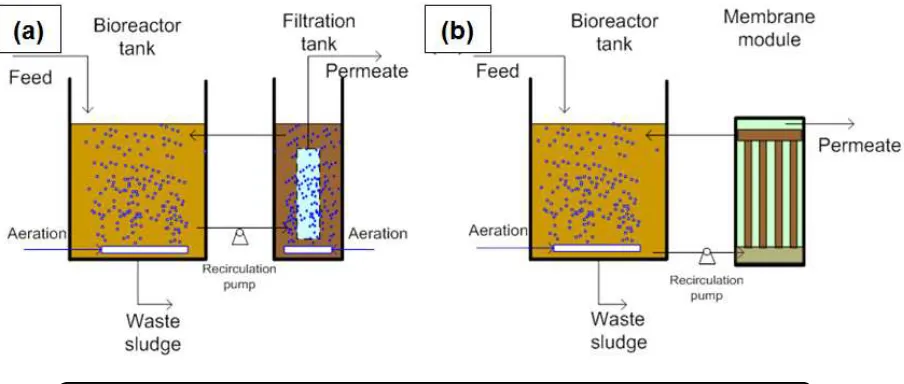
MBRs can be divided into submerged and side stream configurations depending on the way to couple the membrane module (Figure 3). In the submerged MBR, the modules are immersed in the bioreactor, and the filtration is driven by vacuum pressure. The filtration tank often separated from the bioreactor tank, in which the mixed liquor is circulated between them. Fouling is controlled by coarse air bubbles sparging, which creates a tangential flow over the membrane and induces mixing. In a side stream MBR, the modules are coupled to the bioreactor by an external sludge recirculation loop to create cross-flow velocity. Mixed liquor is pumped under pressure over the modules, and the TMP can be further increased by suction at the permeate side of the membrane. High cross-flow velocities are applied to control fouling, sometimes aided by air sparging (Le-Clech et al., 2006). Most of the commercial MBRs are configured as submerged MBR, (Judd, 2008) which will therefore be the main focus of this review.
DOI: http://dx.doi.org/10.17509/ijost.v2i1
3.2. Fouling: Definition, process and mechanism
In its strict form, fouling in MBRs is the coverage of the membrane surface (external and internal) by deposits, which adsorb, get trapped or simply accumulate, resulting in permeability loss and reflected by a increase of TMP during the operation. (Drews, 2010) This results in a typical trade-off or optimization problem: at higher flux, capex decreases while opex increases.
In more details, the MBR mixed liquor consists of biomass, variable amounts of particulates, colloidal and dissolved fractions, all of which are potential foulants (Drews, 2010; Le-Clech et al., 2006; Meng et al., 2009; Meng et al., 2010). During the initial filtration, colloids, solutes, and microbial cells, all summed up as foulants, partly pass through and precipitate on the membrane surfaces, due to convective flow of permeate. As filtration continues, the cake layer is developed, and the deposited
Figure 3. Schematic illustration of (a) a submerged MBR and (b) a side stream MBR.
DOI: http://dx.doi.org/10.17509/ijost.v2i1
p- ISSN 2528-1410 e- ISSN 2527-8045 cells multiply to form a more complex
biofilm. (Liao et al., 2004; Ramesh et al., 2006; Wang et al., 2006) However, the aggressive fouling development is limited (temporarily) by applying a physical and chemical cleaning during the operation.
Fouling can be classified based on the nature of the foulants into biofouling, organic and inorganic fouling. Biofouling refers to the deposition and growth of biomasses or flocs on the membrane surface. The process might start with the deposition of cell(s) followed by cell growth and establishment of a biofilm (Drews, 2010; Liao et al., 2004; Ramesh et al., 2007). On the other hand, organic and inorganic fouling refers to the deposition of biopolymers/organic materials and inorganics from the feed, respectively. They occur simultaneously in a very complex mechanism. Most attentions have been given to organic and biofouling due to their dominance. Only limited studies report the dominance of inorganic fouling in a submerged MBR process. (Lee & Kim, 2009)
Fouling can also be classified into internal fouling, pore blocking, and cake layer formation, depending on the location of the foulants and their impact on the The accumulation of foulants that cover the membrane surface is referred to as “cake layer". The cake layer can be comprised of cells, extracellular polymeric substances (EPS) and soluble microbial products (SMP), etc. This cake can also perform as a secondary filtration layer, normally referred to as a dynamic membrane. In this case, the cake porosity plays a more important role foulant interaction, together with foulant location, affect their removability. Based on their removability, fouling can be classified into reversible, residual, irreversible and irrecoverable fouling (Drews, 2010; Meng et al., 2009) (Figure 4). Reversible fouling can be removed by physical means (such as relaxation and/or backwash under tangential flow conditions) (Meng et al., 2009). In this type of fouling, foulants have a weak affinity to the membrane surface. The residual or irreversible fouling can only be removed by maintenance and intensive cleaning. The irrecoverable fouling is permanent fouling that cannot be removed by any means. The gradual accumulation of the irrecoverable fouling eventually determines the membrane life-time. The severely fouled membranes then have to be replaced by new ones.
3.3. Critical flux concept
Flux is one of the most important parameters in membrane filtration. Different fluxes give different fouling rates. The highest value at which no fouling occurs is called the critical flux (CF or JC) in its
strictest form. (Field et al., 1995) Beyond this flux, higher fluxes lead to more membrane fouling. Operation in this flux is however undesirable because it is too-low and thus leads a reduced productivity.
DOI: http://dx.doi.org/10.17509/ijost.v2i1
between flux and TMP ceases to appear. (Le Clech et al., 2003; van der Marel et al., 2010) A threshold value is used to express the fouling rate, because a flux below which fouling is completely absent simply does not exist. In practice, fluxes below this CF (i.e.
2/3 of CF) are selected as operational fluxes. This flux is referred to as sustainable flux or sub-critical flux (Field & Pearce, 2011). The operational flux selection is aimed to meet the economical objective of optimizing capex and opex. High operational fluxes lead to higher productivity per membrane area, thus reducing capex. On the other hand, high fluxes promote fouling, so higher opex is required to perform the cleaning cycle. Low operational fluxes increase the capex but reduce the opex.
The CF has been extensively used as a quantitative parameter for the filterability of different membranes and/or different feeds. In activated sludge filtration, the CF is generally regarded as the flux above which cake or gel formation by particles or colloids (Howell, 1995) occurs, i.e. convection of the long-term fouling rate using the term of critical flux for irreversibility (JCir). In addition, many methods were also developed to quantify the filterability, such as the Membrane Bioreactor-VITO Fouling Measurement (Huyskens et al., 2008), The
Delft Filtration Characterization method (Evenblij et al., 2005), Berlin filtration method (de la Torre et al., 2010) and the filtration index (FI). (Rosenberger & Kraume, 2002)
3.4. Fouling stages
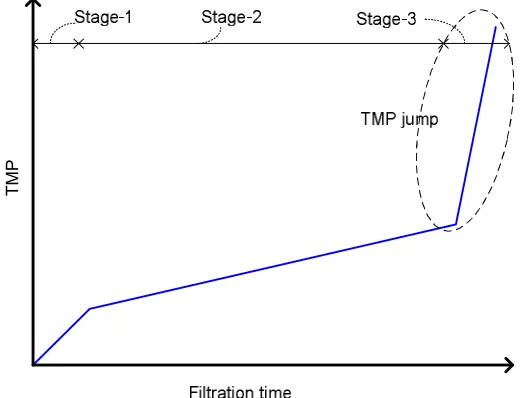
The evolution of fouling is reflected in the TMP profile during the operation. A typical TMP profile of a long-term MBR operation consists of three stages (Figure 5)
DOI: http://dx.doi.org/10.17509/ijost.v2i1
p- ISSN 2528-1410 e- ISSN 2527-8045
3.5. Fouling factors and control strategies
The factors that affect the fouling can be classified into feed properties, membrane properties and hydrodynamics. They are inter-related with each other and it is very difficult, if not impossible, to isolate an individual specific parameter to investigate its effect independently.
3.5.1. Feed
The mixed liquor properties are the end
product of combined operational
parameters, mostly from biological aspects, such as SRT, HRT, dissolved oxygen (DO), F/M ratio, and bioreactor configuration. They are also affected by environmental conditions such as temperature and feed composition. The filtration parameters, such as aeration intensity and sludge recirculation also influence the feed properties (Drews, 2010; Le-Clech et al., 2006; Meng et al., 2009). Because of the important of feed in determining membrane fouling, the selection of biological and filtration parameters in first instance is to achieve the effluent quality standard, and
then to achieve the condition that is favorable for filtration.
Biomass concentration was initially thought to control fouling rate. However, it was proven that the most dominant foulants are the slimy and sticky substances. These are grouped into the terms EPS when they are bound to the flocs or SMP when freely suspended in the supernatant (Drews, 2010;
Le-Clech et al., 2006; Meng et al., 2009). They are produced and excreted by biomass, and to a lesser extent come from the MBR influent.
Two mixed liquor components that are the main culprit of membrane fouling are EPS and SMP. EPS mainly consists of carbohydrates and proteins, and the former was found to be more dominant. In some cases, the cake resistance was found proportional to the EPS concentration (Ahmed et al., 2007; Cho et al., 2005). Therefore, both their concentration and their composition are important. However, other studies found no impact of EPS on fouling (Rosenberger & Kraume, 2002) or at least only their loosely bound components
T
M
P
DOI: http://dx.doi.org/10.17509/ijost.v2i1
to affect the fouling (Ramesh et al., 2006). On the other hand, SMP is expected to more easily accumulate on the membrane surface.
The effect of EPS and SMP and their mechanism on fouling is somehow contradictive. In order to achieve better mixed liquor filterability, extensive reviews have been given elsewhere (Drews, 2010;
Le-Clech et al., 2006; Meng et al., 2009). In general, biological parameters have to be adjusted in order to reduce the dominant fouling components, but still being capable of achieving the desired effluent quality and economical limitations (i.e., lowest capex and opex). This can also be achieved by adding a wide variety of foulant reducers, such as powdered activated carbon (Akram & Stuckey, 2008), ferric chloride (Song et al., 2008; Zhang et al., 2008), chitosan (Le Roux et al., 2005), polymeric ferric sulfate (Wu & Huang, 2008), cationic polymer (Yoon & Collins, 2006), etc. The optimum set of parameters and the most effective fouling reducer might be plant specific.
3.5.2. Membrane
Conventional wisdom generally attributes lower fouling to membranes with a smooth surface, having a low foulant affinity and being highly porous with a narrow pore size distribution. Extensive studies investigate the effect of individual membrane properties in order to formulate the ideal membrane for MBRs. However, many discrepancies are found, which limits in capturing general trends because of the diversity of experimental methods applied, varying test durations and the lack of proper membrane characterizations (Drews, 2010;
Le-Clech et al., 2006). Nevertheless, a comprehensive study on the effect of membrane properties has been reported elsewhere (van der Marel et al., 2010). They concluded that an asymmetric membrane with an interconnected pore structure,
hydrophilic properties, larger pore size and higher surface porosity favors less fouling.
To improve the membrane fouling resistance, several studies have modified membrane properties to render them more membrane surfaces, respectively (Bae et al., 2006; Bae & Tak, 2005), coating ferric hydroxide onto the membrane surfaces (Zhang et al., 2008), coating an amphiphilic graft copolymer poly(vinylidene fluoride)-graft-poly(oxyethylene) methacrylate (PVDF-application. Most literature focuses only on investigating an individual effect of membrane properties on filtration performance. Many recent studies report the performance of novel membranes as cheaper alternatives to replace the traditional phase inverted membranes, such as non-wovens (Seo et al., 2003), mesh filters (Fuchs et al., 2005; Wang et al., 2006) or nanofibers (Bilad et al., 2011). However, these new materials are still under development and to date, none of them has been used in a full-scale application. The severe fouling (due to their rough surface and too large pore sizes and wide pore size distributions) still limit their application.
3.5.3. Hydrodynamics
DOI: http://dx.doi.org/10.17509/ijost.v2i1
p- ISSN 2528-1410 e- ISSN 2527-8045 parameters to be managed (Braak et al.,
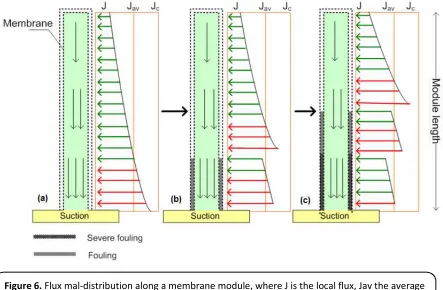
2011). Due to the nature of the module design, homogeneous hydrodynamics are very difficult to be achieved. Along the membrane module, there is an internal pressure drop: TMP is high at the start of the module (suction) where the permeate is withdrawn (Figure 6). Therefore, local-flux at this region is higher than at the other end, thus inducing fouling that eventually spreads to the other regions (Chang et al., 2002; Yoon & Collins, 2006; Yu et al., 2003). In the case of hollow fiber modules, an increase in packing density leads to a more heterogeneous permeate profile along the fiber length and also induced membrane fouling (Braak et al., 2011). Furthermore, a filtration cycle including relaxation or backwash induces a high instantaneous flux to compensate for the filtration downtime, which results in the compression of the cake layer (Metzger et al., 2007).
The role of air bubbles in submerged systems is to provide direct shear, to induce a secondary flow of liquid, and to move the membranes (in the case of hollow fibers). This approach has several disadvantages (Genkin et al., 2006). First, the shear-rates experienced by the membrane surfaces are relatively weak. This, only modest fluxes can
be used. At a certain air supply, increasing aeration rate will not further increase the cleaning effect (Genkin et al., 2006; Wu et al., 2008). Second, an elevated aeration intensity leads to breakage of sludge flocs and excess production of SMP, and under such condition, the released colloids and solutes could become the major foulants (Rosenberger & Kraume, 2002). Third, increasing the bubble flow reaches a “plateau” in terms of flux improvement and this makes the realization of a higher throughput difficult (Genkin et al., 2006). Finally, it is difficult to achieve an effective bubble distribution and a significant portion of the aeration “energy” will have only small impact. As coarse bubble aeration dominates the operational cost of MBRs, recent studies focus on optimizing this parameter.
The intensity, module configuration and arrangement, bubble size, and sludge viscosity were proven to affect the hydrodynamics (Le-Clech et al., 2006). Furthermore, improving the hydrodynamics can also be performed by applying dynamic membrane systems (Altaee et al., 2009;
DOI: http://dx.doi.org/10.17509/ijost.v2i1 4. MBR membranes
4.1. Types, materials and configurations
All types of pressure driven membranes have been used in lab-scale MBRs, but only MF and UF membranes are used so far in full-scales (Judd, 2008). The application of NF and RO in MBRs was driven by the motivation to realize a single process for direct water re-use purposes. Such membranes would also exclude internal fouling (Asatekin et al., 2006; Choi et al., 2002; Choi et al., 2005) due to their ability to retain almost everything except water. However, salts accumulated inside the bioreactor and endangered the biological processes. Furthermore, NF and RO membranes operate at very high pressure and low flux, leading to an increased pumping cost and membrane investment, respectively (Judd, 2008; Kraume et al., 2009).
The most common polymers that are used to prepare MBR membranes are
polysulfone (PSF), polyvinylidene difluoride (PVDF), polyacrylonitrile (PAN) or derivatives of polyethylene (PE) (Judd, 2008). Although all of these polymers are hydrophobic, they are mostly post-treated to become more hydrophilic (Le-Clech et al., 2006). The membrane materials should have good mechanical strength and high flexibility. This is important to prevent pore collapse and maintain the lateral movement of the fiber (for HF). They must also have good chemical resistance and must tolerate a wide pH range. This is required especially to deal with the chemical cleaning conditions, i.e.
pH> 11 for base and pH<4 for acid.
An ideal membrane module for MBRs should have a high packing density, allow a high degree of turbulence at the feed side,
facilitate cleaning and permit
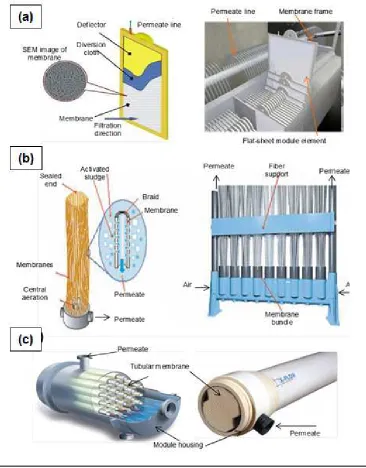
modularization (Judd, 2008; Le-Clech et al., 2006). To meet those requirements, the typical configuration of the module used in MBRs is MT, FS and HF (Figure 2). In full-scale, a variety of module configurations is
DOI: http://dx.doi.org/10.17509/ijost.v2i1
p- ISSN 2528-1410 e- ISSN 2527-8045 available and no standardization of module
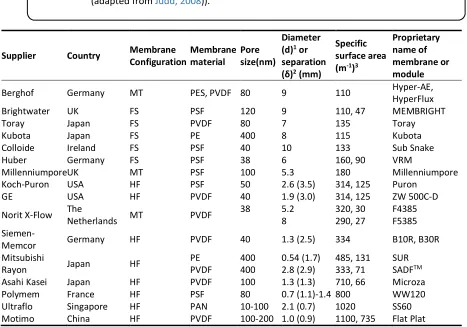
design is currently present for MBR membranes. The typical membrane product specifications from different membrane suppliers are summarized in Table 1.
4.2. Membrane characteristics
Membrane characteristics provide information about the filtration performances and the physical properties. The performance related characteristics are discussed in Section 2. The morphology-related parameters are pore size, pore size distribution, surface porosity, cross section structure, pore shape, and other physical-chemical properties such as hydrophilicity
and charge density. It is possible to relate those physical properties to the performance properties, which enables to design the most suitable membrane for a particular application.
Membrane pore size and distribution, surface porosity, hydrophilicity, roughness, materials and configuration are among the membrane characteristics that have been reported to have a direct effect on membrane fouling. (Le-Clech et al., 2006) The effect of the individual membrane characteristics, especially in relation to the membrane fouling are listed below.
Supplier Country Membrane Configuration
MillenniumporeUK MT PSF 100 5.3 180 Millenniumpore
Koch-Puron USA HF PSF 50 2.6 (3.5) 314, 125 Puron
1Diameter of hollow fiber
2Distance between two flat-sheet membranes in a module 3The membrane area divided by the volume of module
DOI: http://dx.doi.org/10.17509/ijost.v2i1
4.2.1. Pore size and distribution
The pore size mainly determines which particles or molecules are retained, and which will pass through the membrane. Pore size can refer to an absolute value where distribution can be determined from electron microscope images, using the bubble point method, or many other methods. Larger pores allow particles smaller than the pore size to clog the pore internally. A narrow pore size distribution
prevents an inhomogeneous flow
distribution between pores that would lead to preferential deposition and blockage of larger pores (Bilad et al., 2011; van der Marel et al., 2010).
4.2.2. Surface porosity
The surface porosity is defined as the fraction of the membrane surface that is occupied by pores. Together with pore size, distribution and shape, they determine the membrane permeability. It can be determined from electron microscope images of membrane surfaces using image-processing software. (AlMarzooqi et al., 2016) It also has a severe impact on fouling. Membranes with sparse surface porosity can aggravate the effect of adsorption and fouling due to a large build-up of solute near the pores. (Fane & Fell, 1987) Upon increasing surface porosity, the solute accumulation will be spread more evenly, which will also decrease the fouling.
4.2.3. Surface roughness
The effect of surface roughness on the membrane performance is unclear. Roughness not only increases the surface area, but also changes the hydrodynamics near the surface. The former increases the surface porosity, thus reducing the local flux. The latter promotes the effect of concentration polarization and fouling by enhancing the interaction with foulants through preferential accumulation of foulant materials in the valleys of the rough membrane surfaces. As a result, valleys become blocked and fouling becomes more severe. (Elimelech et al., 1997; Vrijenhoek et al., 2001)
4.2.4. Hydrophilicity and charge density
Surface hydrophilicity is normally quantified using contact angle measurement (Rana & Matsuura, 2010). It is usually assumed that fouling decreases with an increase in hydrophilicity of the membrane surface, because most foulants in water are hydrophobic. Depending on their molecular structure, membrane surfaces can contain different types of charged spots. The repulsive forces between the charged surface and the co-ions in the feed solution prevent the solute deposition on the membrane surface. Most membranes are negatively charged, considering the factor that most colloidal particles, such as EPS and SMP, are also negatively charged.
DOI: http://dx.doi.org/10.17509/ijost.v2i1
p- ISSN 2528-1410 e- ISSN 2527-8045 why in most cases, due to the hydrophobic
nature of the activated sludge in the mixed liquor, hydrophobic membranes are more prone to foul.(Rana & Matsuura, 2010) In rare cases, when the mixed liquor is dominated by hydrophilic materials, hydrophobic membranes are superior over the hydrophilic ones(Fang & Shi, 2005).
5. Dynamic Membrane Filtration
5.1. Principles and commercial dynamic filtration systems
Exposing the membrane surface to a shear is the most efficient way to control membrane fouling. (Jaffrin, 2008) Surface shear is necessary in order to reduce concentration polarization and reduce fouling phenomena such as deposition, pore blocking and cake layer formation. In principle, shear-rates can be induced by creating relative motion between membrane surface and feed liquid.
In traditional systems, shear-rate is provided by coarse bubble aeration and liquid cross flow velocity. In the cross-flow system, high shear-rates at the membrane surface are obtained by increasing the tangential fluid velocity along the membrane and reducing the tube diameter or channel thickness, which generates a large axial pressure gradient. This combination of high velocity and pressure gradient not only requires much energy to
drive the pumps, but also causes a decrease of TMP along the membrane, leading to non-optimal membrane utilization. This also occurs along the module length in dead-end filtration (Figures 6(a), (b), and (c)).
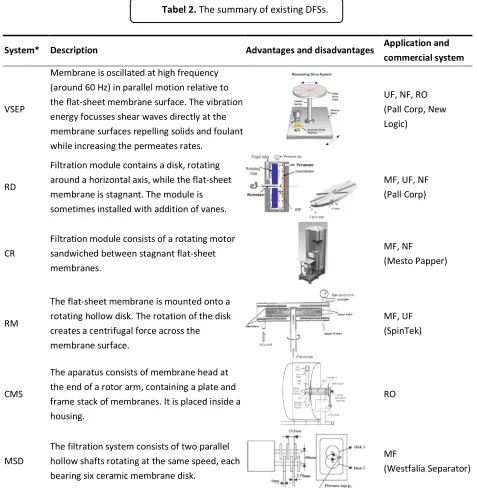
Another approach to induce surface shear-rate is by moving the membrane surfaces instead of the surrounding fluid or by moving a mass very near to the membrane surface. This type of technique is categorized as dynamic filtration systems (DFSs), also called shear-enhanced filtration. A summary of the existing DFS is given in
Table 2.
Most DFSs decouple the generation of surface shear-rate from the feed velocity, thus in theory, the mechanical energy is more efficiently directed toward the membrane surface by membrane or fluid mass movement. Therefore, ideally, these
systems offer a reduced energy
DOI: http://dx.doi.org/10.17509/ijost.v2i1
System* Description Advantages and disadvantages Application and commercial system
VSEP
Membrane is oscillated at high frequency (around 60 Hz) in parallel motion relative to the flat-sheet membrane surface. The vibration energy focusses shear waves directly at the membrane surfaces repelling solids and foulant while increasing the permeates rates.
UF, NF, RO (Pall Corp, New Logic)
RD
Filtration module contains a disk, rotating around a horizontal axis, while the flat-sheet membrane is stagnant. The module is sometimes installed with addition of vanes.
MF, UF, NF (Pall Corp)
CR
Filtration module consists of a rotating motor sandwiched between stagnant flat-sheet membranes.
MF, NF
(Mesto Papper)
RM
The flat-sheet membrane is mounted onto a rotating hollow disk. The rotation of the disk creates a centrifugal force across the membrane surface.
MF, UF (SpinTek)
CMS
The aparatus consists of membrane head at the end of a rotor arm, containing a plate and frame stack of membranes. It is placed inside a housing.
RO
MSD
The filtration system consists of two parallel hollow shafts rotating at the same speed, each bearing six ceramic membrane disk.
MF
(Westfalia Separator)
Only a limited number of reports mentions the weakness of DFS systems. General energy calculations in comparison to the conventional dead-end or the cross-flow system are scarce, making it difficult to verify the claim of energy savings during operation compared to conventional membrane filtration systems. These systems also have other drawbacks, such as apparatus complexity, high tendency of the apparatus to breakdown at the moving parts, and most systems have a very low
packing density that leads to very high costs per membrane area. (Beier et al., 2006) Currently, only relatively low numbers of existing DFS are available in the full-scale applications. However, the new generation of commercial DFSs, such as vibratory shear-enhanced processing systems (VSEP) that minimize energy consumption by using the resonance frequency, are expected to present a low specific energy per volume of permeate in a large industrial module, as the power consumption of the vibrating
DOI: http://dx.doi.org/10.17509/ijost.v2i1
p- ISSN 2528-1410 e- ISSN 2527-8045 elements is almost independent of the
membrane area. (Bilad et al., 2012b)
5.2. DFSs in MBRs
Several DFSs have also been applied in MBRs, such as the vibrating hollow fiber module (VHFM) and VSEP. The VHFM is still under development at lab-scale and only tested in short-terms. The VSEP system was only used to filter an activated sludge solution and showed a low fouling tendency (Low et al., 2009). The VHFM system was tested using a yeast solution (Beier et al., 2006; Genkin et al., 2006) and an activated sludge solution (Altaee et al., 2009) in short-term. Only the HUBER vacuum rotation membrane, Fraunhofer Rotating disk filter and Grundfos BioBooster have been commercialized in the full-scale applications. The schematic illustration or pictures of DSFs in MBRs is given in Figure 7.
5.2.1 Vibrating hollow fiber modules (VHFM)
In VHFM, the membrane module consists of hollow fiber membranes placed vertically. The skin layer is located at the outside of the fibers, thus the permeate is sucked from the outside to the inside of the fibers. The membrane modules are vibrated in a vertical motion at different frequencies (0-30 Hz) and different amplitudes (0.2-4 cm) (Altaee et al., 2009; Beier et al., 2006;
Genkin et al., 2006). This type of DFS has recently been applied in the lab-scale submerged MBRs. The surface shear rate can periodically be changed and significant improvement of the CF achieved by this system. These improvements were even
higher in addition of coagulants and additional vanes (Genkin et al., 2006). The oscillation of the membrane in a VHFM system can also be performed in the transverse direction, which is also proven to maintain a good performance (Kola et al., 2012; Kola et al., 2014).
5.2.2 HUBER vacuum rotation membrane
The HUBER vacuum rotation membrane is commercialized under the trade mark of VRM® Bioreactor, and is basically a
DOI: http://dx.doi.org/10.17509/ijost.v2i1
4.2.4. Fraunhofer rotating disk filter
Fraunhofer IGB (Germany) developed a rotating disk filter that has also been implemented in decentralized wastewater treatment plants. It is claimed to have the capability of achieving filtration at high flux with a minimum maintenance and low energy consumption. It is composed of a cylindrical housing, containing a stack of ceramic membrane disks on a rotating hollow shaft. The membrane module is placed inside an enclosed pressurized tank of 0.2-1.5 bar. The permeate passes through the separation layer on the membrane disk outside-in and is drawn off via the hollow
shaft. The foulants are removed from the membrane surface by means of the centrifugal force field created. This enables the laminar particle layer – adhering on the filter disk and thereby rotating together with the disks – to flow off. Thus, the particle layer is continuously renewed. This
technology is manufactured and
commercialized and has been implemented on a large scale for the first time in Heidelberg-Neurott in 2005. Another filtration plant is installed for sludge digestion of the wastewater treatment plant of Tauberbischofsheim.
DOI: http://dx.doi.org/10.17509/ijost.v2i1
p- ISSN 2528-1410 e- ISSN 2527-8045
6. CHALLENGES FOR FUTURE MBR RESEARCH
6.1. Dynamic Behavior, Interdisciplinary Field and Multi-Inter-Relationship Parameters
As MBRs involve many different fields, MBR research attracts many research groups from many different disciplines. It results in an outstanding number of publications regarding this topic. State-of-the-art characterization techniques have also been implemented to cover many different aspects, such as morphological visualization, componential characterization, and microbiological identification. (Meng et al., 2010)
It has been discussed earlier that general trends are often hard to catch within the MBRs studies. In the MBR, biological suspensions are characterized by their dynamic behavior and constant changes. The physical and physiological conditions of the biological suspension change in response to the change in environmental conditions. The MBR studies do not only involve the biology, but also chemical and physical aspects. Moreover, no standardization exists in MBRs, allowing a wide variety of different configurations at both full- and lab-scale studies (Drews, 2010). For instance, lab-scale tests are mostly performed in a relatively short period, with a constant synthetic feed composition and temperature, while this is more fluctuating at a full-scale (Kraume et al., 2009). It leads to different characteristics of the mixed liquor, different microbial communities, different levels of SMP concentrations, and different fouling propensity (van der Gast et al., 2006), thus not allowing a fair comparison of both scales. The lab-scale set-up also has a much higher energy input that might lead to more exposure of the activated sludge to shear (Drews, 2010).
6.2. Energy consumption and cost considerations
Both capex and opex for MBRs are still higher than for conventional activated sludge and will remain higher unless possibility of permeate reuse is counted (Judd, 2008). In general, this is associated with the occurrence of membrane fouling which has been discussed widely throughout literature (Braak et al., 2011). Most MBR studies aim at developing or inventing the strategies to control fouling in lab-scale set-ups, or at optimizing the system in full-scale to minimize the costs associated with the coarse bubble aeration which varies from 30-50% of opex (Judd, 2008).
6.3. Research perspectives
DOI: http://dx.doi.org/10.17509/ijost.v2i1
7. ACKNOWLEDGEMENTS
Authors acknowledged Universiti Teknologi PETRONAS for providing facilities for conducting the research activities.
8. AUTHORS’ NOTE
The author(s) declare(s) that there is no conflict of interest regarding the publication of this article. Authors confirmed that the data and the paper are free of plagiarism.
9. REFERENCES
Ahmed, Z., Cho, J., Lim, B. R., Song, K. G., & Ahn, K. H. (2007). Effects of sludge retention time on membrane fouling and microbial community structure in a membrane
bioreactor. Journal of membrane science, 287(2), 211-218.
Akram, A., & Stuckey, D. C. (2008). Flux and performance improvement in a submerged
anaerobic membrane bioreactor (SAMBR) using powdered activated carbon (PAC).
Process biochemistry, 43(1), 93-102.
AlMarzooqi, F. A., Bilad, M. R., Mansoor, B., & Arafat, H. A. (2016). A comparative study of image analysis and porometry techniques for characterization of porous membranes.
Journal of materials science, 51(4), 2017-2032.
Altaee, A., Al-Rawajfeh, A. E., & Baek, Y. J. (2009). Application of vibratory system to improve the critical flux in submerged hollow fiber MF process. Separation science
and technology, 45(1), 28-34.
Asatekin, A., Menniti, A., Kang, S., Elimelech, M., Morgenroth, E., & Mayes, A. M. (2006).
Antifouling nanofiltration membranes for membrane bioreactors from self-assembling graft copolymers. Journal of membrane science, 285(1), 81-89.
Bae, T. H., Kim, I. C., & Tak, T. M. (2006). Preparation and characterization of fouling-resistant TiO2 self-assembled nanocomposite membranes. Journal of membrane
science, 275(1), 1-5.
Bae, T. H., & Tak, T. M. (2005). Preparation of TiO2 self-assembled polymeric nanocomposite membranes and examination of their fouling mitigation effects in a membrane
bioreactor system. Journal of membrane science, 266(1), 1-5.
Beier, S. P., Guerra, M., Garde, A., & Jonsson, G. (2006). Dynamic microfiltration with a
vibrating hollow fiber membrane module: filtration of yeast suspensions. Journal of
membrane science, 281(1), 281-287.
DOI: http://dx.doi.org/10.17509/ijost.v2i1
p- ISSN 2528-1410 e- ISSN 2527-8045
Bilad, M. R., Marbelia, L., Laine, C., & Vankelecom, I. F. (2015). A PVC–silica mixed-matrix
membrane (MMM) as novel type of membrane bioreactor (MBR) membrane. Journal
of membrane science, 493, 19-27.
Bilad, M. R., Mezohegyi, G., Declerck, P., & Vankelecom, I. F. (2012a). Novel magnetically induced membrane vibration (MMV) for fouling control in membrane bioreactors.
Water research, 46(1), 63-72.
Bilad, M. R., Mezohegyi, G., Declerck, P., & Vankelecom, I. F. (2012b). Novel magnetically
induced membrane vibration (MMV) for fouling control in membrane bioreactors.
Water research, 46(1), 63-72.
Bilad, M. R., Westbroek, P., & Vankelecom, I. F. (2011). Assessment and optimization of electrospun nanofiber-membranes in a membrane bioreactor (MBR). Journal of
membrane science, 380(1), 181-191.
Bilad, M. R. (2016). Module-Scale Simulation of Forward Osmosis Module-Part A:
Plate-and-Frame. Indonesian journal of science and technology, 1(2), 249-261.
Braak, E., Alliet, M., Schetrite, S., & Albasi, C. (2011). Aeration and hydrodynamics in submerged membrane bioreactors. Journal of membrane science, 379(1), 1-18.
Chang, S., Fane, A. G., & Vigneswaran, S. (2002). Modeling and optimizing submerged hollow fiber membrane modules. AIChE journal, 48(10), 2203-2212.
Chen, L., Gu, Y., Cao, C., Zhang, J., Ng, J. W., & Tang, C. (2014). Performance of a submerged anaerobic membrane bioreactor with forward osmosis membrane for low-strength
wastewater treatment. Water research, 50, 114-123.
Cho, B. D., & Fane, A. G. (2002). Fouling transients in nominally sub-critical flux operation of
a membrane bioreactor. Journal of membrane science, 209(2), 391-403.
Cho, J., Song, K. G., Yun, H., Ahn, K. H., Kim, J. Y., & Chung, T. H. (2005). Quantitative analysis
of biological effect on membrane fouling in submerged membrane bioreactor. Water
science and technology, 51(6-7), 9-18.
Choi, J. H., Dockko, S., Fukushi, K., & Yamamoto, K. (2002). A novel application of a submerged nanofiltration membrane bioreactor (NF MBR) for wastewater treatment. Desalination, 146(1-3), 413-420.
Choi, J. H., Fukushi, K., & Yamamoto, K. (2005). Comparison of treatment efficiency of submerged nanofiltration membrane bioreactors using cellulose triacetate and
de la Torre, T., Mottschall, M., Lesjean, B., Drews, A., Iheanaetu, A., & Kraume, M. (2010). Filterability assessment in membrane bioreactors using an in-situ filtration test cell.
Water science and technology, 61(11), 2809-2816.
Drews, A. (2010). Membrane fouling in membrane bioreactors—characterisation,
contradictions, cause and cures. Journal of membrane science, 363(1), 1-28.
Elimelech, M., Zhu, X., Childress, A. E., & Hong, S. (1997). Role of membrane surface morphology in colloidal fouling of cellulose acetate and composite aromatic polyamide reverse osmosis membranes. Journal of membrane science, 127(1),
101-109.
Evenblij, H., Geilvoet, S., Van der Graaf, J. H. J. M., & Van der Roest, H. F. (2005). Filtration characterisation for assessing MBR performance: three cases compared.
Desalination, 178(1-3), 115-124.
Fane, A. G. (2011). Membranes and the water cycle: challenges and opportunities. Applied water science, 1(1-2), 3-9.
Fane, A. G., & Fell, C. J. D. (1987). A review of fouling and fouling control in ultrafiltration.
Desalination, 62, 117-136.
Fang, H. H., & Shi, X. (2005). Pore fouling of microfiltration membranes by activated sludge.
Journal of membrane science, 264(1), 161-166.
Field, R. W., & Pearce, G. K. (2011). Critical, sustainable and threshold fluxes for membrane
filtration with water industry applications. Advances in colloid and interface science,
164(1), 38-44.
Field, R. W., Wu, D., Howell, J. A., & Gupta, B. B. (1995). Critical flux concept for microfiltration fouling. Journal of membrane science, 100(3), 259-272.
Fuchs, W., Resch, C., Kernstock, M., Mayer, M., Schoeberl, P., & Braun, R. (2005). Influence of operational conditions on the performance of a mesh filter activated sludge
process. Water research, 39(5), 803-810.
Gao, F., Li, C., Yang, Z. H., Zeng, G. M., Feng, L. J., Liu, J. Z., & Cai, H. W. (2016). Continuous
microalgae cultivation in aquaculture wastewater by a membrane photobioreactor for biomass production and nutrients removal. Ecological engineering, 92, 55-61.
Genkin, G., Waite, T. D., Fane, A. G., & Chang, S. (2006). The effect of vibration and coagulant addition on the filtration performance of submerged hollow fibre membranes. Journal of membrane science, 281(1), 726-734.
Howell, J. A. (1995). Sub-critical flux operation of microfiltration. Journal of membrane
DOI: http://dx.doi.org/10.17509/ijost.v2i1
p- ISSN 2528-1410 e- ISSN 2527-8045
Huyskens, C., Brauns, E., Van Hoof, E., & De Wever, H. (2008). A new method for the
evaluation of the reversible and irreversible fouling propensity of MBR mixed liquor.
Journal of membrane science, 323(1), 185-192.
Hwang, B. K., Lee, W. N., Park, P. K., Lee, C. H., & Chang, I. S. (2007). Effect of membrane fouling reducer on cake structure and membrane permeability in membrane
bioreactor. Journal of membrane science, 288(1), 149-156.
Jaffrin, M. Y. (2008). Dynamic shear-enhanced membrane filtration: a review of rotating
disks, rotating membranes and vibrating systems. Journal of membrane science,
324(1), 7-25.
Judd, S. (2008). The status of membrane bioreactor technology. Trends in biotechnology,
26(2), 109-116.
Kharraz, J. A., Bilad, M. R., & Arafat, H. A. (2015). Simple and effective corrugation of PVDF membranes for enhanced MBR performance. Journal of membrane science, 475,
91-100.
Kola, A., Ye, Y., Ho, A., Le-Clech, P., & Chen, V. (2012). Application of low frequency transverse vibration on fouling limitation in submerged hollow fibre membranes.
Journal of membrane science, 409, 54-65.
Kola, A., Ye, Y., Le-Clech, P., & Chen, V. (2014). Transverse vibration as novel membrane
fouling mitigation strategy in anaerobic membrane bioreactor applications. Journal
of membrane science, 455, 320-329.
Komesli, O. T., Teschner, K., Hegemann, W., & Gokcay, C. F. (2007). Vacuum membrane applications in domestic wastewater reuse. Desalination, 215(1-3), 22-28.
Kraume, M., Wedi, D., Schaller, J., Iversen, V., & Drews, A. (2009). Fouling in MBR: What use are lab investigations for full scale operation?. Desalination, 236(1-3), 94-103.
Le Clech, P., Jefferson, B., Chang, I. S., & Judd, S. J. (2003). Critical flux determination by the flux-step method in a submerged membrane bioreactor. Journal of membrane
science, 227(1), 81-93.
Le-Clech, P., Chen, V., & Fane, T. A. (2006). Fouling in membrane bioreactors used in wastewater treatment. Journal of membrane science, 284(1), 17-53.
Lee, M., & Kim, J. (2009). Membrane autopsy to investigate CaCO3 scale formation in pilot‐ scale, submerged membrane bioreactor treating calcium‐rich wastewater. Journal of
Le Roux, I., Krieg, H. M., Yeates, C. A., & Breytenbach, J. C. (2005). Use of chitosan as an antifouling agent in a membrane bioreactor. Journal of membrane science, 248(1),
127-136.
Liao, B. Q., Bagley, D. M., Kraemer, H. E., Leppard, G. G., & Liss, S. N. (2004). A review of
biofouling and its control in membrane separation bioreactors. Water environment
research, 76(5), 425-436.
Low, S. C., Cheong, K. T., & Lim, H. L. (2009). A vibration membrane bioreactor. Desalination
and Water Treatment, 5(1-3), 42-47.
Marbelia, L., Bilad, M. R., Bertels, N., Laine, C., & Vankelecom, I. F. (2016). Ribbed PVC–silica mixed matrix membranes for membrane bioreactors. Journal of membrane science,
498, 315-323.
Marbelia, L., Bilad, M. R., Passaris, I., Discart, V., Vandamme, D., Beuckels, A., Muylaert, K. &
Vankelecom, I. F. (2014). Membrane photobioreactors for integrated microalgae cultivation and nutrient remediation of membrane bioreactors effluent. Bioresource
technology, 163, 228-235.
Melvin, S. D., & Leusch, F. D. (2016). Removal of trace organic contaminants from domestic wastewater: A meta-analysis comparison of sewage treatment technologies.
Environment international, 92, 183-188.
Meng, F., Chae, S. R., Drews, A., Kraume, M., Shin, H. S., & Yang, F. (2009). Recent advances
in membrane bioreactors (MBRs): membrane fouling and membrane material. Water
research, 43(6), 1489-1512.
Meng, F., Liao, B., Liang, S., Yang, F., Zhang, H., & Song, L. (2010). Morphological visualization, componential characterization and microbiological identification of
membrane fouling in membrane bioreactors (MBRs). Journal of membrane science,
361(1), 1-14.
Metzger, U., Le-Clech, P., Stuetz, R. M., Frimmel, F. H., & Chen, V. (2007). Characterisation of
polymeric fouling in membrane bioreactors and the effect of different filtration modes. Journal of membrane science, 301(1), 180-189.
Prasertkulsak, S., Chiemchaisri, C., Chiemchaisri, W., Itonaga, T., & Yamamoto, K. (2016). Removals of pharmaceutical compounds from hospital wastewater in membrane
bioreactor operated under short hydraulic retention time. Chemosphere, 150, 624-631.
Ramesh, A., Lee, D. J., & Lai, J. Y. (2007). Membrane biofouling by extracellular polymeric
substances or soluble microbial products from membrane bioreactor sludge. Applied
DOI: http://dx.doi.org/10.17509/ijost.v2i1
p- ISSN 2528-1410 e- ISSN 2527-8045
Ramesh, A., Lee, D. J., Wang, M. L., Hsu, J. P., Juang, R. S., Hwang, K. J., Liu, J.C., & Tseng, S. J.
(2006). Biofouling in membrane bioreactor. Separation science and technology,
41(7), 1345-1370.
Rana, D., & Matsuura, T. (2010). Surface modifications for antifouling membranes. Chemical
reviews, 110(4), 2448-2471.
Ratkovich, N., Chan, C. C. V., Bentzen, T. R., & Rasmussen, M. R. (2012). Experimental and CFD simulation studies of wall shear stress for different impeller configurations and
MBR activated sludge. Water science and technology, 65(11), 2061-2070.
Ren, L., Ahn, Y., & Logan, B. E. (2014). A two-stage microbial fuel cell and anaerobic fluidized
bed membrane bioreactor (MFC-AFMBR) system for effective domestic wastewater treatment. Environmental science and technology, 48(7), 4199-4206.
Rosenberger, S., & Kraume, M. (2002). Filterability of activated sludge in membrane bioreactors. Desalination, 146(1), 373-379.
Seo, G. T., Moon, B. H., Lee, T. S., Lim, T. J., & Kim, I. S. (2003). Non-woven fabric filter separation activated sludge reactor for domestic wastewater reclamation. Water
science and technology, 47(1), 133-138.
Shannon, M. A., Bohn, P. W., Elimelech, M., Georgiadis, J. G., Marinas, B. J., & Mayes, A. M. (2008). Science and technology for water purification in the coming decades. Nature,
452(7185), 301-310.
Song, K. G., Kim, Y., & Ahn, K. H. (2008). Effect of coagulant addition on membrane fouling
and nutrient removal in a submerged membrane bioreactor. Desalination, 221(1-3), 467-474.
Su, X., Tian, Y., Sun, Z., Lu, Y., & Li, Z. (2013). Performance of a combined system of microbial fuel cell and membrane bioreactor: wastewater treatment, sludge reduction, energy recovery and membrane fouling. Biosensors and bioelectronics, 49, 92-98.
van der Gast, C. J., Jefferson, B., Reid, E., Robinson, T., Bailey, M. J., Judd, S. J., & Thompson, I. P. (2006). Bacterial diversity is determined by volume in membrane bioreactors.
Environmental microbiology, 8(6), 1048-1055.
van der Marel, P., Zwijnenburg, A., Kemperman, A., Wessling, M., Temmink, H., & van der
Meer, W. (2010). Influence of membrane properties on fouling in submerged membrane bioreactors. Journal of membrane science, 348(1), 66-74.
the critical flux for irreversibility in a membrane bioreactor. Journal of membrane
science, 332(1), 24-29.
Vrijenhoek, E. M., Hong, S., & Elimelech, M. (2001). Influence of membrane surface properties on initial rate of colloidal fouling of reverse osmosis and nanofiltration
membranes. Journal of membrane science, 188(1), 115-128.
Wang, W., Jung, Y. J., Kiso, Y., Yamada, T., & Min, K. S. (2006). Excess sludge reduction performance of an aerobic SBR process equipped with a submerged mesh filter unit.
Process biochemistry, 41(4), 745-751.
Wang, X., Chang, V. W., & Tang, C. Y. (2016). Osmotic membrane bioreactor (OMBR) technology for wastewater treatment and reclamation: Advances, challenges, and prospects for the future. Journal of membrane science, 504, 113-132.
Wu, J., & Huang, X. (2008). Effect of dosing polymeric ferric sulfate on fouling
characteristics, mixed liquor properties and performance in a long-term running membrane bioreactor. Separation and purification technology, 63(1), 45-52.
Wu, Z., Wang, Z., Huang, S., Mai, S., Yang, C., Wang, X., & Zhou, Z. (2008). Effects of various factors on critical flux in submerged membrane bioreactors for municipal wastewater treatment. Separation and purification technology, 62(1), 56-63.
Yoon, S. H., & Collins, J. H. (2006). A novel flux enhancing method for membrane bioreactor (MBR) process using polymer. Desalination, 191(1-3), 52-61.
Yu, K., Wen, X., Bu, Q., & Xia, H. (2003). Critical flux enhancements with air sparging in axial hollow fibers cross-flow microfiltration of biologically treated wastewater. Journal of
membrane science, 224(1), 69-79.
Yu, H. Y., Xu, Z. K., Lei, H., Hu, M. X., & Yang, Q. (2007). Photoinduced graft polymerization of
acrylamide on polypropylene microporous membranes for the improvement of antifouling characteristics in a submerged membrane-bioreactor. Separation and
purification technology, 53(1), 119-125.
Zhang, H. F., Sun, B. S., Zhao, X. H., & Gao, Z. H. (2008). Effect of ferric chloride on fouling in membrane bioreactor. Separation and purification technology, 63(2), 341-347.
Zhang, J., Chua, H. C., Zhou, J., & Fane, A. G. (2006). Factors affecting the membrane performance in submerged membrane bioreactors. Journal of membrane science,