International Seminar Biotechnology OII / 1 XYLANASE FROM Xylanolytic Bacteria INDUCED
BY UTILIZING VINASSE WASTES
KAHAR MUZAKHAR
Department of Biology, Faculty of Mathematics and Natural Sciences, the University of Jember
Address: Jl. Kalimantan 37 Jember 68121 Indonesia, Email:[email protected]
ABSTRACT
The production of xylanase by using vinasse waste as carbon source was studied. Isolate MK-20, identified as xylanolytic bacteria can grow aerobically on vinasse without any nutrients added. During the cultivation, this isolate released xylanase and capable produced xylose from hydrolization of oat spelt xylan. The optimum for xylanase production was obtained after 3 days cultivation at 300C. The enzyme was purified and characterized to have molecular weight of 88.2 KDa, respectively. The enzyme stable in pH 4-8 and temperature below 550C while optimum activity at pH 5 and temperature 500C.
Keywords: xylanase, xylanolytic bacteria, vinasse
INTRODUCTION
International Seminar Biotechnology OII / 2 The bacteria and other microbes have therefore attracted considerable attention as sources
of xylan degrading enzyme. Up to now, there have been many studies of xylanase but only a few studies of the production by utilizing raw material of agriculture wastes. A huge material wastes vinasse was released during ethanol production from molase. This material rich in organic substance including hemicelluloses fiber. In this works, the production of xylanase by utilizing vinasse is expected to be an effective strategy to minimize environmental problem of wastes.
MATERIAL AND METHODE Sampling and screening of isolates
Ten grams of sample soil from 5 polluted locations by vinasse at PT. PASA Ethanol Industry Jatiroto Indonesia were sampled and suspended to 0.9% of NaCl solution 100 ml in Erlenmeyer flask. The samples were diluted 10-2 to 10-8 from initial concentration. For screening, one hundred micro liters of each diluted sample was plated to NA medium and incubated for 48 hours at 300C. This step was repeated until getting the single colony of some different type of microorganisms. Twenty four isolates of bacteria were successfully screened. All isolates were further pre-culture in the same medium for 24 hours at 300C. Optimization of xylanase production
The xylanase production was optimized by cultivation of pre-culture xylanolytic bacteria MK-20 in 100 ml vinasse. Under sterile condition, 1 ml of culture was harvested everyday and the xylanase activity was measured to obtain optimum cultivation.
Enzyme assay
The xylanase activity was determined by measuring of reducing sugar released using the method of Nelson [6] as modified by Somogy Nelson [7]. For this measurement, 1% xylan on 50 mM buffers was used as substrate.
Gas chromatograph analysis of xylose production
International Seminar Biotechnology OII / 3 modification. The sample was hydrolyzed with 2N HCL for 6 hours, reduced with equal
amount of NaBH4 at room temperature overnight and then a batch of Dowex resin H type was added to the mixture followed by filtration. The filtrate was evaporated to dryness and residual boric acid was removed by repeated evaporation with methanol. The sugar alcohol was acetylated in 2 ml of acetic acid anhydride:pyridine (1:1) at 1000C for 10 min. The mixture was diluted with chloroform:water (1:4), shaken well and the supernatant removed by centrifugation at 2000 rpm for 10 minutes. Remaining pyridine was removed by washing with water by removal of aqueous phase after centrifugation. The alditol acetates of sugar was dried and dissolved in chloroform to an appropriate volume. The GC analysis was performed on stainless column, 2mm I.D.1.83 m, packed with 3%(w/w) ECNSS-M on Gas Chrom Q, 100-120 Mesh. The initial column temperature was 1900C for 5 minutes and then using gradient up to 2100C at 10C/min.
Effects of pH and temperature on the enzyme activity and stability
Analyzing the stability of the xylanase at different pH values, the purified enzyme was incubated at 37°C in 30 mM buffers Na-acetate, pH 3 to 5; Na-citrate, pH 6 to 6.5; and Tris/HCl, pH 7 to 9. The remaining activity of each sample was measured after 30 min of incubation. For measuring its thermal stability, the purified xylanase was incubated in 30 mM Na-acetate, pH 5, for 30 min, at 25 to 700C. Remaining activity was measured after 30 min of incubation. The effects of pH and temperature on the optimum activity of enzyme were also measured in series pH and temperature range as mentioned above, using 1% substrate with 10 minutes incubation at 370C.
Purification of enzymes
All purification steps were carried out at room temperature using 20 mM acetate buffer pH 5. Detail of this experiment was described under result and discussion.
Molecular weight analysis
International Seminar Biotechnology OII / 4 standards. Proteins Standard (KDa) used were Phosphorylase (97,4), Albumin (66,3),
Aldolase (42,4), Carbonic anhydrase (30) and Trypsin inhibitor (20,1). Gel was stained with Coomassie Brillant Blue.
RESULTS AND DISCUSSION
Among 24 isolates, bacteria identified as MK-20 can grow well on vinasse as carbon source although no other substances were added. This bacteria secreted an extracellular xylanase enzyme when aerobically cultivation was done under 300C 120 rpm. The optimum cultivation was achieved in 3-4 days incubation (Figure
Figure 1. Aerobic cultivation of MK-20 using vinasse as carbon and nitrogen source at
300C 120rpm. Optimum cultivation was achieved at 3 days cultivation.
International Seminar Biotechnology OII / 5 Further analysis for xylanolityc activity, MK-20 was tested using a xylan solid medium.
Five microlitres of overnight grown culture of MK-20 was spot plated on xylan agar (0.2% NaNO3, 0.1% K2HPO4, 0.05% MgSO4, 0.05% KCl, 0.2% oat spelt xylan, 0.02% peptone, 1.7% agar, adjusted to pH 7) and incubated at 300C. After 72 hours incubation, the medium plate was then flooded with Gram’s iodine (2.0 gKI and 1.0 g iodine in 300 ml de-ionized water) within 3 to 5 minutes [10]. It is shown in Figure 2., clear zone within colony indicated that MK-20 released xylanase and actively hydrolysed xylan medium during cultivation, respectively.
Figure 2. MK-20 was spot plated on xylan agar (0.2% NaNO3, 0.1% K2HPO4, 0.05% MgSO4, 0.05% KCl, 0.2% oat spelt xylan, 0.02% peptone, 1.7% agar, adjusted to pH 7) and incubated at 300C for 72 hours. The clear zone within colony (A) indicated the hydrolysis of xylan occurred while at control (B) no hydrolysis activity was detected. Crude xylanase obtained from optimum cultivation was collected and purified. For the first step, the crude enzyme was brought to 60% of saturated ammonium sulfate, precipitated
by centrifugation at 12000 rpm for 20 minutes, and followed by dialysis on cellulose tube (10KDa pores) using 20 mM acetate buffer at pH 5 to remove remaining ammonium sulfate. After dialysis, the concentrated enzyme was loaded onto open column containing DEAE cellulose pre-equlibrated with the same buffer. For the fractionation, the column was eluted using same buffer with the gradient 0-0.5 M NaCl. The active fractions were pooled, reloaded onto DEAE Q-Sepharose and eluted with the same gradient NaCl.
International Seminar Biotechnology OII / 6 Finally, a size exclusion chromatography Sephadex G-100 was used to obtain purified
xylanase, resulting in 11% yield and 898 folds. The result of purification was summarized at Table 1 as follow.
Table 1. Purification of xylanase
Purification step
Total ABS-280
Total Activity (unit)
Specific Activity
Yield
(%) Fold
Ammonium sulfate
Precipitation 79,400 2,300 0 100 1
DEAE Cellulose 3,200 2,110 1 92 23
DEAE Q Sepharose 134 1,268 9 55 327
DEAE Sephadex G-100 9 234 26 11 898
The effect of temperature and pH on the optimum activity and stability were examined. The optimum activity for this enzyme was found at temperature 500C and stability below 550C. The optimum pH for activity for this enzyme was found at pH 5. The enzyme showed 95% activity in the pH range from 4 to 8.
0
Retention time
A B
Xylose
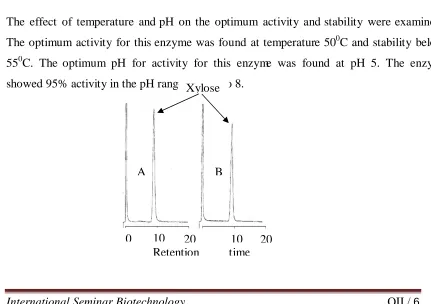
International Seminar Biotechnology OII / 7 Figure 3. GC analysis of standard xylose (A) as control and hyrolyzate (B) after 120 min.
incubation
To affirm this xylanase attacked the xylan and produced xylose, qualitatively and quantively analysis using GC was used. For this purpose, 20 ml of mixtures containing 20 units of xylanase and 1% oat spelt xylan were incubated under optimum temperature and pH for 4 hours. Every 30 minutes of 1 ml of hydrolyzates was sampled and the sugar directly converted to alditol acetate form using method as mentioned at material and method. The acetylated samples were then injected to GC for analysis. Pure xylose was used as standard. We found that the xylan from oat spelt was readily hydrolyzed by xylanase and released xylose (Figure 3). In a period 30 min to 60 min incubation, the hydrolization was exponentially occurred and GC analysis revealed of hydrolysis products are 32 and 64mg/ml of xylose produced. After 90 to 120 min incubation, the production of monosaccharide as reducing sugar xylose still increased 72 and 84mg/ml. However, after 180 to 240 min incubation, only 86 and 87mg/ml of xylose were produced. Suggested the hydrolysis was optimum in 120 min incubation where about 85% of xylan was hydrolysed.
Figure 4. SDS-PAGE of the purified xylanase. Lane 1 is protein standards (KDa) and lane
2 is purified xylanase.
88.2 97.4
66.3
42.4
30
International Seminar Biotechnology OII / 8 Molecular weight of the enzyme was estimated by SDS-PAGE. This xylanase was 88.2
KDa approximately
CONCLUSION
Inducible of xylanase from isolate MK-20 xylanolytic bacteria was done successfully by employing vinasse only as carbon and nitrogen source. The enzyme was purified with 11% yield and 898 folds purification. The enzyme was purified and characterized to have molecular weight of 88.2 KDa, respectively. The enzyme stable in pH 4-8 and temperature below 550C while optimum activity at pH 5 and temperature 500C.
REFERENCES
Gessesse, A., 1998. Purification and Properties of Two Thermostable Alkaline Xylanase from an Alkaliphilic Bacillus sp. App. Envi. Microbiol., 64: 3533-3535.
Muzakhar, K., Hayashi H., Kawaguchi, T., Sumitani, J. and Arai, M., (1998). Purification and properties of -Larabinofuranosidase and endo--D-1,4-galactanase from Aspergillus niger van Tieghem KF-267 which Liquefied the Okara Proceed. MIE BIOFORUM 98 Genetics, Biochemistry and Ecology of Cellulose Degradation, K. Ohmiya et al. (ed.), Uni Publisher Co., LTD. Tokyo Japan.
Blanco, P., Sieiro, C., and Villa, T. G., 1999. Production of pectic enzyme in yeast. FEMS Microbiol. Letters, 175:1-9.
Muzakhar K., Kawaguchi T., Sumitani J., Ogura, S., and Arai, M., 1999. Enzymatic hydrolysis of sugar rich okara and utilization of the hydrolyzates for single cell protein and ethanol production. Appl. Biol. Sci., 5, 13-29.
Gessesse, A., 1998. Purification and Properties of Two Thermostable Alkaline Xylanase from an Alkaliphilic Bacillus sp. App. Envi. Microbiol., 64: 3533-3535.
International Seminar Biotechnology OII / 9 Somogy, M. 1952. Notes on sugar determination. J. Biol. Chem. 195: 19-23.
Arai, M., and S. Murao. 1978. Characterization of Oligosaccharides from an Enzymatic Hydrolyzate of red yeast cell walls by lytic enzyme. Agric. Biol. Chem. 42:1651-1659. Hondmann, Dirk H. A. and J. Visser. 1994. Carbon metabolism. p. 61-139. In S.D. Martinelli and J. R. Kinghorn (ed.), Aspergillus: 50 years on. Elsevier, Amsterdam – Lausanne - New York – Oxford – Shannon – Tokyo.
Ramesh Chand Kasana, Richa Salwan, Hena Dhar, Som Dutt and Arvind Gulati. 2008. A Rapid and Easy Method for the Detection of Microbial Cellulases on Agar Plates Using Gram’s Iodine. Curr Microbiol. 57:503–507.