ROLE OF RELIGION MOTIVES AND BRAND IMAGE TOWARDS CONSUMER SATISFACTION AND CONSUMER
LOYALTY OF ISLAMIC BANKING
Risca Fitri Ayuni Ananda Sabil Hussein
Radityo Handrito
Universitas Brawijaya, Indonesia
Abstract:
Islamic/ sharia labelling on every product have mass impact on consumer behavior on consumption. Shari’ label originally created to capture niche segment who very concern on islamic value of banking. In fact, non-moslem also interested and become loyal consumer on those product. This study address to answer what is role of religion motibes and brand image through satisfaction and loyalty in banking industry. Study found that religion motives (sharia principles) impacts brand image and plays significant role on determining consumer satisfaction and loyalty.
INTRODUCTION
Riba/ usury is forbidden in Islamic economic jurisprudence. Nevertheless the conventional banking system cannot be separated from this usury concept. Since there are many banks practice usury, the Moslem society starts to worry that this practice will inflict them.
The increasing demand on usury-free banking system leads to the establishment of sharia banking system. Moreover, sharia banks exist due to Moslems demand on Kaffah, which is banking operating activities based on the sharia, particularly focusing on the matters forbidden in Islamic economic jurisprudence such as riba/usury, maisyir (gambling and high speculation), gharar (unsure uncertainty), jahalaand the requirement to ensure the halalness of the way and object of investment. The activity of sharia bank differs from conventional bank in term of product pricing. The product pricing in sharia bank is based on the agreement between the bank and the customer as well as the type of deposit and the length of time, which later determine he amount of shared profit given to the customers. History records that sharia banks appeared in Indonesia in early 1990s. The founding fathers of sharia bank was Indonesian Ulema Council (MUI) on 18 – 20 august 1990. The first sharia Bank in Indonesia was Bank Muamalat Indonesia (BMI) established since 1 may 1992.Sudarsono (2003) explains thatsharia bank is commonly defined as financial institution providing loans and other service related to financial transaction and money circulation on the base of sharia principles. Therefore, these banks will always deal with finance, which is their main commodity.
Perwataatmadjaand Antonio (1999) suggest thatsharia banking, also commonly known as Islamic banking, has operation system, which does not rely on interest. This institution is recognized as the financial institutionwhich the operation and product are developed based on Quran and Hadist of the Prophet Muhammad SAW.In other word, Islamic bank is a financial institution which provides loans and other service related to financial transaction and money circulation on the base of Islam sharia principles.
construct in the area Islamic Banking study, to date just Fatmah (2008) who has empirically investigated the effect if this construct to other constructs such as satisfaction and behavioural intention. Hence, to have a better understanding about the role of shariah principles adherence, there is a need to examine this construct further.
Apart of the adherence of Islamic Bank toward the Islam value, brand image and customer satisfaction are also recognized to have an importance role in shaping customer loyalty (Michael Daniel Clemes & Gan, 2013; Michael Daniel Clemes, Shu, & Gan, 2014; Suhartanto, Clemes, & Dean, 2013). However, just few studies have determined the interrelationships among these constructs in the context of Indonesia Islamic Banking sector. Therefore, to have a comprehensive insight about the importance of brand image and customer satisfaction in the area of Islamic Bank industry, there is a need to evaluate these constructs especially the relationships between these constructs and loyalty.
Based on these research issues, this study aims :
1. to determine the effect of sharia principles adherence of Islamic bank on customer’s satisfaction and brand image
2. to examine the effect of customer’s satisfaction and brand image on loyaltyand,
3. to examine the relation between customer’s satisfaction and brand image
This study is expected to provide both thereotical and practical contribution. Theoretically this research benefits in examining the theoretical relationship between sharia principles adherenceand other variables well known in the area of marketing such as brand image, customer satisfaction and loyalty. For practical contribution this study benefits in providing guidance for Islamic banking to create customer loyalty and to develop a business strategy based on Islamic principles.
LITERATURE REVIEW
Sharia Principles Adherence
In Sharia banking, There are three main principles and values of Islam which as used as the foundation philosophy of conducting business (Dewi, Wirdyaningsih, & Barlinti, 2005). Those three principles are honesty (Ash-Shidiq) - honesty is to be done by every human being in every aspect of life including in mu’amalah (human relation to other beings), honesty becomes the commitment evidence on the importance of true words that can be used as basis as which parts benefit the parties having contract ( agreement) as well as the society and environment, equality (Al Mussawah) –there is an equality in trusting each other party which is set forth in a contract and becomes a determinant factor for their success relating to the rights and obligations for each other so as not to harm the profits / surplus to others, there is willingness to cooperate equally and justly as well as righteously (Al Adialah) –each contact ( transaction) should be pay attention to the sense of fairness and as far as possible to avoid a sense of unfairness (Dzalim )
In banking realm, consumer perceptions of the values given by the banks play an important role in increasing customer loyalty and satisfaction (Lewis & Soureli, 2006; Roig, Garcia, Tena, & Monzonis, 2006). Like in the realm of conventional banking, in sharia banking consumer perceptions of Islamic principles applied by the Islamic banking plays an important role in improving customer satisfaction and loyalty (Aisyah et al., 2014; Metawa & Almossawi, 1998). The higher the consumer's perception of Islamic banking capabilities in applying Islamic principles in their business, the higher the customers’ satisfaction and loyalty.
In the context of marketing in the image of a company cannot be separated from its credibility. In general the credibility has a close relation with the skills and conviction. The greater the company good credibility, the more positive the image of the company. In the management of Islamic banking, the banks will have a good image if they consistently apply the concepts and principles of Islam. Therefore, the greater the perception of customer on the adherence of Islamic banking in carrying the concept and principles of Islam the more positive the image of the sharia bank.
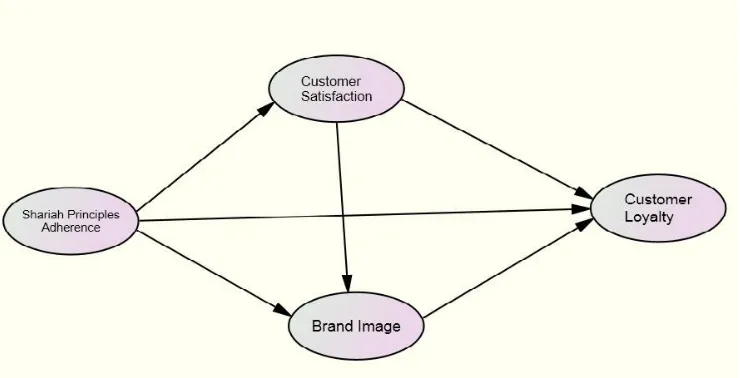
Hence From its elaboration, this study formulate hypotheses: H1 : Shariah pinciples adherence affects customer satisfaction H2 : Shariah principles adherence affects brand image of
banking
Customers’ satisfaction
Oliver (1999) explains that customer satisfaction results from psychological condition when emotion that surrounds the expectations does not suit the real condition and are multiplied by the emerging feelings on the experience. To satisfy customer is essential for a business organization since satisfied customer has tendency to be loyal and re-buy product from the same manufacturer (Michael D. Clemes, Gan, & Zhang, 2010; Michael Daniel Clemes et al., 2014; Suhartanto, 2011)
As a manifestation of the relationship between what was expected and perceived, customer satisfaction has a significant impact on Bank customer loyalty. Several studies have described that the higher satisfaction perceived by customers, the greater the loyalty (Beerli, Martín, & Quintana, 2004; Michael D. Clemes et al., 2010).
Besides having an important role in affecting loyalty, customer’s satisfaction has a significant role in enhancing the company image. The more satisfied the customers for services rendered, the more positive the image of the company.
Hence From above discussion, this study formulate hypotheses: H4 : Customer satisfaction significantly affect the bank's image
satisfaction
H5 : Customer satisfaction significantly affect customer loyalty
Brand Image
Kotlerand Armstrong(2008) suggest that brand name, term, sign, symbol, or design, or a combination of all of these show the identity of the products and services of manufacturer or seller. From these definitions, the brand is a symbol or logo of the products or services offered by the company, which can differentiate similar products or services, the brand is a name, symbol, logo, or a term which indicates the identity of a product or service that sets it apart from competitors who plunge in the market. Customers learn about brands through their past experience upon the product and marketing program.
Brand image is about consumer perception of a brand as a reflection of brand associations that exist in the minds of consumers(Kotler & Armstrong, 2008). Perception itself is an activity sensing, integrating, and providing an assessment of the physical and social objects, and sensing depends on the physical and social stimuli in the environment.
price, but also the brand image attached to the product. The rapid growing market will encourage customer to consider more the image of the brand than characteristics of the products offered. This shows that there is a customer’s tendency to prefer a product well known through the experience of using the product and based on information obtained through different sources.
Recently several empirical research has discovered that the image of a brand has a significant influence in generating loyalty. Study by Bloemer and de Ruyter (1998)finds that the general banking customers will be more loyal if the bank in which they have transaction has a positive image. In line with the study of Bloemer et al ( 1998) in retail banking industry, the bank's brand image plays significant role in affecting customer loyalty. Therefore, this study hypothesize that customer loyalty in Sharia banks are significantly influenced by the image of the bank.
H6: The image of the bank significantly affects customer loyalty. Based on the review of literature the conceptual framework proposed in this study
Figure 1. Research Model
RESEARCH METHOD
Research Design
questionnaire. Researchers in this study collecting the data by implementing questionnaires.
This study uses a quantitative approach which is under the purpose of (1) quantifying the data and generalizing the results of the sample and population, (2) the number of samples that much, (3) conducted in structured, (4) data analysis by using statistic and (5) study results to provide recommendations by the customers unit analysis on whom have deposit in Sharia banks.
Samples
The respondents of this study are the customers who deposit their money in sharia bank in Malang, East Java Province, Indonesia. A total of 119 respondents participate in this study by returning the questionaire. These respondents were recruited by using convinience sampling.
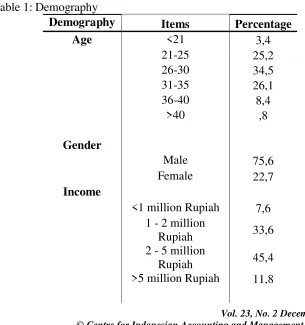
The following demographic profile emerged from the sample: 85% of the respondents are aged between 21 and 35 years, 75 % are male, 75% have tertiary education and45% have income between Rp 2.000.000 - Rp. 5000.000 Table 1 presented the demographic of respondents of this study.
Table 1: Demography
Demography Items Percentage
Age <21 3,4
21-25 25,2
26-30 34,5
31-35 26,1
36-40 8,4
>40 ,8
Gender
Male 75,6
Female 22,7
Income
<1 million Rupiah 7,6 1 - 2 million
Rupiah 33,6
2 - 5 million
Rupiah 45,4
Education
High school 14,3
Diploma degree 23,5
Undergraduate
degree 52,9
Graduate and
Post-graduate degree 7,6
DATA ANALYSIS
This study uses the Generalized Structured Component Analysis (GSCA) to analyse the data. The first step is to analyse the data to test the outer model consisting of convergent validity, discriminant validity and reliability. The second step in analysing the data is the inner test models. Test was conducted by looking at the model inner R2, FIT, and GFI. The final step is testing the hypothesis
Outer Model Evaluation
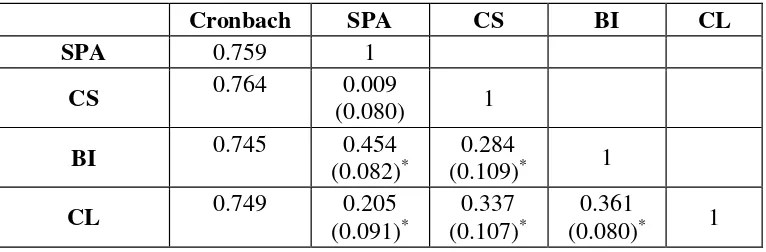
Table 2: Summary of Inner Model Evaluation
The inner model were analysed by observing the value of R2, FIT and GFI. On the value of R2, the provisions of cut off value is above 0.1 (Falk & Miller, 1992). This study found that the values of R2are 0.284 and 0.197. For FIT indicator, experts stated that the FIT value must be above 0.5. Nonetheless, in the model built in this study, the FIT value is 0.491. The last indicator used to indicate the outer model accuracy is a GFI. According to Hair et al. (2010), cut off from GFI is> 0.9. The GFI value in this study is 0.989.
Of the three indicators, it appears that the value of R2 and GFI are above the recommended cut-off. Therefore it can be said that a model built on this study is robust. Table 5.6 summarizes the indicators of the model. .
Table 3: Goodness of Fit Model
Model Fit
This study tested the hypothesis by using a 5% confidence level (α = 5%). At the 5% confidence level the hypothesis was tested in both directions with sample size of 120, the t-statistic value is 1.98.
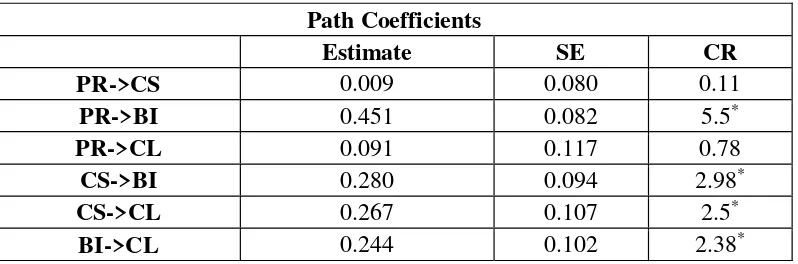
The effect of religious perception on the image of the bank is formulated in hypotheses 2. The study discovered that in accordance with the hypothesis 2 that the image of the bank is significantly and positively influenced by the religious perception (β = 0.451; t = 5.5). This means that Hypothesis 2 is accepted. Since this causal relationship is positive, it means that the higher the bank's customers perception for adherence to Islamic values, the greater the customer satisfaction.
In line with its effect on customer satisfaction, religious perception does not have influence on customer loyalty (β = 0091; t = 0.78). This means that Hypothesis 3 is rejected.
Hypothesis 4 stated that the bank's image is affected by customer satisfaction. Statistically, the study discovered that there is significant influence by the image of the bank toward customer satisfaction (β = 0.280; t = 2.98). This suggests that the more satisfied customers with the services provided, the more positive the image of the bank in the eyes of consumers. This means Hypothesis 4 is accepted. Same with the resulting effect on the bank's image, this study also discovered that customer satisfaction has a significant positive effect on customer loyalty (β = 0.267; t = 2.5). This tells us Hypothesis 5 is accepted.
Hypothesis 6 states that the bank's image is a predictor of customer loyalty. This study indicates that the customers loyalty is positively and significantly influenced by the image of the bank (β = 0244; t = 2.38). In this case Hypothesis 6 is accepted. Thus this means that the more positive the image of a Sharia Bank, the more loyal customers of the bank. Table 3 shows tha summary of Hypotheses testing
Table 4: Hypotheses Testing
Path Coefficients
Estimate SE CR
PR->CS 0.009 0.080 0.11
PR->BI 0.451 0.082 5.5*
PR->CL 0.091 0.117 0.78
CS->BI 0.280 0.094 2.98*
CS->CL 0.267 0.107 2.5*
CONCLUSION
This study discovered that customer perceptions of the bank's adherence on the values and concepts of Islam (religious perception) plays a significant role in enhancing the image of the bank. The better the perception of the customer on of the banks religiosity in doing business, the more positive the image of the bank. The image of a company is a form of manifestation on how the company applying the values espoused in business applications.
Granting that it has a significant influence on brand image, religious perception does not have a significant impact on customer satisfaction and loyalty. This finding is unexpected that even good religious perception does not give effect to satisfaction and loyalty. The possibility in deciding whether customers are satisfied or not is the services provided, the consumer is adhered to the quality of services provided. So it is not enough that Sharia banking is just to expose their religiosity. Nonetheless they likewise have to always maintain the quality of service.
REFERENCES
Aisyah, S., Hadiwidjojo, D., Sudiro, A., & Ashar, K. (2014).
Relationship Between Shariah Principles Adherence , Corporate Social Responsibility , Trust and Customer Loyalty: Theoretical Study at Indonesia BMT. International Journal of Business and Management Invention, 3(10). Retrieved from
http://www.ijbmi.org/papers/Vol%283%2910/Version-2/E03102036046.pdf
Beerli, A., Martín, J. D., & Quintana, A. (2004). A model of customer loyalty in the retail banking market. European Journal of Marketing,
38(1/2), 253–275. doi:10.1108/03090560410511221
Bloemer, J., & de Ruyter, K. (1998). On the relationship between store image, store satisfaction and store loyalty. European Journal of Marketing, 32(5/6), 499–513. doi:10.1108/03090569810216118
Bloemer, J., de Ruyter, K., & Peeters, P. (1998). Investigating drivers of bank loyalty: the complex relationship between image, service quality and satisfaction. International Journal of Bank Marketing, 16(7), 276–286. doi:10.1108/02652329810245984
Clemes, M. D., & Gan, C. (2013). Mobile Communications: A Comprehensive Hierarchical Modelling Approach. Asia Pacific Journal of Marketing and Logistics, 26(1), 8.
Clemes, M. D., Gan, C., & Zhang, D. (2010). Customer switching behaviour in the Chinese retail banking industry. International Journal of Bank Marketing, 28(7), 519–546. doi:10.1108/02652321011085185
Clemes, M. D., Shu, X., & Gan, C. (2014). Mobile communications: a comprehensive hierarchical modelling approach. Asia Pacific Journal of Marketing and Logistics, 26(1), 114–146.
Falk, R. F., & Miller, N. B. (1992). A primer for soft modeling. Akron: University of Akron Press.
Ganguli, S., & Roy, S. K. (2011). Generic technology‐based service quality dimensions in banking. International Journal of Bank Marketing, 29(2), 168–189. doi:10.1108/02652321111107648
Hair, J. F., Black, W. C., & Babin, B. (2010). Multivariate Data Analysis: A Global Perspective. Pearson Education. Retrieved from http://books.google.com/books?id=SLRPLgAACAAJ&pgis=1
Kline, R. B. (2011). Principles and Practice of Structural Equation Modeling. Guilford Press. Retrieved from
http://books.google.com/books?hl=en&lr=&id=mGf3Ex59AX0C&p gis=1
Kotler, P., & Armstrong, G. M. (2008). Principles of Marketing. Retrieved from
http://books.google.co.id/books/about/Principles_of_Marketing.html ?id=5FEfAQAAIAAJ&pgis=1
Lewis, B. R., & Soureli, M. (2006). The antecedents of consumer loyalty in retail banking. Journal of Consumer Behaviour, 5(1), 15–31. doi:10.1002/cb.46
Metawa, S. A., & Almossawi, M. (1998). Banking behavior of Islamic bank customers: perspectives and implications. International Journal of Bank Marketing, 16(7), 299–313.
doi:10.1108/02652329810246028
Mu’allim, A. (2003). Persepsi Masyarakat terhadap Lembaga Keuangan Syariah. Jurnal Al Mawarid, (10).
Roig, J. C. F., Garcia, J. S., Tena, M. A. M., & Monzonis, J. L. (2006). Customer perceived value in banking services. International Journal of Bank Marketing, 24(5), 266–283.
doi:10.1108/02652320610681729
Sector in Bangladesh. International Journal of Business and Management, 6(3), 12–36.
Suhartanto, D. (2011). An examination of brand loyalty in the Indonesian hotel industry. Faculty of Commerce. Lincoln University.
Suhartanto, D., Clemes, M., & Dean, D. (2013). Analyzing the Complex and Dynamic Nature of Brand Loyalty in the Hotel Industry.