VOL. 6, NO. 3, pp. 136 - 141, September 2016 Submitted January 2016; Revised May 2016; Accepted August 2016
Bleach Solution Requirement for Hatching of Daphnia magna Resting Eggs
Catur Retnaningdyah 1*, Dieter Ebert 2
1 Biology Study Program, Faculty of Mathematics and Natural Sciences, Brawijaya University, Malang, Indonesia 2
Department of Evolutionary Biology, Zoological Institute, University of Basel, Basel, Switzerland
ABSTRACT
Daphnia (water fleas) belong to the zooplankton group called Cladocerans have sexual reproduction when condi -tions less favorable that produce diapausing eggs are enclosed in the ephippium. Hatching ephippial eggs in the laboratory is important in ecological, toxicology, genetical, and evolutionary studies. This study aims to improve the current methods of egg hatching from ephippium. Each of 50 ephippium were treated together by placing them in a glass jar and adding 50 mL bleach solution (sodium hypochlorite). Concentrations of sodium hypochlo -rite used in this experiment were 0%, 0.5%, 1%, 2%, 4% and 8%. These concentration treatments were crossed with the following exposure times (1, 2, 4, 8, 16, and 32 minutes). Culturing was done in 80 mL of artificial Daphnia medium, incubated in constant light and temperatures 20°C for 25 days. There were two repetitions in this experiment that were run at the same time. Result of this experiment showed that pretreatment with 0.5-8% bleach solution significantly increases the yield of total hatch rate of Daphnia magna resting eggs by about 21% over unbleached control. However, there was no significant difference among the bleach treatments. Concentra -tion of bleach solu-tion 0.5%, 1% and 4% significantly accelerated the time period until the first hatching (first day hatching). Difference of exposure time (1 - 32 minutes) at each concentration treatments were not influence the yield of total hatch and the time period until first hatching.
Keywords: Bleach solution, D. magna resting eggs, hatching
Daphnia belong to the zooplankton group referred to as Cladocerans (Crustacea), often called water fleas.-Daphnia magna is the largest European species of the genus, reaching an adult size of up to 5 mm [1]. Re-production of Daphnia is characterized by alternating asexual (parthenogenic) and sexual stages [2, 3].
Parthenogenesis, or asexual reproduction, is the mode which Cladocerans utilize for most of the year. The Daphnia multiply by parthenogenesis when favor-able conditions such as their food is abundant. The Cladocerans molt to increase in size throughout their life. Following each molt, the mature females have be-tween 0 and 50 eggs in their brood chamber. These eggs develop without fertilization into immature fe-males. After the next molting stage, the juveniles are released. These juveniles begin to feed and mature at a
rapid pace. Parthenogenesis allows for quick popula-tion growth, assuming favorable condipopula-tions [4].
Later in the season, when conditions for partheno-genesis become less favorable due to overcrowding, ac-cumulation of metabolic wastes and when food avail-ability and/or temperature begins to decrease, some of the eggs that were produced parthenogenically by the females, hatch into males [4]. The production of males and sexual females is triggered by the environment [5,6]. Males are genetically identical to their clonal sis-ters [7]. Males mate and fertilize haploid diapausing eggs produced by females entering the sexual phase of the reproductive cycle [8,9]. The fertilized eggs are kept in the brood chamber of the female. Diapausing eggs are enclosed in the ephippium, a protective struc-ture modified from the carapace that the female moults. When the female next molts, the ephippium INTRODUCTION
*Corresponding author: Catur Retnaningdyah
Biology Department, Faculty of Mathematics and Natural Sciences, Brawijaya University
Jalan Veteran, Malang, Indonesia 65145 E-mail: [email protected]
How to cite:
Daphnia is stimulated by a number of environmental components. The light was known capable to breaks the diapause of ephippial eggs. The diapausing eggs of the Paul Lake strain are clearly activated by light but in a manner which suggests that light is not essential for diapause release under conditions of the experiments. However, activation by light occurred only after the ephippia were soaked in a bleaching solution of sodium hypochlorite (NaClO) which is an effective disinfecting agent and widely used for sterilization of materials. A significantly larger number of young Daphnia hatched from ephippia soaked in a 1% solu-tion of sodium hypochlorite for 5 minutes and incu-bated in light, but it did not exceed 17% [13, 14]. Hatching ephippial eggs in the laboratory is important in ecological, toxicology, genetical and evolutionary studies [3, 15, 16]. Based on the above, the aim of this research is to improve the current methods of egg hatching from ephippia. This paper is a continuation of that work to determine if the bleaching solution is essential for the release of diapause. Besides that, we also determined how the exposure time of sodium hypochlorite influences hatching of D. magna resting eggs.
Ephippia of D. magna for the experiments were gathered from an intermittent carp breeding pond near Munich, Germany. The ephippia are extremely buoy-ant and are concentrated by the wind in a small area at the margin of the lake. Collection was made in March 1997 when the pond was dry. The material was stored at 4°C in complete darkness. This experiment was done in September-November 2004, at Unit Ecology and Evolution, Biology Department, University of Fri-bourg, Switzerland.
medium: ADaM (Ebert, D. Web-guide to Daphnia par-asites). Incubation of all replicates was done in con-stant light and temperatures 20°C for 25 days. We used four fluorescent light tubes OSRAM BOLUX Re-cyclable 36 watt each placed side by side in a distance of 25 cm over the jars. Hatching yields were deter-mined by counting the number of hatched D. magna present at daily intervals. Than these were removed at the time of observation. For the graphical presentation, the counts were converted in a percentage of the eggs hatching. To estimate how many eggs we can expect in 50 ephippia, we opened ephippia. We counted 51 eggs in 75 ephippia, giving an estimate of 0.68 eggs per ephippium or 34 eggs per treatment jars. In this experi-ment we prepared two samples control with 0% of bleach solution but used eggs which were taken out of their ephippia.
Percentage of egg hatching
Treatment with NaClO resulted in a significant in-crease in percentage of hatch. Hatching rates of ephip-pial eggs at the treatments of bleach solution when in-cubated for 25 days varied from 8.8% to 48.5%. On the other hand the average range of hatched of the control from 4.4% to 11.8% (Figure 1). The develop-ment of an ephippial eggs about to hatch had observed before [17]. Hatching results from the gradual swelling of subchorionic membrane causing first the equatorial rupture of the chorion and terminating with the in-stantaneous rupture of the membrane after it has swollen to about twice its original linear dimensions. The swelling is clearly osmotic as it may be reversed or retarded by dilute solutions of sucrose. Rupture of the membrane is apparently spontaneous and dependent on reaching a sufficient degree of stretch. The animals RESULTS AND DISCUSSION
Figure 1. Average total cumulative hatch each treatment after 25 days incubation (sample size was 50 ephippia per jar and 2 jars/replicates per treatment combination)
Figure 2. Average total cumulative hatch of D. magna ephippial eggs per treatments concentration of bleach solution within 25 days of incubation (note: the levels in the same block no connected by same letter are significantly different based on Tukey HSD at a=0.05)
Based on full factorial two-way ANOVA (Table 1), there is a significant difference in total cumulative hatching between block (F = 9.28, P = 0.00) and among concentration of sodium hypochlorite (F=3.68, P = 0.01), but this contrast did not differ among time ex-posing (F = 1.30, P = 0.29) and no interaction between concentration of NaClO and time exposing (F = 0.85, P = 0.66). The difference between this block indicates that there is a difference in quality of ephippia. It was due to ephippia have been stored at 4°C in complete darkness for seven years. Because there is no difference total cumulative hatching between block and treat-ments of time exposing, so we did one way ANOVA tests between the concentration of NaClO on each block as shown in Figure 2. From this figure we can see in the block II that treatment with bleach solution will increase the hatching rate by about 21% over un-bleached controls. However these was no significant difference among the 5 levels of bleach treatments.
Using eggs without the ephippia and no treat with bleach solution result 41% hatching, which is not diff-fferent from the group of ephippia that received a
bleach solution treatment (Figure 1). During the exper-iment, we observed that treatments with 4% - 8% bleach exposing 8 to 32 minutes caused a decapsula-tionof eggs. The ephippial is not a barrier to an ade-quate light stimulus but does constitute a powerful
bar-Table 1. Two way ANOVA of total cumulative hatching (%)
Source F. Ratio Prob. > F
Block 9.28 0.00
Concentration of NaClO 3.68 0.01
Exposure time 1.30 0.29
Concentration of NaClO* time exposing 0.85 0.66
exposure to light.
The time period until first hatching
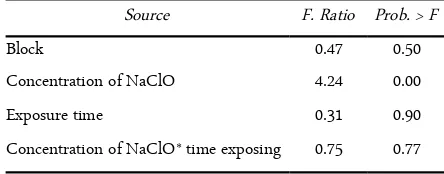
The average time period until the first hatching in a jar was observed varied from 3.5 to 20.5 days. Based on full factorial two-way ANOVA (Table 2), there is a sig-nificant difference of days until first hatch among con-centration of NaClO (F=4.24, P=0.00). These were no effect of Block (F=0.47, P=0.50), exposure time (F=0.31, P=0.90) and interaction between concentration of Na-ClO and exposure time to the first day hatching. Based on the result, so we did one way ANOVA tests be-tween the concentration of NaClO as shown in Figure 3.
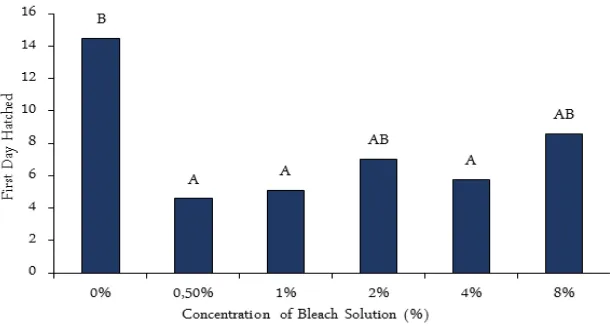
Figure 3 shows that in the treatments with bleach solutions of 0.5%, 1% and 4% hatching occurred sig-nificantly earlier (average hatched on day 4.6-5.8) than concentration 2% and 8% (average hatched on day 7.0 and 8.6 respectively). The ephippia without bleach treatment (0% control treatment) needed much longer times to first hatch (average hatched on day 14.2). Generally, 10% of the total hatch was obtain on the first or second day after hatching and 25% of the total-hatch was found on the third day after total-hatching. This experiment indicated that NaClO is required to induce the hatching of D. magna resting eggs in lower con-centration. But in the high concentration, bleaching so
Table 2. Two way ANOVA of time period until the first hatching
Source F. Ratio Prob. > F
Block 0.47 0.50
Concentration of NaClO 4.24 0.00
Exposure time 0.31 0.90
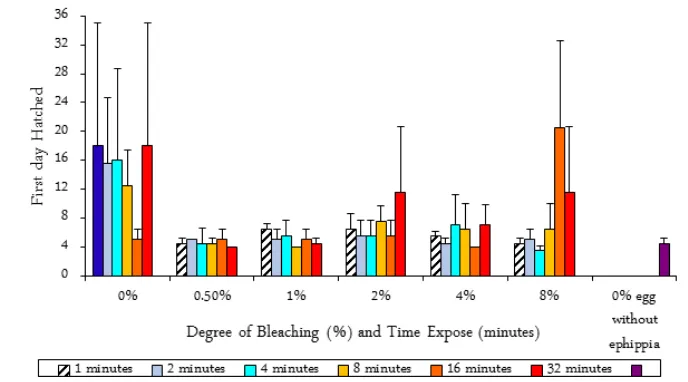
lution will be inhibited the release of diapause due to the toxicity of this substance. Although there was no significant difference the first day of hatch among time expose of bleach solution (Table 2), but from Figure 4 we can see that the longer time exposing (32 minutes) on the higher concentration of bleach solution (2%, 4% and 8%) needed the longer time to first hatch (7– 11.5 days). It was happened too on the concentration of bleach solution 8% and time exposed 16 minutes with the average first hatched on day 20.5 days. It was indicated that NaClO in the high concentration (2%, 4% and 8%) and longer exposure times (16 and 32 minutes) will be inhibit the development of embryo might be because it is an effective disinfectant agent that has been known having high toxicity.
From the observation of two block, there was found that the range of time minimum needed to first hatched of ephippial eggs generally is 3-6 days, except the control treatment (4-9 days) and the treatment con-centration of bleach solution 8% crossed with exposure time 16 minutes (12 days). Eggs prepared out from ephippia when didn’t give a treatment with bleach so-lution need 4-5 days to first hatched (Figure 4).
The implication of this experiment that although NaClO can induce the hatching of D. magna resting eggs, but in the higher concentration and longer expo-sure times will be inhibit the development of embryo. NaClO is an effective disinfectant agent that has been known having high toxicity. It might cause the lethal effect to bacteria and fungi surrounding ephippia and so the hatching success is will be higher. In the water NaClO will become ion of sodium and chloride. Sodium is one of the most abundant elements and is a common
constituent of natural waters. The presence of chlorides in natural waters can mainly be attributed to dissolu-tion of salt deposits in the form of ions (Cl-). It is the major form of inorganic anions in water for aquatic life.
Preliminary treatment with 0.5-8% NaClO (bleach solution) significantly increases the yield of total hatch rate of D. magna resting eggs by about 21% over un-bleached control. However, there was no significant difference among the bleach treatments. Concentration of bleach solution 0.5%, 1% and 4% significantly ac-celerated the time period until the first day hatching. Difference of exposure time (1-32 minutes) at each concentration treatments were not influence the yield of total hatch and the time period until first hatching.
These result showed that NaClO can induce the hatching of D. magna resting eggs which can then be used in research experiment in the field of ecology, ge-netics, toxicology and evolutionary studies.
I thank to members of the Ecology and Evolution Unit, Biology Department, Fribourg University – Switzerland for permitted and support this research and thank you for project of TPSDP 2004, Biology Department, Faculty of Mathematics and Natural Sciences Brawijaya University for giving the fund for this trainer-ship so this research can be done.
1. Haag CR, Hottinger JW, Riek M, Ebert D (2002) Strong
CONCLUSION
ACKNOWLEDGMENT
REFERENCES
male mating behaviour and avoidance of inbreading. Freshwater Biology 47: 441-450.
7. Haag CR, Sakwiñska O, Ebert D (2003) Test of synergis-tic interaction between infection and inbreeding in Daph-nia magna. Evolution 57 (4): 777-783.
8. Hebert PDN (1978)The population biology of Daphnia (Crustacea, Daphnidae). Biological Reviews 53: 387-426. 9. Innes DJ (1997) Sexual reproduction of Daphnia pulex in
a temporary habitat. Oecologia 111: 53-60.
ogy 9: 21.
16. Roulin AC, Routtu J, Hall MD et al. (2013) Local adapta-tion of sex inducadapta-tion in a facultative sexual crustacean: in-sight from QTL mapping and natural populations of Daphnia magna. Molecular Ecology 22: 3567-3579. 17. Davison J (1969) Activation of the ephippial egg of