December 2013 165
Accredited by DGHE No: 66b/DIKTI/Kep/2011 DOI: 10.5398/medpet.2013.36.3.165
*Corresponding author:
E-mail: �erd���saputra�gmail.com�erd���saputra�gmail.com
Genetic Variation of mtDNA Cytochrome Oxidase Subunit I (COI) in Local Swamp
Bufaloes in Indonesia
F. Saputraa,*, Jakariab, & C. Sumantrib
aMajor Program o� Animal Science Production and Technolog�, Graduate School, Bogor Agricultural Universit� bDepartment o� Animal Production and Technolog�, Facult� o� Animal Science, Bogor Agricultural Universit�
Jln. Agatis, Kampus IPB Darmaga, Bogor 16680, Indonesia (Received 19-06-2013; Reviewed 18-09-2013; Accepted 26-01-2014)
ABSTRACT
The objective of this research was to identify genetic variation of mitochondria DNA especially
in cytochrome oxidase subunit I (COI) among population of Indonesian bufaloes. Samples of swamp bufaloes were collected from Aceh (n= 3), North Sumatra (n= 3), Riau (n= 3), Banten (n= 3), Central Java (n= 3), West Nusa Tenggara (n= 3) and South Sulawesi (n= 3), and riverine bufalo from North Sumatra (n= 1) out of group for comparison. Sequence of COI was analyzed using MEGA 5.10
software with neighbor-joining method kimura 2-parameter model to reconstruct phylogeny tree.
The result showed that three haplotypes for swamp bufalo and one haplotype for riverine bufalo in Indonesia resulted from 41 polymorphic sites. This inding showed that the COI gene could be considered as a marker to distinguish among swamp bufaloes in Indonesia.
Key words: COI, ilogeny, genetic variation, Indonesian bufaloes
ABSTRAK
Tujuan penelitian ini adalah untuk mengidentiikasi keragaman DNA mitokondria, khususnya
pada daerah cytochrome oxidase subunit I (COI) pada delapan populasi kerbau lokal Indonesia.
Sampel kerbau lumpur berasal dari Aceh (n= 3), Sumatra Utara (n= 3), Riau (n= 3), Banten (n= 3), Jawa Tengah (n= 3), Nusa Tenggara Barat (n= 3) dan Sulawesi Selatan (n= 3); dan sebagai pembanding di
-gunakan kerbau sungai yang berasal dari Sumatra Utara (n= 1). Sekuen gen COI dianalisis menggu
-nakan program MEGA 5.10 software dengan metoda neighbor-joining substitusi kimura 2 parameter
untuk merekonstruksi pohon ilogeni. Hasil penelitian menunjukkan adanya 41 situs polymorime
dan dapat dikelompokkan kedalam tiga haplotipe untuk kerbau lumpur dan satu haplotipe untuk kerbau sungai. Gen COI dapat dipakai sebagai penciri genetik untuk membedakan antar populasi kerbau di Indonesia.
Kata kunci: COI, ilogeni, kerbau Indonesia, variasi genetik
INTRODUCTION
Indonesian animal genetic resources �or bufaloes consist o� swamp bufalo, riverine bufalo, spoted bu�-�alo (toraja bufalo) and kalang bufalo (borneo bufalo) (Director General o� Livestock Services, 2003). Riverine bufaloes were introduced into Indonesia �rom India. Spoted bufalo and kalang bufalo are Indonesian swamp bufalo breed. Indigenous bufalo in Indonesia is swamp bufalo. Characterization o� bufalo breeds in Indonesia are usuall� just based on the phenot�pe in�ormation. Stud� o� the genetic distance estimation o� local swamp bufaloes through morpholog� anal�sis has been done (Anggraeni et al., 2011) and growth hormone
Cricula trifenestrata (Suriana et al., 2012), lepidoptera (Wilson, 2010), beetles (Funk et al., 1995), some insect pests (Toda & Murai, 2006) Mermerodes hamona moth (Hulrc et al., 2007), mosquito (C�winska et al., 2006), and Thrips tabaci (Karimi et al., 2010).
COI variations between bird species averaged 7.93%, whereas variation within species averaged 0.43% (Herbert et al. 200�). Genetic diversit� o� COI gene in Chinese chicken breed �ound seven haplot�pes (Gao et al., 2011). Genetic diversit� o� COI gene in Indonesian bufalo has not been explored �et. This stud� was therefore aimed to identify genetic variation of mito-chondria DNA especiall� in c�tochrome oxidase subunit I (COI) among population o� local swamp bufaloes in Indonesia.
MATERIALS AND METHODS
DNA Materials
Samples o� blood swamp bufaloes were collected �rom Aceh (n= 3), North Sumatra (n= 3), Riau (n= 3), Banten (n= 3), Central Java (n= 3), West Nusa Tenggara (n= 3) and South Sulawesi (n= 3); and riverine bufalo �rom North Sumatra (n= 1) out o� group �or comparison. All samples were stored in vacutainer tube with EDTA. DNA extraction was per�ormed b� using phenol chloro-�orm method (Sambrook & Russel, 2001) and modiied by Andreas et al. (2010), with the �ollowing procedure:
Sample preparation. The blood in the alcohol was as much as 200 μL. Sample was inserted to a 1.5 mL tube. Alcohol was eliminated from the sample by adding dis-tilled water until 1000 μL, and le�t in room temperature �or 20 min. Then it was precipitated b� centri�ugation at a speed of 8000 rpm for 5 min.
Protein degradation. The samples were cleared from al-cohol and added b� 200 μL 1x STE (sodium tris EDTA), �0 μL sodium dosesil sul�ate 10%, and 20 μL proteinase K (5 mg/mL). The mixture ware incubated overnight at 55 °C temperature while shaken gentl�.
Organic material degradation. A�ter incubated, samples were added b� �00 μL phenol solution, �00 μL cholo�orm: isoam�l alcohol (2�:1), and �0 μL 5M NaCl. Then, the mixture was shaken at room temperature �or one hour.
DNA precipitation. Samples were centri�uged at a speed of 5000 rpm for 10 min to separate the water phase with
phenol phase. Water phase was trans�erred in a new tube with the volume measured. DNA molecules deposited b� adding a 2x volume o� alcohol absolute and 0.1 x volume o� 5M NaCl. Then the mixture was incubated at a tem-perature o� -20 °C over night. Subsequent DNA precipita-tion was b� centri�ugated at a speed o� 12000 rpm �or 10 min. Obtained DNA precipitate was washed by 70% alco-hol, and then precipitated again. Precipitated DNA clean �rom alcohol restored b� adding 100 μL TE (Tris-EDTA). DNA samples were stored at -20 °C and read� �or use.
PCR Ampliication and Sequencing
Two pair o� primer was designed b� using Primer-Blast (htp://www.ncbi.nlm.nih.gov/tools/primer-blast/) with re�erence o� genbank accession numbers o� NC_020615, EF536351, AY�88�91, AF5�7270, NC_006295 and AY702618 (Table 1). PCR ampliication was carried out with 35 μL PCR reaction containing o� 50-100 ng sample DNA, 10 pmol Primer (Alpha DNA), 10 mM dNTPs (Fermentas), 25 mM MgCl2 (Fermentas), 10xBu�-�er (Fermentas), and 2.5 U Taq Pol�merase (Fermentas). The condition of thermal cycling consisted of prade-naturation at 95 oC for 5 min, followed by 35 cycles of denaturation 95 oC for 40 s, annealing 60 oC for 45 s, and extension 72 oC �or 1 min. The inal extension step was at 72 oC �or 5 min. Ampliication was carried out in a ther-mal cycler (Geneamp 9700, AB S�stem). PCR amplicons were visualized on 1.5% agarose gels in 0.5 x TBE bufer containing 10% ethidium bromide at 100 volt �or �5 min and visualized b� UV transiluminator.
Sequencing anal�sis was carried out b� sending PCR amplicon samples to a commercial service (1st BASE, Mala�sia). Sequences were anal�zed using MEGA 5.10 so�tware (Tamura et al., 2011). Method o� neighbor-joining with kimura 2-parameter model was applied �or reconstructing ph�logen� tree.
RESULTS AND DISCUSSION
DNA Ampliication
COI gene o� the riverine bufalo and swamp bu�-falo has 1545 bp in length (according genbank acces-sion number AF5�7270 and NC_006295). Primer FS2 ampliied at position 636� in the C�tochrome Oxidase Subunit I (COI) to position 7�11 in the tRNASer (accord-ing genbank accession number AF5�7270) with �ragment prediction o� 10�7 bp in length (Figure 1). Primer FS3 ampliied at position 59�8 to position 6729 in the COI
Table 1. Overlapping primer for COI gene
Primer Sequence (5’-3’) Size Position* Name of gene
FS2 F: CAG CGG GGG GAG GAG ATC CTA TTC TAT ACC
1047 bp 6364-6393 COI
R: GCC TAG TTG TAT AGG GTA TGC CAT ATG AGA 7383-7411 tRNASer
FS3 F: TCC CTC TAA TAA TTG GCG CTC CCG
781 bp 5948-5971 COI
R: GCC TAG GGC TCA CAT TAT AGC GGG 6706-6729 COI
December 2013 167
Sample % Total
T(U) C A G T+A C+G
NC 020615.1|Bubalus depressicornis 29.4 26.0 27.6 17.0 57.0 44.6 1243
EF536351.1|Bubalus depressicornis 29.4 26.0 27.6 17.0 57.0 44.6 1243
AY�88�91.1|Riverine Bufalo 29.6 25.7 28.0 16.7 57.6 42.4 1243
AF5�7270.1|Riverine Bufalo 30.1 25.3 27.9 16.7 58.0 42.0 1243
Riverine Bufalo North Sumatra 8 29.6 25.7 28.0 16.7 57.6 42.4 1243
NC 006295.1|Swamp Bufalo 29.2 26.1 28.2 16.5 57.4 42.6 1243
AY702618.1|Swamp Bufalo breed Haikou 29.2 26.1 28.2 16.5 57.4 42.6 1243
Swamp Bufalo Aceh 7 29.1 26.4 27.6 16.9 56.7 43.3 711
Swamp Bufalo Aceh 8 29.1 26.4 27.6 16.9 56.7 43.3 711
Swamp Bufalo Aceh 73 29.1 26.4 27.6 16.9 56.7 43.3 711
Swamp Bufalo North Sumatra 16 29.0 26.4 28.2 16.4 57.2 42.8 1243
Swamp Bufalo North Sumatra 21 29.0 26.4 28.0 16.7 57.0 43.0 1243
Swamp Bufalo North Sumatra 26 29.2 26.1 28.2 16.5 57.2 42.8 1243
Swamp Bufalo Riau 1� 29.0 26.4 28.2 16.4 57.0 43.0 1243
Swamp Bufalo Riau 26 29.2 26.1 28.2 16.5 57.4 42.6 1243
Swamp Bufalo Riau 30 29.2 26.1 28.2 16.5 57.4 42.6 1243
Swamp Bufalo Banten 7 29.2 26.1 28.2 16.5 57.4 42.6 1243
Swamp Bufalo Banten �1 29.2 26.1 28.2 16.5 57.4 42.6 1243
Swamp Bufalo Banten 50 29.2 26.1 28.2 16.5 57.4 42.6 1243
Swamp Bufalo Central Java � 29.2 26.1 28.2 16.5 57.4 42.6 1243
Swamp Bufalo Central Java 20 29.2 26.1 28.2 16.5 57.4 42.6 1243
Swamp Bufalo Central Java 16 29.2 26.1 28.2 16.5 57.4 42.6 1243
Swamp Bufalo West Nusa Tenggara 7 29.2 26.1 28.2 16.5 57.4 42.6 1243
Swamp Bufalo West Nusa Tenggara 13 29.2 26.1 28.2 16.5 57.4 42.6 1243
Swamp Bufalo West Nusa Tenggara 23 29.2 26.1 28.2 16.5 57.4 42.6 1243
Swamp Bufalo South Sulawesi 102 29.2 26.1 28.2 16.5 57.4 42.6 1243
Swamp Bufalo South Sulawesi 103 29.2 26.1 28.2 16.5 57.4 42.6 1243
Swamp Bufalo South Sulawesi 117 29.2 26.1 28.2 16.5 57.4 42.6 1243
!,)0+& )&$&/!**,,%!+% ')&,+$'#!!)&$*$'#*
' #) *!1 *+%) %&)+ *,$+) )!-) ,#& %&)+
,$+) *.$' ,#& )!, *.$' ,#& %+% *.$'
,#& %+)# "- *.$' ,#& .*+ %,* +%) *.$'
,#& *&,+ *,#.*! *.$' ,#& % *.$' ,#&
%$&')!$)
!,) (,% &0+& )&$&/!**,,%!+ %
500 bp
1047 bp 781 bp
FS2 FS3
Figure 1. C�tochrome oxidase subunit I gene PCR product ampliied �rom samples. M= 100 bp ladder size standard; 1= North Su -matra (river bufalo); 2= North Su-matra (swamp bufalo); 3= Riau (swamp bufalo); �= Banten (swamp bufalo); 5= Central Java (swamp bufalo); 6= West Nusa Tenggara (swamp bufalo); 7= South Sulawesi (swamp bufalo); and 8= Aceh (swamp bufalo) (FS2 & FS3= name o� primer).
168 December 2013
(according genbank accession number AF5�7270) with �ragment prediction o� 781 bp in length (Figure 1). Aceh samples not ampliied using primer FS2 but ampliied using primer FS3 (Figure 1).
Sequence Variation and Haplotype Sharing
Nucleotide composition o� sequences (Table 2) showed a slight diference in the nucleotide composition o� the sample. It is especiall� in Swamp Bufalo North Sumatra 16, Swamp Bufalo North Sumatra 21 and Swamp Bufalo Riau 1�. Genetic variation at mitochon-drial D-loop region in Eg�ptian river bufalo showed 28 diferent haplot�pes resulting �rom 77 pol�morphic sites (Hassan et al., 2009). In this research at mitochondrial C�tochrome Oxidase subunit I (COI) showed �our hap-lot�pes �or local swamp bufaloes in Indonesia resulted �rom �1 pol�morphic sites (Table 3).
The irst haplot�pe consisted o� Banten Samples, South Sulawesi Samples, West Nusa Tenggara Samples,
Central Java Samples, Riau 30, Riau 26, North Sumatra 26, NC_006295.1 and AY702618.1. The second haplot�pe consisted of Aceh samples. The third haplotype was North Sumatra 21. The �ourth haplot�pe consisted o� North Sumatra 16 and Riau 1�. The i�th haplot�pe con-sisted o� North Sumatra 8 (River Bufalo) and AF5�7270 (River Bufalo). A unique sequence o� North Sumatra 21 (Swamp bufalo) has man� nucleotide diferences (Table 3). As a result, the sample is separated �rom the swamp bufalo group (Figure 2).
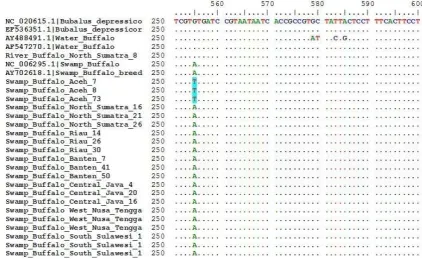
Genetic variation was �ound in swamp Bufalo population in Aceh (with blue highlight color) at posi-tion 555 bp in c�tochrome oxidase subunit I (Figure 2). Nucleotide at positition 555 bp encoded with th�mine (T) called haplot�pe 2. This haplot�pe onl� �ound in Swamp Bufalo population in Aceh (Figure 2 and Table 3). Swamp Bufalo in Aceh is possibilit� o� indigenous bufalo in Indonesia although onl� one nucleotide di�-�erence. This requires �urther research to prove this h�pothesis. Ph�logen� tree (Figure 3) showed no genetic H Table 3. Haplotype and polymorphic site
Note: *according bufalo COI gene (H is haplot�pe)
December 2013 169 diferences between Indonesian swamp bufaloes with
Chinese swamp bufaloes. This inding suggests those Indonesian swamp bufaloes are ver� closel� related to swamp bufaloes in China. This present result supports that swamp bufaloes are the result o� bufalo domesti-cation in China (Kumar et al., 2007). Historical data o� local swamp bufaloes in Indonesia are not available, so that it cannot explain the genetic relationship between the bufaloes in Aceh, Banten, Central Java, West Nusa Tenggara and South Sulawesi with swamp bufalo in China. Genetic variation at mitochondrial DNA D-loop and c�tohrome b sequence showed eight haplot�pes �or D-loop mitochondria in Bogor and South Sulawesi and one haplot�pe �or c�tochome b in Bogor and South Sulawesi (Lau et al., 1998). This results support the �ol-lowing h�pothesis domestication o� swamp bufalo in china spread with rice cultivation through two separate routes (a) through Taiwan, to the Philippines and to the eastern islands o� Borneo and Sulawesi, (b) south through mainland south-east Asia (likel� interbreeding with wild bufalo) to peninsular Mala�sia and on to the western island o� Sumatra and Java (Lau et al., 1998).
Lei et al. (2007) �ound 12 haplot�pe o� mtDNA D-loop Chinese swamp bufaloes and two maternal linages. Kierstein et al. (200�) �ound “unique group” based on mtDNA D-loop with assumpsion during migration to Indochina and South-East Asia occasional cross-breeding with wild bufaloes could have lead to those haplot�pes now �ound in the “unique group”, intermixing with the haplot�pes o� the �ounder population o� domestic riverine bufaloes. Based on our results we h�pothesize a “unique sequence” (Third haplot�pe) based on COI gene assuming the same happens with assumption o� Kierstein et al. (200�). To clari�� a “unique sequence”, it is necessar� to conduct more samples o� local swamp bufaloes in Indonesia. Ph�logen� tree shows the difer-ence between river bufalo with swamp bufalo (Figure 3).
CONCLUSION
This research ind three haplot�pes in the c�to-chrome oxidase subunit I (COI) gene o� local swamp bufaloes resulted �rom �1 pol�morphic sites. The COI Figure 3. The phenogram tree according to c�tochrome oxidase subunit I o� eight population o� Indonesian local bufaloes
.%(,$'')+!,%+)
.%(,$'',+!,$.*"
.%(,$'*+,*& )
.%(,$'&+)$-.%(,$'&+&
.%(,$'",
.%(,$'')+!,%+)
.%(,$'!
/,$,*()**"')&"*
/.%(,$'
.%(,$'!
.%(,$'')+!,%+)
.%(,$'",
.%(,$'&+&
.%(,$'&+)$-
/+),$'
"-),$'')+!,%+)
/,$,*()**"')&"*
/.%(,$')"#',
.%(,$'!
.%(,$'",
.%(,$'&+&
.%(,$'&+)$-.%(,$'*+,*& )
.%(,$'*+,*& )
.%(,$'',+!,$.*"
.%(,$'',+!,$.*"
/+),$'
!,) %&)$ +) &)!% +& 0+& )&$ &/!* *,,%!+ & ! +
'&',#+!&%&%&%*!%#&#,#&*
Riverine Buffalo
gene could be considered as a marker to distinguish among swamp bufaloes in Indonesia. However, this stud� has to be validated in large bufaloes populations in order to evaluate its potential in selective breeding.
REFERENCES
Andreas, E., C. Sumantri, H. Nuraini, A. Farahjallah, & A. Anggraeni. 2010. Identiication o� GH/AluI and GHR/AluI
genes pol�morphism in Indonesian Bufalo. JITAA. 35:
215-221.
Anggraeni, A., Sumantri C, Praharani L, Dudi, & Andreas E. 2011. Estimasi jarak genetik kerbau rawa lokal melalui pendekatan analisis mor�ologi. JITV 16: 199-210.
Cywinska, A. C., F. F. Hunter, & P. D. N. Hebert. 2006.
Identi-��ing Canadian mosquito species through DNA barcodes. Med. Veter. Entomol. 20: �13-�2�. htp://dx.doi.org/10.1111/ j.1365-2915.2006.00653.x
Director General of Livestock. 2003. National report on animal
genetic resources Indonesia. A Strategic Polic� Document. FAO.
Funk, D. J., D. J. Futuyma, G. Orti, & A. Meyer. 1995.
Mito-chondrial DNA sequence and multiple data sets: A ph�-logenetic stud� o� ph�otophagus beetles (Chr�somelidae: Ophraella). Mol. Biol. Evol. 12: 627-640.
Gao, Y. S., Y J Tu, J. X. Lu, & X. Y. Zhang. 2011. Studies on the
DNA barcoding of two newly discovered chicken breeds
b� mtDNA COI gene. J Anim Vet Adv. 10: 1711-1713. htp://dx.doi.org/10.3923/javaa.2011.1711.1713
Hassan, A. A., S. M. El Nahas, S. Kumar, P. S. Godithala, & Kh. Roushdy. 2009. Mitochondrial D-loop nucleotide se
-quences o� Eg�ptian river bufalo: Variation and ph�log
-en� studies. J. Livsci. 125: 37-42.
Hebert, P. D. N., M. Y. Stoeckle, T. S. Zemlak, & C. M. Fran -cis. 200�. Identiication o� Birds through DNA Barcodes. PLoS Biol. 2: e312. htp://dx.doi.org/10.1371/journal.
pbio.0020312
Hulrc, J., S. C. Miller, G. P. S. K. Darrow, D. N. Muller, P. D. N. Hebert, & G. D. Weiblen. 2007. DNA barcoding conirms
polyphagy in a generalist moth, Hontona mermerodes
(Lepi-doptera: Tortricidae). Mol. Ecol. 7:5�9-557.
Karimi, J., M. H. Kakhki, & M. Modarres. 2010. Identifying
thrips (Insecta: Th�sanoptera) using DNA barcodes. J. Cell Mol. Res. 2: 35-41.
Kierstein, G., M. Vallinoto, A. Silva, M. P. Schneider, L. Ian -nuzzi, & B. Breniga. 2004. Analysis of mitochondrial
D-loop region casts new light on domestic water bufalo (Bubalus bubalis) ph�logen�. Mol. Ph�logenet. Evol. 30: 308–32. htp://dx.doi.org/10.1016/S1055-7903(03)00221-5 Kumar, S., J. S. Sandhu, N. Kumar, V. Behl, & G. Nishanth.
2007. Mitochondrial DNA anal�ses o� Indian water bu�
-�alo support a distinct genetic origin o� river and swamp
bufalo. Anim Genet. 8: 227-32. htp://dx.doi.org/10.1111/ j.1365-2052.2007.01602.x
Lau, C. H., R. D. Drinkwater, K.Yusof, S. G. Tan, D. J. Het -zel, & J. S. Barker. 1998. Genetic diversity of Asian water
bufalo (Bubalus bubalis): mitochondrial DNA D-loop and c�tochrome b sequence variation. Anim Genet. 29: 253-64.
htp://dx.doi.org/10.10�6/j.1365-2052.1998.00309.x
Lei, CZ., W. Zhang, H. Chen, F. Lu, Q. L. Ge, R. Y. Liu, R. H. Dang, Y. Y. Yao, L. B. Yao, Z. F. Lu, & Z. L. Zhao. 2007.
Two Maternal Lineages Revealed b� Mitochondrial DNA D-loop Sequences in Chinese Native Water Bufaloes (Bub
-alus bubalis). Asian-Aust. J. Anim. Sci. 20: �71-�76
Lunt, D. H., D. S. Zhang, D. M. Zhimura, & G. M. Dewit. 1996. The insect c�tochrome oxidase I gene: evolutionar� patern and conserve primer �or ph�logenetics studies. In-sect. Mol. Biol. 5:153-165. htp://dx.doi.org/10.1111/j.1365-2583.1996.tb000�9.x
Mueller, R. L. 2006. Evolutionar� rates, divergence dates, and the per�ormance o� mitochondrial genes in Ba�esian ph�-logenetic anal�sis. S�st. Biol. 55: 289–300. htp://dx.doi. org/10.1080/10635150500541672
Sambrook, J. & D. W. Russell. 2001. Molecular Cloning: A Lab
-orator� Manual, 3rd ed. Cold Spring Harbor Laboratory Press. New York, USA.
Sumantri, C., R. Diyono, A. Farajallah, A. Anggraeni & E. Andreas. 2010. Peman�aatan �amili gen hormon pertum
-buhan (GH, GHR, GHRH dan PIT-1) untuk mendeteksi keragaman genetik kerbau di Kabupaten Pandeglang dan Lebak Provinsi Banten. JITV. 15:286-296.
Suriana, D., D. Solihin, R. R. Noor, & A. M. Thohari. 2012. The
Characteristics o� C�tochrome C Oxidase Gene Subunit I in Wild Silkmoth Cricula trifenestrata Hel�er and Its Evalu
-ation �or Species Marker. Med. Pet. 35: 102-110. htp:// dx.doi.org/10.5398/medpet.2012.35.2.102
Syed-Shabthar, S. M., M. K. Rosli, N. A. Mohd-Zin, S. M. Ro -maino, Z. A. Fazly-Ann, M. C. Mahani, O. Abas-Mazni, R. Zainuddin, S. Yaakop, & B. M. Md-Zain. 2013. The
molecular ph�ogenetic signature o� Bali catle revealed b� maternal and paternal markers. Mol Biol Rep. [Epub ahead to print] htp://dx.doi.org/10.1007/s11033-013-2619-� Tamura, K., J. Dudley, M. Nei & S. Kumar. 2011. MEGA
soft-ware (version 5) : Molecular Evolutionar� Genetics Anal�
-sis. Center o� Evolutionar� Functional Genomics Biodesign Institute. Arizona State Universit�.
Toda, S. & T. Murai. 2006. Phylogenetic analysis based on
mi-tochondrial COI gene sequences in Thripstabaci Lindeman
(Th�sanoptera: Thripidae) in relation to reproductive �orms and geographic distribution. Appl. Entomol. Zool. �2: 309-316. htp://dx.doi.org/10.1303/aez.2007.309