Introduction
Along with mankind recent advances in various fields, medical science also advance from curing people with disease to improving what can be improve from human body, that advances led into the development of medical esthetic fields. The development of medical esthetic fields based on human basic desire to always look attractive, as an example nowadays a lot of people undergo orthodontic treatment to improve their dental and facial appearance.
The concept of attractive facial appearance is intensely involving perception psychology aspect. Perception psychology itself involving various processes, initiated by sensation and perception
Perception psychology and facial attractiveness in
orthodontic treatment
Joko Kusnoto *, Dharmayati U. Lubis **, Miesje Karmiati ***
* Orthodontic Department, Faculty of Dentistry, Trisakti University, [email protected] ** Clinical Psychology Department, Faculty of Psychology, University of Indonesia, [email protected] *** Orthodontic Department, Faculty of Dentistry, University of Indonesia, [email protected]
Correspondence:
Abstract
Background : Being physically attractive is one of the fundamental desires for all human being. To fulfill that desire, a lot of individuals undergo orthodontic treatment as one of the attempts to achieve attractive facial appearance. Perception psychology is deeply involved in building a concept of attractive facial appearance. Purpose : This literature review will discuss its role in determining facial attractiveness and in increasing patient satisfaction toward treatment result. Reviews : Process of determining facial attractiveness initiated by sensation and perception, followed by organizing and concluding the perception, and influenced by self concept and body image. It is important for an orthodontist to consider patient’s initial perception and expectation regarding attractive facial appearance, as it is known that fulfilling initial expectation is closely related to their satisfaction towards treatment result. Conclusion : It can be concluded that perception psychology plays important role in determining facial attractiveness and increasing patient satisfaction toward treatment result.
Keywords:psychology, perception, attractiveness, orthodontic
Sensation and Perception
In life, how a person can experience what happened around him? Human being can experience what happened around because he experienced a “sensation” which is describe as basic experience caused by simple stimuli. In higher order, we know a word “perception” which is a process of interpreting and organizing a sensation that then will give a meaning of what happened. As an example, if we hear someone playing a piano, the tone and pitch of a note can be describe as sensation, whereas if after a few notes we realize that those notes create a melody that is not just a compilation of random notes, then that is what was called by perception.1,2
Visual Perception
Human being can experience perception through various sensory organs such as hearing, tactile, smell, and taste. Compared to the other sensory organs, sight can be said as the most important. Other then sensory function, sight also entertains human being, thus dominating human sensation and perception.
The basic organ for human sight is an eye that gathers information about shape, color, movement, and distance of an object. Visual stimuli that initiate human eyesight are a light which is a form of electromagnetic radiation. Light travel in waves, the length of the wave forms the characteristic of a light which include its hue and brightness. Human eye can capture the light that travel between 400 nm (purple) up to 700 nm (red).
Visual perception itself can be categorized into perception towards shape, movement, distance, consistency, and illusion. This literature review will discuss the visual perception towards shape that directly related to the perception of human being in judging facial attractiveness. Without shape perception, human eyesight will only produce indiscriminate pattern of light. Fortunately, human is blessed with shape perception so what someone see is not only indiscriminate pattern of light but an image that is very accurate and realistic of what is being seen. Few aspects construct shape perception such as understanding of relation between figure and its background, ability to categorize, and pattern recognition.1
Organization and Contextual Perception
Right after someone chooses an object that will be perceive, he will try to organize that object. The way of organizing a perception is not something indiscriminate but through a certain “rule”. According to gestalt psychology those “rules” is
already learned intuitively, but according to behavior psychology that “rules” is learned through social interaction.2
Gestalt is a word in German
language meaning overall configuration or pattern. Figure 1 gives an example that if a picture is fragmented into several fractions, each fraction by itself is meaningless.3
Gestalt psychology also stated that visual
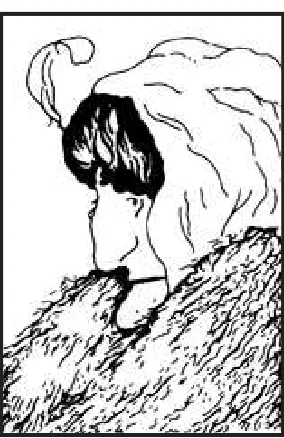
perception is an active process. As an example, if someone sees Figure 2 at the beginning maybe only indiscriminate shape of black and white is seen, but after sometimes it will begin to appear as something that we can recognize. If that process occur, it can be said that someone had organize those shapes into an image.2,3
Scientifically, it is difficult to explain how someone can organize a perception. However,
gestalt psychology attempt to explain the principles
on how someone can organize a perception. Those principles are as follows 1,3: (1) Proximity, is a Figure 1. A figure fragmented into thirty two fractions 3
tendency to perceive objects that were put closely together as a group, (2) Similarity, is a tendency to perceive identical objects as a group, (3) Continuation, if a figure is broken, by design we perceive the continuity of that broken image. In Figure 3, we can perceive that there are two figures, the first one is a rectangular covering the back part of a horse and the second one is a rectangular covering the front part of a horse. On the other hand, we also can perceive that the rectangular is covering a picture of an exceptionally long horse, (4) Closure, if a common shape is not complete; automatically the incomplete part of that figure is filled by our imagination, that process is known as closure, (5) Human being tend to perceive a good figure which is a figure that constructed by continues and symmetrical lines. Figure 4 shows that even someone saw the creation process of the figure on the right; still that person will perceive that figure as a darker colored square covering the lighter colored square.
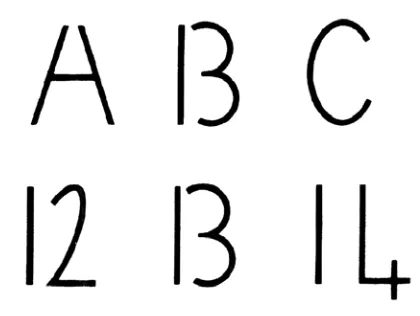
In interpreting what is seen, a person often time is influenced by the context of an object with the surrounding objects. As example, in Figure 5, the number 13 is seen as a letter B if it is preceded by letter A, but it will be seen as number 13 if it is preceded by number 12. The interpretation of an object that is seen by someone is intensely influenced by the context of that object with the surrounding objects and also the maturity of the person who perceive it.2
Self Concept
Self concept is define by someone reflection and feeling towards himself as an individual. It also can be described as the way how someone sees himself. Self concept is constructed since someone is born and getting more complex during adult life.1,4 Mental picture known as self concept is influenced by three dimensions, which are 4: (1) Person knowledge toward himself, throughout human life, everyone caries “labels” such as age, sex, citizenship, ethnic group, occupation, education level, et cetera. Other than that, when someone get into a group in society such as political party, social economical classes, religion groups, et cetera then another “label” will be added. Other things that will shape a person knowledge towards himself is by comparing themselves to other people, it will label our quality such as generous or self centered, calm or aggressive, et cetera. Those labels will develop someone knowledge toward himself, (2) Person expectation toward himself, when someone constructs a mental picture as what he wants to be, automatically that person will try to fulfill that mental picture. It can be said that everyone have an expectation toward himself, usually that expectation is in ideal form. That expectation will create a drive Figure 3. Continuation 3
Figure 4. Good figure 3
that will push someone toward the future and act as guidance throughout someone life, (3) Person rating toward himself, everyday a person will rate himself around how he is doing and how he should be. Someone rating toward himself is what we call as self esteem, which a rating of how much someone like himself. The greater the discrepancy between the rating of how he is doing and how he should be, the lower someone self esteem will be.
The development of self concept according to the psychodynamics theory that was proposed by Erik Erikson can be categorized into eight stages. Through childhood, stages 1-4 developed as follows 1,5: Stage 1, developing trust to other people or
environment; Stage 2, learn how to walk and be independent; Stage 3, planning something without help from other people; Stage 4, competence in academic, sports, and social interaction.
In adolescent until adulthood stage, self concept development is also known as identity development that covers stage 5-8 as follows: stage 5, try to answer the question of “Who am I and Where My Life is Going?”; stage 6, develop intimate relation with other people and developing career; stage 7, raising children, working productively and creatively, doing social works; stage 8, evaluating the achievements throughout life. According to this theory, self concept will develop well if someone doing well through stage 1-8. 1,5
Body Image
Body image is someone mental picture and evaluation toward own physical appearance; it is also an integral part of the self concept. Body image usually developed by comparing own physical appearance to local beauty standard. That beauty standard has large variation from one society to other society.4,6
In general, human being is very concern with their physical appearance. A research that categorized people into three main age groups which are: under 25 years (young adult), 25-45 years old, and above 45 years old showed that the young adult group that society believe is in their best appearance surprisingly have same concern with other groups regarding their physical appearance. It is also showed that someone body image have a strong correlation with their happiness in life, a person with good body image tend to be happier in their life compared to a person with average or poor body image.6,7
Facial Attractiveness
According to Kamus Besar Bahasa Indonesia, attractive means charming, capable of attracting, and excite the pleasurable emotions of a person.8 When a person is described as attractive, what is it really means? Is that person having something that we call “attractiveness”? Attractiveness can be defined as someone perception towards other person based on that person physical appearance. In general, attractiveness refers to a level someone perceives other person as a person that he wants to know or have a relationship with.
Attractiveness can be categorized into three categories as follows 6
: (1) Physical attractiveness, this type of attractiveness plays crucial role in human interpersonal interaction, especially with people that is new to us., (2) Social attractiveness, this type of attractiveness is referring to perception level of a person as a person that we would like to socialize with, (3) Vocational attractiveness, this type of attractiveness is referring to perception level of a person as a person that we would like to work with. After we discussed various type of attractiveness, a question occurred as why attractiveness especially physical attractiveness is very crucial in human life? The answer is because physical attractiveness is a very strong non-verbal message that was communicated through human physical appearance. Physical attractiveness often time is utilize by someone as information source in knowing another people. A person social life, working skill, and characteristic usually are attributed based on their physical characteristic. 6,9
Physical attractiveness is proved to have wide implication in a person life, such as better attention from parents and teacher at school, higher chance in getting a job, and especially higher chance is choosing mate. It can be concluded that physical attractiveness has a substantial effect in interpersonal communication. This very strong non-verbal message can influence someone decision in knowing, hiring, even wed another person. A person perception against physical attractiveness is influenced by body shape and size, hairstyle, skin color, and also the wardrobe that is used.6,9
in a community. On the other hand, criminals and people with mental disorder generally have inferior physical appearance if compared to their society norms.10,11
Since the beginning of human history, attractive facial profile becomes something that was seek and wanted by human being. Ancient Greek society is the first one who studies human facial profile. Greek philosopher such as Plato (427-347 BC) and Aristoteles (384-322 BC) seek an answer of the meaning of attractive facial profile by studying theories and philosophies regarding attractive facial profile preference. Two Greek famous sculpture artists named Polykleitos (450-420 BC) and Phidias (500-432 BC) defining the criteria of ideal and harmonic facial proportion. Facial profiles that is consider attractive have a prominent forehead, straight nose, orthognathic lower face, slightly retrusive lips, and ended with prominent chin (Figure 6).12
In Renaissance era, Leonardo da Vinci (1452-1519) represent a new era when he combine exacts with art in finding mathematical explanation of an attractive facial profile. Later he concludes divine proportion theory which is structural ratio for everything in the universe including human facial profile.12
In 17th
century at Europe, an influential art historian named Johann Joachim Winckelmann that develop neoclassical stream, stated that classic Greek sculpture named Apollo Belvedere is a picture of an ideal facial profile, so it can be utilize as an attractive facial profile standard for European (Figure 7). This European facial standard becomes a universal standard in the field of art and medicine.12
Discussion
Human attractiveness, especially physical attractiveness, plays fundamental role in human being life. Physical attractiveness is proved to have wide implication in a person life, especially in interpersonal communication. In judging physical attractiveness several processes were involved, it was initiated by a sensation and perception that was experienced by a person through his eyesight, and then continued by organizing the shape and context of the object. To conclude someone attractiveness, self concept and body image of people who does the judgment is also play an essential role.
In judging human physical appearance, facial aspect plays an important role, and in face itself, mouth and eyes are two most important parts in determining facial esthetics.10,11 Since the beginning of human history, attractive facial appearance becomes something that was seek and wanted by human being. Numerous attempts have been done to define attractive facial appearance.12
Nowadays, attractive facial appearance is commonly agreed as something that was very individual, it is also influenced by culture, race, sex, and fashion trend.13,14,15,16
The role of mass media, such as internet, television, and printed media also plays a fundamental role in constructing society opinion against what is considered attractive facial appearance. Hence, the concept of attractive facial appearance is dynamic and always changing from time to time according to the trend that was created by the mass media.17,18
Conversely, age or generation differences were proved to be non influential in judging someone appearance, scientific evidence showed there is a Figure 6. Attractive facial profile according to ancient Greek
society. 12
substantial agreement between different age groups or generations regarding which physical appearance is consider attractive.7
Nevertheless, regardless that there is a common consensus regarding which physical appearance is consider attractive, it is not easy to verbally describe the composition of facial components which will make someone appear attractive.9
The concluding rating of patient satisfaction towards a medical service is highly influenced by patient initial expectation toward a service that is going to be received.19
Fulfilling patient initial expectation had been proved to increase patient satisfaction towards a medical service, in contrast, failure to fulfill patient initial expectation will result in dissatisfaction.20,21,22
In rendering orthodontic treatment, an orthodontist is expected to have the knowledge in psychology and giving attention on patient psychological aspect in daily practice, especially regarding patient initial expectation in the form of patient perception towards dental and facial esthetics that is considered attractive. By recognizing that aspect, an orthodontist can direct the orthodontic treatment rendered towards fulfilling patient initial expectation. If that happen, it will lead into an increase in patient satisfaction level towards the orthodontic treatment that the patient endure.
It can be concluded that individual attractiveness, especially physical attractiveness, has a broad and substantial implication in life, especially in developing communication with other people. Desire to appear attractive is dependent on individual perception against self concept and body image; it is also influenced by his contextual surrounding and what he see on mass media. In judging human physical appearance, facial aspect plays a major role, and in face itself, mouth and eyes are two most important parts in determining facial esthetics. An orthodontist is expected to have knowledge in psychology and always paying attention to patient initial expectation regarding dental and facial appearance that is consider esthetic, by doing that orthodontists can deliver a better service to their patients, that will lead into an increase of satisfaction level towards the orthodontic treatment that the patient endure.
References
1. Matlin MW. Psychology, 3rd
edition. Harcourt Brace College Publishers, Forth Worth, 1999: 113-135, 337, 368-369.
2. Myers GE and Myers MT. The Dynamics of Human
Communication, 6th
edition. McGraw-Hill Inc, New York, 1992: 47-52.
3. Kalat JW. Introduction to Psychology, 2nd
edition. Wadsworth Publishing Co, Belmont, 1990: 164-166. 4. Calhoun JF and Acocella JR. Psychology of Adjustment
and Human Relationship, 3rd
edition. McGraw-Hill Inc, New York, 1990: 59-85.
5. Butler JM and Haigh GV. Changes in the Relation between Self-Concepts and Ideal Concepts Consequent upon Client-Centered Counseling. In Psychotherapy and Personality Change, CR. Rogers and RF. Dymond (editors). University of Chicago Press, Chicago, 1954: 58-62.
6. Richmond VP, McCroskey JC, and Payne SK.
Nonverbal Behavior in Intrapersonal Relations, 2nd
edition. Prentice Hall, New Jersey, 1991: 16-25. 7. Hatfield E. Mirror. The Importance of Looks in
Everyday Life. State University of New York Press, New York, 1986: 269-295.
8. Tim Penyusun Kamus Pusat Pembinaan dan Pengembangan Bahasa. Kamus Besar Bahasa Indonesia, 2nd
edition. Balai Pustaka, Jakarta, 1989: 904.
9. Baron RA and Byrne D. Social Psychology, 9th
edition. Allyn and Bacon, Boston, 2000: 280-282.
10. Giddon DB. Orthodontic Applications of Psychological and Perceptual Studies of Facial Esthetics. Seminars in Orthodontics, 1995: 1: 82-93.
11. Kurtz R and Prestera H. The Body Reveals: How to Read Your Own Body. Harper and Row Publishers, San Francisco, 1984:89-97.
12. Peck S and Peck L. Selected Aspects of the Art and Science of Facial Esthetics. Seminars in Orthodontics, 1995: 1: 105-113.
13. Albino JE and Tedesco LA. Esthetic Need for Orthodontic Treatment. In Current Controversies in Orthodontics, B. Melsen (editor). Quintessence Publishing, Chicago, 1991: 11-24.
14. Susher NI. A Photographic Study of the Soft-Tissue Profile of the Negro Population. Am J Orthod, 1977: 72: 373-385.
15. Satravaha S and Schlegel KD. The Significance of the Integumentary Profile. Am J Orthod Dentofacial Orthop, 1987: 92: 422-426.
16. Lew KKK, Ho KK, Keng SB, Ho KH. Soft-Tissue Cephalometric Norms in Chinese Adults with Esthetic Facial Profiles. J Oral Maxillofac Surg, 1992: 50: 1184-1189.
17. Nguyen DD and Turley PK. Changes in the Caucasian Male Facial Profile as Depicted in Fashion Magazines during the Twentieth Century. Am J Orthod Dentofacial Orthop, 1998: 114: 208-217.
19. Vig PS, Griffen AL, Vig KW. Outcomes and the Scientific Basis of Critical Care. Pediatr Dent 1998: 20: 216-219.
20. Hsieh MO and Kagle JD. Understanding Patient Satisfaction and Dissatisfaction with Health Care. Health Soc Work 1991: 16: 281-290.
21. Larsen DE dan Rootman I. Physician Role Performance and Patient Satisfaction. Soc Sci Med 1976: 10: 29-32. 22. Martin R, Sterne A, Hunter M. Share and Share Alike: