E-Commerce Recommendation Applications
J. BEN SCHAFER∗ [email protected]
JOSEPH A. KONSTAN [email protected]
JOHN RIEDL [email protected]
GroupLens Research Project, Department of Computer Science and Engineering, University of Minnesota, Minneapolis, MN 55455, USA
Editors:Ron Kohavi and Foster Provost
Abstract. Recommender systemsare being used by an ever-increasing number of E-commerce sites to help con-sumers find products to purchase. What started as a novelty has turned into a serious business tool. Recommender systems use product knowledge—either hand-coded knowledge provided by experts or “mined” knowledge learned from the behavior of consumers—to guide consumers through the often-overwhelming task of locating products they will like. In this article we present an explanation of how recommender systems are related to some traditional database analysis techniques. We examine how recommender systems help E-commerce sites increase sales and analyze the recommender systems at six market-leading sites. Based on these examples, we create a taxonomy of recommender systems, including the inputs required from the consumers, the additional knowledge required from the database, the ways the recommendations are presented to consumers, the technologies used to create the recommendations, and the level of personalization of the recommendations. We identify five commonly used E-commerce recommender application models, describe several open research problems in the field of recom-mender systems, and examine privacy implications of recomrecom-mender systems technology.
Keywords: electronic commerce, recommender systems, personalization, customer loyalty, cross-sell, up-sell, mass customization, privacy, data mining, database marketing, user interface
1. Introduction
“If I have 3 million customers on the Web, I should have 3 million stores on the Web.”
—Jeff Bezos, CEO of Amazon.comTM
Imagine a physical world where there are hundreds upon hundreds of branches of the same store. I have a branch in my neighborhood tailored to my needs, and you have a branch in your neighborhood tailored to yours. In the physical world this would be impossible (notwith-standing a Starbucks on every corner); however, the movement toward E-commerce— commerce in the virtual space—has produced business strategies that could never exist in the physical world. In his bookMass Customization(Pine, 1993), Joe Pine argues that com-panies need to shift from the old world of mass production where “standardized products, homogeneous markets, and long product life and development cycles were the rule” to the
116 SCHAFER, KONSTAN AND RIEDL
new world where “variety and customization supplant standardized products.” Pine argues that building one product is simply not adequate anymore. At a minimum, companies need to be able to developmultipleproducts that meet themultipleneeds ofmultipleconsumers. While E-commerce hasn’t necessarily allowed businesses to produce more products, it has allowed them to provide consumers with more choices. Instead of tens of thousands of books in a superstore, consumers may choose among millions of books in an online store. Increasing choice, however, has also increased the amount of information that consumers must process before they are able to select which items meet their needs. To address this information overload, e-commerce stores are applying mass customization principles not to the products but to their presentation in the on-line store (Pine and Gilmore, 1999). One way to achieve mass customization in e-commerce is the use ofrecommender systems.
Recommender systems1are used by E-commerce sites to suggest products to their
cus-tomers and to provide consumers with information to help them decide which products to purchase. The products can be recommended based on the top overall sellers on a site, on the demographics of the consumer, or on an analysis of the past buying behavior of the consumer as a prediction for future buying behavior. The forms of recommendation include suggest-ing products to the consumer, providsuggest-ing personalized product information, summarizsuggest-ing community opinion, and providing community critiques. Broadly, these recommendation techniques are part of personalization on a site because they help the site adapt itself to each customer. Personalization, to this extent, is one way to realize Pine’s ideas on the Web. Mass customization originally referred to the physical modification of products and services to make them fit each consumer’s needs (Pine, 1993). More recently, mass customization has evolved to encompass a wide range of methods for customizing theconsumer experience (Pine and Gilmore, 1999). The consumer experience includes the physical products, which can be customized in function or in appearance, and the presentation of those products, which can be customized automatically or with help from the consumer. Under this broader definition, recommender systems serve to support a customization of the consumer experi-ence in the presentation of the products sold on a Web site. In a sense, recommender systems enable the creation of a new store personally designed for each consumer. Of course, in the virtual world, all that changes is the selection of products shown to the consumer, not an underlying physical store.
February? Recommender systems answer questions about individual consumers: which product will this consumer prefer to buy right now?
Recommender systems include processes that are conducted largely by hand, such as manually creating cross-sell lists, and actions that are performed largely by computer, such as collaborative filtering. We will refer to the latter asautomatic recommender systems. Automatic recommender systems are specialized data mining systems that have been opti-mized for interaction with consumers rather than marketers. They have been explicitly designed to take advantage of the real-time personalization opportunities of interactive e-commerce. Accordingly, the algorithms focus more on real-time and just-in-time learning than on model-building and execution. We study both manual and automatic recommender systems since each offers many interesting ideas about the presentation of recommendations to consumers. This paper serves as an introduction to the elements of recommender systems and their application to e-commerce.
Recommender systems enhance E-commerce sales in three ways:
Converting Browsers into Buyers: Visitors to a Web site often look over the site without purchasing anything. Recommender systems can help consumers find products they wish to purchase.
Increasing Cross-sell: Recommender systems improve cross-sell by suggesting additional products for the customer to purchase. If the recommendations are good, the average order size should increase. For instance, a site might recommend additional products in the checkout process, based on those products already in the shopping cart.
Building Loyalty: In a world where a site’s competitors are only a click or two away, gaining consumer loyalty is an essential business strategy (Reichheld and Sesser, 1990; Reichheld, 1993). Recommender systems improve loyalty by creating a value-added relationship between the site and the customer. Sites invest in learning about their customers, use recommender systems to operationalize that learning, and present custom interfaces that match consumer needs. Consumers repay these sites by returning to the ones that best match their needs. The more a customer uses the recommendation system—teaching it what he wants—the more loyal he is to the site. “Even if a competitor were to build the exact same capabilities, a customer . . . would have to spend an inordinate amount of time and energy teaching the competitor what the company already knows” (Pine et al., 1995). Creating relationships between consumers can also increase loyalty, for consumers will return to the site that recommends people with whom they will like to interact.
118 SCHAFER, KONSTAN AND RIEDL
that have not been adequately explored by the existing applications. Finally, in the appendix, we consider privacy issues that are evolving as more sites begin to implement recommender applications.
The paper is useful to two groups: academics studying recommender systems in E-commerce and implementers considering applying recommender systems in their site. For academics, the examples and taxonomies provide a useful initial framework within which their research can be placed. The framework will undoubtedly be expanded to include fu-ture applications of recommender systems. Also, the paper identifies research challenges in recommender systems for the data mining community. For implementers, the paper pro-vides a means of making choices among the available applications and technologies. An implementer can choose a moneymaking goal, select the interfaces that will help achieve that goal, and pick an implementation technique that supports the goal within the interface. This paper differs from our earlier work (Schafer et al., 1999) in several key ways. First, the examples have been updated and expanded to better reflect the rapidly expanding field of recommender systems. Second, the taxonomy has been modified and expanded to more accurately encompass all of the aspects of recommendation technology and to be appropriate for a data mining audience. Third, the opportunities section has been expanded to feature additional ideas and to reflect the current state of the field. Finally, several new sections have been added, including sections relating recommender systems to traditional marketing techniques and a discussion of privacy concerns.
2. Prior and related work
As merchandisers gained the ability to record transaction data, they started collecting and analyzing data about consumer behavior. The termdata mining is used to describe the collection of analysis techniques used to infer rules from or build models from large data sets. One of the best-known examples of data mining in commerce is the discovery of association rules—relationships between items that indicate a relationship between the purchase of one item and the purchase of another. These rules can help a merchandiser arrange products so that, for example, a consumer purchasing ketchup sees relish nearby. More sophisticated temporal data mining may suggest that a consumer who buys a new charcoal grill today is likely to buy a fire extinguisher in the next month.
More generally, data mining has two phases. In the learning phase, the data mining system analyzes the data and builds a model of consumer behavior (e.g., association rules). This phase is often very time-consuming and may require the assistance of human analysts. After the model is built, the system enters a use phase where the model can be rapidly and easily applied to consumer situations. One of the challenges in implementing data mining within organizations is creating the organizational processes that successfully transfer the knowledge from the learning phase into practice in the use phase.
Approaches
Many different approaches have been applied to the basic problem of making accurate and efficient recommender and data mining systems. Many of the technologies used in the actual recommender systems studied are fairly simple database queries. Automatic recommender systems, however, use a wide range of techniques, ranging from nearest neighbor algorithms to Bayesian analysis. The worst-case performance of many of these algorithms is known to be poor. However, many of the algorithms have been tuned to use heuristics that are particularly efficient on the types of data that occur in practice.
The earliest recommenders used nearest-neighbor collaborative filtering algorithms (Resnick et al., 1994; Shardanand et al., 1995). Nearest neighbor algorithms are based on computing the distance between consumers based on their preference history. Predictions of how much a consumer will like a product are computed by taking the weighted average of the opinions of a set of nearest neighbors for that product. Neighbors who have expressed no opinion on the product in question are ignored. Opinions should be scaled to adjust for differences in ratings tendencies between users (Herlocker et al., 1999). Nearest neighbor algorithms have the advantage of being able to rapidly incorporate the most up-to-date information, but the search for neighbors is slow in large databases. Practical algorithms use heuristics to search for good neighbors and may use opportunistic sampling when faced with very large populations.
Bayesian networks create a model based on a training set with a decision tree at each node and edges representing consumer information. The model can be built off-line over a matter of hours or days. The resulting model is very small, very fast, and essentially as accurate as nearest neighbor methods (Breese et al., 1998). Bayesian networks may prove practical for environments in which knowledge of consumer preferences changes slowly with respect to the time needed to build the model but are not suitable for environments in which consumer preference models must be updated rapidly or frequently.
Clustering techniques work by identifying groups of consumers who appear to have similar preferences. Once the clusters are created, predictions for an individual can be made by averaging the opinions of the other consumers in that cluster. Some clustering techniques represent each consumer with partial participation in several clusters. The prediction is then an average across the clusters, weighted by degree of participation. Clustering techniques usually produce less-personal recommendations than other methods, and in some cases, the clusters have worse accuracy than nearest neighbor algorithms (Breese et al., 1998). Once the clustering is complete, however, performance can be very good, since the size of the group that must be analyzed is much smaller. Clustering techniques can also be applied as a “first step” for shrinking the candidate set in a nearest neighbor algorithm or for distributing nearest-neighbor computation across several recommender engines. While dividing the population into clusters may hurt the accuracy or recommendations to users near the fringes of their assigned cluster, pre-clustering may be a worthwhile trade-off between accuracy and throughput.
120 SCHAFER, KONSTAN AND RIEDL
that the user has found interesting in the past. Information filtering or information retrieval systems are often used in search systems on e-commerce sites to help consumers find specific products in which they are interested. These systems have some features in common with recommender systems, in that both systems produce lists of suggestions for a user; however, the more the system provides direct responses to syntactic user queries the less it feels like a recommender system to the user. Information filtering systems that notify users when interesting items are for sale are more like recommender systems, especially if part of the selection process involves attributes that are not under the user’s direct control, such as whether other users have liked the item.
Classifiers are general computational models for assigning a category to an input. The inputs may be vectors of features for the items being classified or data about relationships among the items. The category is a domain-specific classification such as malignant/benign for tumor classification, approve/reject for credit requests, or intruder/authorized for security checks. One way to build a recommender system using a classifier is to use information about a product and a customer as the input, and to have the output category represent how strongly to recommend the product to the customer. Classifiers may be implemented using many different machine-learning strategies including rule induction, neural networks, and Bayesian networks. In each case, the classifier is trained using a training set in which ground truth classifications are available. It can then be applied to classify new items for which the ground truths are not available. If subsequent ground truths become available, the classifier may be retrained over time.
Classifiers have been quite successful in a variety of domains ranging from the identifi-cation of fraud and credit risks in financial transactions to medical diagnosis to intrusion detection. Basu et al. (1998) built a hybrid recommender system that mixes collaborative and content filtering using an induction-learning classifier. Good et al. (1999) implemented induction-learned feature-vector classification of movies and compared the classification with nearest-neighbor recommendation; this study found that the classifiers did not perform as well as nearest neighbor, but that combining the two added value over nearest-neighbor alone.
Horting is a graph-based technique in which nodes are consumers, and edges between nodes indicate degree of similarity between two consumers (Wolf et al., 1999). Predictions are produced by walking the graph to nearby nodes and combining the opinions of the nearby consumers. Horting differs from nearest neighbor as the graph may be walked through other consumers who have not rated the product in question, thus exploring transitive relationships that nearest neighbor algorithms do not consider. In one study using synthetic data, Horting produced better predictions than a nearest neighbor algorithm (Wolf et al., 1999).
In this paper we review existing e-commerce implementations according to how they are presented to consumers. Most of the Web stores we review consider the algorithms they use to be proprietary. Many of these algorithms could be used while still presenting the same interface to the user. For this reason, our taxonomy is based on the basic approach to recommendation, rather than the specific technology used.
Marketing technologies
Recommender systems evolved in response to an increasing set of choices in products to buy and information to consume, combined with consumer frustration at a decreasing level of professional support for making these choices (i.e., fewer expert shopkeepers). These conditions created challenges for both consumers and merchandisers. Consumers experienced information overload and sought help in selecting from an overwhelming ar-ray of products while merchandisers lost their relationships with consumers and sought to re-build and deepen those relationships by better helping consumers find products of interest.
Recommender systems responded directly to consumers, giving them independent ad-vice modeled after informal “word of mouth.” At the same time, new database marketing techniques, data mining, and targeted advertising responded to merchandisers, giving them tools to respond to consumer needs, understand consumer behavior, and best use the limited available customer attention. This section briefly describes database marketing and targeted advertising technologies and their relationship to recommender systems.
Database marketingis an attempt by businesses to provide more personal service to their customers. Neighborhood shopkeepers knew their regular customers and could provide each one with personal assistance, services, and advice. Many businesses today cannot maintain that one-to-one human relationship because of the prevalence of much larger retail stores, low employee-to-customer ratios, and high turnover among employees. Some businesses responded by treating all consumers the same. Others used database marketing to divide consumers into segments based on demographic characteristics such as ZIP code, income, and occupation and marketed to each segment as a group. In some cases database marketing chiefly treats consumers according to their individual needs, but in other cases consumers treated as part of a segment find that the business no longer understands their individual preferences, needs, or desires.
122 SCHAFER, KONSTAN AND RIEDL
(e.g., learning that a particular customer always wants gifts shipped overnight or that a particular customer collects an entire line of porcelain dolls). Other parts involve changing business practices to use the consumer knowledge gathered by the business.
Recommender systems are a technology that helps merchandisers implement a one-to-one marketing strategy. The recommender system analyzes a database of consumer preferences to overcome the limitations of segment-based mass marketing by presenting each customer with a personal set of recommendations. Of course, recommender systems are not a complete solution. It is still necessary to record and use other consumer data, such as preferred credit card and shipping address, to deliver complete one-to-one service to consumers.
Ad targeting, or moregenerally offer targeting, is an attempt to identify which consumers should be made an offer based upon their prior behavior. Traditional marketers watch for a given “event” in a customer’s life and then aim specific advertisements or offers to the consumer. When a consumer applies for his first credit card, he begins receiving offers from numerous banks for their version of the card. When he purchases a house, he begins receiving offers for loan consolidation, second mortgages, life insurance and aluminum siding. When he has a child, he finds himself inundated with advertisements for everything from diapers and formula to book clubs and, once again, life insurance.
Offer targeting treats consumers as both individuals and as members of a market group. Offers are typically made to all consumers whose names appear on a list (i.e., the “just acquired a mortgage” list). However, individual customers are added and removed from these lists based on their individual behavior. Achieving a “life event” gets a customer added to a list. Consumers who continue to ignore the offers will eventually be removed from the list.
Recommender systems are a technology that can help businesses decide to whom to make an offer. Such systems allow search engines and advertising companies to suggest advertisements or offers to display based on consumer behavior. Yahoo or Excite could use a recommender system to identify which banner ad to display based on which key-words the consumer queried, or to which subsection of the hierarchy a customer navigated. Not surprisingly, customers who enter the keywords “Buick Century” in a search engine may find a banner advertising the latest Buick product. Likewise, consumers searching through the NFL section at Yahoo may receive a banner add for SportsAuthority.com, while consumers navigating to the directory of insurance agents in Utah may find an ad for AccuQuote.
3. Recommender system examples
3.1. Amazon.com
We will focus here on recommender systems in thebooksection of Amazon.com.
Customers Who Bought: Like many E-commerce sites, Amazon.comTM (www.amazon.
com) is structured with an information page for each book, giving details of the text and purchase information. The Customers Who Bought feature is found on the information page for each book in their catalog. It is in fact two separate recommendation lists. The first recommends books frequently purchased by customers who purchased the selected book. The second recommends authors whose books are frequently purchased by customers who purchased works by the author of the selected book.
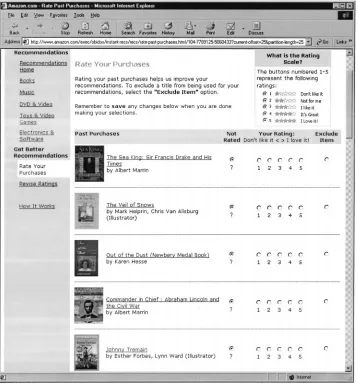
Your Recommendations: Amazon also encourages direct feedback from customers about books they have read. Customers rate books they have read on a 5-point scale from “hated it” to “loved it.” After rating a sample of books, customers may request recommendations for books that they might like. At that point, a half dozen non-rated texts are presented that correlate with the user’s indicated tastes. Figure 1 shows a sample screen from Your Recommendations.
Eyes: The Eyes feature allows customers to be notified via email of new items that have been added to the Amazon.com catalog. Customers enter requests based upon author, title, subject, ISBN, or publication date information. Customers can use both simple and more complex Boolean-based criteria (AND/OR) for notification queries. One of the interesting variations of the Eyes system allows requests to be directly entered from any search results screen, creating a persistent request based on the search.
Amazon.com Delivers: Amazon.com Delivers is a variation on the Eyes feature. Customers select checkboxes to choose from a list of specific categories/genres (Oprah books, bi-ographies, cooking). Periodically the editors at Amazon.com send their latest recommen-dations by email to subscribers in each category.
Bookstore Gift Ideas: The Gift Ideas feature allows customers to receive recommendations from editors. Customers pick a category of books for which they would like some sug-gestions. By navigating to that section of the “Gift Department,” they can view a general list of recommendations created by the editors of Amazon.com. They also can select to view recommendations in one of a predefined list of categories including Globetrotter, Entrepreneur, and Teens. In many ways this serves as an online version of the Amazon. com Delivers feature discussed earlier. However, customers can be provided with recom-mendations anonymously since there is no need to register with the site as there is with Delivers.
124 SCHAFER, KONSTAN AND RIEDL
Figure 1. The Amazon.com ratings page prompts the customer to rate items recently purchased. These ratings are used as input to a recommendation engine to help the customer find other items that she is likely to like. Customers are asked to invest effort in rating, in exchange for which they get more useful recommendations.
them to select a “domain” with which they associate themselves. Customers can view Purchase Circles by navigating to the Circle that interests them.
3.2. CDNOW
Album Advisor: The Album Advisor feature of CDNOWTM(www.cdnow.com) works in
three different modes. The first two are similar to the Customers Who Bought feature of Amazon.com. Customers locate the information page for a given album or artist. The system then recommends ten other albums related to the album or artist in question. Results are presented as “Customers who bought X also bought set S” or “Customers who bought items by Y also bought set T.” The third mode works as a “gift advisor.” Customers type in the names of up to three artists, and the system returns a list of ten albums CDNOW considers similar to the artists in question.
Related Artists: The Related Artists feature of CDNOW works on the assumption that if a customer likes a certain performer, there is a group of artists with similar styles that she will also like. Customers locate an artist and select the Related Artists link. Upon doing so, they are provided with a list of these artists who are considered to be “similar artists” and a list of artists who are considered to be among the “roots and influences” for the selected artist.
Buyer’s Guides: The Buyer’s Guide feature at CDNOW allows customers to receive rec-ommendations based on a particular genre of music. Customers browse a list of genres provided by the site, including categories such as British Invasion, Big Chilling, and Parent Pop. Selecting one of the links from this list takes customers to a new list of albums the editors consider the essential part of this genre.
Artist Picks: In the Similar Artist feature at CDNOW one of the categories of recommenda-tions is “roots and influences.” Presumably editors create this list. The Artist Picks feature provides similar recommendations, directly from the artists. Each week a different artist is featured, who lists the albums that shaped his or her taste as well as what is currently in their CD player.
Top100: Traditionally, hype and “bestseller” status have been used by commerce sites to make recommendations to their customers. After all, if an album is on the Billboard Top 10, then it must be a good album. The Top 100 feature allows customers of CDNOW to receive this type of recommendation, but the 100 are drawn from the sales figures of the site and can theoretically be continuously upgraded to reflect actual sales.
126 SCHAFER, KONSTAN AND RIEDL
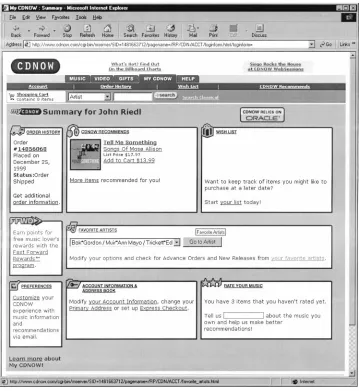
Figure 2. The My CDNOW page includes recommendations, prompts to rate past purchases, updates on favorite artists, and a Wish List, to communicate gift wishes to family or friends. This page serves as an entry point for a frequent CDNOW customer, as well as serving for an integrated access point to recommendations.
3.3. Drugstore.com
provided with this information the Advisor returns a list of products recommended to meet the conditions.
Test Drives: In the Test Drives feature, a team of volunteers, made up of customers from the site, is sent a new product. These “fellow customers” provide reviews of the product including a star rating and text comments.
3.4. eBay
Feedback Profile: The Feedback Profile feature at eBay.comTM(www.ebay.com) allows both buyers and sellers to contribute to feedback profiles of other customers with whom they have done business. The feedback consists of a satisfaction rating (satisfied/neutral/ dissatisfied) as well as a specific comment about the other customer. Feedback is used to provide a recommender system for purchasers, who are able to view the profile of sellers. This profile consists of a table of the number of each rating in the past 7 days, past month, and past 6 months, as well as an overall summary (e.g., 867 positives from 776 unique customers). Upon further request, customers can browse the individual ratings and comments for the sellers.
Personal Shopper: The personal shopper feature of eBay allows customers to indicate items they are interested in purchasing. Customers input a “short term” (30/60/90 days) and search on a set of keywords of their choosing, including their price limit. On a periodic basis (one or three day intervals) the site performs the customer’s search over all auctions at the site and sends the customer an email with the results of this search.
3.5. MovieFinder.com
MovieFinder.com is the movie site maintained by E! Online.
Users Grade/Our Grade: Both the Users Grade and the Our Grade features report a letter grade recommendation to the customer. The Users Grade feature allows customers to register with the site and give letter grades (A-F) to the movies they have seen. These grades are then averaged over all customers and reported as the Users Grade. The Our Grade feature provides customers with a grade from the editors of E! Online. Thus, customers viewing the information page for Toy Story 2 might find that it gets a grade of A from the editors with a grade of A-from the customers who have rated it.
Top 10: The Top 10 feature at E! Online allows the customers to get recommendations from the editors in a category of their choice. Customers select a category from a list of previously defined categories such as chick flicks, sex scenes, and movies from books. Selecting a list takes the customer through descriptions of the top ten movies in that category as defined by one of the editors of E! Online.
3.6. Reel.com
128 SCHAFER, KONSTAN AND RIEDL
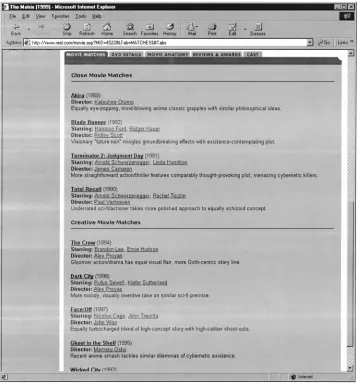
Figure 3. Reel.com’s Movie Matches presents editors’ picks for movies that will appeal to a customer using the movie a customer is currently browsing as an indication of interest. The picks are made by human editors, and come in two categories: Close Movie Matches, designed to provide safer recommendations, and Creative Movie Matches, designed to provide more serendipity in the recommendation.
4. A taxonomy for recommender applications
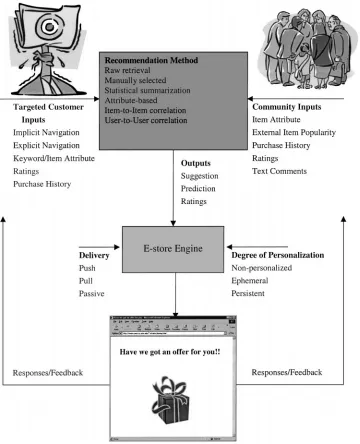
Using the previous examples, we have developed a taxonomy for E-commerce recommender applications that separates their attributes into three categories: the functional I/O, the recommendation method, and other design issues. Figure 4 illustrates how sub-parts of these categories are used in the recommendation process, as well as what the dimensions are within each portion. These parts and their dimensions are explained in more detail in the remainder of this section.
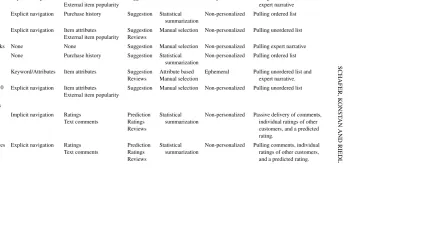
These three categories are not independent; as the examples in Table 1 illustrate, certain design choices require specific outputs. Similarly, certain outputs can be produced only by some, but not all, of the recommendation methods. Furthermore, our taxonomy includes only recommenders that attempt to help individual consumers based on preference data, such as interest information about products or purchase history. We do not consider methods that recommend according to less personal information, such as segmentation, demographic or psychographic or purely business information. Finally, we do not claim that the taxonomy is complete. Rather, it represents the range of E-commerce applications in use at the time of this writing. We fully expect new I/O, methods, and designs to emerge. We do, however, expect the basic structure of the taxonomy to remain useful as new practices are integrated into it.
4.1. Functional I/O
To simplify the process, we begin by concerning ourselves only with the data flowing into and out of these systems. Each system takes in a collection of inputs that may include consumer preference data, attribute data, and other correlates. Since this covers a large space of data, we additionally divide these inputs to indicate their origin—inputs about the targeted customer (i.e., about the customer for whom we are making recommendations) vs. general inputs regarding the community of other customers. Recommender applications use these inputs to produce output recommendations for other items. Analysis of these I/O produced the following dimensions.
Targeted customer inputs. Inputs about the targeted customer are fed into the recommen-dation process to provide personalized recommenrecommen-dations. An application that uses no inputs about the targeted customer can produce only non-personal recommendations. Adding one or more types of inputs allows the recommender application to personalize recommenda-tions based on the customer’s current activity, the customer’s long-term preferences, or both. While there are multiple ways of categorizing the inputs from the targeted customer, one compelling set of categories evolves from the customer’s approach toward providing the input.
130
SCHAFER,
K
ONST
AN
AND
RIEDL
Table 1. Taxonomy of recommender applications, organized by application model.
Functional I/O Design issues
Targeted Community Recommendation Degree of
Application model customer input input Output method personalization Delivery
Broad Recommendations List
Amazon Bookstore Explicit navigation Item attributes Suggestion Manual selection Non-personalized Pulling unordered list and
Gift Ideas External item popularity expert narrative
Amazon Purchase Explicit navigation Purchase history Suggestion Statistical Non-personalized Pulling ordered list
Circles summarization
CDNOWBuyer’s Explicit navigation Item attributes Suggestion Manual selection Non-personalized Pulling unordered list
Guides External item popularity Reviews
CDNOW Artist Picks None None Suggestion Manual selection Non-personalized Pulling expert narrative
CDNOW Top 100 None Purchase history Suggestion Statistical Non-personalized Pulling ordered list summarization
Drugstore Advisor Keyword/Attributes Item attributes Suggestion Attribute based Ephemeral Pulling unordered list and
Reviews Manual selection expert narrative.
MovieFinder Top 10 Explicit navigation Item attributes Suggestion Manual selection Non-personalized Pulling unordered list External item popularity
Comments and ratings
Amazon Customer Implicit navigation Ratings Prediction Statistical Non-personalized Passive delivery of comments,
Comments Text comments Ratings summarization individual ratings of other
Reviews customers, and a predicted
rating.
Drugstore Test Drives Explicit navigation Ratings Prediction Statistical Non-personalized Pulling comments, individual
Text comments Ratings summarization ratings of other customers,
RECOMMEND
A
TION
APPLICA
TIONS
131
Text comments Ratings summarization individual ratings of other
Reviews customers, and a predicted rating.
Notification service
Amazon Eyes Keyword/Attribute Item attributes Suggestion Attribute based Persistent Pushing single recommendation
Amazon.com Delivers Keyword/Attribute Item attributes Reviews Manual selection Persistent Pushing expert narrative
eBay Personal Shopper Keyword/Attribute Item attributes Suggestion Attribute based Persistent Pushing unordered list
Product-associated
Amazon Customers Implicit navigation Purchase history Suggestion Item-to- Ephemeral Passive delivery of unordered list who Bought
Item correlation
CDNOW Album Explicit navigation Purchase history Suggestion Item-to- Ephemeral Passive delivery of unordered list
Advisor-Single Item correlation
CDNOW Album Keyword/Attribute Purchase history Suggestion Item-to- Ephemeral Pulling unordered list Advisor-Multiple Item
Item correlation
CDNOW Related Artists Explicit navigation Item attributes Suggestion Manual selection Ephemeral Pulling unordered list
MovieFinderUsers/Our Implicit navigation Ratings Prediction Statistical Ephemeral Passive delivery of predicted rating
Grade summarization
Reel.com Movie Matches Implicit navigation Item attributes Suggestion Item-to-Item Ephemeral Passive delivery of unordered list correlation
Deep personalization
Amazon Your Purchase history Ratings Prediction User-to- Persistent Pulling (un)ordered list
Recommendations Ratings Purchase history Suggestion
User correlation
My CDNOW Purchase history Purchase history Suggestion User-to- Persistent Passive delivery of unordered list Ratings
132 SCHAFER, KONSTAN AND RIEDL
performs for the sole purpose of enhancing the recommendations.Implicit navigationinputs are, generally, inferred from the customer’s behavior without the customer’s awareness of their use for recommendation processes. This input may include thespecific item or items that the customer is currently viewing or those items in the customer’s shopping cart. For example, Amazon.com utilizes the particular book that a customer is browsing to recommend a set of additional books considered in some way similar to the currently viewed text. This input may also include thecategory or feature to which the customer has navigated. In doing so, e-merchants hope these applications will help convince the browser that the initial product is worthwhile—if he likes the “similar” item(s)—and help sell multiple products at once.
In contrast,explicit navigationinputs are intentionally made by the customer with the purpose of informing the recommender application of his or her preferences. To offer these, sites provide the customer with a finite set of attribute choices as navigational links. For example, a customer using MovieFinder’s Top 10 feature is provided with a hyperlinked list of top ten lists produced by the editors. By navigating to a list of interest, the customer can get recommendations for products in a fairly specific category. Despite differences in the configuration of these systems, from a customer’s point of view, he is simply navigating.
In some cases, input from the customer can not be limited to a single category or item of interest. In these cases, applications may usekeywords and item attributes, either explicitly from a search or implicitly, derived from the items being viewed. In either case, these keywords/attributes are interpreted as input that models the customer’s current interests. For example, customers using the Advisor at Drugstore.com provide information about their wants and/or needs before receiving recommendations for products such as cold and flu remedies. Systems using these types of inputs replace the feel of navigation with the feel of searching.
134 SCHAFER, KONSTAN AND RIEDL
Community inputs. Community inputs include a broad range of data regarding how multiple individuals in the community, or the community as a whole, perceive items. Inputs that reflect overall community opinions includeitem attributeassignments that as-sign community-based labels and categories to items. For example, many attributes such as film genre and book categories reflect the consensus of the broader society. Similarly, external item popularitymay reflect popularity in broader communities such as global box-office sales or national best-seller lists. In manually selected recommendation lists such as CDNOW’s Buyer’s Guides, it is presumed that editors are taking into account more than site sales figures to generate their list of most popular products. Finally, just as we described using the purchase history of an individual customer as a set of implicit rat-ings about products, we can utilize thecommunity purchase historyto do the same. These can be combined to produce site-specific top seller lists (Purchase Circles), or mined to discover similarities, and draw conclusions about sales trends or item similarity (Album Advisor).
While the previous community inputs are tied to the community as a whole, other inputs are directly associated with individual members of the recommender community. Several sites encouragetext commentsfrom their customers. Systems such as Drugstore.com’s Test Drives gather comments about a single product and present these as a means to facilitate the decision-making process. While text comments are helpful, they require a fair amount of processing by the targeted customer. The customer must read each paragraph and interpret to what degree it is positive or negative. To simplify this process, most sites offering the opportunity for the community to write text comments also encourage the members to indicate some form of numerical score orratings. Just as recommendation systems can use the ratings of the targeted customer, they can also gather the ratings of all customers to provide data for use in producing recommendations.
Worth discussing at this time is the source of these inputs. Most of the sites in our survey appear to be using largely site-specific data about their customers, combined with both site-specific and syndicated data about their products. Item attributes are usually syndicated through services that publish digital catalogs comprising categorizations and descriptions of products. For instance, book vendors often use third party genre and keyword classifications. These third party attributes are often supplemented with a smaller amount of site-specific data. External item popularity is nearly always syndicated to provide a broad measure of consumer interest. Community purchase information is always site-specific, based on purchase behaviors of groups of customers from the site. Community text comments and ratings are primarily site-specific. In principle these data could be shared between sites, but we do not know of examples of such sharing to date.
enhance recommendations for consumers; whether or not it will be common in practice is still an open issue.
Outputs. Output recommendations of specific items vary in type, quantity, and look of the information provided to the customer. The most common type of output can be considered asuggestion. This often takes the form of “try this,” or simply placing “this” in the web page viewed by the user. The simplest form of “this” is the recommendation of a single item. By recommending only a single item, the e-merchant increases the chance that the customer will seriously consider the item since the recommendation takes little time to process. However, it also places all of the risk in a single recommendation, which may be rejected because the customer already owns the item or has other outside knowledge. Tar-geted advertising also generally results in an individual recommendation as do “check-out coupon” promotions and some other systems designed to elicit up-selling. More commonly, recommender systems provide a set of suggestions for a customer in a particular context. Some application designers prefer to leave the list unordered, to avoid giving the impres-sion that a particular recommendation is the best one. Unordered lists may avoid premature customer dismissal of an entire set of recommendations based on rejection of the first one. (Of course, every list has some order; many “unordered” lists are deliberately presented in another order, such as alphabetical order, to avoid being misinterpreted as best-first.) Other applications rank recommended items. The ordered list provides extra information that may be helpful to customers.
Several recommender algorithms present consumers with apredictionof the rating they would give to an item. These estimates can be presented as personalized estimates for individual consumers or as non-personalized estimates for typical community members. These predicted ratings can help customers understand the strength of a recommendation. Predicted ratings can be displayed in the context of individual recommendations or lists of recommendations, or they can be displayed in the context of general item information. MovieFinder’s “Customer Grade/Our Grade” feature provides two different predictions (community and editorial) on an A to F scale that are presented as a user browses the information screen for a movie of her selection.
136 SCHAFER, KONSTAN AND RIEDL
of comments. It is possible to select or order comments based on a customer’s history of agreement with the commenter, but we are unaware of any E-commerce applications that do so. By doing so, these systems would be providing commenters with “credentials”— some indication that this person’s comments hold value. The closest step we’ve seen is a level of “meta-rating” on Amazon.com where readers of comments can rate the comments themselves. There is as yet no mechanism for automatically using those ratings to create personalized sets of comments.
4.2. Recommendation method
In the previous section we focused on the data utilized and generated in the recommenda-tion process. In this secrecommenda-tion we provide an overview of the specific processes used in actual E-commerce recommender systems. We should point out that individual systems may actu-ally use a combination of these processes. Each category discussed here represents a family of algorithms and approaches. It is beyond the scope of this work to survey the variant implementations of each process. Breese et al. (1998) compare a variety of algorithms for recommendation generation, and Herlocker et al. (1999) provide a detailed comparison of customer-to-customer correlation algorithms.
Theraw retrieval“null recommender” system provides customers with a search interface through which they can query a database of items. In this case, recommendation is a “binary,” syntactic process whereby the system “recommends” whatever the customer has requested. While not technically a recommender application, such an application may appear as one to customers. For example, when a customer asks a music site for albums by “The Beatles,” the system returns a list of Beatles albums that may be helpful and may indeed lead the customer to an album of which he was previously unaware. Raw retrieval systems are ubiquitous in E-commerce applications.
which provides average ratings of buyers and sellers. Prospective sellers and buyers can consult the average and the individual evaluations but cannot see the rating by “customers I’ve agreed with.” While these summaries provide only non-personalized recommendations, they are popular because they are easy to compute, and they can be used in non-customized environments such as physical store displays.
Recommendations based on the syntactic properties of the items and customer interests in those properties useattribute-basedrecommendation technologies. Though the simplest attribute-based recommendation is raw retrieval, true “recommenders” that use attributes model customer interests beyond a simple query. For example, a customer who is browsing in the “country music” section of a music store and who has several “$9.99 special” compact disks in her shopping cart might receive recommendations for discount country CDs. Other attribute-based recommenders use customer profiles that indicate likes or dislikes to make recommendations to the customer. For example, the same music store may learn that a particular customer only buys discounted CDs or that another customer never buys music from the 1970s.
Other applications use item-to-item correlation to identify items frequently found in “association” with items in which a customer has expressed interest. Association may be based on co-purchase data, preference by common customers, or other measures. In its simplest implementation, item-to-item correlation can be used to identify “matching items” for a single item, such as other clothing items that are commonly purchased with a pair of pants. More powerful systems match an entire set of items, such as those in a customer’s shopping cart, to identify appropriate items to recommend. Item-to-item correlation rec-ommender applications usually use current purchases or other current interests rather than long-term customer history, which makes them particularly well-suited for recommending gifts. A customer merely needs to identify some other items liked by the recipient to elicit gift recommendations tailored to the recipient rather than the giver.
Finally, recommender systems usinguser-to-user correlationrecommend products to a customer based on the correlation between that customer and other customers who have purchased products from the E-commerce site. This technology is often called “collaborative filtering” because it originated as an information filtering technique that used group opinions to recommend information items to individuals (Resnick et al., 1994; Hill et al., 1995; Shardanand and Maes, 1995; Konstan et al., 1997). My CDNOW is a system that uses user-to-user correlations to identify a community of customers who tend to own and like the same sets of CDs. The principle is that if several members of my community owned and liked the latest Sting album, then it is highly likely that I will too. Though we use the word correlation in the name of this technique, thus hinting at nearest-neighbor techniques based on linear correlation, the technique can be implemented with many other technologies as well (Breese et al., 1998).
138 SCHAFER, KONSTAN AND RIEDL
attribute-based are all simple computations that are usually performed during customer interaction. Item-to-item correlation and user-to-user correlation are computationally more intensive and often require an offline component to prepare a model that can be executed efficiently online. One challenge in designing the model-building is to ensure the resulting online system is as responsive as possible to interactive input from the user.
4.3. Other design issues
Degree of personalization. Recommender applications may produce recommendations at varying degrees of personalization. The degree of personalization encompasses several factors including both the accuracy and the usefulness of recommendations. Accuracy measures how correct the system is while usefulness includes such factors asserendipity— whether the system provides valuable, but unexpected recommendations-and individua-lization—whether the system provides different recommendations to different people— measures which are both important. An accurate system that only recommends consensus best-sellers provides less value than a system that can find and recommend more obscure books of interest to particular users. Similarly, a system that recommends obscure books, but that is rarely correct, would not be used for long. While personalization is a continuum across several dimensions, we find it useful to specifically identify three common levels.
When recommender applications provide identical recommendations to each customer, the application is classified asnon-personalized. The specific recommendations may be based on manual selection, statistical summarization, or other techniques. Many of the E-commerce recommendation examples are non-personalized. Top-sellers, editor choices, average ratings, and unfiltered customer comments all present the same recommendations to each customer of the system.
Recommenders that use current customer inputs to customize the recommendation to the customer’s current interests provideephemeral personalization. This is a step above non-personalized recommenders because it provides recommendations that are responsive to the customer’s navigation and selection. Particular implementations may be more or less personal, however. A recommender application with a high degree of ephemeral person-alization would be one that uses an entire current browsing session or shopping cart to recommend items. Conversely, a recommender application that simply attaches recommen-dations to the current item is nearly non-personalized. Ephemeral personalization is usually based on item-to-item correlation, attribute-based recommendation, or both. Examples of ephemeral personalization include CDNOW’s multi-item Album Advisor and certain ver-sions of Drugstore.com’s Advisors. Both take information provided by the customer at recommendation time and return a list of suggestions from that ephemeral context.
Amazon.com’s Eyes and eBay’s Personal Shopper, which use persistent attribute recom-mendation.
Delivery. Matching the delivery of recommendations to the customer’s activity is a critical design decision in E-commerce recommender systems, just as it is in traditional marketing. In fact, E-commerce provides close analogues to traditional solicitation and retail mod-els. Marketers have long used direct mail and outbound telemarketing in an attempt to get customers to initiate a new buying session.Pushtechnologies have the benefit of reaching out to a customer when the customer is not currently interacting with the e-merchant. In E-commerce applications, e-mail is the most commonly used push technology for deliver-ing recommendations. Senddeliver-ing recommendations, and perhaps promotional offers, invites the customer to return to the e-merchant. Indeed, today’s technology allows customers to click on a link in the e-mail message and be taken directly to the recommended product on-line.
Applications usingpulltechnologies allow the customer to control when recommenda-tions are displayed. They make the customer aware that recommendarecommenda-tions are available (e.g., by displaying a link to them) but do not actively display recommendations until the customer requests them. This request may appear in different contexts, such as a request to evaluate a specific product, a request to find a gift, or a request for recommendations in a category. Some early applications used pull delivery because recommendation compu-tation was expensive and could slow down the interactivity of a site. Today, pull delivery is a design choice for applications where types of recommendations are considered pe-ripheral (e.g., top 10 lists or gift recommendations) rather than integrated into the applica-tion.
Sometimes referred to as “organic” recommendations,passivedelivery presents the rec-ommendation in the natural context of the rest of the E-commerce application. Examples of passive recommendation include displaying recommendations for products related to the current product (Amazon.com’s Customers Who Bought feature), displaying recommenda-tions for products related to the topic of a text article (CDNOW’s Artist Picks) and displaying recommendations in the context of exploration (Drugstore.com’s Advisors). Passive rec-ommendation has the advantage of reaching the customer at the time when the customer is already receptive to the idea. Indeed, E-commerce uses passive recommendation as part of the ordering process, suggesting upgraded shipping options, for example, at the time when the customer is completing a purchase (where it is much more effective than asking about shipping on a link off the home page). A possible disadvantage of passive recommendations is that customers may not actively notice them, but we are not aware of any research that suggests that noticing recommendations explicitly makes them more effective than having them as part of the overall experience.
140 SCHAFER, KONSTAN AND RIEDL
5. E-commerce recommender application models
Section 4 classifies e-commerce recommendation applications by the functional inputs and outputs to the application, the recommendation method, and other design issues. Table 1 reveals five patterns in e-commerce recommender application designs, each addressing different business goals. This section identifies the five business goals and the application models used to address them. Designers of e-commerce recommender applications can use these models as examples of already-proven solutions to be emulated or can use these as a base from which to explore as-yet-untested recommender application models that may address new business needs.
Helping new and infrequent visitors: Broad recommendation lists
One of the key challenges for e-commerce sites is to engage visitors—especially new and infrequent visitors—before they leave to visit another site. For sites that list thousands to millions of different products, this challenge is particularly acute; they must not only en-gage the visitor but also keep him from getting lost and frustrated. Nearly every site visited has some form of broad recommendation list designed to direct customers towards engag-ing products. These lists typically allow the targeted customer to use current navigation to pull non-personalized suggestions. These include overall best sellers, best sellers in a cate-gory, editor and expert recommendations, and other collections of products selected either manually or through simple statistical summarization. In essence, these recommendation lists replace the tabletop displays, endcaps, and large product displays in physical stores. Whichever technique is used, the lists help orient users who might otherwise leave before finding compelling products.
Part of what makes broad recommendation lists so prominent is the low level of needed input; no personal information is needed, except for minimal ephemeral context about the category of interest to the customer. Broad recommendation lists allow marketers to adjust pricing and inventory to match the recommendations since they can be assured that these recommendations will reach a large audience. Editors or experts can create text to surround broad recommendations to market the recommended products to customers. The recommendations themselves can be delivered in several different ways, though most applications either place them on a home page or “category home” page or advertise them and have users directly select them.
Building credibility through community: Customer comments and ratings
navigation to suggest which non-personalized reviews, ratings, and predictions to display passively. By building a “community center,” sites allow customers to communicate with each other and provide each other with advice and feedback on products.
These “grass roots” recommendations require little site-directed effort, since the tomers do all of the evaluation. They also provide a high degree of credibility since cus-tomers often are more likely to believe a set of other cuscus-tomers than the marketer who makes money on the purchases. As a side benefit, they create a sense of community that can distinguish the site from others and thereby retain customers. Customer comment applica-tions provide a summary of the ratings, either as an average or another figure representing the rate of positive and negative recommendations, and give the customer an opportunity to read through the ratings and form her own opinion.
Inviting customers back: Notification services
Stores that know their customers’ interests can leverage that information by inviting them back to the store when new products of interest arrive or are discounted. Notification ser-vices use keywords provided by the targeted customer and attributes of the items being recommended to push persistent, personalized suggestions and can thereby build stronger customer relationships. Many e-merchants allow customers to describe the products they find interesting and then automatically notify them when such products are available. These notification services can provide a great service to the customer, who becomes quickly aware of new products of interest, and can be very effective at bringing customers back to the e-commerce site on a regular basis. The form of the descriptions can vary from a simple keyword or attribute query to a more complex specification that includes price ranges.
Cross-selling: Product-associated recommendations
Suggestive selling is particularly effective when the seller knows the current interests of the buyer. Retailers arrange products to enhance cross-selling by placing complementary items in close proximity. On-line retailers are freed from physical layout and can directly suggest products related to the one a customer is viewing. By using the targeted customer’s current navigation as an ephemeral indication of interest, such systems use item-to-item correlation and community purchase history to passively display suggestions to the targeted customer. Many different recommender applications use the context of a current product or several current products to recommend other products using a variety of recommender methods. This popularity is partly due to the variety of inputs that can be used to generate such recommendations, including anonymous purchase histories, customer purchase histories, ratings, product attributes and expert opinions. Product-associated recommendations are particularly well suited for passive delivery since they can be integrated into a product information page.
Building long-term relationships: Deep personalization
142 SCHAFER, KONSTAN AND RIEDL
on a customer’s history of preferences, purchases, or navigation, is the strongest and most difficult type of personalization to implement. Deep personalization is common already in web advertising and is becoming more widely used in e-commerce now that collaborative filtering recommendation engines are readily available. By utilizing collaborative filtering’s ability to match the targeted customer’s history with histories of other customers, deep personalization is able to generate persistent, personalized suggestions or predictions. Deep personalization builds a customer relationship over time, leveraging the history developed to provide increasingly better recommendations. Unlike notification services that require manual updating, deep personalization updates the user profile whenever the customer interacts with the merchant. Deep personalization systems can use user-to-user correlation, attribute-based systems with a learning module to identify user interests, or a combination of the two.
6. Research challenges
Although commercial recommender systems have been available for several years now, challenging research problems remain. This section outlines some of the more important technical challenges and when appropriate, describes recommender system applications that face the challenge as well as the opportunity that can be realized by overcoming the challenge.
Scalability and real-time performance
Scalability in recommender systems includes both very large problem sizes and real-time latency requirements. For instance, a recommender system connected to a large Web site must produce each recommendation within a few tens of milliseconds while serving hun-dreds or thousands of consumers simultaneously. The key performance measures are the maximum accepted latency for a recommendation (tens to hundreds of milliseconds), the number of simultaneous recommendation requests (tens to thousands), the number of con-sumers (hundreds of thousands to millions), the number of products (tens to millions), and the number of ratings per consumer (tens to thousands). Many techniques from data mining can be adapted to the scalability problem for recommender systems, including dimension-ality reduction and parallelism, but must be modified to meet the simultaneous throughput and latency requirements.
reduction techniques work poorly with extremely sparse data, so these techniques will have to be modified to work for recommender systems.
Ironically, not enough data is also a challenge for recommender systems, which must collect enough data to make effective recommendations for new customers. Sites can make good recommendations faster if they share information about their customers with other sites. Shared information benefits customers who receive more accurate recommendations in less time. Sites that use shared information benefit because the better recommendations help their customers find more products to purchase and because the customers prefer to return to stores with the better recommendations. Large sites that have a wide variety of customer data tend to prefer not to share the data with competitors because they feel having the data gives them a competitive advantage. Smaller sites can band together to overcome this competitive disadvantage by sharing customer data. Further, a consortium of non-competing sites may form with the goal of sharing data to increase the value to companies within the consortium. Customers of sites that share data will need assurances that their privacy will be carefully protected, even as their data are shared beyond the boundary of a single site. The appendix discusses privacy issues in recommender systems.
Incorporating rich data
Recommender applications currently use a wide range of input data in forming their rec-ommendations, including explicit ratings and simple behavioral data such as purchases and click-throughs. However, there are many other types of data that can be collected and used. In the future, recommender systems will commonly collect dozens of different types of data and integrate them into effective recommendations. Ongoing research in web usage min-ing and more general commerce-related data minmin-ing may reveal techniques for exploitmin-ing complex behavioral data.
144 SCHAFER, KONSTAN AND RIEDL
the value to customers of having access to agents trained for other customers (i.e., those that try to mimic others but do so by building a preference model based on content features and therefore can rate all items). Adding other machine learning systems to recommender systems may increase the accuracy of the recommender system, especially in cases where few humans have tried the products in question.
While many products appeal to consumers over a long time period, others have temporal relevance. Seasonal goods such as snow shovels and lawn care products may be highly desirable one month and useless two months later. Products for children exhibit similar pat-terns; the parent who buys toys for an infant should not receive infant toy recommendations for the same child two years later. Data mining research has addressed some issues in se-quence identification and temporal associations. How can these results be used to influence recommendations to make them more helpful to consumers?
Consumer-centered recommendations
One important difference between a recommender system and a traditional data mining system is that the end-user for the recommender system is the consumer. This difference leads to several desirable properties for recommender system algorithms that have not been explored in data mining algorithms.
Some recommendations are most valuable when they apply to a group of consumers rather than an individual. For instance, movies are most often attended socially. The choice of the right “date movie” can be very important. Recommenders can be used to select products that maximize the value of the product to a group of people. Some systems already support simple versions of this idea, such as selecting a movie that two people will like. Future multi-user recommendation systems will let customers control how the recommender system balances their interests in choosing a product. Should it choose a movie that neither will hate? That she will love? That they will both like? Different algorithms are needed for each of these scenarios to maximize the social good for the group, according to their needs.
Connecting recommenders to marketers
Recommender systems are currently used as virtual salespeople, rather than as marketing tools. The recommender system makes good decisions locally, but it is neither able to give the type of feedback needed for marketing professionals, nor is it able to accept input from marketing professionals about global preferences. In the future, recommender systems must integrate marketing features more completely.
Systems based on association rules or other non-personal data mining approaches build models of customer preference and must then filter out products the customer already owns to avoid seemingly trivial recommendations. Personalized recommender systems include customer ratings and purchases in the process and thereby avoid this challenge, but they too could benefit from more effective filtering of recommendations. Frequently either the mar-keter or the customer wants a recommendation set that is restricted based on specific criteria. For instance, a consumer might want recommendations only for products that are currently in stock, or a marketer might want to avoid recommending an R-rated movie to an eleven year old. Today’s recommender applications must post-filter recommendations or pre-filter candidates for recommendation. Research is needed to better integrate the recommendation process with other forms of product filtering to allow more integrated solutions.
Recommender systems should also be integrated with the marketer’s reporting systems. Recommender systems target each individual customer differently, making it difficult to produce the reports to which marketing professionals are accustomed. These reports usually partition the population into a manageable number of segments. One way to bring these two worlds together would be to use the people-to-people correlations implemented by some recommender system algorithms to create segments for the reports. Open questions include “How can names be assigned to the automatically generated segments?” and “Are automatically generated segments more useful for managing marketing campaigns than traditional segments?”
Recommender systems can be made more useful as marketing systems in other ways as well. Current recommender systems are mainly “buy-side” systems; that is, they are designed to work on behalf of the consumer to help him decide what products he should purchase. However, modern marketing is designed not only to maximize utility to the customer but also to maximize value to the business at the same time. The recommender system could produce an indication of the price sensitivity of the customer for a given product. For instance, one customer might be willing to purchase the product at a price that would earn the site ten cents of profit while another customer might purchase the same product at a one-dollar profit. Furthermore, this price sensitivity indication could be com-bined with a lifetime value model (e.g., Mani, 1999) to determine when it is in the best interest of the site to sell a product at a lower price-potentially even below cost-to increase the customer’s loyalty and thereby her long term value to the site. There are challenging ethical and practical issues in implementing systems like these that use information from studying the customer to implement price discrimination. The ethics of opinion ownership may lead sites to directly compensate customers for their information (Avery, 1999).