SISTEM PENGESAHAN KESAHIHAN DAKWAAN KENA SIHIR
NURUL NAJIHAH BINTI CHE RAZALI
THESIS SUBMITTED IN FULFILMENT OF THE REQUIREMENTS FOR THE AWARD IN THE DEGREE OF BACHELOR OF COMPUTER SCIENCE
(SOFTWARE ENGINEERING)
FACULTY OF COMPUTER SYSTEM AND SOFTWARE ENGINEERING UNIVERSITY MALAYSIA PAHANG
iv
ABSTRACT
Sistem Pengesahan Kesahihan Dakwaan Kena Sihir will help in terms of time savings
because only directly key-in data on any computer sessions with victim. Then data directly can be store in database. Besides, it can provide data security features of the data exposed or compromised. Further, it can facilitate Practitioners of Islam Al-Manarah Treatment Center analyzes and identifies validity victims, this system would provide bewitched validity from measurement index. Measurement index provides a range of questions and symptoms that can identify whether the facilitate Islam Al-Manarah Practitioner Treatment Center to
identify the victim bewitched or not.
Therefore this system can help the judges in divorce causes a fair judge because by measurement index, the victim can be identified. The Al-Manarah Treatment Center will get assist the court in making a decision pending over the years.
ABSTRAK
Sistem Pengesahan Kesahihan Dakwaan Kena Sihir akan membantu dari segi penjimatan masa kerana maklumat pengadu akan dimasukkan secara langsung pada computer. Kemudian data tersebut disimpan di dalam pangkalan data. Selain itu, ia boleh memberikan ciri-ciri keselamatan data daripada terdedah atau dikompromi. Selain itu, ia boleh memudahkan pengamal perubatan islam pusat rawatan Al-Manarah analisis dan mengenal pasti pengadu atau mangsa secara sah, sistem ini akan memberi kesahihan kena sihir daripada indeks pengukuran. Indeks Pengukuran menyediakan pelbagai soalan dan gejala-gejala yang boleh mengenal pasti setiap jawapan daripada mangsa. Ia juga memudahkan pengamal perubatan islam di Pusat Rawatan Al-Manarah mengenal pasti mangsa yang kena sihir atau tidak. Oleh itu sistem ini dapat membantu hakim dalam kes perceraian dalam membuat keputusan yang adil dengan wujudnya indeks pengukuran mangsa dapat dikenal pasti. Pusat Rawatan Al-Manarah akan dapat membantu mahkamah dalam membuat keputusan yang sebelum ini tidak diselesaikan dalam kes perceraiaan.
vi TABLE OF CONTENTS SUPERVISOR’S DECLARATION i STUDENT’S DECLARATION ii ACKNOWLEDGEMENTS iii ABSTRACT iv ABSTRAK v TABLE OF CONTENTS vi LIST OF TABLES ix LIST OF FIGURES x LIST OF ABBREVIATIONS xi Section Content 1. INTRODUCTION 1.1.1 Problem Statement 1 1.1.2 Objective 2 1.1.3 Scope 2
1.2Review Previous Work
1.2.1 First Case Study 3
1.2.2 Second Case Study 5
1.2.3 Third Case Study 6
1.3 Current System and Limitations 8 Existing System Studies
1.4 Methodology 9
2. SOFTWARE REQUIREMENTS SPECIFICATION 2.1 Product Description 12 2.1.1 Product Perspective 12 2.1.2 Product Function 13 2.1.3 User Characteristic 14 2.1.4 Constraints 14 2.2 Interface Requirement 15 2.2.1 User Interface 15 2.2.2 Hardware Interface 15 2.2.3 Software Interface 16
2.3 Software Product Features 17
2.3.1 Login 17 2.3.2 Register Customer 18 2.3.3 Calculate Survey 19 2.3.4 Search Profile 20 2.3.5 View Result 21 2.4 Requirement Traceability 23 2.5 Development Environment 24
2.6 System Requirement Approval 25
3. SOFTWARE DESIGN DOCUMENT 3.1 General Architecture 26 3.2 Package Module 29 3.3 Data Dictionary 29 3.4 Detailed Design 32 3.4.1 User Module 33 3.4.1.1 Login Module 33 3.4.1.2 Register Customer Module 33 3.4.1.3 Calculate Survey Module 34 3.4.1.4 Search Module 34 3.4.1.5 View Module 35
viii 4. IMPLEMENTATION AND TESTING
4.1 Implementation 38
4.2 Testing 38
4.2.1 Use Case Number One (Login) 39 4.2.2 Use Case Number Two (Register Customer 39 4.2.3 Use Case Three (Calculate Survey) 39 4.2.4 Use Case Four (Search Profile) 40 4.2.5 Use Case Five (View Result) 40
4.3 System Testing approval 41
5. CONCLUSION 5.1 Conclusions 42 5.2 Future works 43 REFERENCES 44 APPENDIX A 45 APPENDIX B 47 APPENDIX C 51 APPENDIX D 60
LIST OF TABLE
Table Number
Page
1.1 Advantages and Disadvantages of RAD 11
2.1 User Characteristics 14
2.2 User interface 15
2.3 Hardware interface 15
2.4 Software interface 16
2.5 Login Use Case Description 17
2.6 Register Customer use case description 18 2.7 Calculate Survey use case description 19 2.8 Search profile use case description 20 2.9 View result use case description 21
2.10 Software Interface 24
3.1 Data dictionary of Pengadu 29
3.2 Data dictionary of simptom 30
3.3 Data dictionary of user 31
3.4 Data dictionary of markah 31
3.5 Data dictionary of pengesahan 32
3.6 Login Module 33
3.7 Register Customer Module 33
3.8 Calculate Survey Module 34
3.9 Search Module 34
3.10 View Module 35
x
LIST OF FIGURE
Figure Number
Page
1.1 Page of Managing High Blood Pressure System 3 1.2 Page of Managing High Blood Pressure System 4 1.3 Page of Stress Management System 5 1.4 Page of Stress Management System 6 1.5 Page of Smoking Cessation program System 7 1.6 Page of Smoking Cessation program System 8
1.7 Flow chart of manual system 8
1.8 Rapid Application Development (RAD) 9
2.1 Context Diagram 12
2.2 Use case Diagram 13
2.3 Login use case 17
2.4 Register Customer use case 18
2.5 Calculate Survey use case 19
2.6 Search profile use case 20
2.7 View result use case 21
3.1 General Architecture 26
3.2 Boundary Package 27
3.3 Web Form package 28
3.4 Middleware Layer 28
LIST OF ABBREVIATIONS
SPKDKS Sistem Pengesahan Kesahihan Dakwaan Kena Sihir RAD Rapid Application Development
SQL Standard Query Language PHP Hypertext Pre-processor TTM Trans Theoretical Model
SRS Software Requirements Specification SDD Software Design Document
NA Not Applicable
1
CHAPTER 1
INTRODUCTION
1.1 INTRODUCTION
1.1.1 Problem Statements
Nowadays , there are many cases that faced by the community member due to magic act done by to human being whom are not grateful for what they have. The most frequent cases due to magic act are the divorce case. There are many different kinds of magic practiced by the community in order to destroy the happiness of a family institution. Usually, there are common symptoms that faced by the people who suffered from this type of magic act for example ignoring their responsibilities in the family, disrespect between husbands and wife and many more. Basically, we can categories few groups of magic acts that occurred towards family members. Recently, in our country divorce cases due to magic act have been raised up in the sharia court (Ismail, M. (2013)).
However, there are still no any solution on the divorce cases that due to magic act. Thus, a system has been proposed in order to help the legislation, to make decision on divorce cases that to bewitched causes.
1.1.2 Objectives
i. To study index measurement validity on divorce system cases that due to magic act.
ii. To develop on online system of bewitched allegation divorce cases use by Treatment Center Al-Manarah
iii. To test the system based on real data given by client.
1.1.3 Scopes
The study is focused on the research that has been carried out by the Al-Manarah Treatment Center. Basically, the study will focused on selected cases that would be conduct at Sharia Courts especially regarding divorce cases that due to magic act. This center will help the victims to identify their emotion and physical condition. Besides that, it help the Sharia courts to access the validity of the develop index. This would help the judges to give impartial decision and to protect the family institution from being the victims of any kinds of magic act. Scopes for this system are:
i. Practitioners of Islam Al-Manarah Treatment Center ii. This system belongs Treatment Center Al-Manarah
iii. This system for develop a web mobile application for standard index of validity of bewitched allegation.
3
1.2 REVIEW PREVIOUS WORK
1.2.1 First Case Study (Managing High Blood Pressure System)
1. Pro-Change’s current Medication Adherence programs are designed to complement physician-prescribed programs of treatment and deal specifically with consistently taking Blood pressure lowering (antihypertensive) medication. The Managing High Blood Pressure program includes a fully tailored CTI for the acquisition of, adhece to, and prevention of discontinuation of antihypertensive medication(s).
Johnson, S.S.. (May 7, 2013).
The Program also provides stage-matched feedback for each of the lifestyle changes required to manage high blood pressure (e.g. exercise, fruit and vegetable consumption, moderate sodium intake, etc.) as per national treatment guidelines from the Seventh Report of the Joint National Committee on Prevention, Detection, Evaluation, and Treatment of High Blood Pressure.
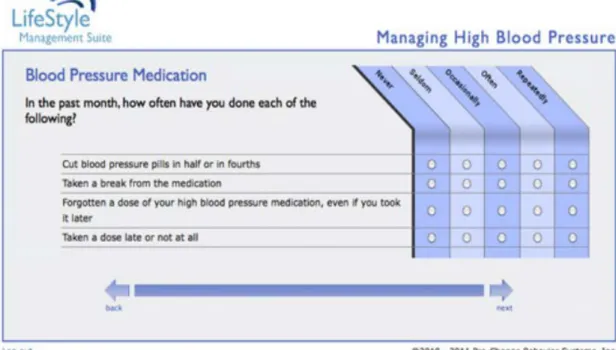
Base on figure 1.1, it shows of question how often we have done each of the optional that system given.
Figure 1.2 : Page of Managing High Blood Pressure System
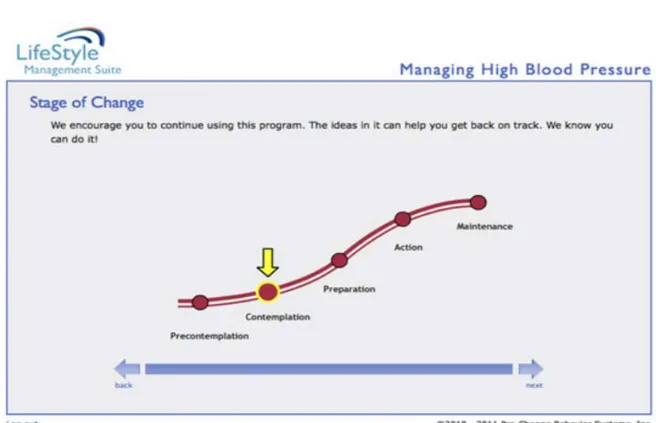
Base on figure 1.2, this page show is stage of change, it give ideas in it can help user get back on track.
5
1.2.2 Second Case Study (Stress Management System)
Pro-Change’s Stress Management program assists adults in effectively managing stress in healthy ways, including: exercising, seeking social support, and using relaxation techniques.
It is recognized by Health Care Innovation Exchange for its quality of underlying research and readiness for dissemination, includes these key messages and techniques:
1. Identifying specific items and events that cause stress
2. Understanding effects of stress on the body and benefits of managing stress
3. Learning stress management practices such as relaxation and time management
Stress management is likely to be important in coming years as Towers Watson (2011) reports that employers are increasingly interested in addressing employee stress. The report states that companies must identify stress-reduction solutions that work for their organizations or suffer the business consequences of increased absences, presenters, and unwanted turnover.
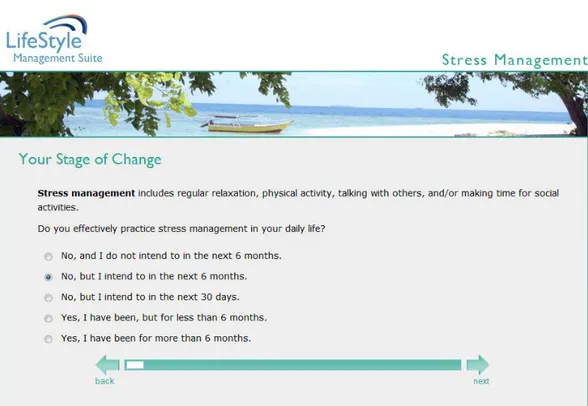
Based on figure 1.3, it show Trans theoretical Model (TTM) of Behavior Change and funded by grants from the National Cancer Institute, the program was developed through extensive research. The mobile-optimized computer-tailored intervention begins with an assessment of the user’s stage of change for effectively managing stress. (Evers, K.E.. (May 7, 2013).
Figure 1.4: Page of Stress Management System
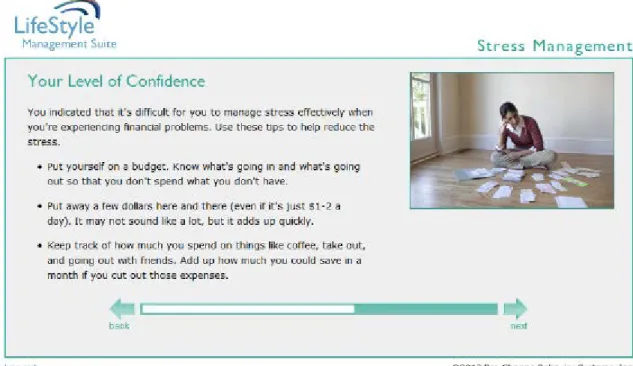
Based on figure 1.4, the system provides feedback on the situation for which the user is least confident in his or her ability to effectively manage stress.
1.2.3 Third Case Study (Smoking Cessation Program System)
Pro-Change’s Smoking Cessation program assists smokers in all stages of quitting and helps those who have quit staying smoke-free. Multiple studies have found Trans theoretical Model (TTM) based individualized interventions for smoking cessation to produce long-term abstinence rates within the range of 22 – 26%. (Prochaska, J.O. (May 5, 2013).
7
Those interventions have also consistently outperformed alternative interventions including action-oriented self-help programs, non-interactive manual-based programs, and other common interventions. Furthermore, these interventions continued to move smokers to abstinence even after the studies concluded.
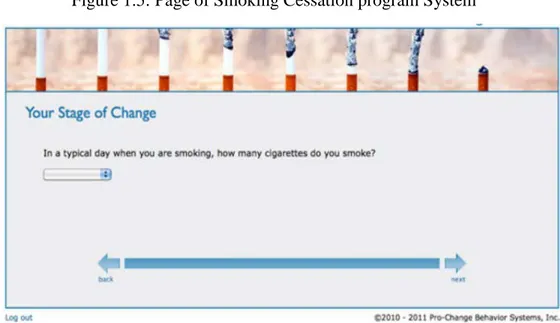
Figure 1.5: Page of Smoking Cessation program System
Based on figure 1.5, for the first page show user’s stage of change and give a list box to list how many cigarettes do user smoke in a typical day.
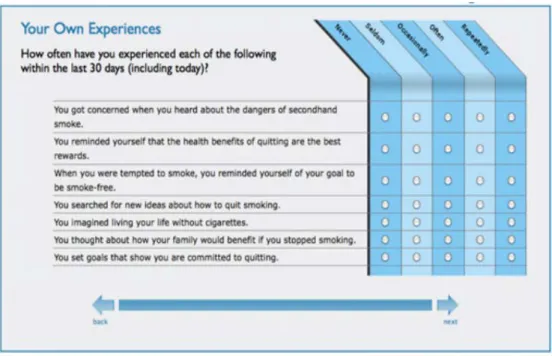
Figure 1.6: Page of Smoking Cessation program System
Based on figure 1.6, this page asked user’s experience, it use radio button optional such as Never, Seldom, Occasionally, Often and Repeatedly.
1.3 CURRENT SYSTEM AND LIMITATIONS
Figure 1.7: Flow chart of manual system
B
Based on figure 1.7, the present manual has many constraints, it cannot help in terms of data safety, factor of time and measurement index make be complex. To facilitate a clear diagram obtained on the research problem domain, the system was carried out. Review the contents of the order and how to describe the features to be developed according to the features used by the system.
9
1.4 METHODOLOGY
Rapid Application Methodology (RAD) is a development lifecycle designed to give much faster development and higher-quality than those achieved with the traditional lifecycle by James Martin (Martin, J. (2000, August
31)). It is designed to take the maximum advantages of powerful development
software that has evolved recently. In short, RAD is exactly that. It is a process through which the development cycle of an application is expedited.
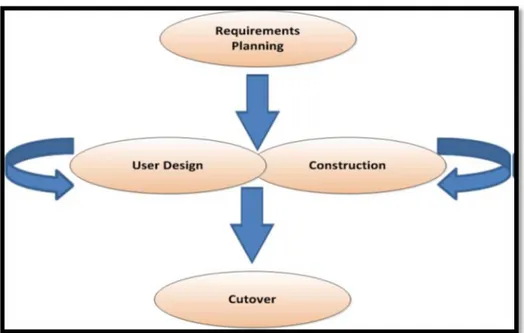
RAD thus enables quality products to be developed faster, saving valuable resources. The structure of the RAD model is thus designed to ensure that developers build the systems that the users really need. This lifecycle, through the following four stages, includes all of the activities and tasks required to scope and define business requirement and design, develop and implement the application system that support those requirements.
The phase of the RAD model:-
Requirements planning phase – combines elements of the system planning and systems analysis phases of the System Development Life Cycle (SDLC). Users, managers, and IT staff members discuss and agree on business needs, project scope, constraints, and system requirements. It ends when the team agrees on the key issues and obtains management authorization to continue.
User design phase – during this phase, users interact with systems analysts and develop models and prototypes that represent all system processes, inputs and outputs. The RAD groups or subgroups typically use a combination of Joint Application Development (JAD) techniques and CASE tools to translate user needs into working models. User Design is a continuous interactive process that allows users to understand, modify, and eventually approve a working model of the system that meets their needs.
Construction phase – focuses on program and application development task similar to the SDLC. In RAD, however, users continue to participate and can still suggest changes or improvements as actual screens or reports are developed. Its tasks are programming and application development, coding, unit-integration and system testing.
Cutover phase – resembles the final tasks in the SDLC implementation phase, including data conversion, testing, changeover to the new system, and user training. Compared with traditional methods, the entire process is compressed.
11
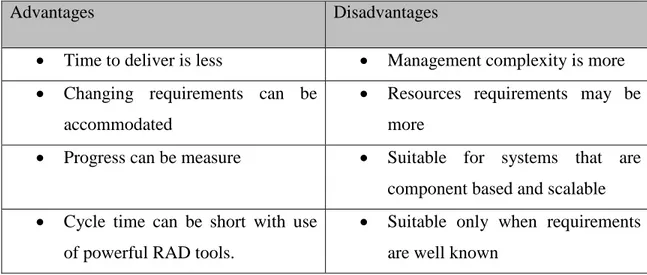
Table 1.1 Advantages and Disadvantages of RAD
Advantages Disadvantages
• Time to deliver is less • Management complexity is more • Changing requirements can be
accommodated
• Resources requirements may be more
• Progress can be measure • Suitable for systems that are component based and scalable • Cycle time can be short with use
of powerful RAD tools.
• Suitable only when requirements are well known
1.5 REPORT ORGANIZATION
This report consists of five parts as below:
Chapter 1 is the introduction to the project. In this part contain introduction, problem statement, objective, scope, previous work reviews, current system, methodology and report organization.
Chapter 2 i s t h e Software Requirements Specification (SRS). In this part contain overall requirement of the system.
Chapter 3 is the Software Desi gn Document (SDD). In this part contain logical and physical design of the system.
Chapter 4 is the Implementation and Testing phas e. Discuss how the system successfully develop, deploy and test by the client.
Chapter 5 is the summarize conclusion of the whole project. In this part consist of discussion and conclusion of the project. This part also contains future works suggestions for this project.
CHAPTER 2
SOFTWARE REQUIREMENTS SPECIFICATION (SRS)
2.1 PRODUCT DESCRIPTION
2.1.1. Product Perspective
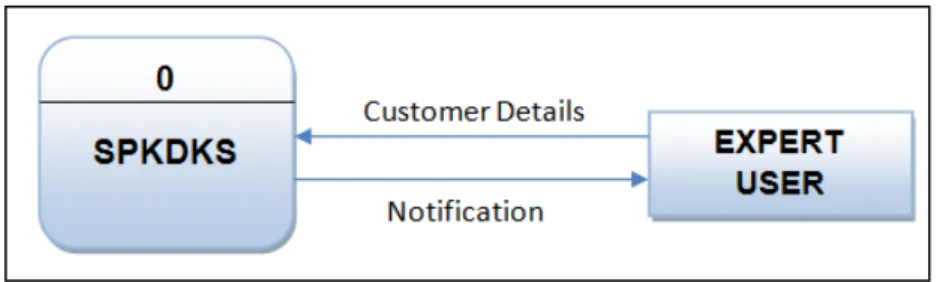
Figure 2.1 Context Diagram
Figure 2.1 shows context diagram for Sistem Pengukuran Kesahihan Dakwaan Kena Sihir ( SPKDKS). It is an application that can help user especially divorced because of alleged sorcery. The admin will sent expert user profile to log in the system. Then, expert user input an information customer for the SPKDKS and the system will sent notification for expert user.
13
2.1.2. Product Functions
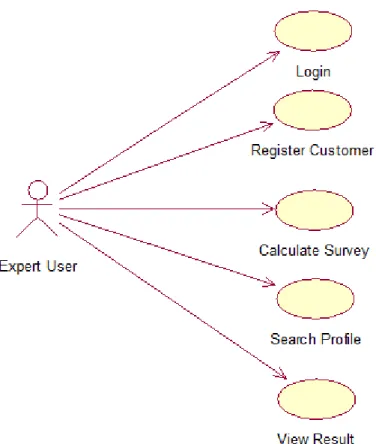
Figure 2.2 Use case Diagram
This use case as figure 2.2 shows functions can use in SPKDKS. There a one characters and some function. Expert user is an expert user and the some functions such as login, register customer, calculate survey of question, search profile and view result. Expert user also has login function in order to protect the system.
2.1.3. User Characteristics
This subsection of the SRS should describe those general characteristics of the intended users of the product, including educational level, experience, and technical expertise.
Table 2.1: User Characteristics
User Education level Background experience Admin Bachelor of Science
Computer in Software Engineering
Excellent inPHP Good in MySQL
Expert User Degree Master
Good in MS Office
Basic skill in using computer system.
2.1.4. Constraints
This must constraints still cannot avoid because it’s related each other’s. These include with :
i. Regulatory policies – This system use policy Sharia Court(Pahang & Selangor). ii. Control functions- Suggestion use android screen 10inch
iii. Higher-order language requirements – This system fully use malay language iv. Signal handshake protocols – Not Applicable
v. Criticality of the application – Result display still need refer Practitioner islamic vi. Safety and security considerations – Username & password constant in database
15
2.2 INTERFACE REQUIREMENTS
2.2.1. User Interface
User interface is a very important part in a system and it is the part that interacts with user. The user interface is a key and determines the application usability; therefore user interface must be user friendly and meet the user requirements. This is required due to the reason of a user who is inexperience and limited knowledge in using the system. There will be different set of user interfaces display according to their role. This section will show and explain about the interface which will be used by the users of the system.
Table 2.2: User interface Interface Function
Display main screen To display all information
Source Expert user fills up the form about source of knowledge. Method The method used by expert user
Material The material used by expert user Statistic This page will generate report
2.2.2. Hardware Interface
Table 2.3: Hardware interface Hardware Interface Function
Tab/Android To view the system and update all information. Printer To print all needed document.