http://dx.doi.org/10.18196/jgp.2017.0049.277 - 295
“In 3 Years We Would Have
Solved This”: Jokowi, ASEAN
And Transboundary Haze
HELENA VARKKEY
Department of International and Strategic Studies, University of Malaya, Kuala Lumpur, Malaysia
Email: [email protected],my
ABSTRACT
Joko Widodo took up office as President of Indonesia barely a month after the Republic ratified the ASEAN Agreement on Transboundary Haze Pollution. This momentous ratification coupled with the severe haze during his first few months in office, positioned haze as a priority issue for Jokowi and his administration. Since then, Jokowi has been proactively taking action at both the central and local levels. This was hoped to be a stepping stone towards better cooperation at the regional level. However, this was met with a somewhat contradictory state- ment by Jokowi in 2015 that quite firmly requested the ASEAN region to give him ‘three years’ to solve the haze issue. This could be taken to mean that Indo- nesia wanted to be ‘leftalone’ to deal with fire and haze issues for three years
without ASEAN ‘interference’. It is important to also assess this administration’s
style of engagement with the ASEAN organization and neighbouring countries over haze issues, particularly Malaysia and Singapore. A thorough consideration of these factors would be able to provide a detailed assessment of the Jokowi
administration’s attitude towards ASEAN cooperation over haze, and what this means for the broader ASEAN community.
Keywords: Joko Widodo, transboundary haze, ASEAN, peatlands, ATHP.
ABSTRAK
Joko Widodo menjabat sebagai Presiden Indonesia hamper sebulan setelah In- donesia meratifikasi ASEAN Agreement on Transboundary Haze Pollution. Ratifikasi ini ditambah dengan kabut parah selama beberapa bulan pertama di kantornya, memposisikan kabut sebagai isu yang menjadi prioritas bagi Jokowi dan pemerintahannya. Sejak saat itu, Jokowi telah secara proaktif mengambil tindakan baik di tingkat pusat maupun tingkat daerah. Hal ini diharapkan dapat menjadi batu loncatan menuju kerjasama yang lebih baik di tingkat daerah. Namun, ini disambut dengan pernyataan yang sedikit kontradiktif oleh Jokowi di tahun 2015 yang dengan tegasnya meminta kawasan ASEAN untuk memberinya “tigatahun” untuk memecahkan masalah kabut asap tersebut. Hal tersebut dapat diartikan bahwa Indonesia ingin “ditinggalkansendiri” untuk mengatasi masalah kebakaran dank abut selama tiga tahun tanpa campur tangan ASEAN. Penting juga untuk
Vol. 8 No. 3 August 2017
278
menilai gaya keterlibatan pemerintah ini dengan organisasi ASEAN dan negara-negara tetangga mengenai isu-isu kabut asap, khususnya Malaysia dan Singapura. Sebuah pertimbangan menyeluruh dari faktor-faktor tersebut akan dapat memberikan penilaian rinci tentang sikap pemerintah Jokowi terhadap kerja sama ASEAN mengenai kabut asap, dana pa artinya ini bagi masyarakat ASEAN yangf lebih luas.
Kata Kunci: Joko Widodo, kabut asap, ASEAN, lahan gambut, ATHP.
INTRODUCTION
Joko Widodo took up office as President of Indonesia on 20 October 2014, barely a month after the Republic ratified the ASEAN Agreement on Transboundary Haze Pollution (ATHP)
on 16 September 2014 (Sentana & Hariyanto, 2014). This was
significant, as the ASEAN region has been waiting for more than a decade for Indonesia’s ratification. While Indonesia was part of the initial cohort that signed the ATHP in 2002, all the other ASEAN states ratified the Agreement before Indonesia, with the Philippines marking the ninth ratification in 2010.
With this momentous ratification as a backdrop for his new Presidential position, coupled with the severe haze that blan- keted the region during his first few months in office, haze has become a priority issue for Jokowi and his administration. Jokowi
is notable to be the only Indonesian President who has gone ‘on
the ground’ to witness for himself the haze-producing fires at the
end of 2014 (Nazeer, 2015). And he famously declared in Sep-
tember 2015 that in three years, the region would see the posi-
tive results of his efforts to tackle haze (BBC, 2015). Since then,
Jokowi has been proactively taking action at both the central and local levels to address the root causes of fires and haze.
LITERATURE REVIEW AND RESEARCH FOCUS
The ATHP is a legally-binding mechanism for haze mitiga-
tion under ASEAN, with the objective to ‘prevent and monitor
transboundary haze pollution as a result of land and/or forest fires which should be mitigated, through concerted national ef- forts and intensified regional and international cooperation’
(ASEAN Secretariat, 2002a). However, previous studies have
Indonesia’s ratification (Florano, 2003; Letchumanan; Tan, 2005;
Varkkey, 2016). Hence, Indonesia’s ratification in 2014 was seen
as an important positive step towards a haze-free ASEAN. Indeed, Jokowi was quick to put into place several new poli- cies and initiatives to combat haze soon after taking office. This was hoped to be a stepping stone towards better cooperation at the regional level, now that Indonesia had ratified the ATHP. However, this was met with a somewhat contradictory statement by Jokowi in 2015 that quite firmly requested the ASEAN region to give him ‘three years’ to solve the haze issue. This could be
taken to mean that Jokowi wanted to be ‘leftalone’ to deal with
fire and haze issues for three years without ASEAN ‘interference’
(Lim, 2015).
Hence, this paper seeks to evaluate how far this sentiment is
true. An important factor to consider is to what extent Jokowi’s
efforts in managing fires and haze are complementary to the ATHP. Furthermore, it is important to also assess this
administration’s style of engagement with the ASEAN organiza-
tion and neighbouring countries over haze issues, particularly Malaysia and Singapore. A thorough consideration of these fac- tors would be able to provide a detailed assessment of the Jokowi
administration’s attitude towards ASEAN cooperation over haze,
and what this means for the broader ASEAN community. The objectives of this research are thus as follows:
1. To take stock of the Jokowi administration’s efforts in com-
bating haze
2. To consider how far these efforts are complementary to the
ATHP
3. To analyse the Jokowi administration’s attitude towards
ASEAN and member states over haze and cooperation in gen- eral
A leader’s personality is particularly important in decision
making on the international level (Smith, 2012). This paper uses
the Idiosyncrasy Credit Theory to explain Jokowi’s behaviour.
Hollander (1958)defined idiosyncrasy credit as “an accumula-
JURNAL STUDI PEMERINTAHAN
(JOURNAL OF GOVERNMENT & POLITICS)
Vol. 8 No. 3 August 2017
280
tion of positively disposed impressions residing in the percep-
tions of relevant others; it is… the degree to which an individual
may deviate from the common expectancies of the group”. In
other words, it describes an individual’s capacity to acceptably deviate from group expectations. Indeed, Jokowi is known for his positive idiosyncrasies. One scholar has described Jokowi’s
idiosyncrasies as follows: “Jokowi has more positive emotions
than negative ones. He is comfortable when socialising with the
community… he has a tendency for social affiliation and has
more stable and organised emotions. Besides being very intellec- tual, he has other qualities that enable him to carry out his du- ties well like communication skills, decision making skills, analysis
and finding creative solutions” (M. Situmorang, 2015). From this
list, it is clear that Jokowi’s idiosyncrasies are largely positively
disposed. Hence, according to the Idiosyncrasy Credit theory, Jokowi has the ability to accumulate considerable idiosyncrasy credit to enable him to deviate from the common expectancies
of the group. In this paper, I argue that because of Jokowi’s idio-
syncrasy credit, he is able to deviate from the common expectan- cies of the ASEAN organization, which is to cooperate fully with the ATHP.
RESEARCH METHOD
RESULT
In a candid statement in September 2015, President Jokowi
declared that he “no longer want[s] to talk about the cause of the
problem or what is the solution. Everyone knows what needs to
be done” (Nazeer, 2015). In this context, this section details the
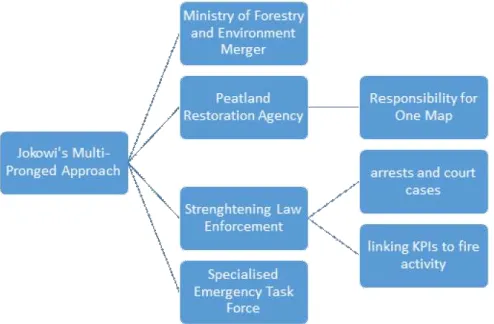
specific efforts put into place by the Jokowi administration to combat fires and haze in Indonesia. The Jokowi administration identified a multi-pronged approach to tackle the root causes of haze, consisting of law enforcement, fire prevention, peatland restoration, the One Map and moratorium of new concessions
(M. Sembiring, 2016).
FIG. 1: JOKOWI’S MULTI-PRONGED APPROACH
One of Jokowi’s first acts in office was the merge the Ministry
of Forestry and Ministry of Environment, to form the mono- lithic Ministry of Environment and Forestry. Before the merger, the Environment Ministry was in effect a ‘junior ministry’ with limited influence over other ministries like the Forestry Minis-
try (Varkkey, 2016). This resulted in land use licenses being given
out without ecological considerations (Purwanto, 2014). When
sensitive lands like peatlands are given out without such envi- ronmental considerations, haze is more likely to occur because peatlands are highly fire-prone. With the merger, all services re-
JURNAL STUDI PEMERINTAHAN
(JOURNAL OF GOVERNMENT & POLITICS)
Vol. 8 No. 3 August 2017
282
lated to the issuance of permits could be brought under one roof
(H. N. Jong, 2014), and due considerations can be given to
ecological concerns before lands are released. Furthermore, it is hoped that the merger will improve bureaucratic coordination and efficiency in responding to haze and other environmental
issues (M. Sembiring, 2015). However, due to the fact that the
Forestry Ministry is traditional the more ‘powerful’ ministry
(Varkkey, 2016), there are legitimate apprehensions that environ-
mental concerns will be stifled by the more developmental- minded Forestry bureaucrats. Others are concerned that the merger would only further complicate inter-sectoral coordina-
tion (M. Sembiring, 2015).
There have been some visible positive outcomes of this merger. Soon after the unification, Jokowi formally ordered the ministry to tackle these permit-issuance problems. A presidential instruc- tion was announced in 2015 that no new development should occur on any peatlands in Indonesia, even those covered by ex- isting concessions. Previously, the moratorium put into place by the former premier, Susilo Bambang Yudhoyono, did not include such a clawback clause for existing concessions. This was comple- mented by two edicts from the ministry. However as yet, Jokowi has not declared a presidential decree, which would enable this ban to be codified in national law. Without such a decree, this
ban will lack legal basis (Jacobson, 2016) and will merely be treated
as ‘planningdocument’ or ‘suggestion’ to local authorities, where
it is likely to be ignored (Haze Beat, 2015).
In this vein, Jokowi established the Peatland Restoration Agency (BRG) in early 2016, in order to coordinate and acceler- ate the recovery of peatlands. This agency reports directly to the president. Led by a team of conservationists, it aims to rehabili- tate more than 2 million hectares of peat by 2019. Restoring peatlands is expected to increase resilience against fires especially during the dry season. An important step in this process is the
mapping of burnt and degraded peatlands (A. W. Situmorang
decree to speed up the implementation of the One Map for this
purpose, however this remains a slow process (H. N. Jong, 2016a).
Restoration will begin in earnest in 2017 when a state budget
will be allocated for this purpose (A. W. Situmorang & Dunstan,
2016). Currently, the agency is focusing on determining the best
procedures for restoring peatlands. It is in discussion with
Malaysia’s Tropical Peat Research Laboratory (TPRL) over resto-
ration methods (Sun Daily, 2016), but some scientists have ex-
pressed concern over the TPRL’s preferred method of restora-
tion which involves compacting the peat (Wijedasa et al., 2016).
Law enforcement has also been one of the priority areas of the Jokowi administration in response to the haze. Jokowi in- structed the Environment and Forestry Ministry and the police to work together to revoke the licenses of companies which break land use and burning laws. So far, the administration has ar- rested executives from seven companies accused of contributing
to the haze pollution in the region (S. Ismail & Siswo, 2015).
The Ministry has further revoked or suspended the land-clear-
ing licenses of 27 firms linked to land and forest fires (Arshad,
2016). A few high-profile cases have also resulted in victory for
the government. For example, the Supreme Court ordered palm oil firm PT Kallista Alam to pay $26 million in fines and repara-
tions (Jacobson, 2016), and PT Nasional Sago Prima was ordered
to pay an even higher sum of $91.7 million for causing forest
fires and haze (M. Sembiring, 2016). However, there are still chal-
lenges with regards to law enforcement, including mindsets of the judges themselves. Palembang pulp and paper supplier PT Bumi Mekar Hijau was found not guilty for causing fires on their land, as judges decided that there was no damage done to the environment as a result of the fires, and the Indonesian govern- ment had not experienced losses as a result of the forest fires (S. Ismail, 2015). In other areas, the Riau Police have issued Letters of Order to Stop Investigations upon 15 companies, citing a lack
of supporting evidence (M. Sembiring, 2016).
The Riau Police example of suddenly dropping investigations
JURNAL STUDI PEMERINTAHAN
(JOURNAL OF GOVERNMENT & POLITICS)
Vol. 8 No. 3 August 2017
284
is related to another deep-seated problem in fire and haze man- agement in Indonesia. Due to decentralization, central initia- tives are often overruled or downplayed by local administrators
who do so for their own vested interests (Varkkey, 2016). Local
military and police personnel, in classic patron-client fashion, have in fact been known to personally protect well-connected
wrongdoers, very much like hired guards (H. N. Jong, 2016b). In
an attempt to reduce such instances, Jokowi has announced that
fire activity will be included in police and military officials’ key
performance indicators. If the administration area of the official shows high fire activity, the official will be removed from his or her position. Likewise, if there is a decrease in fire activity, the
official will be promoted (Humas, 2016). This may be an impor-
tant first step towards breaking the strong patron client relations that have built up between such officials and businesses involved
in land mismanagement at the local level (Varkkey, 2016). How-
ever, while the central government does hold the power to re- ward and punish military and police officials, it cannot do the same for administrative officials, who are often also patrons and are only answerable to local leaders. Hence, there is still a gover- nance gap here which can be abused by well-connected clients. Getting the police and military on board nevertheless is an important part of fire and haze mitigation on the ground. In his
effort to improve patrol and fire suppression response time (M.
Sembiring, 2016), Jokowi has also set up a specialised haze emer-
sion can be quickly and easily granted (H. N. Jong, 2015). As a whole, Jokowi has definitely been very proactive in put- ting into place new initiatives, and strengthening older ones, in
his administration’s efforts to curb haze. It is observable how-
ever that most of Jokowi’s initiatives have been focused on the
central level. While promising, many of the root causes of fires and haze actually originate from the local level, as a product of the decentralization of land management and related matters
(Varkkey, 2016). Jokowi’s clout at the local level is certainly con-
strained by Indonesia’s decentralization laws. However despite
these constraints, Jokowi confidently declared that his adminis- tration can see and end to the fire and haze crisis within three years. The following section thus delves deeper into this state- ment, discussing it within the context of ASEAN cooperation over haze.
DISCUSSION AND IMPLICATION
Certainly, all the measures that Jokowi put into place were done under the so-called spectre of the newly-ratified ATHP.
Indeed, before Indonesia’s ratification, the lukewarm success of
the ATHP in curbing regional haze was often blamed on
Indonesia’s non-ratification. Hence, it would be timely now to
consider to what extent Jokowi’s efforts would contribute to plug-
ging the shortcomings of the ATHP pre-ratification by Indone-
sia. In general, Indonesia’s prior non-ratification had limited the
effectiveness of the ATHP in three distinct ways:
1. Non-ratification has delayed the establishment of the ASEAN
Coordination Centre for Haze (ACCH) and its dedicated Secretariat in Riau, which was supposed to be for the pur- poses of facilitating cooperation and coordination among the parties in managing the impact of land and/or forest fires in
particular haze pollution arising from such fires (ASEAN Sec-
retariat, 2002b). Currently, the ASEAN Secretariat in Jakarta,
which acts as an interim coordination centre, is crippled by its limited staff and location far away from the fires.
JURNAL STUDI PEMERINTAHAN
(JOURNAL OF GOVERNMENT & POLITICS)
Vol. 8 No. 3 August 2017
286
2. As part of the ATHP mechanism, if a serious forest fire was
spotted by the ASEAN Specialised Meteorological Centre, neighbouring states could activate fire-fighting services and move in, without having to write in to the receiving govern- ment to get diplomatic clearance for aircrafts and permission
from local fire services for each new case (Khalik, 2006). How-
ever, this clause was only applicable if both countries have ratified the treaty.
3. ASEAN-level initiatives have not been able to address sensi-
tive issues like influencing Indonesian land and forest policy and the implementation of laws. Article 9 of the Agreement does call for the development of appropriate policies to curb
activities that may lead to land and/or forest fires (ASEAN
Secretariat, 2002b), however this is only applicable to ratified
states.
Among the list, the ACCH was expected to be the low-hang- ing fruit for Indonesia to take up soon after ratification. Indeed,
the ACCH would seem to be an ideal home for Indonesia’s haze
emergency task force that has been set up. A home in Riau, close to many of the fires, would allow for more ownership and better
coordination all around (Varkkey, 2016). However, Indonesia
seems to be dragging its feet on this matter. While ASEAN con- tinues to urge Indonesia to set up the centre, Indonesia’s only formal move towards this thus far has been one Workshop on the Preparation for the Establishment of the ACCH held in April
2016 in Jakarta (Environment Division, 2016). No further indi-
cation has been made on when the ACCH would finally be es- tablished. As it is, Indonesia task force continues to be housed in Jakarta under auspices of the Ministry of Environment and Forestry.
Not much progress has been made in terms of fire-fighting
cooperation and assistance as well. While Indonesia’s new task
nesian law dictates that provinces have to declare an emergency
before foreign countries can help (Channel NewsAsia, 2015),
and even then, diplomatic clearance is still required. Track record
has shown that emergencies are often declared too late (Ferguson,
2004), when fires and haze are already out of control. For ex-
ample, many were expecting President Jokowi to declare an emer- gency when he visited ground zero in South Sumatra during the
fires in October 2015, however he did not (Soeriaatmadja &
Chan, 2015). A somewhat disheartened statement by Malaysia’s
Minister for Natural Resources and Environment (MNRE) ex- pressed this:
“Don’t assume that just because we have something here, we
can just bulldoze (through) anything, that when we know there is a fire somewhere, we can just go in on a boat or ship or truck
or car, and cross over to the border and start doing it, we can’t
do it like that. That’s still a foreign country and we have to deal
with them and we must respect our neighbour’s sovereignty. We
cannot assume that because the agreement already exists and we want to set up certain things, that we (can) do it whatever way we
want to. We can’t.” (Naidu, 2016)
The final area is in terms of addressing sensitive issues like
policymaking and implementation. While Jokowi’s administra-
tion has put into place many new policies pertaining to the issu- ance of licenses and peatland management, there has been no indication that any of this was done under consultation with ASEAN. Indeed, Indonesia’s Minister for Environment and Forestry, Dr Siti Nurbaya Bakar, was conspicuously absent from both the 2015 and 2016 Meetings of the Conference of the Par- ties to the ASEAN Agreement on Transboundary Haze Pollu- tion. Instead, only a senior advisor on energy attended on behalf
of the ministry (Naidu, 2016). This has doubtlessly made it diffi-
cult for ASEAN and its member states to advise and share best practises on policies and implementation without the proper leadership in attendance for ASEAN-level meetings. Given, as
mentioned above, Indonesia’s BRG has been seeking advice from
JURNAL STUDI PEMERINTAHAN
(JOURNAL OF GOVERNMENT & POLITICS)
Vol. 8 No. 3 August 2017
288
the Malaysian TPRL, however this seems to intentionally exclude the Global Environment Centre, a Malaysian NGO specialising in peatlands that is one of ASEAN’s key partners on peatland
management (GEC, 2016).
Hence, it can be concluded that the Jokowi administration’s
efforts on haze mitigation has not been geared towards fulfilling its responsibilities under the ATHP. Instead, they seem to focus
more on strengthening Indonesia’s ability to manage the fires
and haze independently from ASEAN. While this is good, and
in line with one of the ATHP’s objectives to ‘strengthen national
capabilities’(ASEAN Secretariat, 2002a), it portrays a state that
has grown wary of regional pressure and wants to take matters into its own hands. Indeed, actions like the Indonesian Minister not attending important ASEAN-level haze meetings would seem like Indonesia is deliberately making it difficult for ASEAN to engage with Indonesia over haze. Hence, when Jokowi stated
that “in three years we would have solved this”,‘we’ here can be
taken to mean Indonesia alone, and not Indonesia and ASEAN. Hence, the three years could be understood as not three years of full cooperation from Indonesia on regional efforts, but three years free of regional scrutiny or pressure while it works inter- nally address fires and haze.
On the government-to-government level as well, this sentiment remains. A spokesperson from the Malaysian MNRE explained that since ratification, Indonesia has in fact been more reluctant to engage in any bilateral activities for haze mitigation
(Muralitharan, 2016). For example, Malaysia previously had a
collaboration with Riau as part of the ATHP, to help with capac- ity-building, community training, peatland rehabilitation and
early warning systems (Bahagian Udara, 2010; Malaysia & Re-
public of Indonesia, 2008; New Straits Times, 2008; Varkkey, 2016).
However, when Malaysia recently approached Indonesia to re- vive this collaboration in the spirit of the recent ratification, this
was met with a resounding no (Muralitharan, 2016). Another
aggressive attitudes during recent ASEAN-level haze meetings that he attended. Furthermore, the Indonesian Environment and Forestry Minister recently refused to accept a meeting with her
counterpart in Malaysia to discuss haze matters (Paramasua,
2016). Indonesia also vehemently turned down several offers of
fire-fighting assistance by both Malaysia and Singapore during the fires of 2015, with the Environment and Forestry Minister saying that Indonesia has things under control, and that foreign
help would be ‘insignificant’ (AFP, 2015; Lassa, 2015)1.
With Jokowi coming into power just weeks after Indonesia’s
ratification of the ATHP, many in the region expected Indone-
sia to commit to the agreement with renewed vigour (Straits
Times, 2014). Jokowi studied forestry in university (Emont, 2016)
and furthermore, one of Jokowi’s closest advisors is Alexander Sonny Keraf, a former Indonesian Environment Minister. In fact, Keraf was head of the delegation to ASEAN during the forma- tive period of the ATHP, and one of the strongest advocates for
its ratification at home (Varkkey, 2016). Hence, Indonesia’s rati-
fication of the ATHP in the days leading up to Jokowi’s presi-
dency should have set the scene for the new administration to reinvigorate engagement with ASEAN and its member states over haze.
However, it must be noted that Jokowi’s administration was
not the administration that ratified the agreement – it was rati-
fied under Yudhoyono’s administration, as one of his few final
acts in office. While Jokowi has been very vocal about seriously resolving the haze issue within Indonesia once and for all during
his tenure (Lim, 2015), the illustrations above indicate that Jokowi
has little interest to do so in collaboration with ASEAN. Indeed,
it may be argued that, considering Indonesia’s responses, ratifi-
cation has actually made no difference at all – at the regional
level at least. Indeed it is questionable if Jokowi would have over- seen a ratification of the agreement at all, if Yudhoyono did not push it through at the last minute.
This actually may not be so surprising, and may not be unique
JURNAL STUDI PEMERINTAHAN
(JOURNAL OF GOVERNMENT & POLITICS)
Vol. 8 No. 3 August 2017
290
to the case of the haze. In fact, the early days of Jokowi’s admin-
istration already showed tendencies that Jokowi is turning away from ASEAN. In a statement that can be taken to express his sentiment on relations with ASEAN and its member states,
Jokowi said that “if it’s not beneficial, I won’t do it…we’ll still
meet but not too much” (Parameswaran, 2014). This may be a
snide jab at ASEAN’s high volume of meetings per year. True
enough, breaking from the traditional ASEAN-wide visits once a new leader took office, Jokowi conducted his first foreign trip as premier not to a neighbouring state but to China, and visits
to ASEAN member states did not immediately follow (Yahya,
2015). Furthermore, apart from haze cooperation Jokowi has been
unsupportive of other notable ASEAN initiatives like the ASEAN
Economic Community’s goal of a single market and production
base (Syailendra, 2015).
This may be a way for Jokowi to forge his own path. Ever since the late President Suharto, Indonesian leaders have consis- tently placed ASEAN as an important cornerstone of their for-
eign policy (Yahya, 2015). Yudhoyono, for example, especially
focused on ASEAN multilateralism and regional norms promo-
tion during his reign (Syailendra, 2015). In contrast, Jokowi’s
presidential campaign highlighted nationalist sentiment and
promised a more inward-looking, ‘pro-people democracy’
(Dlamini, 2015). Hence, this turn away from regional
multilateralism may be Jokowi’s way of fulfilling his election prom-
ises. Indeed, Jokowi’s eagerness to defeat haze may be spurred
more by nationalistic concerns and his people’s well-being rather
than by any feeling of regional responsibility. Jokowi has indeed displayed much concern for the local Indonesians living close to the haze, as his many visits to ground zero and surrounding vil-
lages can attest (Nazeer, 2015; Soeriaatmadja & Chan, 2015).
Another factor may be Jokowi’s political background. Jokowi
famously rose to fame as a former Governor of Jakarta. Some say
this rise was too fast, and Jokowi’s lack of political experience at
dealing with international players (Otto & Rachman, 2015). His relative overconfidence in relying on internal means to address the haze could also be due to such inexperience, and underesti- mation of the complexity involved in governing a sprawling coun- try, in contrast to the city of Jakarta. For example, as part of his
presidential campaign, Jokowi promised a ‘mental revolution’
that would discard patronage for accountability and hard work
(Hutton, 2016). Such a mental revolution is essential in ensur-
ing the workability of some of Jokowi’s key haze mitigation poli-
cies would work; namely those involving policy and law enforce- ment which rely very much on the buy-in of local officials. How- ever, patronage politics, which often discourage these local offi- cials from taking action that may not be in the best interests of
their ‘clients’ (Blake, 2016), are notoriously hard to dismantle or
destroy (Varkkey, 2016).
These observations paint a clearer picture of a more complex idiosyncratic personality as the largely positive one described in the Literature Review section. While Jokowi is indeed comfort- able when socialising with communities in Indonesia, this com- munal comfort does not extend to the ASEAN community, pos- sibly because his own personality is constrained by his national- istic presidential campaign persona which focused inwards. In-
deed, one’s political persona, especially that related to presiden-
tial campaigns, often conflicts and constrains one’s true person-
ality, or in this case, idiosyncrasy (Marshall & Henderson, 2016).
That being said however, his positive qualities of intelligent deci- sion making and analysis, as well as finding creative solutions to problems did indeed come through in the novel national-level
mechanisms that he has put into place to address haze. Jokowi’s
haze mitigation efforts certainly stand out as compared to the efforts of Yudhoyono before him. However again, his campaign persona possibly restricts him from applying these same intelli- gent and creative solutions at the ASEAN level through enhanced cooperation over the ATHP. Despite this, the fact remains that Jokowi is a very positive personality, and is well-liked not only by
JURNAL STUDI PEMERINTAHAN
(JOURNAL OF GOVERNMENT & POLITICS)
Vol. 8 No. 3 August 2017
292
Indonesians but also by other ASEAN leaders (Bernama, 2016;
Parlina, 2016). Hence, Jokowi’s largely positive idiosyncrasy credit,
at the national as well as at the regional level, enabled him to deviate from the common expectancies of the ASEAN organiza- tion without much consequence. Even though there is some underlying negative sentiments from other member states as detailed above, the ASEAN organizations seems willing to adopt
a “wait and see” attitude and give the new president a chance to
prove himself in his independent efforts to combat haze on his own terms.
CONCLUSION
While the region still experienced bad episodes of haze in 2015, 2016 has been a relatively haze-free year for Malaysia and Singapore. However, this may be due more to favourable weather
than positive outcomes of Jokowi’s haze mitigation efforts
(Reuters, 2015). For example, while there were many hotspots
detected in several places in Indonesia in March 2016, the pre- vailing winds did not blow the resulting smoke over to Malaysia
at the time (Cheng, 2016). And later in the year, there were less
hotspots than usual in Indonesia, due to La Nina that has brought heavy rains. Hence, a haze-free 2016 may not be indicative of any
success on Jokowi’s part just yet, and neighbouring countries are
appropriately only ‘cautiously hopeful’ (Blake, 2016).
Either way, ASEAN itself remains ever hopeful, indicating that it expects faster and more effective implementation of all other aspects of the ATHP by Indonesia once the ACCH is op-
erational (Environment Division, 2016). Even while commenta-
tors say that three more years ‘is ridiculous’ (Malay Mail, 2015),
ASEAN has allowed Jokowi to deviate from expectations to fully
cooperate with the ATHP, by tacitly acknowledged Jokowi’s
timeline. After decades of regional pressure from ASEAN, it would perhaps not be entirely out of line for Jokowi, on behalf
of Indonesia, to request (or demand) three year’s breathing space
breathing down its neck. Today, barely one year down the road, it still remains too soon to tell if the region is merely underesti-
mating Jokowi’s capabilities to rally the nation towards a haze-
free ASEAN in 2020. The true test of Jokowi’s progress will be the next El Nino drought cycle, where the lack of rains will re-
veal to what extent Jokowi’s ambitious plans for haze mitigation
have indeed borne fruit.
ENDNOTES
1 Indonesia did finally accept these offers of assistance, but only long after its own fire-
fighters were overwhelmed by the out-of-control fires
REFERENCES
AFP. (2015, 8 October). Indonesia accepts international help to combat fires causing haze across South-East Asia. Agence France-Presse.
Arshad, A. (2016, 11 July). Indonesia revokes or suspends land-clearing licences of 27 firms linked to land and forest fires. Straits Times.
ASEAN Secretariat. (2002a). ASEAN Agreement on Transboundary Haze Pollution. Re- trieved from http://haze.asean.org/?page_id= 185
ASEAN Secretariat. (2002b). ASEAN Agreement on Transboundary Haze Pollution Kuala Lumpur.
Bahagian Udara. (2010). Malaysia-Indonesia Collaboration in Preventive Measures to Deal with Land and Forest Fires and Haze in Riau Province. Putrajaya: Department of Envi- ronment.
BBC. (2015, 29 September). Indonesia ‘needstime’ to tackle haze - Joko Widodo.BBC News.
Bernama. (2016, 6 August). Najib: My relationship with Jokowi is very good. The Star. Blake, C. (2016, 15 June). Weather May Fix Asia Haze as Indonesia Makes Scant Progress.
Bloomberg.
Channel NewsAsia. (2015, 18 September). Jakarta again declines Singapore haze help.
Channel NewsAsia.
Cheng, N. (2016, 10 March). No need to worry about haze, yet. The Star.
Dlamini, K. (2015). How big is the room for ASEAN in Indonesia’s foreign policy under Jokowi? Retrieved from South Africa:
Emont, J. (2016). Visionary or Cautious Reformer? Indonesian President Joko Widodo’s
Two Years in Office. Time.
Environment Division. (2016). MEDIA RELEASE: 18th Meeting of the Sub-Regional Minis- terial Steering Committee (MSC) on Transboundary Haze Pollution. Retrieved from Singapore:
Ferguson, R. J. (2004). ASEAN Concord II: Policy Prospects for Participant Regional “De- velopment”. Contemporary Southeast Asia, 26, 393.
Florano, E. R. (2003). Asssesment of the “Strengths” of the New ASEAN Agreement on Transboundary Haze Pollution. International Review for Environmental Strategies, 4 (1), 127-147.
GEC. (2016). The Peatland Programme. Retrieved from http://www.gec.org.my/ index.cfm?&menuid= 90
Haze Beat. (2015, 26 October). Under-fire Jokowi prepares biggest shift yet in Indonesian
JURNAL STUDI PEMERINTAHAN
(JOURNAL OF GOVERNMENT & POLITICS)
Vol. 8 No. 3 August 2017
294
haze. Mongabay.
Hollander, E. (1958). Conformity, status, and idiosyncrasy credit. Psychological Review, 65(2), 117-127.
Humas. (2016). President Jokowi will Replace the Officials with Many Forest Fire Cases . Retrieved from
Hutton, J. (2016, 11 March). Is Indonesia’s pro-reform leader learning the art of the doable? Christian Science Monitor.
Ismail, S. (2015, 30 December). PT Bumi Mekar Hijau found not guilty by Indonesian court of causing forest fires in Sumatra. Channel NewsAsia.
Ismail, S., & Siswo, S. (2015, 18 September). Indonesia decision on haze help up to jokowi. Channel NewsAsia.
Jacobson, P. (2016). How is Indonesian president Jokowi doing on environmental issues? Retrieved from
Jong, H. N. (2014, 8 November). Ministry to stop granting permits for forest use. Jakarta Post.
Jong, H. N. (2015, 6 September). Haze task force set up. Jakarta Post.
Jong, H. N. (2016a, 22 July). One Map Policy’s success hinges on local involvement. Jakarta Post.
Jong, H. N. (2016b, 9 September). Plantations get military, police backup. Jakarta Post. Khalik, A. (2006, 14 October 2006). ASEAN ups pressure on haze as lawmakers bicker.
Jakarta Post.
Lassa, J. A. (2015). Indonesia’s Haze and Disaster Governance Deficit . Retrieved from Singapore:
Letchumanan, R. Overview and Implementation of the ASEAN Agreement on Transboundary Haze Pollution. Paper presented at the Powerpoint Presentation. Powerpoint Presentation retrieved from
Lim, I. (2015, 4 October). DPM: Three years too long a wait for Indonesia to solve haze problem. Malay Mail.
Malay Mail. (2015, 2 October). Analysts pin haze on Jokowi weakness in decentralised system of government. Malay Mail.
Malaysia, & Republic of Indonesia. (2008). Memorandum of Understanding between the Government of Malaysia and the Government of the Republic of Indonesia on Col- laboration in Preventive Measures to Deal with Land and Forest Fires and Haze in Riau Provinceq. Jakarta.
Marshall, P. D., & Henderson, N. (2016). Political Persona 2016 - An Introduction. Persona Studies, 2(2), 1-18.
Muralitharan, J. (2016). Government-Academics-Industry round-table discussion. Paper presented at the 10th 7-SEAS International Workshop of Technologies and Sciences on Transboundary Haze, ANGKASA, Kuala Lumpur.
Naidu, S. (2016, 11 August). ASEAN adopts roadmap for transboundary haze-free region by 2020. Channel NewsAsia.
Nazeer, Z. (2015, 7 September). Indonesian President Joko Widodo goes to haze’s ground zero. Straits Times.
New Straits Times. (2008, 6 June 2008). Malaysia to help Riau ‘clear the air’.New Straits Times.
Otto, B., & Rachman, A. (2015, 23 July). Political Strains Test Indonesian Leader. Wall Street Journal.
Paramasua, M. (2016, 12 October) Malaysia as a Middle Power for the Environment (Follow-Up)/Interviewer: H. Varkkey . Putrajaya.
Parameswaran, P. (2014, 18 December). Is Indonesia Turning Away From ASEAN Under Jokowi?. Pakistan Defence.
Purwanto, E. (2014, 4 November). Environmental values of forest resources. Jakarta Post. Reuters. (2015). Efforts to Stop Indonesian Haze Fires May Not Work for 2016. Jakareta
Globe.
Sembiring, M. (2015). Here Comes the Haze, Yet Again: Are New Measures Working? Retrieved from RSIS:
Sembiring, M. (2016). Combating Haze: Holding One’s Breath A Year On . RSIS. Sentana, I. M., & Hariyanto, J. (2014, 16 September). Indonesia Ratifies Regional Pollu-
JURNAL STUDI PEMERINTAHAN
(JOURNAL OF GOVERNMENT & POLITICS)
295
tion Treaty as Haze Spreads to Neighbors. The Wall Street Journal. Situmorang, A. W., & Dunstan, I. (2016). Work of The Indonesia Peatland Restoration
Agency Gains Momentum. Retrieved from
Situmorang, M. (2015). Orientasi Kebijakan Politik Luar Negeri Indonesia di bawah Pemerintahan Jokowi-JK. Jurnal Ilmiah Hubungan Internasional, 11(1), 67-85. Smith, C. (2012). Personality in Foreign Policy Decision-Making. Students. Retrieved from
http://www.e-ir.info/2012/10/16/personality-in-foreign-policy-decision-making/ Soeriaatmadja, W., & Chan, F. (2015, 30 October). Heavy rain clears haze as Jokowi ar-
rives in S. Sumatra. Straits Times.
Straits Times. (2014, 8 September). Ratification of Asean haze agreement a historic step in tackling problem: Malaysia PM Najib Razak. Straits Times.
Sun Daily. (2016, 2 April). Idonesia to test M’sian peatland compaction method to pre- vent forest fires. Sun Daily.
Syailendra, E. A. (2015). Consensual Leadership in ASEAN: Will It Endure Under Jokowi? Retrieved from Singapore:
Tan, A. K. (2005). The ASEAN Agreement on Transboundary Haze Pollution: Prospects for Compliance and Effectiveness in Post-Suharto Indonesia. N.Y.U. Environmental Law Journal, 13, 647-722.
Varkkey, H. (2016). The Haze Problem in Southeast Asia: Palm Oil and Patronage. Lon- don: Routledge.