IJSTE - International Journal of Science Technology & Engineering | Volume 3 | Issue 05 | November 2016 ISSN (online): 2349-784X
All rights reserved by www.ijste.org 78
Recent Advancement for Various Attacks in Ad
hoc On-Demand Distance Vector Routing for
Mobile Ad Hoc Networks
Ashish Srivastava Akhilesh Tripathi
Department of Information Technology Department of Information Technology REC, Azamgarh India REC, Azamgarh India
Mitra Bhushan Mayank pandey
Department of Information Technology Department of Information Technology REC, Azamgarh India REC, Azamgarh India
Abstract
In ad hoc network there is no any base station to manage all other nodes. Therefore nodes communicate with each other and share their routing table through which they communicate in the entire network and message passing takes place .In order to do the routing different protocols are there in ad hoc network .The vulnerabilities in ad hoc network or mobile ad hoc network because of its openness is more than other which leads to different attacks (active and passive) resulting the degradation in network performance and makes it unreliable.
Keywords: MANET, AODV
________________________________________________________________________________________________________
I. INTRODUCTION
In parallel of protection trial worry, an enormous number of routing protocols have been proposed, in between number of them are towards consistency through the MANET [2]. Unrelated protocols are publicized to be suitable for different network settings, and, unquestionably, there may not be a particular protocol that outperforms all option in same settings.
Main motto in this paper is the reactive route discoveries that bear a resemblance to the Ad hoc On-demand Distance Vector (AODV) protocol [1], whose role can be priceless: nodes safeguard information only for destinations that dynamically communicate with, and the network overhead per route request and reply packet does not raise with the number of nodes along a revealed route in Mobile Ad-hoc network or in case of Ad-hoc Network because nodes in the network runs on battery which has limited power . One extra portion is the better control of topological knowledge, as it is not necessary every time to carry the control and data packets links of the exposed or consume routes.
Ad hoc network Protocols are of three types: Table driven [3,] routing protocol (proactive) On – demand [4] routing protocol (reactive) Hybrid [3] routing protocol
A mobile node which acts as both viz. hosts and routers used routing protocols to route this packets. MANET protocol stack is similar to TCP/IP model [2]. A MANET [5] consists of “mobile nodes" which are free to move randomly and anywhere in the network. These nodes which are linked by Wireless LAN [6] often act as router which runs totally on battery powered. MANET is a self-configuring and self-controlled system of networks. The self-controlled system can function in separation or can communicate to a fixed network by the help of gateways.
In MANET [15] one cannot specifically define a physical perimeter of the network. The nodes in a network are vagabond where they are let on to join and leave the wireless network at occurrence of time. Instantly an oppugner comes in radio range of a node it will be endowed to interact with that node.
Nodes in a network are free to roam swiftly thus the network topology which is normally multihop changes haphazardly and quickly at fluctuating times and may consists of both unidirectional and bidirectional links.
Unsteady low capacity links exists related to wireless network which are more vulnerable to signal attenuation, interference, fading-noise, multiple access, congestion because of relatively low to moderate link capacities.
In a Manet all the nodes are dependent on batteries or other modest means for their energy. For these nodes, the modest decisive system blue print benchmark for optimization is Energy conservation. Scarcity of energy in mobile nodes often causes a severe complication in the network. A node in Manet acts as both a router and host. So, if a node dies early in the network it will lead to the network partition and lifetime of the network will also decrease rapidly.
Recent Advancement for Various Attacks in Ad hoc On-Demand Distance Vector Routing for Mobile Ad Hoc Networks
(IJSTE/ Volume 3 / Issue 05 / 015)
All rights reserved by www.ijste.org 79
be thoroughly treated. It’s because of distributive feature of network control in Mantes render additional strength against the single point of failure of more incorporate approaches [2].
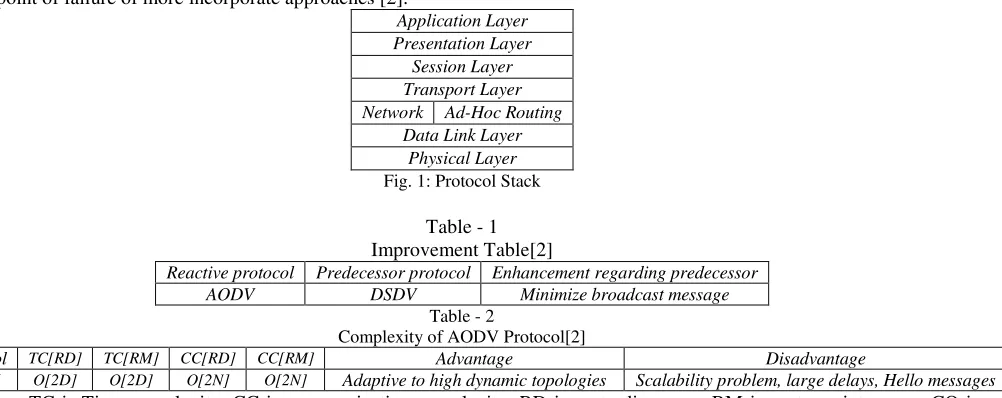
Application Layer Presentation Layer
Session Layer Transport Layer Network Ad-Hoc Routing
Data Link Layer Physical Layer Fig. 1: Protocol Stack
Table - 1 Improvement Table[2]
Reactive protocol Predecessor protocol Enhancement regarding predecessor
AODV DSDV Minimize broadcast message
Table - 2
Complexity of AODV Protocol[2]
Protocol TC[RD] TC[RM] CC[RD] CC[RM] Advantage Disadvantage
AODV O[2D] O[2D] O[2N] O[2N] Adaptive to high dynamic topologies Scalability problem, large delays, Hello messages Where, TC is Time complexity, CC is communication complexity, RD is route discovery, RM is route maintenance, CO is control overhead, D is diameter of the network, N is the number of nodes in the network.
II. LITERATURE SURVEY
Prior to the work in the vicinity of security issues in MANETs has been based on reactive routing protocols mainly on Ad-Hoc on Demand Distance Vector (AODV). Numerous kinds of attacks have been calculated and the behaviors to prevent these attacks have been devising. The different approach and proposals has been given by others.
In Aad et al. (2008) [7], the authors propose protocol yielding attacks for closed loop flow and called them JellyFish attack. Authors in this paper presented how these attacks spot the openness in flow control and congestion control in TCP and use them to trim down the throughput of the network.
Wazid et al. (2013) put forward an efficient TCP, a healthier version of TCP, to shrink the impact of JellyFish delay variance attack. It empowers selective appreciation if jellyfish invader is there and disables fast redelivery in TCP [10]. Even though, improvement is not much there in performance under JellyFish attack proficiently because the selective ACK boost the performance even in ordinary network with no intruder node present.
Kaur et al (2015) suggest a selective node sharing approach for JellyFish delay variance by using temporarily ordered routing protocol (TORA) [11].
In Jaya Singh et al (2010), they build up a method that signifies the JellyFish attack at a node and that can be proficiently deployed at all the other nodes [12].
Kumar et al (2015) present an in detail study of JellyFish delay variance attack and its force on the variants of TCP [13]. In Aad et al. (2004), the authors portray a denial of service structure for Jellyfish and black hole attacks [14].
Esha et al. (2016) suggested there views in study of Detection and Prevention of Jellyfish Attack in AODV Routing Protocol in MANET.
III. AD HOC ON DEMAND DISTANCE VECTOR ROUTING PROTOCOL
AODV is a technique of routing messages between mobile computers. It helps these mobile computers, or nodes, to pass messages through their adjacent nodes with which they cannot unswervingly communicate. AODV does it by finding the routes through which communication can be done. AODV create these routes which do not contain loops and try to find the shortest possible route. A change of routes in AODV is also handling and it can create a new dynamic route if there is any discrepancy.
Recent Advancement for Various Attacks in Ad hoc On-Demand Distance Vector Routing for Mobile Ad Hoc Networks
(IJSTE/ Volume 3 / Issue 05 / 015)
All rights reserved by www.ijste.org 80 IV. SECURITY ATTACKS
MANETs is a wireless network with dynamic topology associated with them, they are very susceptible to different attacks [9]. In protocol stack, Physical layer has security issues like Denial of Service (DoS) attacks and preventing signal jamming. Network layer has to deal with safety measures of ad-hoc routing protocol and associated parameters. Transport layer has issues with end to end data security with encryption methods and Authentication. Application layer has security concerns with prevention, worms, malicious codes, application abuses as well as virus detection. Classification of attacks is normally of two types: passive and active. A passive attack is one that does not concern the regular network operation while an active attack does it. In passive attack, invaders sneak data without changing it. Passive attacks are complicated to detect as there is no transform in the functionality of the network. Active attacks can be internal or external. Modification, Impersonation and Fabrication are some of the most common attacks which is root of a secure concern for MANET.
A node may attack by changing the protocol fields in messages or inset routing messages with bogus values in order to find out the shortest path. A malicious node can set the false hop counts. By impersonating a node (spoofing), a malicious node can cause plenty of attacks in MANET.
Fabrication attacks have fake routing information which is normally generated by an intruder. These forged route error messages (RERR) and routing updates may upset the entire network operations or guzzle node resources. Different fabricated attacks are listed below:
1) Blackhole attacks: A black hole is a malicious node that incorrectly replies for route requests without having a correct route to the destination. It exploits the routing protocol to broadcast itself as having a superior and suitable path to a destination node. It also tries to turn into an aspect of a lively route. It has bad intent of disturbing data packets being sent to the destination node or obstructing the route discovery process. Black hole attack may be internal or external.
2) Grayhole attacks: A gray hole may ahead all packets to certain nodes but may drop packets approaching from or destined to specific nodes. In other type of attack, node may behave maliciously for some time but later on it behaves totally normally. 3) Wormhole attacks: In this type of attacks, the attacker affects routing by short circuiting the usual flow of routing packets.
This type of attack is possible with one node also. Normally, two or more attackers join via a link called wormhole link. They confine packets at one end and replay them at the other end using private high speed network. Wormhole attacks are reasonably easy to deploy but may cause great damage to the network.
V. CONCLUSION
In this paper we have given a detailed review of ad hoc on demand distance vector routing protocol with its vulnerabilities and proposed solution. Openness of ad hoc network makes it vulnerable and attackers found it easy to target and data replication and other losses occur in network. Different approaches based on simulation and there result has been given by researchers and we have tried to provide a detailed report regarding it.
Our effort was to categorize different-different types of ad hoc security attacks based on their characteristics so that mitigation period can reduce.
REFERENCES
[1] C. Perkins, E. Belding-Royer, and S. Das, “Ad hoc On-Demand Distance Vector (AODV) Routing,” IETF RFC 3561, Jul. 2002
[2] Srivastava, A., Mishra, A., Upadhyay, B., & Yadav, A. K. (2014, August). Survey and overview of Mobile Ad-Hoc Network routing protocols. IEEE International Conference on In Advances in Engineering and Technology Research (ICAETR), 2014 (pp. 1-6).
[3] C. Siva Ram Murthy and B.S Manoj, Mobile Ad Hoc Networks-Architectures & Protocols, Pearson Education, New Delhi, 2004.
[4] E.M. Royer, C-K. Toh, A Review of Current Routing Protocols for Ad-Hoc Mobile Wireless Networks, IEEE Personal Communications Magazine, April 1999, pp. 46-55 http://www.cs.ucsb.edu/~eroyer/publications.html.
[5] Basagni, Stefano, et al., eds. Mobile ad hoc networking JohnWiley & Sons, 2004
[6] Wireless LAN Medium Access Control (MAC) and PhysicalLayer (PHY) Specification, IEEE Std. 802.11, 1997.
[7] Aad I, Hubaux J-P, Knightly E. Impact of denial of service attackson ad hoc networks. IEEE/ACM Trans. Netw 2008; 16(4):791e802.
[8] C. E. Perkins and E. M. Royer, “Ad Hoc On-Demand Distance Vector Routing”, Proceedings of IEEE Workshop on Mobile Computing Systems and
Applications 1999, February 1999, pp.
[9] Jhaveri, Rutvij H., et al. "MANET routing protocols and wormhole attack against AODV." International Journal of Computer Science and Network Security 10.4 (2010): 12-18.
[10] Mohammad Wazid et aI., "E-TCP for Efficient Perfonnance of MANET under JF delay variance Attack" in IEEE Conf. Information & Communication Technologies (lCT), JeJu Island, 2013, pp. 145 -150.
[11] Amandeep Kaur, Deepinder Singh Wadhwa, “Effects of Jelly Fish Attack on Mobile Ad-Hoc Network’s Routing Protocols”, Sep-Oct 2013.
[12] Jaya singh. B. B. and Swathi B "A Novel Metric for Detection of Jellyfish Reorder Attack on Ad Hoc Network.” Bharati Vidyapeeth's Institute of Computer Applications and Management. pp. 164, 2013.
[13] S. Kumar, Implementation of delay variance attack using video streaming in MANET, Optik - Int. J. Light Electron Opt. (2015).
[14] Aad I, Hubaux J-P, Knightly EW. Denial of service resilience in ad hoc networksi. In: Proceedings of the 10th Annual International Conference on Mobile Computing and Networking, MobiCom '04; 2004. p. 202e15.