46
RETERRITORIALIZING CHINESE LIVING SPACE APARTMENTS IN
SINGAPORE
Sherly de Yong
Jurusan Desain Interior, Fakultas Seni dan Desain Universitas Kristen Petra - Surabaya e-mail: [email protected]
ABSTRACT
A home can be more than just a house or a place to live in. A home is a place where a person can express his feelings privately (personal) and socially (public). As in Chinese traditional houses, a home can give a concrete form of significant ethical relations between the horizontal hierarchy (within the family) and vertical hierarchy (with God). The shape of the traditional Chinese house has a unique arrangement of space. The house has a wall to protect them from intruders and bad conditions. The family’s ancestor altar in the main hall which is connected to the bedrooms reveal the relationship of the family, and the courtyard represents a space to show their relationship with God. The arrangement of the living spaces show how they were reterritorializing their private and public spaces. Due to the flocking of population in Singapore, lack of space and modernity, the Chinese Singaporeans are rapidly replacing one-story traditional homes to multi-leveled apartments. Old and big extended family patterns like in the traditional Chinese houses are no longer present. They are breaking up the family into separate living units and reterritorializing their private and public space. Reterritorializing means migrating their previous territory of space and making a new territory in the new place. The examples of this phenomenon of reterritorializing of space is: putting God’s worship outside their apartment’s door or the corridor and putting the service area (kitchen) that used to be in the private area to the public area of the house.
Keywords: Territory, reterritory, chinese house, apartments, singapore.
ABSTRAK
Rumah adalah tempat di mana seseorang dapat mengekspresikan perasaannya secara privat maupun secara sosial. Rumah tradisional Cina memiliki bentukan yang menunjukkan etika hubungan horisontal (antara keluarga) dan hubungan vertikal (dengan Tuhan). Bentuk rumah tradisional China memiliki penataan ruang yang unik. Rumah memiliki dinding untuk melindungi keluarga dari orang asing dan kondisi yang buruk. Meja persembahan leluhur berada di hall utama. Hall utama ini terkoneksi langsung dengan kamar tidur di sampingnya. Sebuah halaman untuk sembayang kepada Tuhan. Penataan ruang tinggal menunjukkan bagaimana mereka menteritori ruang privat dan publik. Dikarenakan populasi di Singapore yang meningkat, keterbatasan ruang dan moderinsasi, Orang Chinese Singapore secara perlahan mengganti rumah traadisional satu lantai menjadi sebuah apartemen. Tidak ada lagi pola penataan ruang keluarga lama dan besar. Mereka terbagi-bagi menjadi ruang tinggal yang terpisah dan menata ulang teritori (reteritori) ruang privat dan publik. Reteritori berarti migrasi ruang teritori yang sebelumnya dan membuat teritori yang baru di tempat yang baru. Salah satu contohnya adalah dengan meletakkan tempat sembayangan untuk Dewa di area depan koridor dan area servis (dapur) yang sebelumnya berada di area privat menjadi di area publik.
Kata kunci: Territori, reterritori, rumah orang cina, apartemen, singapore.
INTRODUCTION
Edward T. Hall (1966:171) quoted Fried’s words “home, is not merely an apartment or a house but a local area in which some of the most meaningful aspects of life are experienced.” A home with its lay -outing and planning of space might be an anthro-pometric’s design, but sometimes it is still uncom-fortable for the users. The designers still need to consider the psychological factors, privacy, the feeling
of space, and the territorial behavior (in order to make the space more comfortable for the users). People need to feel safe, affiliation, and esteem in their own home. This is why, in designing a human living space we also need to consider the characters, the culture, the need (especially the need of privacy and territory) and the behavior of the users.
cosmo-logy and the origins of the world. For example, in the concept of cosmology, the Chinese believe that the sacred space is to be found in heaven or anything closer to heaven (like the mountain) and the Chinese also believe that the earth becomes the intermediary between heaven and human. These beliefs become the basic concept of Taoism, Confucianism and also Buddhism.
This Chinese cosmology concept, by careful division and arrangement of space, was adopted in the Chinese traditional houses. The Chinese traditional houses give concrete form to significant ethical rela-tions between the horizontal hierarchy (the relation-ship within the family) and the vertical hierarchy (the relationship between man and heaven). This tradition-nal Chinese’s houses generally follow a basic struc -tural form, a central rectangular unit with two or three connected wings surrounding a central courtyard (Shen, 1988:32). It use jian or bay the interval bet-ween four columns as the fundamental unit of space and give shape to all buildings. (Knapp, 1989:33)
Most Chinese houses dwelling with three or five jian linked laterally to form a line which transverse to the axis of the house (Knapp, 1989:33). They expand the space by adding a pairs of parallel columns and extending the overhead roof. In the Chinese traditional house, they also put a courtyard in the middle of the house. This courtyard functioned as sky-well and vertical hierarchy (ethical relations with God). The surrounding enclosed unit with all rooms opening toward the courtyard has a meaning of family protections from intruders (Shen, 1988:32). Beside the sky-well, the courtyard can also be functioned as an extra living space (This function depends on the events and needs).
There is also a room that is very important in the Chinese traditional house. It is the main hall which can be used for various purposes. The main hall can be used as a sacred or profane activity. All the important events of the family life (for example wedding or death) are held in this main hall and in front of ancestor worship. Ancestor worship is a family affair and the Chinese put it in the main hall. They believe that their ancestor’s spirits will look after the family, take an interest in the affairs of the world and possess the ability to influence the fortune of the living.
Singapore is one of the countries with the largest Chinese ethnicity. In 2010, Singapore has 74,1% of Chinese residents. Singapore itself has a very limited land to build houses. As the result of this, the Singa-pore’s government replaced the one-story Chinese traditional house to a high rise apartment building. The public apartments are managed by the govern-ment board called HDB (Housing and Developgovern-ment
Board). There are several types of HDB available, classified on the basis of the number of rooms and size of the flat (from 3 rooms flat to executive apartments). As the result of this limitation of space in an apartment, the traditional Chinese living space layout is gradually torn up. For example, the Chinese could not have their courtyard and the God’s altar inside the apartment but they still need to pray to the God. As solutions for this, the Chinese put their God’s worship outside their apartment’s door, in the corridor. This phenomenon becomes reterritorialization of a living space (the phenomenon of migrating their previous territory of living space and making a new territory in the new living place). The courtyard that used to be inside the traditional house, now lies outside the house. The changing of territory in the Chinese living space becomes an interesting phenomenon to be discussed.
This paper is trying to give an understanding about the dynamics of territory trough a public and private space in the Chinese traditional space and also the changing of its territory (reterritorialization) in the Chinese apartment space (HDB) in Singapore. Secondly, using territorial behavior theory, the ethics and the habitual practices of the Chinese, this paper is trying to give the understanding about the setting of Chinese traditional homes. After understanding the territory, private and public setting and the ethics beyond it, the next step is to compare it with the Chinese apartment in Singapore. Comparing the traditional and modern Chinese homes, can give an understanding about the reterritorialization in Chinese modern apartments home.
RESEARCH METHODOLOGY
This is a descriptive-comparative qualitative researach. Qualitative research aims to gather an in-depth understanding of human behavior and commu-nicate it in a compelling way to provide insight and a more successful design direction. This research is focusing on the territory of public and private space in Chinese House (both the traditional and the modern
observation, we can see a phenomena we wish to descriptive-comparative methodology is used to ana-lyze the data. Descriptive methodology is a method to give description about the facts and the relationships of the phenomena. We can examine factors that might be influencing behaviors, environments, circumtences, etc. The goal of this methodology is to improve practice and presuppose a case/effect between behavior and outcome. In this descriptive, we will also comparing certain phenomena and creating a com-parative study. Based on the description of descript-tive-comparative methodology, the first object (the public and private space in Chinese Traditional house) will be described with territorial behavior theory to get the territoriality space in Chinese traditional house. Then this Chinese territoriality space will be compared with the Chinese Singaporean HDB apartments. We are analyzing and comparing both of the houses, to get a conclusion about the effect and the phenomena of reterritoriality in Chinese HDB space.
DEFINITION OF TERRITORY, DETERRITORY AND RETERRITORY
First, we need to understand the term of territory. From the book “Territory: Short Introduction” by David Delaney (2005:2), territory means of providing security to those inside from those ever present dangers located outside. While Forrest Wilson defined territory as the domain of an animal that is defended upon intrusion by another animal of the same or a different species and territoriality is the perception of a person of group that they possess a given place and all others are intruders there. Amos Rapoport (1969:278) defined territory as a particular area or areas which are owned and defended–whether physically or through rules and symbols–which indentify an area as a belonging to an individual or group, and one important way in which people territorialize is though personalization. Territory involves personal space, status, dominance and a number of other biological and cultural actions and responses. Robbert sommer in Wilson described that the defense of territories hinges on visible boundaries and markers, but the defence of personal space (whose boundaries are invisible) is a matter of gesture; posture; and choosing a location that conveys clear meaning to others.
Based on definition of territory above, territority can be defined as an area with boundaries (the
boundaries can be physically or through rules and symbols) where he/she can defend the area and become him/her self. The basic characteristics of territories are the ownership of or rights to a place, the personalization or marking of an area, the right to fulfillment of some basic human needs: the needs for identity, the needs for stimulation, the need for security and the need for a frame of reference. The need for identity is associated with the needs for belonging, self esteem and self actualization. The need for stimulation is concerned with self-fulfillment and self-actualization. The security needs is to be free from cencure, to be free from outside attack and to possess self-confidence. Frame of reference needs are those involving the maintenance of one’s relationship with others and the surrounding environment (Lang, 1987:148).
Robbert Sommers in Wilson (1984:262) has listed four territorial types:
1. Public territories such as a park that can provide the freedom off access for the human or shopping mall
2. Home territories that are public areas taken over by groups of individuals such as toilet or the circulation inside the open office area.
3. Interactional territories that are areas where social gatherings may occur. The example for this interactional territory is living room area.
4. Body territories are territories encompassing the body that are most private and inviolate space belonging to the individual. The examples for body territories are a bedroom or a bathroom.
While Irwin Altman in Hadinugroho (2002) listed three categories of territory:
1. Primary Territory (owned and personalized in relatively permanent manner by occupant; per-ceived by others as belonging to occupant on a long term basis; the owner has complete control intrusion is a serious matter)
2. Secondary Territory (Not owned and may be personalized to some extent during period of legi-mate occupancy; occupant perceived by others as one of a number of qualified users; there are some regulatory power during periods when individuals is legimate occupant)
In the behavior terminology, the type of a pri-vacy space is based on culture context, personality and interpersonal individual. The used of walls, screen, distance and other signs of territory are to show the privacy of a person.
Erik Werner Petersen (2009) quoted the defi-nition of deterritorialization by Gilles Deleuze and Felix Guatarri as the movement by which one leaves a territory, for example in terms of the evolution of species, all species were first territorilized in the sea, later some species deterritorialized by migrating to land and then they were reterritorialized on land. Based on definition of above, reterritorilialization means migrating their previous territory of space and making a new territory in the new place.
THE SPACE CONCEPT IN CHINESE TRADITIONAL HOUSE
Based upon weather, location in China, historical period and degree of family wealth, there are many
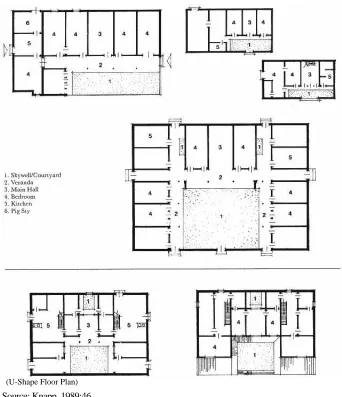
various structurals dan shapes in traditional Chinese house. But in general, a Chinese traditional home follow a basic structural and shape form, a central rectangular unit (courtyard) with two or three connec-ted wings surrounding it (Shen, 1988:32). These homes were called san ho yuan (for the horseshoe shaped three sided home) and si ho yuan (for the fully enclosed four sided home). (see Figure 1)
A Chinese traditional house is an enclosed unit, with all rooms opening toward the central courtyard or secondary courts, and the orientation and primary entrances of the main buildings are on a north-south axis with the most important rooms oriented toward the south. The openings (windows and doors) are in limited number (for protection reasons and intruders). The portions of the central courtyard in a si hu yuan house, usually is representing as much as 40% of the total area. Symmetrical placement of trees, walkways and gateways complements the balanced proportions of Chinese traditional houses.
(U-Shape Floor Plan)
Source: Knapp, 1989:46
Overall, the composition of traditional Chinese houses is a residential quadrangle, the orientation is toward the south, and it has a clear axiality (x-y axis) and a balanced symmetry. The horizontal buildings in the layout (east-west axis) are mostly the primary buildings. The main hall is located in the horizontal building and situated north of the courtyard. The vertical wings are called protector dragons. Bedrooms and kitchen are situated in these vertical wings (Shen, 1988:33). The courtyard is situated in the middle of the connected component building (see Figure 2).
1
Figure 2. Courtyards are axiomatic components in Chinese Traditional houses
The division and arrangement of in architecture of Chinese traditional homes gives concrete form to significant ethical relations. It shows the relationship within the family and as well as the cosmological ties between man and heaven (Shen, 1988:33). The arrangement of rooms emphasizes the rules of pro-priety that govern interactions in all personal relation-ships. There are five keys relationships: husband and wife, father and son, older and younger brother, friends, and the ruler with the ruled. These ethical considerations can be viewed in the Chinese architect-ture.
Outside the main gate is the domain of neigh-bors, and ties of guild, party, and nation, while inside is the family. Visitors are received in a reception hall, which is different from the family sitting room. The living arrangements are based upon seniority in age, generation or individual position. The doorkeepers and servants are housed in the front (the front is appropriate for the public and subordinates), while the back rooms shield senior or female members (the back is appropriate for privacy and seniors) (Shen, 1988:34).
The greatest importance in the relations among all family members is given to family ancestors. The
family ancestor is representing the very life and cultural origin of each member of the extended family. For the Chinese, worshipping ancestors in the home is honoring the continuity of the family over generations. This is why the Chinese put the ancestors worship in the main hall and closest to the family nucleus (Shen, 1988:34). The main hall itself is used for a variety purposes, ranging from sacred rituals (like wor-shipping the ancestors) to the profane rituals (parties), and all the important events of family life also happened in the main hall. The purpose is that the spirits of deceased ancestors will look after the family, take an interest in the affairs of the world and possess the ability to influence the fortune of the living (Shen, 1988:34)
In the Chinese family, the courtyard is a symbol of unity between heaven and earth. Physically, the arrangement of the home makes the courtyard (include the garden and the sometimes a pond) become an integral part of the residence. This courtyard also becomes the recreational center for the family and the ritual of God offerings. The courtyard symbolizes the unity and harmony of the entire family (see Figure 3.). Another example of unity and harmony within the family and God occurs during the festivals or special occasion. The Chinese put several decorations and ritual offerings as signage of this special occasion. They also change the interior decoratings, their behaviors and the way they dress.
Source: http://depts.washington.edu/chinaciv/3intrhme.htm, 4 March 2010
Figure 3. The Example of Chinese Traditional Courtyard
like a man stretching out his arms to protect those who live there. The main hall becomes the brain; the wings becomes the arms and linked with heaven and earth. This house is to protect, balance and give harmony to the family. In order to create protection, balance and harmony, the traditional Chinese house showed territoriality withtin the family. This ruled territory was given based on seniority in age, generation and individual position. For example, in the main hall, the father sits near the ancestor worship.
THE CONCEPT OF SINGAPORE HIGH RISE BUILDING (HDB)
HDB (Housing Development and Board) and high rise housing has existed in Singapore for quite sometimes (±40 years). This modern high-rise housing is an improvement in dwelling conditions from the cramped landed housing space.
This HDB housing culture is something new and different. As a result for this, the areas of a particular importance such as family have changed in respond to HDB life (for example, the large extended family that having a big landed housing in Singapore, becomes a small family in a high-righ suulding). This change was due in part to limited space in HDB housing, have greatly reduced the need for the support of an extended family (Chang, 2000:97).
Source: http://www.bradleyfarless.com/2009/09/hdbbalcony- gardens.html, 4 March 2010
Figure 4. The Example of Shared Spaces of Corridors in HDB
One of the areas in HDB is called the void desk. It is the exposed area at the base of HDB high-rises. These areas have become the settings for various distinct activites involving the residents including major ceremonies and daily socializing (such as Malay weddings and for Chinese funerals) (Chang,
2000:97). Outside the house, there are shared spaces along the corridors. These shared spaces often personalized by the residents as a various way to put plants, shoe racks, and items of religious importance (see Figure 4).
There are several types of public and semi-public housing available, classified on the basis of the number of rooms and size of the flat. Size is usually denoted by the terms such as 4 rooms, five rooms or similar, and is based on the number of bedrooms inclusive of the living room. But newer five-room apartments come with only three bedrooms and a dining room. An HDB flat contains living/dining area, kitchen, bedroom(s), main bedroom, bathroom(s), service yard, and household shelther. A 3-rooms flat has two bedrooms in about 750 sq ft (70 m²). A 4-room flat has three bed4-rooms with about 970 sq ft (90 m²) of space. A 5-room is about 1200 sq ft (110 m²). An executive apartment has three bedrooms and separate dining and living rooms with 1600 sq ft (150 m²) (see Figure 5.)
THE RETERRITORIALIZATION OF CHINESE APARTMENT LIVING SPACE
Territory can be defined as an area with boun-daries (the bounboun-daries can be physically or through rules and symbols) where he/she can defend the area and become him/her self; while reterritorilialization means migrating their territory of space in a new place and making a new territory.
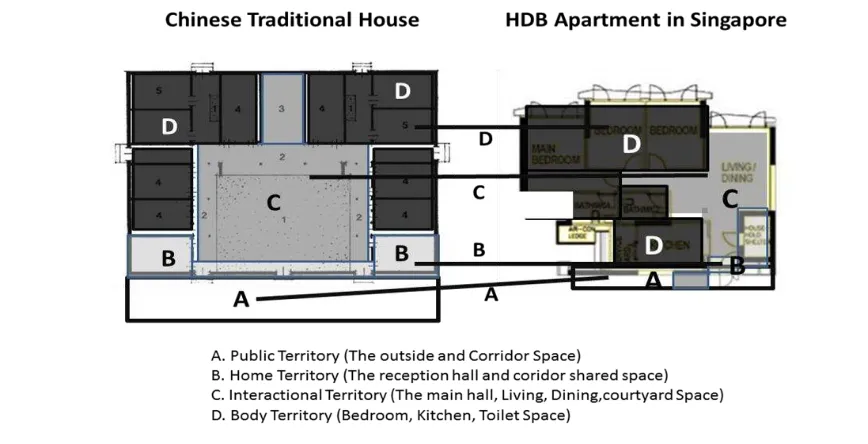
Overall, the Chinese traditional house can be divided into four territories (Public, home, interac-tional and body territory). The territory of space in the Chinese traditional house took place in all area of the house. The boundary between each territory was pretty clear.
Public territory is an area that can provide the freedom of access for the human. This public area took place in the outside of Chinese traditional house. In the outside, people can do whatever they want. The reception hall becomes the connector for the family and the outsiders. The boundary’s signs between the outside and the reception hall is an at least 3 meter wall and the connector between the public and the reception hall is the outside doors and few steps of stairs (see Figure 6).
Source: http://www.h88.com.sg/article/HDB+launches+new+BTOs%3A+Fernvale+Palms+and+Boon+Lay+Meadow/, 4 March 2010
Figure 5. Typical Floor plans of HDB apartments in Singapore
The boundary’s signs and the between the corridor and
the reception hall is a wall . The connector between the public and the reception hall is the outside doors and a
step (sometimes the see-through metal gate)
Source: (http://winnieyong.wordpress.com/2009/12/10/2-nights-in-a-glorified-hdb-flat/, 7 march 2010)
Chinese Traditional House HDB Apartment in Singapore
The boundary’s signs between the outside and the reception hall is an at least 3 meter wall and the connector between the public and the reception hall is the outside doors and few steps of stairs
Source: (
http://www.heartsandminds.org/speak/links/cn-links.htm, 3 March 2010)
The boundary’s sign between the corridor and the reception hall is a wall and the connector between the public and the reception hall is the outside doors and a step (see Figure 7). In some flats, the corridor shared space also becomes the reception hall, which is not as big as in the Chinese traditional hall. The reception hall is only approximately 1,5 meter x 1
meter. This reception hall is small, compared to the reception hall in Chinese traditional house. The connector between the public and home territory is the see-through metal gate.
Home territories are public areas taken over by groups of individuals. This home territory area was in the reception hall, the doorkeeper/servants’ bedroom
The corridor shared space also
becomes the reception hall. The connector between the corridor and the reception hall is the inside massive
door
Source: (http://winnieyong.wordpress. com/2009/12/10/2-nights-in-a-glorified-hdb-flat/, 7 march 2010)
Chinese Traditional House HDB Apartment in Singapore
The boundary’s signs in the reception hall is an at least 3
meter wall and the connector between the reception hall and the courtyards is the garden doors and few steps of stairs
(Knapp,1989:38)
Source: http://us.cdn4.123-rf.com/168nwm/ytea/ytea09 12/ytea091200094/6117926- well-and-door-of-chinese-temple.jpg, 9March 2010 Source:
http://traditions.cul-turalchina.com/en/123T20 T68.html
Source:
Figure 7. Comparison of Home Area in Chinese Traditional House and HDB
Chinese Traditional House HDB Apartment in Singapore
Source: private documentation/writera
http://traditions-cultural-china.com/en/123T20T72.html, March 9, 2010
Source:
area of Chinese traditional house. When there was a visitor, the reception hall also became the public area. In the reception hall and the doorkeepers/servants’ bedroom, even people can still do whatever they want, yet there were still rules of using the space from the owner. The reception hall becomes the connector for the family and the outsiders/public. The doorkeeper’s bedroom can also become the connector for the family and public. The boundary’s sign in the reception hall is an at least 3 meter wall and the connector between the reception hall and the courtyards is the garden doors and few steps of stairs (see Figure 7).
An HDB apartment also has a home area. The territory of home area is the reception area. As mentioned before, in some flats, the corridor shared space also becomes the reception hall. This reception hall is not as big as in the Chinese traditional hall. In some other cases, there is no space between the corridor and the reception hall. The connector between the reception hall and the house inside is the massive door.
Interactional territory is an area where social gatherings may occur. The interactional territories took place in the courtyard, verandah and main hall. The boundary between the courtyard and the verandah is steps where the verandah is higher than the courtyard. While the boundary between the courtyard and main hall is the steps and doors. The boundary between the interactional territories is biased. The family still needs to communicate and interact with
other family members. The connector between the interactional and body territory is doors and windows. (see Figure.8)
An HDB apartment also has an interactional area. The territory of interactional area is the living/dining area. This living/dining area becomes the area to communicate within the family. The living/dining area in the HDB is located next to the public area (front door). In this living/dining area, the Chinese usually put their ancestor worship. Because of living/dining area next to the public area, the ancestor worship that was usually closed to the public become open to the public. The boundary of the living/dining area is the wall, and the connector to the body territory (the bedroom) is the door.
Body territories are territories encompassing the body that are most private and inviolate space belonging to the individual. The body territories took place in the bedroom and the service area (kitchen and bathroom). The boundary between the interactional territories and the body territories are the steps and doors. This so-called private territory was needed in order to create private space for individual family. The main bedroom was usually at the back (near the main hall) and the one who stay here is the head of the family/the eldest. There is no dry kitchen in the trade-tional house; they only have the wet kitchen. This wet kitchen is always dirty; this is why the Chinese place the kitchen in the back. The connector between each of body territories are doors and windows. (See Figure.9)
Chinese Traditional House HDB Apartment in Singapore
Source:
Source:
http://renovation_ greencoal.blogspo t.com/2008/02/w hat-no-store-room_402.html
The body territory in an HDB flat is the bedroom and service area (kitchen and bathroom). This bedroom area becomes a private area; the main bedroom is usually the most further from the main door. The head of the family usually stays in the main bedroom. In the traditional house, the Chinese usually placed the service area at the back, but due to the convinience access to the service area (kitchen and bathroom) for the guests and limited space in the flat, they put the service area near the living/dining area. This placing is also for functional purposes, so everyone can use the kitchen and bathroom (including the visitors). The boundary of the bedroom area is the wall, and the connector to the body territory (the bedroom) is the door. The connector between the living/dining and service area is door and/or an opening.
CONCLUSION
The reterritorialiazation of public territory in the HDB apartment is the corridor and reception hall of the Chinese traditional house. The public territory (the outside) and the home territory (the reception hall) in the Chinese traditional reterritorialize to the corridor shared space and a small reception hall. The connector of this public and home territory is also different. In traditional Chinese house, the connector of public and home space is a massive door, while in HDB is a see-through metal door where people still can see the inside of the house.
In traditional Chinese house, the connector of home and interactional space is a garden door (sometimes an opening); while in the HDB is the
massive door. Because of the space and the need of privacy in HDB, they changed and reterritorialized the home and interactional space’s connector. In the Chinese traditional house, they have already used the outside massive door in the public territory space; therefore they do not need another massive door inside the home and interactional territory space.
The reterritorialiazation of interactional territory in the HDB apartment is: the use of corridor as a courtyard in the public territory. Because there is no courtyard in the flat, they use the corridor shared space as a courtyard. In this courtyard, the Chinese are worshiped their God and also planted some plan-tations and water features. As the effect of this retteritorialization, there is no boundary between the public and the interactional courtyard area. The HDB corridor shared space is usually the one near the main door. The Chinese adopted the HDB corridor shared space as the sky-well to worship the God. This is why they reterritorialized the courtyard’s interactional territory to the corridor shared space.
The reterritorialization of body territory in the HDB apartment is: the use of kitchen (service area) near to the living area (interactional territory). Because of its function, the kitchen and the bathroom are reterritorializing next to the living area (near the main door), while the service area in the Chinese traditional house was layouting at the back of the house. This reterritorialization of the kitchen and bathroom to the front area, is also making easier for the visitors to access it. The boundary between the living and the service area is an opening (sometimes a door) (see Figure 10).
REFERENSI
Chang, Sishir. (2000). A High-Rise Vernacular in Singapore’s Housing Development Board Housing. Berkeley Planning Journal Vol 14, 97-116. Delaney, David (2005). Territory: a short
Introduc-tion. London: Blackwell Publishing Ltd.
Hadinugroho, Dwi L. (2002). Jelajah Pembentukan Tempat pada Rumah Jawa (Dengan Pendekatan Territorial Behavior). http://repository.usu.ac.id/ bitstream/123456789/1312/1/arsitek-dwi6.pdf. 4 March 2010.
Hall, Edward T. (1966). A Hidden Dimension. New York: Doubleday.
Knapp, Ronald G., (1989). China’s Vernacular Archi -tecture: House Form and Culture. Honolulu: University of Hawaii Press.
Lang, Jon. (1987). Creating Architectural Theory. The Role of the Behavioral Science in Environmental Design. New York: Van Nostrand Reinhold Com-pany.
Petersen, Erik W. (2009). Design as Seven Steps of Deterritorialization. http://tii.se/reform/inthemak-ing/files/p16.pdf. 4 March 2010.
Rapoport, Amos. (1969). House Form and Culture. Prentice Hall.
Shen, Vincent. (1988). Ethics Shaping Architecture. Free China Review, December 1988, 32-35. Wilson, Forest. (1984). A Graphic Survey of