MALE GENITAL CUTTING IN YOGYAKARTA AND MADURA Issues of Technique and Safety
Faturochman* and Sri Purwatiningsih**
Intisari
Fenomena genital cutting di Asia Tenggara belum banyak tergali sehingga kurang diperhatikan oleh dunia internasional. Namun dari beberapa studi yang pernah dilakukan, secara umum informasi yang ada menunjukkan bahwa praktik male genital cutting atau yang dikenal dengan sirkumsisi laki-laki tersebar di berbagai daerah dan disahkan secara sosial. Hasil studi yang dilakukan dengan memadukan teknik kuantitatif dan kualitatif ini menunjukkan sebagian besar masyarakat melakukan sirkumsisi dengan justifikasi menjalankan perintah agama. Aspek kebersihan dan kesehatan juga ditonjolkan oleh beberapa tokoh agama untuk semakin mengesahkan pentingnya dilakukan sirkumsisi di samping adanya beberapa mitos yang terkait dengan seksualitas yang menyertai praktik sirkumsisi laki-laki tersebut. Namun mitos-mitos seksualitas yang banyak dianut masyarakat di wilayah penelitian sangat bias yang menunjukkan dominasi laki-laki atas perempuan.
Kata kunci: sirkumsisi, seksualitas, variasi sirkumsisi
Introduction
Male genital cutting, generally termed male circumcision, is still practiced to this day among the Muslim community. The practice of male genital cutting a contentious issue in the Western World where it is considered a violation of human rights, and the lack of medical evidence that it offers any benefits to the individual. However, recent evidence testifies to the fact that male genital cutting is associated with the reduction of risk of HIV infection in Sub-Sahara Africa (Van Dam and Anastasia, 2000). In countries where female genital cutting is still practiced, male genital cutting is considered matter of fact, in other words must be done.
* Faturochman adalah staf pengajar Fakultas Psikologi, Universitas Gadjah Mada, Yogyakarta.
The term male genital cutting, which is practiced in areas with Muslim majorities such as in Yogyakarta and Madura, is usually associated with Khitan, an Arabic word. The meaning of the term khitan is to cut part of the male or female genital skin. The influence of Islam on local traditions can also be construed from local terms used to describe the practice of male genital cutting. These include Sunat (in the Java dialect) and Sonat in the Madura dialect. The acculturation of Java and Arabic is influenced by the spread of Islam. Genital cutting is understood to mean the practice of cutting part of the penis skin, which covers the level when the penis is visible (Wiener, 1998).
Although the practice of male cutting is carried out with the reason that it is a religious obligation, yet other interpreters of law tend to forward diametrically opposing views to those of the Ulama. Those who follow the teachings of Hambali and Syafii are convinced that male genital cutting is an obligation, while those who adhere to Hanafi and Maliki contend that carrying out the practice does not constitute a religious obligation, but Sunna (Al Marsyafi, 1996). However, because of the need to cleanse the genitals of any impurities that may be clogged in the genitals, a precondition for praying salat, implies that the practice of male genital cutting, though Sunnah by Islamic law, must be carried out. Nonetheless, the debate over genital cutting is not an interesting one as it is difficult to differentiate between those who carry it out to fulfill religious obligation and those who do it as a preservation of a tradition.
Discussing the issue of male genital cutting is an interesting issue because practically there are various techniques used by non-medical practitioners such as bong supit and other traditional practitioners. There are many procedures, which do not fulfill health standards among which include the use of inappropriate tools such as bamboo clamp, razor blade, hammer, ruji sepeda, and unsterilized medical tools.
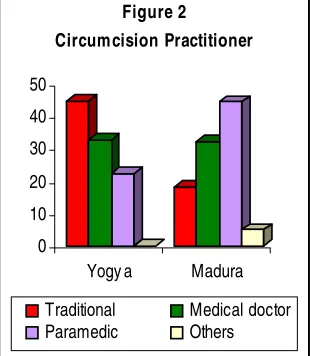
more clients during school holidays, hotels go to the extent of including genital cutting activities carried by bong supit from Bogem as part of their holiday packages. This is in contrast with the situation in Madura where traditional practices are being abandoned, in preference for medical practitioners, such as midwives, nurses and doctors. The use of medical practitioners to carry out genital cutting practice is more pronounced in Madura than in Yogyakarta, which is evidenced by the immense importance still attached to bong supit. In Madura, on the other hand, traditional practitioners can only be found in remote locations.
Background Differences
The choice of Yogyakarta and Madura was based on the assumption that the practice of male genital cutting is often carried out in the two areas and those societies in both regions have similar culture-Java. Nonetheless, Yogyakarta society has become more open and heterogeneous as a direct consequence of outside cultural influence brought about by new comers from other areas. Madura, on the other hand, is still a closed society, relatively low education level, homogeneous society with almost 100 percent of the population adhering to the Islamic religion and hail from the Madura tribe by ethnicity.
The difference in the characteristics in the two societies has a bearing on the nature or pattern of genital cutting carried out and the meaning attached to it. To delve into such an issue in this study, the viewpoint and practice of genital cutting by minority groups, such as ethnic Chinese and Christians was made or carried out. The people of Yogyakarta whom are heterogeneous and multi-ethnic are assumed to attach different meaning to the genital cutting practice from that possessed by Madura society where minorities constitute closed groups.
carrying out genital cutting that included the practitioners of genital cutting, traditional practitioners of the practices such as bong supit, doctors, nurses or midwives, and prominent religious leaders in the area. In-depth interviews were deemed necessary in the development of theoretical framework underlying the genital cutting practice, techniques used, and the intensity of carrying it out.
Justification of Cutting
Most people in Yogyakarta and Madura consider the practice of male genital cutting as a religious obligation. This implies then that carrying out the genital cutting practice must be gone through. Most people in Yogyakarta and Madura adhere to Islamic religion, which is why the prevalence of the practice in the two communities is still considered high, with Yogyakarta having 87.5 percent of its male population and 94.7 percent of Madura people having undergone the genital cutting practice. Those who do not carry out genital cutting are not adherents to Islam.
Carrying out the genital cutting ritual as a religious obligation is the most dominant reason given by the Madura society with 96 percent of respondents expressing such a view, while among the heterogeneous Yogyakarta society those who have nurse such a view amount to only 67.7 percent. Considering the practice of genital cutting as a religious ritual is based on injunctions from the Koran. Nonetheless, there is no explicit verse that deals with the issue of genital cutting, the implicit verse on genital cutting is found in Alquran surah An-Nahl verse 123, which means:
And We call on you (Muhammad), follow the religion of Ibrahim a faithful person (QS, an-Nahl: 123).
The implication of following Nabi Ibrahim is interpreted as a command that made him carry out circumcision at the age of 80.
to maintain good health. The medical justification for carrying out male genital cutting is that it protects the individual from infections. There are indications that genital cutting can prevent diseases and other ailments that are associated with the presence of prepusium such as fimosis, parafimosis, tumor, candyloma accuminata (Hermana, 2000).
The aspect of sanitation and health is emphasized according to several Kiais because carrying out genital cutting opens up the penis head making it possible to maintain purity. Impurities underneath the uncircumcised penis skin constitute najis, which must be removed before salat five times a day is carried out. Genital cutting is the means by which such impurity is cleansed to enables the male Muslim to conduct prayers in the way prescribed. One Kiai in Sumenap states that:
Is it possible for man to clean his body of impurities without carrying out genital cutting. Without it there will always be urine remains that get stuck underneath, which makes ones purity ques-tionable, which in turn invalidates salat/ ibadah.
A bong supit in Yogyakarta also contends that the main reason for carrying out genital cutting is to maintain good health:
because sanitation does not produce bad odor. Without genital cutting there are often impurities, which in Java language is called gadul, which is najis.
According to the following diagram it is apparent that the meaning attached to the practice of genital cutting is strongly related to tradition. For the Madura society, genital cutting is considered preservation of tradition because most people especially those living in rural areas find it difficult differentiate what constitutes religious teachings from tradition. This is made the worse by the tendency to associate some local and Arabic traditions to be part and parcel of Islamic teachings. As for the Yogyakarta society the notion that genital cutting must be undergone as part of preservation of tradition is often found among the believers of Kejawen, which considers genital cutting as a purification ritual.
purifies the child, and frees him of sukerto. As part of the myth to remove sukerto, the skin from the penis head is not thrown anyhow, but must be purified.
Genital cutting is sometimes connected with enhancing mans sexual satisfaction during intercourse. One practitioner of genital cutting among the Madura acknowledges the existence of such point of view that associates genital cutting with increase in
mans sexual enjoyment. A group of Chinese men who undergo the process of genital cutting do so in order to enhance sexual enjoyment. Nonetheless, proving both notions isnt an easy task as they are inextricably linked with prevalent myths about sex in the society.
For the people of Yogyakarta, genital cutting is also inferred as part of an individuals periodic life cycle. The child who is circumcised is considered ready to enter the maturity stage, which is why children undergo genital cutting at an average age of 11.1 years. Among the aristocrats of Keraton a number of rituals have to be gone through by the child until he is considered to have entered entirely into maturity. Genital cutting is carried out when the child reaches adolescence. Such meaning attached to genital cutting is not found among the Madura community.
Variations
There are principally two patterns of carrying out the practice of genital cutting, which are medically and non-medically. Using medication in the process of carrying out genital cutting has begun to take root over the past few years. Nonetheless, in Yogyakarta, the part played by medical practitioners has not reduced the dominance held by non-medical practitioners bong supit of the process of carrying out the ritual of genital cutting. Despite that with time techniques and ways of carrying out the practice are becoming closer and sometimes similar to those used by medical practitioners.
Bong supit still attract a large section of Yogyakarta community as a place where process of circumcising their children is carried out. This is due to the following reasons. First, there is belief by the parents that genital cutting carried out by bong supit leads to quick healing and recovery. Second, there is, in many cases, a strong social relationship between the parents whose child undergoes genital cutting and the traditional practitioner. The two factors are psychologically the healing processes in the aftermath of genital cutting. This contrary to the situation in Madura where the tendency is toward using medical ways in line with the shift from traditional practitioner to medical doctors, nurses, and midwives.
traditional to medical genital cutting practices. The healing process that is immediately seen and felt makes the practice of genital cutting using medical ways more acceptable in Madura community.
As has been mentioned earlier, the practice of genital cutting among Muslims is carried out in order to ensure that the penis is clean free from impurities. This is why techniques used in carrying out the practice are directed toward attaining that goal. This is well understood by both the individual who undergoes and the practitioner. It is such background that explains why the practice of genital cutting to be carried out by Kiais, especially in Madura. If the practice of genital cutting is carried out by Kiai, it is considered to be line with religious teachings. Other practitioners also adhere to such prerequisite of genital cutting.
The most common technique used in carrying out genital cutting is by cutting the penis head skin elliptically/askew. Medical practitioners such as medical doctors and midwives in Yogyakarta and Madura often use such a technique. The cutting is made of the skin askew until almost the entire skin on the penis head is removed. The technique follows the form of the penis head and the line around the urethra, which must not be cut. Cutting the skin on the penis head elliptically is a standard technique, which is conducted by making incisions in three parts, which are at position 11; 1; and 6 hours. Once bleeding stops, stitching is made of the open part by using cloth.
One midwife in Puskesmas Banyuanyar, Sampang, Madura states that the technique of cutting the skin on the penis head elliptically is use because it is easier and convenient in carrying it out. Nonetheless, not few midwives in carrying out the technique, because it leaves part of the skin which is considered to augment sexual enjoyment during intercourse
In some instances in Madura another variation of cutting is found, which involves cutting in forms of a triangle and flower. This technique of male genital cutting does not involve cutting rather by making an incision at the position of 5; 8; and 1 hours. After cutting open the skin, it is then rolled up and stitched. This technique carry the danger that the skin can hang lose any time since it is till intact.
Techniques used by traditional practitioners are varied. One traditional practitioner in certain remote area in Sampang, Madura uses an unconventional technique. This technique involves inserting a piece of wood into the penis head, after which the part that is to be cut is placed on the knife and beaten using a hammer. In Madura, there is also a traditional practitioner who uses the technique similar to that employed in cutting sugar canes. He uses a knife and bamboo clamp. In Sumenep region, also in Madura, it is not uncommon to find traditional practitioners who use the elliptical cutting technique by using razor blade and bamboo clamp. Basically the two techniques involve the discarding of part of the penis skin by cutting linearly or at an askew angle the foremost part of the penis head.
The difference between traditional practitioners in Madura and those in Yogyakarta lies in the cutting technique. While traditional practitioners in Yogyakarta, bong supit, have adopted medical ways in carrying out the practice of genital cutting. Even the tools used during the process no longer comprise razor blades and bamboo, but pair of scissors (bisturi) and clamp. It must be noted however, that not all bong supit use the same technique in carrying the genital cutting practice. One such way is described underneath:
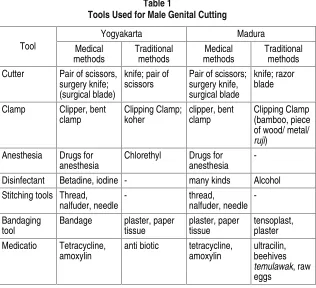
Besides the variation in cutting techniques between medical and traditional practitioners, differences are also found in the equipment used. Table 1 illustrates types of tools used. Viewed from tools used by medical personnel in Yogyakarta and Madura there is basically no difference since both areas utilize standardized equipment. On the other hand, looked at from the angle of traditional male genital cutting practice there is difference between Yogyakarta and Madura. In Yogyakarta, tools used are almost similar to those used by medical personnel, except that there is no stitching of the wound and use of disinfectants to clean the tools and the wound. Traditional practitioners in Madura have not yet adopted medical ways in carrying out male genital cutting practice. This is evidenced by the tools used, which are basically knife, razor blade and bamboo clamp during the cutting process. In addition, using traditional drugs such as traditional
Table 1
Tools Used for Male Genital Cutting
Yogyakarta Madura Cutter Pair of scissors,
surgery knife;
concoctions, beehives, and droppings of domesticated animals does the healing process.
Procedures
The general procedure used in Yogyakarta and Madura today involves the cutting of the skin on the penis head until it is ripped off. This procedure has its roots in Islamic teachings that taking reference from the term khitan, which is comes from the word khan that means to cut. According to opinion of the ulama from the four mazhab (Hanafi, Maliki, Syafii, and Hambali) agree to the notion that the entire part that covers the penis head (glans penis) until it becomes exposed (Al Marsyafi, 1996). So, in line with the above definition, the part of the skin that is cut is the prepusium, is the skin and mucous that covers the glans penis.
Research findings in the two areas indicate that the male genital cutting procedure of cutting is in the main used by both medical and traditional practitioners. The procedure used by traditional practitioners in Madura involves the discarding of part of the skin on the penis head by cutting in either a straight line or at a skewed angle. The two male genital cutting procedures used by the two traditional practitioners in Madura are explained as follows:
The traditional practitioner, Mr. T, Sampang:
(Without preceding with the use of anesthesia), bamboo is inserted (inside the penis skin) which is then clipped followed by cutting the sugar cane using a razor blade treated with ultracilin after it is wrapped up by tensoplast to complete the process salat is read as well as bismillah).
The traditional practitioner, Mr. P, Sumenep:
(The penis skin) is clipped using bamboo clamp which is then cut using a shaving knife after cutting (the remainder of the pe-nis skin) is discarded in other words the pepe-nis skin is immersed into some egg solution to get frozen.
from forefathers to descendants. The statement made by bong supit that he also obtained knowledge about male genital cutting from his parents attests to that fact. Nonetheless, the male genital cutting procedure used by traditional practitioners in Yogyakarta differ from those used by traditional practitioners in Madura. In general bong supit in Yogyakarta circumcise using the dorcumcision procedure that is cutting the part foremost part of the penis head. Although looked at from the angle of technique used there is a lot of similarity, the procedures used by three bong supits who were interviewed tended to differ from one to the other. One of the most renowned bong supit in Yogyakarta, Mr. B in Bogem, conceals the procedure he uses, but merely hints that he carries out elliptical male genital cutting, but cuts the upper part of the penis, which is done in accordance with the condition of the patient.
Bong Supit, Mr. K, Bantul, Yogyakarta:
First, the skin covering the penis head is clipped using a clipper, then to anesthetize it, it is sprayed with kloteril until bleeding stops. After that the upper part of the penis (upper penis) is cut at an a skewed angle, after which it is wrapped by paper tissue
Bong Supit, Mr. S, Yogyakarta:
The skin on the penis head is pulled forwards using a clipper, after which it is local anesthesia is carried out. The upper part of penis head is then cut at skewed angle, the cut skin is then pulled backwards without stitching it and then wrapped up by paper tissue.
In general medical personnel and paramedics use the male genital cutting procedure that cuts the skin on the penis head in an elliptical way. The procedure used by a certain nurse in Sumenap, Madura is described as follows:
Before carrying out the cutting, the inside part between the penis and the penis head is cleaned using betadine and iodine providon 10%. Then local anesthesia is carried out by injecting the penis. After that the skin on the upper part of the penis head is clipped in three points, that is towards the 11:1:6 oclock. The skin is then cut between 11 and 1 hour by making an incision in the direction of the penis, followed by encircling it following the line around the penis head until the position of 6 oclock, and then the skin is slit open. Upon completing the cutting process, bleeding is stopped and then stitching is carried out starting at the 6 oclock position to 6 oclock position one again, after which it is covered. It is then cleaned again using betadine.
Besides the above procedures, which are commonly used, in one area, which is very remote in Jrengik village, Sampang, Madura a certain unusual procedure was found. It was practiced by Kiai M, who inherited knowledge about male genital cutting from his parents. The unusual male genital cutting procedure used involves hitting the skin with a hammer. The part of the skin that is cut is at the upper part of the skin on the penis head. The procedure goes as follows:
The circumcision process starts with inserting a piece of stick inside the urethra. The stick determines the confines of the penis head as well as the tool to cut the skin. After wards the edge of the lower part of the penis is held and pulled downwards. To make an incision into the upper part of the skin, the knife is then placed above it and hit once again. The incision process can be done twice or thrice depending on the condition of the patient. The skin on the penis head is just left in such a manner and only a small part if discarded merely to fulfill religious prescriptions. After the process, the wound on the penis head of the patient is spit with saliva reading mantra-mantra in the process, and smearing it with water.
into the ground and sprayed with water obtained from the bathroom. This is meant to ensue that by the time the piece of wood will be used again to circumcise it will be able to cool the penis to be cut. That stick is only removed if it is going to be used in the cutting.
The difference of procedures used by medical and traditional practitioners lies in the way such knowledge was obtained. Medical practitioners and paramedics carry out the male genital cutting process using the knowledge they acquire in the course of their studies in nursing and medical schools, which are why the procedures they use, are generally similar. The traditional practice, which is transferred from father to son, shows difference in procedure since it depends on how it was obtained. Bong supit in Yogyakarta even though acquires his knowledge through inheritance combines it with medical ways which include; the dorsumcision procedure which is almost similar to the elliptical technique such as is used by medical personnel; tools which are in line with those used by medical practitioners such as knife, pair of scissors, kokher; and treatment provided the aftermath of the cutting process using antibiotics.
In Madura on the other hand, knowledge of traditional male genital cutting practice, which is known as kiai is likewise acquired through inheritance, but does not involve the use of medication. The skill they have in carrying out male genital cuttings is backed by their knowledge acquired from books on Islam dealing with the subject of male genital cutting. This Kiai still uses simple traditional treatment such as utilizing temulawak, chicken egg, and mantra-mantra. Nonetheless there are some who have begun using simple medication such as alcohol and ultracilin ointment.
Effects and Complications
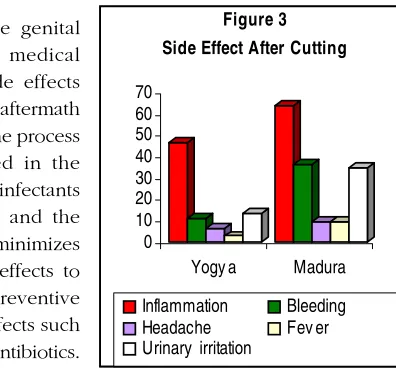
male genital cutting, which are: swelling, bleeding, headaches, fever, and feeling pain while making short calls. Such complaints are usually felt long after the process of male genital cutting is gone through. Despite that there are sources, which express fears that male genital cutting will impair erotic sensation at the time of making intercourse because the foreskin constitutes part of the penis with the most sexual sensitivity (Cruz, 2001).
Swelling or as the people of Yogyakarta call it, gendhelen constitutes a side effect that often occurs. According to one bong supit, the swelling is part of the healing process, which eventually withers by itself. In addition, swelling occurs because after cutting treatment or wrapping bandages is carried out under closed doors which causes pain once it is opened. The hailing process also depends on the patients state of health. Side effects that occur in the aftermath of undergoing male genital cutting are caused by three things, which are: the physical condition of the child, the cutting technique used and attendant procedures, and the nature of treatment after the cuttings.
The process of male genital cutting carried out by medical practitioner reduces side effects that affect patients in the aftermath of the cutting practice. The process of sterilizing tools used in the process, the giving of disinfectants before cutting is made and the presence of anesthesia minimizes the probability of side effects to occur. Besides, other preventive measures against side effects such as giving analgesics and antibiotics.
According to AAP (American Academy of Pediatrics) carrying out local anesthesia, which is meant to reduce the pain, instead causes complications during the cutting process, which include: bleeding as a result of the injecting in the area that is to be cut (Cruz, 2001). Similar finding emerge
from research, which indicate the presence of bleeding in the aftermath of undergoing male genital cutting practice. According to medical resources, bleeding which comes as a aside effect of cutting can be stopped in several ways, among which: pressing the bleeding part; blood vessel that is somewhat big; tying with cat gut; casing obstruction by desiccating the bleeding part using heated items; gelatin sponge which is placed on the bleeding area; and collastypt (Hermana, 2000).
The incidence of post cutting complications is generally very low and ranges from 0.2 per cent to 2 percent, and in fact are minor in scale even though more complicated cases some times occur (Cruz, 2001). This is more so in Yogyakarta and Madura cases where male genital cutting is carried out when children are still in their infancy, which reduces such occurrences. The practice of male genital cutting in NTT (East Nusa Tenggara) is carried out when the child has reached maturity. There are at least 24 complications that came as a result of undergoing male genital cutting, which include bleeding, infection and urinary retention (Cruz, 2001).
Side effects that come about as a result of male genital cutting carried out medical practitioners are easy to overcome because monitoring the patients is made from the very beginning. The side effects that occur in the aftermath of male genital cutting practice carried out by traditional practitioners are very difficult to handle. Such complications are as a consequence of using un-sterilized tools such as klem from bamboo which is used over and over again, razor blade and knife that have got rust due to frequent use, as well as using drugs and tools that are not appropriate.
Research show that in both Yogyakarta and Madura paramedics often find cases of patients who suffer from infections and bleeding as a consequence of male genital cutting. A nurse in one of the hospitals in Yogyakarta complained that they often receive patients with complications as a result of using wrong cutting procedures by bong supit.
In a case that occurred in Madura, on the other hand, one paramedic had to carry out the cutting process once again because the initial process led to serious infections to the penis.
A patient aged 25 years. He was circumcised while still a child by the Dukun traditional healer. It was only the tip of the skin on the penis head that was cut, which meant that it was still not open, hardened, and sticky. With time it begun to swell. May be he wanted to marry and probably felt sense of unease with his wife any way, whatever the case he asked to be circumcised once again.
Besides inappropriate male genital cutting procedures, the healing process carried out by traditional practitioners by using concoctions extracted from temulawak, making solutions using bee hives which is then sprinkled on the wound or using chicken egg for immersing the wound constitute unhygienic procedures. More appalling still is the presence of one traditional practitioner in Madura who spits saliva at the wound as he is reading mantra as away to facilitate the healing process. Such unhygienic procedures are still used by traditional practitioners in rural areas in Madura.
Genital Cutting and Sexuality
There is almost no reliable source that associates genital cutting with sexuality. Nonetheless myths are abounding in the society, which associate the practice with sexuality. It is believed that male genital cutting enhances sexual enjoyment during intercourse. There are even more popular sexual myths in Madura, which are socialized by kiai that the penis is analogized with banana, that:
The advantage attained through genital cutting is the enhance-ment of sexual at the time of intercourse. It is likened to the pro-cess of eating banana, the skin of which must be removed before it is eaten.
which is closed, is considered a disturbance: and that is not enjoyable, similar to using condom He clarifies this issue further by saying that at one time when he received a patient to be circumcised who was married and of Chinese ethnicity. In the aftermath of undergoing the male genital cutting practice he said that his sexual relation with his wife became more enjoyable as there was no longer any hindrance.
The male genital cutting technique carried out by traditional practitioners in Madura is also believed to augment sexual enjoyment. Mr. Tholib who is a traditional male genital cutting practitioner in Sampang said that: Because underneath there is still part of the penis skin that remains which increases sexual enjoyment. Cutting the penis skin in an elliptical manner since it leaves part of the skin underneath is believed to enhance sexual sensation. This fact was also made clear by a certain nurse in one Puskesmas in Sampang that: This technique, cutting elliptically, leaves some part of the skin which augments sexual enjoyment. From the medical point of view contends that with the removal of the foreskin reduces the sensitivity of the penis. Physiologically, foreskin is reckoned to be part of the complex nervous system designed to protect the penis especially during intercourse. Foreskin is the most sensitive part of the penis (Cruz, 2001). Thus, by removing the foreskin, the sensitivity of the penis decreases which lengthens the ejaculation process. The same view was expressed by one medical doctor based at Pademawu Puskesmas in Madura, that:
From the medical point of view it is assumed that the man who undergoes genital cutting experiences a reduction in the sensitiv-ity of his penis which makes the coitus longer. This is because with the absence of the foreskin, what remains is the glans skin, which is not very sensitive.
Such myths that are abound in society though lack empirical evidence to support them, add more weight and justify the continuation of the genital cutting practice. This is seen from the tendency of ethnic minorities such as Christians and ethnic Chinese to under go the practice as a direct result of the environment that circumscribes them. Moreover such myths are associated with highly regarded people in society such as kiai in Madura.
The evaluation made by women of their social life as the other sex or even tend to regard it, as the second sex is also evidence over the issue of male genital cutting. Women are still regarded as mens sexual objects. This can be inferred from opinions that contend that sexual enjoyment is for men. That is why the view of the society about male genital cutting that it must be carried out because it increases sexual enjoyment for men, but pay no any regard to what occurs to women.
In social life the wife is depicted as servant of the husband, which follows that she must also play the role of a sexual servant as well. This is expressed in the following statement by a man in Madura:
What is modest produces the feeling of enjoyment the issue of enjoyment or lack of it in relation to sex when one is in ecstatic mood, does not lead to fatigue. But the husband once rebuffed he becomes angry. The wife should never ever refuse.
The case of male genital cutting strengthens the argument that male dominates sexual life. This is made clearer by the following statement made by one kiai in Madura:
God created a pair, that is benefit. The benefit is for men to enjoy. The wife possesses it, but it is the husband who knows how it feels.
Conclusion
is the individual who has undergone male genital cutting that eventually goes to medical personnel. In line with that techniques that emerge are evaluated from the extent to which they are effective in the process of the cutting from the medical standpoint. Among the Muslim community, most of who carry out male genital cutting, the techniques that are used constitute no problem as long as they fulfill the conditions and essence of the practice of male genital cutting, which is to keep the penis clean during prayers. Several techniques are identified some of which are categorizes as special, seen from the angle of both the cutting procedure and tools used. Nonetheless, cases involving such practices are very rare, and they are carried by non-medical practitioners. Another problem that has strong bearing on the male genital cutting issue is that of sexuality. From both the medical and religious standpoints, the practice is seen as enhancing sexual enjoyment. The problem with this notion is that it is based on gender bias by regarding women as meant for mens source of satisfaction. The implication is that women are not considered much in such relationship.
Reference
Al Marshafi, Saad. 1996, Khitan, Jakarta: Gema Insani Press
Cruz, Rio. 2001, Circumcision Information for Health Professionals and Parents, International Coalition for Genital Integrity.
Hermana, Asep. 2000, Tehnik Khitan: panduan lengkap, sistematis, dan praktis, Jakarta: Widya Medika
Schoen, Edgar J. 1997. The Circumcision Decision: On the cutting Edge. url: www.MohelJoel.com
Van Dam, Johannes dan Marie-Christine Anastasi. 2000. Male Circumcision and HIV Prevention: Direction for future research, Horizon: June, Published by Population Council.