VEINS AND HYDROTHERMAL BRECCIAS OF
THE RANDU KUNING PORPHYRY Cu-Au AND
EPITHERMAL Au DEPOSITS AT SELOGIRI
AREA, CENTRAL JAVA INDONESIA
Sutarto*1,2, Arifudin Idrus2, Agung Harijoko2, Lucas Donny Setijadji2, and Franz M. Meyer3
1Universitas Pembangunan Nasional ”Veteran” Yogyakarta
2Department of Geological Engineering, Gadjah Mada University, Yogyakarta, Indonesia 3RWTH Aachen University, Germany
Abstract
The Randu Kuning prospect is situated at Selogiri area, Wonogiri, Central Java, Indonesia. This lo-cation is about 40 km to the south-east from Solo city or approximately 70 km east of Yogyakarta city. Many Tertiary dioritic rocks related alteration-mineralisation were found at the Randu Kuning area and its vicinity, including hornblende microdior-ite, hornblende-pyroxene diorite and quartz diorite. Mineralisation type of the Randu Kuning prospect was interpreted as porphyry Cu-Au and a number epithermal Au-base metals deposits in its surround-ing. The closed existing of porphyry Cu-Au and ep-ithermal Au-base metals type deposits at the Randu Kuning area produced a very complex of veins and hydrothermal breccias crosscutting relationship. A lot of porphyry veins types were found and observed at the Randu Kuning area, and classified into at least seven types. Most of the porphyry veins were cross cut by epithermal type veins. Many epither-mal veins also are found and crosscut into deeply porphyry vein types. There are genetically at least two type of hydrothermal breccias have recognized in the research area, i.e. magmatic-hydrothermal breccia and phreatomagmatic breccia. Magmatic hy-drothermal breccias are mostly occured in contact
be-*Corresponding author: SUTARTO, Department of
Geological Engineering, Gadjah Mada University. Jl. Grafika 2 Yogyakarta, Indonesia. E-mail: sutarto [email protected]
tween hornblende microdiorite or quartz diorite and hornblende-pyroxene diorite, characterized by angu-lar fragments/clasts supported or infilled by silicas, carbonates and sulphides matrix derived from hy-drothermal fluids precipitation. Phreatomagmatic breccias are characterized by abundant of the ju-venil clasts, indicated contact between hot magma with fluid or water as well as many wall rock fragments such as altered diorites and volcaniclas-tic rock clasts set in clasvolcaniclas-tical matrix. The juvenil clasts usually compossed by volcanic glasses and aphanitic rocks in rounded-irregular shape. Both veining and brecciation processes have an impor-tant role in gold and copper mineralisation of the Randu Kuning Porphyry Cu-Au and epithermal Au-base metals deposits, mostly related to the pres-ence of quartz veins/veinlets containing significant sulphides, i.e., quartz with thin centre line sul-phides (Abtype) veins, pyrite±chalcopyrite (C type) veinlets, pyrite+quartz± chalcopyrire±carbonate (D type) veins of porphyry types as well as epithermal environment quarts+ sulphides+carbonate veins.
Keywords: Veins, Hydrothermal breccia, Por-phyry, Epithermal
1 Introduction
four or two wheel vehicle, about 40 km to the south-east from Solo city, or approximately 70 km east of Yogyakarta (Figure 1).
The Randu Kuning area and its vicinity is a part of the East Java Southern Mountain Zone, mostly occupied by both plutonic and volcanic igneous rocks, volcanic clastic rocks, siliciclas-tic rocks as well as carbonate rocks. Magma-tism and volcanism in this area is represented by the Mandalika Formation consisting mostly volcanic igneous rocks such as andesite-dacitic lavas, volcaniclastic rocks namely dacitic tuffs, and volcanic breccias. The rock unit was in-truded by dioritic intrusive rocks. Volcaniclas-tic rocks of the Semilir Formation, as a product of the huge eruption, are exposed and scattered at the south of Selogiri area such as tuffs, lapilli tuffs, dacitic pumice breccias, tuffaceous sand-stones and tuffaceous shales.
Many dioritic composition intrusive rocks were found at the Randu Kuning area, consist of pre, syn- and post-mineralization intrusive rocks. However, it is difficult to distinguish this kind of dioritic intrusive in the area, due to the similar composition and texture with varying relationship to alteration-mineralization. Imai
et al. (2007) have identified three different type of intrusive rocks, namely hornblende an-desite porphyry, hornblende diorite porphyry and hornblende diorite. Muthiet al. (2012) rec-ognized that there are at least four type of dior-ite at the Randu Kuning area i.e. coarse grain diorite, medium diorite, microdiorite and por-phyritic plagioclase diorite.
Mineralization type of Randu Kuning prospect was interpreted as a porphyry Cu-Au ore deposit and a number gold-base metals epithermal deposits in its surrounding (Imaiet al., 2007; Suasta and Sinugroho, 2011; Corbett, 2011, 2012 and Muthi et al., 2012). The inten-sive erosion process has uncovered the upper parts of the porphyry deposit, whereas sev-eral gold-base metal epithermal are preserved along adjacent ridge (Suasta and Sinugroho, 2011). Many epithermal veins were also found and crosscut into deeply porphyry veins and re-lated potassic alteration (Suasta and Sinugroho, 2011; Corbett, 2012).
Many researcher have recognized the
miner-alization in the Selogiri area (Suprapto, 1998; Is-nawanet al., 2002; Prihatmokoet al., 2002; Imai
et al., 2007; Suasta and Sinugroho, 2011 and Muthiet al., 2012), but detailed scientific study on the deposit is still limited, particularly to velop the genetic model of hydrothermal de-posit in the Selogiri area. The existing porphyry Cu-Au and low sulphidation epithermal Au-base metals type deposits at the Randu Kuning area provide an excellent opportunity to study the evolution of the hydrothermal fluids from the deep porphyry system to the sallow low sulphidation epithermal setting, by integrating petrographic-ore microscopic, rock and mineral chemistry as well as fluid inclusion data.
Although researches on hydrothermal evolu-tion of porphyry to epithermal mineralisaevolu-tion at several locations in the world have reported (e.g., Hedenquistet al., 1998; Muntean and Ein-audi, 2001; Kouzmanov et al., 2009), but in In-donesia this theme has never been studied in detail by the integrating data approach men-tioned above. Many breccias type including hy-drothermal breccias type have recognized at the research area, but detailed study about it have not been done. Corbett (2011, 2012) has gave comment on the Randu Kuning porphyry Cu-Au project that there are many type of breccia at the Randu Kuning area as well as polyphasal brecciation have taken place both in porphyry and epithermal environment.
2 Exploration history
Explorations of copper and gold deposits in Wonogiri area have done since the Dutch era (1929–1935), and by reference of this explo-ration, then were followed by the Japanese dur-ing the occupation of Indonesia (1942–1954) (Is-nawan et al., 2002). The production recorded from this mine is in small amounts and could be exported to Japan (Van Bemmelen, 1949). The remaining mine tunnel of Japanese, now can still be seen in the village Ngrejo, Tirtomoyo, Wonogiri (Prihatmokoet al., 2005).
Figure 1: Location map of Selogiri area, Wonogiri.
that there were three abundant outcrops of quartz veins containing chalcopyrite (Isnawan
et al., 2002). In 1969, PT. Kennecot started explo-ration through the COW Geneexplo-ration II, which covers an area of 7,000 km2 in Wonogiri, Paci-tan, Ponorogo, and Trenggalek to seek the por-phyry Cu deposits (Burton, 1971 in Prihatmoko
et al., 2005). Since 1995, the Selogiri prospect area attracted the attention of university stu-dents when illegal gold mining activity started in the area (Suasta and Sinugroho, 2011).
May 2009, PT. Alexis Perdana Mineral (the owner of IUP in Selogiri) and PT. Oxindo Ex-ploration subsidiary of the Minerals and Metals Group (MMG) signed a definitive Joint Venture Agreement to explore and develop the Selogiri porspect, and commenced the exploration ac-tivities (Suasta and Sinugroho, 2011). In 2011, Augur Resources then has 90% register interest in PT. Alexis Perdana Mineral and the remain-ing 10% interest is held on behalf of PT. Oxindo.
3 Materials and methods
This paper is a preliminary study on the vein type and hydrothermal breccia and part of the dissertation research progress. In this study, veins and rocks samples were collected sys-tematically from both drilling and local mining
tunnel as well as surface outcrops. Secondary minerals assemblages were identified from polarizing light microscopic observation (120 samples), X-ray diffractometer (43 samples) and Qemscan analysis (4 samples). The X-ray diffractometer was conducted at the Geologi-cal Engineering Department of Gadjah Mada University using Rigaku RINT-2100. Petro-graphic and ore microscopic analysis were car-ried out at Geological Engineering Department of Gadjah Mada University and Department of Mineralogy and Economic Geology, RWTH Aachen University, Germany. Four selected samples representing potassic, inner propy-litic and phyllic-argillic alteration types, were analysed at Department of Mineralogy and Economic Geology, RWTH Aachen Univer-sity, Germany, using QemScan (Quantitative Evaluation of Minerals by Scanning Electron Microscopy).
4 Geologic setting
Eastern Sunda arc
include the Sunda-Banda, Central Kalimantan, Sulawesi-East Mindanau, Halmahera and Me-dial Irian Jaya (Carlile and Mitchell, 1994) (Fig-ure 2).
Sunda-Banda arc is one of the most impor-tant six major Tertiary arcs in Indonesia ex-tending from Sumatra through Java to east of Damar island, known has many ore deposits (van Leeuwen, 1994; Charlile and Mitchell, 1994). The arc is the longest arc in Indone-sia, developed by northwards subduction of the Indian-Australian oceanic plate beneath the southeastern margin of Eurasian continental plate, named the Sundaland (Hamilton, 1979; Katili, 1989). Setijadji and Maryono (2012) di-vided this long arc in three segments, i.e., the Western Sunda arc (Sumatra island), the East-ern Sunda arc (Java, Bali, Lombok and Sum-bawa or Flores islands), and the Banda arc for the islands east of Flores (Figure 3). The East-ern Sunda Arc is one of the most complex arc magmatism settings in the world (Setijadji and Maryono, 2012).
Geology of the Selogiri and its vicinity
Magmatism-volcanism products at Selogiri area indicated by the abundant of igneous rocks and volcanic clastic rocks of Manda-lika and Semilir Formation as part of the Late Eocene-Early Miocene magmatism. A K/Ar age of the diorite porphyry within Mandalika Formation in the south flank of a wall of the depression is 21.7 Ma (JICA-JOGMEG, 2004 in Imaiet al. 2007). The eruption and deposition of the Semilir Formation is believed as the final stage of volcanic activity in the the Southern Mountains Arcs, which distributed as over a wide area and may be comparable to the Pleis-tocene eruption of Toba in Sumatra (Smyth et al., 2008). After the Semilir eruption, there was a lull in volcanic activity during the Middle Miocene (Smythet al., 2008), and then followed by the movement in Late Miocene-Pliocene arc activity to the north of the Late Eocene-Early Miocene Southern Mountain Arc. There are many rocks types found at the Selogiri area and its surrounding, such as volcanic brec-cias, andesite lavas, tuffs, and many igneous intrusive rocks such as diorites and andesites
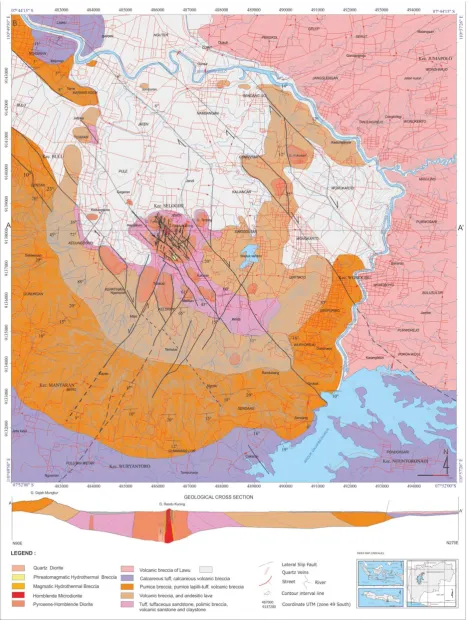
of the Miocene Mandalika and Semilir For-mations, unconformably underlie Quaternary volcanic rocks of Lawu and Merapi Volcanoes. Most of the Tertiary rocks have been strongly hydrothermal altered; causing primary rock forming minerals (feldspar, hornblende, py-roxene), were replaced by secondary minerals (chlorite, carbonate, quartz, hematite). Lithos-tratigraphically, these rocks could be grouped into many rock units, i.e.: tuff unit, andesitic lava, pumice breccia, calcareous sedimentary rock, dioritic intrusive rocks and hydrother-mal breccias, volcanic breccia unit, and alluvial deposit, respectively from the oldest to the youngest (Figure 4). Based on the observation both on surface outcrops and drilling core sam-ples, the intrusive rocks at the researched area consist of hornblende-pyroxene diorite (pre-vious researcher called as a medium diorite), hornblende microdiorite and quartz diorite.
Geology of the Randu Kuning area
Lithology
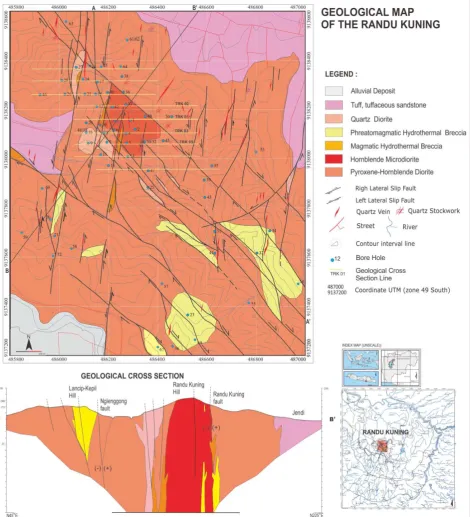
Randu Kuning area is situated in the area where porphyry Cu-Au and epithermal Au low sul-phidation occured. The area is occupied by dioritic intrusive rocks and hydrothermal brec-cias as well as many veins/veinlets types. In-trusive rocks consist of hornblende-pyroxene diorite, hornblende microdiorite and quartz diorite, while the hydrothermal breccia can be classified as magmatic hydrothermal breccia and phreatomagmatic breccia.
Hornblende-pyroxene diorite generally shows gray color in fresh condition (lighter than hornblende microdiorite), porphyritic tex-ture (moderate-strong), having medium crystal size (1-2 mm) with pyroxene and hornblende phenocryst size varies up to 2 cm. Contain high proportion of plagioclase or at about 35– 50 percent with lesser amount of hornblende and pyroxene (3–8 percent). At the contact with the microdiorite, most of the primary miner-als generally altered to the secondary minerminer-als formed potassic zones and gradually became into propylitic zone outward.
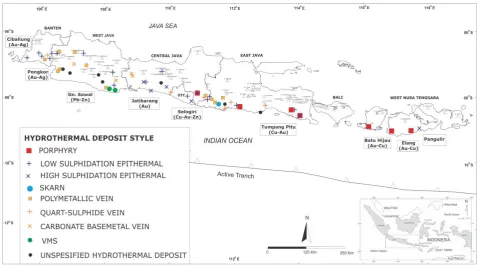
Figure 2: Magmatic arcs distributing in Indonesia (redraw after Carlile and Mitchell, 1994 and different styles of mineral deposits in Indonesia (Carlile and Mitchell, 1994; Setijadji and Maryono, 2012).
of samples microscopically classified as an-desite (porphyritic texture), commonly consist of about 30-45 percent of plagioclase and 5–14 percent of hornblende. The hornblende mi-crodiorite is believed to be responsible for the extensive alteration and Cu-Au porphyry ore deposit in the study area. Physically, it seen darker in color and finer in crystals size than pyroxene diorite. It is caused not only the amount of mafic minerals but also the abun-dant of the secondary magnetite. Most of the body was altered to potassic assemblage and lack of propylitic and phyllic alteration types.
Quartz diorite intrusive rock has the bright-est colors and the coarsbright-est crystals sizes (>2 mm), equigranular to weak porphyritic texture, characterized by the abundant of plagioclases (40–55%) and small quantities of quartz (4–7%) and alkali feldspars (2–5%). Due to have coarse grained crystal size, Muthi et al. (2012) recog-nized and described the intrusive as a coarse diorite. It was generally altered to phyllic-argillic and propylitic minerals assemblage, as-sociated with Au-base metals epithermal type mineralization. Dimensions and distribution of this intrusion relatively narrower and smaller than those of hornblende-pyroxene diorite and hornblende microdiorite intrusions.
Structural Geology
Major structures at the Selogiri area are dom-inated by relatively the NW–SE, NE–SW, and rare N–S trends, cross cut all of the rocks in the area, but minor E–W trending fault also was found (Suasta and Sinogrogo, 2011). The ear-liest and most dominant structures in the re-search area is the NW–SE dextral (right) lateral-slip fault, and commonly have a longer dimen-sion rather than the other trends. These struc-tural trends then were cross cut by NE-SW and N-S sinistral (left) lateral-slip faults. The NE– SW and N–S trend mostly concentrated in the central area.
Drill core and surface outcrop data suggest the the earlier porphyry vein types were may be controlled by dextral (right) lateral-slip faults, whereas the later porphyry vein and epithermal vein types controlled by sinistral (left)
lateral-slip faults. The geological map of the Randu Kuning area can be seen at Figure 5
5 Alteration and Mineralization
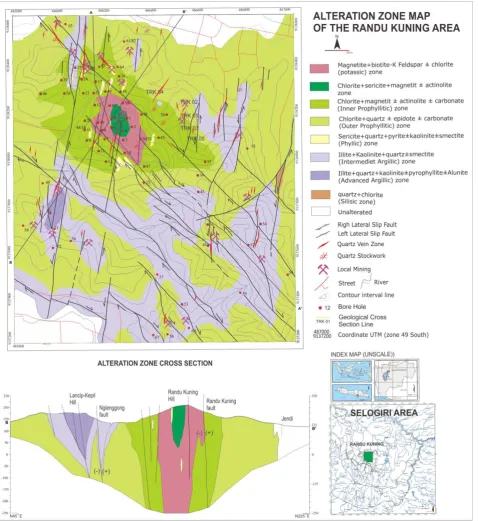
Creasey (1966) suggested the classification of hydrothermal alteration type on por-phyry copper deposit into three types, i.e., prophylitic (chlorite+calcite±epidote±talc), argillic (kaolinite or dickite)+ montmo-rillonite±sericite±chlorite, potassic (K-feldspar+biotite± magnetite±quartz± chlorite), and quartz+sericite+pyrite mineral assem-blages. Lowell and Guilbert (1970) created a model of alteration-mineralization on porphyry ore deposits as well, adding the term of phyllic type, for quartz+sericite+pyrite± chlorite±rutil ±chalcopyrite mineral assemblage. Due to many new prospects of hydrothermal ore min-eralization around the world were found, then proposed many new term alteration type such as advanced argillic, intermediate argillic and inner propylitic (Seedorff et al., 2005; Sillitoe, 2010). Alteration zones distribution of the re-searched area are generally controlled by the NE–SW and NW–SE trending structure. At least eight types of hydrothermal alteration at the Randu Kuning area and its vicinity had identified (Figure 6):
4. Chlorite+epidote±carbonate (outer propy-litic)
5. Sericite+quartz+pyrite (phyllic).
6. Illite+kaolinite±smectite (intermediate argillic).
7. Illite+kaolinite± pyrophyllite± alunite (ad-vanced argillic).
8. Quartz+chlorite (silicic) zones.
hill. This zone is characterized by the present of secondary minerals assemblage i.e. one or both of secondary biotite and/or K-feldspar associ-ated with magnetite, actinolite, quartz and lack of carbonate minerals (Suasta and Sinugroho, 2011; Corbett, 2011, 2012 and Muthiet al., 2012). The chlorite+sericite+magnetite±actinolite is widespread on the upper part of the magnetite+biotite±K-feldspar±chlorite (potas-sic) characterizing by the dominant of chlorite and sericite, although other sec-ondary minerals such as magnetite, quartz, and sometimes actinolite are still found. The chlorite+sericite+magnetite±actinolite zone is developed on the small upper part of hornblende microdiorite. The chlo-rite+magnetite+±actinolite± carbonate alter-ation type is commonly recognized between magnetite+biotite±K-feldspar±chlorite (potas-sic) zone and chlorite+epidote±carbonate (outer propylitic) zone. The zone mostly is widespread in pyroxene-hornblende diorite rocks, and within small part of hornblende microdiorite. In some places this alteration zones seen cut to minerals assemblage of the magnetite+biotite±K-feldspar±chlorite (potas-sic) zone and gradually outward changed to chlorite+epidote±carbonate (outer propylitic) zone. The chlorite+epidote±carbonate, (outer propylitic) alteration zone is widespread on pyroxene-hornblende diorite rocks and small part of quartz diorite, gradually from the inner propylitic to least altered rock, comprising of chlorites, epidotes, carbonates and quartz.
The sericite+quartz+pyrite (phyllic) alter-ation is commonly appear in the fault struc-ture zones, locally overprint to the potas-sic alteration and inner propylitic zone, on hornblende-pyroxene diorite rocks, microdior-ite hornblende as well as quartz diormicrodior-ite (Suasta and Sinugroho, 2011; Corbett, 2011, 2012 and Muthiet al., 2012). This zone is characterized by retrograde silica-sericite-chlorite-pyrite assem-blages, which is mostly limited to fault zones or selvages to late stage quartz-pyrite veins likened to D veins (Corbett, 2012).
The illite+kaolinite±smectite, (intermediate argillic) zone appears mainly adjacent to brec-cia and fault zone, espebrec-cially in the
epither-mal prospect area, which is characterized by the present of clay minerals. Illite, kaolinite and smectite are the main minerals identified in the vein samples suggesting structural controlled argillic alteration (Muthi et al., 2012). The il-lite+kaolinite± pyrophyllite± alunite (advanced argillic) is situated at the centre of Kepil hill, southwest of the Randu Kuning hill, compris-ing mostly illite, pyrophyllite, kaolinite, quartz and lack of alunite, carbonate and chlorite. The quatz+chlorite (sillisic) zone is restricted found at the fault zones, both within drilling core data and surface outcrop, consist of quartz, sericite, carbonate, clay minerals and opaque minerals. It is mostly related to the preatomagmatic hy-drothernal breccia occurrence of the epithermal system.
6 Veins and hydrothermal breccias
Veins types
An understanding of the veins and veinlets in the porphyry system is very important, espe-cially in the Cu-Au porphyry deposit, as most of mineralization is associated with the pres-ence of veins and veinlets. Various types of veins in porphyry-type ore deposit are sum-marized from several experts (Gustafson and Hunt, 1975; Corbett, 2008; Sillitoe, 2010; Cor-bett, 2012) include EB type or EDM type, M type, A type, B type, AB type, C type and D type. A lot of vein types were observed at the Randu Kuning area, both porphyry vein and epithermal vein types. Some of them are dif-ficult to be grouped according to the classifi-cation of previous researchers above. Here are some vein types criteria that were found in the study area based on observations of drilling core samples and surface outcrops (using com-pilation of Gustafson and Hunt, 1975; Corbett, 2008; Sillitoe, 2010; Corbett, 2012). At least seven porphyry veins type have been observed, respectively from the earliest are (Figure 7):
1. Magnetite-chalcopyrite±quartz-biotite, 2. Quartz±magnetite (A type),
3. Banded/Laminated quartz-magnetite (M type),
5. Quartz with thin centre line sulphide (AB type),
6. Pyrite±chalcopyrite (C type), and
7. Pyrite-quartz+chalcopyrire+carbonate (D type).
Most of the porphyry vein style cross cut by epithermal vein types (Figure 8). At least six epithermal environment veins classifying into two group that are sul-phide±quatz±calcite±magnetite veins and quartz+calcite±gypsum±sulphide veins.
Hydrothermal breccia
Many experts have tried to classified breccia both on the basis of genetic and descriptive, such as Sillitoe (1985), Bakeret al. (1986), Law-less and White (1990). Sillitoe (1985) classi-fied ore-related hydrothermal breccia into mag-matic hydrothermal breccia, hydromagmag-matic breccia (phreatic and phreatomagmatic), mag-matic breccia, intrusive breccia and tectonic breccia.
The hydrothermal breccia in the Randu Kun-ing and its vicinity has not previously been reported in detail. Corbett (2011) stated that the upper portion of breccia pipe of Jangglen-gan (WDD23) is intersects milled matrix brec-cia typical of other Pacific rim phreatomagmatic breccia pipes where are intruded by breccias term milled clast intrusion matrix breccias of an interpreted magmatic hydrothemal origin.
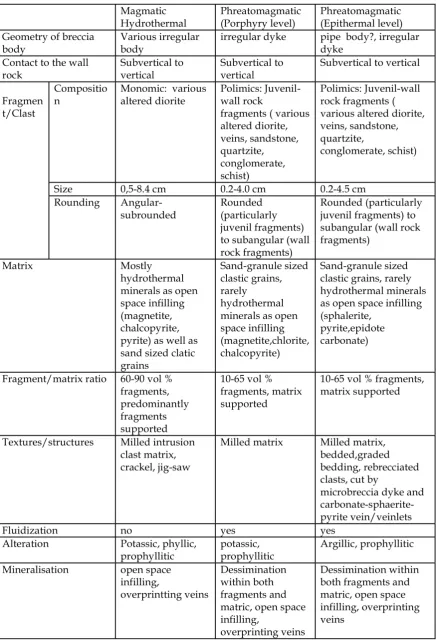
In the basis of Sillitoe (1985) classification, ge-netically many type of breccias have recognized in the researched area, such as hydrothermal breccias, volcanic breccias, fault breccia and intrusive breccia. In this paper we focus to discuss about hydrothermal breccia only. There are at least two type of hydrothermal breccia have recognized in the research, i.e. magmatic-hydrothermal breccias and phreatomagmatic breccias, which were found at the Randu Kun-ing hill area (Table 2. Magmatic-hydrothermal breccias are products of the release of hy-drothermal fluids from magma chamber (Sil-litoe, 1985). As an intrusive body cools, the residual melt become increasingly concentrated in volatile components including water and it
therefore has a considerable potential for hy-draulic fracturing of overlying rocks forming breccia and related mineral deposits (Lawless and White, 1986). Phreatomagmatic breccia occurred when upwelling magma encounter water, may be groundwater, connate water or a body or surface water (Lawless and White, 1986).
Magmatic hydrothermal breccia
Magmatic-hydrothermal breccias in research area are characterized by various irregular body, showing subvertical to vertical in contact to the wall rocks, fragments mostly monomic, i.e. various altered diorite, angular-subrounded and larger in grain size (0.5–8.4 cm), matrix mostly consist of hydrothermal minerals (mag-netite, chalcopyrite and pyrite) as open space infilling, fragment/matrix ratio is high (60–90 vol. %) or predominantly fragment supported, texture/structures usually cracked, jig-saw and rotated fragments, no fluidization. The brec-cias are associated with potassic, phyllic and propylitic alteration type and open space in-filling mineralization as well as veins/veinlets overprinting (Table 2; Figure 9). This brec-cias have a different characteristics to those of phreatomagmatic breccias, particularly in frag-ment and matrix as well as mineralization style. Magnetite-K-feldspar-biotite (potassic) altered diorite clasts and also later magnetite flooding in the matrix indicated that the breccias devel-oped during the process of intrusion emplace-ment and hydrothermal alteration (Corbett, 2012).
Phreatomagmatic breccia
SUT
AR
T
O
et
al.
©
2015
Department
of
Geological
Engineering,
Gadjah
Mada
Figure 8: Many epithermal vein types at the Randu Kuning area: A) Epidote-quartz veinlets within chlorite-epidote-carbonate-quartz alteration (WDD 59-122.30); B) Chalcopyrite-sphalerite-quart-pyrite vein and carbonate centre line in Kepil Hill; C) Pyrite-sphalerite-carbonate vein with sericite selvage (WDD54-156.80); D) Quartz-pyrite vein typical in Lancil Hill; E) Pyrite-chalcopyrite-silica-carbonate vein with sericite selvage (Location deep porphyry Randu Kuning (WDD 19-449.75); F) Carbonate-gypsum vein.
dissemination and open space infilling (Table 1).
There are at least two phreatomagmatic brec-cia stages at the area, firstly is related with por-phyry environment and the second one asso-ciated to the epithermal processes. The char-acteristics between such two phreatomagmatic breccias type in the researched area is rela-tively similar, particularly in the composition, size and roundness of fragments, fragment ma-trix ratio, and mineralization styles, but dif-ferent in the geometry of breccia body, ma-trix composition, texture and alteration type (Table 2; Figures 10–11). Geometry of breccia body of porphyry level phreatomagmatic brec-cia, mostly as irregular dyke, while in the ep-ithermal level probably as pipe body. Mag-netite, chlorite and chalcopyrite are common hydrothermal minerals which present as open space infilling matrix, otherwise in the epither-mal level, pore space commonly were infilled by sphalerite, pyrite, epidote and carbonate. Breccia textures of epithermal enviroment more vary than those of porphyry level, consist of
bedded, graded bedding, rebrecciated clasts and cut by many vein/veinlets. Corbett (2011) stated that the upper portion of phreatomag-matic breccia pipe of Jangglengan (WDD23) is intersects milled matrix breccia typical of other Pacific rim phreatomagmatic breccia pipes in-terpreted to have breached the surface, charac-terized by the bedded, locally graded bedding and possibility of accretionary lapilli compo-nents.
7 Veins and hydrothermal breccias con-trol on Cu-Au mineralizations
Most of the mineralization at the Randu Kun-ing area are related to the veins/veinlets and hydrothermal breccias, and can be summarized as follows:
Figure 9: Magmatic hydrothermal stages: A) Hydrothermal fluids infilling rock fractures as magnetite-silicate veinlets (WDD2-49.80); B) magmatic hydothermal crackel breccia (WDD 02-51.30); C) Magmatic hydrothermal breccia with magmetite infilling pore space between fragments as matrix (WDD 02-84.00).
high temperature, during the veins were devel-oped. Based on the fluid inclusions analysis of A and M veins, the temperature of hydrother-mal fluid is at>600°C, it was not condition for gold-copper precipitations.
Quartz-sulphides veins mineralization: In the upper portion and later stage or at the time of the ore fluids ascending, the quartz veins accompanied by minor sulphides and can de-velop AB veins (formed by the filling at central termination within A veins by sulphides), C veins (chalcopyrite-pyrite veins), and on the reactivated lamination parting of laminated M veins (Corbett, 2011; 2012). These quartz-sulphides veins are commonly associated with the Au-Cu mineralization. Stockwork AB vein cut by C style chalcopyrite vein in WDD8-1384m comprising 1 g/t Au; 2570 ppm Cu (Corbett, 2012).
D veins mineralization: This vein type com-prise quartz, sulphides and carbonate with prominent silica-sericite±pyrite alteration sal-vages. D vein is distinguished to epithermal veins by width, banding/centre line as well as contact with the wall rocks. This vein is a latest vein in porphyry environment or may as a transition from porphyry to epithermal environment. D veins most common occurred within fault zones, overprinting of earlier bar-ren quartz+magnetite veins, quartz-sulphides veins and disseminated sulphides mineraliza-tion. It may contain locally elevated Au to 5 g/t Au, 1.1 g/t Ag and 292 g/t Cu (in DDH WDD18-358.4m) with typically low Ag:Au ra-tios of 0.2 (Corbett, 2011; 2012).
Epithermal veins: The vein which asso-ciated with mineralization particularly is pyrite+sphalerite+chalcopyrite+quartz+carbonate vein. Many sulphides such as pyrite, chalcopy-rite, sphalerite and lack of galena within open space hydrothermal breccia also have impor-tant role in gold-silver-zinc-lead mineraliza-tion, particularly in the epithermal environm-ment.
Hydrothermal breccias: Many hydrothermal breccia, both porphyry and epithermal environ-ment, have contribution in Cu-Au mineraliza-tion. Many of porphyry level-magmatic hy-drothermal breccias matrix comprising dissem-ination of chalcopyrite-magnetite-pyrite. Brec-ciated pyrite-carbonate vein in Geblag (WDD 54 depth 167–169m) contains 0.63–2.229ppm Au, 28.1–31.4ppm Ag, 784–1150ppm As, 0,45– 0.65% Cu, 301–640ppm Pb and 0.054–0.57% Zn. Hydrothermal breccia at the Jangglen-gan prospect has also an important role in Au-Zn-Ag mineralization. Drilling core sam-ples of WDD 69 depth 70–76m comprising 0.3– 1.08ppm Au, 1–1.4 ppm Ag, 33–195ppm Pb, 182–2010ppm Zn and 13–56ppm As.
8 Conclusions
hydrothermal breccia contributed to Au-Ag-Zn mineralization.
Acknowledgements
Our sincere thanks go to the management of PT. Alexis Perdana Mineral, which has given us permission to do this research in the Selogiri prospect area and its vicinity. Special thanks to Mas Sapto and his staff, Mbak Dina, and Rama Dani (Methun) for their facilities support and assistance during the fieldwork. We also would like to thank the Head and staff of the Institute of Mineralogy and Economic Geology (IML) of Aachen (RWTH) University, Germany and the Geological Engineering Department, Fac-ulty of Engineering, Gadjah Mada University who gave me permission to access to the lab-oratories.
References
Baker, E.M., Kirwin, D.J., and Taylor, R.G. (1986) Hydrothermal Breccia Pipes, Contri-butions of the Economic Geology Research Unit, Geology Department James Cook Uni-versity of North Queensland, 45p.
Bemmellen, van, R.W. (1949) The Geology of Indonesia, and Adjacent Archipelagoes, Vol. IA, Gov. Print. Office, Martinus Nijhoff, the Hague.
Carlile, J.C. dan Mitchell, A.H.G. (1994) Mag-matic Arcs and Associated Gold and Copper Mineralisation in Indonesia, Journal of Geo-chemical Exploration, Elsevier Science, Ams-terdam, 50: 92-142.
Corbett, G. (2008) Influence of Magmatic Arc Geothermal Systems on Porphyry-Epithermal Au-Cu-Ag Exploration Models, Paper presented at the Terry Leach Sympo-sium, Sydney, 17 October 2008. Australian Institute of Geoscientist Bulletin 48.
Corbett, G. (2011) Comments on The Explo-ration Potential of The Wonogiri Porphyry Cu-Au Project, Central Java, Indonesia, Cor-bett Geological Services Pty. Ltd., Unpub-lished, 27p.
Corbett, G. (2012) Further Comments on The Wonogiri Porphyry Cu-Au Project Central
Java, Indonesia, Corbett Geological Services Pty. Ltd., Unpublished, 37p.
Creasey, S.C. (1966) Hydrothermal Alteration, op.cit. p. 51-74.
Gustafson, L.B. dan Hunt, J.P. (1975) The Por-phyry Copper Deposit at El Salvador, Chile, Economic Geology 70: 857–912.
Hamilton,W.B. (1979) Tectonics of the Indone-sian Region. Professional Paper 1078, U.S. Geolology Survey, Washington, DC., 345 p. Hartono, H.G. (2010) The Role of
Paleovolcan-ism in The Tertiary Volcanic Rock Product Setting at Gajahmungkur Mt., Wonogiri, Cen-tral Java, Dissertation in UNPAD, Unpub-lished, 190p.
Hedenquist, J.W., Arribas, A.J., and Reynolds, T.J. (1998) Evolution of Intrusion-Centered Hydrothermal System: Far Southeast-Lepanto Porphyry and Epithermal Cu-Au deposits, Philipines, Economic Geology 93: 373–404.
Imai, A., Shinomiya, J., Soe, M.T., Setijadji, L.D., Watanabe, K., and Warmada, IW. (2007) Porphyry-Type Mineralization at Selogiri Area, Wonogiri Regency, Central Java, In-donesia, Resources Geology 57: 230–240. Isnawan, D., Sukandarrumidi and Sudarno, I.
(2002) Kontrol Struktur Geologi Terhadap Je-bakan Tembaga Sebagai Arahan Eksploitasi di Daerah Ngerjo dan Sekitarnya Kecamatan Tirtomoyo, Kabupaten Wonogiri Propinsi Jawa Tengah, Gama Sains IV (2) Juli 2002, pp.149–157.
Katili, J. A., 1989. Evolution of the South-east Asian arc complex, Geology Indonesia. Jakarta, 12: 113–143.
Kouzmanov, K., Moritz, R., von Quadt, A., Chiaradia, M., Peytcheva, I., Fontignie, D., Ramboz, C., and Bogdanov, K. (2009) Late Cretaceous Porphyry Cu and Epithermal Cu-Au Association in the Southern Panagyur-ishte District, Bulgaria: the Paired Vlaykov Vruh and Elshitsa Deposits, Mineralium De-posita 44: 611–646.
Maryono, A., Setijadji, L.D., Arif, J., Harri-son, R., Soeriaatmadja, E. (2012) Gold, Sil-ver and Copper Metallogeny of the Eastern Sunda Magmatic Arc Indonesia, Proceeding of Banda and Eastern Sunda Arcs 2012 MGEI Annual Convention, 26-27 November 2012, Malang, East Java, Indonesia, pp. 23–38. Muntean, J.L. and Einaudi, M.T. (2001)
Porphyry-Epithermal Transition: Maricunga Belt, Northern Chile, Economic Geology 96: 743–772.
Muthi, A., Basten, I.G., Suasta, I.G.M., and Litaay, N.E.W. (2012) Characteristic of Alter-ation and MineralizAlter-ation at Randu Kuning-Wonogiri Project, Proceeding of Banda and Eastern Sunda Arcs 2012 MGEI Annual Con-vention, 26-27 November 2012, Malang, East Java, Indonesia, pp. 117–132.
Seedorff, E., Dilles, J.H., Proffett, Jr., J.M., Einaudi, M.T., Zurcher, L., Stavast, W..J.A, Jonhson, D.A., and Barton, M. (2005) Por-phyry Deposit: Characteristics and Origin of Hypgene Features, Economic Geology 65: 251–298.
Setijadji, L.D., Kajino, S., Imai, A., and Watan-abe, K. (2006) Cenozoic Island Arc Magma-tism in Java Island (Sunda Arc, Indonesia): Clues on Relationships between Geodynam-ics of Volcanic Centers and Ore Mineraliza-tion, Resources Geology 56: 267–292.
Setijadji, L.D., and Maryono, A. (2012) Geology and Arc Magmatism of the Eastern Sunda Arc, Indonesia, Proceeding of Banda and Eastern Sunda Arcs 2012 MGEI Annual Con-vention, 26-27 November 2012, Malang, East Java, Indonesia, p.1–22.
Sillitoe, R.H. (1985) Ore-Related Breccias in Vol-canoplutonic Arcs, Economic Geology 80: 1467–1514.
Sillitoe, R.H. (2010) Porphyry Copper System, Economic Geology 105: 3–41.
Smyth, H.L., Hall, R. and Nichols, G. (2008) Cenozoic Volcanic Arc History of East Java
Indonesia: The Stratigraphic Record of Erup-tion on An Active Continental Margin, The Geological Society of America Special Paper No. 436, p. 199–221.
Suasta, I.G.M and Sinugroho, I.A. (2011) Occur-rence of Zoned Epithermal to Porphyry Type Cu-Au Mineralization at Wonogiri, Central Java, Proceeding of The 36th HAGI and 40th IAGI Annual Convention.
Suprapto (1998) Model Endapan Emas Epiter-mal Daerah Nglenggong, Kecamatan sel-ogiri, Kabupaten Wonsel-ogiri, Jawa Tengah. Tesis Magister, Program Studi Rekayasa Per-tambangan, Fakultas Pasca Sarjana, Institut Teknologi Bandung, 47 p.
Surono, Toha, B., and Sudarno, I. (1992) Geolog-ical map of the Surakarta-Giritontro Quad-rangles, Java, Geological Research and Devel-opment Centre, Bandung.
Sutarto, Idrus, A., Putranto, S., Harijoko, A., Setijadji, L.D., Meyer, F.M., and Danny, R. (2013) Veining Paragenetic Sequence of The Randu Kuning Porphyry Cu-Au Deposit at Selogiri Area, Central Java. Extended Ab-stract: CD Proceeding of The 38thHAGI and 42nd IAGI Annual Convention and Exibition Medan, 28-31 October 2013.
Sutarto, Idrus, A., Meyer, F.M., Harijoko, A., Setijadji, L.D., and Danny, R. (2013) The Dioritic Alteraation Model of The Randu Kuning Porphyry Cu-Au, Selogiri Area, Cen-tral Java. Proceedings International Confer-ence on Georesources and Geological Engi-neering, December 11-12, 2013 Yogyakarta, ISBN 978-602-14066-5-6. p.122-132.