Form and Function of Expressive Morphology: A Case Study of Russian
by
OLGA STERIOPOLO
A THESIS SUBMITTED IN PARTIAL FULFILLMENT OF THE REQUIREMENTS FOR THE DEGREE OF
DOCTOR OF PHILOSOPHY in
THE FACULTY OF GRADUATE STUDIES (Linguistics)
THE UNIVERSITY OF BRITISH COLUMBIA (Vancouver)
ABSTRACT
In this thesis, I conduct a detailed case study of expressive suffixes in Russian. I show that although the suffixes under investigation have the same function (“expressive”), they differ significantly in their formal properties. I identify two major semantic types of expressive suffixes: attitude and size suffixes. Attitude suffixes convey an attitude of the speaker toward the referent. Size suffixes both convey an attitude and refer to the size of the referent.
I argue that the two different semantic types map onto different syntactic types. Attitude suffixes are syntactic heads, while size suffixes are syntactic modifiers. As heads, attitude suffixes determine the formal properties (syntactic category, grammatical gender and inflectional class) of the derived form. As modifiers, size suffixes do not determine the formal properties of the derived form. Attitude suffixes can attach both to category-free √Roots and to categories (n/a/v), while size suffixes can only attach to a noun category.
I investigate the functional and formal properties of Russian expressive suffixes in a systematic way, which has not been done before. In doing so, I analyze how expressive suffixes pattern along several kinds of criteria (gender/class change, category change, subcategorization). An important byproduct of this analysis is that I show how grammatical gender of an expressive form can be predicted from its inflectional class (combined with animacy and natural gender of the base).
TABLE OF CONTENTS
3.2.2.1. Why the properties of -išč’ favour the traditional approach ... 51
LIST OF TABLES
Table 3.2 Masculine and feminine nouns, by phonological form of stem……….… 36
Table 3.3 Singular vs. plural agreement with an adjective……….…... 39
Table 3.8 Inflectional Class II (feminine, masculine, and common gender nouns).. 46
Table 3.9 Inflectional Class III ………. 49
Table 3.10 Inflectional classes in Russian, according to Corbett (1982, 1991)….….. 50
Table 3.11 Masculine animate and inanimate nouns (Class I)……….... 58
Table 4.20 Final consonants of Class III stems……….………… 108
Table 4.21 Non-expressive -išč’ and expressive -išč’………..……..113
Table 4.22 Non-expressive -ec and expressive -ec………..…….. 115
Table 4.23 Non-expressive -k and expressive -k……….... 116
Table 4.24 Syntactic heads vs. syntactic modifiers……….…….. 117
Table 4.25 Expressive suffixes in Russian……….…117
Table 5.1 Attitude suffixes (attachment to √Roots)……….…… 122
Table 5.2 Attitude suffixes (merging with adjectives)……….… 124
Table 5.3 Attitude suffixes (merging with verbs)……….... 127
Table 5.4 Attitude suffixes (merging with categories)……….…128
Table 5.5 Attitude suffixes (attachment to √Roots and to categories)……….…… 134
Table 5.6 Size suffixes (merging with nouns)……….…….138
Table 5.7 Size suffixes (no merging with adjectives)…..……… 139
Table 5.8 Size suffixes (no merging with verbs)……….…… 140
Table 5.9 Size suffixes (attachment to n, a, v, and √Roots)……….… 143
Table 5.10 Attitude vs. size suffixes (difference in attachment sites)………....143
Table 6.1 Distributional difference #1 between attitude and size suffixes in Russian……….... 149
Table 6.2 Distributional difference #2 between attitude and size suffixes in Russian……… 150
Table 6.3 Asymmetries between attitude and size suffixes in Russian…………... 150
Table 6.4 Syntactic heads that can only merge with a noun category (German).… 154 Table 6.5 Expressive morphology in Russian, German, and Halkomelem…….… 157
LIST OF ABBREVIATIONS USED
a adjective
ACC Accusative case
adj adjective
affect affectionate
anim animate
ANTIHON antihonorific
ASP aspect
aug augmentative
BP Brazilian Portuguese
CAUS causative
CLASS inflectional class
COP copular
D, DET determiner
DAT Dative case
DEFIN definite
DELIM.PREF delimitative prefix
dim diminutive
DIRC direct
EMOT emotional
ERG ergative
EVID evidence/evidential
EXPR expressive
F functional projection
FEM feminine
GEN Genitive case
INDEF indefinite
INF infinitive
INST Instrumental case
LEX lexical prefix
MASC masculine
MASC/FEM masculine or feminine
n noun
NEUT neuter
N.SG/Nom sg. Nominative singular
NOM nominalizer
NONEXP non-experienced
non-EXPR non-expressive
OOC out-of-control
PERF perfective
PL plural
PREP preposition
PRES present
PROG progressive
SG singular
SUBJ.HON subject honorific
SUFF suffix
SUPERLEX superlexical prefix
TH theme vowel
v verb
VERB.PREF verbal prefix
ACKNOWLEDGEMENTS
I would like to thank my supervisor, Martina Wiltschko, for her huge help with this thesis. Thank you, Martina, for all your advice and suggestions for this work. Your supervision has made doing this work a true pleasure and a lot of fun. Thank you for believing in me from the start and for taking a lot of time away from your family in order to help me with this research. It is your enthusiasm that has made me fall in love with my work. Thank you very much for teaching me the “structure”; it will be my great pleasure to take it with me wherever I end up in life.
Thank you very much to my committee members, Gunnar Hansson and Hotze Rullmann for all your comments and suggestions. Thank you for your help with the difficult issues in phonology and semantics, which I would have never figured out without your help. Thank you for devoting many hours to reading this work and for giving me very detailed and helpful comments. And thank you for all your encouragement and moral support, which were so welcomed and appreciated during both difficult and happy times as I worked on this thesis.
Thank you to Henry Davis for fighting through the bureaucratic difficulties in order to enroll me in the Ph.D. program in the first place. Thank you for giving me this great chance to earn my Ph.D. degree from the University of British Columbia. I would also like to thank you for supervising my work on Nuu-chah-nulth. You have made me fall in love with this wonderful language, as well as the First Nations culture and people. Although I am not currently working on First Nations languages, I will always keep a place in my heart to appreciate their fascinating complexity.
Thank you to Patricia Shaw, Joseph Stemberger, and Douglas Pulleyblank for your huge help with my work on “Jer vowels in Russian prepositions”. I also would like to thank you for your everlasting encouragement, support and for making me fall in love with the Russian phonology.
Thank you to Lisa Matthewson for your financial support during the difficult times. Thank you for never letting me go without help, in spite of your own difficulties and many students that also relied on your support.
Many thanks to Katrina Petrik for her huge help with editing of this work. Thank you, Katrina, for devoting many long hours to proofreading and formatting this thesis and for always finding time to do all this work under the biggest time pressure.
Thank you very much to Edna Dharmaratne for helping me to survive my many years in the Ph.D. program. Edna, you have become my true friend and my guardian angel since the first day I set my foot in this department. Thank you for always being there for me, through the good and especially though the bad times. And thank you for always finding kind words for me when I most needed them. I will always remember your never-ending support and encouragement.
To my mother, Elena Steriopolo
Chapter 1: Introduction
1.1. EXPRESSIVE CONTENT AND EXPRESSIVES
An utterance can have descriptive content and expressive content. For example, the descriptive content of the English utterance in (1) is the proposition that Kresge is famous, as illustrated in (i). The expressive content conveys the negative attitude of the speaker toward Kresge, as illustrated in (ii).
(1) That bastard Kresge is famous.
i. Descriptive content: ‘Kresge is famous’
ii. Expressive content: ‘Kresge is a {bastard/bad in the speaker’s opinion}’
(Potts 2007:3) To give another example, the descriptive content of the Japanese utterance in (2) is the proposition that Sam laughed (i). The expressive content conveys the positive attitude of the speaker toward Sam (ii).
(2) Sam-ga o-warai-ninat-ta.
Sam-N.SG SUBJ.HON-laugh-SUBJ.HON-PAST ‘Sam laughed’
i. Descriptive: ‘Sam laughed’ ii. Expressive: ‘The speaker honours Sam’
1.2. RUSSIAN EXPRESSIVE SUFFIXES
Russian employs many expressive suffixes to convey the speaker’s attitude. According to Polterauer (1981), there are over 30 simplex and complex expressive suffixes. For the purpose of this thesis, I only investigate simplex expressive suffixes (a brief discussion of complex expressive suffixes is given in Chapter 7). Russian has been chosen as the language of investigation because it has many suffixes that have the same function (expressive), as well as the same morphological form (suffixes). Thus, Russian is an ideal candidate to investigate whether there is a correlation between the form and function of expressives.
Expressive suffixes in Russian present certain puzzles in terms of both their functional and formal properties. For example, although they are associated with the same expressive function, there are differences in meaning. Some expressive suffixes only convey the attitude of the speaker toward the referent (3), while others can both convey the attitude and refer to the size of the referent (4).
(3) d’ed-úl’-a pr’išól
grandfather-EXPR-N.SG came
‘Grandfather came (affectionate attitude)’
i. Descriptive: ‘Grandfather came’
ii. Expressive: ‘The speaker feels affection toward the grandfather’ (4) zv’er’-ók pr’išól
animal-EXPR.N.SG came
‘(The) animal came (affectionate attitude & small size of the referent)’ i. Descriptive: ‘The small animal came’
ii. Expressive: ‘The speaker feels affection toward the animal’
(5) adj noun
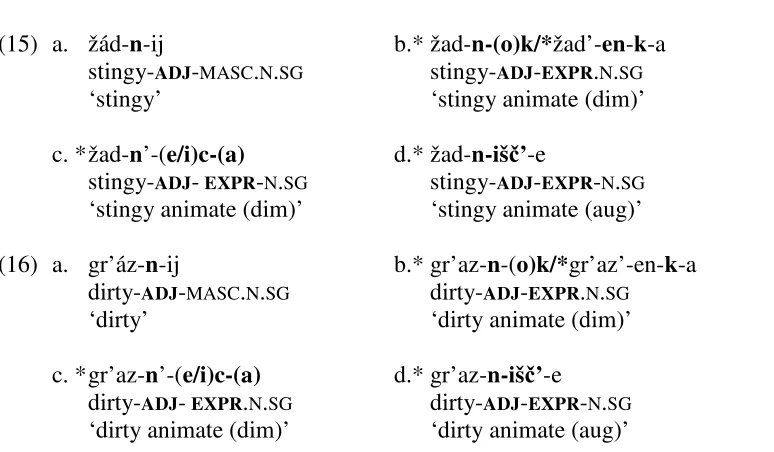
a. gr’áz-n-ij b. gr’az-n-úx-a
dirty-ADJ-MASC.SG dirty-ADJ-EXPR-N.SG
‘dirty’ ‘dirty animate’ (6) *adj noun
a. gr’áz-n-ij b. *gr’az-n-ok dirty-ADJ-MASC.SG dirty-ADJ-EXPR.N.SG
‘dirty’ ‘dirty animate’
With respect to (3)–(6), the following question arises: Are we dealing with only one class or different classes of expressives suffixes in Russian? If there are different classes, how do we distinguish them? Despite the fact that a great deal of descriptive research has been devoted to individual expressive suffixes in Russian (Bratus 1969; Dementiev 1953; Fentslova 1985; Ivanova 1965; Kolomiets 1988; Kosmeda 1999; Mandelshtam 1903; Ogol’cev 1960; Plyamovataya 1955, 1961; Polterauer 1981; Popoff-Böcker 1973; Popov 1967; Protasova 2001; Rakušan 1981; Shvedova et al.1982; Spiridonova 1999; Stankiewicz 1968; Vaseva 1977, among others), Russian expressive suffixes have not yet been analyzed in a systematic way.
Here, I systematically study the functional and formal properties associated with Russian expressive suffixes by (i) analyzing their meaning and (ii) determining whether or not they can change formal properties of the base.
1.3.FINDINGS
I show that there are two major semantic types of expressive suffixes in Russian: attitude and
size suffixes. Attitude suffixes only convey an attitude (examples 3 and 5 above); while size suffixes both convey an attitude and refer to the size of the referent (example 4 above).
I further argue that the two semantic types (attitude vs. size) map onto two distinct syntactic types. Attitude suffixes are syntactic heads (7a), while size suffixes are syntactic modifiers (7b).
(7) a. HEADS X b. MODIFIERS Y
X Y X Y
EXPRattitude EXPRsize
Attitude suffixes are noun heads that can attach to √Roots (8a) or to various syntactic categories (n/a/v) (8b). Size suffixes are noun modifiers that can only attach to a noun category (9).
(8) HEADS
a. n b. n
n √Root n n/a/v
EXPRattitude EXPRattitude
n/a/v √Root
(9) MODIFIERS n
EXPRsize n
n √Root
1.4.BYPRODUCTS OF THE ANALYSIS
This thesis systematically shows how this works with respect to expressive forms, which has never been done before.
Another byproduct of this analysis is that Russian expressive suffixes differ with respect to whether or not they can have descriptive content in addition to expressive content. I show that size suffixes can have both expressive and descriptive content, while attitude suffixes can have only expressive content. To the best of my knowledge, Russian expressive suffixes have never been studied before in terms of their descriptive vs. expressive content.
1.5.THEORETICAL FRAMEWORK
In this thesis, I assume the Principles and Parameters (P&P) framework, which contrasts with descriptivist frameworks focusing on a particular language of investigation. The descriptivist frameworks view categorization in terms of inflection vs. derivation, but this has been proven problematic with respect to the behaviour of expressives (Dressler & Barbaresi 1994; Manova 2004; Scalise 1984, 1988; Vinogradov 1972). It has been shown in the literature that the behaviour of expressives is not wholly inflectional or derivational. In contrast, the P&P framework regards inflection and derivation not as primitives, but as derived notions, and thus, this framework can better account for the behaviour of expressives.
For the purpose of this thesis, I assume a model of grammar in which syntax and morphology are analyzed as a single engine, as for example, in the framework of Distributed Morphology (DM) (Halle & Marantz 1993; Halle 1997; Marantz 1997; Harley & Noyer 1999, 2003; Marantz 2001; Bobaljik 2002; Marvin 2002; Arad 2003; Embick & Noyer 2005; Müller 2005; Halle & Matushansky 2006, among others). The particular assumption I adopt is that words are built by the same principles as phrases and sentences—by syntactic principles.
Another assumption I adopt is in regards to the treatment of √Roots and syntactic categories. √Roots are language-specific combinations of sound and meaning, such as √break- or √
more than one category, for example: the break(noun) in the glass and John breaks(verb)the glass. The category-defining functional heads are determined either by phonologically realized or zero affixes (10).
(10) n
n √cat
Ø
By hypothesis, the grammar makes reference to so-called dissociatedfeatures (Embick 1997, 1998; Embick & Noyer 2005). Dissociated features are absent in the syntax but are inserted at PF (Phonological Form). One example of a dissociated feature is morphological case. According to Embick (1997, 1998), morphological case is a feature that is added at PF and conditions the choice of the vocabulary item that expresses case. For example, in Latin, morphological case and number are fused in one morpheme (femin-a ‘woman-N.SG’). According to this approach, only Number (#) is present in a syntactic structure. Morphological case, however, does not figure in the syntax and is added at PF (11).
(11) Syntactic structure for a number morpheme #
# [+/ Pl] n
n √Root
Like in Latin, Russian case and number are also fused in a single morpheme, thus I assume that the structure in (11) also applies to Russian. For example, for the Russian word sobak-a
(12) Structure for sobak-a ‘dog-N.SG’ #
# n
n √sobak
Under the assumption that category labels are independent of √Roots, we expect two different sites for building words in the syntax: (i) words are created from √Roots, and (ii) words are created from other words. Thus, a category head X (e.g., n, a, v) may merge either with a √Root, as illustrated in (13a), or with a pre-existing word, as illustrated in (13b).
(13) a. X b. X
X √Root X n/a/v
n/a/v √Root
The distinction between word formation from √Roots and word formation from other words is a universal distinction, but its manifestations may differ from language to language (Marantz 2001). For example, in English, many category-defining affixes attach to √Roots. This is evident from a mechanism that Aronoff (1976) calls “truncation” (compare atroc-ious
and atroc-ity1). Marantz (2001) claims that what seems like truncation reflects word formation from √Roots. The √Root atroc- creates atroc-ious in an adjectival environment (suffix -ous) and it creates atroc-ity in a nominal environment (suffix -ity) (14).
(14) a. a b. n
a √atroc n √atroc
ous ity
Marantz (2001) also shows that there are suffixes in English that can attach both to a √Root and to a category. The nominalizing suffix -or is one such example: don-or, don-at-or
(derived from the verb don-ate) (15).
(15) a. n b. n
n √don n v
or or
v √don
ate
This thesis provides additional empirical support for a distinction between word formation from √Roots and word formation from categories. I show that both structures (15a) and (15b) are productively used by Russian expressive suffixes.
1.6.IMPLICATIONS OF THE ANALYSIS
One implication of this analysis is that the formal criteria which I develop for a small set of expressive suffixes in Russian can be extended to set up a typology of expressives. Despite the fact that much research has been devoted to expressives across languages (Dressler & Barbaresi 1994; Dressler 1997; Ettinger 1974, 1980; Gillis 1998; Helbig 1974; Schneider 2003; Beard and Szymanek 1988; Kalasniemi 1992; Voeykova & Dressler 2002; Volek 1987, among others), such formal criteria do not currently exist. As such, this work has the potential to trigger a whole new direction of research on expressives across languages.
1.7.STRUCTURE OF THE THESIS
The thesis is organized as follows. In Chapter 2, I discuss expressive content and its characteristics. I study the semantic function of Russian expressive suffixes by analyzing what they contribute to meaning. I show that expressive suffixes fall into two major semantic types: attitude and size suffixes. I also discuss how attitude and size suffixes differ with respect to whether or not they can have descriptive content in addition to expressive content.
In Chapter 3, I outline the background of Russian morphology. I discuss grammatical and natural gender, inflectional class, and animacy in Russian.
In Chapter 4, I investigate how expressive suffixes attach—as a head or as a modifier. I show that attitude suffixes are syntactic heads, while size suffixes are syntactic modifiers. By doing so, I show in a systematic way how grammatical gender of an expressive form is predictable on the basis of inflectional class, animacy, and natural gender (sex). I also discuss non-expressive suffixes that are homophonous with size suffixes in Russian. I show thatthe non-expressive suffixes differ from size suffixes both in meaning and in syntactic structure.
In Chapter 5, I investigate where expressive suffixes attach (to category-free √Roots or categories). I show that attitude suffixes can attach both to √Roots and to categories, while size suffixes can only attach to categories. I also analyze co-occurrence restrictions in both attitude and size suffixes, and show that all predictions about these co-occurrence restrictions are borne out in Russian.
In Chapter 7, I present the conclusions and discuss topics for further research, including complex expressive suffixes in Russian, the delimitative prefix po-, and further issues like stress and palatalization.
In the Appendix, I give examples of attitude suffixes which show the effects of each individual suffixes on the formal properties of linguistic objects it attaches to. Examples of size suffixes are described and analyzed in the body of the thesis.
Chapter 2: Expressive content and its characteristics
In this Chapter, I examine how to determine whether a given linguistic object (LO) is expressive or descriptive. I start with a brief discussion of the differences that set apart descriptive from expressive meanings (§2.1). I then introduce several diagnostic properties of expressive linguistic objects (LOs) as developed in Potts (2007), and I show that Russian expressive suffixes satisfy these properties. In §2.3, I present the conclusions.
2.1. DESCRIPTIVE AND EXPRESSIVE CONTENT
The expressive content of an utterance conveys information about the attitudes and emotions of the speaker toward the content of the utterance (Potts 2003:1). The expressive content is usually secondary to the descriptive content of the utterance, but can have a significant impact on discourse. This is illustrated in the following examples from Japanese. In (1), the subject honorific o-…-ninat is used. The descriptive content of this sentence is that Sam laughed. The expressive content is that the speaker views Sam with honour.
(1) Sam-ga o-warai-ninat-ta.
Sam-N.SG SUBJ.HON-laugh-SUBJ.HON-PAST
‘Sam laughed (with honorific)’ i. Descriptive: ‘Sam laughed’
ii. Expressive: ‘Speaker views Sam with honour’ (Potts & Kawahara 2004:1) In contrast, in (2), the antihonorific -yagat is used. The descriptive content of this sentence is that Sam laughed. The expressive content is that the speaker does not view Sam with honour.
(2) Sam-ga warai-yagat-ta.
Sam-N.SG laugh-ANTIHON-PAST
‘Sam laughed (with antihonorific)’
i. Descriptive: ‘Sam laughed’
ii. Expressive: ‘Speaker does not view Sam with honour’
The honorific o-…-ninat and antihonorific -yagat in (1) and (2) are markers of the expressive content (Potts & Kawahara 2004:2). An example from English is the expressive attributive adjective damn. In (3), the expressive damn indicates that the speaker views the Republicans negatively. The Japanese and English examples show that expressives can be bound (as in Japanese) or free (as in English) forms.
(3) Bush says the damn Republicans deserve public support.
i. Descriptive: ‘Bush says the Republicans deserve public support’
ii. Expressive: ‘Speaker views the Republicans negatively’ (Potts 2003:6) The examples above show that expressive content can be positive or negative: the honorific
o-…-ninat is a marker of positive expressive content, while the antihonorific -yagat and the attributive adjective damn are markers of negative content.
In Russian, there are a large number of suffixes that serve to convey expressive content. They can express both positive and negative attitudes. For example, in (4a), the expressive suffix -ul’ indicates that the speaker views his/her grandfather positively. The form with this suffix contrasts with the unmarked form in which expressive content is absent (4b).
(4) a. d’ed-úl’-a pr’išól
grandfather-EXPR-N.SG came
‘Grandfather came’
i. Descriptive: ‘Grandfather came’ ii. Expressive: ‘Speaker views grandfather positively’ b. d’éd pr’išól
grandfather.N.SG came ‘Grandfather came’
i. Descriptive: ‘Grandfather came’
(5) a. vor’-úg-a pr’išól
thief-EXPR-N.SG came
‘(The) thief came’
i. Descriptive: ‘The thief came’ ii. Expressive: ‘Speaker views the thief negatively’ b. vór pr’išól
thief.N.SG came ‘(The) thief came’
i. Descriptive: ‘The thief came’
Positive expressive suffixes in Russian indicate an attitude of affection and tenderness toward the referent on the part of the speaker (Bratus 1969; Efremova 2006; Kosmeda 1999; Shvedova et al. 1982). For this reason, I call them affectionate (affect) suffixes. Examples of these types of suffixes are given in (4 above) and (6 below). In (6a), the affectionate suffix -us’ indicates that the speaker views his/her grandmother with affection; compare this with the neutral statement in (6b).
(6) a. bab-ús’-a pr’išlá
gandmother-EXPR-N.SG came
‘Grandmother (affect) came’
i. Descriptive: ‘Grandmother came’ ii. Expressive: ‘Speaker views grandmother positively’ b. báb-a pr’išlá
grandmother-N.SG came ‘Grandmother came’
i. Descriptive: ‘Grandmother came’
(7) a. # Já n’e l ’ubl’ú svojú bab-ús’-u.
I not love self’s grandmother-EXPR-N.SG
‘I do not love my grandmother (affect)’
i. Descriptive: ‘Speaker does not love his/her grandmother’ ii. Expressive: ‘Speaker views his/her grandmother positively’ b. Já l’ubl’ú svojú bab-ús’-u.
I love self’s grandmother-EXPR-N.SG
‘I love my grandmother (affect)’
i. Descriptive: ‘Speaker loves his/her grandmother’
ii. Expressive: ‘Speaker views his/her grandmother positively’
Negative expressive suffixes indicate a vulgar attitude toward the referent (Bratus 1969; Efremova 2006; Kosmeda 1999; Shvedova et al. 1982). Such suffixes are only used informally and they are very productive in colloquial speech.2 For this reason, I call them
vulgar (vulg) suffixes. For example, in (8a), the vulgar suffix -an indicates that the speaker views an old man with contempt; compare this with the neutral statement in (8b), where -an
is absent.
(8) a. star’-ik-án pr’išól
old-NOM-EXPR.N.SG came
‘(The) old man came (vulg)’
i. Descriptive: ‘The old man came’ ii. Expressive: ‘Speaker views the old man negatively’ b. star’-ík pr’išól
old-NOM.N.SG came ‘(The) old man came’
i. Descriptive: ‘The old man came’
Vulgar suffixes are normally not used in a formal setting. This is illustrated in (9). In (9a), the vulgar suffix -an is used in a formal setting, indicated by the formal form of the verb pozvol’-t’e ‘let-formal’ and by the formal pronoun Vam ‘you (formal)’. As a result, the sentence is infelicitous. In (9b), the same vulgar suffix -an is used in an informal setting, indicated by the
informal form of the verb smotr’-í ‘look-informal’ and by the informal pronoun t’eb’e ‘you (informal)’. The sentence in (9b) is felicitous.
(9) a. # Pozvól’-t’e Vám predstáv’it’ étogo star’-ik-án-a.
Let-formal you(formal) introduce this old-NOM-EXPR.ACC.SG
‘Let me introduce you to this old man (vulg)’
b. Smotr’-í, vót star’-ik-án, o kotórom já t’eb’é govor’íl.
Look-informal here old-NOM-EXPR.N.SG about who I you(informal) told
‘Look, here is the old man (vulg), I told you about’
In Table 2.1, I list simplex affectionate and vulgar suffixes in Russian.
Affectionate suffixes -án’, -áš, -ón, -úl’, -ún’, -úr, -ús’, -úš
Vulgar suffixes -ág, -ák, -ál, -án, -ár, -áx, -íl, -in, -ób, -ot,
-óx, -úg, -úk, -úx
Table 2.1: Affectionate and vulgar suffixes in Russian
2.2. CHARACTERISTICS OF EXPRESSIVE CONTENT
According to Potts (2007), expressive content has the following characteristics (10).
(10) Characteristics of expressive content (Potts 2007:2):
1. Independence: Expressive content contributes a dimension of meaning that is separate from the regular descriptive content.
2. Nondisplaceability: Expressives predicate something of the utterance situation.
3. Perspective dependence: Expressive content is evaluated from a particular perspective. In general, the perspective is the speaker’s, but there can be deviations if conditions are right.
4. Descriptive ineffability: Speakers are never fully satisfied when they paraphrase expressive content using descriptive, i.e., non-expressive, terms.
5. Immediacy: Like performatives, expressives achieve their intended act simply by being uttered: they do not offer content so much as inflict it.
In what follows I discuss these characteristics in more detail and apply them to Russian data to establish that the suffixes under consideration are indeed expressive.
2.2.1. Independence of Russian expressive suffixes
According to Potts (2007), expressive content is independent of the descriptive content of an utterance. Consequently, the former can be changed or removed without affecting the latter. Potts (2006:4) uses an example from Japanese to illustrate this point. In (11a), the antihonorific -chimat is used, adding expressive content (‘It sucks that I overslept’). In (11b), the antihonorific is removed, which immediately removes the expressive content of the phrase. Although the expressive content is changed, the descriptive content that the speaker overslept does not change.
(11) a. nesugoshi-chimat-ta
overslept-ANTIHON-PAST
‘It sucks that I overslept (with antihonorific)’ i. Descriptive: ‘I overslept’
ii. Expressive: ‘Speaker views oversleeping negatively’ b. nesugoshi-ta
overslept-PAST ‘I overslept’
i. Descriptive: ‘I overslept’ (Potts 2007:4)
Russian expressive suffixes display the same kind of behaviour: they add content that is independent of the descriptive content. For example, in (12a), the affectionate suffix -ul’
expresses the speaker’s affection toward his/her grandmother. In (12b), the affectionate suffix is removed, which also removes the expressive content. Nonetheless, the descriptive content indicating that grandmother came remains unchanged.
(12) a. bab-úl’-a pr’išlá
grandmother-EXPR-N.SG came
i. Descriptive: ‘Grandmother came’
ii. Expressive: ‘Speaker views grandmother positively’ b. báb-a pr’išlá
grandmother-N.SG came ‘Grandmother came’
i. Descriptive: ‘Grandmother came’
Similarly, in (13a), the vulgar suffix -ug expresses the speaker’s contempt toward the thief. In (13b), the vulgar suffix is removed, which also removes the expressive content. The descriptive content indicating that the thief came does not change.
(13) a. vor’-úg-a pr’išól
thief-EXPR-N.SG came
‘(The) thief came (vulg)’
i. Descriptive: ‘The thief came’
ii. Expressive: ‘Speaker views the thief negatively’ b. vór pr’išól
thief.N.SG came ‘(The) thief came’
i. Descriptive: ‘The thief came’
We have now seen that Russian affectionate and vulgar suffixes behave similarly to the Japanese antihonorific in (11): they contribute an expressive meaning that is independent of the descriptive content. This property of Japanese honorifics and antihonorifics has received a lot of attention in the Japanese literature (Kikuchi 1994; Tokieda 1940; Ooishi 1975), where they are identified as a case of “Taiguu Hyoogen” (Attitudinal Expressions).3 Following the Japanese tradition, I am going to call Russian affectionate and vulgar suffixes
attitude suffixes, as they express the speaker’s attitude of affection or vulgarity. The attitude suffixes are defined in (14).
(14) Definition of attitude suffixes:
Russian attitudesuffixes express the speaker’s attitude (affection or vulgarity) toward the referent and contribute an expressive meaning to the phrase.
In addition to attitude suffixes that have expressive content, there is another type of expressive suffix in Russian: suffixes that have both expressive and descriptive content. Such suffixes express the speaker’s attitude and indicate the size of the referent (small or big) (Apres’an 1995; Kosmeda 1999; Mandel’štam 1903; Popov 1967; Spiridonova 1999; Stankiewicz 1954, 1968; Volek 1987, among others), as shown in (15). In (15a), the sentence contains only descriptive content. In (15b), the expressive suffix -ik is added to dóm ‘house’, which indicates both the small size of the house (descriptive content) and the positive attitude of the speaker toward the house (expressive content).
(15) a. Dóm stoít na gor’é.
house.N.SG stands on mountain ‘(A) house stands on a mountain’
i. Descriptive: ‘A house stands on a mountain’ b. Dóm’-ik stoít na gor’é.
house-EXPR.N.SG stands on mountain
‘(A) house (size) stands on a mountain’
i. Descriptive: ‘A small house stands on a mountain’ ii. Expressive: ‘Speaker views the house positively’
Example (16a) shows that dóm’-ik cannot be modified by the adjective ‘huge’; compare this with (16b), where it can be modified by ‘small’. Example (17a) shows that dóm’-ik cannot be used in a context when the speaker denies his/her positive attitude toward the referent house; compare this with (17b), where the speaker expresses a positive attitude.
(16) a. # Ogrómnij dóm’-ik stoít na gor’é.
huge house-EXPR.N.SG stands on mountain
‘A huge house stands on a mountain’
b. Mál’en’kij dóm’-ik stoít na gor’é.
‘A small house stands on a mountain’ (17) a. # Já n’enav’ížu náš dóm’-ik.
I hate our house-EXPR.N.SG
‘I hate our house’
b. Já l’ubl’u náš dóm’-ik.
I love our house-EXPR.N.SG
‘I love our house’
To distinguish this type of expressive suffix from the attitude suffixes described above, I call them size suffixes, because they indicate the size of the referent in addition to the speaker’s attitude. Size suffixes are defined in (18).
(18) Definition of size suffixes:
Russian size suffixes express the speaker’s attitude (positive or negative) toward the referent, and they also indicate the size (small or big) of the referent. Thus size suffixes contribute both expressive and descriptive content.
In the literature, size suffixes are referred to as diminutive (dim) or augmentative (aug) (Derkach 2005; Nesset 2003; Polterauer 1981; Popov 1967; Shvedova et al. 1982; Stankiewicz 1954, 1968; Wade 2000, among others). Diminutive suffixes indicate the small size of a referent, while augmentative suffixes indicate the big size of a referent. Examples of diminutive suffixes were given in (15)–(17) above. I have shown that diminutive suffixes can express the positive attitude of the speaker; less frequently, they can also express the negative (pejorative) attitude of the speaker (Shvedova et al. 1982:210). For example, in (19a), id’éj-k-a ‘idea (dim)’ is used with the diminutive suffix -k, which indicates that the speaker views the idea negatively; compare this with the neutral sentence in (19b), where the expressive suffix is absent.
(19) a. mn’é v gólovu pr’išlá id’éj-k-a
me prep head came idea-EXPR-N.SG
‘(An) idea (dim) came to my mind’
b. mn’é v gólovu pr’išlá id’éj-a me prep head came idea-N.SG ‘(An) idea came to my mind’
i. Descriptive: ‘An idea came to the speaker’s mind’
(Shvedova et al. 1982:210) Augmentative suffixes can also express the positive or negative attitude of the speaker (Derkach 2005; Nesset 2003; Schneider 2003). For example, in (20a), sobáč’-išč’-a ‘big/malevolent dog’ (translation from Derkach 2005:11) is used with the augmentative suffix -išč’, which indicates that the speaker views the dog negatively; compare this with the
neutral (20b), where the expressive suffix is absent.
(20) a. Sobáč’-išč’-a pr’išlá.
dog-EXPR-N.SG came
‘(A) dog (aug) came’
i. Descriptive: ‘A big dog came’
ii. Expressive: ‘Speaker views the dog negatively’ b. Sobák-a pr’išlá.
dog-N.SG came
‘(A) dog came’
i. Descriptive: ‘A dog came’ (Derkach 2005:11) The data in (21a) illustrate that sobáč’-išč’-a cannot be modified by the adjective ‘small’; compare this with (21b), where it can be modified by ‘huge’. The data in (22a) show that
sobáč’-išč’-a cannot be used in a context when the speaker denies his/her negative attitude toward the dog; compare this with (22b), where the speaker expresses a negative attitude.
(21) a. # Mál’en’kaja sobáč’-išč’-a pr’i-š-l-á
small dog-EXPR-N.SG came
‘(A) small dog (aug) came’
b. Ogrómnaja sobáč’-išč’-a pr’i-š-l-á
huge dog-EXPR-N.SG came
(22) a. # Já l’ubl’u étu sobáč’-išč’-u.
I love this dog-EXPR-ACC.SG
‘I love this dog (aug)’
b. Já n’enav’ížu étu sobáč’-išč’-u.
I hate this dog-EXPR-ACC.SG
‘I hate this dog (aug)’
The list of simplex size suffixes in Russian is given in Table 2.2.
Diminutive suffixes -k (-c (allomorphsallomorphs: -ok, -ek, -ik) : -ec, -ic)
Augmentative suffix -išč’
Table 2.2: Size suffixes in Russian
To summarize, a difference between attitude and size suffixes in Russian is that the former have expressive content, while the latter have both expressive and descriptive content. Attitude suffixes can be removed without affecting the descriptive content of a phrase, which confirms Potts’ (2007) criterion of independence. In contrast, size suffixes have descriptive content of their own, and thus, by removing a size suffix, its descriptive content is also removed, which indicates a change in the descriptive content.
2.2.2. Nondisplaceability of Russian expressive suffixes
Nondisplaceability is another characteristic that distinguishes expressive from descriptive content. Expressives predicate the speaker’s attitudes in a particular utterance situation that are valid only for the speaker at the time and place of the utterance. Consider for example the following German data from Potts (2007). In (23a), the descriptive content is Hermann believes that Hella’s dog is dead. In (23b), the expressive nominal Köter ‘damn.dog’ is used instead of the neutral Hund ‘dog’. As a result, (23b) conveys that the speaker holds Hella’s dog in low regard, in addition to the proposition Hermann believes that Hella’s dog is dead.
i. Descriptive: ‘Hermann believes that Hella’s dog is dead’ b. Hermann glaubt, dass Hellas Köter gestorben ist.
Hermann believes that Hella’s damn.dog dead is
‘Hermann believes that Hella’s damn dog is dead’
i. Descriptive: ‘Hermann believes that Hella’s dog is dead’
ii. Expressive: ‘Speaker views Hella’s dog negatively’ (Potts 2007:6) This example demonstrates the characteristic of nondisplaceability because the expressive
Köter ‘damn.dog’ relates directly to the utterance situation: it is the speaker who expresses a negative attitude toward the dog. This negative attitude cannot be attributed to the subject of the sentence Hermann (Potts 2007:6). It is worth pointing out that Köter ‘damn dog’ also has both expressive and descriptive content, similar to the Russian size suffixes discussed above.
Russian data with expressive suffixes also demonstrate the characteristic of nondisplaceability. This is shown in (24) for the vulgar suffix -an, which is used to refer to an old man (star’-ik-án ‘old man’). The sentence conveys a vulgar attitude toward an old man in addition to the proposition Mom thinks that Olga’s old man is a good person. The suffix -an indicates here that it is the speaker who expresses a vulgar attitude toward the old man, not the subject of the sentence ‘mom’, since mom says that the old man is a good person and thus has a positive attitude toward the old man.
(24) Predstáv’, máma dúmajet, čto Ol’in star’-ik-án xoróšij č’elov’ék.
imagine mom thinks that Olga’s old-NOM-EXPR.N.SG good person
‘Imagine, mom thinks that Olga’s old man (vulg) is a good person’
The same property also holds for size suffixes. For example, in (25), the diminutive suffix -k
(25) Pr’edstáv’, máma dúmajet, čto Ol’ina t’etrád-k-a našlá-s’.
imagine mom thinks that Olga’s notebook-EXPR-N.SG found-self
‘Imagine, mom thinks that Olga’s notebook (dim) was found’
To summarize, both attitude and size suffixes relate directly to the utterance situation expressing the attitude of the speaker at the time and place of the utterance. This confirms Potts’ (2007) criterion of nondisplaceability. Note in passing that the criterion of nondisplaceability also pertain to the descriptive content of a size suffix. For example, in (26), it seems that the suffix -išč’ indicates that the speaker views the dog as being big, but
does not indicate that the subject ‘mom’ also sees it as being big.
(26) Pr’edstáv’, máma dúmajet, čto Ol’ina sobáč’-išč’-a mál’en’kaja.
imagine mom thinks that Olga’s dog-EXPR-N.SG small
‘Imagine, mom thinks that Olga’s dog (aug) is small’
2.2.3. Perspective dependence of Russian expressive suffixes
Some expressives appear to contradict the criterion of nondisplaceability. In particular, Potts (2007) notes (after Kratzer 1999 and Schlenker 2003) that expressives may reflect the perspective of someone other than the speaker. This suggests that expressives do not necessarily express the attitude of the speaker but instead the attitude of the perspective bearer, which in most but not all cases is the speaker. For example, in (27), the expressive
that bastard indicates the negative emotion of the speaker’s father, and not the speaker herself (Potts 2007:7).
(27) My father screamed that he would never allow me to marry that bastard Webster. i. Descriptive: ‘Speaker’s father screamed that he would never allow the speaker to
marry Webster’
ii. Expressive: ‘Speaker’s father views Webster negatively’
expressive -an indicates the negative emotion of the speaker’s father, rather than the speaker herself.
(28) Ot’éc kr’ičál, čto n’e pozvól’it mn’e žen’ít’s’a na étom
father screamed that (he) not let(fut) me marry prep this
star’-ik-án’-e.
old- NOM-EXPR-LOC.SG
‘Father screamed that he won’t let me marry this old man (vulg)’
i. Descriptive: ‘Speaker’s father screamed that he would never allow the speaker to marry that old man’
ii. Expressive: ‘Speaker’s father views the old man negatively’
To deal with examples such as (27) and (28), Potts (2007) uses the notion of the “judge”. The judge is the person whose attitude is expressed by the expressive. Normally the judge is the speaker (in accordance with nondisplacebility), but sometimes it can be someone else. Potts doesn't discuss under which conditions the judge is not the speaker.
To summarize, Russian expressive suffixes, like English expressives such as bastard, indicate that sometimes the perspective bearer (or “judge”) is someone other than the speaker, which confirms Potts’ (2007) criterion of perspective dependence.
2.2.3.1. The speaker’s attitude
With respect to both nondisplaceability and perspective dependence, the following question arises: what is the speaker’s (or judge’s) attitude directed at? In the literature, there is no uniform answer to this question. One definition of expressivity is that it is a direct expression of the emotive attitude of the speaker toward what he/she is speaking about (Bühler 1934; Jakobson 1960). Another definition is that emotional meaning reflects the personal feeling of the speaker, including his/her attitude toward the hearer or the content of speech (Leech 1974).
grandmother, but it does not indicate the speaker’s attitude toward the hearer. This is better illustrated in (29b), where the hearer is addressed in a vulgar manner using the vulgar suffix -an. Although the listener is addressed by the speaker with a negative attitude, the affectionate suffix -ul’ still indicates the speaker’s positive attitude toward grandmother.
(29) a. Bab-úl’-a pr’išlá.
grandmother-EXPR-N.SG came
‘Grandmother (affect) came’
i. Descriptive: ‘Grandmother came’
ii. Expressive: ‘Speaker views grandmother positively’
b. Ej, star’-ik-án, id’í s’udá, bab-úl’-a pr’išlá.
Hey, old-NOM-EXPR.N.SG , come here, grandmother-EXPR-N.SG came
‘Hey, old man (vulg), come here, grandmother (affect) came’
Unlike affectionate suffixes that indicate the speaker’s attitude toward the referent, not the hearer, vulgar suffixes can target the hearer indirectly. Vulgar suffixes can only be used in informal settings and thus, they belong to an informal register. Such suffixes indicate that the speaker treats a particular discourse as informal; thus, if used in the wrong (e.g., formal) register, they might affect the hearer indirectly and even provoke a negative reaction. Consequently, vulgar suffixes can indirectly target the hearer while directly expressing an attitude toward the referent. For example, the sentence in (30), used with the vulgar suffix
-ox, can be uttered among close friends, but in a formal situation, it is considered rude and inappropriate.
(30) Bab’-óx-a pr’išlá.
grandmother-EXPR-N.SG came
‘Grandmother (vulg) came’
i. Descriptive: ‘Grandmother came’
ii. Expressive: ‘Speaker views the grandmother negatively’
indicates that the speaker views a dog with a positive attitude (small and nice dog). However, it does not express the speaker’s attitude toward the hearer. This is also shown in (31b), where the hearer is addressed in an irreverent manner with the vulgar suffix -an. Although the hearer is addressed with a negative attitude, the diminutive suffix -k still expresses the speaker’s positive attitude toward the dog.
(31) a. Sobáč’-k-a pr’išlá.
dog-EXPR-N.SG came
‘(The) dog (dim) came’
i. Descriptive: ‘The small dog came’
ii. Expressive: ‘Speaker views the dog positively’
b. Ej, star’-ik-án, id’í s’udá, sobáč’-k-a pr’išlá.
Hey, old-NOM-EXPR.N.SG , come here, dog-EXPR-N.SG came
‘Hey, old man (vulg), come here, (the) dog (dim) came’
2.2.4. Descriptive ineffability of Russian expressive suffixes
Another property of expressives is their lack of propositional content, that is, their descriptive ineffability. As such, expressives are similar to interjectives like ‘ouch’, which cannot be paraphrased with a description such as ‘I feel pain’. Their content is not a proposition, but the expression of an attitude/emotional state. According to Potts (2007), speakers are never fully satisfied when they paraphrase expressive content using descriptive terms, because paraphrases miss a wide range of emotive uses.
that the speakers view expressive sentences and their paraphrases differently, with expressive sentences being more ‘emotive’. Consider now the sentences reviewed by the speakers (the speakers were given only the Cyrillic version).
In (32a), the affectionate suffix -ul’ is used with the word ‘mother’, expressing the speaker’s affection toward mother. In (32b), the suffix -ul’ is removed and the paraphrase ‘Mother who I love’ is used. As a result, the sentence in (32a) seems more emotive to the speakers, compared to the sentence in (32b).
(32) a. Мамуля пришла.
Mam-úl’-a pr’išlá.
mother-EXPR-N.SG came
‘Mother (affect) came’
i. Descriptive: ‘Mother came’
ii. Expressive: ‘Speaker views his/her mother positively’ b. Мама, которую я люблю, пришла.
mám-a, kotóruju ja lubl’ú, pr’išlá mother-N.SG who I love came
‘Mother, who I love, came’
In (33a), the vulgar suffix -ug is used with the word ‘thief’, expressing the speaker’s irreverent attitude toward the thief. In (33b), the suffix -ug is removed and the paraphrase ‘The thief who I despise’ is used. The sentence in (33a) seems more emotive to the speakers than the sentence in (33b).
(33) a. Ворюга пришел.
Vor’-úg-a pr’išól.
thief-EXPR-N.SG came
‘(The) thief (vulg) came’
i. Descriptive: ‘The thief came’
ii. Expressive: ‘Speaker views the thief negatively’ b. Вор, которого я презираю, пришел.
Vór, kotórogo já pr’eziráju, pr’išól thief.N.SG who I despise came
In (34a), the size suffix -ik is used with kl’úč’ ‘key’, indicating that the key is small and nice
in the speaker’s opinion. In (34b), the suffix -ik is removed and the paraphrase ‘The small and nice key’ is used. The sentence in (34a) seems more emotive to the speakers, compared to the sentence in (34b), which supports the view that diminutive suffixes are not just descriptive, but also expressive.
(34) a. Ключик нашелся. Kl’úč’-ik našól-s’a.
key-EXPR.N.SG found-self
‘(The) key (dim) was found’
i. Descriptive: ‘The small key was found’
ii. Expressive: ‘Speaker views the key positively’ b. Маленький и славный ключ нашелся.
Mál’en’kij i slávnij kl’úč’ našól-s’a. small and nice key found-self ‘(The) small and nice key was found’
To summarize, Russian data with expressive suffixes seem more emotive to the speakers than their descriptive paraphrases because their content is not a proposition, but the expression of an attitude/emotional state. Thus, they satisfy Potts’ (2007) criterion of descriptive ineffability.
2.2.5. Immediacy of Russian expressive suffixes
One property of expressives makes them similar to performatives. That is, just by means of uttering the expressive linguistic object, the speaker is performing a social act (such as insulting somebody). So, the act of uttering an expressive is the emotive performance. Potts (2007) refers to this property as immediacy.
Potts uses the following example to illustrate immediacy in English (35).
(35) a. That bastard Kresge was late for work yesterday.
i. Descriptive: ‘Kresge was late for work yesterday’ ii. Expressive: ‘Speaker views Kresge negatively’
b. # But he’s no bastard today, because today he was on time. (Potts 2007:13) Just by saying (35a) ‘That bastard Kresge…’, the speaker expresses hostility towards Kresge, which explains why (35b) ‘But he is no bastard today..’ is infelicitous. The speaker expresses a negative attitude towards Kresge and then denies it without indicating that he/she has changed his/her mind.
According to Potts (2007), performatives exhibit exactly the same characteristic. An example of a performative is illustrated in (36) (promise). The sentence in (36a) is a promise to wash the dishes later. In (36b), the speaker denies his/her promise to wash the dishes later, which makes the sentence infelicitous.
(36) a. I promise that I will wash the dishes later.
(37) a. Mam-úl’-a pr’išlá.
mother-EXPR-N.SG came
‘Mother (affect) came’
i. Descriptive: ‘Mother came’
ii. Expressive: ‘Speaker views his/her mother positively’ b. #No já ejé n’e lubl’ú.
but I her not love ‘But I do not love her’
In (38a), the speaker uses the size suffix -k, which expresses a positive attitude toward the children. In (38b), the speaker denies the positive attitude toward the children, which makes the sentence infelicitous.
(38) a. Segódn’a pr’ixod’íl’i d’ét-k’-i.
today came child-EXPR-N.PL
‘(The) children (dim) came today’
i. Descriptive: ‘The small children came today’
ii. Expressive: ‘Speaker views the children positively’ b. #No já íx t’erp’ét’ n’e mogú.
but I them bear not can ‘But I can not stand them’
To summarize, both attitude and size suffixes behave like performatives and achieve their intended act simply by being uttered, which confirms Potts’ (2007) criterion of immediacy.
2.2.6. Repeatability of Russian expressive suffixes
(39) a. Damn, I left my keys in the car. b. Damn, I left my damn keys in the car.
c. Damn, I left my damn keys in the damn car. (Potts 2007:15) Descriptive content differs from (39), because repetition of descriptive content leads to redundancy instead of strengthening of emotion. This is illustrated in (40), which is infelicitous because of redundant repetition of the descriptive content.
(40) # I’m angry! I forget my keys. I’m angry! They are in the car. I’m angry!
(Potts 2007:15) In Russian, expressive suffixes demonstrate the characteristic of repeatability. Multiple expressive suffixes lead to a strengthening of emotion instead of redundancy (Mandel’štam 1903; Popoff-Böcker 1973; Popov 1967; Stankiewicz 1954, 1968; Volek 1987). For example, in (41a), the proposition ‘Nina came to mother’ is descriptive with no expressive content. In (41b), the affectionate suffix -ul’ is used to express the speaker’s affection toward Nina. In (41c), the affectionate suffix -ul’ is used twice, indicating that the speaker feels affection toward both Nina and her mother. Of the three sentences in (41), the one in (41c) with multiple affectionate suffixes would seem the most “emotional” to speakers of Russian.
(41) a. N’ín-a pr’išlá k mám’-e.
Nina-N.SG came to mother-DAT.SG
‘Nina came to mother’
i. Descriptive: ‘Nina came to mother’ b. N’in-úl’-a pr’išlá k mám’-e.
Nina-EXPR-N.SG came to mother-DAT.SG
‘Nina (affect) came to mother’ i. Descriptive: ‘Nina came to mother’
c. N’in-úl’-a pr’išlá k mam’-úl’-e.
Nina-EXPR-N.SG came to mother-EXPR-DAT.SG
‘Nina (affect) came to mother (affect)’ i. Descriptive: ‘Nina came to mother’
ii. Expressive: ‘Speaker views both Nina and her mother positively’
In (42a), the proposition ‘The dog hurt its leg’ is also descriptive without expressive content. In (42b), the diminutive size suffix -k is used making the proposition expressive and indicating the speaker’s positive emotion toward the dog. In (42c), the diminutive suffix -k is used twice, expressing the speaker’s positive emotions toward both the dog and its leg. As a result, there is heightening of the emotional state of the speaker.
(42) a. U sobák’-i zabol’éla láp-a. PREP dog-GEN.SG hurt leg-N.SG ‘(The) dog hurt (its) leg’
i. Descriptive: ‘The dog hurt its leg’ b. U sobáč’-k’-i4 zabol’éla lápa.
PREP dog-EXPR-GEN.SG hurt leg-N.SG
‘(The) dog (dim) hurt (its) leg’
i. Descriptive: ‘The small dog hurt its leg’
ii. Expressive: ‘Speaker views the dog positively’
c. U sobáč’-k’-i zabol’éla láp-k-a.
PREP dog-EXPR-GEN.SG hurt leg-EXPR-N.SG
‘(The) dog (dim) hurt (its) leg (dim)’
i. Descriptive: ‘The small dog hurt its small leg’
ii. Expressive: ‘Speaker views both the dog and its leg positively’
The diminutive size suffix -k (allomorphs: -ok, -ek, -ik) also allows for repeatability in the same word. For example, in (43), it is used twice in the same word (see §5.5 on a more detailed discussion of this kind of repeatability). In (43b), there is heightening of the emotional state of the speaker, compared to (43a).
4 There is a k~č’ alternation in this word typical for Russian, which can also be seen in the diminutive suffix -ek
(43) a. U sobáč’-k’-i zabol’éla lápa.
PREP dog-EXPR-GEN.SG hurt leg-N.SG
‘(The) dog (dim) hurt (its) leg’
i. Descriptive: ‘The small dog hurt its leg’
ii. Expressive: ‘Speaker views the dog positively’ b. U sobáč’-eč’-k’-i zabol’éla láp-a.
PREP dog-EXPR-EXPR-GEN.SG hurt leg-N.SG
‘(The) dog (dim-dim) hurt (its) leg’
i. Descriptive: ‘The very small dog hurt its leg’
ii. Expressive: ‘Speaker views the dog very positively’
To summarize, multiple attitude and size suffixes in Russian lead to strengthening of emotion rather than redundancy, which confirms Potts’ (2007) criterion of repeatability.
2.3. CONCLUSIONS
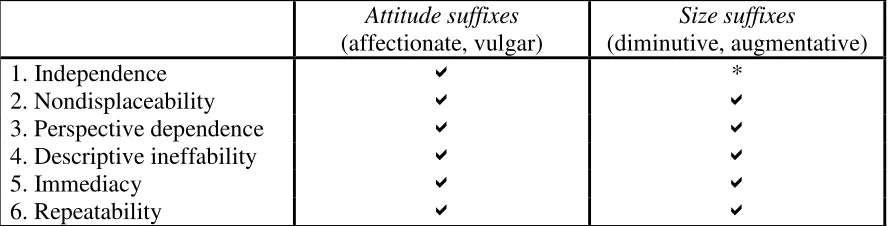
To conclude, Russian attitude and size suffixes demonstrate the following characteristics of expressive content outlined in Potts (2007) (Table 2.3).
Attitude suffixes
(affectionate, vulgar) (diminutive, augmentative) Size suffixes
1. Independence *
2. Nondisplaceability 3. Perspective dependence 4. Descriptive ineffability 5. Immediacy
6. Repeatability
Table 2.3: Characteristics of expressive suffixes in Russian
Attitude suffixes Expressive content Descriptive content
Affectionate suffixes
(-án’, -áš, -ón, -úl’, -ún’, -úr, -ús’, -úš)
* Vulgar suffixes
(-ág, -ák, -ál, -án, -ár, -áx, -íl, -in, -ób, -ot, -óx, -úg, -úk, -úx)
* Table 2.4: Attitude suffixes are expressive
Size suffixes Expressive content Descriptive content
Diminutive suffixes
-k (allomorphs: -ok, -ek, -ik)
-c (allomorphs: -ec, -ic) Augmentative suffix -išč’
Table 2.5: Size suffixes are expressive and descriptive
Chapter 3: Background Information
This chapter presents background information on Russian grammatical gender, inflectional class, natural gender (or sex), and animacy. This background information is important to better understand the behaviour of Russian expressive suffixes. Grammatical gender and inflectional class are used as tests to determine whether a certain expressive suffix is a head or a modifier. Natural gender and animacy are also important to this discussion, because with respect to expressive suffixes, animate nouns that have natural gender behave differently from both animate nouns without natural gender, and inanimate nouns.
The structure of this chapter is as follows. In §3.1, I discuss grammatical and natural gender. In §3.2, I outline different approaches to Russian inflectional class. In §3.3., I discuss animacy. In §3.4, I describe phonological alternations relevant to expressive suffixes in Russian.
3.1. GENDER
Grammatical gender serves as one of the diagnostic properties5 for the two syntactic types of expressive suffixes. The purpose of this section is to introduce the properties of grammatical gender (§3.1.1). Moreover, to fully understand grammatical gender it is important to discuss nouns with natural gender, since these behave systematically differently than nouns that do not have natural gender (§3.1.2).
3.1.1. Grammatical gender
Russian has three grammatical genders: masculine, feminine, and neuter, as illustrated in Table 3.1. That grammatical gender is indeed a grammatical category is evident from the fact that it cannot be predicted by either semantic or phonological properties of the noun (Corbett 1991).
Masculine Feminine Neuter
č'áj ‘tea’ vod-á ‘water’ v'in-ó ‘wine’ dóm ‘house’ škól-a ‘school’ zdán'ij-e ‘building’
žurnál ‘magazine’ gaz'ét-a ‘newspaper’ p'is'm-ó ‘letter’ Table 3.1: Russian grammatical genders (Corbett 1991:35)
With the exception of nouns that have natural gender, grammatical gender cannot be predicted from the semantics of a noun. For example, in Table 3.1, all words in the first row (čáj ‘tea’, vod-á ‘water’, and v’in-ó ‘wine’) denote drinking liquids; however, their
grammatical gender differs. They can be associated with each of the three grammatical genders: masculine, feminine, and neuter, respectively. Similarly, the nouns in the second row (dóm ‘house’, škól-a ‘school’, and zdán'ij-e ‘building’) all denote buildings, but they also have different grammatical genders: masculine, feminine, and neuter, respectively. And finally, the nouns in the third row all denote readable things; and again they are all associated with different genders. This establishes that grammatical gender cannot be predicted from the meaning of a given noun.
Similarly, grammatical gender cannot be predicted from the phonological form of a stem, as illustrated in Table 3.2. For example, the stem portf’él’ ‘briefcase’, ends in a palatalized consonant [l’] and the word is masculine. The stem m’et’él’ ‘snowstorm’ also ends in [l’], but the word is feminine. Both stems d’én’ ‘day’ and t’én’ ‘shadow’ end in [n’], however, the words are masculine and feminine, respectively.
Masculine Feminine
portf’él’ ‘briefcase’ m’et’él’ ‘snowstorm’
d’én’ ‘day’ t’én’ ‘shadow’
Table 3.2: Masculine and feminine nouns, by phonological form of stem