• daily news about financial reporting globally.
• summaries of all Standards, Interpretations and proposals. • many IFRS-related publications available for download. • model IFRS financial statements.
• an electronic library of several hundred IFRS resources. • all Deloitte comment letters to the IASB.
• links to several hundred international accounting websites. • e-learning modules for each IAS and IFRS – at no charge.
• complete history of adoption of IFRSs in Europe.
From its inception in 1973, the former International Accounting Standards Committee (IASC) worked towards harmonising global accounting standards by developing standards that could serve as a model on which national standard setters could base their own requirements. The IASC was replaced by the International Accounting Standards Board (IASB) effective in 2001. Its mission became one of convergence of global accounting standards – development of a single set of high quality, understandable and enforceable global accounting standards that require high quality, transparent and comparable information in financial statements and other financial reporting to help participants in the world’s capital markets and other users make economic decisions.
Convergence with US GAAP
The Norwalk agreement
In October 2002, following a joint meeting at the offices of the US Financial Accounting Standards Board (FASB) in Norwalk, Connecticut, the FASB and the IASB formalised their commitment to the convergence of generally accepted accounting principles in the United States (US GAAP) and International Financial Reporting Standards (IFRSs) by issuing a memorandum of understanding
(sometimes called ‘the Norwalk agreement’). The two boards pledged to use their best efforts to:
• make their existing financial reporting standards fully compatible as soon as is practicable; and
• coordinate their future work programmes to ensure that once achieved, compatibility is maintained.
“Compatible” means that the two sets of standards do not contain conflicts. Compatible does not mean word-for-word identical standards.
Sarbanes-Oxley
The Sarbanes-Oxley Act of 2002 provided some impetus and support for the Norwalk agreement. Section 108 of the Act permits the US Securities and Exchange Commission (SEC) to recognise standards established by a private-sector accounting standard setter (i.e. FASB) provided that the standard setter considers “the extent to which international convergence on high quality accounting standards is necessary or appropriate in the public interest and for the protection of investors”. Section 109 of the Act provides US Government funding to the SEC-recognised standard setter.
Why the emphasis on the convergence of IFRSs and US GAAP?
To a large extent, national standards in most countries of the world have been based either on IFRSs or US GAAP. Despite the tendencies of national standard setters to make small or large changes to those standards, they cannot and do not ignore those two substantial and advanced bodies of literature in developing their own national standards. Therefore, a sensible way to achieve a single set of global accounting standards in a reasonable time span is to work towards a convergence of IFRSs and US GAAP – in turn causing a ‘trickle down effect’ in those countries that continue to maintain their national GAAPs. This is the approach that the IASB has adopted.
The IASB-FASB convergence process
The IASB and the FASB have various joint initiatives to accomplish the goal of convergence, including:
twice-yearly joint board meetings;
aligned agendas, including explicit consideration of convergence potential in all agenda decisions;
short-term projects to revise their individual standards to eliminate as many inconsistencies as possible;
a convergence research project seeking to identify all of the substantive differences between US GAAP and IFRSs and to develop strategies for resolving them. Any recognition, measurement, presentation or disclosure topic in which a specific accounting treatment would be permissible under one basis of accounting but would not be permissible under the other basis of accounting is included in the project scope; and
coordination between their respective interpretive bodies (FASB’s
Emerging Issues Task Force and the IASB’s International Financial Reporting Interpretations Committee).
Between December 2003 and March 2004, the IASB amended the majority of the standards that it inherited from its predecessor, and it also issued several new standards. Many of those changes were in the interest of convergence. The current international standard on business combinations and goodwill (IFRS 3), for instance, is virtually identical to the FASB’s recent standards. Likewise for the IASB’s standard on assets held for disposal (IFRS 5).
In February 2006, the IASB and the FASB released a ‘roadmap’ which identified short- and long-term convergence projects.
Short-term convergence projects
For the projects identified as short-term, the goal by 2008 is to reach a conclusion about whether major differences in those few focussed areas should be eliminated through one or more short-term standard-setting projects and, if so, to complete or substantially complete work in those areas. These topics for short-term convergence include:
•
•
•
• Borrowing costs (remove expense option)
• Joint ventures (remove proportionate consolidation option for jointly controlled entities and clarify definition)
FASB
• Fair value option for financial instruments (issued as FAS 159 in February 2007) • Investment properties
• Research and development • Subsequent events
Joint • Impairment • Income taxes
Long-term projects
The goal for 2008 for the projects listed below is to have made significant progress in the following areas identified for improvement:
• Business combinations • Conceptual framework
• Fair value measurement guidance (FAS 157 used by IASB as basis for Discussion Paper)
• Intangible assets
• Leases
More specific goals have been set for each individual project. The objective is to provide a timeframe for convergence efforts in the context of both the objective of removing the need for IFRS reconciliation requirements by 2009 and the existing agendas of the FASB and the IASB.
IFRS in Europe
The most important event for the worldwide recognition of IFRS, is a regulation of the European Commission (EC), published in June 2002.
This document demands the compulsary use of IFRS for the consolidated financial statements of European listed companies.
This requirement was effective as from 1 January 2005 and has meant that 7,000 European listed companies, including those listed on the Luxembourg stock exchange, have applied the IFRS to their financial reporting as from this date.
The EC also provides the member states with the option of applying the IFRS to the parent company financial statements and to the category non- listed companies.
IFRS in Luxembourg
IFRS will be introduced into the local Luxembourg commercial law as an alternative to the current Luxembourg accounting principles. The international standards have already been included as an accounting option for credit institutions.
the option to use IFRS for statutory accounts, to any limited companies registered in Luxembourg.
Where the Luxembourg commercial law does not require or specify an accounting method, guidance is taken from the best practices used in foreign accounting principles.
Comparison of IFRSs, US GAAP
and Lux GAAP
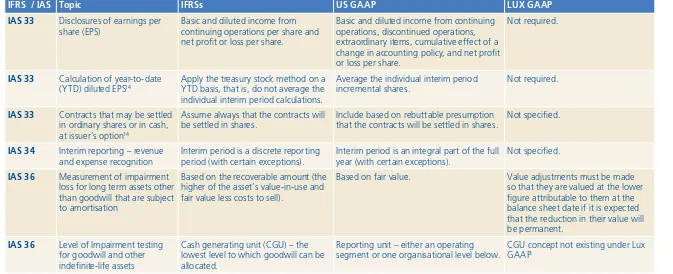
The table on the following pages sets out the key differences between IFRSs and US GAAP as of 28 February 2007. The summary does not attempt to capture all of the differences that exist or that may be particular to an entity’s financial statements. Our focus is on variations that are commonly found in practice.
The significance of these – and others not included in the list – will vary between entities. It will depend on such factors as: the nature of the entity’s operations, the industry in which it operates, and the accounting policy choices it has made. Reference to the underlying accounting standards and any relevant national regulations is essential in understanding the specific differences.
End-note references indicated in superscript in the comparison table are located on page 30. FAS Financial Accounting Standard (US)
FASB Financial Accounting Standards Board (US) GAAP Generally Accepted Accounting Principles GAAS Generally Accepted Auditing Standards IASB International Accounting Standards Board IASC International Accounting Standards Committee IAS(s) International Accounting Standard(s)
IFRIC International Financial Reporting Interpretations Committee IFRS(s) International Financial Reporting Standard(s)
_ General approach More “principles based” standards
with limited application guidance.
More “rules-based” standards with specific application guidance.
More “rules-based” standards with specific application guidance.
_ General approach Substance prevails over form. Substance prevails over form. Form generally prevails over
substance.
_ General approach Prudence is one of the qualitative
characteristics of the financials.
Prudence is one of the qualitative characteristics of the financials.
Prudence is generally the key quality of the financials.
IFRS 1 First-time adoption General principle is full retrospective
application of IFRSs in force at the time of adoption, unless the specific exceptions and exemptions in IFRS 1 permit or require otherwise.
No specific standard.
Practice is generally full retrospective application unless the transitional provisions in a specific standard require otherwise.
Not addressed.
IFRS 1 General Certain exceptions and exemptions at transition in accordance with IFRS 1 can give
rise to differences between IFRSs and US GAAP in areas that would not normally give rise to such differences.
Not addressed.
IFRS 2 Date for measuring
share-based payments to non-employees
Modified grant date method. Earlier of counterparty’s commitment
to perform (where a sufficiently large disincentive for nonperformance exists) or actual performance.
Not addressed.
IFRS 2 Use of historical volatility or industry index measurement for non-public entities when it is not practicable to estimate expected volatility
IFRS 2 Modification of an award
by change in performance condition (improbable to probable) (Type III modifications)
Expense determined based on the grant date fair value.
Expense determined based on fair value at the modification date.
Not addressed.
IFRS 2 Share-based payments with
graded vesting features
Charge is recognized on an accelerated basis to reflect the vesting as it occurs.
An accounting policy choice exists for awards with a service condition only to either: (a) amortise the entire grant on a straight-line basis over the longest vesting period, or (b) recognise a charge similar to IFRSs.
Not addressed.
IFRS 2 Balance sheet classification
of share-based payment arrangements
Focus on whether the award can be cash settled.
More detailed requirements that may result in more share based arrangements being classified as liabilities.
Not addressed.
IFRS 3 Date on which marketable
equity Securities issued as consideration in a business combination are measured1
Acquisition date (date on which control passes).
Within a reasonable period before and after the date that the terms of the acquisition are agreed to and announced.
Acquisition date (date on which control passes).
IFRS 3 Date on which contingent
consideration is recorded (as part of consideration)
Acquisition date (if the amount is probable and can be measured reliably).
Generally when contingency is resolved. Generally when contingency is resolved.
IFRS 3 Recognising a liability for
a planned post acquisition restructuring1
Only if acquiree has already recognised a provision under IAS 37.
Can be recognised if the restructuring relates to the acquired business and certain conditions are met.
IFRS 3 Measuring minority interest1 Minority’s percent of fair values. Minority interest measured at fair value
if entity consolidated under the risk and rewards model (FIN 46); otherwise, it is recorded at proportion of historical cost.
Minority interest is recorded at proportion of historical cost.
IFRS 3 Purchased inprocess R&D1 Can be recognised as an acquired
finite life intangible asset (amortised), or as part of goodwill if not separately measurable (not amortised but subject to an annual impairment test).
Determine the fair value of in-process R&D and expense immediately unless it has an alternative future use.
Can be recognized as intangible asset.
IFRS 3 Excess of fair value of net
assets acquired over the acquisition cost1
Recognise immediately as a gain. Allocate on a pro rata basis to reduce the carrying amounts of certain acquired non financial assets, with any excess recognised as an extraordinary gain.
Recognise immediately as a gain or depreciated or as a deduction from equity.
IFRS 3 Combinations of entities
under common control1
Outside the scope of IFRS 3 though merger accounting (pooling of interests method) is generally used in practice.
Pooling of interests method is required. Pooling of interests method is used.
IFRS 4 Rights and obligations under
Insurance contracts2
IFRS 4 addresses recognition and measurement in only a limited way. It is an interim standard pending completion of a comprehensive project.
Several comprehensive pronouncements and other comprehensive industry accounting guides have been published.
10
IFRS 4 Derivatives embedded in
insurance contracts
An embedded derivative whose characteristics and risks are not closely related to the host contract but whose value is interdependent with the value of the insurance contract need not be separated out and accounted for as a derivative.
An embedded derivative whose characteristics and risks are not closely related to the host contract must be accounted for separately.
Refer to the Law of 8 December 1994 on the Accounts of Insurance and Reinsurance Undertakings
IFRS 5 Definition of a discontinued
operation
A reportable business or geographical segment or major component thereof.
A component which may be an operating segment, a reporting unit, a subsidiary, or an asset group (less restrictive than the IFRS 5 definition).
Not addressed.
IFRS 5 Definition of a discontinued
operation – continuing involvement
Not addressed. Disposing entity should have no continuing
cash flows representative of significant continuing involvement.
Not addressed.
IFRS 5 Presentation of discontinued
operations
Post-tax income or loss is required on the face of the income statement.
Pre-tax and post-tax income or loss are required on the face of the income statement.
Not addressed.
IFRS 8 Disclosure of non-current
assets attributable to segments3
Include intangible assets. Exclude intangible assets. Not addressed.
IFRS 8 Disclosure of measure of
liabilities3
11
IFRS 8 ‘Matrix’ form of organization
– identification of segments3
Operating segments are identified on the basis of the core principle.
Operating segments are identified based on products and services.
Disclose the group’s turnover by geographical breakdown.
IAS 1 Elements of the financial
statements
Balance sheet Income statement Cash flow statement
Statement of change in equity Notes to the financial statements • Cash flow statement
Statement of change in equity Notes to the financial statements •
Notes to the financial statements •
• •
IAS 1 Financial statement
presentation4
Specific line items required. Certain standards require specific presentation of certain items. Public companies are subject to SEC rules and regulations, which require specific line items.
Regulated companies are subject to CSSF/CAA rules and regulations, which require specific line items. Non-regulated companies are subject to Company Law, which requires specific line items.
IAS 1 Comparative prior year
financial statements4
One year comparative financial information required.
No specific requirement under US GAAP to present comparatives. Generally at least one year of comparative financial information is presented. Public companies are subject to SEC rules and regulations, which generally require two years of comparative financial information.
One year comparative financial information required.
Restatement of comparative is forbidden. Errors and changes in accounting principles are recognised in the profit and loss account as extraordinary result in the current year.
IAS 1 Reporting “comprehensive
income”4
Total presented in the statement of changes in equity.
Can be presented in statements of income, comprehensive income or changes in shareholders’ equity, or within the notes to the financial statements.
1
IAS 1 Departure from a standard
when compliance would be misleading
Permitted in “extremely rare” circumstances to achieve a fair presentation. Specific disclosures are required.
Not directly addressed in US GAAP literature, although an auditor may, under Generally Accepted Auditing Standards (GAAS) rule 203, conclude that by applying a certain GAAP requirement the financial statements are misleading, thereby allowing for an “override”.
In exceptional cases, where the application of a provision is incompatible with the obligation to give a true and fair view, that provision must be departed from. Any such departure must be
disclosed in the notes to the accounts together with an explanation of the reasons for it and a statement of its effect on the assets, liabilities, financial position and results.
IAS 1 Classification of liabilities on
refinancing4
Non-current if refinancing is completed before balance sheet date.
Non-current if refinancing is completed before date of issuance of the financial statements.
Not specified, but separate presentation of liabilities into amounts due within one year, or after one year, is required.
IAS 1 Classification of liabilities due
on demand due to violation of debt covenant4.
Non-current if the lender has granted a 12-month waiver before the balance sheet date.
Non-current if the lender has granted a waiver for a period greater than one year (or operating cycle, if longer) before the issuance of the financial statements or when it is probable that the violation will be corrected within the grace period, if any, prescribed in the long-term debt agreement.
Requires separate presentation of liabilities into amounts due within one year, or after one year, at the date of the balance sheet.
IAS 1 Extraordinary items. Prohibited. Extraordinary items are permitted, but are
restricted to items that are both infrequent in occurrence and unusual in nature.
Separate disclosure of the
1
IAS 2 Reversal of inventory
write-downs
Required, if certain criteria are met. Prohibited. Required if the reasons for which the
value adjustments were made have ceased to apply.
IAS 2 Measuring inventory at net
realisable value even if above cost
Permitted only for producers’ inventories of agricultural and forest products and mineral ores and for broker-dealers’ inventories of commodities.
Similar, but not restricted to producers and broker-traders.
Inventories must be valued at purchase price or production cost. They shall be subject to value adjustments with a view to stating them at market value, where lower only.
IAS 2 Method for determining
inventory cost
LIFO is prohibited. LIFO is permitted. LIFO is permitted.
IAS 7 Classification of interest
received and paid in the cash flow statement
May be classified as an operating, investing or financing activity.
Must be classified as an operating activity. Cash Flow Statements not required.
IAS 7 Inclusion of bank overdrafts
in cash
Included if they form an integral part of an entity’s cash management.
Excluded. Cash Flow Statements not required.
IAS 11 Method of accounting for
construction contracts when the percentage of completion cannot be determined
Cost recovery method. Completed contract method. Not specified, but cost recovery or
completed contract methods can be used.
IAS 12 Classification of deferred tax
assets and liabilities5
Always non-current. Classification is split between current and
non-current components based on the classification of underlying asset or liability, or on the expected reversal of items not related to an asset or liability.
1
IAS 12 Subsequent recognition of
a deferred tax asset after a business combination5
First reduce goodwill to zero, any excess credited to net profit or loss.
First reduce goodwill to zero, then any other non current intangible assets to zero, any excess credited to net profit or loss.
Not specified.
IAS 12 Reconciliation of actual and
expected tax expense5
Required for all entities applying IFRSs; expected tax expense is computed by applying the applicable tax rate(s) to accounting profit, disclosing also the basis on which the applicable tax rate(s) is(are) computed.
Required for public companies only; expected tax expense is computed by applying the domestic federal statutory tax rates to pre-tax income from continuing operations. Non-public companies must disclose the nature of the reconciling items but not amounts.
Not required.
IAS 12 Calculation of tax benefits
related to share-based payments5
Deferred tax is computed based on the tax deduction for the share-based payment under the applicable tax law (i.e. intrinsic value).
Deferred tax is computed based on the GAAP expense recognised, and trued up at realisation of the tax benefit.
Not specified.
IAS 12 Impact of temporary
differences related to intercompany profits5
Deferred tax effect is recognised at the buyer’s tax rate.
Deferred tax effect is recognised at the seller’s tax rate, as if the transaction had not occurred.
Not specified.
IAS 12 Initial recognition exemption5 Deferred tax not recognised for
taxable temporary differences that arise from the initial recognition of an asset or liability in a transaction that is (a) not a business combination, and (b) does not affect accounting profit or taxable profit. Nor are changes in this unrecognised deferred tax asset or liability subsequently recognised.
1
IAS 12 Other specific exemptions
to the basic principle that deferred tax is recognised for all temporary differences5
Does not have all the exemptions comparable to those in US GAAP.
US GAAP has some six special exemptions from providing deferred tax including goodwill, leveraged leases, most
undistributed earnings of subsidiaries, and intangible development costs in the oil and gas industry.
Not specified.
IAS 12 Tax rate for measuring
deferred tax assets and liabilities6
Use enacted or ‘substantively enacted’ tax rate.
Use enacted tax rate. Not specified.
IAS 12 Measurement of deferred tax
on undistributed earnings of a subsidiary5
Must use rate applicable to undistributed profits.
Generally, US GAAP requires the use of the higher of the distributed and the undistributed rate.
Not specified.
IAS 12 Changes in deferred taxes
that were originally charged or credited to equity (‘backwards tracing’)5
The tax effects of items credited or charged directly to equity during the current year are allocated directly to equity. A deferred tax item originally recognised by a charge or credit to shareholders’ equity may change either from changes in assessments of recovery of deferred tax assets or from changes in tax rates, laws, or other measurement attributes. Consistent with the initial treatment, IAS 12 requires that the resulting change in deferred taxes also be charged or credited directly to equity.
SFAS 109 prohibits ‘backwards tracing’ and would require allocation to continuing operations.
1
IAS 14 Basis of reportable segments3 Lines of business and geographical
areas.
Components for which information is reported internally to top management, which may or may not be based on lines of business or geographical areas.
If the categories and sectors, in which the sale of products and the provision of services falling within the company’s ordinary activities are organised, differ substantially from one another, the net turnover must be broken down by categories of activity and into geographical sectors. Disclosure in the notes is required.
IAS 14 Types of segment disclosures3 Required disclosures for both
“primary” and “secondary” segments.
Only one basis of segmentation, although certain “enterprise-wide” disclosures are required such as revenue from major customers and revenue by country.
Not required.
IAS 14 Accounting basis for
reportable segments3
Amounts are based on IFRS measures. Amounts are based on whatever basis is used for internal reporting purposes. These amounts should be reconciled to the relevant amounts contained in the financial statements.
Not required.
IAS 14 Segment result3 Defined segment result. No definition of segment result. Not required.
IAS 16 Basis of property, plant, and
equipment
May use either revalued amount or historical cost. Revalued amount is fair value at date of revaluation less subsequent accumulated depreciation and impairment losses.
1
IAS 16 Major inspection or overhaul
costs
Generally accounted for as part of the cost of an asset.
Generally expensed. Provide a provision for major
inspections on a pro-rata temporis basis.
IAS 16 Measuring the residual
value of property, plant and equipment
Current net selling price assuming the asset were already of the age and in the condition expected at the end of its useful life.
Generally the discounted present value of expected proceeds on future disposal.
Generally the residual value is assumed to be nil.
IAS 17 Present value of minimum
lease payments7
Generally would use the rate implicit in the lease to discount minimum lease payments.
Lessors must use the implicit rate to discount minimum lease payments. Lessees generally would use the incremental borrowing rate to discount minimum lease payments unless the implicit rate is known and is the lower rate.
Leases are generally considered as operational leases. For tax purposes, financial leases might be recognised on the tax balance sheet based on rules mainly similar to IAS 17.
IAS 17 Recognition of a gain on a
sale and leaseback transaction where the leaseback is an operating lease7
The gain is recognised immediately. Generally, the gain is amortised over the lease term.
Not specified.
IAS 17 Disclosure of lease maturities7 Less detailed disclosure. More detailed disclosure. Not specified.
IAS 18 Revenue recognition
guidance8
General principles are consistent with US GAAP, but IFRSs contain limited detailed or industry-specific guidance.
More specific guidance, particularly industry specific issues. In addition, public companies must follow more detailed guidance provided by the SEC.
No detailed guidance except: - Accrual basis
1
IAS 19 Termination benefits9 No distinction between “special”
and other termination benefits. Termination benefits recognised when the employer is demonstrably committed to pay.
Recognise special (onetime) termination benefits generally when they are communicated to employees unless employees will render service beyond a “minimum retention period” in which case the liability is recognised ratably over the future service period. Recognise contractual termination benefits when it is probable that employees will be entitled and the amount can be reasonably estimated.
Provide for provision when employer is committed to pay.
IAS 19 Measurement of gain or loss
on curtailment of a benefit plan
A curtailment gain or loss comprises (a) the change in the present value of the defined benefit obligation, (b) any resulting change in fair value of the plan assets, and (c) a pro rata share of any related actuarial gains and losses, unrecognised transition amount, and past service cost that had not previously been recognised.
Unrecognised actuarial gains and losses arising subsequent to transition do not affect the curtailment gain or loss, while the amount of gain or loss would be offset by any portion of the unrecognised transition asset or liability.
Not specified.
IAS 19 Timing of recognition of
gains/losses on curtailment of a benefit plan
Both curtailment gains and losses are recognised when the entity is demonstrably committed and a curtailment has been announced.
A curtailment loss is recognised when it is probable that a curtailment will occur and the effects are reasonably estimable. A curtailment gain is recognised when the relevant employees are terminated or the plan suspension or amendment is adopted, which could occur after the entity is demonstrably committed and a curtailment is announced.
1
1
IAS 19 Recognition of past service
cost related to benefits that have vested
Recognised immediately. Generally amortised over the remaining
service period or life expectancy.
Recognised immediately.
IAS 19 Multi-employer plan that is a
defined benefit plan
Should be accounted for as a defined benefit plan if the required information is available, otherwise as a defined contribution plan.
Accounted for as a defined contribution plan.
Not specified.
IAS 19 Minimum liability recognition
for benefits under defined benefit plans
No minimum liability requirement. At a minimum, the unfunded accumulated
benefit obligation is recognised.
Not specified.
IAS 19 Limitation on recognition of
pension assets
Pension assets cannot be recognised in excess of the net total of unrecognised past service cost and actuarial losses plus the present value of benefits available from refunds or reduction of future contributions to the plan.
No limitation on the amount that can be recognised.
No limitation on the amount that can be recognised.
IAS 19 Recognising actuarial gains
and losses, when they arise, directly in the statement of equity
Permitted Not permitted. Not permitted.
IAS 23 Borrowing costs related to
assets that take a substantial time to complete10
Capitalisation is permitted. Capitalisation is mandatory. Capitalisation is permitted.
IAS 23 Types of borrowing costs
eligible for capitalisation
Includes interest, certain ancillary costs, and exchange differences that are regarded as an adjustment of interest.
0
IAS 23 Income on temporary
investment of funds borrowed for construction of an asset
Reduces borrowing costs eligible for capitalisation.
Does not reduce borrowing costs eligible for capitalisation except in limited circumstances.
Not specified.
IAS 27 Basis for consolidation11,12 Control (look to governance and risk
and benefits).
Approach depends on the type of entity. For voting interests, entities generally look to majority voting rights. For variable interest entities, look to a risks and rewards model.
Control (majority of the voting rights, board members)
IAS 27 Basis for consolidation11,12 Dissimilar activities are consolidated. Dissimilar activities are consolidated. Dissimilar activities are equity
accounted when full consolidation would compromise fair view of the accounts.
IAS 27 Special purpose entities11,12 Consolidate if “controlled”. Generally
follow the same principles as for commercial entities in determining whether or not control exists.
If SPE is not a “qualifying SPE”, then consolidation generally based on majority voting interests (if SPE is a voting interest entity) or based on a risks and rewards model (if SPE is a variable interest entity). Special rules apply for consolidation of “qualifying SPEs”.
No specific guidance for special purpose entities.
IAS 27 Different reporting dates of
parent and subsidiaries
Reporting date difference cannot be more than three months. Must adjust for any significant intervening transactions.
Reporting date difference generally should not be more than three months. Must disclose effects of any significant intervening transactions.
If the reporting date difference is more than three months, the subsidiary is consolidated on the basis of temporary reports.
IAS 27 Different accounting policies
of parent and subsidiaries11
Must conform policies. No specific requirement to conform
policies.
1
IAS 27 Accounting for investments
in subsidiaries in parent’s separate financial statements
Either cost method or use IAS 39 (i.e. apply the financial instrument rules) but not equity method.
Investments in subsidiaries may be presented either using equity or cost method.
Cost method generally used but equity accounting is permitted.
IAS 28 Different reporting dates of
investor and associate
Reporting date difference cannot be more than three months. Must adjust for any significant intervening transactions.
Reporting date difference generally should not be more than three months. Must disclose any significant intervening transactions.
If the reporting date difference is more than three months, the subsidiary is consolidated on the basis of temporary reports.
IAS 28 Different accounting policies
of investor and associate
Must conform to policies. No specific requirement to conform to
policies
Generally conform to policies, otherwise disclosure in the notes is required.
IAS 28 Accounting for investments in
associates in parent’s separate financial statements
Either cost method or use IAS 39 (i.e. apply the financial instrument rules) but not equity method.
Equity method. Cost method generally used but
equity accounting is permitted.
IAS 29 Adjusting financial statements
of an entity that operates in a hyperinflationary economy
Adjust using a general price level index before translating.
Adjust the financial statements as if the reporting currency of the parent was the entity’s functional currency.
Not specified.
IAS 31 Investments in joint ventures May use either the equity method or
proportionate consolidation.
Generally use the equity method (except in construction and oil and gas industries).
May use either the equity method or proportionate consolidation.
IAS 32 Classification of convertible
debt instruments
Split the instrument into its liability and equity components and measure the liability at fair value with the equity component representing the residual.
Classify the entire instrument as a liability. However, the intrinsic value of the conversion feature at the commitment date of the instrument, if any, should be recognised as additional paid-in capital.
Classify convertible debt as liability as a whole.
IAS 32 Offsetting amounts due from
and owed to two different parties
Permitted when and only when a legally enforceable right and the intention to settle net exist.
Prohibited. Permitted when and only when a
IAS 33 Disclosures of earnings per
share (EPS)
Basic and diluted income from continuing operations per share and net profit or loss per share.
Basic and diluted income from continuing operations, discontinued operations, extraordinary items, cumulative effect of a change in accounting policy, and net profit or loss per share.
Not required.
IAS 33 Calculation of year-to-date
(YTD) diluted EPS14
Apply the treasury stock method on a YTD basis, that is, do not average the individual interim period calculations.
Average the individual interim period incremental shares.
Not required.
IAS 33 Contracts that may be settled
in ordinary shares or in cash, at issuer’s option14
Assume always that the contracts will be settled in shares.
Include based on rebuttable presumption that the contracts will be settled in shares.
Not specified.
IAS 34 Interim reporting – revenue
and expense recognition
Interim period is a discrete reporting period (with certain exceptions).
Interim period is an integral part of the full year (with certain exceptions).
Not specified.
IAS 36 Measurement of impairment
loss for long term assets other than goodwill that are subject to amortisation
Based on the recoverable amount (the higher of the asset’s value-in-use and fair value less costs to sell).
Based on fair value. Value adjustments must be made
so that they are valued at the lower figure attributable to them at the balance sheet date if it is expected that the reduction in their value will be permanent.
IAS 36 Level of Impairment testing
for goodwill and other indefinite-life assets
Cash generating unit (CGU) – the lowest level to which goodwill can be allocated.
Reporting unit – either an operating segment or one organisational level below.
IAS 36 Calculating impairment of
goodwill
One-step: compare recoverable amount of a CGU (higher of (a) fair value less costs to sell and (b) value-in-use) to carrying amount.
Two steps:
1. Compare fair value of the reporting unit with its carrying amount including goodwill. If fair value is greater than carrying amount,no impairment (skip step 2)
2. Compare “implied fair value” of goodwill with its carrying amount recording an impairment loss for the difference.
No annual impairment test required. Goodwill must be written off within a maximum period of five years. It may be written off systematically over a period exceeding five years provided that this period does not exceed the useful economic life of the asset. This requires disclosure in the notes.
IAS 36 Calculating impairment of
indefinite-life intangible assets other than goodwill
Goodwill and other indefinite-life intangible assets are included in a CGU. The CGU is tested for impairment.
Goodwill is included in the CGU. Other indefinite-life intangible assets are tested separately.
Indefinite life intangible assets and CGU concept do not exist under Lux GAAP.
IAS 36 Subsequent reversal of an
impairment loss
Required for all assets, other than goodwill, if certain criteria are met.
Prohibited. Required for all assets if certain
criteria are met.
IAS 37 Measurement of provisions9 Best estimate to settle the obligation,
which generally involves the expected value method. Discounting required.
Best estimate to settle the obligation. If no one item is more likely than another, use the low end of the range of possible amounts. Most provisions are not discounted.
Best estimate to settle the obligation. No discounting is required.
IAS 37 Measurement of
decommissioning provisions9
Use the current, risk adjusted rate to discount the provision when initially recognised. Adjust the rate at each reporting date.
Use the current, credit adjusted risk-free rate to discount the provision when initially recognised. Do not adjust the rate in future periods.
IAS 37 Recognition of restructuring provisions
Recognise if a detailed formal plan is announced or implementation of such a plan has started.
Recognise when a transaction or event occurs that leaves an entity little or no discretion to avoid the future transfer or use of assets to settle the liability. An exit or disposal plan, by itself, does not create a present obligation to others for costs expected to be incurred under the plan.
Not specified. In practice, provide with a provision when decision has been taken by the management.
IAS 37 Disclosures that may prejudice seriously the position of the entity in a dispute9
“In extremely rare cases” amounts and details need not be disclosed, but disclosure is required of the general nature of the dispute and why the details have not been disclosed.
Disclosure is required. Not specified.
IAS 38 Start-up costs15 Expensed as incurred Expensed as incurred. Start-up costs can be capitalized and
written off within a maximum period of five years.
IAS 38 Development costs Capitalise, if certain criteria are met. Expense (except for certain website development costs and certain costs associated with developing internal use software).
Research and Development costs can be capitalised and written off within a maximum period of five years.
IAS 38 Subsequent expenditure on
purchased in process R&D
Capitalised if it meets the definition of development and certain criteria are met.
Expense. Capitalised and written off within a
maximum period of five years.
IAS 38 Revaluation of intangible
assets
Permitted only if the intangible asset trades in an active market.
IAS 39 Option to designate any
financial asset or financial liability to be measured at fair value through profit or loss
Option is allowed if certain criteria are met.
No such option. Option is allowed through application
of the Fair Value Directive.
IAS 39 Investments in unlisted equity
instruments
Measured at fair value if reliably measurable; otherwise at cost.
Measured at cost less “other than temporary” impairments, if any.
Measured at cost less impairment, if any.
IAS 39 Reclassification of financial
instruments into or out of the trading category
Prohibited. Permitted but expected to be rare. No such option.
IAS 39 Classification of financial
assets
Financial assets are classified following the 5 categories available.
Financial assets are classified following the 5 categories available.
Financial assets are classified as i) participations and measured at cost less impairment or ii) financial instruments measured at lower of cost or market.
Derivatives are recognised off balance sheet.
IAS 39 Classification of financial assets as held-to- maturity
Puttable debt instruments cannot be classified as held-to-maturity.
No such prohibition exists. Category applicable only to credit institutions. No such prohibition exists.
IAS 39 Effect of selling investments classified as held-to maturity
Prohibited from using held-to-maturity classification for the next two years.
Prohibited from using held-to-maturity classification. SEC indicates that prohibition is generally for two years.
IAS 39 Subsequent reversal of an impairment loss recognised in the income statement
Required for loans and receivables, held to- maturity, and available-for-sale debt instruments, if certain criteria are met.
Prohibited for held-to-maturity and available for-sale securities. Reversals of valuation allowances on loans are recognised in the income statement.
Required for all financial assets.
IAS 39 Derecognition of financial assets
Combination of risks and rewards and control approach. Can derecognise part of an asset. No “isolation in bankruptcy” test. Partial derecognition allowed only if specific criteria are complied with.
Derecognise assets when transferor has surrendered control over the assets. One of the conditions is legal isolation. No partial derecognition.
Derecognition is based on the legal ownership of the instrument.
IAS 39 Use of “partial term hedges” (hedge of a fair value exposure for only a part of the term of a hedged item)
Allowed. Although not explicitly prohibited, these items would most probably fail the correlation requirement of FAS 133 and hence not qualify for hedge accounting.
Allowed.
IAS 39 Hedging Foreign currency risk in a held-to-maturity investment
Can qualify for hedge accounting. Cannot qualify for hedge accounting. Not defined. In practice,
neutralisation of the volatility in the profit and loss accounts would be expected.
IAS 39 Assume perfect effectiveness of a hedge if critical terms match
Prohibited. Must always measure effectiveness.
Allowed for hedge of interest rate risk in a debt instrument if certain conditions are met – “Shortcut Method”.
Formal effectiveness testing is not required.
IAS 39 Application of the effective interest rate (EIR) method
Several differences exist between IFRSs and US GAAP on this topic. Given the case-by-case nature of such calculations, IFRSs and US GAAP specialists should be consulted as and when a comparative calculation is required.
Use of the straight line method generally but EIR is accepted.
IAS 39 Impairment of debt and securities
All impairments must be recognised, no matter how temporary.
Impairment is recognised only when the decline in fair value is not temporary.
IAS 39 Use of “basis adjustment” Fair value hedge – required.
Cash flow hedge of a transaction resulting in a financial asset or liability – same as US GAAP.
Cash flow hedge of a transaction resulting in a non-financial asset or liability – choice of US GAAP or basis adjustment.
Fair value hedge required.
Cash flow hedge of a transaction resulting in an asset or liability – gain/loss on hedging instrument that had been reported in equity remains in equity and reclassified into earnings in the same period the acquired asset or incurred liability affects earnings.
Basis adjustment as from the beginning of the hedge relationship.
IAS 39 Macro hedging Fair value hedge accounting treatment for a portfolio hedge of interest rate risk is allowed if certain specified conditions are met.
Hedge accounting treatment is prohibited, though similar results may be achieved by designating specific assets or liabilities as hedged items.
Not existing under Lux GAAP as derivatives are not recognised on balance sheet.
IAS 39 Accounting for securities sold but not yet purchased
Short positions (sell) must use trade date value, i.e. no choice between trade date and settlement date value as for long positions (buy).
Buy and sell transactions are accounted for identically, i.e. at trade date value.
Short positions (sell) must use trade date value.
IAS 39 Written puts over own (treasury) shares
Recognise a gross obligation for the present value of the strike price.
Recognise a derivative together with subsequent changes in fair value.
Disclose in the notes.
IAS 40 Measurement basis for investment property
Option of (a) historical cost model (depreciation, impairment) or (b) fair value model with value changes through profit or loss.
Generally required to use historical cost model (depreciation, impairment).
IAS 40 Property interests held under
an operating lease
Accounted for as investment property under IAS 40 if held for investment and if measured at fair value with value changes in profit or loss. Otherwise treated as a prepayment.
Always treated as a prepayment. Always treated as rental expense.
IAS 41 Measurement basis of
agricultural crops, livestock, orchards, forests
Fair value with value changes recognised in profit or loss.
Historical cost is generally used. However, fair value less costs to sell is used for harvested crops and livestock held for sale.
The differences may change once the final revised version of IFRS 3 (Business Combinations Phase II) (exposure draft released in June 2005) is published.
The IASB is developing a comprehensive standard on accounting for rights and obligations under insurance contracts that is consistent with the IASB Framework definitions of assets and liabilities.
The joint IASB/FASB project has resulted in the IASB deciding to converge with US statement FAS 131. IFRS 8 Operating Segments was issued in November 2006. It is effective for the periods beginning on or after 1 January 2009, with earlier application permitted (may also be subject to local endorsement processes). In advance of application of IFRS 8, IAS 14 Segment Reporting is the relevant Standard.
This issue is being addressed in the joint IASB/FASB project on Financial Statements Presentation.
The FASB and the IASB are addressing some IAS 12 / FAS 109 differences in their short-term convergence projects.
The IASB will retain “substantively enacted” but clarify that it means “virtually certain”.
The IASB has a comprehensive project on leases on its Research Agenda.
A joint IASB/FASB project on revenue recognition concepts is underway.
The differences may change once the final revised versions of IAS 19 and IAS 37 (exposure drafts released in June 2005) are published.
The IASB has been addressing elimination of this difference in its short-term convergence project.
The differences may change once the final revised version of IAS 27 (exposure draft released in June 2005) is published.
The IASB has on its agenda a project on control including SPEs. This will become a joint project at a later stage.
As defined by FAS 140 Accounting for Transfers and Servicing of Financial Assets and Extinguishments of Liabilities.
As part of its convergence project, the FASB issued an exposure draft in December 2003 that would eliminate these differences. The exposure draft has not yet been finalised as a standard.
The FASB may address this in its short-term convergence project. 1.
2.
3.
4.
5.
6.
7.
8.
9.
10.
11.
12.
13.
14.
0
In addition to this publication, Deloitte Touche Tohmatsu has a range of tools and publications to assist companies in implementing and reporting under IFRSs. These include:
www.iasplus.com Updated daily, iasplus.com is your one-stop shop for information related to IFRSs.
Deloitte’s IFRS e-Learning IFRS training materials, one module for e-Learning Modules each IAS and IFRS and the Framework, with
self-tests, available without charge at www.iasplus.com.
IAS Plus Newsletter A quarterly newsletter on recent developments in IFRSs and accounting updates for individual countries.
To subscribe, visit www.iasplus.com.
IFRSs in your Pocket Published in English, French, Spanish, Polish, Danish, Finnish, Chinese, and other languages, this pocket sized guide
includes summaries of all IASB Standards and Interpretations, updates on agenda projects, and other IASB-related information.
Presentation and disclosure checklist 2006 Checklist incorporating all of the presentation and disclosure requirements of Standards effective in 2005.
Model financial Model financial statements illustrating the statements presentation and disclosure requirements of IFRSs.
iGAAP 2007 Financial Instruments: Guidance on how to apply both of these complex Financial Instruments, including illustrative examples and
interpretations.
First-time Adoption: A Guide to IFRS 1 Application guidance for the “stable platform” Standards effective in 2005.
Share-based Payment: A Guide to IFRS 2 Guidance on applying IFRS 2 to many common share-based payment transactions.
Business Combinations: A Guide to IFRS 3 Supplements the IASB’s own guidance for applying this Standard.
1
Contacts
IFRS Taskforce
IFRS Liaison Partner
Georges Kioes Eric van de Kerkhove [email protected] [email protected]
IFRS Technical Team
Coordination Insurance and Reinsurance Training
Alexandre Prost-Gargoz Jérôme Lecoq Carole Houpert [email protected] [email protected] [email protected]
Funds Private Equity and Financial Instruments Credit institutions
Justin Griffiths Alexandre Prost-Gargoz Alexandre Prost-Gargoz [email protected] [email protected] [email protected]
John Psaila Martin Flaunet
[email protected] [email protected]
Industries and Commercial Companies Securitization and Real Estate Consolidation
John Psaila Jan van Delden Karine Thil
[email protected] [email protected] [email protected]
Tax issues
© 05/2007 • Deloitte SA • All rights reserved
Designed and produced by MarCom at Deloitte, Luxembourg.
As a Swiss Verein (association), neither Deloitte Touche Tohmatsu nor any of its member firms has any liability for each other’s acts or omissions. Each of the member firms is a separate and independent legal entity operating under the names “Deloitte,” “Deloitte & Touche,” “Deloitte Touche Tohmatsu,” or other related names.
This publication contains general information only and is not intended to be comprehensive nor to provide specific accounting, business, financial, investment, legal, tax or other professional advice or services. This publication is not a substitute for such professional advice or services, and it should not be acted on or relied upon or used as a basis for any decision or action that may affect you or your business. Before making any decision or taking any action that may affect you or your business, you should consult a qualified professional advisor.