Clinical Profile of Extrapulmonary
Tuberculosis Among TB-HIV Patients
in Cipto Mangunkusumo Hospital
Gurmeet Singh1, Anna Uyainah1, Evy Yunihastuti2, Darma Imran3
1Division of Respirology and Critical Care, Department of Internal Medicine, Universitas Indonesia, Cipto Mangunkusumo Hospital, Jakarta, Indonesia.
2Division of Clinical Allergy Immunology, Department of Internal Medicine, Universitas Indonesia, Cipto Mangunkusumo Hospital, Jakarta, Indonesia.
3Division of Neuroinfection, Department Neurology, Universitas Indonesia, Cipto Mangunkusumo Hospital, Jakarta, Indonesia.
ABSTRACT
Background: In view of increase in incidence of EPTB after the epidemic of human immunodeficiency (HIV) virus infection, the clinical profile of EPTB in patients with HIV infection was studied.
Objective: To obtain the profile and to assess the distribution of EPTB in TB-HIV patients.
Methods: We conducted a descriptive cross-sectional study by browsing through the medical records of TB-HIV patients who received treatment in HIV referral center (POKDISUS) Cipto Mangunkusumo Hospital between July 2008-December 2010. Ethical clearance was obtained from the ethical committee of Faculty Medicine, Universitas Indonesia and written on approval letter 135/PT02.FK/ETIK2010.
Results: EPTB prevalence was 32,95%. Overall, medical record of 522 HIV-positive TB patients were evaluated. The majority of the patients were males (84.3%), 18-40 years age group (91.9%), finished mid-level education (77.3%), and 31.4% belonged to Batavian ethnic group. Intravenous drug use were found to be the main transmission risk factor, representing 60.5% of the subjects. Prolonged fever (63.4%) was the most common clinical manifestation. Negative Acid Fast Baciili (AFB) smears were found in 34.9% of the subjects, while CD4+ counts of <50 cells/µL was found in 34.9% of the subjects. The most frequent site of extrapulmonary TB was peripheral lymph node (18,0%).
Conclusion: Our study therefore gives some perspective of EPTB and HIV coinfection in Indonesia thereby setting a platform for more studies. Furthermore, our findings might help reinforce the need for integrated management of HIV and TB in Indonesia, which is mandatory for the global fight against TB.
Key words: Extrapulmonary Tuberculosis, HIV
ABSTRAK
Latar Belakang: Dikarenakan terjadinya peningkatan insidensi tuberkulosis ekstra paru pasca epidemi infeksi
human immunodeficiency virus (HIV), diperlukan penelitian mengenai profil klinis tuberkulosis ekstra paru (EPTB) pada pasien dengan infeksi HIV.
Tujuan: Untuk memperoleh profil dan menilai distribusi tuberkulosis ekstra paru pasien TB-HIV.
Metode: Studi merupakan penelitian potong lintang deskriptif dengan mempelajari rekam medis pasien TB-HIV di pusat rujukan HIV (POKDISUS) Rumah Sakit Cipto Mangunkusumo antara Juli 2008-Desember 2010. Lolos kaji etik diperoleh dari komite etik Fakultas Kedokteran, Universitas Indonesia dengan surat persetujuan nomor 135/ PT02.FK/ETIK2010.
Hasil: Prevalensi EPTB sebesar 32,95%. Mayoritas terdiri dari laki-laki (84,3%), usia 18-40 (91,9%), menyelesaikan pendidikan tingkat menengah (77,3%), dan 31,4% kelompok etnis Betawi. Penggunaan obat narkotika intravena menjadi faktor risiko transmisi utama (60,5%). Demam berkepanjangan (63,4%) menjadi manifestasi klinis yang paling sering ditemui. Apusan basil tahan asam (BTA) negatif ditemukan pada 34,9%, jumlah CD4 <50 sel/ul ditemukan pada 34,9% dari subyek. Lokasi terbanyak tuberkulosis ekstra paru adalah limfadenopati perifer (18,0%).
Kesimpulan: Penelitian in memberikan perspektif terhadap TB ekstra paru dan koinfeksi HIV di Indonesia, sehingga membuka peluang untuk penelitian lainnya. Selanjutnya, penelitian ini dapat membantu meningkatkan kebutuhan terhadap manajemen terintegrasi pada HIV dan TB di Indonesia, yang diperlukan untuk melawan TB secara global.
Kata kunci: Tuberkulosisi ekstra paru, HIV
Correspondence:
Gurmeet Singh, MD
Contact: +62-21-3149704 Mobile: +62-81385159159
E-mail: [email protected]
INTRODUCTION
Pulmonary Tuberculosis (PTB) is a common manifestation in adults with TB-HIV co-infection. However, as the immunity gets worse, HIV-infected individuals more often develop extrapulmonary and disseminated TB. The Incidence of extrapulmonary TB (EPTB) has increased after the epidemic of HIV infection. It is responsible for 10-50% of all TB case among HIV negative individuals, while in HIV positive group, it occurs in 38-80%.1 Several studies found that
up to 50% TB-HIV patients die during TB treatment.2,3
In Thailand, verbal autopsies, laboratorium data, and medical records of TB-HIV patients who die during TB treatment state that TB is the cause of death in 27% of those patients, whereas more than a half of them were disseminated and Multi Drug Resistant TB (Complicated EPTB).2
In many part of the world, many studies had mentioned susceptibility of HIV patients to develop extrapulmonary TB.4-6,8 Additionally, in the recent
guideline to improve diagnosis and treatment of extrapulmonary TB, World Health Organization (WHO) states EPTB in HIV-infected person has become a new clinical problem especially in remote area where
advance modality supporting diagnosis and treatment are unavalaible. Although pulmonary TB is the most common presentation of TB disease, it can involve any organ in the body. Extrapulmonary Tuberculosis is defined as the isolated occurrence of TB in any part of the body other than lungs such as lymph nodes, abdomen, genitourinary system, musculoskeletal and meninges. Mycobacteria may spread to any organ of the body through lymphatic or haematogenous dissemination and lie dormant for years at a particular site before causing disease. Manifestations may relate to the system involved, or simply as prolonged fever and non specific systemic symptoms. Tuberculosis is a worldwide disease and one of the major health problems of Indonesia. Extrapulmonary tuberculosis is increasing all over the world. However, only limited data is available about the situation of EPTB in developing countries including Indonesia, hence diagnosis may be elusive and is usually delayed.1,3
This study reviews the general spectrum of cases diagnosed with EPTB at a large HIV referral center (POKDISUS) and presents their key demographics, dominant infection sites and the laboratory findings.
METHODS with extrapulmonary TB, with single or multiple organ involvement and also MDR-TB patients. TB case with multiple organ involvement was classified based on the site representing the most severe form of disease. We excluded patients with both pulmonary and extrapulmonary tuberculosis, as per WHO guidelines they were defined as pulmonary. We explored sosio- demographic characteristic, clinical and laboratorium findings among patients co-infected with HIV and tuberculosis. Diagnosis of HIV infection was confirmed in all cases.Ethical clearance was obtained from the ethical committee of Faculty Medicine, Universitas Indonesia and written on approval letter 135/PT02. FK/ETIK2010. Patient confidentiality was assured for all the information provided.
RESULTS
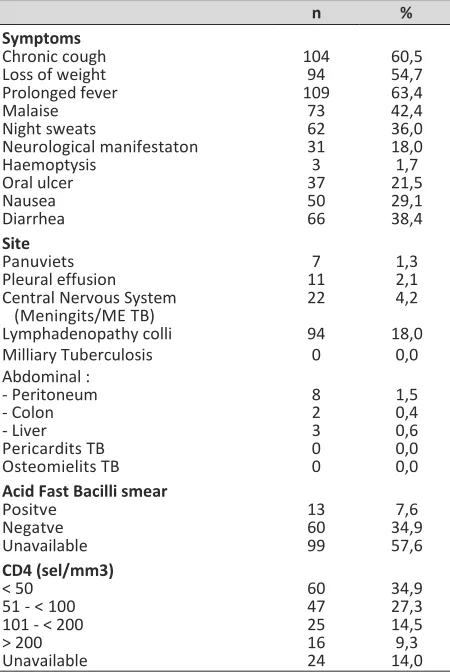
Among 522 HIV-positive patients with TB, 172 subjects were extrapulmonary TB (32.95%). One hundred seventy two medical records of EPTB patients, and its distribution based on characteristic mentioned above were enrolled. Our subjects were mostly males (84.3%); the majority of the patients belonged to the 18-40 years age group (91.9%). The educational status and ethnicity of patients showed that 77.3% finished mid-level education, and 31.4% of the subjects belonged to Batavian ethnic group. Intravenous drug use were found to be the main transmission risk factor, representing 60.5% of the subjects, as seen in table 1. Prolonged fever (63.4%) was the most common clinical manifestation followed by chronic cough (60.5%). Negative Acid Fast Baciili (AFB) smears were found in 34.9% of the subjects, while CD4+ counts of <50 cells/µL was found in 34.9% of the subjects. The most frequent extrapulmonary site was peripheral lymph node (54.6%), followed by meningitis TB (12.7%) (Table 2)
Table 1. Demographic Profile the HIV pandemic it accounts for more than 50% of all TB cases.9
A prevalence of EPTB of 32.95 % in our study is quite high compared with a recent finding of EPTB of 17% in Yaoundé the capital city of Cameroon. Our finding is, however, similar to what was found in Nepal in 2008 and in India in 2006, which are settings with similar TB burden like ours. Relatively lower prevalence of 20-25% was found in Iran and in many areas of the United States, which are areas with lower TB burden10. In our study, out of 172 cases of EPTB,
145 (84.3%) cases were in males. The distribution of
Table 2. Clinical, Distributon and Laboratorium Findings
n %
Central Nervous System 22 4,2
(Meningits/ME TB)
accordance with other studies. However, several other studies have shown female reponderance. The causes of female preponderance in their studies were thought to be due to low socioeconomic status and male dominant society.6,9,11-15
Most of our study group patients (91,9%) belonged to the age group of 18-40 years, which is the sexually active age and is also the most productive
in one’s life. In India, a study reported 76% in the
age group of 21-40 years and also the occupational profile of their patients revealed that a majority of them were farmers and laborers followed by transport drivers16. Mohanty et al17 reported 36.8% patients
working as manual laborers while Rajsekaran et al18
whereas other studies correlates knowledge and educational level. Patients with a better knowledge has a better adherence. This influences treatment outcome, including the progresivity of TB.20 However
in our study, EPTB were mostly found among of them who finished mid-level education. No significant correlation between the time of dignosis of TB after HIV-positive diagnosis was established. Contrast to the study in Thailand evaluating cause of death in TB- HIV patients, found that delay of TB diagnosis were partially responsible for those incidence.2 Delay of
diagnosis also motivated the release of new algorithm for screening TB in HIV-infected individuals by New England Journal of Medicine in 2010.3
There are some factors which influence progresivity of TB. Among them is host immunity status. As the age gets older, immunity status is weakened. Data from recent study is consistent with epidemilogical finding in United States where 27% of extrapulmonary TB were found in those age >60 years old where the mean age for this case is 44 years old.12
This is contrast to our study where EPTB were mostly found in group age < 35 years. Similar results were study was conducted in Jakarta where majority of the population are batavians. Unfortunately, we did not explore the spesific characteristic of Batavian ethnic group that enable them to be more susceptible to infection and associated degree of immunodeficiency. In early HIV-1 infection, the features are characteristic for post primary TB and resemble those seen in the pre-HIV era. More advanced immunodeficiency is usually associated with an increased frequency of disease resembling primary pulmonary TB and extra- pulmonary disease. Prolonged insidious symptoms found in majority of patients consisting of weight loss, prolonged low grade fever and nocturnal sweat may delay the diagnosis. The classical picture of pulmonary TB is seenmainly in less immuno-compromised patients
(CD4 counts > 200 cells/mm3)21. A BMI of <18 was
found to be a significant predictor of a low CD4 count. Apart from suggesting severe immunosuppression, these results imply that nutritional support should form part of the comprehensive package of care of HIV-Extrapulmonary tuberculosis at a regional hospital in Thailand also showed lymph nodes as a common location (29.6%).1 Our result was comparable with
that of the other studies. Some other studies have shown other sites as the commonest location of EPTB other than lymph nodes. Study done by Noertjojo et al in Hong Kong suggested pleura as the most common subjects with supraclavicular lymphadenopathy being the most common findings in 14 (12.4%) subjects with mediastinal mass.24
Unavailability of laboratorium finding of some medical records of our subjects is an obstacle in this study. Moreover data regarding Acid Fast Bacilli status was unavailable in more than a half of our patients.
Extrapulmonary TB occurs frequently and causes high mortality, but definitive diagnosis requires culture or pathological examination of specimens that may be difficult to obtain.25 In World Health Organization
(WHO) guidelines for TB diagnosis, mycobacterial
sputum culture must be performed in HIV-infected
WHO’s guidelines for diagnosing extrapulmonary TB
recommend using symptoms or signs to guide testing of extrapulmonary sites. In multiple studies from high- burden TB countries, mycobacterial blood culture has been found to aid TB diagnosis in HIV-infected patients
with advanced immune suppression. Mycobacterial blood culture should probably be reserved for use in
the parameter to determine the stage of HIV infection that represent degree of immunity deficiency. It is estimated that more than 50% of HIV-infected patients will develop TB in their lifetime, and the annual risk of developing TB if HIV infected is 10%. Various studies have shown high mortality rates in HIV-infected TB patients in resource-limited settings. HIV infection increases the risk of acquiring TB, alters the clinical HIV coinfection in Indonesia thereby setting a platform for more studies. Furthermore, our findings might help reinforce the need for integrated management of HIV and TB in Indonesia, which is mandatory for the global fight against TB. A comprehensive research plan
wide. Health care providers must remain cognizant of emerging issues such as increasing drug resistance and HIV prevalence in the country. A prospective cohort study can be conducted to asses risk factors/ predictors of EPTB in HIV population, thus a more optimal treatment can be established.
ACKNOWLEDGEMENT
The author would like to thank dr. Tiona Romauli and dr. Lani Suryani and staff of HIV referral center (POKDISUS) for their contribution and support in this study.
REFERENCES
Barthwal, Rajan KE , Deoskar RB , Sharma SK. Extrapulmonary Tuberculosis in Human Immunodeficiency Virus Infection. MJAFI 2005;61:340-41.
Cain KP, Anekthananon T, Burapat C, Akksilp S, Mankhatitham W, Srinak C et al. Cause of Death in HIV-infected Persons who have Tuberculosis, Thailand. Emerging Infectious Disease 2009;15:258-64.
Cain KP, McCarthy KD, Heilig CM, Monkongdee P, Tasaneeyapan T, Kanara N et al. An Algorithm for Tuberculosis Screening and Diagnosis in People with HIV. N Eng J. Med 2010; 362: 707-16. Corbett E, Marston B, Churchyard GJ, De Cock KM. Tuberculosis in
Sub-Saharan Africa: Opportunities, Challenges, and Changes in the Era of Antiretroviral Treatment. London School of Hygiene and Tropical Medicine 2006;367:926-37.
Dean GL, SG Edwards, NJ Ives, Gail M, EF Fox, Lesley N et al. Treatment of Tuberculosis in HIV-infected Persons in the Era of Highly Active Antiretroviral Therapy. AIDS 2002;16: 75-83. Forssbohm M, Zwahlen M, Loddenkemper R, Rieder HR.
Demographic Characteristic of Patients with Extrapulmonary Tuberculosis in Germany. Eur. Respir J 2008;31:99-105.
Frieden T 2004. Toman’s Tuberculosis Case detection, treatment,
and monitoring. World Health Organization, Geneva. Gopi A, Madhavan SM, Sharma SK, Sahn SA. Diagnosis and Treatment
of Tuberculosis Pleural Effusion in 2006. CHEST 2007;131:880-9. Makaju R,Mohammad A, Thakur NK. Scenario of Extrapulmonary
Tuberculosis in a Tertiary Care Center. J Nepal Health Res Counc 2010;8:48-50.
Namme L, Marie-Solange D, Bertrand M, Elvis T, Achu J, Christpoher K. Extrapulmonary Tuberculosis and HIV Coinfection in Patients Treated for Tuberculosis at the Douala General Hospital in Cameroon. Ann Trop Med Public Health 2013;6:100-4. Razanamparany VR, Ménard D, Aurégan G, Gicquel B, Chanteau S.
Extrapulmonary and Pulmonary Tuberculosis in Antananarivo (Madagascar): High Clustering in Female Patients. J. Clin. Microbiol 2002;40:3964-9.
Peto HM, Pratt RH, Harrington TA, LoBue PA, Armstrong LR. Epidemiology of Extrapulmonary Tuberculosis in United States, 1993-2006. Clinical Infectious Disease 2009; 49:1350-7. Verver S, van Loenhout-Rooyackers JH, Bwire Z, Annee-van Bavelde
Langevan Gerven. Tuberculosis Infection in Children who are Contacts of Imigrant Tuberculosis Patients. Eur Respir J 2005;26:126-32.
Yang Z, Kong Y, Wilson F, Foxman B, Fowler AH, Marrs CF et al. Identification of Risk Factors for Extrapulmonary Tuberculosis. Clinical Infectious Disease 2004;38:199-205.
Patients with TB/HIV Coinfection: A Case Series of 50 Patients.
Lung India 2011;28:93-6.
Mohanty KC, Sundrani RM, Nair S. HIV infection in patients with respiratory disease. Indian J Tuberc. 1993;40:5.
Rajasekaran R, Lima A, Kamakshi S, Jeyaganesh D, Senthamizhchelvan
A, Savithrr S, et al. Trend of HIV infection in patients with tuberculosis in rural south India. Indian J Tuberc. 2000;47:223.
Bhagyabati DS, Naorem S, Singh TJ, Singh KB, Prasad L, Shantidevi T. HIV and TB Co-infection. Journal, Indian Academy of Clinical Medicine. 2005;6:220.
Kusumahayu D, Sekar D, Aprianto M, Puspasari M. Faktor-faktor yang berhubungan dengan Pengetahuan Masyarakat tentang
Tuberculosis di Kelurahan Utan Panjang Kecamatan Kemayoran
Jakarta Pusat Januari 2010. Ilmu Kesehatan Masyarakat FK YARSI; 2010.
Ong C, Tan W, Leong K, Muttalif A. Tuberculosis-HIV Coinfection: The Relationship Between Manifestation of Tuberculosis and
the Degree of Immunosuppression (CD4 Counts). IeJSME 2009;2:17-22.
Nzou C, Kambarami R, Onyango F, Ndhlovu C, Chikwasha. Clinical
Predictors of Low CD4 Count Among HIV-Infected Pulmonary
Tuberculosis Clients: A Health Facility-Based Survey. S Afr Med
J 2010;100:602-5.
Leeds I, Magee M, Kurbatova E, Rio C, Blumberg H, Leonard M, et al. Site of Extrapulmonary Tuberculosis is Associated with HIV
Infection. Clinical Infectious Diseases. 2012;55:75-81 Singh G, Amin Z, Wuryantoro, Wulani V, Shatri H. Profile and
factors associated with mortality in mediastinal mass during
hospitalization at Cipto Mangunkusumo Hospital, Jakarta. Acta
Med Indones. 2013;45:3-10.
Monkongdee P, McCarthy K, Cain K, Tasaneeyapan T, Dung N, Lan N, et al. Yield of Acid-fast Smear and Mycobacterial Culture for Tuberculosis Diagnosis in People with Human