Allied Academies
International Conference
Las Vegas, Nevada
October 14-16, 2009
Academy of
Marketing Studies
PROCEEDINGS
Table of Contents
CUSTOMER DELIGHT: A REVIEW . . . 1 M. Wayne Alexander, Minnesota State University Moorhead
HOW DOES CUSTOMER SERVICE AFFECT BRAND
LOYALTY . . . 2 Stephen Cohen, Baptist Health
Melissa Manzanero, Stephen James Associates Cira Posada, Oscient Pharmaceuticals
Samuel Lane, Lane Import
STRENGTHENING THE IMPACT AND VALUE OF INTERNATIONAL MARKETING CURRICULUM
OUTCOMES: A COMPARATIVE STUDY OF BUSINESS STUDENTS PERCEPTIONS OF COURSEWORK
AND CAREERS . . . 7 A.Ercan Gegez, Marmara University
Svend Hollensen, University of Southern Denmark Beverly T. Venable, Columbus State University
MARKET FOCUS IN AACSB MEMBER SCHOOLS – AN EMPIRICAL EXAMINATION OF MARKET
ORIENTATION BALANCE AND BUSINESS SCHOOL
PERFORMANCE . . . 8 Kevin L. Hammond, The University of Tennessee at Martin
Robert L. Webster, Ouachita Baptist University
USING THE BLACKBOARD CMS TO DEVELOP TEAM WORK SKILLS IN UNDERGRADUATE MARKETING
PRINCIPLES CLASS . . . 9 Lewis Hershey, Fayetteville State University
Paula Wood, Fayetteville State University
A THEORETICAL FRAMEWORK FOR SERVICE SMES
BASED ON CULTURE, MARKET ORIENTATION AND
NETWORK BENEFITS . . . 15 Cheryl Luczak, Saint Xavier University
SERVICE GUARANTEES: A REVIEW AND
EXPLANATION OF THEIR CONTINUED RARITY . . . 20 Michael A. McCollough, University of Idaho
CUSTOMER SERVICE IN ORGANIZATIONAL
DEVELOPMENT . . . 21 Juan-Carlos Mereles, Systemax Inc.
Monica Montoya, Carnival Cruise Lines Samuel Lane, Lane Import
Roscoe Dandy, Nova Southeastern University
THE IMPORTANCE OF A DANCE FLOOR IN THE
SELECTION OF A BAR BY UNIVERSITY STUDENTS . . . 26 Martin Meyers, University of Wisconsin at Stevens Point
ASYMMETRIC MARKET REACTION TO NEW
PRODUCT ANNOUNCEMENTS: A PROSPECT
THEORY APPROACH . . . 27 Vivek S. Natarajan, Lamar University
Gurumurthy Kalyanaram, GK Associates James Munch, Wright State University
BUSINESS-TO-BUSINESS RELATIONSHIP MARKETING AND ETHICAL VALUES:
CUSTOMER DELIGHT: A REVIEW
M. Wayne Alexander, Minnesota State University Moorhead
ABSTRACT
HOW DOES CUSTOMER SERVICE AFFECT BRAND
LOYALTY
Stephen Cohen, Baptist Health
Melissa Manzanero, Stephen James Associates
Cira Posada, Oscient Pharmaceuticals
Samuel Lane, Lane Import
ABSTRACT
This research is a broad view of how customer service affects brand loyalty. The research discusses how today’s economy is affecting brand loyalty and the aspects of what is most important to customers. Studies show that a customer develops loyalty towards a brand because they think that the brand is offering quality product or service at the right price. As soon as a customer knows that their purchase has value, they will then be encouraged to buy the products or services. Results show that branding is important, but brand loyalty is best generated by excellent customer service, especially in this day and age, and not by "traditional" branding activities. The research examines how marketing and customer service are now coming together to produce brand loyalty. This paper will also briefly discuss successful customer relationship management (CRM) and how important it is to get the right people to provide the right kind of excellent customer service that leads to brand loyalty.
INTRODUCTION/CONCLUSIONS
A copy of the full paper is available from the first author.
REFERENCES
Buckley, M.R., Carraher, S.M., Carraher, S.C., Ferris, G.R., & Carraher, C.E. (2008). Human resource issues in global entrepreneurial high technology firms: Do they differ? Journal of Applied Management & Entrepreneurship, 13 (1), 4-14.
Buckley, M., Fedor, D., Veres, J., Wiese, D., & Carraher, S.M. (1998). Investigating newcomer expectations and job-related outcomes. Journal of Applied Psychology, 83, 452-461.
Buckley, M., Mobbs, T., Mendoza, J., Novicevic, M., Carraher, S.M., & Beu, D. (2002). Implementing realistic job previews and expectation lowering procedures: A field experiment. Journal of Vocational Behavior, 61 (2), 263-278.
Budd, J. & Carraher, S. (1998). Validation of an inventory to measure attributes of strategic management.
Carland, J. & Carland, J. (1993). The role of personality in new venture creation. Entrepreneurship, Innovation and Change, 2(2), 129-141.
Carland, J & Carland, J. (1995). The case of the reluctant client. Journal of the International Academy for Case Studies, 1(2), 76-79.
Carland, J. & Carland, J. (1997). A model of potential entrepreneurship: Profiles and educational implications. Journal of Small Business Strategy, 8 (1), 1-13.
Carland, J. & Carland, J. (2003). Pawn takes queen: The strategic gameboard in entrepreneurial firms. Academy of Strategic Management Journal, 2, 93-104.
Carland, J. & Carland, J. (2004). Economic development: Changing the policy to support entrepreneurship. Academy of Entrepreneurship Journal, 10(2), 104-114.
Carland, J. & Carland, J. (2006). Eminent domain: What happens when the state takes part of your land? The Entrepreneurial Executive, 11, 95-113.
Carland, J.A.C., & Carland, J.W. (1991). An empirical investigation into the distinctions between male and female entrepreneurs managers. International Small Business Journal, 9 (3), 62-72.
Carland, J.A., Carland, J.W., & Stewart, W.H. (1996). Seeing what’s not there: The enigma of entrepreneurship.
Journal of Small Business Strategy 7 (1), 1-20.
Carland, J., Carland, J.A., & Abhy, C. (1989). An assessment of the psychological determinants of planning in small businesses. International Small Business Journal, 23-34.
Carland, J., Carland, J., & Carland, J. (1995). Self-actualization: The zenith of entrepreneurship. Journal of Small Business Strategy, 30-39.
Carland, J.W., Carland, J.A., & Hoy, F. (1992). An entrepreneurship index: An empirical validation. Babson Entrepreneurship Conference, Fontainebleau, France.
Carland, J.W., Carland, J.A., Hoy, F., & Boulton, W.R. (1988). Distinctions between entrepreneurial and small business ventures. International Journal of Management, 5 (1), 98-103.
Carland, J.W. III, Carland, J.W., Carland, J.A., & Pearce, J.W. (1995). Risk taking propensity among entrepreneurs, small business owners and managers. Journal of Business and Entrepreneurship, 7 (1), 12-23.
Carland, J.W., Hoy, F., Boulton, W.R., & Carland, J.A.C. (1984). Differentiating entrepreneurs from small business owners: A conceptualization. Academy of Management Review, 9 (2), 354-359.
Carland, J.W., Hoy, F., & Carland, J.A.C. (1988). Who is an entrepreneur? is the wrong question. American Journal of Small Business 12 (4), 33-39.
Carraher, S.M. (1991). A validity study of the pay satisfaction questionnaire (PSQ). Educational and Psychological Measurement, 51, 491-495.
Carraher, S.M. (2005). An Examination of entrepreneurial orientation: A validation study in 68 countries in Africa, Asia, Europe, and North America. International Journal of Family Business, 2 (1), 95-100.
Carraher, S.M. & Buckley, M. R. (1996). Cognitive complexity and the perceived dimensionality of pay satisfaction.
Journal of Applied Psychology, 81 (1), 102-109.
Carraher, S.M. & Buckley, M.R. (2008). Attitudes towards benefits and behavioral intentions and their relationship to Absenteeism, Performance, and Turnover among nurses. Academy of Health Care Management Journal, 4 (2), 89-109.
Carraher, S.M., Buckley, M.R., & Carraher, C. (2002). Cognitive complexity with employees from entrepreneurial financial information service organizations and educational institutions: An extension & replication looking at pay, benefits, and leadership. Academy of Strategic Management Journal, 1, 43-56.
Carraher, S.M., Buckley, M.R., & Carraher, C.E. (2008). Research challenges in sustainable strategic management: Change and sustainability. International Journal of Sustainable Strategic Management, 1 (1), 2-15. Carraher, S.M., Buckley, M. & Cote, J. (1999). Multitrait-multimethod information management: Global strategic
analysis issues. Global Business & Finance Review, 4 (2), 29-36.
Carraher, S.M., Buckley, M., & Cote, J. (2000). Strategic entrepreneurialism in analysis: Global problems in research.
Global Business & Finance Review, 5 (2), 77-86.
Carraher, S.M., Buckley, M., Scott., C., Parnell, J., & Carraher, C. (2002). Customer service selection in a global entrepreneurial information services organization. Journal of Applied Management and Entrepreneurship, 7 (2), 45-55.
Carraher, S.M. & Carraher, S.C. (2006). Human resource issues among SME’s in Eastern Europe: A 30 month study in Belarus, Poland, and Ukraine. International Journal of Entrepreneurship. 10, 97-108.
Carraher, S.M., Carraher, S.C., & Mintu-Wimsatt, A. (2005). Customer service management in Western and Central Europe: A concurrent validation strategy in entrepreneurial financial information services organizations.
Journal of Business Strategies, 22, 41-54.
Carraher, S.M., Carraher, S.C., & Whitely, W. (2003). Global entrepreneurship, income, and work norms: A seven country study. Academy of Entrepreneurship Journal, 9, 31-42.
Carraher, S.M., Gibson, J. W., & Buckley, M.R. (2006). Compensation satisfaction in the Baltics and the USA. Baltic Journal of Management, 1 (1), 7-23.
Carraher, S., Hart, D., & Carraher, C. (2003). Attitudes towards benefits among entrepreneurial employees. Personnel Review, 32 (6), 683-693.
Carraher, S.M., Mendoza, J, Buckley, M, Schoenfeldt, L & Carraher, C. (1998). Validation of an instrument to measure service orientation. Journal of Quality Management, 3, 211-224.
Carraher, S.M. & Michael, K. (1999). An examination of the dimensionality of the Vengeance Scale in an entrepreneurial multinational organization. Psychological Reports, 85 (2), 687-688.
Carraher, S.M., Parnell, J., Carraher, S.C., Carraher, C., & Sullivan, S. (2006). Customer service, entrepreneurial orientation, and performance: A study in health care organizations in Hong Kong, Italy, New Zealand, the United Kingdom, and the USA. Journal of Applied Management & Entrepreneurship, 11 (4), 33-48. Carraher, S.M., Parnell, J., & Spillan, J. (2009). Customer service-orientation of small retail business owners in Austria,
the Czech Republic, Hungary, Latvia, Slovakia, and Slovenia. Baltic Journal of Management,4 (3), 251-268. Carraher, S.M., Scott, C., & Carraher, S.C. (2004). A comparison of polychronicity levels among small business owners and non business owners in the U.S., China, Ukraine, Poland, Hungary, Bulgaria, and Mexico.
International Journal of Family Business, 1 (1), 97-101.
Carraher, S.M. & Sullivan, S. (2003). Employees’ contributions to quality: An examination of the Service Orientation Index within entrepreneurial organizations. Global Business & Finance Review, 8 (1) 103-110.
Carraher, S.M., Sullivan, S. & Carraher, S.C. (2005). An examination of the stress experience by entrepreneurial expatriate health care professionals working in Benin, Bolivia, Burkina Faso, Ethiopia, Ghana, Niger, Nigeria, Paraguay, South Africa, and Zambia. International Journal of Entrepreneurship, 9 , 45-66.
Carraher, S.M., Sullivan, S.E., & Crocitto, M. (2008). Mentoring across global boundaries: An empirical examination of home- and host-country mentors on expatriate career outcomes. Journal of International Business Studies, 39 (8), 1310-1326.
Carraher, S.M. & Welsh, D.H.B. (2009). Global Entrepreneurship. Dubuque, IA: Kendall Hunt Publishing. Carraher, S.M. & Whitely, W.T. (1998). Motivations for work and their influence on pay across six countries. Global
Business and Finance Review, 3, 49-56.
Chait, H., Carraher, S.M., & Buckley, M. (2000). Measuring service orientation with biodata. Journal of Managerial Issues, 12, 109-120.
Crocitto, M., Sullivan, S.E. & Carraher, S.M. (2005). Global mentoring as a means of career development and knowledge creation: A learning based framework and agenda for future research. Career Development International, 10 (6/7), 522-535.
Lockwood, F., Teasley, R., Carland, J.A.C., & Carland, J.W. (2006). An examination of the power of the dark side of entrepreneurship. International Journal of Family Business, 3, 1-20.
Paridon, T. & Carraher, S.M. (2009). Entrepreneurial marketing: Customer shopping value and patronage behavior.
Journal of Applied Management & Entrepreneurship, 14 (2), 3-28.
Scarpello, V. & Carraher, S. M. (2008). Are pay satisfaction and pay fairness the same construct? A cross country examination among the self-employed in Latvia, Germany, the U.K., and the U.S.A. Baltic Journal of Management, 3 (1), 23-39.
Sethi, V. & Carraher, S.M. (1993). Developing measures for assessing the organizational impact of information technology: A comment on Mahmood & Soon's paper. Decision Science, 24, 867-877.
Stewart, W., Watson, W., Carland, J.C., & Carland, J.W. (1999). A proclivity for entrepreneurship: A comparison of entrepreneurs, small business owners, and corporate managers. Journal of Business Venturing, 14, 189-214. Sturman, M.C. & Carraher, S.M. (2007). Using a Random-effects model to test differing conceptualizations of
multidimensional constructs. Organizational Research Methods, 10 (1), 108-135.
Sullivan, S.E., Forret, M., Carraher, S.M., & Mainiero, L. (2009). Using the kaleidoscope career model to examine generational differences in work attitudes. Career Development International, 14 (3), 284-302.
STRENGTHENING THE IMPACT AND VALUE OF
INTERNATIONAL MARKETING CURRICULUM
OUTCOMES: A COMPARATIVE STUDY OF BUSINESS
STUDENTS PERCEPTIONS OF COURSEWORK
AND CAREERS
A.Ercan Gegez, Marmara University
Svend Hollensen, University of Southern Denmark
Beverly T. Venable, Columbus State University
ABSTRACT
Tremendous growth in the internationalization of businesses over the past decade has been fueled by numerous factors (market saturation, growing demand, etc.). With this growth, there is a need to expand business school curricula, placing more importance on international studies than in the past. This has been emphasized by the American Assembly of Collegiate Schools of Business (AACSB) as being a priority for accredited colleges of business. The real driver of these changes is the fact that regardless of size, more and more firms are moving into international markets. This expansion requires an intensive recruitment of marketing graduates from business schools. Given the increasing demand for marketing professionals who have an understanding and appreciation for the significance of international markets, it is imperative that innovative international marketing curricula be developed.
The purpose of this study was to examine the perceptions of business school students regarding international marketing courses and careers. A comparative study of Turkish and Northern European (NE) students’ perceptions towards international marketing courses and international marketing careers was conducted. Results of the study indicated significant differences between Turkish and Northern European students regarding their perceptions of international marketing both in terms of course work and careers. Turkish students in this study perceived international marketing courses as being exiting, trendy and providing opportunities leading to better job opportunities and better salaries. In contrast, the Northern European students perceived international marketing courses as a ‘natural’ required course for marketing majors and not providing any specific better job opportunities or salaries. Turkish students also perceived international marketing careers in general more prestigious than did then Northern European students.
MARKET FOCUS IN AACSB MEMBER SCHOOLS –
AN EMPIRICAL EXAMINATION OF MARKET
ORIENTATION BALANCE AND BUSINESS SCHOOL
PERFORMANCE
Kevin L. Hammond, The University of Tennessee at Martin
Robert L. Webster, Ouachita Baptist University
ABSTRACT
This manuscript reports the results of a national survey examining the magnitude and balance of market orientation toward students, parents, and employers of graduates exhibited in AACSB member schools. We reword Narver and Slater’s (1990) “market orientation” scale and Jaworski and Kohli’s (1993) “overall performance” scale for use within the higher education context. We group respondents into clusters based on their market orientation component scores. Each cluster thus represents a unique combination of market focus (or lack of focus) on students, parents, and employers of graduates typically employed by AACSB member schools. We examine and report magnitude and balance of market orientation toward the three markets, balance of emphasis between the market orientation components, relative emphasis of customer orientation and competitor orientation, and overall business school performance for each cluster. Additionally, we employ t-tests to identify significant differences in overall business school performance exhibited by the clusters.Results support the suggestion from Baldrige Education Criteria for Performance Excellence (BNQP 2005) that educational organizations should identify the student/stakeholder market segments that they wish to pursue, and then strategically determine the appropriate balance of focus for those markets.
USING THE BLACKBOARD CMS TO DEVELOP TEAM
WORK SKILLS IN UNDERGRADUATE MARKETING
PRINCIPLES CLASS
Lewis Hershey, Fayetteville State University
Paula Wood, Fayetteville State University
ABSTRACT
DEMOGRAPHIC DIFFERENCES ON THE
PERCEPTIONS OF ELECTRONIC COMMERCE
ADOPTION: RECENT EVIDENCE FROM KOREA
Jung Wan Lee, Boston University
ABSTRACT
This article examines the effects of demographic factors on the linkages between perceptions of information technology and electronic commerce adoption. Many firms are moving to create virtual marketplace as their primary points of consumer contact. In this environment, demographic factors such as gender, age, education and income may play a role in adopting electronic commerce. Quantitative research is applied with data collected from Internet users in South Korea. The data is analyzed using factor analysis, multivariate analysis of variance, and regression analysis methods. The findings suggest that the effects of demographic factors have moderated in information technology use; the respondents demonstrate positive attitudes toward the benefits of electronic commerce and its adoption regardless of gender, age, education and income levels. Based on the results, important managerial implications discussed.
INTRODUCTION
The advancement of information technology (IT), in particular the Internet, has altered the way commerce is being transacted. The Internet provides a wide range of information and the selection of payment tools available. It has the capability of enhancing purchasing almost all levels of products and services. Given the current prevalence of usage of the Internet in commerce, it is imperative for users to obtain the relevant skills to use the Internet as well as have the right attitude for the benefits of information technology. The skilful use of the Internet and the right attitude ensure that users will make the right selection of relevant and appropriate websites for their purposes.
The “digital divide” has been presented in IT since the beginning of the computer. The divide alludes to the notion of the “haves and have nots” pertaining to availability and use of computers and IT related products/services. Throughout the course of history, some groups had better access to computer and IT than other groups. For example, between male and female, young and old, rich and poor, this disparity has existed for a variety of reasons, among them political, cultural, and socioeconomic in nature.
socioeconomic development, and/or international cooperation in nature. The review of studies concerning Internet usage reveals that the once large gender gap is closing rapidly. In addition, the recent emergence of ubiquitous IT in schools, homes, and workplaces promotes people to employ it regardless of their gender, age, and income levels.
According to a recent survey on Internet usage (National Internet Development Agency of Korea, 2008), Internet usage rate of the population ages between 6 and over reached at 77.1% or about 35 million Internet users in Korea who use the Internet at least once a week. Among them, about 43% users access the Internet with high-speed broadband with 100Mbps (megabits per second) Ethernet networking standards in Korea as of July 2008. Internet usage rate by gender is estimated at 81.6% of male and 71.5% of female, respectively. Internet usage rate of the ages from 6 to 9 years old reached at 82.2%, the ages from 10 to 39 years old reached at 99%, and for the 50s at 49%, respectively (see Table 1).
Table 1. Demographics of Internet Users and Penetration Rate (Korea, as of July 2008)
Age 3-9 years 10s 20s 30s 40s 50s 60 over Number of population (thousand) 3760 6640 7180 8280 8360 6020 7030 Number of Internet users (thousand) 3090 6630 7170 8170 6850 2950 1330 Internet usage rate (%) 82.2 99.9 99.7 98.6 82 48.9 19 Source: The author compiled the data from the National Internet Development Agency of Korea (2008), Survey on the Internet Usage.
There would be no overall dominance of any particular gender or age groups in all types of Internet usage. The present study attempts to reinforce this trend and examines not only if gender divide is decreasing in overall Internet usage, but also if there is any disparity in the perceptions toward e-commerce benefits and e-commerce adoption. In addition, the author investigates other demographic factors such as age, education and income levels with relation to perceived e-commerce benefits and e-e-commerce adoption. The author would answer the following questions in undertaking this research:
* Is there any difference in terms of e-commerce adoption between gender, age, income, and education levels?
* If so or if not so, what marketing implications does this result have upon business firms?
HYPOTHESES
Hypothesis 1: There is a gender difference in the adoption of e-commerce over the Internet. Hypothesis 2: There is an age group difference in the adoption of e-commerce.
METHODOLOGY Survey and Sample Characteristics
A questionnaire was developed for determining the perceptions toward e-commerce usage image and adoption variables. A survey was conducted to online panel members through web-based survey method during December 2008 in Korea. Five hundred respondents were chosen at random for in-depth analysis. More than 54% had been employed full time for 1 year or more. The average income per capita for these respondents was $2100 US dollars per month, which is slightly higher than the average income per capita of $1900 US dollars per month for Korean employees in 2008. The respondents were spending a mean of $151.3 (S.D. = 24.4) for the monthly expenses of purchasing goods and services over the Internet and had an average of 6.2 years (S.D.=1.2) experience in purchasing goods and services over the Internet. The respondents showed their satisfaction with current Internet shopping mall service providers with a mean of 5.8 (S.D.=0.8) out of a 7 point scale and had intension to continue online purchasing at the average of 5.6 (S.D.=0.9) out of a 7 point scale.
Measurement Scales
To measure e-commerce adoption variable, this study uses single item: “experience and intension to continue engaging in e-commerce transactions” with their responses that range from ‘least likely=1’ to ‘most likely=7.’ To ensure the minimization of idiomatic wording, all of the instruments were first translated into Korean, and then results were checked and translated back to English by the author.
RESULTS Results by Analysis of Variance
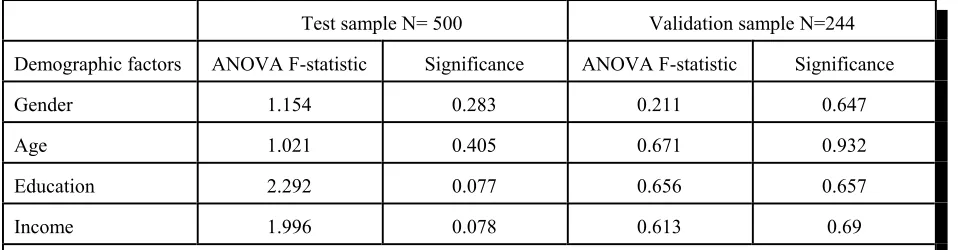
Analysis of variance (ANOVA) is used to uncover the main and interaction effects of categorical independent variables on an interval dependent variable. A main effect is the direct effect of an independent variable on the dependent variable. An interaction effect is the joint effect of two or more independent variables on the dependent variable. The key statistic in ANOVA is the F-test of difference of group means, testing if the means of groups formed by values of the independent variable are different enough not to have occurred by chance. If the group means do not differ significantly then it is inferred that the independent variables did not have an effect on the dependent variable. If the F-test shows that overall the independent variables are related to the dependent variable, then multiple comparison tests of significance are used to explore just which values of the independents have the most to do with the relationship. The results of ANOVA for the empirical data suggest that there are no significant differences in the mean values of demographic factors (Table 2).
demographic factors (gender, age, education, income level) in terms of e-commerce adoption and their intention to continuing e-commerce transactions over the Internet.
Table 2. Outputs of Analysis of Variance between Demographic Factors (ANOVA)
Test sample N= 500 Validation sample N=244 Demographic factors ANOVA F-statistic Significance ANOVA F-statistic Significance Gender 1.154 0.283 0.211 0.647 Age 1.021 0.405 0.671 0.932 Education 2.292 0.077 0.656 0.657 Income 1.996 0.078 0.613 0.69 Dependent variable: e-commerce adoption
DISCUSSION AND MANAGERIAL IMPLICATIONS
The purpose of this research was to investigate the extent of demographic differences in attitudes toward e-commerce adoption over the Internet. Indeed, most of the previous studies indicated that there was a serious demographic difference in attitudes toward IT, e-commerce. This study, however, do not lend any support to these results; instead, it offers some evidence that the demographic divides in e-commerce adoption are diminished or extremely marginal. The results reveal that demographic gaps in e-commerce adoption among the respondents are marginal and not significant.
The results reveal that there are no gender differences detected in terms of perceptions of e-commerce adoption. It is reported that the nation has continued to upgrade the Internet infrastructure to enhance the Internet accessibility across the country and to offer a variety of IT education/training programs to her citizens regardless of gender, age, and income levels, in which making this information technology readily available to all citizens and sharing its benefits equally to all citizens. With the improved IT infrastructure and the immensely offered IT education/training efforts by the society, both females and males; both the young and the old; both the less educated and the higher educated; both less haves and many haves have equal access the Internet and opportunities to employ e-commerce with no disparity between them.
this in mind, the author sees a win-win situation. Companies will benefit financially by engaging this relatively untapped market segments for information communications technology. All consumers would benefit from being able to use information communications technology directly to improve their quality of life. At the same time, the digital divide will shrink as it pertains to this component.
CONCLUSIONS
The result of this research shows that IT, e-commerce, has touched all segments of the society equally regardless of gender, age, education, and socioeconomic levels in Korea. While IT is going to be an essential part of everyday life; people from different demographics in the society enjoy the same advantages of IT. In the coming era of information communications technology ubiquity, the digital divide should be resolved in advance; and it should be done through efforts of social welfare and policies that were exampled by Korea. The author sees this study just as a stepping stone to better ways to get rid of the asymmetric windows of opportunity to information communications technology ubiquity. It should be noted that this study was exploratory in nature. All data collected from online panel members. Therefore, caution must be taken when generalizing findings for the entire population of citizens in Korea.
REFERENCE
A THEORETICAL FRAMEWORK FOR SERVICE SMES
BASED ON CULTURE, MARKET ORIENTATION AND
NETWORK BENEFITS
Cheryl Luczak, Saint Xavier University
Sumaria Mohan-Neill, Roosevelt University
ABSTRACT
Do the cultural roots of business owners influence the owners’ market orientation and social networks, and ultimately affect the benefits derived from the owners’ networks? This research focuses on the relationship between culture and perceived network benefits of small and medium sized service firms. A thorough literature review which examined Hofstede’s model of national culture, network theory, social capital theory and relationship marketing was conducted. It is an attempt to construct a theoretical foundation upon which the framework of a collectivist culture and an individualist culture and business owners’ abilities to achieve perceived network derived benefits in service firms can be analyzed. The primary goal of this paper is to employ a variety of theoretical frameworks from the literature to create a holistic conceptual model from which one can derive research propositions and hypotheses concerning the influence of culture, market orientation, and social networks on the perceived benefits gained by SMEs in the service sector. The conceptual model presented in this paper contributes to our scholarly understanding of networking theory, and provides insight into how the relationship between culture, business owners’ market orientations and network benefits influence small service firms and their owners as they conduct business.
BACKGROUND AND SCOPE
Do perceived benefits from networks differ in terms of relational market orientations versus transactional market orientations and business owners’ cultural roots? Does a collectivist culture foster a more relational commitment between people in social networks than an individualist culture, and does this represent a competitive advantage in the services sector of business? Research into this area is both relevant and timely due to the increase in the service sector within the world economy. It provides an opportunity to explore the perceived benefits derived from networks in the service sector, and further the scholarly understanding into the nature of relational and transactional market orientations from different cultural perspectives (Murray and Schlacter 1990).
activities. These findings are used to derive at several research propositions and develop a conceptual model.
There has been a considerable amount of research conducted to study factors that lead to the success of small service firms; however few of these attempts include research into the effects of culture on market orientation and networking practices in small service firms (Ramachandran and Ramnarayan, 1993; Arnold and Bianchi, 2001; Birley, Cromie, and Myers, 1991; Aldrich et al., 1989). An examination of Hofstede’s model of national culture, social capital and relationship marketing theories are used to build a foundation upon which to analyze business owners from both collectivist and individualist cultures.
Hofstede Model
The Hofstede Model characterizes national cultures based on five independent dimensions including: power distance, collectivism/individualism, femininity/masculinity, uncertainty avoidance and long-term/short-term orientation. According to Hofstede, these dimensions “allow us to make predictions on the way that society operates” based on cultural considerations (Hofstede, 1993). Hofstede describes culture as assumptions, values, and beliefs that are shared between members of a specific group (1991). The self is formed by its membership and interaction within a specific group. The self then affects the way that a person assesses and evaluates information and ultimately affects social behavior. Although some aspects of self may be universal there are certain aspects that are culturally dependent (Hofstede, 1991). Robert and Probst describe culture as the human-made part of society which consists of shared perceptions of the social environment. These shared perceptions shape the prescribed behavior within a specific group (Robert and Probst, 2000). Culture isa construct that is difficult to directly observe, but may be inferred from daily societal activities and verbal exchanges. This cultural characterization is often used as a basis to distinguish one group of people from another.
In this study, the collectivist culture will be represented by Indian culture, and the individualistic culture will be represented by US culture. The dimensions used to characterize Indian and Western culture are based on the results of a comprehensive multi-country analysis conducted by Hofstede; in which each country was scored on the five dimensions in his model (Table 1). It is premise of this study that differences in these cultural dimensions affect business owners’ market orientations and ultimately lead to differences in business owners’ networking activities and perceived benefits derived from theses networks.
Table 1 Hofstede's Dimensions of Cultural Scales (Hofstede, G., (1980) Country Power Distance Individualism Uncertainty
Avoidance
Masculinity Long term orientation Australia 36 90 51 61 31 Belgium 65 75 94 54
Brazil 69 38 76 49 65 Canada 39 80 48 52 23 Germany FR 35 67 65 66 31 Great Britain 35 89 35 66 25 Hong Kong 68 25 29 57 96 India 77 48 40 56 61 Japan 54 46 92 95 80 Netherlands 38 80 53 14 44 New Zealand 22 79 49 58 30 Philippines 94 32 44 64 19 South Korea 60 18 85 39 75 Sweden 31 71 29 5 33 Taiwan 58 17 69 45 87 Thailand 64 20 64 34 56 USA 40 91 46 62 29 West Africa 77 20 54 46 16
Hofstede’s gender dimension explores which dominant values are associated with masculinity and femininity. The dimension of masculinity measures the degree to which values, based on assertiveness, competition and performance are associated with the males in society. The polar measure of this dimension is femininity, which emphasizes values that revolve around nurturing relationships, service and quality-of-life issues. The Western culture emphasizes masculinity and values associated with performance, competition and success. The Indian culture is geared toward the feminine dimension and emphasizes creating and nurturing relationships, performing services for the community, caring for the elderly and ensuring solidarity within the group (Hofstede, 1983). Hofstede also suggests that feminine countries tend to be successful in the service sector due to their strong focus on relationship building (1983).
Hofstede’s fourth dimension, uncertainty avoidance, measures how comfortable people, in a given culture are with uncertainty in situations, as well as the degree of ambiguity and change that can be tolerated. Cultures that measure high in uncertainty avoidance have a low tolerance for uncertainty and prefer more structure and may feel threatened by ambiguity and uncertainty. Individuals from cultures with a greater tolerance for uncertainty tend to be less formal and more flexible. In Hofstede’s multi-country analysis Indian culture measured lower in uncertainty avoidance than the United States, meaning that uncertainty is better tolerated in India than in the United States. People from an American culture measure higher in uncertainty avoidance, exhibit less tolerance for uncertainty and attempt to mitigate uncertainty by engaging in strict sets of laws and formal rules (Hofstede, 1980; Doney, Canon and Mullen, 1998).
Hofstede’s fifth dimension focuses on long-term and short-term orientations. Long-term perspectives tend to concentrate on the future and focus on long-term relationships. The relationships, based on long-term perspectives, are open-ended and indefinite in duration. Short-term perspectives concentrate on the past and the present and involve values related to social obligations and transactional based relationships. These transactional based relationships are more specific and short term (Grimmer and Oddy, 2007). The Western culture has been identified by Hofstede as having a short-term orientation, as opposed to the Indian culture which encompasses a long-term orientation (Hofstede, 1993).
Networking Theory
Networking theory suggests that successful business owners’ possess a positive pattern of social networking behavior. These networking behaviors aide the owners in their acquisition of scarce resources needed to grow a business. Diomande describes networking as “the use of personal relationships to obtain external resources” (1990). Ramachandran and Ramnarayan support the notion that business owners success depends on networking: “higher networking behavior is a common denominator underlying both the personal and business agenda” (1993). According to Robben, entrepreneurs must expand their networks to include other “social spheres” in an effort to gain a competitive advantage through vertical social mobility in which they raise their social status, providing them access to additional resources (1984).
ties provide access to resources, and influence ties legitimize the business owner’s activities and create barriers to entry. The assets created through social relations can be leveraged to gain a competitive advantage. According to Mitchell, different ethnic groups utilize networking in different ways in order to obtain social capital and network derived benefits (2003).
SERVICE GUARANTEES: A REVIEW AND
EXPLANATION OF THEIR CONTINUED RARITY
Michael A. McCollough, University of Idaho
ABSTRACT
CUSTOMER SERVICE IN ORGANIZATIONAL
DEVELOPMENT
Juan-Carlos Mereles, Systemax Inc.
Monica Montoya, Carnival Cruise Lines
Samuel Lane, Lane Import
Roscoe Dandy, Nova Southeastern University
ABSTRACT
Since the introduction of the marketing concept, the theory and practice of marketing management has long maintained customer orientation as the most vital and important element (Athanassopoulos, 2000). Many will acknowledge that a customer-oriented corporation is more likely to succeed. By anticipating the ever evolving needs of consumers and then responding with services and goods that offer superior value to the consumer, firms that are customer oriented are able to outperform competitors (Houston, 1986). Therefore, it may be implied that the results of greater customer satisfaction and superior value attribution is a direct result from a corporation learning that consumer-orientation leads to success (Slater & Narver, 1995). Being customer-orientated, allows a firm to learn, develop, and design marketing strategies that result in more profitable and successful results. The primary objective of our study is to evaluate how organizational performance and outcome behavior will be influenced by customer orientation. The performance of a firm’s employees, the firm’s environment, and the goods or services provided to consumers is positively related to customer orientation (Beatty, 1988). Due to this, strong customer orientation improves the value and satisfaction of an exchange. This eventually will also improve the behavioral outcome seen in Organizational Development outcomes.
INTRODUCTION/CONCLUSIONS
A copy of the full paper is available from the first author.
REFERENCES
Buckley, M.R., Carraher, S.M., Carraher, S.C., Ferris, G.R., & Carraher, C.E. (2008). Human resource issues in global entrepreneurial high technology firms: Do they differ? Journal of Applied Management & Entrepreneurship, 13 (1), 4-14.
Buckley, M., Fedor, D., Veres, J., Wiese, D., & Carraher, S.M. (1998). Investigating newcomer expectations and job-related outcomes. Journal of Applied Psychology, 83, 452-461.
Carland, J. & Carland, J. (1993). The role of personality in new venture creation. Entrepreneurship, Innovation and Change, 2(2), 129-141.
Carland, J & Carland, J. (1995). The case of the reluctant client. Journal of the International Academy for Case Studies, 1(2), 76-79.
Carland, J. & Carland, J. (1997). A model of potential entrepreneurship: Profiles and educational implications. Journal of Small Business Strategy, 8 (1), 1-13.
Carland, J. & Carland, J. (2003). Pawn takes queen: The strategic gameboard in entrepreneurial firms. Academy of Strategic Management Journal, 2, 93-104.
Carland, J. & Carland, J. (2004). Economic development: Changing the policy to support entrepreneurship. Academy of Entrepreneurship Journal, 10(2), 104-114.
Carland, J. & Carland, J. (2006). Eminent domain: What happens when the state takes part of your land? The Entrepreneurial Executive, 11, 95-113.
Carland, J.A.C., & Carland, J.W. (1991). An empirical investigation into the distinctions between male and female entrepreneurs managers. International Small Business Journal, 9 (3), 62-72.
Carland, J.A., Carland, J.W., & Stewart, W.H. (1996). Seeing what’s not there: The enigma of entrepreneurship.
Journal of Small Business Strategy 7 (1), 1-20.
Carland, J., Carland, J.A., & Abhy, C. (1989). An assessment of the psychological determinants of planning in small businesses. International Small Business Journal, 23-34.
Carland, J., Carland, J., & Carland, J. (1995). Self-actualization: The zenith of entrepreneurship. Journal of Small Business Strategy, 30-39.
Carland, J.W., Carland, J.A., & Hoy, F. (1992). An entrepreneurship index: An empirical validation. Babson Entrepreneurship Conference, Fontainebleau, France.
Carland, J.W., Carland, J.A., Hoy, F., & Boulton, W.R. (1988). Distinctions between entrepreneurial and small business ventures. International Journal of Management, 5 (1), 98-103.
Carland, J.W. III, Carland, J.W., Carland, J.A., & Pearce, J.W. (1995). Risk taking propensity among entrepreneurs, small business owners and managers. Journal of Business and Entrepreneurship, 7 (1), 12-23.
Carland, J.W., Hoy, F., Boulton, W.R., & Carland, J.A.C. (1984). Differentiating entrepreneurs from small business owners: A conceptualization. Academy of Management Review, 9 (2), 354-359.
Carland, J.W., Hoy, F., & Carland, J.A.C. (1988). Who is an entrepreneur? is the wrong question. American Journal of Small Business 12 (4), 33-39.
Carraher, S.M. (1991). A validity study of the pay satisfaction questionnaire (PSQ). Educational and Psychological Measurement, 51, 491-495.
Carraher, S.M. (1991). On the dimensionality of the pay satisfaction questionnaire. Psychological Reports, 69, 887-890.
Carraher, S.M. & Buckley, M. R. (1996). Cognitive complexity and the perceived dimensionality of pay satisfaction.
Journal of Applied Psychology, 81 (1), 102-109.
Carraher, S.M. & Buckley, M.R. (2008). Attitudes towards benefits and behavioral intentions and their relationship to Absenteeism, Performance, and Turnover among nurses. Academy of Health Care Management Journal, 4 (2), 89-109.
Carraher, S.M., Buckley, M.R., & Carraher, C. (2002). Cognitive complexity with employees from entrepreneurial financial information service organizations and educational institutions: An extension & replication looking at pay, benefits, and leadership. Academy of Strategic Management Journal, 1, 43-56.
Carraher, S.M., Buckley, M.R., & Carraher, C.E. (2008). Research challenges in sustainable strategic management: Change and sustainability. International Journal of Sustainable Strategic Management, 1 (1), 2-15. Carraher, S.M., Buckley, M. & Cote, J. (1999). Multitrait-multimethod information management: Global strategic
analysis issues. Global Business & Finance Review, 4 (2), 29-36.
Carraher, S.M., Buckley, M., & Cote, J. (2000). Strategic entrepreneurialism in analysis: Global problems in research.
Global Business & Finance Review, 5 (2), 77-86.
Carraher, S.M., Buckley, M., Scott., C., Parnell, J., & Carraher, C. (2002). Customer service selection in a global entrepreneurial information services organization. Journal of Applied Management and Entrepreneurship, 7 (2), 45-55.
Carraher, S.M. & Carraher, S.C. (2006). Human resource issues among SME’s in Eastern Europe: A 30 month study in Belarus, Poland, and Ukraine. International Journal of Entrepreneurship. 10, 97-108.
Carraher, S.M., Carraher, S.C., & Mintu-Wimsatt, A. (2005). Customer service management in Western and Central Europe: A concurrent validation strategy in entrepreneurial financial information services organizations.
Journal of Business Strategies, 22, 41-54.
Carraher, S.M., Carraher, S.C., & Whitely, W. (2003). Global entrepreneurship, income, and work norms: A seven country study. Academy of Entrepreneurship Journal, 9, 31-42.
Carraher, S.M., Gibson, J. W., & Buckley, M.R. (2006). Compensation satisfaction in the Baltics and the USA. Baltic Journal of Management, 1 (1), 7-23.
Carraher, S., Hart, D., & Carraher, C. (2003). Attitudes towards benefits among entrepreneurial employees. Personnel Review, 32 (6), 683-693.
Carraher, S.M., Mendoza, J, Buckley, M, Schoenfeldt, L & Carraher, C. (1998). Validation of an instrument to measure service orientation. Journal of Quality Management, 3, 211-224.
Carraher, S.M. & Parnell, J. (2008). Customer service during peak (in season) and non-peak (off season) times: A multi-country (Austria, Switzerland, United Kingdom and United States) examination of entrepreneurial tourist focused core personnel. International Journal of Entrepreneurship, 12, 39-56.
Carraher, S.M., Parnell, J., & Spillan, J. (2009). Customer service-orientation of small retail business owners in Austria, the Czech Republic, Hungary, Latvia, Slovakia, and Slovenia. Baltic Journal of Management,4 (3), 251-268. Carraher, S.M., Scott, C., & Carraher, S.C. (2004). A comparison of polychronicity levels among small business owners and non business owners in the U.S., China, Ukraine, Poland, Hungary, Bulgaria, and Mexico.
International Journal of Family Business, 1 (1), 97-101.
Carraher, S.M. & Sullivan, S. (2003). Employees’ contributions to quality: An examination of the Service Orientation Index within entrepreneurial organizations. Global Business & Finance Review, 8 (1) 103-110.
Carraher, S.M., Sullivan, S. & Carraher, S.C. (2005). An examination of the stress experience by entrepreneurial expatriate health care professionals working in Benin, Bolivia, Burkina Faso, Ethiopia, Ghana, Niger, Nigeria, Paraguay, South Africa, and Zambia. International Journal of Entrepreneurship, 9 , 45-66.
Carraher, S.M., Sullivan, S.E., & Crocitto, M. (2008). Mentoring across global boundaries: An empirical examination of home- and host-country mentors on expatriate career outcomes. Journal of International Business Studies, 39 (8), 1310-1326.
Carraher, S.M. & Welsh, D.H.B. (2009). Global Entrepreneurship. Dubuque, IA: Kendall Hunt Publishing. Carraher, S.M. & Whitely, W.T. (1998). Motivations for work and their influence on pay across six countries. Global
Business and Finance Review, 3, 49-56.
Chait, H., Carraher, S.M., & Buckley, M. (2000). Measuring service orientation with biodata. Journal of Managerial Issues, 12, 109-120.
Crocitto, M., Sullivan, S.E. & Carraher, S.M. (2005). Global mentoring as a means of career development and knowledge creation: A learning based framework and agenda for future research. Career Development International, 10 (6/7), 522-535.
Lockwood, F., Teasley, R., Carland, J.A.C., & Carland, J.W. (2006). An examination of the power of the dark side of entrepreneurship. International Journal of Family Business, 3, 1-20.
Paridon, T. & Carraher, S.M. (2009). Entrepreneurial marketing: Customer shopping value and patronage behavior.
Journal of Applied Management & Entrepreneurship, 14 (2), 3-28.
Scarpello, V. & Carraher, S. M. (2008). Are pay satisfaction and pay fairness the same construct? A cross country examination among the self-employed in Latvia, Germany, the U.K., and the U.S.A. Baltic Journal of Management, 3 (1), 23-39.
Sethi, V. & Carraher, S.M. (1993). Developing measures for assessing the organizational impact of information technology: A comment on Mahmood & Soon's paper. Decision Science, 24, 867-877.
Stewart, W. H. Jr., Carland, J.C., Carland, J.W., Watson, W.E., & Sweo R. (2003). Entrepreneurial dispositions and goal orientations: A comparative exploration of United States and Russian entrepreneurs. Journal of Small Business Management, 41(1), 27–46.
Stewart, W., Watson, W., Carland, J.C., & Carland, J.W. (1999). A proclivity for entrepreneurship: A comparison of entrepreneurs, small business owners, and corporate managers. Journal of Business Venturing, 14, 189-214. Sturman, M.C. & Carraher, S.M. (2007). Using a Random-effects model to test differing conceptualizations of
Sullivan, S.E., Forret, M., Carraher, S.M., & Mainiero, L. (2009). Using the kaleidoscope career model to examine generational differences in work attitudes. Career Development International, 14 (3), 284-302.
THE IMPORTANCE OF A DANCE FLOOR IN THE
SELECTION OF A BAR BY UNIVERSITY STUDENTS
Martin Meyers, University of Wisconsin at Stevens Point
ABSTRACT
ASYMMETRIC MARKET REACTION TO NEW
PRODUCT ANNOUNCEMENTS: A PROSPECT
THEORY APPROACH
Vivek S. Natarajan, Lamar University
Gurumurthy Kalyanaram, GK Associates
James Munch, Wright State University
ABSTRACT
BUSINESS-TO-BUSINESS RELATIONSHIP
MARKETING AND ETHICAL VALUES:
THE MEDIATION EFFECT OF COMMITMENT
Nelson Oly Ndubisi, Nottingham University Business School, Malaysia
ABSTRACT
This paper examines the mediation effect of commitment in the association of the relationship marketing dimensions on ethical values in Malaysia's business process outsourcing sector. Specifically, the paper argues that trust, competence, communication and conflict handling will lead directly to ethical values and indirectly through commitment. Data was collected from 180 customer service officers in Malaysia. Confirmatory factor analysis and hierarchical multiple regression were conducted. The results show that there is a direct significant relationship between trust, competence, communication, conflict handling, commitment and ethical values. Commitment mediates in the relationship between competence, communication and ethical values. Implications of the findings are discussed.
INTRODUCTION
that since business relationships and personal networks often overlap substantially, which increase the social cost of unethical decisions (Longenecker, Moore, Petty, Palich & McKinney, 2006), that ethical standards will improve when relationship marketing strategy is implemented in business process outsourcing. Set in the outsourcing context, the paper examines the impact of relationship marketing variables namely, trust, competence, communication and conflict handling on ethical values directly and indirectly through relationship commitment.
HYPOTHESES DEVELOPMENT
One of the early empirical researches on ethical beliefs was Baumhart (1961), which considered the attitudes of Harvard Business Review readers towards business ethics. The author documented salient ethical problems that business managers wanted to eliminate, namely gifts, gratuities, bribes, ‘call girls’, price discrimination and unfair pricing, dishonest advertising, unfair competitive practices, and cheating customers. Out of eight most important ethical problems, five have to do with marketing activities (Kavali, Tzokas & Saren 1999). A follow-up study to Baumhart’s by Brenner and Molander (1977) found the same set of undesirable practices. Murphy and Laczniak (1981) concluded that the function within business firms most often charged with ethical abuse is marketing. However, the concept of ethics is “a complex one that is predicated on an interchange of views about the individual belief systems among the citizens of any culture” (Svensson & Wood 2003).
Gundlach and Murphy (1993) discussed the ethical and legal foundations of relational marketing exchanges, and were the first to acknowledge ethical principles as a prerequisite to fostering the collaborative atmosphere necessary for RM to flourish. Kavali, Tzokas and Saren (1999) discussed the association between RM and organizational ethical behaviour. They suggested that RM inputs can positively affect ethical behaviour by affecting categories of ethical factors and preventing a number of ethical problems from arising in the first place. Kavali, Tzokas and Saren (1999) argue that given the increasingly favourable view of the RM business philosophy, that it should be examined for its effect on ethical problems and ethical decision making in marketing and possibly considered as a means for enhancing more ethical behaviour in organizations. The researchers remarked that relationship marketing is about healthy relationships characterized by trust and other factors or organizational climates – which proactively set the conditions that may influence ethical behaviour. They further argue that RM theory has the potential to contribute significantly to an improved ethical behaviour by affecting categories of ethical problems and preventing a number of them from arising in the first place.
& Agarwal, 2004), shared values (Morgan & Hunt, 1994), mutual goals (Wilson, 1995), making and keeping promises (Bitner, 1995), uncertainty (Crosby, Evans & Cowles, 1990), and actions with positive outcomes (Anderson & Narus, 1984). Indeed, one would expect a positive outcome from a partner on whose integrity one can rely on confidently (Morgan & Hunt, 1994). Recognition of the need for trust in outsourcing relationship will lead to commitment and ethical values.
H1: A trustworthy outsourcing service provider will be more (a) committed and (b) more ethical.
Competence is the buyer’s perception of the supplier’s technological and commercial competence (Anderson & Weitz, 1989). The National Retail Merchants Associations reported that businesses lose approximately 20 percent of their customers each year, most of which arise from issues relating to incompetent service delivery. Incompetent service is unethical and also undermines the importance of customer retention. For example, Reichheld (1993) reported that a 5 percent increase in customer retention grew the company’s profit by 60 percent by the fifth year. Besides, it costs five to six times more to attract a new customer than to retain an existing one (Rosenberg & Czepiel, 1983). Thus, competent outsourcing service providers are likely to be seen as committed and ethical.
H2: A competent outsourcing service provider will be more (a) committed and (b) more ethical.
Communication refers to the ability to provide timely and trustworthy information. Both content and style of communication are important in building quality relationship with customers. Sheth (1976) distinguished content and style in communication, noting that the latter recognizes the importance of ritualistic behavior patterns in shaping the outcomes of buyer/seller interactions. Communication is also about mutual disclosure or sharing of secrets. Derlega, Winstead, Wong and Greenspan (1987) remarked that mutual disclosure is among the behaviors often noted as important in establishing and maintaining interpersonal relationships. The absence of a reciprocal disclosure will make the disclosing party suspicious or even ‘lose face’ which can weaken the relationship. Moreover, the frequency of communication (or contact intensity) is vital. Contact intensity reflects an effort on the part of the salesperson (service provider) to keep the communication channels open with the customer and exhibit a commitment to the relationship (Williamson, 1983). Efforts to “stay in touch” with the customer have been identified as a key determinant of relationship maintenance in wholesale banking (Greenwich Associates, 1987; Crosby Evans & Cowles, 1990). Anderson and Narus (1990) argue that there is a new view of communications as an interactive dialogue between the company and its customers that takes place during the pre-selling, selling, consuming and post-consuming stages.
H3: An open communication by the outsourcing service provider will lead to greater (a) commitment and (b) ethical values.
patronage, defection or complaint. However, Rusbult, Farrell, Rogers and Mainous (1988) argued that the likelihood that an individual will engage in loyalty, exit or voice behaviors depends on the degree of prior satisfaction with the relationship, the magnitude of the person’s investment in the relationship and an evaluation of the alternatives one has. Nonetheless, conflict handling requires cooperative behavior from exchange partners. Crosby, Evans and Cowles (1990) argued that the extent to which another party is expected to behave cooperatively in part reflects the rules of problem/conflict resolution. According to Evans and Beltramini (1987), in a negotiation setting, cooperative rather than competitive intentions are linked to satisfactory problem resolution. Conflict resolution mirrors the commitment of the service provider as well as his/her ethical standards.
H4 A good conflict handling outsourcing service provider will be more (a) commitment and (b) ethical.
H5: There is a significant relationship between commitment and ethical values.
H6: Commitment mediates in the relationship between (a) trust, (b) competence, (c) communication, (d) conflict handling and ethical values.
METHODOLOGY
The study focuses on business-to-business relationship. The population of the study comprises customer service officers in the outsourcing service sector in Kuala Lumpur, Malaysia. The list of outsourcing service providers in Malaysia was obtained and used as the study’s sampling frame. The list consisted of 400 CSOs. Participation by respondents was purely voluntary. All 400 CSOs were invited to participate in the survey, however, only 200 accepted the invitation and completed the survey form. Of this number 180 usable responses were recorded and the remaining 20 were void because of incomplete data resulting in a response rate of 45 percent.
The questionnaire was designed and developed in several stages. The first stage involved both item and construct generation through a review of literature and consultation with industry experts. The second stage involved in-depth interviews with three managers who were asked to indicate buyer-seller relationships variables that were important in enhancing ethical behaviour in their organisations. Multi item measures were developed for each construct and these were adapted to suit the study context. All measures were measured on a 5- point Likert scale anchored on (1) ‘strongly disagree’ to (5) ‘strongly agree’. The questionnaire items were adapted from prior sources. Communication, commitment and conflict handling items were adapted from Morgan and Hunt (1994) and Ndubisi (2006). Competence and trust items were adapted from Ndubisi and Chan (2005) and Churchill and Surprenant (1982) respectively. Ethics items were adapted from Satgunasingam and Ndubisi (2006).
MEASUREMENT PURIFICATION
confirmatory factor analysis (CFA) using the Analysis of Moment Structures (AMOS) Version 6 (Arbuckle & Wothke, 1999). A single measurement model was estimated for all the constructs and the results of the CFA revealed good model fit. Multiple goodness-of-fit statistics were used to evaluate the overall fit of the measurement model as recommended by Bentler and Bonett (1980) and Browne and Cudeck (1993). The fit indexes included; the comparative fit index (CFI) (Bentler, 1990), the goodness-of-fit index (GFI) and the adjusted goodness-of-fit index (AGFI) (Joreskog & Sorbom, 1996). The model fit statistics were ÷2 =189; df = 112; RMSEA= 0.051; GFI= 0.96; AGFI=
0.93; CFI=0.95. The GFI, AGFI and CFI were above the 0.90 benchmark indicating the model fitted the data well (Schumacker & Lomax, 1996). The root mean squared error of approximation (RMSEA) was below the 0.06 cut-off limit indicating good model fit (Hu & Bentler, 1999; Schumacker & Lomax, 1996). Convergent validity is assumed if indicator’s estimated pattern coefficient exceeds .50 and the overall measurement model possesses acceptable fit indices (Bagozzi, Yi & Phillips, 1991).The results of the CFA indicate that measurement items’ estimated pattern coefficients ranged from .51 to .79 (except for one item under the trust construct) and were significantly related to their underlying constructs (at p < .05 and t > 2.0), the t-values were above 5.00 providing evidence of convergent validity (Anderson & Gerbing, 1988). The internal consistency of the scaleswas assessed through the calculation of the coefficient alpha (Cronbach, 1951). The alpha coefficients ranged from 0.71 to 0.81 exceeding the 0.70 cut-off point recommended by Nunnally (1978).
Hierarchical Multiple Regression Model was employed to predict relationships. Mediation effect of commitment was measured based on Baron and Kenney (1986). According to Baron and Kenney (1986), a variable functions as a mediator when it meets the following conditions: (a) variations in levels of the independent variable significantly account for variations in the presumed mediator, (b) variations in the mediator significantly account for variations in the dependent variable, and (c) when a and b are controlled, a previously significant relation between the independent and dependent variables is no longer significant or it is significantly decreased.
DESCRIPTIVE RESULTS
The distribution of the key demographic variables of respondents is as follows: Gender – 42% males and 58% females; Age – 77% “18-28 years”, 22% “29-42 years”, and 1% “43-60 years”;
education – 23% had secondary education or less, 47% had high school/diploma, 27% had degree/professional qualification, and 3% had post graduate degree. The results show more female customer service officers responding to the survey than their male counterparts. This may demonstrate the willingness of more women than men to participate in volitional exercises.
REGRESSION RESULTS
Table 1: Predictors of Commitment.
The results in Table 1 also show that there is significant relationship between competence, communication, and commitment at 5% significance level. This justifies the acceptance of hypotheses 2a and 3a. CSOs that are competent and communicate effectively are deemed to be committed. The positive sign of the estimates shows that the higher the level of competence and communication, the greater the level of commitment of the CSO. Trust and conflict handling show no significant relationship with commitment at 5% significance level. Therefore hypotheses 1a and 4a are rejected.
Next we examine the direct effect of trust, competence, communication and conflict handling on ethical values. The results of the regression analysis in Table 2 show that trust, competence, communication, and conflict handlingcontribute significantly (F = 32.64; p = .000) and predict 43% of the variations in ethical values. The relationship marketing dimensions predict a substantial change in ethical values.
The results in Table 2 also show that there is significant relationship between trust, competence, communication, conflict handling and ethical values at 5% significance level. This justifies the acceptance of hypotheses 1b to 4b. Therefore, CSOs that are sensitive to and demonstrates trust, competence, and those that communicate effectively and handle conflicts well are deemed ethical.
MEDIATION EFFECT
To test for the mediation effect of commitment in the association of the independent dimensions with ethical values, another regression that hierarchically regressed, trust, competence, communication, and conflict handling (model 1) and commitment (model 2), against ethics (dependent dimension) was conducted. Table 3 shows the results of this analysis.
Table 3: Mediation Effect of Commitment.
Based on Baron and Kenny (1986), commitment mediates in the association of competence and communication with ethical values. From the above table, it is observed that there is an increase in the coefficient of determination (R2) between model 1 and model 2 of the regression analysis.
This increase is accounted for by the introduction of the mediator (commitment) in model 2. Furthermore, the beta coefficients significantly decreased between model 1 and model 2 for competence and communication becoming non-significant in model 2. Such decrease in beta coefficients and increase in R2 explain the mediation effect of commitment in the association of
competence and communication with ethical values. Hence, the two independent dimensions have an indirect relationship with ethical values through commitment. In contrast, commitment does not mediate in the trust-ethics and conflict handling-ethics relationship. This is because of the violation of condition (c) of the mediation test. The above results lead to the acceptance of hypotheses 6b, 6c, as well as the rejection of hypotheses 6a and 6d.
IMPLICATIONS AND CONCLUSIONS
contrasting or conflicting values as the principal is selected. The focus of the agency theory (Jensen & Meckling, 1976) is on determining the optimal contract that governs the relationship between a principal and an agent in this case the outsourcer and the outsourcing services provider. If the contract is outcome based, the quality of the process could be either ignored or assigned little importance. If it is behaviour-based, the question that arises is ‘How can the agent’s behaviour be monitored to ensure it is ethical? Because of such monitoring difficulty, and the high cost of behavior-based contract, exchange partners go for outcome-based contract. However, the possibility of compromising the quality of the process makes some principals reluctant to adopt the outcome model. It therefore becomes imperative that the principal seek out and engage an agent with high ethical values, so that whether the contract is outcome or behaviour-based, the agent will represent the principal well, even when the later enjoys full autonomy. With little or no supervision, the principal can be rest assured that the agent will abide by his moral obligations in the contract through relationship building. As the study shows, the outsourcer can contribute to enhancement of ethical standards by engaging service providers that are committed, trustworthy, competent, and communicates effectively, as well as handles conflict well or at least are conscious of the outsourcer’s need for these virtues in the business relationship.
To build quality and highly ethical business-to-business relationship, the outsourcer and (outsourcing) service provider, should agree on the optimal contract that will govern such relationship and the degree of autonomy the later should enjoy. This should be spelt out at the beginning of the relationship. As time goes on and the relationship grows, the service provider should able to function (ethically) well, even with little or no supervision by the outsourcer.
In sum, this research has investigated the direct and indirect relationship between the relationship variables and ethical values of outsourcing service providers in Malaysia. The findings are that the RM variables are directly associated with ethical values. There is also an indirect relationship through commitment between competence, communication and ethical values. Since it is important that outsourcers engage ethical service providers who can represent them well, it is important to engage those that are sensitive to the outsourcer’s need for trust, competence, communication, conflict resolution and commitment in thee relationship. This will not only reduce the need for close monitoring which can be costly for the outsourcer, it will also allow for a behaviour or outcome-based contract which does not infringe on the quality of the service process.
REFERENCES