15 DOI: 10.15608/iccc.y2016.546
FARMERS’ ADAPTATION
STRATEGIES TO CLIMATE CHANGE
AND FOOD SECURITY OF HOUSEHOLDS OF ORGANIC RICE
FARMERS IN TANGGAMUS REGENCY (ORDINAL LOGIT
MODEL APPROACH)
KTUT MURNIATI1*, JANGKUNG HANDOYO MULYO2,3, IRHAM2, and SLAMET HARTONO2
1Lecturer Department of Agriculture, Lampung University, Indonesia 2 Lecturers Department of Agriculture, Gadjah Mada University, Indonesia 3 Researcher of Center for Population and Policy Study (CPPS), Gadjah Mada
University, Indonesia
ABSTRACT
These research aims were to analyze: (1) the farmers‘ adaptation strategies to climate change in farming and in maintaining food security, (2) the degree of food security of
farmers’ households in both rainy and dry season, and (3) factors affecting the food security
of farmers’ households. This research was carried out in Pekon Tampang Tua, Pematang
Sawa Sub-district, Tanggamus Regency. The sample was taken in the census from 60 farmers who were certified to plant organic rice. Data was taken directly by interview survey on each farmer. Food security was measured by its definition according to FAO (1996) and Law of Indonesia. No.7 Year 1996. Factors affecting the food security of households were analyzed by using ordinal logit regression approach. The results showed that only 10 adaptation and anticipation on climate change strategies which has been applied by farmers Meanwhile, only 5 out of 7 strategies were applied by farmers to maintain the food security during climate change. The food security level of organic rice
farmer’s households was higher in the rainy season compared to the dry season The analysis result showed that the farmers ‘adaptation strategies to climate change, education level of the patriarch, the price of rice, land area, and seasonal dummy variable in rice plantation affect positively on food security. Whilst, the number of family member, the price solid and liquid organic fertilizer negatively affect the food security level of organic rice farmer’s households.
Keywords: Adaptation strategies, food security, organic rice, rain-fed rice field
1 INTRODUCTION
Indonesian agriculture is at crossroads, with rice as Indonesian staple food, a rice plantation in Indonesia is important and need to be developed to support the livelihood of millions of Indonesians. Report of Indonesian Statistic Central Bureau (BPS) in 2010 showed that Indonesian population was 237,641,326 with a net increase of 1.43 % annually (Suhendi and Azikin 2010). If the rice consumption level rice is 130 kg/capita/year, thus in 2050,
16
Indonesia will need 52.6 tons of rice. Yet the domestic production of rice was predicted only 43.2 million tons, as a result, Indonesia will have a deficit of 9.4 million tons rice in 2050. This condition will affect food security either in national, household, or individual level. Although Indonesian is the third largest country regarding global rice production (FAOSTAT DATA 2004), the Indonesian government has been importing rice mainly from Thailand and Vietnam to safeguard the country rice reserve.
In order to achieve rice self-sufficiency and sustainability, Indonesia government uses two approaches, first is encourage rice farmer to increase their productivity by introducing the proper farming technique, new technological innovation, providing subsidize fertilizer and give funding to farmers. Second, by trying to lower the citizen’s rice consumption through
“one day a week without rice” campaign. However, these approaches were not a success yet as there is a mild increase in rice production, Indonesian citizen refuse to replace rice with other food products.
The devastating impact on global warming, deforestation, a forest fire has changed the climate in Indonesia which becomes the sensitive issues in crop production (Nurdin 2012). The Climate Laboratory in Bogor Agricultural Institute stated that during 1981-1990 every regency in Indonesia experienced a reduction in rice production annually of 100,000 tons. During the period of 1992-2000, this reduction in rice production averaged 300,000 tons per year (UNDP Indonesia 2007) three times the annual loss in a previous decade. Besides having an effect on agricultural sector especially plantation subsector, climate change also affecting food security. As rainfall decreases which escalate the drought risk and consequently lowering crop yield, food stock and community accessibility on food, climate
change will speed up Indonesia’s progress on poverty and food insecurity. Therefore, the Indonesian government has to take climate change challenge seriously by putting the climate adaptation into agenda and promote sustainability of land usage. Climate change will act as a multiplier of the existing threat toward food security. In 2050, the risk of poverty is projected to increase 10-20%, and malnutrition of children will be 20% higher compared to the absence of climate change. The key to reaching national food security under the climate change is to decrease the vulnerability of rice production, broaden the distribution of rice which leads to increase in food accessibility (WFP et al. 2009).
17
steady growth, because of the increasing awareness of healthy products. Farmers are shift gradually from the chemical-intensive conventional farming to the environment-friendly (organic rice) one. Therefore organic rice cultivation could be the solution in maintaining the food security of Indonesia.
Lampung Province is one of largest rice producer in Indonesia. However, global climate change may affect Lampung rainfall distribution which leads to significant loss in agricultural productivities in several areas in Lampung Province. Therefore, in order to decrease the loss in rice production, Lampung Province also produces organic rice. One of the regencies in Lampung which has produced certified organic rice is Tanggamus Regency. Tanggamus Regency experienced a change of climate type from D1 climate type (based on the data of rainfall during 1976-1990) according to Oldeman, climate type, changed into D2 climate type (based on the data of rainfall in 1991-2010) directing to hotter climate type. Based on the data of rainfall, Tanggamus Regency in June to September 2012 (rainfall average was 45 mm) which was far under the average of normal rainfall, indicating that there had been drought which resulting in the reduction in rice production to the worst. In order to determine the extents of climate change effect on organic rice farmers livelihood based on food security, this study aimed to analyze farmers’ adaptation strategies to climate change in farming and in maintaining food security, (2) analyze the level of food security of
farmers’ household in rainy season and in dry season, and (3) analyze the factors affecting food security of farmers’ households.
2 RESEARCH METHODS
2.1 Location, Respondents, and Research Period
Research location was chosen purposively in Pekon Tampang Tua, Pematang Sawa Sub-district, Tanggamus Regency, considering that the area is the central production of organic rice of rain-fed rice field, has a certificate on organic rice from Indofice and had experience drought in 2012.
Respondents were taken using census by taking all farmers who plant organic rice totaling 60 farmers in Pekon Tampang Tua, Pematang Sawa Sub-district. The research was carried out from February to July 2013.
2.2 Data Analysis
18 2.2.1 Analytical method of the first objective
To measure the first objective, it was used descriptive analysis by describing in detail the strategies of adaptation which had been taken by farmers in farming and in maintaining food security to anticipate climate change. The strategies which can be taken by farmers in farming were referred from the idea of Las (2007); Surmaini et al. (2011); Adiyoga et al. (2012); and Nurdin (2012).
2.2.2 Analytical Method of the Second Objective
The level of food security of household is measured by food security index based on the indicator of the definition of food security according to FAO (1996) and the law of Indonesian Republic No.7 year 1996, which has been used by Indonesian Center of population research (Nuhfil 2012). Food security is measured from four aspects which are food availability, food stability, food accessibility, and food quality, and further categorized in food security, less food security, and food insecurity
2.2.3 Analytical Method of the Third Objective
To measure the effect of climate change adaptation strategies of farmers in farming and food security, an ordinal logit model was used, then estimated with Maximum Likelihood Estimator (MLE) completed with the help of Stata 11 software. The equation of food security function used was as follow:
Pr (yj = i) = o + 1lnX1 + 2 lnX2 + 3 lnX3 + 4 lnX4 + 5 lnX5 + 6 lnX6 + 7 lnX7 + 8 lnX8 + 9 lnX9 + 10 lnX10 + 11 lnX11 + 12 lnX12 + 13 lnX13 + 1D1 + ...(1) Note:
Pr(yj=i) = Probability of organic farmers’ households food security level category, in which I = 1,
2, 3 (1 = food insecurity; 2 = low food security;3 = food security)
= intercept
= regression coefficient (predicted parameter) (i=1 to 13)
= dummy regression variable coefficient (predicted parameter) (i=1)
X1 = adaptation or anticipation strategies towards the effect of climate change in food security (number).
X2 = adaptation or anticipation strategies towards the effect of climate change in rice farming (number).
X3 = Head of household’s education level (year)
X4 = number of family member (people)
X5 = rice price (rupiah/kg)
X6 = sugar price (rupiah/kg)
X7 = egg price (rupiah/kg)
X8 = frying oil price (rupiah/litter)
X9 = solid organic fertilizer price (rupiah/kg) X10 = liquid organic fertilizer price (rupiah/litter) X11 = rice seed price (rupiah/kg)
X12 = field width of farming (ha)
X13 = total household revenue (rupiah annually)
D1 = seasonal dummy variable (1 = rainy season; 0 = dry season)
= error term
19
Pr(X < X) = ᴧ(x) =1+exp(x)Exp(x) = 1+exp(−x) 1 ... (2)
The assumption used in ordered logistic model is that error term follows the logistic distribution. Therefore, as the KP having three categories then the equation above can be written into (Boroah, 2001):
Pr(yi=1) = ᴧ(1 – Zi) = ... (3) Pr(yi=2) = ᴧ (2 – Zi) - ᴧ (1 – Zi) = - ……...… (4) Pr(yi=3) = 1 - ᴧ(2 – Zi) ...…. (5)
Note:
Y = Food security (food security of households)
Zi = Zk=1k.Xik (equation of log estimation result)
1 = lower threshold
2 = upper threshold
The marginal effect for independent variable continues from the calculation above is: = [Ʌ(δ1 - Zi]. = Ʌ’((δ1 - Zi). Βk = Ʌ(δ1 - Zi) .[1- Ʌ’((δ1 - Zi). Βk ] …...…. (6)
)
Subsequently, the marginal effect for independent dummy variable is the difference between Zi1-Zi0 = Bk, (because Zi1 = Zi0 + Bk) ………...…. (9) 3 RESULT AND DISCUSSION
3.1 The Strategies of Adaptation and Anticipation of Farmers on the Effect of Climate
Change in Rice Farming.
Research result concluded that from 27 options of adaptation strategies asked to anticipate the effect of climate change in rice farming, most of the farmers assumed 3 to 15 strategies of adaptation which is relevant or applicable in organic rice farming. But, the average of strategies of adaptation which had been applied by farmers was 10 strategies, comprising of: (1) better and thorough seeds/seedling preparation, (2) using of organic pesticides, (3) using of organic compost, (4) recommending the planting space, (5) changing or adjust the planting time, (6) postharvest management by minimizing the loss of crop, (7) making dams, (8) increasing wedding intensity, (9) using early ripened variety (to shortened planting
= = [Ʌ’((δ1-Zi) -Ʌ’(δ1-Zi)] .Βk = {{Ʌ(δ2 - Zi).
[1-Ʌ(δ1 - Zi )]}- { Ʌ(δ1 - Zi ).[1- [1-Ʌ(δ1 - Zi )]}Βk ... (7)
20
period), and (10) making trenches (table 1). Unfortunately, these strategies used by farmers were more short term strategies in anticipating the climate change effect (Nurdin 2012). 3.2 Strategies of Adaptation of Farmers for the Effect of Climate Change in Food
Security
The result showed that only 5 to 6 strategies were chosen as a most suitable strategy to maintain food security during climate change, with average strategies used by organic farmers was 5 strategies (Table 1).
Table 1. Distribution of farmers based on farmers’ adaptation strategies to climate change in farming and food security.
Source: Primary Data source, Indonesian central bureau of statistics (BPS) 2013
The strategies which had been taken by farmers comprised of (1) preparing food stock, (2) borrowing food product from farmers’ community or middleman seller in the village if there was lack of food, (3) carry out planting, farming and fishery diversification, (4) revenue diversification (on-farm and off-farm jobs), such as motorcycle taxi driver, labor, fisherman, or making furniture, and (5) empowering other family member to gain additional income.
3.3 The Level of Food Security of Households
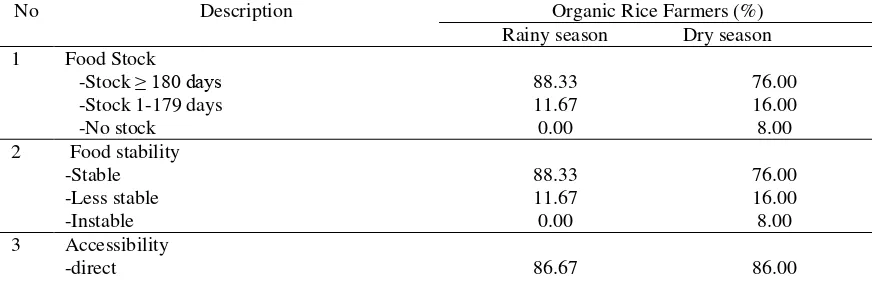
The analysis result of the level of food security of households of organic rice farmers in the rainy season (RS) and in the dry season (DS) in Tanggamus according to the definition of FAO and Law of Indonesian Republic No. 7 the year 1996 is presented in Table 2.
Table 2. Level of food security of organic rice farmers households in rainy season and dry season in Tanggamus Regency, Lampung Province
No Description Organic Rice Farmers (%)
21
-indirect 13.33 14.00
4 Continuity
-Continue 73.33 66.00
-Less continue 26.67 26.00
-Discontinue 0.00 8.00
5 Stage of Food Security
-Food security 60.00 48.00
-Low Food security 31.67 38.00
-Food insecurity 8.33 14.00
Based on Table 2, it was found out that the percentage of organic rice farmers’ households in rainy season which have adequate food stock, stable food supply, direct food access, and continuity of food supply was higher compared to the dry season. In the dry season, most farmers experienced harvest loss as a result of drought (climate change), which reduce the food stock. Based on the indicator of food stock, food stability, food accessibility, and continuity of food supply, most organic farmers’ households in Tanggamus were fall into having food security (>48%). Table 2 indicated that less than 14% of households were having food insecurity, the rice in these type of households, did not come from their own field, but from the co-owned field, therefore, the yield of rice production was shared. In order to fulfill the stock, the insecure households bought rice from the market until the next planting season.
3.4 Factors Affecting the Level of Food Security of Households
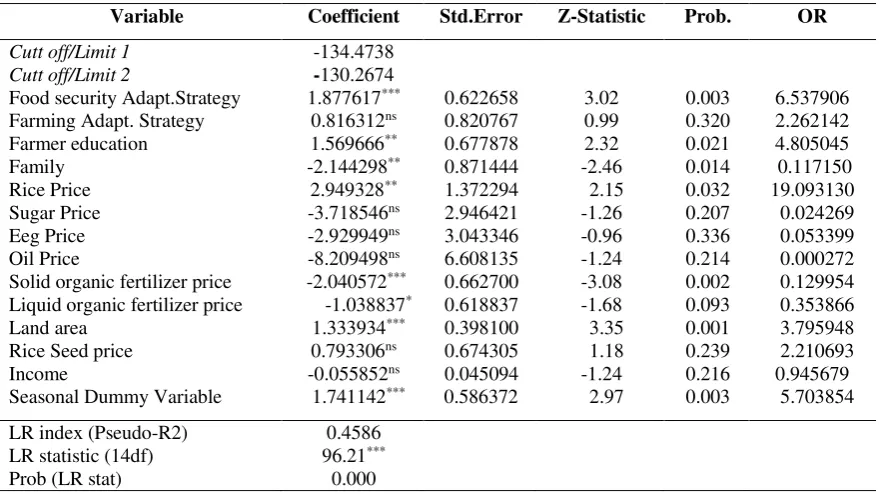
To determine factors affecting the food security of farmers’ households, ordinal logit regression Analysis was used. In Ordinal Logit, there should be categorization on the level of food security, according to the definition of FAO (1996) and Law of Indonesian Republic No. 7 (1996) food security category was divided to (3), low food security (2), and food insecurity (1). The analysis result of factors affecting the food security of organic rice
farmers’ households is presented in Table 3.
22
Table 3. Analysis Result of factors affecting the level of food security of organic rice
farmers’ Tanggamus Regency
23
Table 4. Result of analysis of marginal effect of ordinal logit of factors affecting the
level of the organic rice farmers’ households in Tanggamus Regency
Variable Pr(DKP= 3) Pr (DKP= 2) Pr (DKP=1)
Food adaptation strategy.*** 0.4675309 -0.4435144 -0.0240165
Head of household education level ** 0.3908505 -0.370773 -0.0200775
The number of family member.** -0.5339351 0.5065075 0.0274276
Rice price** 0.7343894 -0.6966647 -0.0377247
Solid organic fertilizer price *** -0.508107 0.4820062 0.0261008
Liquid organic fertilizer price * -0.2586727 0.245385 0.0132877
Land price *** 0.3321526 -0.3150904 -0.0170623
Seasonal dummy Variable *** 0.4095378 -0.3826285 -0.0269093
Note: *** = dominant effect, ** = marginal effect, * = low effect,
Subsequently, Table 4 also showed that each increase head of household education level of 1 year, would increase the probability of food security occurrence (DKP=3) in organic rice
farmers’ households of 39.08%, reduce the probability of lack of food security (DKP=2) of 37.08%, reduce the probability of household who have food insecurity (DKP=1) of 2.01%. The increase in farmers’ education level, would increase the farmers’ knowledge and master the agricultural technology in organic rice farming, which helps increase the capacity of rice production. The gain in productivity would increase the food stock which leads to food security. The result showed that increase of rice price by 1 rupiah would escalate the probability of food security (DKP=2) by 73.44%, reduce the probability of lack of food security (DKP=2) by 69.67%, and reduce the probability of does not have food security (DKP=1) of 37.72%).
Based on the result of the survey, rice was the staple food products which was regularly consumed by households in the research area. Usually, farmers will save the rice first for food stock as seen in food availability of farmers’ households in rain-fed rice field in Tanggamus Regency which was included into the category of having adequate stock (88.33% ) stock > 6 months/> 180 days) and lack of stock of 11.67% (stock 1-179 days). If there an excess in crop production, rice will be sold for other needs. The percentage of households selling their harvest was 85.0%. Those which did not sell their harvest were 13.33%. Meanwhile, a farmer who bought food because the lack of food stock was only 1 household (1.67%). With the increase of rice price, thus farmers would be motivated in organic farming so that it would increase the productivity of rice. With the increase of productivity, thus in would increase food stock in households, which finally would increase food security of those households.
24
reduction of the use of solid organic fertilizer in organic rice farming. Such a condition would cause the reduction of productivity so that it would cause the reduction of feedstock and would cause the reduction of food security of farmers’ households.
The result of the analysis also showed that each increase of liquid organic fertilizer price of 1 rupiah would reduce the probability of food security (DKP=3) of organic rice farmers’ households of 25.88%, in which at the same time it would increase the probability of lack of food security (DKP=2) of 24.54%, and increase the probability of does not have food security (DKP=1) of 1.33%.
The result of analysis in Table 4 also showed that each increase of field price of 1 hectare would increase the probability of the food security occurrence (DKP=3) of organic rice
farmers’ households of 33.22%, in which at the same time it would reduce the probability of
lack of food security (DKP=2) of 31.51% and reduce the probability of does not have food security (DKP=1) of 1.71%. The increase of field price of rice farming would increase the number of rice production result owned by households so that it would increase their food stock, which finally would increase their household's food security.
Subsequently, the result of the analysis also showed that season dummy variable (rainy season = 1, and dry season = 0) had a positive marginal effect toward the probability of
farmers’ households food security. This meant that in the rainy season the probability of an increase of food security in organic rice farmers’ households was higher than farmers’ households in the dry season.
4 CONCLUSIONS AND SUGGESTIONS
4.1 Conclusions
The farmer’s adaptation strategies for climate change in farming applied by farmers were 10 strategies. Meanwhile, the farmer’s adaptation strategies for climate change in food security applied by farmers were 5 strategies. Organic rice farmer’s households had more food security in the rainy season than in dry season. The head of the household's education level, rice price, farmland area, and planting season had a positive effect on the food security of rain-fed organic rice farmers household. Meanwhile, the number of family member, solid organic fertilizer price, and liquid organic fertilizer price had a negative effect. The rice price variable had the highest influence to increase food security of households of rain-fed organic rice farmers in Tanggamus Regency.
4.2 Suggestions
25
increase the business diversity into livestock and fishery, and carrying out diversification of plants in order to add revenue for the family. For the government, it should help to develop a productive business based on a local resource in sea fishery, plantation, and livestock. Rice price is a very important in supporting food security of households. Therefore, the government should formulate policy to stabilize the price of rice and help to facilitate the marketing of organic rice and increase the price of organic rice to motivate farmers in organic rice farming which an environment-friendly farming method and helps the farmer to survive in harsh climate change effect.
REFERENCES
Adiyoga. W., R.S. Basuki., D. Djuariah., and Safaruddin. 2012. Farmer’s perception and adaptation towards climate change: a Case study on a highland vegetable plantation in south Sulawesi. Report X. 174. Indonesian Ministry of Research and Technology
Borooah, V.K. 2002. Logit and Probit, Ordered and Multinomial Model. Sage Publications, Inc. Thousand oaks, London.
Indonesian Food Security Council (DKP), 2009, Indonesia’s Food Security 2015, draft, Indonesian Ministry of Agriculture.
Indonesian Central Bureau of Statistics (BPS), 2013, agricultural census, retrieved 14 September 2013 at http://bps.go.id
Food and Agricultural Organization (FAO). 1996. 50th Anniversary of The Food and Agriculture Organization of The United Nations Food and Agriculture Organization of The United Nation (F.A.O). Report Jacques Diouf, Rome Italy,
Food and Agricultural Organization (FAO). 2014, FAOSTAT database, retrieved 1 January 2015
Heltberg, R and Misha B.. Mapping Vulnerability to Climate Change. World Bank Policy Research Working Paper # 5554. Social Development Unit, The World Bank; 2011.
IPCC. 2007. Climate Change 2007. Impacts, Adaptation and Vulnerability Contribution of working Group II to the Fourth Assesment Report of the Intergovernmental Panel on Climate Change (IPCC). M.L. Parry, O.F Canziani. J.P Palutikof, P.J van der Linden and C.E. Hanson (Eds) Cambridge University Press. Cambridge. 200 pp.
Las, I. 2007. How to deal with climate anomalies phenomenon to stabilize national rice production in the era of sustainable green revolution. Journal of Biotechnology Indonesian institute of Science (LIPI). Inaugural Professor Text of Oration Indonesian Agency for Agricultural Research and Development.
The Indonesian Republic, 1996, Law of Indonesia no 7 years 1996 about Food, Indonesian Food Security Council, Jakarta
Nuhfil, H.A.R., 2012. Indonesia Food Security Paradigm. University of Brawijaya lecture notes.
Nurdin. 2012. Climate Change anticipation for sustainable food security, a journal of public policy dialogue, Directorate of public media management, Indonesian Ministry of communication and information technology, Jakarta.
Suhendi and Azikin S. 2010. Climate Change and Food Security vulnerability, Bogor Institute of Agriculture.5 (2); 1-2.
Surmaini, E., Runtunuwu E., and Las. I 2011. Agricultural Sector Efforts in Facing Climate Change. Journal of Indonesian Agency for Agricultural Research and Development, 30(1); 1-7.
26