ISLAMIC ECONOMIC SYSTEM FOR DEVELOPMENT AREA (STUDY OF AGRICULTURE AND TRADE)
N.Oneng Nurul Bariyah and Ahmad Taufikurahman University of Muhammadiyah Jakarta
Introduction
Religion has values of emancipation inherently, because religion has established itself as a driver of change in the history. In the Indonesian context, a delay which means poverty is a challenge that must be addressed with the participation and religious alignments, because of the composition of Indonesian society is known as a religious community. However, significant untapped potential to free people from a variety of problems
According to data obtained from Press Release No. 45/07 / Th.XIII, July 1, 2010 that the reduction in the number and percentage of poor people during the period March 2009-March 2010 seems to be related to the following factors: 1) Inflation was relatively low; 2) The average daily wage laborers and peasants 3.27% 3.86% construction workers; 3) Rice production in 2010 reached 65.15 million tons of paddy; 4) Most poor people work in the agricultural sector; and 5) The Indonesian economy first quarter of 2010 grew by 5.7% against the first quarter of 2009, while household consumption expenditure increased by 3.9% in the same period.
Gross inequality in income distribution (which included economic inequality) of the poverty level (percent of total population living below the poverty line) are two major problems in many LDCs, not least in indonersia. Said to be large, because if these two issues are left to drag on or get worse, it will eventually lead to political and social consequences are very serious (Tulus, 2003: 34). Turmoil of social life is strongly influenced by the level of social welfare that occurs when economic inequality, it is possible the vulnerability.
The problem mentioned above is the problem of poverty in Indonesia, another case with Nobel laureate Prof. Norway October 13, 2006 Muhammad Yunus (2007: 14) a hard struggle for 30 years with one of Philosophical Reflection Analysis of Poverty and Human Rights.
Islamic Economic System that can provide solutions to all the problems of life, offers a number of formats poverty and income inequality. Islamic Economics aims to study the human victory to be good, which is achieved through the organization of natural resources based on cooperation and participation as stated by Akhram Khan in Muhammad (2004: 34) that: "Islamic Economics aims to the study of human falah (wel being ) Achieved by organizing the resources of the earth on the basis of cooperation and participation ".
The fact suggests that the problems and natural resources, man-made resources, and human resources each district / city is different from each other. The difference in the potential of these resources can be a cause of the development gap in each region, especially with the strengthening of regional egoism has encouraged more area to look into. Based on the background of the research problem above issues include: the concept of Islamic economics in addressing poverty and income inequality and efforts to be made in developing the business model of agriculture and trade.
Research methodology
- West Bogor, Garment in Cimanggu - Tanah Sareal, bubur Cianjur in Bantar Jati - Central Bogor in Bogor City, and Baso Malang in Bilabong - Kemang, Bogor. The reasons for selecting these locations as a test site because the majority of the Moslem community and economic conditions of low or relatively poor. While their place of many natural resources such as vacant land. Human resource potential in the area varied there are graduates of formal education (high school, D3, and S1) but have not been able to improve the local economy. Agriculture can be a job for the residents in the region.
The data used in this research process is the primary data and secondary data. Primary data is information collected directly from the source, results form interviews, observations, and participate directly with farmers and traders as well as a team of field extension. Secondary data is data obtained by means of literature study, which is done by reviewing and understanding the information according to the subject matter covered.
Instruments used for the data mengumpulkan to prepare a list of questions, samples and materials that will be asked outreach workers, farmers and traders. Another instrument used for ongoing research activities include: 1 Table of information, namely the development of the periodic table are used throughout the study as a medium for writing the information obtained during the course of the study. 2 digital cameras, as a documentation tool important events during the study. 3. Notebook, as the recording medium while from the information obtained. 4. stick, used as a data storage medium.
After the data collected and then reviewed and analyzed for the discussion set forth in the form of an easy construction. Analysis of the data used in this study is qualitative deskriptir. In addition, the authors also conducted a comparative analysis of the research object is related to the difference in income between before and after the experiment. The experiments referred to in this research is the venture capital assistance to farmers and traders.
The object of study in this study are the ones who do not have jobs named idle. They were given help to try to fit their abilities and interests have. Among them are some who have an interest in farming and trade. Furthermore, they are given financial aid to increase the family income. Capital assistance for people who are interested in agriculture: farming eels and planted spinach, sweet corn, and others. As for people who are interested in trading capital assistance to sell cartridges.
Al-Kasb
1 Al-Kasb (work)
Working means physical exertion or thought undertaken to obtain financial rewards. This includes all forms of work, whether done by hand or with intelligence. Imam Syaibani in Azra (2010: 137) defines Al-Kasb (work) as a search for the acquisition of property through lawful means. Based on such understanding then any property acquisition in a way that is not kosher does not belong to the category of al-kasb (work). Given the importance of work to acquire wealth as well as work in producing wealth, the Qur'an gives tremendous pressure to it. It is very clearly stated in the letter of al-Najm verse 39:
ىَعَساَمّلإإ إناَسنإلإل َسْيّل نَأَو
"Surely not get anything, except what has been cultivated"ىّلَص إهللا ُلْوُسَر َلاَق :َلاَق ُهْنَع ُهللا َيإضَر َةَرْيَرُه ىإبَأ ُثْيإدَح
ٌرْيَخ إهإرْهَظ ىَلَع َةَمْزُح ْمُكُدَحَا َبإطَتْحَي ْن
َ لَ" َمّلَسَو إهْيَلَع ُهللا
ىف ىراخبلا هجرخا( .ُهَعَنْمَي ْوَأ ُهَيإطْعُيَف ًاَدحَا َل
َأْسَي ْنَا ْنإم
)عويبلا باتك
Meaning: hadeeth of Abu Hurayrah may Allah he said: "The Prophet., Said;" Bundle of firewood on his back one among you indeed better than others she asked and he gave him or reject (request) ". (collected by al-Bukhari in the book of al-Buyu ').
Thus, stronger human body meant that he was indeed able to overcome all the difficulties of life. He was given the resilience and strength to be able to bear all the burden of suffering in the struggle to achieve success and victory (Afzalurrahman, 1997: 237) Looking for a living is part of the human task that has a position as worship. In the Qur'an al-Jumu'ah mailing letters / 62 verse 10 which reads as follows:
اْوُغُتْباَو ِضْرَلا ىِف ْاوُرِشَتْناَف ُةوَلّصلا ِتَيِضُق اَذِإَف
َنْوُحِلْفُت ْمُكّلَعّل ا ًرْيِثَك َهللا او ُرُكْذاَو ِهللا ِلْضَف ْنِم
:ةعمجلا(
10
)
Meaning: "If the prayer has been fulfilled, then Extend you on earth, and look for the gift of God and remember (dhikr) Allah as much as possible so that you are lucky."
Islam really appreciate the efficient workmanship and ordered that Muslims do all kinds of work efficiently and neatly. The factories are also encouraged to produce everything well, durable and neat. In general, the efficiency is highly dependent on the physical, mental, moral, education and skills of workers.
2.Poverty
Simon Kuznets found the existence of a relation between income inequality and capita income levels are interpreted as the evolution of income distribution in the process of transition from a rural economy to an urban economy, or of agricultural economics (traditional) to industrial economy (Modern): at the beginning of the development process , income inequality increase as a result of the process of urbanization and industrialization. But after that the higher the level of development or the end of the development process decreases inequality, namely during the urban industrial sector has been able to absorb most of which come from the rural (agricultural sector), or at the time of the smaller farms in the production and creation of income (Tulus, 2003: 86). These conditions affect the social conditions of the people in its various aspects. Poverty, hunger, and pain, always be the actual problem from time to time in developing countries, including Indonesia.
minimum daily requirement. The difference is only meaningful if the poor material poverty, while poverty Faqir is a mental or work (Marthon, 2007: 123). Quran sometimes mentions people with dzu usrah, people who have difficulty.
The word "poor" is an adjective formed from the verb "Sakana" or "sakuna" which has the basic meaning silent or stay in place, while the word Faqir is the adjective formed from the word "iftaqara" which means the need. By combining these two terms, from the lexical approach, it can be seen that the poor are those whose wealth is not sufficient for a minimum of families, or those who are weak of its human resources so it can not settle the problem of life within the very minimum, namely: clothing, food, and board (An-Nabhani, 2009: 97). Poor people is a group of people who have not been able to meet their needs to the maximum so need help from others.
2 Regional Economic Development
Law no 22 of 1999 on Regional Government is the replacement for Law Number 5 of 1974 on the Principles of regional governance and Law No. 5 of 1979 on Village Government. Of Law No. 22 of 1999 can be seen one of the core implementation of the autonomous region is the presence of local governments the flexibility to organize their own government on the initiative, creativity, and active participation of the community in order to develop and promote the region. Allow local autonomy not only means implementing democracy in the bottom layer, but also encourage auto-activity to carry out what is important for the environment itself. It must be realized that the basic underlying principle is regional otonommi democracy, equality, justice, and awareness of the pluralism of Indonesia.
Economic Development
The development process can be divided into 4 stages. Usually the fourth stage was set in a series that began at the time of the goal set by political leaders and translated into quantitative targets for growth, employment creation, income distribution, poverty reduction, and so on. Political leaders must set priorities for the purpose of directing the planners if there is some conflict of objectives. The result is a welfare function that provides a measure of whether the plan (and planners) will meet the national objective or not. The first is a welfare function that shows the rank (the sequence of destination), which makes the planners to perform judgment. The second phase is to measure the availability of scarce resources in during the planning period, for example: savings, foreign aid, government revenue, export revenue, trained manpower, and other third-lain.Tahap is to choose a variety of ways (activities and tools) that can be used to achieve national objectives. At this stage set of investment projects such as roads, irrigation networks, factories, medical centers were included in the national plan. The fourth stage is the implementation of the program.
Islamic Economic System
al-malkiyyah) c. Distribution of wealth in society (tawzi 'al-Amwal bayn an-nas) (Hafidz, 2007: 217)
Agriculture
Agriculture is an important sector in the national economy. Agriculture has an important contribution to the economy, namely the contribution of products (product contribution) in its contribution to Gross Domestic Product (GDP) also contributed market (market contribution). Agriculture is also the sector that is capable of creating jobs (employment contribution) and bring in foreign exchange for the country (export earnings contribution). Other roles are in demand and supply of energy for humans. Said Dr. Ir. Apriyantono, MS (IPB Rector 2009)
The annual report of the World Bank (World Development Report / WDR 2008) recently published the theme of agriculture to development (Agriculture for the Development). The agricultural sector in the WDR is confirmed (again) can be used as instrrumen fundamental to sustainable development growth) and reduce poverty (pro-poor). The report states that based on GDP growth of other sectors. This was based on the ability of the agricultural sector to absorb and create employment (pr-employment).
Agriculture is a way of life and the source of most people's life. Approximately 45% of our workforce depends on the primary agricultural sector. The role of the agricultural sector in the national economy during this often only seen through its contribution to GDP, employment creation, income generation and foreign exchange earnings society. The new role of agriculture sector can now be placed within the framework of "3 F contribution in the economy", ie food (food), feed (fodder) and fuel (fuel). Agriculture of the role associated with the "food" is the agricultural sector as the leading sector in the development of food security. That is, the role of the agricultural sector largely determines the realization of human resources (HR) quality. Qualified human resources development should be supported by a quality animal food sufficiency as well. This shows that food security is no longer defined as the availability and adequacy of food availability but also accompanied with the adequacy of animal protein and other food in accordance with the desired food pattern (PPH). The livestock sector within the framework of agricultural development in the broadest sense has played a large role in creating high-quality animal food. (Arsyad, 1997: 9-13).
The role played by the agricultural sector, including aspects of food (food), feed (fodder) and fuel (fuel) showed that the existence of the agricultural sector has been able to create added value chain of the business comes from business fields to fast food (from farm to table business). The agricultural sector is not only related to on-farm, but also related to off farm, both upstream and downstream. This shows that the agricultural sector is a strategic role in achieving development comprehensively, so as to reduce the level of poverty, while creating economic growth and employment for jobs.
Trade
The basic principle of Islam that has been set on trade and commerce is halal products, honesty, trust, and sincerity. Today many market imperfections, which should be eliminated if this pinsip accepted by the business community of nations in the world derada. Principles of trade and commerce has been there in the Qur' an and Sunnah, such as the conduct of perjury, giving incorrect doses, and create goodwill in a business transaction. (Mannan, 1992: 288) The behavior deviates in the trade can be detrimental to society because it creates economic instability.
The study of and solution to the problem of poverty continues to be done by a variety of approaches. One is the study, entitled Strategies to overcome poverty in the Fishing Village: A Case Study on the village of Kendal Gempolsewu by Abdul Kobar Mudzkir, SP, M.Sc. According to Abdul Kobar that efforts to overcome poverty, among others, human resource development, the formation of groups of fishermen, and the provision of adequate facilities for pre fisheries, and evaluation of policies that are not in favor of the fishermen. Abdul Kobar studies conducted specifically on the fishing community to community development approach. Meanwhile, Ruslan Abdul Ghafur in his dissertation (2011) concluded that the Islamic economic system load distribution concept is loaded with the value of justice, morals, and norms when applied in accordance with the Indonesian national identity.
Description of Data and Research Results
Here's a description of capital assistance for community empowerment in agriculture and trade.
1 Agriculture
1.1. Sweet Corn; Sweet corn intercropping on cassava plants, with the following provisions;
1.1.1. Overlapping Planting Process Sari (sweet corn) 1) The land area of 5000 m2
2) Sweet Corn Seed = 5 Kg x Rp. 80.000,00.- = Rp. 400.000,00.- 3) chicken manure = 50 sacks x Rp. 6000,00.- = Rp. 300.000,00.-
4) Urea = 150 Kg (3 sacks) x Rp. 80.000,00.- (per sack) = Rp. 240.000,00.- 5) HCL = 50 Kg x Rp. 2000,00.- = Rp. 100.000,00.-
6) The process of planting to harvest for 70 days ________________________________________ Total Capital Rp.
1.040.000,00.-1.1.2 Intercropping crops (sweet corn) 1. 1 Kg seeds of sweet corn yields of 700 kg 2. Results Total harvest 5 kg x 700 kg = 3500 kg 3. sweet corn price Rp. 1500.00 .- / Kg
4. Revenue 3500 Kg x Rp. 1500,00.- = Rp. __________________
Crops Rp. 5.250.000,00.-
c. Postharvest Rp. 5,250,000.00 - Rp. 1.040.000,00.- = Rp 4.210.000,00.- The median income in 30 days = Rp. 4.210.000,00.-: 2 = Rp. 2.105.000,00.-Place: Bogor PDK Complex Rt. 13 Rw. 05 Village Kedong Halang Bogor
1. The land area of 2000 m2
2. Seeds Caesim = 2 packs x Rp. Rp.10.000,00.- = Rp. 20.000,00.-3. chicken manure = 20 sacks x Rp. 6000,00.- = Rp. 120.000,00.- 4. Urea = 25 kg (1/2 sacks) = Rp. 40.000,00.-
5. NPK = 5 Kg x 12.000,00.- = Rp. 60.000,00.-
6 The process of planting to harvest for 30 days __________________________________________
Total Capital Rp.
240.000,00.-b. Overlapping Crops Harvest Sari (Caesim) 1. 1 pack = 200 Kg Yields
2. packs 2 x 200 kg = 400 kg
3. caesim price Rp. 1500.00 .- / Kg
4. Revenue 400 Kg x Rp. 1.500,00.- = Rp. 600.000,00.-_____________________________
Crops Rp. 600.000,00.-
c. Postharvest Rp. 600.000,00.- USD. 240.000,00.- USD. 360.000,00.- The median income in 30 days = Rp. 360.000,00.-
Place: Taman Sari Gg. Sapodilla Rt. 03/04 Sand Village Jaya Bogor
1.3. kale
Kale plants in the home garden soil with the provisions of as follows a. process spinach
1. The land area of 200 m2
2. Seeds Caesim = 2 packs x Rp. Rp.9.000,00.- = Rp. 18.000,00.-
3. chicken manure sacks = 5 x Rp. 6000,00.- = Rp. 30.000,00.- 4. Urea = 10 kg x Rp. 1.600,00.- = Rp. 16.000,00.- 6 The process of planting to harvest for 30 days with 4 times the harvest __________________________________________
Total Capital Rp.
64.000,00.-b. Overlapping Crops Harvest Sari (Caesim) 1. 1 pack = 200 belt Yields
2. packs 2 x 200 = 400 tie belt
3. kale price Rp. 300.00 .- / connective
4 .300 Income connective x Rp. 400,00.- = Rp. 120.000,00.-
5. Within 30 days = 4 harvests x Rp. 120.000,00.- = Rp. 480.000,00.-__________________________
harvest Rp.
480.000,00.-c. Postharvest Rp. 480,000.00. - Rp. 64.000,00.- = 416.000,00.- The median income in 30 days = Rp. 416.000,00.-
Place: Telaga Kahuripan Rt. 17/03 Pa- Bogor Regency Village Jampang
1.4. eel; eel seeding in the pool, with the following provisions; a. Seeding Process Eels
3. cow dung fertilizer sacks x = 5 USD. 10.000,00.- = Rp. 50.000,00.- 4. postharvest rice straw
5. 3 banana trees 6 During the 45 days are not fed, after fed snails and fish Kites (fish Small river or solokan)
7. The process of growth until harvest for 80 days _______________________________
Total Capital Rp.
895.000,00.-b. harvest eel
1. 1 Kg eel harvest produce 13 Kg
2. Results Total harvest 15 kg x 13 kg = 195 kg 3. eels price Rp. 25,000.00 .- / Kg
4. Revenue 195 Kg x Rp. 25.000,00.- = Rp. 5.250.000,00.-___________________________
Crops Rp.
c. postharvest
Rp 4,875,000.00 - Rp. 895.000,00.- = Rp. 3.980.000,00.- The median income in 27 days = Rp. 3.980.000,00.-: 3 = Rp. 1.336.666,67.-
Place: Lamping Rt. 05/01 Village Kedong K. Bogor
In conducting the business of agriculture, business activities in which there are two forms of direct (direct) and indirect (indirect). Forms of assistance made directly done with provision of capital and facilitation of the agricultural measures. For example, in an effort to raise eel farmers briefed eels as well as ways to raise capital. Thus different forms of assistance to farmers kale. Farmers do their business without any target or mentoring. However, coaching as a form of monitoring to see progress is still being done. Mentoring is done so that the desired results can be achieved, namely an increase in revenue (income) for farmers.
Trade
In this trade using contract types Bai 'Al-Murabaha (Sale and Purchase With Tough Payment). Bai 'al-Murabaha is selling goods at the original price agreed with the additional advantage. In Bai 'al-Murabaha seller must deliver the product price that he bought and determine a level of profit in addition. Another source said that Murabaha is a contract sale of goods by declaring prices and earn a profit (margin) as agreed by the seller and the buyer.
Murabahah is one form of certainl natural contract, since the prescribed some require Murabaha rate of profit (the profit to be obtained). Because the character of Murabaha is the seller should inform the buyer on the purchase price of the goods and stating the amount added to the cost, it is necessary to agreed profit.
Al-Murabahah is done based on the verses of the Qur'an and Hadith as follows:
هللللا ىلص هللا لوسر لاق لاق هيبأ نع بيهص نب حلاص نع
لللللجأ ىلإ عيبلللللا . ةللللكربلا نهيف اثل ( : ملللللس و هلللليلع
) عيبللل يبلل ريعشلاب ربلا اثخأو ةضراقملاو
"It was narrated from Salih ibn Suhaib from his father he said: The Messenger of Allah said:" Three things in which there is a blessing: Buying and selling is tough, muqaradhah, (mudaraba), and mixed with wheat flour for home, open for sale "(HR . Ibn Majah)
The purpose of al-Murabahah contract was to provide relief to the community in social life. It is important in al-Murabahah contract is a lack of transparency and honesty between the parties berakad.
Descript of murabahah practice in this study are as follows:
1 Retail Merchants Raffle Ink cartridges with the following details; 1) Purchase price Rp. 300,000.00 .- / 1 kg to fill 6 cartridges
2) Capital 1 cartridges with a price of Rp. 100.000,00.- x 12 cartridges = Rp. 1.200.000,00.-
3) Selling Price 1 cartridges filled Rp. 200.000,00.- 4) Dealer inventory requires 2-fold
5) Suspension of payment for 30 days b. Revenue within 30 days
First Month 6 cartridges 1 x Rp. 200.000,00.- = Rp.1.200.000,00.- Second Month 6 cartridges 2 x Rp. 200.000,00.- = Rp.1.200.000,00.- 3 Third Month 6 cartridges x Rp. 200.000,00.- = Rp.1.200.000,00.-
c. Post-earnings for 90 days (3 months)
1.Capital 12 cartridges 1 x Rp. 100.000,00.- = Rp. 1.200.000,00.-2. Ink Raffle 2 x Rp. 300.000,00.- = Rp. 600.000,00.-
Total Capital Rp. 1.800.000,00.-
2 Payment of the first month of Rp. 1.200.000,00.- The second month of Rp. 1.200.000,00.-
The third month of Rp. 1.200.000,00.- During the 3-month USD. 3.600.000,00.-
The median income in 30 days = Rp. 3.600.000,00.-: 3 = Rp.
1.200.000,00.-Business process as follows: 1 Pre-Production Process
a. Merchants doing business Murabahah in Recharge (Raffle) ink, pre Cilendek products made in West Bogor subdistrict East - Bogor, the price 300,000, - / 1 kg.
b. Premium Toner Ink Type Raffle types 12, 13, 15, etc. and the type of cartridge Series 35, 56, 85 and so on with each price Rp. 300.000, - / 1 kg to fill 6 cartridges.
2. Production Process
The production process of the work done in the merchant can be detailed as follows: a. The time used ink production process Raffle approximately only 2 days to 36 cartridges with filler made by the vendors themselves
b. Implementation efforts based on Murabahah agreement between traders with buyers Ink Raffle (Raffle Ink users) with the agreement of deferred payment for 30 days.
c. Traders should have a supply of ink cartridges Raffle doubled mean 36 cartridges
3 Post-Production Process
a. After the production process for 2 days, then the trader first entered Al Murabaha Ink Toner Premium Raffle kind of type 12, 13, 15 and so on and the type of cartridge Series 35, 56, 85 and so on to 18 cartridges as per 1 kg menghasil 6 cartridges multiplied by 3 kg .
b. Of 18 cartridges are sent upon request to the Foundation Umm Quro Institutions elementary, middle, and high schools in Salabenda West Bogor - Bogor city as much as 5 cartridges, and Foundation Day RBSC IPB Baranang Central Bogor - Bogor many as 10 cartridges, as well as PT. Young Jien Jave Sukagarment Cicurug - District Sukaumi much as 3 cartridges. So the total number of production Inks Raffle proceeds of approximately 200.000, - / 1 multiplied by 18 cartridges each cartridge Rp.3.600.000, - cut buy refill 3 kg multiplied by 300,000, - equal to Rp. 900,000, -,. Total gross proceeds of the sale of production after the above, namely Rp.1.700.000, - (one million seven hundred thousand dollars).
c. Traders generate profits (margins) in 30 days or less Rp.1.700.000, (One nevertheless seven hundred thousand dollars) and has been able to exceed the salary of civil servants 2C group, Al-Murabahah means the system is already providing solutions for the people who pick the willingness and determination to want to work (al-Kasb) in the field of trade. Place: East Cilendek Rt. 04/04 District of West Bogor - Bogor
3 Post-Production Process
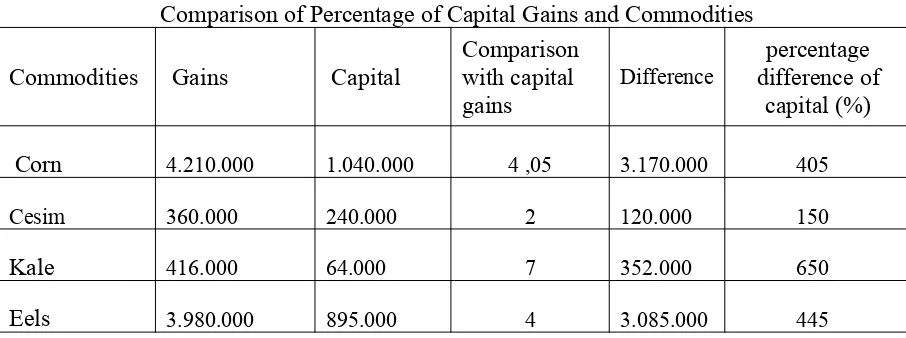
Base on description above, if we look at the development efforts can be seen in the table below:
Table 1
Comparison of Percentage of Capital Gains and Commodities
Commodities Gains Capital
Based on the table above, there is an increase in income through farming and trading business from the initial income. In this study, efforts in the field of agriculture conducted independently commitment and motivation to succeed in the field so as to obtain the desired results so as to increase the family income.
The businesses that use cartridges murabahah with capital of Rp. 1.800.000,00.- the average income in 30 days = Rp. 3.600.000,00.-: 3 = Rp. 1.200.000,00.-. In this case the merchant receives an order 18 ink cartridges from 3 subscribers and the total amount of ink production Rafill proceeds of approximately 200.000, - / 1 multiplied by 18 cartridges each cartridge Rp.3.600.000, - cut buy refill 3 kg multiplied by 300,000, - equal to Rp. 900,000, ,. Total gross proceeds of the sale of production after the above, namely Rp.1.700.000, -(one million seven hundred thousand dollars).
Analysis of Research Findings
The concept of Islamic economics is a system that can be used in addressing poverty and income inequality. Efforts to tackle poverty and inequality income can be done by conducting business activities in the form of agriculture and trade.
In order for agriculture and trade it may be necessary to find a way to overcome poverty model of agriculture and trade in accordance with the ability of the perpetrator. This is to facilitate the business to be conducted so that the benefit can be achieved. Desired benefit in this regard, as mentioned by Abu Hamid Ghazali and Abu Ishaq al-Syatibi ie, (welfare) society as a whole is the goal of Islamic law.
In trade and agriculture substantively contains some welfare benefit both essential (daruriyyat), secondary (hajiyyat) and complementary (luxuries). Beneficiaries that are associated with the maintenance of essential assets due to legitimate business. Thereby avoiding the occurrence of deviant behavior to get the treasure that is not lawful. With a wealth of kosher menajdikan one strong belief in God, so avoid infidelity.
Efforts to create such benefit should be shared between the public and especially public institutions, in this case the government. The government has an obligation to protect the citizens of the various disturbances and obstacles. While the Muslim community has a social obligation through zakat obligation that can be used as an economic instrument in an effort to reduce social inequalities in the society.
Zakat as part of Syari demands' for mukallaf that aims to keep life steady harmonization, integration, and sustained between worldly and hereafter purpose. Encashment charity function properly when dilkaukan with good managerial system and the synergy with the government. Similarly, the role of the company with its CSR can be the driving force of the local economy, especially the dhu'afa, so that they are assured of the protection of life.
The above problems affect the public good is a milestone welfare and prosperity of society. Maintenance of essential needs (necessities) have an influence on hajiyyat interests and luxuries that have the goal of turning a situation into better shape, whether it be social or economic.
Protection as a step towards well-being which includes a sense of justice, compassion, and kindness. Economic oppression can give birth to hatred, hostility, and murder that led to the situation and the conditions become unsafe and full of turmoil
On this basis, as we must understand that the economic system is based on Islamic principles is not only a means to maintain the balance of economic life, but also a means to relocate resources to people who are entitled according to sharia. Thus the goals of economic efficiency and fairness can be realized and achieved simultaneously. Achieve economic success is based on Islamic principles according to Chapra (1992: 215) means to create a perfect society.
Furthermore, according to Chapra (1992: 215) that these goals will not be achieved without maximum effort with earnest work so requires a strategy to restructure the socio-economic system as a whole with the participation of all citizens. Thus the socio-economic benefits based on sharia principles can be felt and achieved by the whole society. Restructuring the funding agencies that adhere to Shariah principles are important.
Education and skill enhancement of the poor people can encourage economic revival and indirectly can also increase market Shari'ah financial institutions. In addition to the problem of education and skills, strengthening character's personality in shaping a strong, efficient, and does not have a culture of wasteful need for habituation. In this case, the habit of saving, leave the snack culture, and shopping items that are not essential should be a public personality, especially the poor people.
Good personality can be a major influence for the improvement of quality of life in many aspects. Will indirectly increase aghniya group (the have) quantitatively and qualitatively and reduced the poor poeple which is an indicator of the realization of a prosperous society.
Conclusion
Based on the results of the research can be broadly concluded that the teachings of Islam who ordered his people to have a job (kasb) has a close relationship with tackling unemployment effect on poverty reduction.
Unemployment can occur due to various factors, among others, because he did not have to venture capital as well as the motivation to perform the business. To that end, efforts to solve problems of poverty and income inequality can be done by promoting the business through agriculture and trade.
The move was done for example by providing venture capital assistance for people who do not have a job (unemployed). The concept of of murabahah may be an option in implementing cooperation in a group coaching unemployed in business. Another important point is also the mental coaching and motivation and strong will and cooperation of all parties, every effort be made to give effect to an increase in their income. This shows that agriculture and trade as an alternative to poverty reduction.
In order for agriculture and trade increased incomes for the unemployed, the need for appropriate strategies according to the capacity and ability of each person. In addition, place or location and type of business to be developed should be appropriate to the abilities, interests, and region or condition of society in which it was built.
REFERENCES
Aedy, Hasan, 2007. Indahnya Ekonomi Islam, Bandung: Alfabeta
---, 2011. Teori dan Aplikasi Ekonomi Pembangunan Perspektif Islam, Yogyakarta: Graha Ilmu
Arsyad, Lincolin, 1997. Ekonomi Pembangunan, Edisi Ke-3, Yogyakarta: SIIE-YKPN Abdurrahman, Hafidz, 2011.Muqoddimah Sistem Ekonomi Islam, Bogor : Al-Azhar Press. ---, 2007. Diskursus Islam Politik Spirtual, Bogor: Al-Azhar
Ali, H. Zainuddin, 2008. Hukum Perbankan Syari’ah, Jakarta: Sinar Grafika
Abdul Azhim, Said, 2009. Halal Haram Dalam Bisnis Kontemporer. Surakarta: Al-Qawam
Abdullah, Muhammad Husen, 2010. Studi Dasar-Dasar Pemikiran Islam, Bogor: Pustaka Thariqul Izzah
Afzalurrahman, 1997. Muhammad sebagai seorang pedagang
Chamid, Nur, 2010. Jejak Langkah Sejarah Pemikiran Islam,Yogyakarta: Pustaka Pelajar
Didin hafidudin dan Hendi Tanjung, 2003. Manajemen Syari’ah Dalam Praktek , Bogor: IPB Press Gusfahmi, 2007. Pajak menurut Syari’ah, Jakarta: Raja Grafindo Persada
Hanif, Muhammad Aslam, 2010. Pemikiran Ekonomi Islam Kontemporer, Jakarta: Rajawali Press Hardiansyah,H.A.M. ,2003.Inovasi Gizi Dan Pengembangan Modal Sosial, Bogor: IPB Press Kho, Riwu, Josef, 2007. Prospek Otonomi daerah di Negara Republik Indonesia, Jakarta:
Rajagrafindo
Manan, Abdul, 1995. Teori Dan Praktek Ekonomi Islam, Jakarta: Dana Bakti Wakaf
Mursi, Abdul Hamid, 1995. al-Syahshiyat al-Muntajah, (terj. Moj. Nurhalim) SDM yang Produktif
Pendekatan Al-Qur’an dan Sain, Jakarta
Muhammad, 2008.Paradigma, Metodologi, dan Aplikasi Ekonomi Syari’ah, Yogjakarta: Graha Ilmu
Muhammad, 2008. Metodologi Penelitian Ekonomi Islam (Pendekatan Kuantitaif), Jakarta: Rajawali Press
Nata, Abuddin, 2011.Studi Islam Komperehensif, Kencana Prenada Media, Jakarta: Kencana Prenada Media
Nain, Mohd. Shukri Ahmad & Yusoff, Rosman dari “Artikel Ekonomi”, 14 maret 2011 Rahman, Afzalur, 2007. Ensikopediana Ilmu dalam Al-Qur’an, Bandung: Mizaania Rosyati, Imas, 2002. Esensi Al-Qur’an, Bandung: Pustaka Setia
Ridwan, 2004. Metode dan Teknik Menyusun Tesis, Bandung: Alfabeta
Reksohasidiprodjo, 1989. Organisasi Perusahaan-Teori Struktur dan Prilaku, Yogyakarta: BPFE Sa’ad Marthon, Said, 2007. Ekonomi Islam di Tengah Krisis Ekonomi Global, Jakarta: Zikrul
Hakim,
Suhardi, Teguh, 2009. Ekonomi Syari’ah, Semarang: Pustaka Rizki Putra
Suyono, H Haryono , “Artikel Ekonomi Pembangunan” , Seminar Nasional Percepatan Pembangunan Sosial Ekonomi Daerah Tertinggal, 05 9ktober 2011
al-Nabhani Taqyudin, 2009. Membangun Sistem Ekonomi Alternatif, Surabaya: Risalah Gusti Ash-Shadr, Muhammad Baqir, 2008. Buku Induk Ekonomi Islam Iqtishoduna, Mizania, Yogyakarta Tambun, Tulus, T.H. 2003. Perekonomian Indonesia (Beberapa Permasalahan Penting) , Jakarta:
Ghalia Indonesia
Yunus, Muhammad, 2007. Bank Kaum Miskin, Jakarta: Batu Merah
REFERENCES
Azra, Azyumardi.2005. History of Islamic Economic Thought, Depok: Gramata Aedy, Hasan, 2007 The beauty of Islamic Economics, London: Alfabeta
---, 2011. Theory and Application of Economic Development Islamic Perspective, London: Graha Science Arsyad, Lincolin, 1997 Economic Development, 3rd Edition, New York: siie-YKPN
Abdurrahman, Hafdz, 2011.Muqoddimah Islamic Economic System, New York: Al-Azhar University Press. ---, 2007 Islamic Political Discourse spirtual, Bogor: Al-Azhar Ali, H. Zainuddin, Shariah Banking Law 2008, Jakarta: Sinar Graphic Abdul Azhim, Said, 2009 Halal Haram In Contemporary Business. Surakarta: Al-Qawam
Abdullah, Muhammad Husen, 2010 Study Basics of Islamic Thought, New York: Library Thariqul Izzah
Afzalurrahman, 1997 Muhammad as a trader Chamid, Nur, 2010 Footsteps of History of Islamic Thought, London: Library Student
Didien hafdudin and Hendi Cape, 2003 Shariah Management in Practice, New York: IPB Press
Gusfahmi, 2007 Tax according to Shariah, London: King Grafndo Persada Hanif,
Muhammad Aslam, 2010 Contemporary Islamic Economic Thought, New York: Eagle Press
Hardiansyah, H.A.M. , 2003.Inovasi Nutrition and Social Capital Development, Bogor: IPB Press
Kho, Riwu, Josef, 2007 Prospects of Decentralization in the Republic of Indonesia, Jakarta: Rajagrafndo
Manan, Abdul, 1995 Theory and Practice of Islamic Economics, New York: Dana Bakti Endowments Mursi,
Muhammad, 2008.
Paradigma, Methodology, and Application of Sharia Economics, Yogyakarta: Graha Science Mohammed, Islamic Economics Research Methodology 2008 )Quantitative Approach(, Jakarta: Rajawali Press
Nata, Abuddin, 2011.Studi Islam comprehensively, Kencana Prenada Media, New York: Kencana Prenada Media
Nain, Mohd. Shukri Ahmad & Yusof, Rosman of "Articles Economics", 14 March 2011
Rahman, Afzalur, 2007 Ensikopediana Science in the Qur'an, London: Mizaania Rosyati,
Imas, 2002 Essence of the Qur'an, London: Loyal Reader
Ridwan, 2004 Methods and Techniques Develop Thesis, London: Alfabeta Reksohasidiprodjo, 1989.-Company Organization Structure Theory and Behaviour, London: BPFE
Sa'ad Marthon, Said, 2007 Central Islamic Economics in the Global Economic Crisis, New York: Zikrul Judge, Suhardi, True, 2009 Economic Shariah, Semarang: Library Rizki Putra
Suyono, H Haryono, "Articles of Economic Development", National Seminar on Socio-Economic Development Acceleration Disadvantaged Regions, 05 9ktober 2011
al-Nabhani Taqyudin, 2009 Build Alternative Economic Systems, New York: Proceedings of Gusti Ash-Sadr, Muhammad Baqir, 2008 Parent Book Iqtishoduna Islamic Economics, Mizania, Yogyakarta
Tambun, Sincere, T.H. Indonesian economy 2003 )Some Important Issues(, New York: Ghalia Indonesia
Yunus, Muhammad, 2007 Bank of the Poor, New York: Red Stone