By:
Nella Kristina Sitinjak SID. 409342025
Biology Education Bilingual Program
THESIS
Submitted to fulfill the requirement for degree Sarjana Pendidikan
BIOLOGY DEPARTMENT
FACULTY OF MATHEMATIC AND NATURAL SCIENCE STATE UNIVERSITY OF MEDAN
ACKNOWLEDGEMENT
First of all, the writer thanks the Almighty God, who has granted countless
blessing, knowledge and opportunity to the writer, so that she has been finally
able to accomplish her thesis.
She gratefully acknowledges the deepest gratitude to her thesis advisor,
Prof. Dr. rer. nat. Binari Manurung, M.Si., who has generously spent precious time in giving guidance, encouragement, suggestion and critics until this thesis
comes to its present form.
Her enormous appreciation is addressed toDra. Martina A. Napitupulu, M.Sc., Dr. Fauziyah Harahap, M.Si and Syarifuddin, M.Sc., Ph.D., as her thesis examiners who gave useful critics and suggestion for this thesis. She also
thanksDr. Ely Djulia, M.Pd. as academic advisor, Drs. Tri Harsono, M.Si. as the head of Biology Department and also all lectures and staffs of FMIPA who
helped and supported during her study in UNIMED.
Writer also appreciated Drs. Alben Sianturias the principal of SMAN 1 Sidikalang, Wahidin, S.Pd. as Biology teacher for helping and guidance during the research. Writer also thanked all teachers, staffs and all students of class XI
IPA 3 and XI IPA 4 SMAN 1 Sidikalang Academic Year 2013/2014 for the
cooperation.
Special thanks address to writer’s parents, Parsaoran Sitinjak and L. Erliana Sitanggang, for their loves, support and encouragement during her academic years until the completion of this thesis. The writers also thank her
brothers David Hendra Sitinjak, Rizal Efesus Sitinjak, Simson Rudi W. Sitinjak, Vicky Octavianus Sitinjak and her sister, Amelia Theresia Sitinjak and all of her big family who gave their love and supports.
At last, writers gives her appreciation and thanks to her good friends who
iv
Writer also thanks her best friends, Reslin Cristina Pandiangan, Mona Lusia Manihuruk, Juspita Elisabeth Jawak, Marta Cristina Simamora, and Frenky Lewis Siahaan,for great times, encouragements and friendship.
Finally, writer says thanks for everyone who have helped and contributed
in this thesis completion. God bless us.
August, 2014 The Writer,
THE EFFECT OF COOPERATIVE INTEGRATED READING AND COMPOSITION (CIRC) MODEL ON STUDENTS’ ACHIEVEMENT
AND STUDENTS’ ACTIVITY IN TOPIC DIGESTIVE SYSTEM FOR GRADE XI SCIENCE SMA NEGERI 1 SIDIKALANG
ACADEMIC YEAR 2013/2014
Nella Kristina Sitinjak (SID. 409342025)
ABSTRACT
Nella Kristina Sitinjak. The Effect of Cooperative Integrated Reading and Composition (CIRC) Model on Students’ Achievement and Students’ Activity in Topic Digestive System for Grade XI Science SMA Negeri 1 Sidikalang Academic Year 2013/2014. Undergraduate Thesis. State University of Medan (UNIMED). 2014. The objectives of this study are to find out whether: (1) Cooperative Integrated Reading and Composition (CIRC) model significantly affect students’ learning achievement. (2) Cooperative Integrated Reading and Composition (CIRC) model significantly affect students’ learning activity. A quasi experimental research with non-equivalent control group was used in this study. The research used this sampling because the classes are homogeny. The population of this study is all students of grade XI Science of SMA Negeri 1 Sidikalang academic year 2013/2014. There are two classes chosen as sample by applying purposive cluster sampling techniques. Classes consist of 30 and 32 students. The instruments that are used for data collection are multiple choice and essay test. Data is analyzed by Independent t-test with SPSS 16.0 for Windows, with level significance α = 0.05. The result of hypothesis showed that: (1) Cooperative Integrated Reading and Composition (CIRC) model significantly affect students’ learning achievement (t=3.403; P = 0.001). (2) Cooperative Integrated Reading and Composition (CIRC) model significantly affect students’ learning activity (t = 1.996; P = 0.05).
vi
TABLE OF CONTENT
Approval sheet i
Abstract ii
Acknowledgement iii
Biography v
Table of Content vi
List of Figures viii
List of Tables ix
List of Appendix x
CHAPTER I INTRODUCTION 1
1.1.Background 1
1.2.Problem Identification 4
1.3.Research Scope 4
1.4.Research Question 5
1.5.Objectives of Study 5
1.6.Significances of Study 5
CHAPTER II REVIEW OF LITERATURE 6
2.1. Theoretical Framework
2.1.1. Learning 6
2.1.2. Learning Achievement 7
2.1.3. Learning Activity 8
2.1.4. Cooperative Learning Model 10
2.1.5. Cooperative Integrated Reading and Composition (CIRC) 11
2.1.6. Direct Instruction Model 14
2.1.7. Relevant Research on Cooperative Integrated Reading and 15 Composition (CIRC)
2.2. Conceptual Framework 15
2.3. Research Hypothesis 16
CHAPTER III RESEARCH METHODOLOGY 17
3.1 Location and Time of Research 17
3.2 Population and Sample 17
3.3 Research Variable 17
3.4 Type and Research Design 17
3.5 Research Instrument 18
3.6 Instrument Testing 21
3.7 Research Procedure 22
3.8 Data Analysis Technique 23
3.8.1 Normality Test 24
3.8.2 Homogeneity Test 24
CHAPTER IV RESULT AND DISCUSSION
25
4.1 Results 25
4.1.1 Instrument Test Data Analysis 25
4.2. Data Description 26
4.2.1 Students’ Achievement 26
4.2.2 Students’ Activity 28
4.2.3 Hypothesis Testing 29
4.3 Discussion 30
4.3.1 The Effect of Cooperative Integrated Reading and Composition 30 on Students’ Achievement
4.3.2 The Effect of Cooperative Integrated Reading and Composition 31 (CIRC) on Students’ Activity
4.4 Limitation of Research 33
CHAPTER V CONCLUSION AND RECOMMENDATION 34
5.1 Conclusion 34
5.2 Recommendation 34
ix
LIST OF TABLES
Pages Table 3.1. Design of study two group Pre-test & Post-test 18 Table 3.2. The Lattice of Concept Understanding 18 Table 3.3. Rubric of Student’s Activity Assessment 19 Table 3.4. The criteria of Test Difficulty 22
Table 1. Macromolecules Digestion 47
LIST OF FIGURES
Pages Figure 4.1.Students’ Achievement Post-test 27
Figure 4.3 Results of Students’ Activity 28
Figure 1. Nutrition Sources 39
Figure 2. Digestive tract and organs 41
Figure 3. Salivary gland of mouth 42
Figure 4. Peristalsis movement 43
Figure 5. Stomach 44
Figure 6. Small Intestine structure 45
Figure 7. Liver 45
Figure 8. Gall bladder 46
Figure 9. Pancreas 46
x
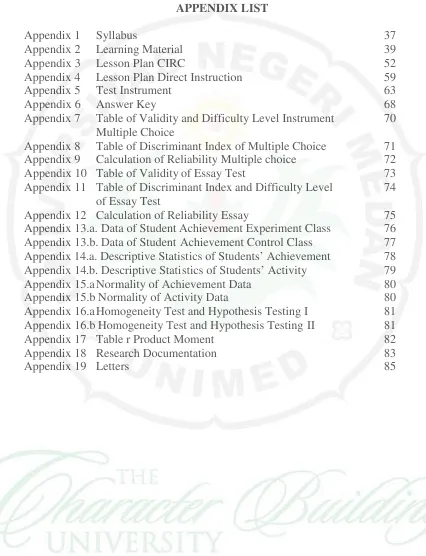
APPENDIX LIST
Appendix 1 Syllabus 37
Appendix 2 Learning Material 39
Appendix 3 Lesson Plan CIRC 52
Appendix 4 Lesson Plan Direct Instruction 59
Appendix 5 Test Instrument 63
Appendix 6 Answer Key 68
Appendix 7 Table of Validity and Difficulty Level Instrument 70 Multiple Choice
Appendix 8 Table of Discriminant Index of Multiple Choice 71 Appendix 9 Calculation of Reliability Multiple choice 72 Appendix 10 Table of Validity of Essay Test 73 Appendix 11 Table of Discriminant Index and Difficulty Level 74
of Essay Test
Appendix 12 Calculation of Reliability Essay 75 Appendix 13.a. Data of Student Achievement Experiment Class 76 Appendix 13.b. Data of Student Achievement Control Class 77 Appendix 14.a. Descriptive Statistics of Students’ Achievement 78 Appendix 14.b. Descriptive Statistics of Students’ Activity 79 Appendix 15.a Normality of Achievement Data 80
Appendix 15.b Normality of Activity Data 80
Appendix 16.a Homogeneity Test and Hypothesis Testing I 81 Appendix 16.b Homogeneity Test and Hypothesis Testing II 81
Appendix 17 Table r Product Moment 82
Appendix 18 Research Documentation 83
CHAPTER V
CONCLUSION AND RECOMMENDATION
5.1. Conclusion
Based on the result and discussion of research, so the conclusion is drawn
as follows:
1. There is an effect of Cooperative Integrated Reading and Composition
(CIRC) learning model on students’ learning achievement in topic human
digestive system in students grade XI Science SMA Negeri 1 Sidikalang
academic year 2013/2014.
2. There is an effect of Cooperative Integrated Reading and Composition
(CIRC) learning model on students’ learning activity in topic human
digestive system in students grade XI Science SMA Negeri 1 Sidikalang
academic year 2013/2014.
5.2. Recommendation
According to the results, discussion and conclusion, these following
presents the recommendation and suggestion as:
1. The result of this research can be considered as an option of learning
model that can be applied in teaching and learning biology to improve
student’s vocabulary and learning achievement.
2. Teacher needs to improve variation of learning model to get students
involved actively in teaching and learning activity.
3. Cooperative learning needs to apply more to improve students’ skill to
35
REFERENCES
Abidin, M.J.Z., Rezaee, A.A., Abdullah, H.N., Singh, K.K.B., (2011), Learning Styles and Overall Academic Achievement in a Specific Educational System, International Journal of Humanities and Social Science, 1(10): 143-152.
Akdemir, E., Arslan, A., (2012), From Past to Present: Trend Analysis of Cooperative Learning Studies, Procedia-Social and Behavioral Sciences, 55(2012): 212-217.
Arikunto, (2012), Dasar-dasar Evaluasi Pendidikan Edisi 2, Bumi Aksara, Jakarta.
Arsyad, A., (2002),Media Pembelajaran,PT. Raja Grafindo Persada, Jakarta. Butar-butar, L.I., (2011), Perbedaan Hasil Belajar Siswa dengan Menggunakan
Model Pembelajaran Number Head Together (NHT) dengan Cooperative Integrated Reading and Composition (CIRC) pada Materi Pokok Sistem Imun di Kelas XI IPA SMAN 14 Medan Tahun Pelajaran 2010/2011. Durukan, E., (2010), Effects of Cooperative Integrated Reading and Composition
(CIRC) on Reading and Writing Skills, Educational Research and Reviews, 6 (1): 102-109.
Fakultas Matematika dan Ilmu Pengetahuan Alam Universitas Negeri Medan, (2011), Buku Pedoman Penulisan Skripsi dan Proposal Penelitian Kependidikan,FMIPA Unimed.
Foster, B., (2006)1001 Plus Soal dan Pembahasan Biologi, Erlangga, Jakarta. Fullick, A., (2008), Edexcel AS Biology,Pearson Education Limited, London. Gillies, R.M., (2006), Teachers' and students' verbal behaviors during cooperative
and small group learning, British Journal of Educational Psychology, 76 (2): 271-287.
Hasan, A.M., (2012), Implementasi Model Pembelajaran Cooperative Integrated Reading and Composition ( CIRC ) Untuk Meningkatkan Hasil Belajar Siswa Pada Materi Perairan Darat Kelas X SMA Negeri 1 Stabat Tahun Ajaran 2011 /2012, Pendidikan Geografi, Fakultas Ilmu Sosial Universitas Negeri Medan.
Hwang, W.Y., Shadiev, R., Wang,C.Y., & Huang, Z. H., (2012), A pilot study of cooperative programming learning behavior and its relationship with students' learning performance. Journals of Computers & Education, 58 (4): 1267-1281.
Jatmiko, A., Maridi, Ariyanto, J., (2012), Penerapan Model Pembelajaran Kooperatif Tipe CIRC (Cooperative Integrated Reading and Composition) disertai Media Komik Biologi untuk Meningkatkan Minat Belajar Siswa dalam Pelajaran Biologi pada Siswa Kelas VII-A SMP Negeri 14 Surakarta Tahun Pelajaran 2011/2012, Pendidikan Biologi, FKIP, Universitas Sebelas Maret, Surakarta.
Joyce, B., Weil, M., (2004), Models of Teaching, 7th Edition, Allyn & Bacon, Boston.
Marieb, E.N., Hoehn, K., (2010), Human Anatomy & Physiology, Pearson Education, USA.
Martin, M.O. & Mullis, I.V.S. (Eds.). (2012).Methods and procedures in TIMSS and PIRLS 2011. Chestnut Hill, MA: TIMSS & PIRLS International Study Center, Boston College.
Retrieved from http:// timssandpirls.bc.edu/methods/index. Html
Prananda, V., (2010),Perbandingan Model Pembelajaran NHT (Numbered Head Together) dengan CIRC (Cooperative Integrated Reading and Composition) Pada Sub Pokok Sistem Indra Manusia Di Kelas XI IPA SMAN 1 Percut Sei Tuan Tahun Pembelajaran 2009 / 2010, Skripsi FMIPA, UNIMED, Medan.
Pratiwi, D.A., Maryati, S., Srikini, Suharno, Bambang, S., (2007), Biologi untuk SMA Kelas XI, Penerbit Erlangga, Jakarta.
Purwanto, M.N., (2004),Psikologi Pendidikan,Remaja Rosda Karya, Bandung. Rossum, E.J.V., Hamer, R., (2010), The Meaning of Learning and Knowing,
Sense Publishers, Rotterdam.
Sadiman, A.S., Rahardjo, R., Haryono, A., Rahardjito, (2009), Media Pendidikan, Pengertian, Pengembangan, dan Pemanfaatannya,Rajawali Press, Jakarta. Santrock, J.W., (2004),Educational Psychology, McGraw-Hill Co, New York. Sarah, S.N., (2012), Perbedaan Hasil Belajar Siswa Menggunakan Model
Pembelajaran Cooperative Integrated Reading and Composition (CIRC) dengan Number Head Together (NHT) pada Sub Materi Pokok Sistem Indera Manusia di Kelas XI IPA SMA Negeri 1 Sei Rampah Tahun Pelajaran 2011/2012.
Slameto, (2010), Belajar dan Faktor-faktor yang Mempengaruhinya, Rineka Cipta, Jakarta.
Slavin, R., Lazarowitz, R.H., Calderon, M., Ivory, G., (1997). Effects of Bilingual Cooperative Integrated Reading and Composition on Student Transitioning from Spanish to English Reading.Center for Research on the Education of Students Placed at Risk (CRESPAR). Johns Hopkins University and Howard University, 2(10): 21.
Slavin, R.E., (1995), Cooperative learning: Theory, research, and practice, Simon & Schuster Company, Needham Heights, MA.
Sofan, A., Ahmadi, I.K., (2010), Konstruksi Pengembangan Pembelajaran dan Pengaruhnya terhadap Mekanisme dan Praktik Kurikulum. PT. Prestasi Pustakaraya, Jakarta.
Sudjana, (2002),Metode Statistika,Penerbit Tarsito, Bandung.
Suprijono, A., (2010),Cooperative Learning,Pustaka Belajar Yogyakarta.
Trianto, (2011), Mendesain Pembelajaran Inovatif-progesif: Konsep Landasan, Dan Implementasinya Pada Kurikulum Tingkat Satuan Pendidikan (KTSP), Penerbit Kencana, Jakarta.