Table of Contents
Articles
AUTECO LO GY O F INVASIVE SPECIES Cyperus rotundus L. IN FO REST EDGE O F
PO HEN M O UNTAIN, BATUKAHU NATURE RESERVE, BALI, INDONESIA
Sutomo Sutomo, Dini Fardila 50-57
STRUKTUR GENETIK DAN RAGAM ALE L TIGA GENE RASI M ASY ARAKAT BALI
BERDASAR LIM A LO KUS PENANDA DNA M IKRO SATELIT AUTO SOM
Ayu Saka Laksmita, I Ketut Junitha, Ni Luh Watiniasih 58-65
PERTUM BUHAN ANGGREK Vanda he lvola PADA M E DIA Y ANG DIPERKAY A JUS
TO M AT
Yully Muharyati, Made Ria Defiani, Ni Putu Adriani Astiti 66-71
KEM AM PUAN ADAPTASI, PENGARUH PUPUK DAN K ANDUNGAN GIZI BERBAGAI
KULTIVAR BRO KO LI (Brassica o leracea L. var. italica) INTRO DUKSI DI KO PANG,
LO M BO K TENGAH
Zaenul Gafari, Eniek Kriswiyanti, Ida Ayu Astarini 72-81
DIVERSITAS SERANGGA PADA PER KEBUNAN PEPA Y A (Carica papaya L.) DI
DAERAH SANUR, DENPASAR, BA LI
Ni Made Suartini, Ni Wayan Sudatri, Ni Luh Watiniasih 82-89
PERTUM BUHAN VEGETATIF DAN PRO DUKTIVITAS BERBAGAI KULTIVAR BRO KO LI
(Brassica oleracea L. var. ita lica P lenck.) INTRO DUKSI DI DESA BATUR,
KECAM ATAN KINTAM ANI, KABUPATEN BANGLI, BALI
Ni Kadek Raleni, Made Ria Defiani, Ida Ayu Astarini 90-97
EFFECT O F ENVIRO NM ENTAL DEGRADATIO N O N A NIM AL DIVERSITY IN BALI,
INDO NESSIA
Editorial Team
t i k e t k e r e t a t o k o b a g u s b e r i t a b o l a t e r k i n i a n t o n n b A n e k a K r e a s i R e s e p M a s a k a n I n d o n e s i a r e s e p m a s a k a n m e n g h i l a n g k a n j e r a w a t v i l l a d i p u n c a k r e c e p t e n b e r i t a h a r i a n g a m e o n l i n e h p d i j u a l w i n d o w s g a d g e t j u a l c o n s o l e v o u c h e r o n l i n e g o s i p t e r b a r u b e r i t a t e r b a r u w i n d o w s g a d g e t t o k o g a m e c e r i t a h o r o r
Chief Editor
1. Dr. I Ketut Ginantra, Prodi Magister Biologi, Program Pascasarjana, Universitas Udayana, Denpasar Bali,
Indonesia
Deputy Chief Editor
1. Dr. Iriani Setyawati, Prodi Magister Biologi, Program Pascasarjana, Universitas Udayana, Denpasar Bali,
Indonesia
Co Editor
1. Dr. Bayu Aji, Lembaga Ilmu Pengetahuan Indonesia
2. Dr. I Wayan Suana, [SCOPUS ID: 55221794000, h-index: 1] Universitas Mataram, Indonesia
3. Dr. Luh Arpiw i, [SCOPUS ID: 55135978300, h-index: 2] University of Western Australia, School of Plant
Biology, Perth, Australia
4. Drs. Ida Bagus Gede Darmayasa, Universitas Udayana, Denpasar Bali, Indonesia
JURNAL METAMORFOSA II (2): 98‐103 (2015)
EFFECT OF ENVIRONMENTAL DEGRADATION ON ANIMAL DIVERSITY IN BALI, INDONESSIA
I Wayan Kasa
Department of Biology, Udayana University, Bukit Jimbaran, Bali, Indonesia Email: [email protected]
ABSTRACT
Bali is a small beautiful tropical island of Indonesia archipelago, lies between the continent of Asia and Australia, as well as the Indian and Pacific Ocean. As a tropical archipelago, many kinds of biodiversity can be found. The island of Bali in particular, there are typical animal diversity that could not be investigated beyond such island, such as, Bali cattle, Bali dog, Bali starling and others. As time goes on, the existance of such biodiversity decreases in both body weight and population number. Both global warming/climate change and land use change are the main factors affecting such phenomenon. This study has been conducted by employing field observation as well as literature study. It was found that, the quality of purebred Bali cattle species decreases genetically that could be notified of smaller bodysize for both male and female. Land use change of agriculture activity to the hotels, house of living, roads and other infrastructures are the main factors for Bali cattle existence. For typical famous bird of Balistarling, the problem is because of deforestation which cause natural habitat loss, due to land use change for agricultural activity and house building by local people. In case of Bali dog, the mad dog of rabies is just introduce and spreading over Bali island, whichis formerly the island of Bali has been recognised as free zone area of the rabies. As consequence, suffering dogs must be eliminated by mass killing cause decrease total number of such poor dog. Overall, it could be concluded that environmental degradations of land use change, deforestation and desease are the main causes of biodiversity decreasing number of the Bali cattle, Bali white starling and Bali dog respectively, beside global warming/climate change natural disaster.
Key words: Environment, Bali cattle, Bali starling, Bali dog, Bali island.
INTRODUCTION
World research on biodiversity have been done from long time ago up to now. For examples, Sanford (2012) on butterfly, Escobar,
et al. (2010) on green iguanas. It was found that
the potential loss of a habitat area and rerunning the reserve design analysis not only could identify the suite of potential sites to be protected under mitigation requirements, but also facilitate
land-use planning negotiations among
JURNAL METAMORFOSA II (2): 98‐103 (2015) ISSN: 2302‐5697
99
As time goes on, habitat of such animals also get worse as result of land use change as well as deforestation. Therefore, this study wascarried out in order to evaluate effect of environmental degradation of the animals on Bali island.
MATERIALS AND METHODS
This study has been conducted by employing field observation as well as literature study. Questionair sheet and personal communication were carried out to complete data.
RESULT AND DISCUSSION
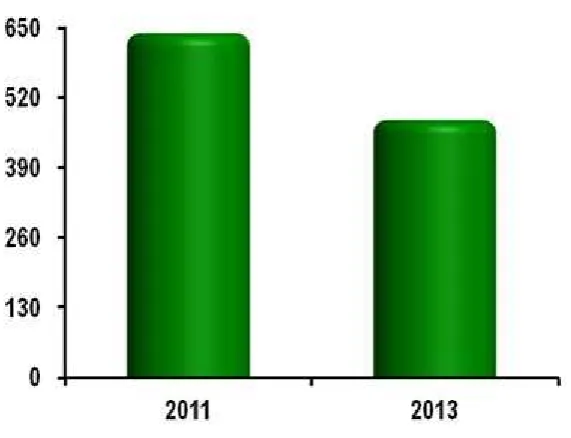
Bali cattle (Bosjavanicusd’Alton). Study showed that the Bali cattle start losing habitat. Evidence could be approved by the fact that in some places in Denpasar and Badung regency clearly advised that in Cargo Street and Suwung dump site, Bali cattle feed whatever they found and available in such places (Fig. 1). Survey also showed population number of Bali cattle and
buffalo decreased. In 2011 and 2013 it was found
639793 and 478706 heads respectively (decrease about 25.2 percent) (Fig. 2, BPS, 2015). This
situation could be due to, land use change occurred recently from agricultural fertile land to infrastructure such as, housing, hotel, road etc.
Therefore, Bali cattle lose their habitat dramatically. The fact is in general agreement with Kasa (2012) who reported that as a consequence of habitat lost, then Bali cattle has been concentrated and found in Cargo street and Suwung dump site of Denpasar city. In addition, it was noted that number of land use change per year is about 800-1000 hectare (Bali Post, 2012). According to Arthana (2015), in 2013 land use change increase gradually in comparison to 2007. For examples, decrease number of paddy rice
field in 2007 was 81482 hektare, meanwhile, in
2008 and 2013 were 81235 hektare and 81165 hektare respectively. Moreover, results could also be suported by decreasing number of farmers. For example, the data clearly proved that from 2003 to 2013 total population of farmers were incredibelly decreased about 16.98 percent from 491725 down to 408229 respectively (BPS, 2015). Such decreases was highest in the city of Denpasar (46.23 percent), meanwhile, the lowest was happened in Bangli regency (3.53 percent).
JURNAL METAMORFOSA II (2): 98‐103 (2015) ISSN: 2302‐5697
100
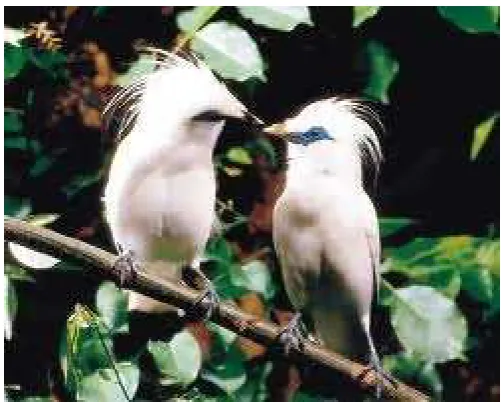
Figure 2. Total Population (thousands) of Bali cattle and Buffalo (BPS 2015). Bali starling (Lencopsar rothcshildi). The
Bali starling is showed in Fig. 3. Formerly, such beautiful bird lived in flock of up to 20 birds. Nowadays, study revealed that in nature total number of the bird decrease gradually. The fact is in general agreement with Craig and Feare (2010) who found that, by 1990 illegal poaching had reduced Bali starling numbers to just 15 individuals, and by 2001 only 6 wild individuals remained (BirdLife International, 2013). The only suitable habitat of the bird is small area of natural forest at west part of Bali island. The range area is now reduce tremendously due to human activity. Additionally, decreased number of beautiful bird is caused by some factors such as, land use change, deforestation, and fire hunting. Unfortunately, the recent Bali's forests and savannah are no longer safe to shelter for birds that had become the mascot of Bali province. Land clearing for agricultural fields and make the tree difficult to find. In fact, the Bali Starling could not adapt to nest in other places, in addition to woodpecker nest holes. Uncontrolled hunting, setting traps, and illegal shooting continue to whack Bali Starling. Insects and fruit-eating animals area also threatened with extinction. This situation is supported by IUCN
Red List (2014), who pointed out that the Bali starling is endemic to the island of Bali, Indonesia. Formerly, this nonmigratory species
(del Hoyo et al., 2009) was found throughout a
strip of land along the north-western third of the island, but its range has since declined drastically, and now only includes a 60-kilometre-squared area within the Bali Barat Nature Reserve (Craig and Feare, 2010).
Subsequently, Bali starling has typical places for nesting during certain season. This phenomenon is in general agreement with BirdLife International (2011) who reported that, the Bali starling often builds its nest in an abandoned woodpecker hole or other natural tree hole, usually between four and ten metres above the ground, using dry twigs to line the nest. Moreover, the Bali starling can typically be found in dry, open lowland forests (BirdLife International (2011), usually with a grassy
understorey (del Hoyo et al., 2009). During the
JURNAL METAMORFOSA II (2): 98‐103 (2015) ISSN: 2302‐5697
101
Bali starling has also been known to occur in coconut groves near villages (BirdLife International, 2013).
Some efforts have been carried out to avoid threatening of Bali satarling. Fig. 4 showed the Governor of Bali release such endangered species to nature. As an endemic species, Bali starling is classified as Critical Endangered and is listed on Appendix I of CITES (IUCN Red List, 2014). Several factors has also been recognized to threat Bali starling e.g. illegal trading etc, therefore, its population declined dramatically
since its discovery. In more detail it was reported that, such declined mostly as a result of the illegal collection of birds for the captive bird trade (Craig and Feare, 2010). Additionally, despite the entire Bali starling population being within a national park, illegal trapping of this species continues, a threat which is further compounded by habitat destruction, interspecific competition, natural predation and disease (BirdLife International, 2013).
Figure 3. Bali White starling (Lencopsar rothcshildi) (BirdLife International. 2013).
Figure 4. The Governor of Bali Release Bali Starling to Nature. Balinese dog (Canis lupus familiaris).
Balinese dog is shown in Fig. 5. Meanwhile Fig. 6 showed, a mass killing of street Balinese dog. Before 2008 Bali island has been declared as the island of rabies free. As time goes by, total number of Bali dog declined due to many factors. The fact is in gentle agreement with BAWA
JURNAL METAMORFOSA II (2): 98‐103 (2015) ISSN: 2302‐5697
102
lives are lost every week to the dog meat trade, acts of cruelty, disease, motor vehicle accidents and basic neglect. The situation is dire and the magnificent animal that is Bali’s heritage dog is under threat.
In more depth, the fact is supported by Wikipedia (2012) who clearly reported that, an outbreak of rabies in dogs began in Bali, Indonesia, in November 2008. More than 100 people have died from rabies in Bali since the outbreak began. Human and animal rabies cases were confirmed near popular tourist destinations throughout the island during the outbreak. Efforts have been made to control the outbreak, including vaccinating dogs for rabies. These
efforts have substantially reduced the number of cases associated with the outbreak on the island.
Importation of many pedigree dogs are probably the main cause of rabies emerged in this island. According to Winn (2014), importation of cats and dogs has always been against the law in Bali. However, many pedigree dogs were smuggled in the island, for expats and also for Balinese who may consider it as a status symbol. As the expat population increased over the last several years and because of a greater demand for these pedigree dogs, more dogs are being imported in Bali (Charlton, 2015).
Figure 5. Balinese dog of Kintamani.
Figure 6. Street dog killing due to rabies. Overall, it could be concluded that animal
biodiversity of Bali (Bali cattle, Bali starling and Bali dog) are all threatened because of
JURNAL METAMORFOSA II (2): 98‐103 (2015) ISSN: 2302‐5697 Lahan Produktif di Bali Meningkat. Badan Pusat Statistik (BPS). 2015. Hasil Sensus
Pertanian.2013.
Balipost. 2012. Alih fungsi lahan pertanian di Bali mengkawatirkan.Terbit kemis, 9 Agustus 2012.
BAWA. 2015. Bali Animal Welfare Association. Myth & Facts about Bali Dogs.
http://bawabali.com/bali-heritage-dog/2585-2/, opened: 13 November 2015. BirdLife International. 2013. Bali starling.
Availalable at:
http://www.birdlife.org/datazone/speciesf actsheet.php?id=6822
BirdLife International. 2011. The Illustrated
Encyclopedia of Birds. Dorling Kindersley Ltd, London.
Charlton, C. 2015. Dead dogs pile up in the streets of Bali after desperate officials poison stray dogs to prevent outbreak of rabies.
http://www.dailymail.co.uk/news/article- 3184820/Dead-dogs-pile-streets-Bali- desperate-officials-poison-stray-dogs-prevent-outbreak-rabies.html, opened, 13 Nov 2015
Craig, A. and C. Feare. 2010. Starlings and
Mynas. A&C Black Publishers Ltd,
London.del Hoyo, J., Elliott, A. and
Christie, D.A. (2009). Handbook of the
Birds of the World.Volume 14:
Bush-shrikes to Old World Sparrows. Lynx
Edicions, Barcelona.
Escobar, R. A., Edsart Besier and K.H.William. 2010. Evaluating headstarting as a management tool: Postreleasesuccess of
green iguanas (Iguana iguana) inCosta
Rica.International Journal of Biodiversity and Conservation Vol. 2(8), pp. 204-214. Government Indonesia. 2012. Rabies. Available
at:
http://wwwnc.cdc.gov/travel/notices/in-the-news/rabies-bali-indonesia2008.htm. edit September 10,
IUCN. 2014. Red List (January, 2014. Available at: http://www.iucnredlist.org/
Kasa, I.W. 2012. Effect of environmental degradation on Bali cattle.National seminar of Bali cattle.Golden anniversary of Udayana University, Denpasar, Bali, Indonesia.
Sanford, M. P. 2012. Integrating environmental influences on patch occupancy into reserve selection and prioritization for the imperiled Carson Valley silverspot
butterfly (Speyerianokomiscarsonensis).
International Journal of Biodiversity and Conservation Vol. 4(2), pp. 90-100. Winn, P. 2014. SALON. Bali’s Government is on
an Unrepentant Dog Killing Spree. GlobalPost.
http://www.salon.com/2014/08/01/balis_g overnment_is_on_an_unrepentant_dog_ki lling_spree_partner/, opened: November 13, 2015.