APPLICATION OF ZINC-OXIDE NANOPARTICLES
BASED ANTIMICROBIAL FILM TO INHIBIT THE
GROWTH OF ESCHERICHIA COLI AND
SALMONELLA SPP. IN DEBONED CHICKEN MEAT
PRACTICAL TRAINING REPORT
This practical training report is submitted for the partial requirement for
Bachelor Degree
By:
ANGELA NOVITA
15.I1.0063
DEPARTMENT OF FOOD TECHNOLOGY
FACULTY OF AGRICULTURAL TECHNOLOGY
SOEGIJAPRANATA CATHOLIC UNIVERSITY
SEMARANG
i
APPLICATION OF ZINC-OXIDE NANOPARTICLES BASED
ANTIMICROBIAL FILM TO INHIBIT THE GROWTH OF
ESCHERICHIA COLI AND SALMONELLA SPP. IN DEBONED
CHICKEN MEAT
Practical Training at Fu Jen Catholic University, New Taipei, Taiwan
By:
Dr. R. Probo Y. Nugrahedi S.TP, M.Sc
ii
PREFACE
Praise in the name of Jesus Christ, because only by His grace and blessing, the author would have the opportunity to undergo the practical training and finish the report smoothly. This report is the complete accountability from the practical training which was done in Taipei, Taiwan that took place from 4th of January until 4th of March, 2018. During the training the author did the research entitled: “Application of Zinc-Oxide Nanoparticles Based Antimicrobial Film to Inhibit the Growth of Escherichia coli and
Salmonella spp.in Deboned Chicken Meat”. This report was written as a requirement to acquire Bachelor Degree of Food Technology. The author would not be able to finish these tasks alone, and only by huge support and guidance given by the great and very helpful people around the author these report could be finished. Special thanks for:
1. Almighty God that always blessed, saved and guided author in every step of practical training in Taiwan.
2. R. Probo Y. Nugrahedi, M.Sc. as dean of faculty of agricultural, Soegijapranata
Catholic University, for giving me the opportunity to join the internship program.
3. Dr. Shaun Chen as my advisor who advised and supported me all the time when
I did this research.
6. My family, Mom, Dad, and Brother who always supported me and cheered for me everyday.
7. My dearest friends Eileen Nathania, Fanny Margareta Phoa, Christopher Hendra, and Evan Fajar who always supported and cheered me for the thing I had gone through.
iii
9. Last but not least, I would like to thanks to all my beloved friends from EP 308, Wen yu xian, Wu yi ru, Cheng ya wen, Zeng bo xuan, Lin jie yin and all others
friends who I can’t say it one by one that always supported me and accompanied me.
The author realized that this report is still far from perfect and there are still many shortcomings due to the limitation of the author. However, the author hope that this report can still be an inspiration and provide useful information for all the readers.
Semarang, May 14th 2018
1.3 Time and Place of Practical Training ... 2
2. INSTITUTION PROFILE... 4
3.3.1 Alginic Acid for Development of Antimicrobial Film... 9
3.3.2 Zinc Oxide (ZnO) Nanoparticles... 9
3.3.3 Escherichia coli ... 11
3.3.4 Salmonella spp. ... 11
4. RESEARCH METHODOLOGY ... 13
v
4.2 Preparation of Zinc-Oxide (ZnO) Based Antimicrobial Film ... 14
4.3 Determination of Mechanical Properties of Zinc Oxide Based Antimicrobial Film 14 4.4 Determination of Antimicrobial Properties of Zinc Oxide Based Antimicrobial Film 15 4.4.1 Preparation of Mueller Hinton II Agar (MHA) for Agar Diffusion Method 15 4.4.2 Culturing Escherichia coli and Salmonella sp. ... 15
4.4.3 Analysis of Inhibitory Zone ... 15
4.5 Application of Zinc Oxide Based Antimicrobial Film to Deboned Chicken Meat 15 4.5.1 Preparation of Tryptic Soy Agar (TSA) for Bacteria Growth ... 15
4.5.2 Culturing Escherichia coli and Salmonella spp. ... 15
4.5.3 Application of Antimicrobial Film to Deboned Chicken Meat... 15
4.5.4 Microbial Growth Analysis ... 16
4.6 Statistical Analysis ... 16
5. RESULTS AND DISCUSSION ... 17
5.1 Zinc Oxide Based Antimicrobial Film ... 17
5.2 Mechanical Properties ... 17
5.3 Inhibitory Zone ... 19
5.4 Results of Escherichia coli ... 19
vi
7. REFERENCES ... 29
8. APPENDICES ... 33
8.1 Results of Escherichia coli Growth ... 33
8.1.1 Application of Control Antimicrobial Film (0 gram ZnO) ... 33
8.1.2 Application of Antimicrobial Film with 0.3 Gram ZnO ... 34
8.1.3 Application of Antimicrobial Film with 0.5 gram ZnO ... 36
8.1.4 Application of Antimicrobial Film with 0.7 gram ZnO ... 37
8.2 Results of Salmonella spp. Growth ... 39
8.2.1 Application of Control Antimicrobial Film (0 gram ZnO) ... 39
8.2.2 Application of Antimicrobial Film with 0.3 gram ZnO ... 40
8.2.3 Application of Antimicrobial Film with 0.5 gram ZnO ... 42
vii
LIST OF TABLES
viii
LIST OF FIGURES
Figure 1. Map of Fu Jen University, New Taipei City, Taiwan ... 2
Figure 2. Logo of Fu Jen University... 5
Figure 3. Faculty Member of Food Science, Fu Jen University, Taiwan ... 6
Figure 4. Flowchart of Research Design ... 13
Figure 5. Zinc Oxide Based Antimicrobial Film ... 17
Figure 6. Results of Tensile Strength ... 19
Figure 7.Results of Elongation at Break ... 19
Figure 8. Zone of Inhibition of Escherichia coli with Initial Number of 104 CFU/mL . 20 Figure 9. Zone of Inhibition of Escherichia coli with Initial Number of 105 CFU/mL . 20 Figure 10. Zone of Inhibition of Escherichia coli with Initial Number of 106 CFU/mL 21 Figure 11. Zone of Inhibition of Escherichia coli with Initial Number of 107 CFU/mL 21 Figure 12. Zone of Inhibition of Salmonella spp. with Initial Number of 104 CFU/mL 22 Figure 13. Zone of Inhibition of Salmonella spp. with Initial Number of 105 CFU/mL 22 Figure 14. Zone of Inhibition of Salmonella spp. with Initial Number of 106 CFU/mL 22 Figure 15. Zone of Inhibition of Salmonella spp. with Initial Number of 107 CFU/mL 23 Figure 16. Effect of Zinc Oxide Against the Growth of Escherichia coli From Different Dillution ... 24
Figure 17. Effects of Zinc Oxide Against the Growth of Salmonella spp. from Different Dillution ... 25
Figure 18. Results of 10-1 dillution with triplicate replication ... 33
Figure 19. Results of 10-2 dillution with triplicate replication ... 33
Figure 20. Results of 10-3 dillution with triplicate replication ... 34
Figure 21. Results of 10-1 dillution with triplicate replication ... 34
Figure 22. Results of 10-2 dillution with triplicate replication ... 35
Figure 23. Results of 10-3 dillution with triplicate replication ... 35
Figure 24. Results of 10-1 dillution with triplicate replication ... 36
Figure 25. Results of 10-2 dillution with triplicate replication ... 36
Figure 26. Results of 10-3 dillution with triplicate replication ... 37
Figure 27. Results of 10-1 dillution with triplicate replication ... 37
ix
Figure 29. Results of 10-3 dillution with triplicate replication ... 38
Figure 30. Results of 10-1 dillution with triplicate replication ... 39
Figure 31. Results of 10-2 dillution with triplicate replication ... 39
Figure 32. Results of 10-3 dillution with triplicate replication ... 40
Figure 33. Results of 10-1 dillution with triplicate replication ... 40
Figure 34. Results of 10-2 dillution with triplicate replication ... 41
Figure 35. Results of 10-3 dillution with triplicate replication ... 41
Figure 36. Results of 10-1 dillution with triplicate replication ... 42
Figure 37. Results of 10-2 dillution with triplicate replication ... 42
Figure 38. Results of 10-3 dillution with triplicate replication ... 43
Figure 39. Results of 10-1 dillution with triplicate replication ... 43
Figure 40. Results of 10-2 dillution with triplicate replication ... 44
1
1. INTRODUCTION
1.1Background
Novel food technology is developing rapidly in this modern era and people currently expect something more than delicious and nutritious. However, there is also a rapid growing of consumers’ interest in consumption of products with secured shelf life and controlled quality.
Food safety also become one of the major concern all over the world, and consumers recognize the necessity to buy a safer food product. Due to those reasons, food manufacturers
are looking for solutions to fulfill every progressive and rapidly changing demands of consumers. Therefore, many researches focusing on active food packaging have been accomplished and those developments effectively lead to longer shelf life and good quality. Nowadays, packaging is an essential process in modern trade goods, because it can guarantee preserving the quality of food products, protecting packed products against external conditions, providing safety of food products, and making storage, transportation, and distribution of products easier.
On awareness of consumer demands, Department of Food Technology at Soegijapranata Catholic University sets up a training program for students to improve their knowledge and research skill. Experiences in food technology could be gained not only by curricular process in university, but also with a working experience in research laboratory. In this program, students are given an opportunity to either join a food industry and work in that company or to take a part of in-house training as part of research group in other universities. While the students do a field work, either in a company or in other universities, they will experience the real practice of food industry and gain more knowledge about how food researchs actually
conduct in the industry. This experience will be one thing that students need once they graduate and have to work in the food industrial field.
2
exchange mutual agreement between Soegijapranata Catholic University and Fu Jen Catholic University.
The title of the present project is “Application of Zinc-Oxide Nanoparticles Based Antimicrobial Film to Inhibitthe Growth of Escherichia coli and Salmonella spp. in Deboned
Chicken Meat”. The advisor of this research is Dr. Shaun Chen, an Associate Professor of Food Science Department, Fu Jen Catholic University, Taiwan. The supervisor of this study is Joanne Huang, a graduate student of Departement of Food Science, Fu Jen Catholic
University, Taiwan.
1.2Purpose of Practical Training
a. To give an experience on how a food science research are conducted abroad with new environment.
b. To improve and broaden knowledge and experience that could be usefull in the real industrial or scientific field in the future.
c. To give an opportunity to learn how to adapt in new circumstances and society in other country with different culture.
d. To give an opportunity to meet new friends and build an international network.
1.3Time and Place of Practical Training
The practical training was conducted in the Faculty of Food Science, Fu Jen Catholic University, New Taipei City, Taiwan, and took place between 4th January to 4th March 2018.
3
The location of Fu Jen Catholic University is located in 242, New Taipei City, Xinzhuang
4
2. INSTITUTION PROFILE
2.1Fu Jen Catholic University
Fu Jen Catholic University is the first Catholic university in China established by the Catholic Church and operates under the auspices of the Holy See and the Ministry of Education Republic of China, Taiwan. Fu Jen Catholic University is a comprehensive, pontifical
university built in Beijing in 1925 and was rebuilt in Taiwan in 1961. In 1925, Catholic University was founded impeaching by the Catholic church by the Benedictines of St.
Vincent Archabbey in the USA. In 1927, the Beijing government approved the trial run and the name officially changed to Fu Jen Catholic University. Moved by the Christian understanding of love and inspired by the high ideals of Confucian education, it adopted the name "Fu Jen", meaning assistance and benevolence, to give expression to its universal vision and mission realized through holistic education in the Chinese cultural context. Fu Jen Catholic University has a history of more than 92 years and has provide the country with well-educated students characterized by integrated physical, social, intellectual, aesthetic, moral and spiritual development. The University also hopes to serve society through various additional academic programs and community services. Aided by extensive scientific research, Fu Jen is committed to the pursuit of truth and the integration of Western and Chinese cultural values so as to promote the well-being of the human family and strengthen world solidarity.
For the formation of students, the University supports a well-balanced division between general education and professional training with a special emphasis on humanistic discipline, which helps students foster lofty sentiments and enrich their lives when they start their
5
Currently, Fu Jen provides 11 colleges (Liberal Arts, Education, Communication, Arts, Medicine, Science and Engineering, Foreign Languages, Human Ecology, Law, Management, Social Sciences) with 48 departments, 47 master programs, 23 in-service master programs, 11 doctoral programs, and also 16 departments in School of Continuing Education. There are seven goals of Fu Jen Catholic University, such as human dignity, the meaning of life, academic research, community awareness, dialogue with cultures, religious
cooperation, and spirit of service.
Figure 2. Logo of Fu Jen University
2.2Faculty of Food Science
The Department of Family Studies and Nutrition Sciences was established in 1963. The department was grouped into two sections, Family Studies section and Nutrition Sciences section. Nutrition Sciences was merged with the Food Sciences section as the Department of Nutrition and Food Sciences in 1971. The Graduate Institute of Nutrition and Food Sciences
was established and started to offer a master’s degree program in 1983. The doctoral program was joined to the Institute in 1995. Food Sciences section became an individual department in 2006. The Department of Food Science offers Bachelor’s degree program and Master’s degree program.
2.3Mission of Faculty
Uphold the spirit of pursuing truth, goodness, beauty and holiness, the Department of Food Science at the Fu Jen Catholic University integrates basic sciences with latest technology for excellence in education, research, and service. The Department of Food Science at the Fu Jen Catholic University are committed to promote the healthier, tastier and safer foods for
6
2.4Faculty Member
Figure 3. was the description of the member of Food Science Faculty in Fu Jen University, Taiwan.
Figure 3. Faculty Member of Food Science, Fu Jen University, Taiwan
Director of Human Ecology
Professor Bing-Hui Chen
Director of Food Science
Assistant Professor Tsung-Yu Tsai
Professor Chiwei P. Chiu Professor John Tung Chien
Food Enzymology Lab.
Associate Professor Jung-Feng Hsieh
Food Physicochemistry Lab.
Associate Professor Meng I-Marie Kuo
Associate Professor Rey-May Huang Associate Professor Shaun-Chen
Food Microbiology Lab.
Assistant Professor Bang-Yuan Chen
Nutraceuticals & Food Processing Lab.
Assistant Professor Tsai-Hua Kao
Food Biochemistry Lab.
7
3. RESEARCH PROJECT
3.1Research Overview
The topic of this research is “Application of Zinc-Oxide Nanoparticles Based Antimicrobial Film to Inhibit the Growth of Escherichia coli and Salmonella spp. in Deboned Chicken
Meat”. The objective of this project was to develop an antimicrobial film immobilizing zinc -oxide nanoparticles, and then applied it to inhibit the growth of Escherichia coli and
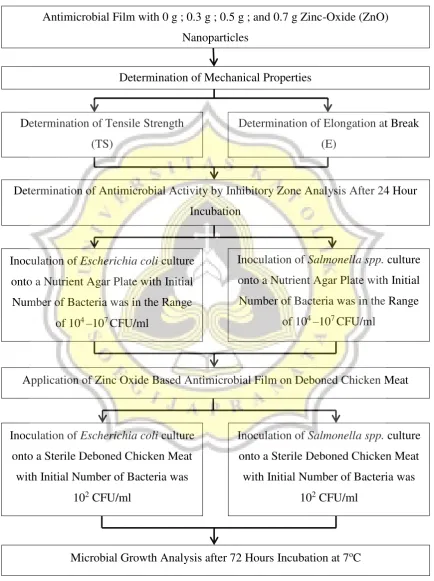
Salmonella spp. on deboned chicken meat. Antimicrobial Films were prepared using 4 different concentrations of ZnO nanoparticles, including 0 ; 0.3 ; 0.5 ; 0.7 g in 100 g alginate gel. The next step was the analysis for the antimicrobial films, which were divided into 2 analysis, first was to determine the physical properties and the second was to determine the antimicrobial activities. Tensile strength and elongation at break tests were achieved to measure the physical properties of antimicrobial film. Agar diffusion method was used to evaluate the antimicrobial effects against the food pathogen. Bacterial strains used in this study were Escherichia coli and Salmonella spp. After the antimicrobial effects were determined, the antimicrobial films were applied to deboned chicken product which were inoculated with activated culture with an approximately concentration of 102 - 103 CFU/mL, which is a high enough concentration to show a noticeable decline in the case of inhibitory action, but low enough to increase noticeably in the absence of inhibitory activity. After 3 days of incubation, the colonies of Escherichia coli and Salmonella spp. were counted manually and all the results were subjected to statistic analysis.
3.2Background of Research
Nowadays, people demand food products which are minimally processed, easy to prepare,
and ready to eat. Those demands lead to pose major challenges in terms of safety and quality. One of essential technology to maintain food quality and safety is food packaging, thus, food manufacturers look forward to providing novel and active packaging to extend shelf life and provide better quality, due to the growing of consumer interest in consumption of safer and tastier food products.
8
continue to draw public attention related to food safety issues. Animal products, including raw meat, poultry, fish are more risky for consumers because those are most likely to contain pathogen. There has been a significant increase in the consumption of poultry and its processed products since the 1960s (Capita et al., 2002). Because of the increase of poultry consumption, the microbial safety of those food products becomes more important for producers, public health officials, especially consumers. There are several different
microorganisms in living poultry animals such as Escherichia coli and Salmonella spp.
Typically, those microorganisms grow on poultry skin, feathers, and in alimentary tract
(Kozacinski et al., 2006). Therefore, contamination of poultry carcasses during slaughtering and processing occurs easily during the change of live animals to meat for human consumption.
Escherichia coli is an organism that is part of the normal microflora in the intestinal tract of human and warm-blooded animals (NSW Food Authority, 2009). The risk of the food contaminated by Escherichia coli can cause many problems to human health, such as enteritis and several extraintestinal diseases (e.g wound infections), mastitis, urogenital infections, septicaemia and meningitis (Johnsen et al., 2001). Salmonella spp. are the most common causes of human foodborne diseases linked to poultry (Hafez, 2005). Gastrointestinal symptoms of salmonellosis can develop from few as 15 to 20 cells after ingesting, and the symptomps include nausea, vomiting, abdominal cramps, diarrhea, and headaches (U.S. FDA, 1992)
Therefore, development of new antimicrobial is needed to ensure food safety and extend shelf life. Antimicrobial packaging is one of the effective methods in maintaining the safety and
quality of food products during storage. The antimicrobial agent in this packaging will migrate slowly to the surface of the food product from the packaging system, that leads to maintain desirable safety and quality of food products. Based on the antimicrobial capacity, development of antimicrobial films to protect fresh and processed foods against pathogens and extend the shelf life of foods is becoming the new trend in food safety research and one of the potential antimicrobial agent is Zinc-Oxide (Du et al., 2009).
9
nanoparticles on antimicrobial activity and mechanical properties of zinc-oxide antimicrobial film. The zinc-oxide antimicrobial film then applied on deboned chicken meat to evaluate the effectiveness on inhibiting the growth of Escherichia coli and Salmonella spp.
3.3Literature Review
3.3.1 Alginic Acid for Development of Antimicrobial Film
Alginic acid is a polysaccharide which naturally contains carboxyl groups in constituent residue, therefore this material has various abilities for preparation of functional materials.
Since alginic acid has high reproducibility and availability as a natural resource, this material can be used as a source of biodegradable or edible films (Lazarus, West, Oblinger, and Palmer, 1976). Furthermore, edible films prepared from alginate form a strong films, but exhibit poor water resistance due to their hydrophilic nature (Guilbert, 1986; Kester & Fennema, 1986). Alginate is able to react with polyvalent metal cations, especially calcium ions to produce strong gels or insoluble polymers (King, 1983 in Rhim, 2004).
Edible film or edible coating is able to carry some food additives, such as antimicrobials, antioxidants, colorants, flavors, and spices (Han, 2001 in Pranoto et al., 2005). The incorporation of antimicrobial agents into edible film or edible coating localizes the functional effect at the food surface. The antimicrobial agents are not directly released to the food surface, thus, they remain at high concentrations for extended periods of time (Ouattara
et al., 2000 in Pranoto et al., 2005). Antimicrobial biodegradable films demonstrate an effective way to inhibit the growth of food-borne pathogens and spoilage microorganisms, therefore it is beneficial to preserve food safety and prevent product spoilage (Du et al., 2009). In addition, the use of biodegradable packaging also contributes to reduce the
municipal solid waste problem.
3.3.2 Zinc Oxide (ZnO) Nanoparticles
10
established by Health Council of the Netherlands (1998) in agreement with the recommendation of the Commission of the European Communities (1993).
The innovation of nanotechnology, which refers to Roco (1999) is the manufacture and use of materials with size of up to about 100 nm in one or more dimensions, has created great chances for the development of new materials as antimicrobial agents. In the study of Rai et
al. (2009), results demonstrated that inorganic compounds in nanosize impart strong antibacterial activity at low concentrations because of their high surface area to volume ratio
and different chemical and physical properties. Additionally, they are more stable in extreme conditions such as high pressures and temperature, considered non-toxic and some even contain mineral elements which are essential to the human body (Roselli et al., 2003). According to Bradley et al., (2011), most antibacterial inorganic materials are metallic nanoparticles and metal oxide nanoparticles, such as zinc oxide (ZnO). Currently, ZnO is one of the five zinc compounds that are listed as a generally recognized as safe (GRAS) material by the U.S. Food and Drug Administration (21CFR182.8991) (FDA, 2011). Furthermore, nanosized ZnO particles now are widely used as a functional inorganic material for coating in many applications.
Refers to Applerot et al. (2009) Escherichia coli has shown higher susceptibility toward ZnO nanoparticles compared to Staphylococcus aureus. The higher resistance shown by
Staphylococcus aureus can be explained because the differences of intracellular antioxidant content between these two bacteria, such as carotenoid pigments in the interior of S. Aureus, which results in a greater oxidant resistance as well as the presence of potent detoxification agent such as antioxidant enzymes, particularly catalase. The functional activity of
nanoparticles is most likely influenced by their size, therefore the antimicrobial activity of ZnO has been improved with a diminution of particle size (Zhang et al., 2007). This can be explained due to an increase in the surface area/volume ratio, which results in the increased reactivity of ZnO surface in nanometer size, since H2O2 generation depends strongly on ZnO
surface area (Ohira et al., 2008 in Espitia et al., 2012). Therefore, a larger surface area will result in more ROS (Reactive Oxygen Species), especially H2O2 compounds on the surface of
11
According to Wang et al., (2009) in Espitia et al., (2012), the toxicity of ZnO nanoparticles is due to the solubility of Zn2+ ions in the medium containing the microorganisms, however, the solubility of ZnO depends of their concentration and time. Thus, low concentrations of solubilized Zn2+ can trigger a relatively high tolerance by the microorganism. Intrinsic factor
of each microorganism could affect the metabolic processes of Zn2+ ions, therefore
differences in toxicity thresholds of ZnO nanoparticles in various microorganisms could be
observed. When studying the effect of ZnO against E. coli at low concentrations, ZnO nanoparticles may actually increase bacterial growth. According to results reported by
Padmavathy and Vijayaraghavan (2008) in Espitia et al., (2012), ZnO nanoparticle suspensions in lower concentration (0,01 – 1 mM) seem to have less antimicrobial activity against E. coli and the presence of soluble Zn2+ ions may act as nutrients for this microorganism.
3.3.3 Escherichia coli
Enterohemorrhagic bacteria, Eschericia coli (EHEC) 0157:H7 is one of the most important foodborne pathogens in food industry and has resulted in a large number of highly publicized and expensive recalls (Al-Qadiri et al., 2006 in Liu et al., 2009). EHEC 0157:H7 can survive in acidic foods and its infective dose is as low as 10-100 cells. Outbreaks owing to this foodborne pathogen have increased in recent years. Foods of various origins, including spinach, lettuce, mayonnaise, raw milk, undercooked ground beef and roast beef were implicated in illnesses and outbreaks caused by E. coli O157:H7 (Smith and Fratamico, 2005 in Liu et al., 2009). The illness caused by E. coli O157:H7 can lead to inflammation of the colon and gives rise to diarrhea and abdominal pain with bloody stools (Al-Holy et al. 2006 in Liu et al., 2009).
3.3.4 Salmonella spp.
12
13
Determination of Antimicrobial Activity by Inhibitory Zone Analysis After 24 Hour Incubation
Inoculation of Escherichia coli culture onto a Nutrient Agar Plate withInitial Number of Bacteria was in the Range
of 104–107 CFU/ml
Inoculation of Salmonella spp. culture onto a Nutrient Agar Plate with Initial Number of Bacteria was in the Range
of 104–107 CFU/ml
Application of Zinc Oxide Based Antimicrobial Film on Deboned Chicken Meat
Inoculation of Escherichia coli culture onto a Sterile Deboned Chicken Meat
withInitial Number of Bacteria was 102 CFU/ml
Inoculation of Salmonella spp. culture onto a Sterile Deboned Chicken Meat
withInitial Number of Bacteria was 102 CFU/ml
14
4.2Preparation of Zinc-Oxide (ZnO) Based Antimicrobial Film
Dry ZnO nanoparticles from Sigma-Aldrich with primary sizes < 100 nm were prepared. A preset amounts of dry ZnO nanoparticles, including 0.3 ; 0.5 ; 0.7 g were mixed with 45 mL distilled water in a glass beaker. The glass beaker was placed in an ultrasonicator (Delta Ultrasonic Cleaner D150 H) for 60 minutes. After that, 5 mL of polyethylene glycol (PEG 400) as dispersant was used to improve the stability of the suspension (Xihong Li et al.,
2009). The glass beaker was placed again in an ultrasonicator for 180 minutes. A solution of alginic acid sodium salt was then prepared, by mixing 1 g of alginic acid sodium salt powder
with 50 mL distilled water in a glass beaker and stirred using a magnetic stirrer in a hotplate at 240 rpm until all the chemicals were dissolved. The ZnO nanofluid was then mixed with the alginic acid sodium salt solution, and placed in an ultrasonicator for 60 minutes. The mixed solution of ZnO nanofluid and alginic acid sodium salt was taken 40 mL and poured into a 15 cm diameter glass petridisc. The petridiscs were placed on a hotplate and heated at 100oC for 1 hour and placed in an oven at 65oC until the solution dried and turned into a sheet of film. Dried film was soaked into 2% of CaCl2 solution for 2 minutes to prevent curling of
the films during drying (Rhim, 2004) and then dried again at room temperature. Film made by mixing 2 g of alginic acid sodium salt alone with 100 mL distilled water was used as a control.
4.3Determination of Mechanical Properties of Zinc Oxide Based Antimicrobial Film
Tensile Strength (TS) and elongation at break (E) were evaluated using a Texture Analyzer (Lotun Science Co. Ltd) according to the ASTM standard methods (ASTM D882 and ASTM D6287). Pre-conditioned films cut into 2.5 cm (W) x 7.2 cm (L) strips and mounted between the grips of the machine. Sample was pulled until break at a cross head speed of 1 mm/second
and trigger force of 5 kg. TS and E were calculated using the following relationship:
𝑇𝑒𝑛𝑠𝑖𝑙𝑒 𝑆𝑡𝑟𝑒𝑛𝑔𝑡ℎ (𝑇𝑆) = (𝑡ℎ𝑖𝑐𝑘𝑛𝑒𝑠𝑠 𝑥 𝑤𝑖𝑑𝑡ℎ)𝐹𝑚𝑎𝑥
𝐸𝑙𝑜𝑛𝑔𝑎𝑡𝑖𝑜𝑛 𝑎𝑡 𝐵𝑟𝑒𝑎𝑘 (%) = 𝐿𝑜 𝑥 100𝐿
15
4.4Determination of Antimicrobial Properties of Zinc Oxide Based Antimicrobial Film
4.4.1 Preparation of Mueller Hinton II Agar (MHA) for Agar Diffusion Method
Nutrient agar plates were prepared by adding 38 g MHA powder with 1 L distilled water in a glass beaker and shaked until completely dissolved. After that, MHA solution were sterilized (121oC, 15 min), and then poured into petridishes asseptically.
4.4.2 Culturing Escherichia coli and Salmonella sp.
Stock cell cultures were activated by taking one colony of each bacteria into a 9 mL buffered
peptone water and vortexed to homogenized the bacterial culture. The cell cultures were then inoculated onto a nutrient agar plate and incubated for 24 hours in an agitating incubator.
4.4.3 Analysis of Inhibitory Zone
The agar diffusion method was used for determination of antibacterial effects of ZnO nanoparticles based films on bacterial strains. The films with different nano ZnO loaded were cut into 15 mm diameter disks and then placed on agar plates which had been seeded with 0.1 mL of activated cell culture. Initial number of bacteria was in the range of 104–107CFU/ml, and the diameters of inhibitory zone on agar plates after 24 hour incubation were analyzed.
4.5Application of Zinc Oxide Based Antimicrobial Film to Deboned Chicken Meat
4.5.1 Preparation of Tryptic Soy Agar (TSA) for Bacteria Growth
The TSA powder (38 g) were initially mixed with 1 L distilled water in a glass beaker and shaked until completely dissolved. After that, TSA solution were sterilized (121oC, 15 min)
then poured into petridishes asseptically.
4.5.2 Culturing Escherichia coli and Salmonella spp.
Stock cell cultures were activated by taking one colony of each bacteria into a 9 mL buffered peptone water and vortexed to homogenized the bacterial culture. The cell cultures were then inoculated onto a nutrient agar plate and incubated for 24 hours in an agitating incubator.
4.5.3 Application of Antimicrobial Film to Deboned Chicken Meat
16
that, the sterilized meats were inoculated with 0,1 ml bacterial culture with initial number of the bacteria was 102 CFU/ml and wrapped with films (ZnO incorporated and/or control), then stored at temperature 7oC for 72 hours.
4.5.4 Microbial Growth Analysis
After 72 hours incubation, the wrapping films from on meat samples were removed and the
meat samples were mixed and washed with 20 mL peptone water for about 1 minute. After that, 1 mL peptone water used for washing the meat samples were taken using 1000 µL
micropipet (Socorex Acura 825) following placed in 9 mL peptone water to reach a 10-1 dilution. The dilution was continued until 10-3 dilution solution was reached. An aliquot 0,1 mL of each dilution was taken, and placed onto a TSA plates, and spreaded on the agar surface with a sterile hockey stick. The dillution samples were taken duplicate. The samples were incubated in the incubator at 37oC for 24 hours. Finally, Escherichia coli and
Salmonella spp. colonies were counted manually and expressed as colony-forming units per mililiter. For computation, total colony per plate was divided by dillution factor and it is
17
5. RESULTS AND DISCUSSION
5.1Zinc Oxide Based Antimicrobial Film
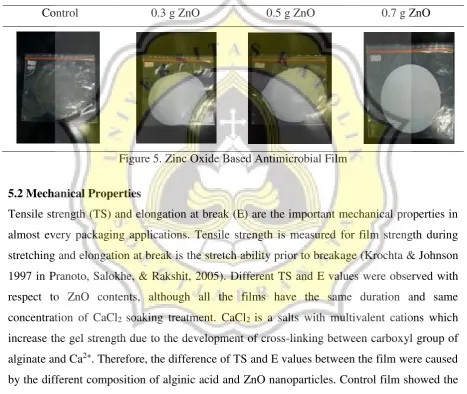
Figure 5. shows the results of control antimicrobial film and ZnO based antimicrobial film with 3 different concentrations, including 0.3 ; 0.5 ; and 0.7 gs of ZnO. As expected, alginate films without ZnO (control) were transparent and pliable, conversely, the antimicrobial films
in the present of ZnO were not translucent, that a milk white tinted color was observed (Rhim, 2004).
Control 0.3 g ZnO 0.5 g ZnO 0.7 g ZnO
Figure 5. Zinc Oxide Based Antimicrobial Film
5.2Mechanical Properties
Tensile strength (TS) and elongation at break (E) are the important mechanical properties in almost every packaging applications. Tensile strength is measured for film strength during stretching and elongation at break is the stretch ability prior to breakage (Krochta & Johnson 1997 in Pranoto, Salokhe, & Rakshit, 2005). Different TS and E values were observed with respect to ZnO contents, although all the films have the same duration and same concentration of CaCl2 soaking treatment. CaCl2 is a salts with multivalent cations which
increase the gel strength due to the development of cross-linking between carboxyl group of
18
(Rhim, 2004). As the concentration of ZnO nanoparticles increased, the TS value decreased because of the presence of ZnO nanoparticles. The presence of ZnO nanoparticles in the films probably interferes with ionic interactions between Ca ions and alginate, which were supposed to help in forming a network, thus, cause a loss of TS values (Pranoto et al., 2005).
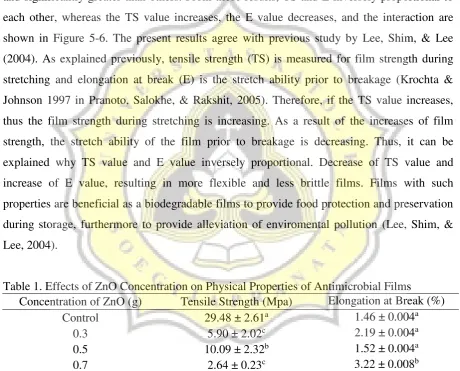
Generally, as TS value increases, the elongation at break (E) value decreases as shown in the
Table 1. The E values between control, 0.3 g and 0.5 g ZnO containing films were not significantly different, while film with 0.7 g ZnO showed the highest percentage of E value
and significantly greater than others. From those results, TS and E inversely proportional to each other, whereas the TS value increases, the E value decreases, and the interaction are properties are beneficial as a biodegradable films to provide food protection and preservation during storage, furthermore to provide alleviation of enviromental pollution (Lee, Shim, & Lee, 2004).
Table 1. Effects of ZnO Concentration on Physical Properties of Antimicrobial Films
Concentration of ZnO (g) Tensile Strength (Mpa) Elongation at Break (%)
Control 29.48 ± 2.61a 1.46 ± 0.004a
0.3 5.90 ± 2.02c 2.19 ± 0.004a
0.5 10.09 ± 2.32b 1.52 ± 0.004a
0.7 2.64 ± 0.23c 3.22 ± 0.008b
a,b,c Within the same column, values not followed by the same superscript are significantly different (P < 0.05).
19
Figure 6. Results of Tensile Strength
Figure 7.Results of Elongation at Break
5.3Inhibitory Zone
5.4Results of Escherichia coli
After 24 hours incubation, the effects of different ZnO concentrations on growth inhibition of
Escherichia coli were accomplished and the control film did not show effective antibacterial properties. As seen on the figures, the control film did not have an effective antibacterial property against Escherichia coli as illustrated in Figure 7-10. The results of antimicrobial films containing nano ZnO were not as expected, where clear zones could not be determined. The results could be due to the insufficient diffuse of antimicrobial agents through agar gel.
20
Furthermore, as the amount of ZnO nanoparticles increased, the bacteriostatic action of the antimicrobial films were expected to increase too, thus increasing the diameter of the inhibitory zone (Hosseini, Razavi, & Mousavi, 2009). The ZnO based antimicrobial films did not show any inhibitory zone despite the antimicrobial activity of ZnO, this might be due to the ZnO agents did not diffused through the adjacent agar media during the agar diffusion test method, thus the organisms did not go through any direct contact with the active sites of ZnO
and the antimicrobial agents could not inhibit the microorganism surrounding the film strips (Hosseini et al., 2009).
104 CFU/mL
Figure 8. Zone of Inhibition of Escherichia coli with Initial Number of 104 CFU/mL
105 CFU/mL
21
106 CFU/mL
Figure 10. Zone of Inhibition of Escherichia coli with Initial Number of 106 CFU/mL
107 CFU/mL
Figure 11. Zone of Inhibition of Escherichia coli with Initial Number of 107 CFU/mL
5.5Results of Salmonella spp.
22
104 CFU/mL
Figure 12. Zone of Inhibition of Salmonella spp. with Initial Number of 104 CFU/mL
105 CFU/mL
Figure 13. Zone of Inhibition of Salmonella spp. with Initial Number of 105 CFU/mL
106 CFU/mL
23
107 CFU/mL
Figure 15. Zone of Inhibition of Salmonella spp. with Initial Number of 107 CFU/mL
5.6Microbial Growth
5.6.1 Eschericia coli
The results of application of the ZnO based antimicrobial film on deboned chicken meat against the growth of Escherichia coli were shown in Table 2. As seen in the table, the average of log CFU/mL of Escherichia coli in contact with the control film were significantly greater than the others, and colonies developed from ZnO based antimicrobial films wrapped products decreased, whereas the initial number of Escherichia coli added to the surface of the deboned chicken meat were log 2 CFU/mL. The results also shows that the average of log CFU/mL of Escherichia coli resulted from antimicrobial film with 0.7 g of ZnO were the lowest compared to the other two antimicrobial films with 0.3 and 0.5 g of ZnO. The deviation showed on the results of the average of log CFU/mL of Escherichia coli on antimicrobial film with 0.5 g of ZnO were slightly higher than the 0.3 g of ZnO, although the results were not significantly different.
Metals and metallic oxide are known to be toxic in relatively high concentrations, but since
24
Therefore, low concentrations of solubilized Zn2+ can cause a relatively high tolerance by the microorganism.
Table 2. Effect of ZnO Concentration Against the growth of Escherichia coli (log CFU/ml)
Dilution
0.05). Control is a film without addition of zinc oxide.
25
antimicrobial films were determined, which were log 2 CFU/mL. Also, there was no significant difference in log CFU/mL of Salmonella spp. between the 0.3 g of ZnO antibacterial and control films.
Table 3. Effect of ZnO Concentration Againts the Growth of Salmonella spp. (log CFU/ml)
Dilution
0.05). Control is a film without addition of zinc oxide.
Figure 17. Effects of Zinc Oxide Against the Growth of Salmonella spp. from Different Dillution
The antimicrobial effects of ZnO to inactivate microorganims were affected primarily by surface area and the concentration, therefore the larger the surface area and higher the concentration of the ZnO, the greater antimicrobial effects. Smaller or dispered particles also have a much better bacteriostatic activity. Therefore, the ZnO nanoparticles suspension has been treated with ultrasonicator (Zhang et al., 2007 in Liu et al., 2009). The mechanism of
the antimicrobial effects of ZnO could be explained in two ways, the first way is caused by the different charges between the bacteria cell surface and ZnO nanoparticles, resulted in
26
charges lead to a strong bond between the bacterial surfaces and ZnO nanoparticles, thus cause cell membrane damage (Zhang et al., 2007; Liu et al., 2009). Furthermore, the interaction between the bacterial surface and ZnO nanoparticles also cause the internalization of ZnO nanoparticles in bacterial cells due to the disruption and collapse of the cell wall, resulting in the inhibition of cell growth. The second way is caused by the reactive oxygen species (ROS), especially hydrogen peroxide (H2O2) which is a strong oxidizing agent
harmful to bacterial cells. This molecules are produced by ZnO nanoparticles which contributes to the antimicrobial activity of ZnO nanoparticles, thus causing a stress to
microorganism’s sensitivity (Raghupathi, Koodali, & Manna, 2011).
Both Escherichia coli and Salmonella spp. are a Gram negative bacteria and could grow better at an environment with a warm constant temperature and have a high concentrations of free amino acids and sugars (Winfiel & Groisman, 2003). Gram negative bacteria have much more complex cell walls compared to the gram positive bacteria. The cell wall of the Gram negative bacteria consists of about 2 nm thick peptidoglycan layer and only accounts for 10% of the cell wall. However, they have outer membrane consists of 50% lipopolysaccharides, 35% phospholipids, and 15% lipoproteins, and it is about 6-18 nm thick and accounts for 90% of the cell wall. Thus, the peptidoglycan and outer membrane provide protection and influence the sensitivity of the antimicrobial agents hence, reduce the absorption of ROS into the cell (Espitia et al., 2012). Consequently, it would need higher concentration of ZnO nanoparticles if the expected results were complete inhibition of the bacterial cells growth, as the generation of H2O2 would increase too, because as seen on the Table 2. and Table 3. there
was still a growth of bacterial cells, even on the results of antimicrobial film with addition of 0.7 g of ZnO nanoparticles.
As seen in the Table 2 and 3, the growth of Salmonella spp. was better than the Escherichia coli, indicating the ZnO based antimicrobial films have more effective antimicrobial activity against the Escherichia coli than the Salmonella spp. This is regarded by the differences in the metabolic processes of Zn2+ ions, which depends on the internal characteristics of each microorganism. Therefore, differences in toxicity thresholds of ZnO nanoparticles to various microorganisms could be observed (Espitia et al., 2012). Additionally, referring to the previous study (Winfiel & Groisman, 2003), that in comparison with Escherichia coli,
27
environmental fluctuations, likewise, Salmonella was more resistant to bactericidal activity by biotic factors, such as microbial predators or competing organisms, thus it can be related with the observed results. The most abundant divalent cation in living organisms is Mg2+ and
bacteria are equipped with systems which have the ability to sense and transport Mg2+. Both Salmonella and Escherichia coli contain the constitutive Mg2+transporter CorA, the Mg2+
responding PhoP-PhoQ two componen regulatory system, and the low-Mg2+ induced Mg2+
transporter MgtA. However, Salmonella also contains something Eschericia coli does not.
Salmonella contains the mgtCB operon, which encodes a third Mg2+ transporter termed MgtB
and the MgtC membrane protein, which is needed for normal growth under Mg2+ limiting conditions. Salmonella can grow in the condition of lower Mg2+ concentrations than
28
6. CONCLUSION AND SUGGESTION
6.1Conclusion
As the ZnO nanoparticle contents increased, the tensile strength (TS) values decreased and elongation at break (E) values increased, because the presence of ZnO nanoparticles in the films probably interferes with ionic interactions presented by Ca ions, which help in forming
a network. The antimicrobial effects of ZnO to inactivate microbial growth were affected primarily with surface area and concentration, whereas the larger surface area and higher
concentration of the ZnO, the better antimicrobial effects, thus addition of 0.7 gram of ZnO nanoparticles in the antimicrobial film demonstrated the best inhibitory effect on the growth of microorganisms among of test films. Moreover, ZnO nanoparticles have more antimicrobial activity against Eschericia coli rather than Salmonella spp., because metabolic processes of Zn2+ ions are affected by intrinsic characteristics of each microorganism, whereas Salmonella is more resistant to bactericidal activity by biotic factors.
6.2Suggestion
29
7. REFERENCES
Al-Holy, M.A., Lin, M., Cavinato, A.G. and Rasco, B.A. (2006) The use of Fourier transform infrared spectroscopy to differentiate Escherichia coli O157:H7 from other bacteria inoculated into apple juice. Food Microbiol 23, 162–168.
Al-Qadiri, H.M., Lin, M., Cavinato, A.G. and Rasco, B.A. (2006) Fourier transform infrared spectroscopy, detection and identification of Escherichia coli O157:H7 and Alicyclobacillus strains in apple juice. Int J Food Microbiol 111, 73–80.
Applerot, G., Lipovsky, A., Dror, R., Perkas, N., Nitzan, Y., Lubart, R., & Gedanken, A. (2009). Enhanced antibacterial activity of nanocrystalline ZnO due to increased ROS-mediated cell injury. Advanced Functional Materials, 19(6), 842–852.
Bradley EL, Castle L & Chaudhry Q (2011) Applications of nanomaterials in food packaging with a consideration of opportunities for developing countries. Trends in Food Science & Technology, In Press, Accepted Manuscript, doi: 10.1016/j.tifs.2011.01.002
Capita, R., C. Alonso-Calleja, M. C. Garcia-Fernandez, and B. Moreno. (2002). Review: Trisodium phosphate (TSP) treatment for decontamination of poultry. Food Sci. Technol. Int. 8:11–24.
Du, W.L., Niu, S.S., Xua, Y.L., Xu, Z.R., Fan, C.L., 2009. Antibacterial Activity of Chitosan Tripolyphosphate Nanoparticles Loaded with Various Metal Ions. Carbohyd. Polym. 75, 385–389.
Echeita, M. A., Aladueña, A., Cruchaga, S., & Usera, M. A. (1999). Emergence and spread of an atypical Salmonella enterica subsp. enterica serotype 4,5,12:i:-strain in Spain. Journal of Clinical Microbiology, 37(10), 3425.
EFSA. (2008). Scientific opinion of the Panel on Biological Hazards on a request from the European Commission on A quantitative microbiological risk assessment on Salmonella in meat: source attribution for human salmonellosis from meat. EFSA Journal, 625,1 –32.
Espitia, P. J. P., Soares, N. de F. F., Coimbra, J. S. dos R., de Andrade, N. J., Cruz, R. S., & Medeiros, E. A. A. (2012). Zinc Oxide Nanoparticles: Synthesis, Antimicrobial Activity and Food Packaging Applications. Food and Bioprocess Technology, 5(5), 1447–1464. https://doi.org/10.1007/s11947-012-0797-6
FDA (2011) Part 182—substances generally recognized as safe. Food and drug administration, Washington DC, USA.
30
Guilbert, S. (1986) Technology and Application of Edible Protective Films. In M. Mthlouthi (Ed.). Food Packaging and Preservation (pp. 371-394). New York: Elsevier.
Hafez, H. M. 2005. Governmental Regulations and Concept Behind Eradication and Control of Some Important Poultry Diseases. World’s Poult. Sci. j. 61:569–581.
Han, J. H. (2000). Antimicrobial food packaging. Food Technology, 54(3), 56–65.
Health Council of the Netherlands (HCN). (1998). Quartz: Evaluation of the Carcinogenity and Genotoxicity. Report No. 1998/02/WGD. Dutch Expert Committee on Occupational Standards-Committee on the Evaluation of the Carcinogenity of Chemical Substances, Wijswijk.
Hosseini, M. H., Razavi, S. H., & Mousavi, M. A. (2009). Antimicrobial, physical and mechanical properties of chitosan-based films incorporated with thyme, clove and cinnamon essential oils. Journal of Food Processing and Preservation, 33(6), 727–743. https://doi.org/10.1111/j.1745-4549.2008.00307.x
Kester, J. J., & Fennema, O. R. (1986). Edible Films and Coatings: A review. Food Technology, 40, 47-59.
King, A. H. (1983). Brown seaweed extracts (Alginates). Food Hydrocolloids, 2, 115–188.
Kozacinski, L., M. Hadziosmanovic, and N. Zdolec. (2006). Microbiological quality of poultry meat on the Croatian market. Vet. Arhiv. 76:305–313.
Krochta, J. M., & Mulder-Johnston, C. D. (1997). Edible and Biodegradable Polymer Films: Challenges and Opportunities. Food Technology, 51, 61-73.
Lazarus, C. R., West, R. L., Oblinger, J. L., & Palmer, A. Z. (1976). Evaluation of a Calcium Alginate Coating and a Protective Plastic Wrapping For the Control of Lamb Carcass Shrinkage. Journal of Food Science, 41, 639-641.
Lee, K. Y., Shim, J., & Lee, H. G. (2004). Mechanical properties of gellan and gelatin composite films. Carbohydrate Polymers, 56(2), 251–254. https://doi.org/10.1016/j.carbpol.2003.04.001
Liu, Y., He, L., Mustapha, A., Li, H., Hu, Z. Q., & Lin, M. (2009). Antibacterial activities of zinc oxide nanoparticles against Escherichia coli O157:H7. Journal of Applied Microbiology, 107(4), 1193–1201. https://doi.org/10.1111/j.1365-2672.2009.04303.x
Li, Xihong., Xing, Y., Jiang, Y., Ding, Y., & Li, W. (2009). Antimicrobial activities of ZnO powder-coated PVC film to inactivate food pathogens. International Journal of Food Science and Technology, 44(11), 2161–2168.
https://doi.org/10.1111/j.1365-2621.2009.02055.x
31
NSW Food Authority (2009), “Keeping food safe; key tips”, available at:
www.foodauthority.nsw.gov.au/consumer/c-food.asp (accessed 4 March 2018)
Ohira, T., Yamamoto, O., Iida, Y., & Nakagawa, Z. (2008). Antibacterial activity of ZnO powder with crystallographic orientation. Journal o Materials Science. Materials in Medicine, 19(3), 1407–1412.
Ouattara, B., Simard, R. E., Piette, G., Begin, A., & Holley, R. A. (2000). Diffusion of acetic and propionic acids from chitosan-based antimicrobial packaging films. Journal of Food Science, 65(5), 768–773.
Padmavathy, N., & Vijayaraghavan, R. (2008). Enhanced bioactivity of ZnO nanoparticles— an antimicrobial study. Science and Technology of Advanced Materials, 9(3), 035004.
Pranoto, Y., Salokhe, V. M., & Rakshit, S. K. (2005). Physical and antibacterial properties of alginate-based edible film incorporated with garlic oil. Food Research International,
38(3), 267–272. https://doi.org/10.1016/j.foodres.2004.04.009
Quintavalla, S. & Vicini, L. (2002). Antimicrobial food packaging in meat industry. Meat Science, 62, 373–380.
Raghupathi, K. R., Koodali, R. T., & Manna, A. C. (2011). Size-dependent bacterial growth inhibition and mechanism of antibacterial activity of zinc oxide nanoparticles. Langmuir :
The ACS Journal of Surfaces and Colloids, 27(7), 4020–4028. Nanoparticle Research, 1(4), 435–438.
Roselli, M., Finamore, A., Garaguso, I., Britti, M. S., & Mengheri, E. (2003). Zinc oxide protects cultured enterocytes from the damage induced by Escherichia coli. Journal of Nutrition, 133(12), 4077– 4082.
Smith, J.L. and Fratamico, P.M. (2005) Look what’s coming down the road: potential
foodborne pathogens. In Foodborne Pathogens – Microbiology and Molecular Biology ed. Fratamico, P.M., Bhunia, A.K. and Smith, J.L. pp. 427– 442. Norfolk, UK: Caister Academic Press.
32
U.S. Food and Drug Administration. 1992. Bad bug book. Salmonella spp. Available from:http://www.cfsan.fda.gov/∼mow/chap1.html.Accessed March 4th, 2018.
Wang, H., Wick, R. L., & Xing, B. (2009). Toxicity of nanoparticulate and bulk ZnO, Al2O3 and TiO2 to the nematode Caenorhabditis elegans. Environmental Pollution, 157(4), 1171–1177.
Winfiel, M. D., & Groisman, E. A. (2003). Role of Nonhost Enviroments in the Lifestyles of Salmonella and E. coli. Applied and Environmental Mcrobiology, 69(7), 3687–3694. https://doi.org/10.1128/AEM.69.7.3687
33
8. APPENDICES
8.1Results of Escherichia coli Growth
8.1.1 Application of Control Antimicrobial Film (0 gram ZnO)
Figure 18. Results of 10-1 dillution with triplicate replication
34
Figure 20. Results of 10-3 dillution with triplicate replication
8.1.2 Application of Antimicrobial Film with 0.3 Gram ZnO
35
Figure 22. Results of 10-2 dillution with triplicate replication
36
8.1.3 Application of Antimicrobial Film with 0.5 gram ZnO
Figure 24. Results of 10-1 dillution with triplicate replication
37
Figure 26. Results of 10-3 dillution with triplicate replication
8.1.4 Application of Antimicrobial Film with 0.7 gram ZnO
38
Figure 28. Results of 10-2 dillution with triplicate replication
39
8.2Results of Salmonella spp. Growth
8.2.1 Application of Control Antimicrobial Film (0 gram ZnO)
Figure 30. Results of 10-1 dillution with triplicate replication
40
Figure 32. Results of 10-3 dillution with triplicate replication
8.2.2 Application of Antimicrobial Film with 0.3 gram ZnO
41
Figure 34. Results of 10-2 dillution with triplicate replication
42
8.2.3 Application of Antimicrobial Film with 0.5 gram ZnO
Figure 36. Results of 10-1 dillution with triplicate replication
43
Figure 38. Results of 10-3 dillution with triplicate replication
8.2.4 Application of Antimicrobial Film with 0.7 gram ZnO
44
Figure 40. Results of 10-2 dillution with triplicate replication