Research priorities for public relations: The Asia Pacific insights from
an international Delphi study
Tom Watson, Bournemouth University
Abstract
This Delphi study reviewed the research pri-orities for public relations research on an international scale. There was strong partici-pation by academics, practitioners, and pro-fessional leaders in Australasia and, to a lesser extent, Asia, among the international panel of experts. The study itself was the first to be completed since the Australian/New Zealand team of Synnott and McKie in 1997, which was based on earlier studies in the United States by McElreath (1980, 1989 & 1994). This study found that Asia-Pacific re-search priorities were broadly in line with the rest of the world. The role of public relations in the strategic operation of organisations, and the creation of value by public relations through social capital and relationships, were ranked as the top two priorities. Some out-comes were comparable with earlier studies; for instance, evaluation of public relations programmes ranked third in this study and was also among the leaders in the most recent similar study. Only ‘management of relation-ships’ was wholly new. The findings set im-portant directives for the next decade of re-search, ensuring that students, academics, professional bodies, and other researchers spend their research resources wisely by tar-geting the areas which are most needed by the discipline.
Introduction
It is more than ten years since Synnott and McKie (1997) reported their Delphi study on public relations research priorities with an emphasis on international issues. Before that
study, McElreath had used this approach in 1980 and 1989, as outlined in his advisory papers, Priority research questions for public relations in the 1980s and … in the 1990s, for North American academics and practitioners. Synnott and McKie acknowledged McElreath’s approach by basing their study on the results of his 1989 research. In the United Kingdom, White and Blamphin (1994) used a Delphi study to review the priorities for research into public relations practice there. It resulted in a list of sixteen topics. Since 1997, there has been an attempt to undertake a Delphi study into the parameters of public relations in Europe (van Ruler, Vercic, Bütschi & Flodin, 2004), but it was not able to develop a research agenda nor did it find a common body of public relations knowledge in Europe (Raupp & van Ruler, 2006).
2
Delphi studies
The Delphi study approach was, as noted above, chosen primarily for comparability, but another aim was to seek consensus or judgement on the issues (Beretta, 1996; Green, James, Hughes & Williams, 1999). Delphi methodology “is well accepted across many disciplines” (Hung, Altschuld & Lee 2008, p.191) and allows the grouping and subsequent analysis of the ideas of experts in order to gain a closer or more analytical un-derstanding of issues that would not be of-fered by other qualitative or quantitative stud-ies. The reasons for conducting a study using the Delphi method have been summarised by Dawson and Brucker (2001) as (a) there is no other group communication process that can elicit the same data; (b) the researcher can identify and access the ‘experts’ to discuss this problem; and (c) the researcher can fore-cast the type of results that may be obtained from these experts through the Delphi method (after Linstone & Turoff, 1975; Ziglio, 1996). There are methodological critiques of the Delphi which some see as unscientific and producing poor quality outcomes “represent-ing the lowest common denominator” (Pow-ell, 2003, p. 377) which are the obverse of a “group communication process designed to obtain a consensus of opinion from a group of experts” (Hung et al 2008, p.191). The Del-phi’s benefits of flexibility and simplicity may also be its disadvantages, unless imple-mentation is rigorous (Hung et al, 2008).
The Delphi method has been used widely in business (Kaynak, Bloom & Liebold, 1994; Addison, 2003), nursing and healthcare (Jen-kins & Smith, 2004; McKenna, 1994), and communication education (Smith, 1997). In public relations research, as noted earlier, there have been several major national and international studies using this method (McElreath, 1980; McElreath, 1989; McEl-reath & Blamphin, 1994; White & Blamphin, 1994; Synnott & McKie, 1997; van Ruler et al., 2004; Boynton, 2006, Wakefield, 2000, Watson, 2008).
The popularity of this method arises be-cause it can be conducted semi-anonymously among respondents who are geographically
dispersed. For example, Synnott and McKie’s 1997 study covered 13 nations in Asia-Pacific, while van Ruler et al. (2004), included between 22 and 25 European countries. A Delphi study typically has two or three rounds of contact with the experts during which comments are first elicited, then summarised and returned for further discussion.
Until recently, most Delphi studies have been conducted by post or some other paper-based method (Kendall, 1996) and, latterly, by email. The use of email or internet-based meth-ods has speeded up the process. Boynton (2006) reports that use of Internet-based survey software for a Delphi study on ethical decision making in public relations shortened the distri-bution and response times. However, her 36% response rate from an expert panel was no bet-ter (and possibly worse) than the previously conventional mail or paper-based methodology. For example, Synnott and McKie (1997) had a 48% response to their initial approach to pan-els, as did White and Blamphin (1994). How-ever, in 2004, van Ruler et al., using email as their communication tool, had a higher initial response rate of 84% although this dropped to 62% in the final round. It appears that the se-lection of the panel and the initial approach may play an important role in gaining and maintaining high levels of continuing participa-tion.
Organising the survey
Research questions
Arising from the literature of previous stud-ies, and allowing comparability, three re-search questions are posed. Unlike earlier studies, a data subset for the Asia Pacific re-gion will be reviewed for comparability with the overall international data set in order that regional differences or similarities can be identified. Studies of practice in Australasia have identified practices very much rooted in the Anglo-American style (Macnamara 1999, Singh & Smyth 2000, Steiner & Black 2000, Watson & Simmons 2004, Simmons & Wat-son 2005, Xavier, JohnWat-son, Patel, WatWat-son & Simmons, 2005) but, apart from the Synnott & McKie (1997) study there has been little investigation of academic researchers’ inter-ests. The RQs are chosen to identify to com-pare and contrast the region with whole-of-the-world responses:
• What are the priorities for research into public relations?
• How do they compare with earlier stud-ies?
• Is there a distinct Asia-Pacific (Asia and Australasia) set of research priorities?
Methodology
The lessons from previous studies to be ap-plied to this research were concerned with selecting, attracting and retaining the experts who would participate in the panel, and in constructing a study process that they saw offered value to them. Unlike previous Delphi studies in public relations, this was aimed at a fully international audience. There was also another change, this time in the sample. Ear-lier studies had focused on academics and practitioners, but this study included the CEOs (or similar title) of public relations pro-fessional and industry bodies because of their overview of the whole sector rather than just the issues that impinged on individual aca-demic or professional respondents. The sam-ple was also to be gender-balanced, reflecting the impact of women in public relations em-ployment in developed nations. With these
elements, triangulation was offered by em-ployment, region and gender that was in ad-vance of earlier studies. The eventual gender balance was almost equal.
Following the lead of Synnott and McKie (1997), there were six stages in the study. Slightly more than three months elapsed from the start of the study to its completion. Stage 1 piloted a set of 24 propositions on the Internet using the author’s personal blog, www.dummyspit.wordpress.com ; Stage 2 was to invite academics, practitioners and industry leaders to participate in the study; Stage 3 was to send Round 1 of the research topic proposi-tions to those who had accepted invitaproposi-tions and prepare a report; Stage 4 was to send the Round 2 propositions and follow up with a report on Round 2’s responses and discussion; Stage 5 had the Round 3 propositions and report; Stage 6 was the distribution of the Final Report on the research topics and related research questions. This was distributed on July 30, 2007 to all those who had accepted the invitation to take part in the study.
Stage 1 – Pre-testing of topics by blog posting
The Stage 1 pre-testing of propositions was posted on the author’s blog, named ‘Dummy Spit’, on April 18, 2007. (See http://dummyspit.wordpress.com/2007/04/18/w
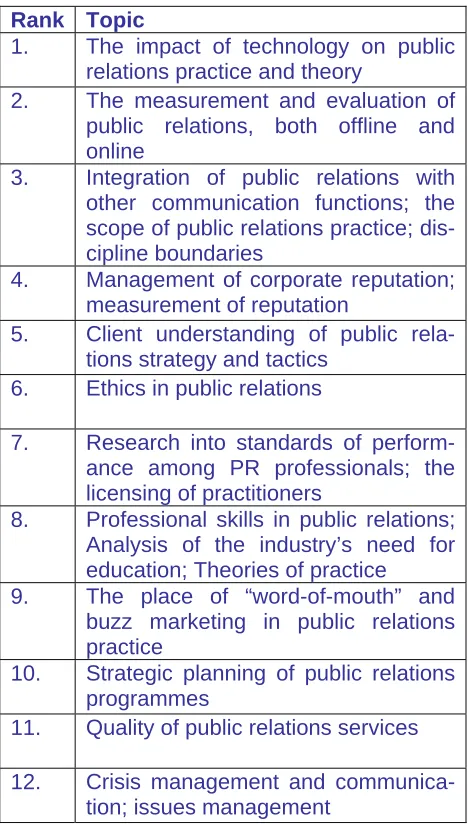
4 Table 1: Topics ranked in priority in blog
pre-test
Rank Topic
1. The impact of technology on public relations practice and theory
2. The measurement and evaluation of public relations, both offline and online
3. Integration of public relations with other communication functions; the scope of public relations practice; dis-cipline boundaries
4. Management of corporate reputation; measurement of reputation
5. Client understanding of public rela-tions strategy and tactics
6. Ethics in public relations
7. Research into standards of perform-ance among PR professionals; the licensing of practitioners
8. Professional skills in public relations; Analysis of the industry’s need for education; Theories of practice
9. The place of “word-of-mouth” and buzz marketing in public relations practice
10. Strategic planning of public relations programmes
11. Quality of public relations services
12. Crisis management and communica-tion; issues management
There were also recommendations for addi-tional topics, of which the best supported were: ‘Public relations’ role in contributing to strategic decision-making, strategy develop-ment and realisation, and organisational func-tioning’; and ‘The value that public relations creates for organisations through building so-cial capital, managing key relationships and realising organisational advantage’. These were added to Round 1 of the formal Delphi study.
Stage 2: Letter of invitation
A letter of invitation (Synnott & McKie, 1997) was sent by email to 44 public relations academics, practitioners and industry leaders
in six international regions (Europe, North America, Central and South America, Africa, Asia and Australasia) on April 10, 2007. They had been chosen for their prominence in re-search, practice and as leaders of major indus-try bodies. Some were known by the author but all were chosen on the basis of their position and expertise, thus qualifying them as experts (Dawson & Brucker, 2001). The letter intro-duced the aim of the study, the research meth-odology and the commitment sought. Anony-mous reporting of comments was emphasised. All were offered a choice of communication methods (email, fax, written or online commu-nication – blog or forum). Some 31 accepted the invitation (70.45 per cent) and all chose email communication. There was no response from three invitations sent to Central and South American contacts at this or any other stage of the study.
Stage 3: Round 1 topics and report
Topics – Round 1
A. Public relations’ role in contributing to strategic decision-making, strategy development and realisation, and or-ganisational functioning
B. Quality of public relations services C. Research into standards of
perform-ance among PR professionals; the li-censing of practitioners
D. Integration of public relations with other communication functions; the scope of public relations practice; discipline boundaries
E. The measurement and evaluation of public relations, both offline and online
F. Client understanding of public rela-tions strategy and tactics
G. Professional skills in public relations; Analysis of the industry’s need for education; Theories of practice
H. Management of relationships I. The definition of public relations
J. The impact of technology on public relations practice and theory
K. The culture of public relations
L. International issues in public relations; Intercultural public relations
M. Public relations’ position as a funda-mental management function; public relations as a profession
N. The expectations of users of public relations; The client: consul-tancy/adviser interface
O. Public relations’ role in organisational change
P. The place of “word-of-mouth” and buzz marketing in public relations practice Q. Ethics in public relations
R. Relations with the media S. The history of public relations
T. Gender issues in public relations prac-tice
U. The role of PR in community/social re-sponsibility programmes
V. Management of corporate reputation; measurement of reputation
W. Crisis management and communica-tion; issues management
X. Political communication and advocacy (lobbying)
Y. Social media and its role in public rela-tions
Z. The value that public relations creates for organisations through building social capital, managing key relationships and realising organisational advantage
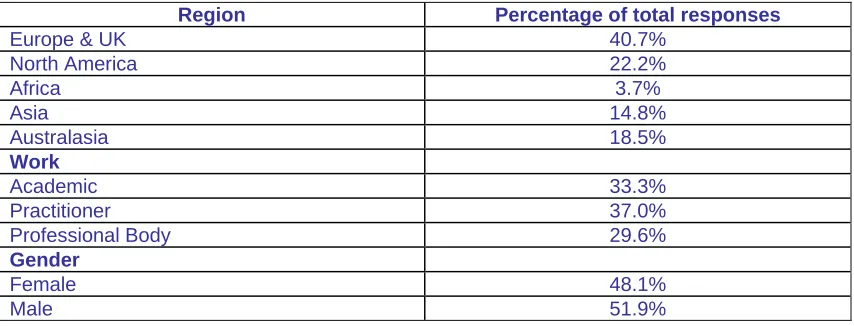
Responses (see Table 2, below) were received from 27 of the 31 participants (87.1 percent) representing five of the six geographic regions, with Europe producing most comments and Af-rica the least. The Asian and Australasian re-sponses made up 33.3% of total rere-sponses. There was a fairly even distribution between the three employment groups and genders.
Table 2: Response rates – Round 1
Region Percentage of total responses
Europe & UK 40.7%
North America 22.2%
Africa 3.7%
Asia 14.8%
Australasia 18.5%
Work
Academic 33.3%
Practitioner 37.0%
Professional Body 29.6%
Gender
Female 48.1%
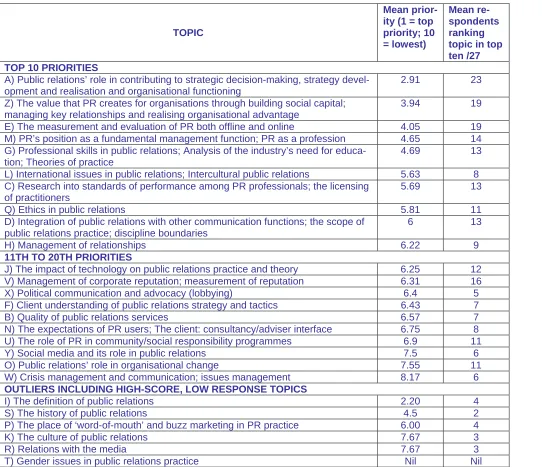
The topics were ranked by the mean of their valid scores (See Table 3). The best-supported three topics were (in rank order) A, Z and E. The first two, A and Z, both focus on the role of public relations in its contribu-tion to organisacontribu-tions in (A) strategic decision-making and organisational functioning and (Z) the creation of value. The third-ranked topic, E, ‘measurement and evaluation of public relations both offline and online’ is an expected highly-ranked topic as it has historic precedents as a first or second ranked topic in previous Delphi studies of public relations
(McElreath, 1980, 1989; White & Blamphin, 1994; Synnott & McKie, 1997). The fourth-ranked topic, M, ‘public relations’ position as a fundamental management function; public rela-tions as a profession’, could also be linked to topics A and Z. There was also comment that ‘public relations as a profession’, was a sepa-rate topic. Topic G, ‘professional skills in pub-lic relations; analysis of the industry’s need for education; and theories of practice’, was fifth-ranked and also commented on as being linked with topic C (seventh-ranked). These were combined in the Round 2 propositions.
Table 3: Round 1 topics ranked by means
TOPIC
Mean prior-ity (1 = top priority; 10 = lowest)
Mean re-spondents ranking topic in top ten /27 TOP 10 PRIORITIES
A) Public relations’ role in contributing to strategic decision-making, strategy devel-opment and realisation and organisational functioning
2.91 23
Z) The value that PR creates for organisations through building social capital; managing key relationships and realising organisational advantage
3.94 19
E) The measurement and evaluation of PR both offline and online 4.05 19
M) PR’s position as a fundamental management function; PR as a profession 4.65 14
G) Professional skills in public relations; Analysis of the industry’s need for educa-tion; Theories of practice
4.69 13
L) International issues in public relations; Intercultural public relations 5.63 8
C) Research into standards of performance among PR professionals; the licensing of practitioners
5.69 13
Q) Ethics in public relations 5.81 11
D) Integration of public relations with other communication functions; the scope of public relations practice; discipline boundaries
6 13
H) Management of relationships 6.22 9
11TH TO 20TH PRIORITIES
J) The impact of technology on public relations practice and theory 6.25 12
V) Management of corporate reputation; measurement of reputation 6.31 16
X) Political communication and advocacy (lobbying) 6.4 5
F) Client understanding of public relations strategy and tactics 6.43 7
B) Quality of public relations services 6.57 7
N) The expectations of PR users; The client: consultancy/adviser interface 6.75 8
U) The role of PR in community/social responsibility programmes 6.9 11
Y) Social media and its role in public relations 7.5 6
O) Public relations’ role in organisational change 7.55 11
W) Crisis management and communication; issues management 8.17 6
OUTLIERS INCLUDING HIGH-SCORE, LOW RESPONSE TOPICS
I) The definition of public relations 2.20 4
S) The history of public relations 4.5 2
P) The place of ‘word-of-mouth’ and buzz marketing in PR practice 6.00 4
K) The culture of public relations 7.67 3
R) Relations with the media 7.67 3
The ranking of topics gave clear priorities from first to eighth, but there was a tight clus-ter from ninth to seventeenth where topics had a mean of between 6 and 6.9. It should be noted that topic J, ‘the impact of technology on public relations theory and practice’, which topped the blog-based pre-test, was only eleventh in the formal study, suggesting the blog audience is predisposed to see tech-nology as important. Some topics with high scores but few responses have been placed within an ‘outliers’ group. Only one topic, T ‘Gender issues in public relations’, elicited a nil response.
Stage 4: Round 2 propositions and report
Following Round 1’s ranking of priorities, discussion of topics and potential RQs, the initial 26 topics were reduced to fifteen. Top-ics with a mean ranking of above seven, and the low-response ‘outlier’ group, were elimi-nated. Three topics (B, F and N) were merged into a single topic because of perceived simi-larity of content. All topics were re-lettered, except topic A, in the ranking order from Round 1. In this round, proposals for new RQs arising from Round 1 were included in the document that was circulated to all 31 original participants. They were again asked to rank topics from 1 (top priority) to 10 (tenth priority) and could propose additional topics and comment on the topics and RQs.
Round 2 - Revised Topics
Topics ranked 1st to 10th
D. Public relations’ position as a fundamen-tal management function
E. Professional skills in public relations; Analysis of the industry’s need for education; Theories of practice
F. International issues in public relations; In-tercultural public relations
G. Performance standards among PR pro-fessionals; licensing of practitioners
H. Ethics in public relations
I. Integration of PR with other communication functions; the scope of PR practice; discipline boundaries
J. Management of relationships
Topics ranked 11th to 15th
K. Impact of technology on PR practice and theory
L. Corporate reputation management; reputa-tion management
M. Political communication and advocacy (lob-bying)
N. Client/employer understanding of public re-lations (Replacing Round 1 topics B, F and N)
O. The role of public relations in commu-nity/social responsibility programmes.
New topics, proposed from Round 1
• The personal/organisational influence
model and its correlation with stakeholder relationship management
• The relationship between public diplomacy and public relations
• The role of public relations in society – what does it mean that “PR serves democ-racy” or that “public relations is an essential element in a democratic society”?
• Further development of theories of publics
• Proof of two-way symmetrical model in op-eration
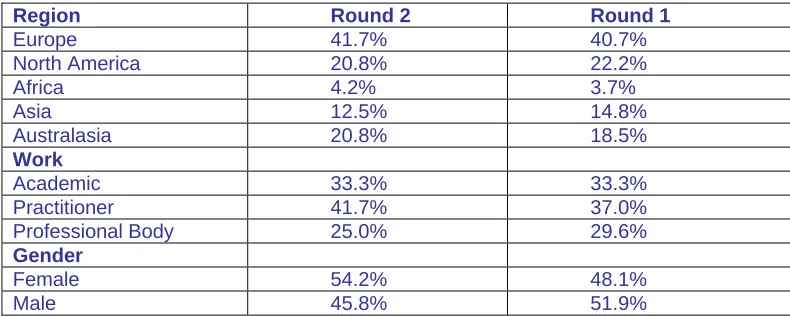
Table 4: Response rates — round 2
Region Round 2 Round 1
Europe 41.7% 40.7%
North America 20.8% 22.2%
Africa 4.2% 3.7%
Asia 12.5% 14.8%
Australasia 20.8% 18.5%
Work
Academic 33.3% 33.3%
Practitioner 41.7% 37.0%
Professional Body 25.0% 29.6%
Gender
Female 54.2% 48.1%
Male 45.8% 51.9%
No topic had a nil response, unlike Round 1. There were clear priorities from first to elev-enth with a statistically insignificant step of 0.03% between tenth and eleventh rank. Broadly, the ranking of topics set after Round 1 remained stable, although not without debate as to whether some topics could be merged. The strongest topics were A, ‘public relations’ role in contributing to strategic decision-making, strategy development and realisation, and
organisational functioning’ and B, ‘the value that public relations creates for organisations through building social capital; managing key relationships and realising organisational ad-vantage’. There was discussion as to whether these should be merged. The third-ranked topic, C, ‘measurement and evaluation of public rela-tions both offline and online’ was an expectedly high-ranked topic, as discussed in Round 1.
Table 5: Round 2 topics ranked by means (with Round 1 mean in brackets)
TOPIC
Mean prior-ity (1 = top priority; 10 = lowest)
Mean re-spondnts ranking topic in top ten /23 TOP 10 PRIORITIES
A) Public relations’ role in contributing to strategic decision-making, strategy de-velopment and realisation and organisational functioning
2.43 (2.91) 22
B) The value that public relations creates for organisations through building so-cial capital; managing key relationships and realising organisational advantage
3.50 (3.94) 21
C) The measurement and evaluation of public relations both offline and online 4.24 (4.05) 17
D) Public relations’ position as a fundamental management function 4.38 (4.65) 16
E) Professional skills in PR; Analysis of the industry’s need for education; Theo-ries of practice
4.67 (4.69) 18
G) Research into standards of performance among PR professionals; the licens-ing of practitioners
5.83 (5.69) 15
L) Management of corporate reputation; measurement of reputation 6.00 (6.31) 11
H) Ethics in public relations 6.19 (5.81) 18
I) Integration of PR with other communication functions; the scope of PR prac-tice; discipline boundaries
6.19 (6.00) 16
J) Management of relationships 6.42 (6.22) 12
11TH TO 15TH PRIORITIES
N) Client/employer understanding of public relations * 6.71 (6.43) 14
K) The impact of technology on public relations practice and theory 6.86 (6.25) 14
O) The role of PR in community/social responsibility programmes 7.00 (6.90) 4
F) International issues in public relations; Intercultural public relations 7.38 (5.63) 16
M) Political communication and advocacy (lobbying) 7.57 (6.4) 7
The main change in the ranking of topics was that topic F, ‘international issues in public relations; intercultural public relations’, fell from sixth to fourteenth, and thus out of the Top Ten. The main riser was topic L, ‘man-agement of corporate reputation; measure-ment of reputation’, which rose from twelfth to seventh, although its mean ranking only changed from 6.31 to 6.00. In the eleventh to fifteenth rankings, topic N, ‘client/employer understanding of public relations’, which was reformulated after Round 1, rose from four-teenth to eleventh. It marginally missed the Top Ten by 0.03 per cent and could arguably be considered as equal tenth. One of the un-expected aspects of the survey was that the topic K, ‘the impact of technology on public relations practice and theory’, remained stub-bornly just outside the Top Ten at eleventh in Round 1 and twelfth in Round 2, despite be-ing top-ranked in the blog pilot and attractbe-ing widespread comment and discussion in practi-tioner media.
There were fewer new topics added than in Round 1, and some of those sought greater clarity in existing topics or proposed new RQs within topics.
Stage 5 – Round 3 propositions
As the rankings from Round 1 to Round 2 were relatively stable and so indicated con-sensus, the participants were asked to com-ment on the RQs for Round 3, rather than again rank the propositions. A letter, the re-port on Round 2, and the Round 3 proposi-tions were disseminated on June 21 for return by July 11. As there were minor changes to the RQs between Round 3 and the final re-port, these will be displayed under Stage 6 – Final Report. Some 16 participants (51.6% of the original acceptances) commented in Round 3, some in considerable detail. The range and depth of responses demonstrated the advantages the Delphi study, a qualitative technique such as “draws on the knowledge of experts without having to gather these ex-perts in one place” (Wakefield, 2000, p.193).
Stage 6 – final report
The outcome of this study was the ranked, pri-oritised research topics and the related research questions. They are presented in the ranking order of the topics from first to tenth. It is nota-ble that measurement and evaluation, some-times expressed as ‘proof’ or ‘value’, appear in several of them, as well as in the dedicated topic C, ‘the measurement and evaluation of public relations both offline and online’.
A) Public relations’ contribution to strategic de-cision-making, strategy development and reali-sation, and efficient operation of organisations
• How does public relations demonstrate its contribution to the formation of organisa-tional strategy?
• Can public relations improve the quality of organisational decision and performance by practitioners acting as the link between the organisations and its stakeholders (i.e. as facilitators)?
• How can public relations leaders influence business decisions via timely involvement?
• Why do public relations practitioners get a seat at the ‘top table’ in some organisations and not at others? Is there a gender or sec-tor bias?
B) The value that public relations creates for organisations through building social capital and managing key relationships
• What is ‘value’ in public relations? Is there a universal rubric or is it situational?
• How can value be best demonstrated in non-financial terms? Can intangible value be translated into measurable “bottom-line” value?
• Can social capital be measured?
• Is there proof of the two-way symmetrical model in operation?
C) The measurement and evaluation of public relations both offline and online
• Following the CIPR’s statement on meas-urement and evaluation in 2005 (see
de-10
veloped to aid practitioner education and introduce best practice?
• How can the effect of public relations ac-tivity on attitude formation and behaviour be modeled and measured?
• What are the factors that affect or aid the widespread adoption of public relations measurement and evaluation methods?
• How can highly targeted communication to special, highly protected audiences (such as legislators) be monitored and measured?
D) Public relations as a fundamental man-agement function
• How is public relations expressed as a management function? What is unique about it and what ‘fundamental’ contribu-tion does it make?
• What is the theory and best practice in the structure and operation of public rela-tions and communication operarela-tions?
• Management of the public relations func-tion: What are the skills of senior PR managers? Are the working practices and long hours culture an excuse for poor management skills? Why are senior managers reluctant to undertake training?
E) Professional skills in public relations; analysis of the industry’s need for education;
Practitioner-focused:
• The creation of an international curricula and competency framework in profes-sional and managerial skills for practitio-ners.
• What is the PR industry’s commitment to the improvement of expertise?
• Should practitioner organisations and universities align educational qualifica-tions to reduce confusion on competing qualifications or maintain separate educa-tional routes for differing needs?
Undergraduate-focused:
• What is the role of public relations educa-tion? Is it to prepare graduates for entry into the industry or to equip them to cri-tique the industry and change it from within or both?
• What is the most appropriate model of academic:professional alignment in
un-dergraduate courses to give students a broad academic and professional education that supports their entry into the industry as preferred employees?
• What is best practice in communicating the nature and content of public relations edu-cation to prospective employers?
G) Research into standards of performance among PR professionals; the licensing of prac-titioners
• What is the role of professional associa-tions and governments in regulating prac-tices and licensing practitioners? Are there benefits and disadvantages of licensing?
• Can standards of practice be developed in order to create a QA or management stan-dard similar to the Consultancy Manage-ment Standard developed by the UK’s Pub-lic Relations Consultants Association?
• Could best practice standards be intro-duced for crisis management, internal communications, issues management, me-dia relations and stakeholder engagement?
L) Management of corporate reputation; man-agement of reputation
• Can reputation be managed? If it can, is this a ‘job’ for PR or a whole-of-organisation task?
• How can ‘lost’ or ‘damaged’ reputation be repaired? Is there a ‘best practice’ model that can be applied?
• Why do some organisations with a ‘poor reputation’ continue to thrive?
• There is much ‘received wisdom’ in reputa-tion management – how can the links be-tween a high-profile individual (e.g. a ‘su-perstar CEO’) and the reputation of an or-ganisation be proven?
H) Ethics in public relations
• Should a universal code of conduct for pub-lic relations practitioners be devised and implemented? How should the ethical be-haviour of members be managed by pro-fessional bodies?
• How can public relations ethics change from an abstract concept to a daily habit? What are the barriers?
• How does public relations practice influ-ence corporate governance? Or is it vice-versa?
• Ethics in online communication: What are the implications? Are new approaches needed?
I) Integration of public relations with other communication functions; the scope of public relations practice; discipline boundaries
• Is there a field of public relations and can it be defined? What is the unique purpose of public relations?
• Are the current boundaries untenable in the new communications environment?
• How does integrated communication
work? Does it work (i.e. is it an effective strategic and tactical model)?
• How can public relations work with mar-keting for better results?
• How does public relations relate to hu-man resources and change hu- manage-ment?
J) Management of relationships
• Who is the ‘owner’ of the relationship: the PR professional or the business line? How can the ‘PR = relationship manage-ment’ model be operationalised? Does current theory stand this test?
• How can the link between communication activity and intangibles such as relation-ship capital be measured?
• How can psychology and communication theory be integrated in implementing rela-tionship management?
• What are the skills, competencies and attitudes needed to develop influence networks?
At the completion of two rounds the ranking, especially from First to Fifth, clearly sets out topics and RQs that have most relevance to academics, practitioners and professional bodies. It is a common agenda that will sup-port bids for funding from government and commercial sources.
Asia-Pacific responses
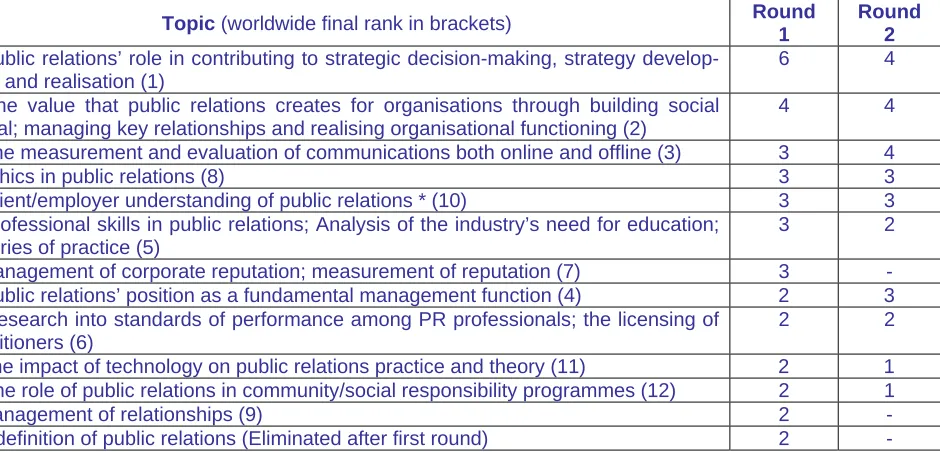
As discussed in the Research Questions section, a geographically-based sample has been drawn from the main study to investigate whether the attitudes of experts in Asia Pacific differ from those other parts of the world, notably North America and Europe (see Table 6, over the page). Although there is a wide range of studies on Australasian practice, some of which were identified above, studies of cultural differences in communication and public relations in Asia are much less common, with the exception of Sriramesh (2004). The total sample, which ranged from seven (Round 1) to twenty-three (Round 2), was too small in size for valid statistical analysis. However, regression tests were run on the data using SPSS and found no variation between the Asia Pacific responses and those from other regions, which seems to indicate a similarity of views. The only varia-tion (< .05) noted across the whole sample was between academics and practitioners in the ranking of ethics and professional skills. Ethics was of more importance to academics than to practitioners but the reverse was the case for professional skills. Both indicative outcomes are not entirely surprising.
The similarity of Asia-Pacific responses to the worldwide sample, which was hinted at in the statistical analyses, is confirmed by a review of the responses to the questions across the first two rounds of the Delphi which shows that the same three leading topics as the rest of the world, namely topics A, B and C, occur in rank order from first to third. The sample is very small for statistical purposes but the remaining ten topics were mostly in the world-wide Top Ten with the exception of ‘the impact of tech-nology’ (ranked eleventh); ‘the role of public relations in community/social responsibility programmes (ranked twelfth) and ‘The defini-tions of public reladefini-tions’, which was eliminated after Round 1.
12 Table 6: Responses by Asia-Pacific experts in rounds 1 and 2
Topic (worldwide final rank in brackets) Round 1
Round 2 A. Public relations’ role in contributing to strategic decision-making, strategy
develop-ment and realisation (1)
6 4
B. The value that public relations creates for organisations through building social capital; managing key relationships and realising organisational functioning (2)
4 4
C. The measurement and evaluation of communications both online and offline (3) 3 4
H. Ethics in public relations (8) 3 3
N. Client/employer understanding of public relations * (10) 3 3
E. Professional skills in public relations; Analysis of the industry’s need for education; Theories of practice (5)
3 2
L. Management of corporate reputation; measurement of reputation (7) 3 -
D. Public relations’ position as a fundamental management function (4) 2 3
G. Research into standards of performance among PR professionals; the licensing of practitioners (6)
2 2
K. The impact of technology on public relations practice and theory (11) 2 1
O. The role of public relations in community/social responsibility programmes (12) 2 1
J. Management of relationships (9) 2 -
The definition of public relations (Eliminated after first round) 2 -
* This category is expressed in the Round 2 version after categories B, F and N were combined. All topics with a single response were elimi-nated
Discussion
With no comparable studies in the past decade, given the European Delphi study on public re-lations failed to find consensus (Raupp & van Ruler, 2006), the comparison of the 2007 study is with one undertaken 10 years earlier which focused on the Asia-Pacific region only (Syn-nott & McKie, 1997). The data from the earlier study on research priorities is compared with this study in order to identify the continuing
research issues as well as those which have entered the research agenda latterly and those which have departed. Synnott and McKie’s re-search drew 37 participants from thirteen coun-tries in a deliberate effort to get a wider spread of cultural and economic development condi-tions. There were seven clusters of questions, of which one focused on “major research trends in the field of public relations during the next 10 years” (Synnott & McKie, 1997, p. 270). It is from this data that comparisons are made.
Table 7: Final report, topics ranked by means (Round 2) compared with Synnott & McKie (1997)
TOPIC Rank Synnott &
McKie 1997 A) Public relations’ role in contributing to strategic decision-making, strategy
de-velopment and efficient operation of organisations
1
-B) The value that public relations creates for organisations through building so-cial capital and managing key relationships
2 =7 (in part)*
C) The measurement and evaluation of public relations both offline and online 3 1
D) Public relations as a fundamental management function 4 =5 (in part)*
E) Professional skills in PR; analysis of the industry’s need for education 5 =7 (in part)*
G) Research into standards of performance among PR professionals; the licens-ing of practitioners
6 3
L) Management of corporate reputation; measurement of reputation 7 =7 (in part)*
H) Ethics in public relations 8
-I) Integration of public relations with other communication functions; the scope of public relations practice; discipline boundaries
9 10
J) Management of relationships 10
Three topics are wholly new, as shown by the comparison in Table 7, above. They are ‘public relations’ role in contributing to strategic deci-sion-making, strategy development and effi-cient operation of organisations’ (Topic A), ‘ethics in public relations’ (Topic H) and ‘the management of relationships’ (Topic J). Rank-ing of topics appearRank-ing in both studies is widely varied, although the ‘measurement and evalua-tion of public relaevalua-tions’ (Topic C) is highly ranked by at third and first in the two studies. Other topics in the Top Ten from both studies are E, ‘professional skills in public relations; analysis of the industry’s need for education’, G, ‘research into standards of performance among PR professionals’, and I, ‘integration of public relations with other communication functions’. ‘The impact of technology on public relations practice and theory’ (Topic K) ranked fifth by the 1997 report when the potential for impact was looming, as opposed to the actuality of the present, when it has been ranked outside the Top Ten. Topic F, ‘international issues in public relations; intercultural public relations’ although outside the Top Ten in the current study was higher earlier at equal seventh.
The topic omitted since 1994 was “the development of suitable models for PR research and suitable techniques such as news content analysis, consumer trend forecasting, issues monitoring and tracking techniques, bench-marking, continuous monitoring, frame analy-sis, public decision-making models, etc.” (Syn-nott & McKie, 1997, p.270).
It is notable that ‘old favourite’ topics, such as ‘what is public relations’, ‘the defini-tion of public reladefini-tions’ and ‘the image of pub-lic relations’ have departed from the current research agenda, although topic I considers ‘the scope of public relations practice; discipline boundaries’. In responses to this topic, there was little sign of defensiveness about the boundaries of public relations. Another change has been that research is no longer engaged with media relations and its monitoring, e.g. ‘news content analysis’. Many of these issues have not been resolved, such as an international definition of public relations or gender issues in this discipline, but they are no longer perceived as current, or other more pressing issues have succeeded them.
Conclusions
This study has reviewed research priorities for public relations internationally and derived in-sights for the Asia Pacific region from regional expert participants. It found that Asia Pacific priorities were very similar to those expressed by the whole panel, with the main two priorities being the role of public relations in the strategic operation of organisations and the creation of value by public relations through social capital and relationships. In comparing these results with Synnott and McKie (1997), seven of the topics appeared in the earlier study but not the No.1 ranked, ‘The role of public relations in the strategic operation of organisations’. Synnott and McKie found that ‘the measurement and evaluation of public relations’ was top-ranked and it was ranked third in this study. Other rankings vary, as shown in the final table, but there is continuity in the research issues that need investigation.
14 that is more robust in delivering valid ranges of
views. Public relations is increasingly being strategised and undertaken using online com-munication and it is beholden on researchers to trial these methods in studying the phenomena and theory of this discipline.
References
Addison, T. (2003). E-commerce project devel-opment links: Evidence from a Delphi sur-vey. International Journal of Information Management, 23(1), 25-40.
Beretta, R. (1996). A critical review of the Del-phi technique. Nurse Researcher, 3(4), 79
Boynton, L. (2006). What we value: A Delphi study to identify key values that guide ethi-cal decision-making in public relations. Pub-lic Relations Review, 32(4), 325-330.
Broom, G.H. (2006). An open-system approach to building theory in public relations. Public Relations Review, 18(3), 141-150.
Chartered Institute of Public Relations (2005). Measurement and evaluation: moving the debate forward. Retrieved from www.cipr.co.uk/research on January 3, 2008
Dawson, M.D., & Brucker, P.S. (2001). The utility of the Delphi method in MFT re-search. The American Journal of Family Therapy, 29, 125-140.
Green, B., Jones, M., Hughes, D., & Williams, A. (1999). Applying the Delphi technique in a study of GPs information requirements.
Health & Social Care in the Community, 7(3), 198-205.
Hung, H-L., Altschuld, J.W., & Lee, Y-F. (2008). Methodological and conceptual is-sues confronting a cross-country Delphi study of educational program evaluation.
Evaluation and Program Planning, 31, 191-198.
Jenkins, D.A., & Smith, T.E. (2004). Applying Delphi methodology in family therapy re-search. Contemporary Family Therapy, 16, 411-430.
Kaynak, E., Bloom, J., & Liebold, M. (1994). Using the Delphi technique to predict future
tourism potential. Marketing Intelligence & Planning, 12(7), 18-29.
Kendall, R. (1996). Public relations campaign strategies: Planning for implementation
(2nd Ed.). New York: Longman.
Linstone, H.A., & Turoff, M. (1975). Introduc-tion. In H.A. Linstone, & M. Turoff, M., (Eds.), The Delphi method: techniques and
application (3-16). London:
Addison-Wesley.
Macnamara, J. (1999). Research in public rela-tions: A review of the use of evaluation and formative research. Asia-Pacific Public Re-lations Journal, 1(2), 1-20.
McElreath, M.P. (1980). Priority research questions for public relations for the 1980s. New York: Foundation for Public Relations Research and Education.
McElreath, M.P. (1989). Priority research questions in the field of public relations for the 1990s: trends over the past ten years and predictions for the future. Paper presented at the meeting of the Speech Communication Association, San Francisco.
McElreath, M.P., & Blamphin, J.M. (1994). Partial answers to priority research questions – and gaps – found in the Public Relations Society of America’s body of knowledge.
Journal of Public Relations Research, 6(2), 69-103.
McKenna, H. (1994). The Delphi technique: A worthwhile approach for nursing? Journal of Advanced Nursing 19, 1221-1225
Powell, C. (2003). The Delphi technique: Myths and realities. Journal of Advanced Nursing, 41(4), 376-382
Raupp, J., & van Ruler, B. (2006). Trends in public relations and communication man-agement research: a comparison between Germany and The Netherlands. Journal of Communication Management, 10(1), 18-26.
Singh, R., & Smyth, R. (2000). Australian pub-lic relations: Status at the turn of the 21st century. Public Relations Review 26(4), 387-401
Smith, M. A. (1997). Perceptions of quality in journalism and communications education: A Delphi study. Journal of the Association for Communication Administration, 1, 32-50
Sriramesh, K. (Ed.) (2004). Public relations in Asia: An anthology. Singapore: Thomson.
Steiner, C.J., & Black, L. (2000). The role of public relations professionals in corporate strategic planning in Australia: Educational implications, Asia Pacific Public Relations Journal, 2(1), 63-82
Synnott, G., & McKie, D. (1997). International issues in PR: Researching research and pri-oritizing priorities. Journal of Public Rela-tions Research, 9(4), 259-282.
van Ruler, B., Vercic, D., Bütschi, G., & Flodin, B. (2004). A first look for parame-ters of public relations in Europe. Journal of Public Relations Research, 16(1), 35-63
Wakefield, R. (2000). Preliminary Delphi re-search on international public relations pro-gramming: Initial data supports application of certain generic/specific concepts. In D. Moss, D. Vercic, & G. Warnaby (Eds.), Per-spectives on public relations research (pp. 179-208). London: Routledge.
Watson, T. (2008). Public relations research priorities: A Delphi study. Journal of Com-munication Management, 12(2), 104-123
Watson, T., & Simmons, P. (2004). Public re-lations evaluation: Survey of Australian practitioners. Proceedings of the Australian and New Zealand Communication Associa-tion, Sydney, Australia, July 2-9, 2004.
Available at: http://conferences.arts.usyd.edu.au/viewabstr
act.php?id=97&cf=3
White, J., & Blamphin, J. (1994). Priorities for research into public relations practice in the
United Kingdom. London: City University
Business School / Rapier Research.
Xavier, R., Johnson, K., Patel, A., Watson T.,
techniques and performance claims to dem-onstrate public relations impact: An Austra-lian perspective, Public Relations Review, 31(3), 417-424
Ziglio, E. (1996). The Delphi method and its contribution to decision making. In M. Adler, & E. Ziglio. (Eds.). Gazing into the oracle: the Delphi method and its applica-tion to social policy and public health. (pp. 3-26). London: Jessica Kingsley Publishers.
Author contact details: Tom Watson, PhD
The Media School Bournemouth University Poole, Dorset
England BH12 5BB Phone: +44 1202 961986 Fax +44 1202 965530
Email address: [email protected]
Copyright statement: