Pilot tests of
Candida sake
(CPA-1) applications to control
postharvest blue mold on apple fruit
Josep Usall
a,*, Neus Teixido´
a, Rosario Torres
a, Xavier Ochoa de Eribe
b,
Immaculada Vin˜as
aaPosthar6est unit,CeRTA,Centre UdL-IRTA,177Ro6ira Roure A6e.,25198Lleida,Catalonia,Spain bSIPCAM INAGRA SA,Prof.Ba´guena,5 46009Valencia,Spain
Received 20 January 2000; accepted 8 June 2000
Abstract
The yeast Candida sake (strain CPA-1) was tested as a biocontrol agent of postharvest diseases, primarily blue mold, caused byPenicillium expansumon apple fruits. In a semi-commercial trial with non-injured fruits stored in air at 1°C, a concentration of 1.6×10⁶colony forming units/ml (CFU/ml) ofC.sakereduced the incidence of decayed fruits by more than 70%. Over a period of three seasons, in commercial trials the efficacy of CPA-1 applied in a drench was evaluated and compared with the fungicides imazalil and thiabendazole+folpet. The application ofC.
sakeat 107CFU/ml resulted in a reduction in the incidence of decay to a level equal to that with imazalil (375 ppm) and higher than that with thiabendazole (425 ppm)+folpet (1000 ppm). Population of the biocontrol agent increased on the surface of wounded fruits 5-fold and decreased on the surface of non-wounded fruits more than 10-fold in the first 60 days in storage at 1°C. The viability ofC.sakewas not reduced after 30 min immersion in benomyl, sulfur, flusilazol, ziram, thiabendazole or diphenylamine. Conversely, captan, imazalil, and ethoxyquin decreased C.sake
viability and would not be compatible with it used at commercial rates. The yeast was able to grow in culture at temperatures from 1 to 34°C. © 2001 Elsevier Science B.V. All rights reserved.
Keywords:Biological control; Yeast;Penicillium expansum; Postharvest diseases
www.elsevier.com/locate/postharvbio
1. Introduction
Microbial antagonism plays an important role in the natural control of numerous postharvest pathogens of fruits (Janisiewicz, 1987; Wilson and Chalutz, 1989; Roberts, 1990; Lima et al., 1997).
Strains of Candida spp can control several postharvest fruit diseases (Jijakli et al., 1993; Wilson et al., 1993; Usall, 1995; Vin˜as et al., 1998) and some bacteria and yeast antagonists have been tested on a large scale under commercial conditions (Pusey et al., 1988; Droby et al., 1993; Chand-Goyal and Spotts, 1997; Arras and Arru, 1999), and in several formulations (Janisiewicz and Jeffers, 1997; Droby et al., 1998). A number of commercial products are available in the USA
* Corresponding author. Tel.:+34-973-702648, fax:+ 34-973-238301.
E-mail address:[email protected] (J. Usall).
market including Aspire (Candida oleophilastrain 182, Ecogen Inc., Langhorne, PA) and Bio-save 10 and 11 (Pseudomonas syringae strains ESC30 and ESC 11, EcoScience Corp., East Brunswick, NJ).
The ultimate acceptance of biological control will depend on its effectiveness and compatibility with current handling and storage. More research is needed to determine the effects of various postharvest practices (such as washing, waxing, and fungicide residues from preharvest applica-tions) on the population dynamics and biological activity of the antagonist.
In previous studies, a naturally occurring yeast,
Candida sake (Saito and Ota) van Uden and Buckley (strain CPA-1), was isolated from the surface of apple fruit and exhibited antagonistic activity in vivo against a wide spectrum of postharvest pathogens of pears and apples (Vin˜as et al., 1998).
In this paper we report the results of a large-scale experiment under cold storage and con-trolled atmosphere conditions and several pilot tests to assess the effectiveness of the yeast antag-onist CPA-1. The population dynamics ofC.sake
(CPA-1) on the apple surface, and its tolerance to commercial pre- and postharvest fungicides and antiscald chemicals, was studied.
2. Materials and methods
2.1. Fruits, pathogen and yeast isolates
The apple cultivar ‘Golden Delicious’ (Malus domesticaBorkh) was used in all the experiments. Fruits were obtained immediately after harvest from commercial orchards in Lleida, Catalonia, Spain.
Penicillium expansum Link isolate CMP1 was isolated from a decayed apple that had been in cold storage for several months. This isolate was the most aggressive one in our collection and caused the largest lesions on inoculated apples. The fungus was maintained on potato-dextrose agar (PDA) with periodic transfers through apple tissue. The inocula consisted of aqueous conidial suspensions of 104 conidia per ml. The
suspen-sions were prepared from 10-day-old cultures in-cubated at 2591°C.
The strain CPA-1 of C. sake (Saito and Ota) Van Uden and Buckley, obtained from UdL-IRTA Centre, Catalonia, was used in this study. This strain was originally isolated from the sur-face of a ‘Golden Delicious’ apple, and was previ-ously show to have antagonistic activity against
P. expansum,Botrytis cinerea andRhizopus nigri
-cans on pome fruits (Usall, 1995; Vin˜as et al., 1998). Stock cultures were stored at 5°C and sub-cultured on nutrient yeast dextrose agar (NYDA). The cells of strain CPA-1 were grown in 6 l of nutrient yeast dextrose broth (NYDB) medium in a 10 l fermentation vessel of a modular fermenter (Gallenkamp, Leicester, UK) for 35 – 40 h at 2591°C and 200 rpm. The medium then was centrifuged at 7520gfor 10 min and the cells were resuspended in 1 l of water. Serial 10-fold dilu-tions in water were made from this concentrated solution and 0.1 ml was spread in Petri plates with NYDA to determine the number of viable cells. The plates were incubated at 2591°C in the dark for 48 h and the colonies were counted. The concentrated yeast cell suspension was stored, for not more than 5 days at 4°C and the desired concentrations were obtained by diluting it before use.
2.2. Growth of C.sake at se6eral temperatures
The growth of CPA-1 at several temperatures was evaluated on Petri dishes containing NYDA medium. Each plate was inoculated with 100ml of
yeast suspension containing about 500 CFU/ml. The plates were incubated for 7 days at 1, 4, 7, 10, 15, 25, 30, 34, 37 and 44 °C, and the presence of yeast colonies was evaluated every day. There were four plates per treatment, and the experi-ment was repeated twice.
2.3. Semi-commercial trial under cold storage conditions
During the 1994 – 1995 season, ‘Golden Deli-cious’ apples were submerged for 30 s in the C.
sake aqueous suspension containing 1.6×10⁴ or
sub-merged again for 30 s in a conidial suspension of
P. expansum(104 conidia/ml).
Sixty apples constituted a single replicate and each treatment was replicated three times. The number of fruits that developed lesions was counted after 8 months in air storage at 1°C.
2.4. In 6itro screenings of tolerance of C.sake to
pre- and posthar6est fungicides and antiscald
products
Since fungicide residues from field applications may affect the activity ofC. sake(CPA-1), fungi-cides commonly applied to trees before harvest (benomyl, captan, ziram, sulfur and flusilazol) were tested for their inhibitory action against the yeast. At the same time, compatibility of the antagonistic yeast with the most common antis-cald chemicals, used to prevent superficial santis-cald, (diphenylamine and ethoxyquin) and postharvest fungicides (imazalil and thiabendazole) were also studied. Two methods to determine inhibitory activity were carried out as follows.
2.4.1. Inhibition of C. sake growth
The paper-disk diffusion method was used to measure inhibition ofC.sakegrowth. The cells at 106 CFU/ml were plated on to Petri plates
con-taining NYDA medium. Paper disks, 5.5-mm di-ameter, were impregnated with 10 ml of several
concentrations of the pre- and postharvest fungi-cides and antiscald products. The disks were al-lowed to dry and then placed on the surface of each prepared plate. The plates were then incu-bated at 25°C in the dark for 48 h. The lowest concentration where a zone of inhibition formed was recorded. There were two plates per treat-ment and the experitreat-ment was repeated twice.
2.4.2. Viability of C. sake in fungicide and antioxidant solutions
Pre- and postharvest fungicides (1 ml) and an-tioxidant chemicals at concentrations five and ten times the recommended commercial rate were transferred to glass test tubes containing 9 ml of
C.sakeat 7×10⁵CFU/ml. After 30 min at 25°C,
0.5 ml of each suspension was removed with a pipette and transferred to a glass tube containing
4.5 ml of 0.05 M phosphate buffer (pH 6.8). Serial 10-fold dilutions were made and 0.1 ml was spread onto Petri plates with NYDA medium. The plates were incubated at 25°C in the dark for 48 h and the colonies were counted. The test was repeated twice.
2.5. Commercial trials under controlled atmosphere conditions
During the 1995/1996, 1997/1998 and 1998/ 1999 seasons, commercial trials were conducted in Lleida (Catalonia). ‘Golden Delicious’ apples were randomly chosen at harvest and stored in bins containing about 1300 fruits each. Fruits were drenched following standard industrial pro-cedures. In the 1995/1996 season, fruits were treated with a solution of imazalil 7.5% (w/v) (Deccozil-S-7.5, Atochem Agri) at a commercial dose (0.5%), and with C. sake strain CPA-1 at either 105 or 106 CFU/ml. In the 1997/1998
sea-son fruits were treated with a solution of imazalil (Deccozil-S-7.5, Atochem Agri) at a commercial dose (0.5%), and with C. sake strain CPA-1 at either 106
or 107
CFU/ml. In the 1998/1999 sea-son, fruits were treated with a solution of thiaben-dazole 17% (w/v)+folpet 40% (w/v) (Tebefred, Agride´s) at a commercial dose (0.25%), and with
C. sake strain CPA-1 at 107 CFU/ml. In each
season, non-treated bins served as controls. Each treatment was replicated four times. All the fruits were stored at 1°C and 3% O2+3% CO2 in a
commercial room, filled to capacity with similar apples that had received standard commercial treatments (in 1995/1996 and 1997/1998 with imazalil at 0.5%, and in 1998/1999 with thiaben-dazole at 0.25%). After 8, 7, or 4 months in the 1995/1996, 1997/1998, and 1998/1999 seasons, re-spectively, decayed fruits were counted.
2.6. Reco6ery of biocontrol agent in the
commercial trials
medium with 0.5 g/l streptomycin sulphate as a bacteriostat. After incubation in the dark at 25°C for 48 h, the colonies were counted. There were four sample aliquots per treatment.
Population sizes of C. sake on the surface of ‘Golden Delicious’ apples were determined during the 1997/1998 season. The biocontrol agent was recovered from the apple surface immediately af-ter drench application and afaf-ter 7 months in storage. Treated apples were weighed and asepti-cally peeled. The peel was shaken in 200 ml sterile phosphate buffer (pH 6.8) on a rotatory shaker for 20 min at 150 rpm and then sonicated for 10 min in an ultrasonic bath. This final step was used to increase detachment of microorganisms from the apple surface. Serial 10-fold dilutions of the washings were made and plated on NYDA con-taining 0.5 g/l streptomycin sulphate as a bacte-riostat. After incubation at 25°C in the dark for 48 h the colonies were counted and the colony forming units per gram fresh weight of fruit were calculated for each sample. There were four single fruit replicates per treatment.
2.7. Population dynamics on the apple surface at
1°C
Population dynamics ofC.sakeon wounded or non-wounded surfaces of ‘Golden Delicious’ ap-ples were determined. In the 1997/1998 season, two sets of apples were rinsed in fresh water after harvest. One of these sets was cut in four loca-tions (midway between the calyx and stem end). The cuts were approximately 10 mm length and 2 mm deep. All (both sets) were dipped for 30 s in
C. sake aqueous suspension containing 1×10⁶
CFU/ml. Fruits were placed in tray packs in plastic boxes and incubated at 1°C. C. sake was recovered as described earlier from the apple sur-face after 0, 4, 30, 60, and 90 days. The experi-ment was repeated twice.
2.8. Scanning electron microscopy
C. sake (isolate CPA-1) at 7.5×10⁵ CFU/ml
was inoculated into wounds (3×3 mm and 3 mm deep) and on the surface of ‘Golden Delicious’ apples. The fruits were incubated at 2091°C and
7595% RH for 24 and 72 h. The peel tissue from the wounds and surface was removed and fixed by immersion in 2.5% glutaraldehyde in 0.1 M phos-phate buffer at pH 7.0 for 2 – 24 h. The samples were washed three times for 30 min with 0.1 M phosphate buffer. The tissue was then dehydrated in an acetone series (30, 50, 70, 95%, and three times 100%) for 10 min each, with critical point drying (CPD) using CO2 as the drying fluid.
Dried tissue was mounted on aluminium studs, coated with gold-palladium, and observed in a DSM 940 A Zeiss scanning electron microscope (SEM).
3. Results
3.1. Growth of C.sake at se6eral temperatures
After 24 h, strain CPA-1 grew in culture at temperatures of 7 – 34°C. At 1 and 4°C CPA-1 grew only after 48 h. There were no colonies of CPA-1 on the plates stored at 37°C after 7 days.
3.2. Semi-commercial trials under cold storage conditions
After 8 months of storage at 1°C, C. sake at 1.6×10⁶ CFU/ml significantly reduced the
inci-dence of decay on non-wounded apples to 2.2% from 8.4% found in untreated control fruits. At 1.6×10⁴ CFU/ml of C. sake the incidence of
decay was reduced to 4.2%, but it was not signifi-cant compared to the untreated control.
3.3. Effecti6eness of C. sake in commercial trials
under controlled atmosphere
The incidence of decay in untreated fruits was about 1.5% in the 1995/1996 and 1997/1998 sea-sons, and more than 5% in the 1998/1999 season. Blue mold and Alternaria rot were the predomi-nant observed diseases.
All the treatments, except C. sake at 8×10⁴
at all the applied concentrations, was equal to the most effective fungicide approved for postharvest use on pome fruits in Spain (Fig. 1). In the third test, incidence of decay was reduced by more
than 70% with 107 CFU/ml of C. sake and
this was significantly more effective than the
com-mercial treatment (thiabendazole+folpet)
(Fig. 1).
3.4. Reco6ery of biocontrol agent in the
commercial trials
In all three tests, the difference between the concentration of cells applied at the start of the trial and that recovered during the trial was simi-lar (Table 1). At both concentrations, recovery of
C.sakefrom the apple surface after 7 months was
Fig. 1. Efficacy ofC.sake(CS) at different concentrations (CFU/ml) in comparison with imazalil (IZ) and thiabendazole+folpet (TBZ+F) at commercial rates to reduce the incidence of postharvest diseases on ‘Golden Delicious’ apples in commercial trials. Seasons 1995/1996 (A), 1997/1998 (B) and 1998/1999 (C). Different letters within the same season indicate significant differences between means according Duncan’s Multiple Range Test (*PB0.05).
Table 1
Concentration ofC.sake(CFU/ml) applied in commercial trialsa
1998/1999 C.sakeconcentration 1995/1996 1997/1998
R
T T R T R
107 1.1×10⁷
107 9.6×10⁶
6×10⁵a 106a
High
8×10⁴ 106
Low 105 1.3×10⁶ – –
aCFU/ml, Colony forming units/ml;T, concentration theoretically applied;R, concentration after the recovery; – treatment not
applied.
Table 2
Recovery ofC. sake (CFU/g) from the surface of ‘Golden Delicious’ apples drenched in commercial trials during the season 1997/1998
7 months 0 months
Applied concentration ofC.sake
(CFU/ml) (CFU/g fresh weight of fruit)a (CFU/g fresh weight of fruit)
1119964
106 19339917
66439844 892092855
107
Table 3
Concentrations of several fungicides and antioxidants that inhibited the growth ofC.sake(CPA-1)
Fungicides and antioxidantsa
Sulfur Captan
Benomyl Ziram Flus IZ TBZ DPA Etox.
1500 100 50 10
Minimumb 10 1 10 100 500
6000 1500 3000 500 1000 2000 2000
Maximumb 1000 4000
– 1500 2000 –
– 1000
MICc – – –
Ø I (mm)d – – 3 2 – 2 – – –
aFlus, flusilazol; IZ, imazalil; TBZ, thiabendazole; DPA, diphenylamine; Etx., ethoxyquin. bMinimum and maximum applied concentrations (ppm).
cMIC, Minimum inhibitory concentration (ppm); –, no inhibition in any dose. dØ I, Diameter (mm) of inhibition area of growth at the MIC, around the paper-disk
Table 4
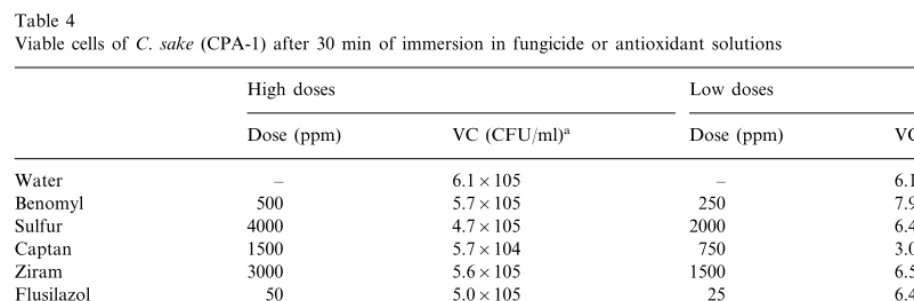
Viable cells ofC.sake(CPA-1) after 30 min of immersion in fungicide or antioxidant solutions
High doses Low doses
VC (CFU/ml)a Dose (ppm)
Dose (ppm) VC (CFU/ml)a
Water – 6.1×10⁵ – 6.1×10⁵
5.7×10⁵ 250
500 7.9×10⁵
Benomyl
4.7×10⁵ 2000
Sulfur 4000 6.4×10⁵
5.7×10⁴ 750
1500 3.0×10⁵
Captan
5.6×10⁵ 1500
Ziram 3000 6.5×10⁵
5.0×10⁵ 25
50 6.4×10⁵
Flusilazol
0 200
Imazalil 400 4.6×10³
5.5×10⁵ 500
1000 7.1×10⁵
Thiabendazole
6.4×10⁵ 500
Diphenylamine 1000 5.3×10⁵
8.3×10² 1000
2000 5.2×10³
Ethoxyquin
aVC, Viable cells ofC.sake(CPA-1).
similar or even greater than the recovery just after application (Table 2). Although the higher applied concentration was 10-fold higher than the low, the recovered population was only six times smaller immediately after application, and this difference was reduced to 4.6-fold after 7 months.
3.5. In 6itro screening of tolerance of C. sake to
pre- and posthar6est fungicides and antioxidant
products
3.5.1. Inhibition of growth of C.sake by fungicides and antioxidant products
Only captan, ziram and imazalil were inhibitory to C. sakeand the minimum doses required were 1550, 2000, and 1000 ppm, respectively. The
inhi-bition zone around the paper-disc ranged from 2 to 3 mm for all three compounds (Table 3).
3.5.2. Viability of C. sake in the fungicide and antioxidant solutions
Viability of C. sake was not reduced after 30 min of immersion in the preharvest fungicides benomyl, sulfur, flusilazol, or ziram at the tested doses, but the growth of C. sake was reduced by captan (Table 4). The high dose of captan reduced the number of live cells of C. sake 10-fold com-pared with water.
sake viability. Of the two chemicals commonly used to prevent superficial scald, only ethoxyquin reduced the C. sake viability after 30 min of immersion. The number of viable cells of C. sake
were two and three log units lower at 1000 and 2000 ppm ethoxyquin, respectively, compared with water.
3.6. Population dynamics on the apple surface at
1°C
Population of C. sake in the wounded fruits stored at 1°C decreased more than 3-fold 4 days after the application and then began to increase (Fig. 2). The maximum population was recovered 60 days after the yeast application. On non-wounded fruits, the initial population recovered was lower than that in the wounded fruits. The populations of C. sake decreased 10-fold during the first 4 days, and then remained stable until the end of the experiment.
3.7. Scanning electron microscopy
C. sake strain CPA-1 grew rapidly inside wounds made on ‘Golden Delicious’ apples. After incubation at 20°C for 24 h the yeast colonized most of the inner surface of the wound (Fig. 3).
Fig. 3. Colonisation of ‘Golden Delicious’ apple by C. sake after incubation at 20°C for 24 h. (A) Apple wound; (B) apple surface. Observation in a DSM 940 A Zeiss SEM.
Fig. 2. Recovery ofC.sake(CFU/g fresh weight of fruit) from ‘Golden Delicious’ apple surfaces with wounds () or without wounds (). Fruits were dipped for 30 s inC.sakesuspension at 106CFU/ml and incubated at 1°C. Bars represent the S.E.
4. Discussion
Previously, we studied the control of the major postharvest diseases on apple during cold storage and under several controlled atmosphere condi-tions using the strain CPA-1 of C.sake(Vin˜as et al., 1998; Usall et al., 2000). In this report, those studies were expanded to evaluate the effective-ness of biological control of postharvest diseases of apple with CPA-1 under commercial packing-house conditions.
Usall and Vin˜as (1989) showed that only 0.2% of the total fungi isolated in eight orchards in Lleida, Catalonia, was of the genus Penicillium. Conversely in two packinghouses in the same area, the genusPenicilliumrepresented 65% of the total fungi isolated (Vin˜as et al., 1991). Wounds are the major point of entry for P. expansum
(Spotts and Cervantes, 1986; Vin˜as, 1990). In our semi-commercial trials, with non-injured fruits and dipped for 30 s in a conidial suspension ofP.
expansum, 8% of the fruit were rotten after 8 months in air storage at 1°C. These results indi-cate that the fruits have natural wounds and the potential risk of decay is very high ifP.expansum
is present in packinghouses.
The semi-commercial trial was severe because the fruits were dipped in a suspension of P.
expansumat a relatively high concentration. How-ever, the incidence of decayed fruits was reduced from a control level at 8.4 – 2.2% in apples treated with a C. sake suspension containing 1.6×10⁶
CFU/ml.
To be commercially acceptable, the application of a biocontrol agent must be compatible with
packinghouse operations. Apple fruits are
drenched after harvest with a fungicide and a chemical to prevent superficial scald in storage. To substitute the fungicide for the antagonist would be ideal, because the drencher was used successfully to apply CPA-1 in this study. Samples of yeast suspension taken before and after passage through the drencher showed that CFU/ml did not change (data not shown), and the recovery of the biocontrol agent after the commercial drench application was the same after dipping during 30 s in aqueous suspension. CPA-1 was compatible with diphenylamine, which is typically used as an
antiscald agent on apples, and with the drenching process.
Sugar and Spotts (1999) reported that two reg-istered biocontrol products (Bio-save and Aspire) combined with 100 ppm of TBZ in commercial trials were as effective as TBZ at 569 ppm in controlling blue mold of pears. In our packing-house trial during the 1998/1999 season, CPA-1 alone was more effective than 425 ppm TBZ+ 1000 ppm folpet in controlling decay in apples. Because CPA-1 is compatible with this fungicide it might be also possible to apply the antagonist mixed with a low dose of TBZ.
Monitoring populations of CPA-1 applied on
‘Golden Delicious’ apples showed that it
colonised and survived on wounded and non-wounded fruits stored at 1°C. On non-wounded fruits, the population increased more than 10-fold in the first 60 days. This suggests that the yeast only grows in wound sites, which are the major point of entry for P. expansum (Vin˜as, 1990). Lima et al. (1998) obtained similar results with two yeasts applied to apples stored at 4°C.
The ability of CPA-1 to grow in culture at low temperatures (including 1°C, the lowest tempera-ture tested) is in agreement with their high efficacy against postharvest diseases during cold storage, and its capacity to grow on apple surfaces and to rapidly colonise the wound sites at 1°C (Vin˜as et al., 1998).
Strain CPA-1 was compatible with the fungi-cides commonly applied to apple trees except captan and ziram. However, preharvest sprays with captan and ziram could have little or no effect on the C. sake applied after harvest, be-cause they have no systematic activity and most of the surface residues will be removed by weath-ering and postharvest washing.
Although strain CPA-1 demonstrated excellent potential, it is important that evaluation of this strain in a product formulation be carried out to better predict its effectiveness in commercial use. Formulation may improve or reduce efficacy. Jan-isiewicz and Jeffers (1997) showed that wettable power formulations of Pseudomonas syringae
C.sakeis also ubiquitous in nature and a major component of the epiphytic community on mature fruits (Beech and Davenport, 1970). It is a very suitable organism for postharvest disease control as C. sakehas never been found to be associated with warm-blooded animals (Hurley et al., 1987) and a temperature of 37°C was lethal for this antagonist. Also, the acute oral toxicity ofC.sake
was determined by the ‘Centre d’Investigacio´ i Desenvolupament Aplicat’ (Barcelona, Catalonia, Spain), calculating the rat oral median lethal dose (LD50). This work showed that the LD50 of C.
sakestrain CPA-1, is higher than 1.7×10¹⁰
CFU/ kg of live weight of Wistar rat and at this concen-tration no mortality or alterations in the tested animals were observed (data not shown).
The concentration of the antagonist needed to obtain control was low enough to be practical for commercial use. Effectiveness was satisfactory at the low temperatures usual in cold storage, and with typical controlled atmosphere mixtures. The facilities used commonly in the packinghouses for these treatments are well suited for use with C.
sake. This makes this antagonist more promising, since additional investments in equipment for the application of alternative chemicals will not be needed.
Acknowledgements
This work was funded by the Spanish Agency Comisio´n Interministerial de Ciencia y Tecnologı´a (CICYT), and had the financial help of SIPCAM INAGRA S.A. We wish to thank Dr Joseph L. Smilanick (USDA, California) for valuable com-ments on the manuscript.
References
Arras, G., Arru, S., 1999. Inhibitory activity of antagonist yeasts against citrus pathogens in packinghouses trials. In: 51st International Symposium on Crop Prot., Gent, Bel-gium, 4 May, 1999, p. 160.
Beech, F.W., Davenport, R.R., 1970. The role of yeasts in cider making. In: Rose, A.H., Harrison, J.S. (Eds.), The Yeasts. Academic Press, London, pp. 73 – 146.
Chand-Goyal, T., Spotts, R.A., 1997. Biological control of postharvest diseases of apple and pear under semi-commer-cial and commersemi-commer-cial conditions using three saprophytic yeasts. Biol. Control 10, 199 – 206.
Droby, S., Hofstein, R.S., Wilson, C.L., Wisniewski, M., Friedlender, B., Cohen, L., Weiss, B., Daus, A., Timar, D., Chalutz, E., 1993. Pilot testing ofPichia guilliermondii: a biocontrol agent of postharvest diseases of citrus fruit. Biol. Control 3, 47 – 52.
Droby, S., Cohen, L., Daus, A., Weiss, B., Horev, B., Chalutz, E., Katz, H., Keren-Tzur, M., Shachnai, A., 1998. Com-mercial testing of Aspire: a yeast preparation for the biological control of postharvest decay of citrus. Biol. Control 12, 97 – 101.
Hurley, R., de Lovvois, J., Mulhall, A., 1987. Yeast and human and animal pathogens. In: Rose, A.H., Harrison, J.S. (Eds.), The Yeasts. Academic Press, London, pp. 207 – 281.
Janisiewicz, W.J., 1987. Postharvest biological control of blue-mold on apples. Phytopathology 77, 481 – 485.
Janisiewicz, W.J., Jeffers, S.N., 1997. Efficacy of commercial formulation of two biofungicides for control of blue mold and gray mold of apples in cold storage. Crop Prot. 16, 629 – 633.
Jijakli, M.H., Lepoivre, P., Tossut, P., Thomard, P., 1993. Biological control ofBotrytis cinereaandPenicilliumsp. on postharvest apples by two antagonistic yeasts. Medical Faculty Landbouww, University of Gent, 58/3b, 1349-1358.
Lima, G., Ippolito, A., Nigro, F., Salerno, M., 1997. Effective-ness of Aureobasidium pullulans and Candida oleophila against postharvest strawberry rots. Postharvest Biol. Technol. 10, 169 – 178.
Lima, G., de Curtis, F., Castoria, R., de Cicco, V., 1998. Activity of the yeasts Cryptococcus laurentii and Rhodo -torula glutinisagainst post-harvest rots on different fruits. Biocontrol Sci. Technol. 8, 257 – 267.
Pusey, P.L., Hotchkiss, M.W., Dulmage, H.T., Baumgarduer, R.A., Zehr, E.I., Reilly, C.C., Wilson, C.L., 1988. Pilot test for commercial production and application of Bacillus subtilis(B3) for postharvest control of peach brown rot. Plant Dis. 72, 622 – 626.
Spotts, R.A., Cervantes, L.A., 1986. Population pathogenicity, and benomyl resistance of Botrytis spp., Penicilliumspp. and Mucor piriformis in packinghouses. Plant Dis. 70, 106 – 108.
Sugar, D., Spotts, R.A., 1999. Control of postharvest decay in pear by four laboratory-grown yeasts and two registered biocontrol products. Plant Dis. 83, 155 – 158.
Roberts, R.G., 1990. Postharvest biological control of gray mold of apple byCryptococcus laurentii. Phytopathology 80, 526 – 530.
Usall, J., 1995. Control biolo`gic de Penicillium expansumen postcollita de fruita de llavor. Universitat de Lleida, Cat-alonia, 194 pp.
Usall, J., Teixido´, N., Fons, E., Vin˜as, I., 2000. Biological control of blue mould on apple by a strain ofCandida sake under several controlled atmosphere conditions, Int. J. Food Microbiol., 58, 83 – 92.
Vin˜as, I., 1990. Principios ba´sicos de la patologı´a de post-cosecha. Frut 5, 285 – 292.
Vin˜as, I., Usall, J., Sanchis, V., 1991. Tolerance ofPenicillium expansum to postharvest fungicide treatments in apple packinghouses in Lleida (Spain). Mycopathologia 113, 15 – 18.
Vin˜as, I., Usall, J., Teixido´, N., Sanchis, V., 1998. Biological control of major postharvest pathogens on apple with Candida sake. Int. J. Food Microbiol. 40, 9 – 16.
Wilson, C.L., Chalutz, E., 1989. Postharvest biological control of Penicillium rot of citrus with antagonistic yeast and bacteria. Sci. Hortic. 40, 105 – 112.
Wilson, C.L., Wisniewski, M.E., Droby, S., Chalutz, E., 1993. A selection strategy for microbial antagonists to control postharvest diseases of fruits and vegetables. Sci. Hortic. 53, 183 – 189.