A Study of Participation in a Therapeutic Recreation Program and its Relationship to Leisure Functioning and Sobriety
By
Charles Michael Robillard
A Thesis
Submitted in Partial Fulfillment of the Requirements for the Masters of Science in Recreation
Department of Recreation, Parks and Leisure Studies STATE UNIVERSITY OF NEW YORK
COLLEGE AT CORTLAND
Approved:
Date Susan Wilson, Ph.D., Professor,
Department of Recreation, Parks and Leisure Studies, SUNY Cortland
Date Lynn S. Anderson, Ph.D., Professor and Chair of the Department of Recreation, Parks and Leisure Studies, SUNY Cortland
Date Robert Walsh, CASAC, LCSW,
ABSTRACT
A Study of Participation in a Therapeutic Recreation Program and its Relationship to Leisure Functioning and Sobriety
Charles Robillard
State University of New York at Cortland 2009
The purpose of this study was to investigate participation in a therapeutic recreation program and its relationship to leisure functioning and achieving and
maintaining sobriety. The study was based at The Willows inpatient program at Syracuse Behavioral Health (SBH), a 28-day inpatient treatment center for substance abuse.
Participants were randomly selected upon entering treatment to participate in the study if went to the SBH outpatient program upon completion of their inpatient treatment. Of the 505 patients entering treatment during the course of this study, 78 patients entered the study, and 33 completed all its requirements. The intervention was participation in the therapeutic recreation program, which used a leisure education model. Participants completed the Leisure Diagnostic Battery (LDB) upon entering the study and upon completion of their treatment. Level of participation in each therapeutic recreation group was rated using a Likert scale by the researcher, who was a Certified Therapeutic
Recreation Specialist. Achieving and maintaining sobriety was determined by completion of the outpatient treatment program at SBH and remaining abstinent for six months. Means of the pre and post LDB were then compared for any change in leisure functioning in relation to level of participation. Results showed that those who participated at a high level in therapeutic recreation showed a significant improvement in leisure functioning, while those who participated at a low level did not. The relationship between
ACKNOWLEDGMENTS
This study would not have been conceivable or obtainable without the support of many individuals. I am very thankful to Dr. Susan Wilson for her patience and
commitment in assisting me in this endeavor. Her flexibility in working with my schedule was paramount in my ability to complete this study. To Dr. Lynn Anderson whose passion for research and professional ethics exemplifies the true meaning of
professionalism. Her passion has instilled in me the responsibility to always represent the field of Therapeutic Recreation as a professional. Dr. Vicki Wilkins, whose constant pursuit of equality opened my eyes to the hidden messages in our society. Her ability to see the strengths in everyone and hold all to the same standard has shown me what the word inclusion really means. Thank you Vicki, you have made me a better person.
TABLE OF CONTENTS
ABSTRACT ………...iii
ACKNOWLEDGEMENTS ...……….iv
TABLE OF CONTENT …..………...v
LIST OF TABLES ...vii
CHAPTER 1 INTRODUCTION/STATEMENT OF PROBLEM .………1
Purpose of Study ...……….….4
CHAPTER 2 REVIEW OF LITERATURE ..………...9
Treatment Options .………..10 Primary Factors for Achieving Sobriety ...13
Level of Involvement in Treatment ...15
Summary ...15
CHAPTER 3 METHODS .………...17
Study Design ………...17
Subjects and Subject Selection ………...19
Intervention ………...20
Instrumentation and Procedures ...………....24
Collection of Data/Procedures ...………....28 Data Analyses Plan...29
CHAPTER 4 RESULTS ...………...30 Description of Participants …...………...30 Leisure Functioning ...………...31 Collection of Data ………...31 Level of Participation ...………...31 Total Population In the Study ………...32
Hypotheses 1 ………...33
Low Level of Participation ………...34
High Level of Participation ………...34
Hypotheses 2 ………...36
TABLE OF CONTENTS (continued)
CHAPTER 5 SUMMARY AND CONCLUSIONS ...………...38
Summary of Procedures ………...39
Selection of Subjects .………...39
Instruments ...39
Intervention ...40
Treatment of Data ………...40
Summary of Findings ...41
Leisure Functioning ...41
Achieving and Maintaining Sobriety ...42
Conclusions ...42
Discussion and Implications ...44
Recommendations ...47
REFERENCES ………50
APPENDIX A Leisure Diagnostic Battery for Adults …………...54
APPENDIX B Participation Level Assessment Instruments ………...78 APPENDIX C
Adult Consent Form ………81
APPENDIX D
LIST OF TABLES
Table Page
4.1 Demographics of Participants in the Study ...31
4.2 Summary of Paired Sample for Total Population in the Study ...33
4.3 Summary of Paired Sample for Low level of Participation .... ...34
4.4 Summary of Paired Sample for High level of Participation ...36
Chapter 1
INTRODUCTION AND STATEMENT OF THE PROBLEM
Existing research that identifies recreation and leisure as an intricate part of recovery from addiction is somewhat limited (Malkin & Benshoff, 1996). The research that has been done has indicated that a healthy and balanced lifestyle is important to
achieving and maintaining sobriety. The greatest potential for use is during a person’s
free time (Deiser &Voight, 1998). A person’s participation in healthy recreation and
leisure pursuits is key to the recovery process (Hood, 2003). A common characteristic of people entering treatment for addiction is a poor leisure attitude or leisure functioning. Examples include the inability to identify a meaningful recreation and leisure lifestyle and its importance to achieving and maintaining sobriety (Deiser &Voight, 1998).
component of most inpatient treatment programs is a therapeutic recreation program (Malkin & Benshoff, 1996). Therapeutic recreation programs can be as diverse as the treatment programs themselves; however, most therapeutic recreation programs focus on
improving the client’s leisure attitude or leisure functioning through focusing on leisure
education. This includes leisure awareness, leisure interest and barriers to leisure participation (Hood, 2003). Shank and Coyle (2002) identify leisure education as becoming informed of one’s health/wellness, lifestyle issues, leisure issues and leisure influences. This is followed by intervention to help with motivation and readiness to implement change in leisure lifestyle (Mobily & MacNiel, 2002). Kunstler (year?) states leisure education in relationship to addictions helps individuals identify self leisure and the relationship to their own lifestyle, as well as developing social skills, assertiveness, stress management and identifying barriers to leisure. Nation, Bensholf and Malkin (1996) state that deficits to sobriety include lack of stress management skills, social skills and assertiveness. Research indicates that all of these areas are addressed in a
comprehensive leisure education therapeutic recreation program.
The treatment for addiction is a complex issue. There are numerous barriers for persons seeking treatment for substance abuse (Miller & Wilbourne, 1997). One of these barriers is early childhood trauma; there is a new awareness of the number of people seeking help with substance abuse who have had significant early childhood trauma. These numbers have increased dramatically over the last three years (R. Walsh, personal communication, October 11, 2006).
childhood trauma has on a client’s ability to successfully complete treatment and
maintain sobriety (R. Walsh, personal communication, October 11, 2006). According to Walsh, clients diagnosed with early childhood trauma have been shown to have difficulty in the areas of trust and positive socialization. This inability to trust others can be directly related to the inability of pursuing positive social leisure activities and interest. As stated earlier, the greatest potential for use is during a person’s free time (Deiser &Voight, 1998). If a person has trust issues, this may impact their ability to expand their leisure interest and develop positive support networks. As Hood (2003) stated, a person’s
participation in healthy recreation and leisure pursuits is key to the recovery process. The inability to trust others and develop positive social support can be a major barrier to achieving and maintaining sobriety.
Studies of persons who have been victims of early childhood trauma indicate that it can have a significant impact on brain development, which in turn can play a crucial role in social development, including a lasting adverse impact on psychosocial
development (Ford, 1998). Ford states, for instance, that extreme traumatization compromises the sense of self and trust and suggests it can alter self-perception, the perception of the perpetrator, as well as systems of meaning.
Children who are exposed to early trauma have also been diagnosed with Post-traumatic Stress Disorder (PTSD) most commonly found in veterans of war (Ford, 1998). Symptoms of (PTSD) include intrusions, flashbacks, avoidance, and hyperarousal.
significantly impact the emotional, behavioral, social, and functional status of a mature brain, thus making it difficult to develop positive social networks (Bruce, 1996).
The inability to develop positive social networks usually manifests in a person with substance abuse who suffers from early childhood trauma. This issue is reflected in their choice of leisure pursuits. The inability to develop positive social networks is related to the pursuit of positive leisure and social activities, thus making it difficult for persons exposed to early childhood trauma to engage in a positive social network which is key to the recovery process.
The review of literature suggests that there are a plethora of treatment options available for persons seeking treatment for substance abuse. The existing research suggests that the most effective way to treat substance abuse and achieve sobriety is through a community support network and positive socialization (Miller & Wilbourne, 1997). These elements can be and are addressed as part of a comprehensive therapeutic recreation program (Malkin & Benshoff, 1996).
Purpose of the study
The purpose of this study is to explore the following:
1) The relationship between one’s level of participation in a therapeutic recreation
2) The relationship between one’s level of participation in a therapeutic recreation
program and improving one’s perceived leisure functioning.
Hypotheses
Assuming clients participates in a majority of the twelve therapeutic recreation sessions offered over the average 28-day treatment period, the following is hypothesized:
1. Clients who have a higher level of participation in the therapeutic recreation program will have a higher level of improvement in their
perceived leisure functioning, while those who have participated at a lower level in the therapeutic recreation program will have a lower level of improvement, as measured by the Leisure Diagnostic Battery.
2. Clients who have a higher level of participation in the therapeutic recreation program will be more successful at achieving and maintaining sobriety after six months than those who participated at a lower level in the therapeutic recreation program
Delimitations
characteristics of clients seeking treatment at the Willows include the following; more than one attempt at inpatient treatment, a significant number of clients are court mandated to treatment due to legal issues, most have had some legal issues including arrest and/or jail time, a majority of clients are underemployed or unemployed and on average clients have a twelfth grade education.
The study is also delimited to the offerings at the Willows for therapeutic recreation. Clients typically are offered three therapeutic recreation sessions per week plus three social activities per week. The therapeutic recreation program at the Willows is a leisure education based model addressing the following dimensions; leisure awareness, leisure attitude, leisure interest, communication skills, socialization and sober leisure activities.
Limitations
1. Level of participation was a subjective measurement as recorded by an observer.
2. History of repeated attempts at in-patient treatment; which can lead to manipulation of staff and the intervention process.
3. The lack of an experimental group does not allow for a true experimental study.
Definitions
The following are defined and used in this study:
Leisure– primarily considered by the general public to be free or discretionary time or an activity (similar to recreation). Leisure researchers generally consider leisure to be the quality of an activity/experience characterized by perceived freedom, intrinsic motivation and satisfaction (Shank & Coyle, 2002).
Perceived Leisure Functioning– consist of five components of the LDB, perceived leisure competency, perceived leisure control, leisure needs, depth of involvement in leisure and playfulness.
Perceived Leisure Competency – measures the level a person feels he or she is competent in their leisure.
Leisure Needs – measures the extent to which ones leisure involvement satisfies his or her intrinsic needs.
Depth of Involvement in Leisure – identifies ones feelings during his or her preferred activity.
Playfulness – is seen as a behavioral component of perceived freedom in relationship to leisure (Burlingame, 2002).
Substance abuse– the overindulgence in and dependence on a stimulant, depressant, or other chemical substance, leading to effects that are detrimental to the individual’s physical or mental health, or the welfare of others (Mosby’s, 2002).
Early Childhood - 18 months or 2 years of age to 4 years of age (Child Development Info, 2007).
Chapter 2
REVIEW OF LITERATURE
The purpose of this study was to explore the relationship of the level of
participation in a therapeutic recreation program and one’s leisure functioning and ability to achieve and maintain sobriety after treatment. A key component of the recovery process is based on the ability to develop a social support network and refocus leisure time into more constructive and rewarding activities. Both of these areas are addressed in a comprehensive therapeutic recreational program designed for the treatment of substance abuse. In the review of literature, it was found that there was limited research devoted to this topic. Malkin and Benshoff (1996) stated, “the majority of research at this point in time is either theory-based and programmatic, or descriptive” (p.26). Malkin and Benshoff further stated that physical activity programs are significant in treatment of substance abuse and need further research. They also stated that “given the demands of credentialing groups, and the asserted importance of leisure/recreation programming in
the recovery process, so little outcome research exists” (p.31).
Based on the presumption that there is such little research in this area, this chapter is devoted to the following areas: types of treatment options available, what are
significant role recreation and leisure has in the treatment of addiction. More research is needed to identify and support the significance that a therapeutic recreation program has in achieving and maintaining a sober lifestyle.
Treatment Options
Review of literature suggests that there are a variety of treatment programs available today. Common components of these interventions include; identifying a
client’s motivation / readiness for change, community reinforcement, a support network
and behavioral skill training.
Motivation and readiness for change are considered to be an elementary component of ones ability to achieve sobriety. DiClemente, Schlundt and Gemmell (2004) did a study on the Trans-theoretical Model (TTM). TTM is a program that focuses on the stages and the readiness of change. They identified five stages of change. The first is the precontemplation stage, where this is little or no interest in change. Then the
contemplation stage; this is a risk reward stage. Next is the preparation stage, which is the commitment and planning stage. This is followed by the action stage, which requires taking the steps to implement the plan. The final stage is maintenance, where new behaviors become normal (DiClemente, et al., 2004). The researchers also state that
communication, October 11, 2006). Walsh, who is the director of inpatient service at Syracuse Behavioral Healthcare (SBH) at the Willows treatment program, stated that SBH implemented a readiness program for their inpatient program last year. This readiness program parallels the TTM approach. Since that time, the rate in which Willows clients leave the program against clinical advice has dropped significantly.
Smith, Meyers, William and Miller (2001) researched the Community
Reinforcement Approach (CRA), which focuses on cognitive-behavioral treatment of addiction. In their research, they define CRA as a non-confrontational approach that helps clients identify internal and external triggers along with the positive and negative rewards of their use. They stated that “the CRA was ranked as one of the most efficacious and
cost effective treatments available” (p.52). They also found that CRA is an effective treatment of addiction and works well across culturally diverse populations.
Community reinforcement and a support network have been identified as key components to achieving and more importantly maintaining a sober lifestyle. Galanter, Dermatis, Keller and Trujillo (2002) researched the network therapy approach to
the point of initial contact. Their study indicated that clients who had a case manager entered substance abuse programs more rapidly than clients without a case manger. They
also stated that rapid access to treatment was critical to maintain the clients’ motivation
for treatment. Their study found that case management clients spent an average of 27 months in treatment compared to 14 months for those without a case manager. This compares to research that states further improvement occurs in direct proportion to time spent in treatment.
Behavioral skills training was found to be a key component in most of the treatment programs identified in this review. Miller and Wilboyrne (1997) identified numerous types of programs and their effectiveness. They identified eleven modalities that include brief intervention, motivational enhancement, medications, skill training, psychotherapy, marital and family therapies, mutual help approach, aversion therapies, specific behavioral procedures, milieu therapy and other clinical methods. They stated
that “the behavioral skill training approaches continue to dominate the top ten most
effective modalities” (p.276).
Primary Factors to Getting and Maintaining Sobriety
The review of literature identified motivation, readiness, community involvement/ a support network, recreation/leisure and social skills as primary factors to maintaining sobriety. DiClemente, et al., (2004) stated that an abuser’s motivation and intentions represent a critical part of the recovery process. They further stated that readiness for treatment and readiness for change do not go hand in hand. Research indicates that motivation or readiness for treatment is related to positive outcome. Mejta et al. (1997) stated that rapid access to treatment is critical to maintain motivation for treatment. DiClemente, et al., (2004) suggested that
Readiness to engage in and comply with treatment recommendations as well as the motivational readiness of a client to change are both important indicators for assessing treatment participation and outcomes (p.105).
Community involvement/support network is a mainstay to any recovery program. Galanter et al. (2002) identified that the number of network sessions a client participated in had more significance to success than did individual sessions. Programs that offer and support community involvement remain one of the more productive forms of treatment. According to Miller and Wilboyrne (1997), empirical research shows that the most effective treatment methods were community reinforcement approach, social skills training and behavioral marital therapy. In a study on the influence of group membership, Elder, Barnes, Ches, Nagy and Leeper (2001) found that teens who participated in
a non-drug use message” (p.26). In another study, Rohsenow, Martin and Monti (2005) stated, “seeking social support, clean recreation, regular relaxation and healthy activities
have lead to less cocaine use in cocaine abuser” (p.211).
Recreation and leisure have a significant role in achieving and maintaining
sobriety. Deiser and Voight (1998) state that “the greatest potential for use is during
one’s free time” (p.78). Malkin and Benshoff (1996) believe that leisure and recreation skills are essential to any treatment program. According to Elder et al. (2001), one’s
participation in group activities has a significant impact on one’s desire to use (p.26).This correlates directly to recreation and leisure pursuits. In a study on women in recovery, Hood (2003) stated “that the women in her study identified their leisure involvement as
the turning point in their recovery process” (p.76). Walsh stated that without a support network, a client’s chance of remaining sober drops significantly (personal
communication, October 11, 2006).
Research has shown social skills training is another component to success in achieving and maintaining sobriety. A majority of the treatment modalities identified in this review have some form of social skills training. Empirical research has supported the effectiveness of social skills training as a key component in the treatment of addiction. Miller and Wilboyrne (1997) found that social skills training was among the top three most effective forms of treatment. According to Miller and Wilbyrne, “behavioral skill training dominates the ten most effective forms of treatment. Three of these methods
Level of Involvement
There is a direct correlation between one’s involvement in the treatment process and the level of success in obtaining sobriety and remaining sober. Joe, Broome, Szal and Simpson (2002) found that individuals who abuse substances who showed a desire to seek help were more involved in the treatment process. They stated that “ones
commitment to actively change through participation is an important element in changing
behaviors” (p.187).
The reason a person chooses to engage in treatment has a significant impact on their level of involvement. In a study on motivation for treatment, Wild, Cummingham and Ryan (2006) found that the more clients felt they were seeking help on their own as opposed to social pressures, the more likely they were to engage in the treatment process. They stated, “external pressures for treatment were generally unrelated to client’s
engagement in the treatment process” (p.1871). DiClemente et al. (2004) stated “there is growing research that is indicating attendance in treatment is related to positive
outcomes” (p.105).
Summary
Chapter 3
METHODS
This study examined the relationship between participation in a therapeutic recreation program, leisure functioning and the ability to achieve sobriety. Specifically examined was the relationship between the level of participation in a therapeutic
recreation program and its relationship to leisure functioning, as measured by the Leisure Diagnostic (LDB) for adults, and the ability to achieve and maintain sobriety contingent upon completion of the out-patient program at Syracuse Behavioral Healthcare (SBH).
This chapter describes the procedures used to examine the relationship between level of participation in a therapeutic program and leisure functioning as well as the ability to achieve and maintain sobriety. Descriptions of the therapeutic recreation program, data collection procedures, the selection of instrument and data analyses are provided below.
Study Design
The design of this study was a pre-experimental, one group pretest posttest design, Henderson and Bialeschki (2002) stated “pre experimental groups are more descriptive than experimental however, they share some of the same characteristics of an
Willows, utilization of a control group was not possible since all clients entering treatment at The Willows were required to participate in the therapeutic recreation program.
There were two different questions evaluated in this study. 1) Was participation in the intervention (the Therapeutic Recreation Program) related to an increase leisure functioning? 2) Was level of participation in the intervention related to achieving sobriety?
The first part of the study measured leisure functioning. The independent variable was the intervention, level of participation in a therapeutic recreation program. The dependent variable was improvement in leisure functioning (a comparison of a pre LDB mean scores to a post LDB mean scores).
The second component of the study addressed the ability to achieve sobriety. The independent variable was the intervention, participation in a therapeutic recreation program. The dependent variable was participants’ completion of outpatient treatment at SBH. Thus, participants’ level of participation in the intervention was compared to completion of outpatient treatment at SBH.
Upon entering the study, participants completed a pre Leisure Diagnostic Battery designed for adults (LDB). Then the intervention, participation in the therapeutic
participant’s pre and post LDB questionnaire and debriefed participants to the findings of their questionnaire.
Upon completion of treatment at The Willows, participants entered into treatment at Syracuse Behavioral Healthcare (SBH) outpatient program. Participants were then tracked for six months and evaluated for remaining abstinent and completing their
treatment at SBH outpatient. Those who remained abstinent and completed the outpatient program were considered to have achieved and maintained sobriety. These results were then compared to level of participation.
Subjects
The study was designed to explore the level of participation in a therapeutic recreation program of persons entering a 28-day substance abuse treatment program at Syracuse Behavioral Health (SBH) the Willows inpatient treatment center. The
population at the Willows consisted of a maximum of 40 clients, 12 female and 28 male, ranging in age from 18 to 78 years of age, with an average age of 28. On average there were 35 clients in the program in a given month. Common characteristics of persons seeking treatment at The Willows included the following: more than one attempt at inpatient treatment, a significant number of patients are court mandated to treatment due to legal issues, most have some legal issues including arrest and/or jail time and, a majority of clients are underemployed or unemployed. On average, clients had a 12th grade education.
attending aftercare at SBH. This requirement was necessary to allow the ability to track patients six months after completion of their treatment at the Willows. Attendance at aftercare was assessed through communication with the clients’ primary counselor. A
client’s discharge plan was developed within the first week of treatment and indicated
whether a client was attending outpatient treatment at SBH. The study was conducted from October 2008 through September 2009. On average there were five clients in the study at any given time. During the duration of the study, 505 patients entered treatment at The Willows. Of these, 78 patients were randomly selected to participate in the study. Of the 78 participants, 33 participants (.065 %, of the total population) completed the study. The population at the Willows at the time of the study consisted of 348 males and 157 females. The sample in the study consisted of 33 participants, 20 males and 13 females.
The average readiness for change for the overall population (505 patients) during the course of the study was 2.72. For males, the average readiness was 2.72, and for females it was 2.75.
Intervention
All clients entering treatment at the Willows were required to participate in the therapeutic recreation program. Clients participated in, on average, three therapeutic recreation sessions per week, plus three social activities per week.
skills, socialization and sober leisure activities. The following didactic modalities were used.
Leisure Awareness
The following are examples of the leisure awareness didactic modalities used in the intervention.
Is you life balanced? - the goals were to address the importance of a balanced leisure lifestyle which includes social health, physical health, mental health and emotion/spiritual health, as well as identifying the impact substance abuse has had on their leisure life.
Life line - the goals was to improve awareness of past and anticipated leisure patterns and improve overall awareness of personal meaning of leisure.
Recreation is where you find it - the goals were to increase knowledge of leisure resources, identify leisure patterns and evaluate level of leisure involvement.
Twenty things I like to do - goals included increased awareness of leisure patterns and ability for leisure planning.
Leisure Attitude
The following are examples of the leisure attitude didactic modalities used in the intervention.
12 by 12 room - the goals were to increase leisure attitudes, values and needs, improve problem solving and improve familiarity with leisure resources.
Leisure coat of arms - the goals were to help identify what the participant is doing with his/her life. Are they simply settling, just reacting to others or in control of the direction of their lives and does their life make a difference. This activity is a kinder gentler fourth step inventory.
I am your recovery creative writing - goals included the opportunity to define what recovery means to them and identify what they have lost due to their addiction.
Leisure Interest
Twenty things I like to do - goals included increased awareness of leisure patterns and ability for leisure planning.
Recreation is where you find it - the goals were increased knowledge of leisure resources, identify leisure patterns and evaluate level of leisure involvement.
Communication Skills
Cross the river - the goals were to improve communication skills, develop teamwork, create a sense of fellowship and introduce the value of the twelve steps of recovery.
Diagrams - the goals were to understand how the lack of communication skills can lead to relapse and to experience emotional recreations during communication and develop ways to handle negative reactions.
Assertiveness - the goals were to clarify the differences between passive, assertive, and aggressive responses, increase the ability to own and express personal options and increase awareness of the need for assertion of personal needs in recovery and in relapse prevention.
Socialization and Sober Leisure Activities
Four square - the goals were to introduce movement, peer interaction, and have fun.
Volley ball - the goals were to introduce movement, peer support, peer communication, team work and have fun.
Sober pictionary - the goals were to increase peer interaction, identify tools of recovery, introduce other forms of excitement, and have fun.
Ice cream social - the goals were to increase peer interaction, value clarification, and improve trust among peers.
Halloween party - the goals were to reintroduce past leisure activities, increase socialization, exposure to creativity, and have fun.
Christmas party - the goals were to reintroduce past leisure activities, increase socialization, exposure to creativity, and have fun.
Summer cookouts - the goals were to increase socialization and reintroduce activity as sober leisure fun.
Instruments and Procedures
This study explored the relationship between the level of participation in a therapeutic recreation program and improvement in leisure functioning and
pre-treatment LDB. Upon completion of their pre-treatment, clients completed a post-pre-treatment LDB. The CTRS on staff debriefed clients as to results of their pre- and post-LDB.
Level of participation was based on a 4-point Likert scale (see appendix B for rating scale), with 1 indicating no participation, 2 indicating a low level of participation, 3 indicating a moderate level of participation and 4, a high level of participation. Level of participation was rated by observation of the CTRS conducting the group. The CTRS
then recorded the client’s level of participation on the level of participation form (see
appendix B). Participants’ recorded level of participation was averaged over their time in the study. For data analysis, those with an average of 3 or higher were designated as high level of participation and those below 3 were designated as low level of participation.
Achieving and maintaining sobriety was determined by completion of the outpatient treatment program at Syracuse Behavioral Healthcare (SBH). After
completing treatment at The Willows, participants in the study entered into the outpatient treatment program at SBH. Participants were tracked for six months. Participants were evaluated for remaining abstinent and for completion of the outpatient program. A completion of the outpatient program along with remaining abstinent was used to designate if participants’ maintained sobriety.
The Leisure Diagnostic Battery (LDB)
depth of involvement in leisure and playfulness (Burlingame, 2002). The LDB measures eight domains of leisure competence and is divided into two sections. Section One measures six domains: 1) perceived leisure competence, 2) perceived leisure control, 3) leisure needs, 4) depth of involvement in the leisure experiences, 5) playfulness, and 6) perceived freedom, which is a total of the first five scores. Section Two measures a
person’s activity domain and style domain. The activity domain measures a person’s
preference in leisure interest, nature/outdoors, music/drama, arts/crafts, sports and
mental/linguistics. The style domain measures a person’s preference in the style of leisure, risk vs. non-risk, active vs. passive and group vs. individual.
There is extensive documentation and information on the reliability and validity of the LDB. Reliability coefficients tend to be .80 or better (Burlingame, 2002).
According to Witt (2009), the Leisure Diagnostic Battery has been used in several studies as a dependent variable. He stated that almost all studies utilizing the LDB have yielded useful established norms and have provided evidence of productive validity. He
concludes in a number of studies that the LDB, when comparing two or more subgroups, successfully discriminates between groups.
Level of Participation
called upon but response was narrow, added to group discussion when call upon but response was narrow, showed no support of peers, client was lacking concentration in group with possible distraction (e.g., cross talking). To receive a rating of 3, the client responded when called upon, added to group discussion when call upon, showed some support of peers, and was attentive to group topic. To receive a rating of 4, the client asked questions, supported other peers, added to group discussions, and appeared to take session seriously (See Appendix B for the rating scale).
To test for reliability, six participants were observed by four separate observers, of the possible 24 scores, 21 of the 24 had the identical scores, two had differences in scores of one and one had differences in scores of two. Thus it was determined that the assessment was shown to be reliable.
Achieving & Maintaining Sobriety
Information about achieving and maintaining sobriety was obtained through
access to participants’ outpatient records at SBH. Participants were tracked for 6 months
after completion of their treatment at the Willows. Participants were subdivided into two groups. Group 1 was comprised of those individuals who completed their outpatient treatment and were classified as having achieving and maintaining sobriety. Group 2 was comprised of those who did not complete their outpatient treatment, and were classified as not achieving and maintain sobriety. There are numerous reasons participants failed to complete treatment. The most common reasons were the participant never engaged in the outpatient process, participant left against clinical advice, and the participant was
Collection of Data/Procedures
Clients were randomly selected from those admitted to the Willows inpatient treatment programs whose discharge plan included continuing their outpatient treatment at SBH. Clients in the study were administered the LDB within the first week of
treatment at the Willows. The CTRS on staff at the Willows conducted the
administration of the LDB. The participants received oral as well as written instructions and the CTRS was available to answer any questions the participant had regarding test questions. There was also a staff member fluent in Spanish who could help participants whose first language is Spanish.
Participants in the study were evaluated for the level of participation in all therapeutic recreation groups as well as all socialization groups they attend using the 4-point Likert scale level of participation form.
Upon successful completion of treatment, participants were again administered the LDB. Pretest and posttest scores were compared to identify any change or lack of change in perceived leisure functioning. Upon completion of the post-LDB, clients received a 30- minute debriefing to discus the results of the LDB. The CTRS advised the participants of the findings and discussed appropriate action that the participant may want to follow.
months after completion of inpatient treatment program at the Willows, participants were assessed on the following two criteria: completion of outpatient treatment at SBH and remaining abstinent throughout their outpatient treatment.
Data Analyses Plan
For the first component of the study, when comparing the level of participation (low or high) in the therapeutic recreation program to increased leisure functioning, a two-tailed t test was utilized to analyze the data. Pre-treatment perceived leisure freedom mean scores from the LDB were compared to post-treatment perceived leisure freedom mean scores from the LDB.
The second component of the study addressed the level of participation in the intervention and the participants’ ability to achieve sobriety. The clients’ level of participation in the intervention (high or low) was compared to completion of the
Chapter 4
RESULTS
The purpose of this study was to explore the relationship between the level of
one’s participation in a therapeutic recreation program and both leisure functioning and achievement and maintaining of sobriety. Leisure functioning was measured using the Leisure Diagnostic Battery (LDB). Sobriety was defined in this study as completion of the outpatient program at Syracuse Behavioral Healthcare (SBH). Participants’ level of participation was a subjective score determined by the CTRS conducting the intervention, using a rating scale. The rating scale helped the researcher classify participants into a high or low participant group.
Description of the Participants
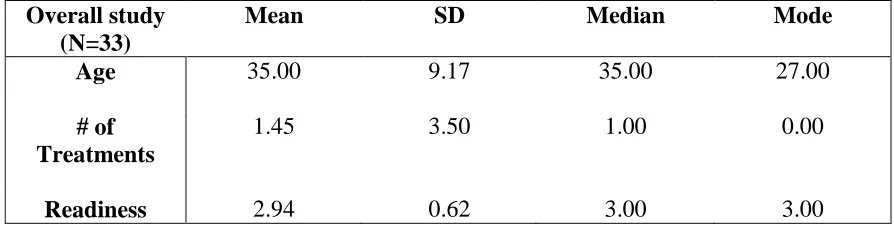
The study included 33 out of 78 participants randomly selected from the total population of 505 clients at The Willows over the duration of the study. The sample included 20 males and 13 females. Participants had a mean age of 35 and a mean of 1.5 prior attempts at treatment. The University of Rhode Island Change Assessment
1) precontemplative, 2) contemplative, 3) action, and 4) maintenance stage. Participants were indicated to have a readiness for treatment with a mean of 2.93 (see Table 4.1)
Table 4.1
Demographics of Participants
Overall study (N=33)
Mean SD Median Mode
Age 35.00 9.17 35.00 27.00
# of Treatments
1.45 3.50 1.00 0.00
Readiness 2.94 0.62 3.00 3.00
Leisure Functioning
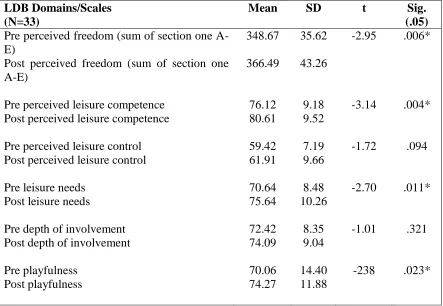
Leisure functioning was determined by using the Leisure Diagnostic Battery (LDB) designed for adults. It was used to measure perceived leisure competence, perceived leisure control, leisure needs, depth of involvement in leisure and playfulness (Burlingame, 2002). The total score of Section One of the LDB, comprised of all five sub-scales, resulted in the perceived freedom score, which was used to measure participants' leisure functioning.
Level of Participation
participation rating scale. Those who participated at a high level scored 3.0 or higher on the participation rating scale
Results for the Total Sample
Table 4.2
Summary of Paired Sample t test for the Leisure Diagnostic Battery for the Total Sample
LDB Domains/Scales (N=33)
Mean SD t Sig.
(.05) Pre perceived freedom (sum of section one
A-E)
348.67 35.62 -2.95 .006* Post perceived freedom (sum of section one
A-E)
366.49 43.26
Pre perceived leisure competence 76.12 9.18 -3.14 .004* Post perceived leisure competence 80.61 9.52
Pre perceived leisure control 59.42 7.19 -1.72 .094
Post perceived leisure control 61.91 9.66
Pre leisure needs 70.64 8.48 -2.70 .011*
Post leisure needs 75.64 10.26
Pre depth of involvement 72.42 8.35 -1.01 .321
Post depth of involvement 74.09 9.04
Pre playfulness 70.06 14.40 -238 .023*
Post playfulness 74.27 11.88
Hypothesis One
Hypothesis One stated:
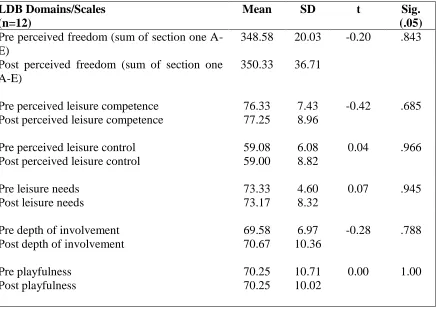
First, the Low Participation Group was tested. There were 12 participants in the low level of participation group. The total score for Section One, Perceived Freedom, was the score used to measure if any significant change occurred in perceived leisure
functioning. There was no significant change in perceived freedom in leisure, as indicated by the t test results, shown in Table 4.3. In addition, there was no significant change in any of the subscales of the LDB for those in the Low Participation Group.
Table 4.3
Summary of Paired Sample t test for the Leisure Diagnostic Battery for the Low
Participation Group
LDB Domains/Scales (n=12)
Mean SD t Sig.
(.05) Pre perceived freedom (sum of section one
A-E)
348.58 20.03 -0.20 .843 Post perceived freedom (sum of section one
A-E)
350.33 36.71
Pre perceived leisure competence 76.33 7.43 -0.42 .685 Post perceived leisure competence 77.25 8.96
Pre perceived leisure control 59.08 6.08 0.04 .966
Post perceived leisure control 59.00 8.82
Pre leisure needs 73.33 4.60 0.07 .945
Post leisure needs 73.17 8.32
Pre depth of involvement 69.58 6.97 -0.28 .788
Post depth of involvement 70.67 10.36
Pre playfulness 70.25 10.71 0.00 1.00
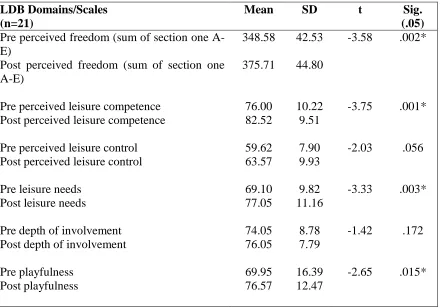
Next, the High Participation Group was tested (n=21). The total score for Section One, Perceived Freedom, was the score used to measure if any significant change
occurred in perceived leisure functioning. The High Participation Group showed an improvement in mean scores for all domains, as seen in Table 4.4. There was a
significant change in perceived leisure freedom (pretest M= 348.58, posttest M = 357.71, P < .05). The sub-scales also showed a significant change from pre- to post-treatment. As can be seen in Table 4.4, perceived leisure competence, leisure needs, and playfulness all showed a significant change. Based on these results, Hypothesis One was supported – those participants who had a high level of participation in the therapeutic recreation program experienced a significant increase in their perceived leisure functioning, while those who had a low level of participation did not change overall in their leisure
Table 4.4
Summary of Paired Sample t test for the Leisure Diagnostic Battery for the High
Participation Group
LDB Domains/Scales (n=21)
Mean SD t Sig.
(.05) Pre perceived freedom (sum of section one
A-E) Post perceived leisure competence 82.52 9.51
Pre perceived leisure control 59.62 7.90 -2.03 .056
Post perceived leisure control 63.57 9.93
Pre leisure needs 69.10 9.82 -3.33 .003*
Post leisure needs 77.05 11.16
Pre depth of involvement 74.05 8.78 -1.42 .172
Post depth of involvement 76.05 7.79
Pre playfulness 69.95 16.39 -2.65 .015*
Post playfulness 76.57 12.47
Hypothesis Two
Hypothesis Two stated:
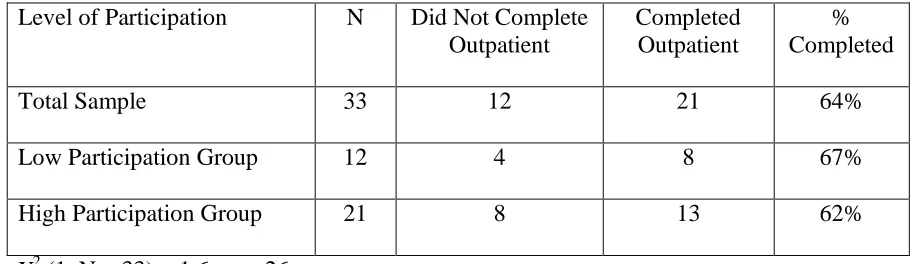
The indicator used to determine if a participant achieved and maintained sobriety was completion of the outpatient treatment program at Syracuse Behavioral Health (SBH) outpatient treatment. The overall group consisted of 33 participants. Of these, 12 were in the Low Participation Group and 21 in the High Participation Group (see Table 4.5). Of the Low Participation Group, 67% completed outpatient treatment, while 62% of the High Participation Group did so.
To determine if there was a relationship between level of participation in
therapeutic recreation programming and achieving and maintaining sobriety, a Chi square test was used. The results showed that there was no relationship between the two
variables (see Table 4.5). Table 4.5
Participation Groups and Achievement/Maintenance of Sobriety
Level of Participation N Did Not Complete Outpatient
Completed Outpatient
% Completed
Total Sample 33 12 21 64%
Low Participation Group 12 4 8 67%
High Participation Group 21 8 13 62%
Chapter 5
SUMMARY AND CONCLUSION
This study examined the how the level of participation in a therapeutic recreation program related to leisure functioning and the ability to achieve sobriety. The researcher specifically examined: 1) the relationship between the level of participation in a
therapeutic recreation program and its impact on leisure functioning as measured by the Leisure Diagnostic (LDB), and 2) the ability to achieve and maintain sobriety contingent on completion of the outpatient program at Syracuse Behavioral Healthcare (SBH).
In the review of the literature, there was little empirical evidence to support the significance participation in a therapeutic recreation program has on one’s long-term sobriety. The review of literature suggested further studies were needed to understand the role that therapeutic recreation has in the field of treating addiction.
This chapter presents a discussion of the results from examining the impact participation in a therapeutic recreation program has on leisure functioning and the ability to achieve and maintain sobriety. Conclusions and recommendations for future research are also offered.
Summary of Procedures
This study used a pre-experimental design, consisting of one group with pretest and posttest design. There were two different hypotheses tested in the study. The first hypothesis asked if level of participation in the therapeutic recreation program increased leisure functioning. The second hypothesis asked if level of participation in a therapeutic recreation program was related to achieving and maintaining sobriety. This section outlines the procedures of the study.
Selection of Subjects
The target population was individuals entering a 28-day substance abuse
treatment program at Syracuse Behavioral Health (SBH) the Willows inpatient treatment center. The only requirement for participation in this study was attendance in the
aftercare outpatient treatment program at SBH. A total of 78 patients were randomly selected to participate in this study. Of the 78 participants, 33 participants completed the entire study.
Instruments
The Leisure Diagnostic Battery designed for adult (LDB) was used to evaluate leisure functioning. The LDB is designed to measure perceived freedom in leisure, perceived leisure competence, perceived leisure control, leisure needs, depth of
Level of participation was based on a 4-point Likert scale, with one indicating no participation, two indicating a low level of participation, three a moderate level of participation and four, a high level of participation. Level of participation was a subjective rating by the CTRS conducting the group. Participants’ recorded level of participation was averaged over their time in the study. Those with an average of 3 or higher were designated as a high level of participation and those with a score of 2.9 or lower were designated as a low level of participation.
Achieving and maintaining sobriety was determined by completion of the outpatient treatment program at SBH. Participants were evaluated for remaining abstinent and for completion of the outpatient program, which was six months in duration.
Intervention
Participants in the study attended on average three therapeutic recreation sessions per week plus three social activities per week. The therapeutic recreation program was a leisure education based model addressing the following dimensions: leisure awareness, leisure attitude, leisure interest, communication skills, socialization and sober leisure activities
Treatment of Data
Summary of Findings
This section summarizes findings of the study, addressing relationship between participation in a therapeutic recreation program and a person’s ability to achieve and maintain sobriety, as well as improving a person’s leisure functioning.
Leisure Functioning
Leisure functioning was measured using the Leisure Diagnostic Battery (LDB) designed for adults. For this study, the total score of Section One of the LDB (perceived freedom score) was used to measure participants’ overall leisure functioning.
Results of the total sample (N=33) indicated that there was significant change in leisure functioning from pretest to posttest. All six scores indicated an increase in mean scores. Overall leisure functioning significantly increased, as did 3 of the 5 subscales: perceived leisure competence, .perceived leisure needs, and playfulness
Results of the low level of participation group (n=12) indicated that there was no significant change in perceived leisure freedom, nor in any of the subscales. Thus, those participants who did not engage fully in therapeutic recreation did not improve their overall leisure functioning.
Results of the high level of participation group (n=21) showed a significant increase in their overall leisure functioning, as well as a significant improvement in perceived leisure competence, perceived leisure needs, and playfulness.
Achieving and Maintaining Sobriety
The indicator used to determine if a participant achieved and maintained sobriety was completion of their outpatient treatment program at Syracuse Behavioral Health (SBH) outpatient treatment.
Results of the analysis showed that there was no relationship between level of participation in therapeutic recreation as an inpatient and a person’s ability to achieve and maintain sobriety. Thus, the second hypothesis in this study was not supported.
Conclusions
Based upon the findings and within the limitations of this study, the following conclusions can be made. First, level of participation in a therapeutic recreation program was related to an improvement in one’s leisure functioning. Those with higher levels of participation in therapeutic recreation showed greater improvement in leisure functioning. Though improvement in one’s leisure functioning is difficult to measure, the Leisure Diagnostic Battery for Adults (LDB) has been used successfully for both assessment and research. It was rigorously designed to measure perceived leisure competence, perceived leisure control, leisure needs, depth of involvement in leisure, and playfulness
(Burlingame, 2002). Because of its scope and reliability, the LDB best fit the needs of this study and was likely a highly valid and reliable measure.
Interestingly, depth of involvement and leisure control were not significantly related to level of involvement in therapeutic recreation.
Any increase in leisure functioning is a positive step toward engaging in healthy recreation and leisure activities, thus theoretically improving one’s ability to remain abstinent. Participants engaging at a low level of participation indicated a small but insignificant increase in perceived leisure freedom, perceived leisure competence and depth of involvement. There is no change in playfulness and a decrease in perceived leisure control and leisure needs. Even with no significant change in leisure functioning with this group, exposure to a therapeutic recreation program may initiate a change in their pursuit of leisure needed and introduces them to identify healthier recreation and leisure activities.
The second hypothesis in this study stated that there would be a relationship between level of participation in therapeutic recreation and maintaining abstinence. In fact, this study found that there was no correlation between participation in a therapeutic
recreation program and one’s ability to achieve and maintain sobriety. Of the 33
participants in the study, 21 participants or about every 2 out of 3 participants (63.6%) in the study remained abstinent six months after completing their inpatient treatment. Though the study established that there was no correlation between participation in an inpatient therapeutic recreation program for the treatment of people with substance abuse and the ability to achieve and maintain sobriety, it did not explore what relationship may exist between outpatient therapeutic recreation services and sobriety.
observer, which may have led to bias. Second, some participants had a history of repeated attempts at inpatient treatment, which could have led to manipulation of staff and the intervention process. Finally, the lack of an experimental group makes it possible to only examine relationships between variable, and does not allow one to draw conclusions about cause and effect.
Discussion and Implications
Previous research has indicated that healthy leisure activities are a cornerstone of
recovery from substance abuse. Deiser and Voight (1998) state that “the greatest potential
for use is during one’s free time” (p.78). Malkin and Benshoff (1996) believe that leisure and recreation skills are essential to any treatment program. In a study on women in
recovery, Hood (2003) states “that the women in her study identified their leisure
involvement as the turning point in their recovery process” ((p.76). The findings of this study support the idea that participation in a therapeutic recreation group can improve one’s chances at improving leisure functioning. While inpatients, those participants who participated at a high level in therapeutic recreation showed greater improvements in leisure functioning. The structure of the therapeutic recreation program, using a leisure education model, provided daily involvement in a healthy leisure pursuit.
recovering from the consequences of their use. For those who have attempted recovery from addiction, the biggest trigger for relapse is often boredom. When a person attempts to get sober, they need to change their leisure lifestyle. The lack of social support and meaningful leisure pursuit can lead to isolation and boredom, thus triggering the desire to use again.
A leisure education based intervention introduces participants to leisure
awareness, leisure attitude, leisure interest, communication skills, socialization and sober leisure activities. This form of intervention can reintroduce or educate a person
recovering from addiction to the skills, interests, and needs that are required to engage in healthy leisure pursuits, increase socialization, and offset boredom.
While there has been previous research on the importance of healthy leisure pursuits in relationship to the recovery from addiction, little if any, has been done on the impact participation in a therapeutic recreation intervention has on improving these skills. This study has identified that a therapeutic recreation intervention does have the potential
to improve a person’s leisure functioning while an inpatient. This can improve a person’s ability to choose a healthier leisure lifestyle which previous studies have indicated as an essential part of achieving and maintaining sobriety.
outpatient programming, it was not targeted toward maintaining a healthy leisure lifestyle. The implementation of a therapeutic recreation program for outpatient
treatment, as well as halfway houses and supportive living environments, would reinforce the knowledge and opportunity to practice the skills the participant acquired during their inpatient treatment.
The findings of this study can be far reaching, including different levels of
treatment for substance abuse as well as other addictions. Many people seeking treatment for substance abuse do not enter an inpatient treatment program on the first attempt at recovery. Most will attend a day program (outpatient treatment) or private counseling. Most of the participants in this study have had numerous attempts at recovery. Few, if any, outpatient treatment programs have a therapeutic recreation program in place. In most cases socialization and recreation education is done once a week by a social worker. Studies have shown that a person seeking treatment for substance abuse who attends outpatient programs or private counseling have a high rate of relapse. It is reasonable to expect that the implementation of therapeutic recreation groups in outpatient treatment programs, halfway houses, and supportive living programs, would improve their chances of remaining sober and, at the least, improve their leisure lifestyle to a healthier level.
exposure to a therapeutic recreation program can increase one’s leisure awareness,
interest, needs and social skills thus improving overall life satisfaction.
Recommendations for Further Study
There were a number of factors that limited finding in this study. These include; 1) the lack of an experimental group, 2) the limited numbers of participants in the study,
and 3) the short length of time (six months) for following up on the participants’ ability to
maintain sobriety. The limitations and findings of the study suggest further research is needed.
The Leisure Diagnostic Battery proved to be an acceptable tool for this study. There is extensive documentation and information on the reliability and validity of the LDB. Reliability coefficients tend to be .80 or better (Burlingame, 2002; Witt, 2009) The Leisure Diagnostic Battery has been used in several studies as a dependent variable. Witt reported that almost all studies utilizing the LDB have yielded successful discriminates between groups.
The process to evaluate the level of participation was a subjective measurement recorded by the CTRS conducting the interventions. While the pretesting provided evidence that the Likert rating scale used to measure participation level was reliable, the
ability of the CTRS conducting the group to accurately assess the participants’ level of
participation could be questioned. Possible ways to overcome this limitation would be to have one or two independent observers for all groups and calculate the level of
observers throughout the study would strengthen validity and reliability. Another
possibility for more accurate rating of level of participation would be to record the groups on video and asses level of participation after the group is completed.
The lack of an experimental group and limited number of participants in the study were other limitations. The nature of a 28-day inpatient treatment program does not allow for an experimental group. Providing alternative treatment options in lieu of therapeutic recreation would be one possible method of establishing a control or equivalent group. As for the number of participants in the study, the small number was somewhat a function of
the researcher’s ability to complete multiple observations at one time. It may be possible to increase the amount of observation data that could be collected, and thus include more participants, by having two independent observers or by recording the groups on video. Also, if all patients were part of the study, this would lend itself to a more generalizable outcome.
Achieving and maintaining sobriety is difficult to measure. Relying on those with addiction to admit that they have relapsed is a problem in itself. Most addicts have feelings of guilt and shame when they relapse and are not likely to be forthcoming with this information. Also the six month time period used to assess the maintaining of sobriety is limited. A long term longitudinal study of 3 years would produce more valid results. Having participants check in every month for random urine screens would be another method to increase validity of the measure of sobriety. In addition, the
As the review of literature suggested, a healthy recreation and leisure life style is a key component in overcoming addiction. How does a person develop and maintain a healthy leisure lifestyle? As this study has shown, an intervention of therapeutic
recreation increases a person’s leisure functioning. More research is needed to assess the effectiveness of a therapeutic recreation program and its impact on helping those with addiction maintain their healthy leisure functioning and their sobriety
Concluding Statement
REFERENCES
Bernstein, D. P., & Fink, L. (1998). Childhood trauma questionnaire: A retrospective self-report. The Psychological Corporation. San Antonio, TX: Harcourt.
Bruce, P.D., Pollard, R. A., Blakley, T. L, Baker, W.L., & Vigilante, D. (1996).
Childhood trauma, the neurobiology of adaptation & use-dependent development of the brain: How states become traits. Infant Mental Health Journal. Retrieved January 31, 2007 from http: / / www.trauma-pages.com/a/perry96.php.
Bruce, P.D.. (2001). Violence and childhood: How persisting fear can alter the
developing child’s brain The Child Trauma Academy. Retrieved January 31, 2007 from http: / / www.ChildTrauma.org.
Bruce, P.D. (1999). Memories of fear: How the brain stores and retrieves physiologic states, feeling, behavior and thoughts from traumatic events. The Child Trauma Academy. Retrieved January 31, 2007 from http: / / www.ChildTrauma.org.
Child Development Info. (2007). Erikson’s eight stages of development. Retrieved February 24, 2007 from http://www.childdevelopmentinfo.com
Deiser, R. B., & Voight, A. (1998). Therapeutic recreation and relapse prevention. Parks& Recreation, 33, (S) 78-84.
DiClemente, C .C., Schlundt, D., & Gemmell, L. (2004). Readiness and stages of change in addiction treatment. The American Journal on Addiction,13,(2), 103-118.
Elder, C., Barnes, J., Dunn-Leaver, D., Nagy, S. & Leeper, J. (2001) The influence of group membership on multiple substance use. Journal of Alcohol &Drug Education,47(1), 19 30.
Ford, J. D., & Kidd, P. (1998). Early childhood trauma and disorders of extreme stress as predictors of treatment outcome with chronic posttraumatic stress disorder. Retrieved January 31, 2007 from http: / / www.trauma-pages.com/a/ford98.php.
Galanter, M., Dermatis, H., Keller, D., & Trujillo, M. (2002). Network therapy for cocaine abuse: Use of family and peer supports. The American Journal on Addiction,11(2), 161-166.
Joe, G. W., Broome, K.M., Rowen-Szal, G.A., & Simpson, D.D. (2002). Measuring patient attributes and engagement in treatment. Journal of Substance Abuse Treatment,22(4), 183-196.
LePage, J.P., & Garcia-Rea, E.A. (2008). The association between healthy lifestyle behaviors and relapse rates in a homeless veteran population. The American Journal of Drug and Alcohol Abuse,34, 171-176.
Malkin, M. J., & Benshoff, J.J. (1996). Therapeutic recreation interventions in substance abuse. Parks & Recreation, 31(1), 26-29.
Mejta,C.L., Bokos, P..J., Mickenberg, J., Maslar, M.E. & Senay, E. (1997). Improving substance abuse treatment access and retention using A case management approach. Journal of Drug Issues,27(2), 329-340.
Miller, W.R., & Wilboyrne, P.L. (2002). Mesa grande: A methodological analysis of clinical trials of treatment for alcohol use disorders. Society for the Study of Addiction to Alcohol and other Drugs Addiction,97, 265-277
Mosby’s (2002). Medical, nursing, & allied health dictionary (6th Ed.). St. Louis London
Rohsenow, D.J., Martin, R.A. & Monti, P.M. (2005) Urge-specific and lifestyle coping strategies of cocaine abusers. Drug & Alcohol Dependence, 78(2), 211-219.
Shank, J., & Coyle, C. (2002). Therapeutic recreation in health promotion and rehabilitation. State College, PA: Venture.
Smith, J.E., Meyers, R.J., & Miller W.R. (2001). The community reinforcement approach to the treatment of substance use disorders. The American Journal of Addiction, 10,(Sup). 51-59.
Wegner, L., Flisher, A. J., Muller, M. & Lombard, C. (2006). Leisure boredom and substance abuse among high school students in South Africa. Journal of Leisure Research, 38(2), 249-266.
Wild, C.T., Cunningham, J.A. & Ryan, R.M. (2006). Social pressure, coercion and client engagement at treatment entry: a self-determination theory perspective. Addictive Behaviors. 31(10), 1858-1872.
APPENDIX A
Dear Charles,
Permission is granted to include the LDB for adults in your thesis paper.
You will give credit to origin from Venture Publishing, Inc., of course.
With best regards,
Kay
Kay Whiteside
Venture Publishing, Inc. 1999 Cato Avenue State College, PA 16801
Phone: 814-234-4561 Fax: 814-234-1651
LEISURE DIAGNOSTIC BATTERY
Version C of the Leisure Diagnostic Battery Long Form is intended for use with adults. Information
about the conceptualization, development, testing procedures, scoring, reliability and validity of any of
the LDB forms can be obtained by consulting the Leisure Diagnostic Battery Users Manual. Additional
copies of any of the forms or copies of the Users Manual can be obtained from Venture Publishing, 1999
Cato Avenue, State College, PA 16801.
Copyright 1987 © by Peter A. Witt and Gary W. Ellis. Venture Publishing is the licensed distributor of
the Leisure Diagnostic Battery Users Manual and the various LDB scales. No part of the material
protected by this copyright and license may be reproduced in any form or by any means, electronic or
mechanical, including photocopying, recording, or by any information storage and retrieval system,
Leisure Diagnostic Battery Long Form Version C Question Booklet
Name Gender Age Date
SCALE A
Instructions: This survey deals with how you feel about your recreation and leisure experiences. These
include participation in activities such as reading, hobbies and crafts, social activities, music, sports, etc.
Please read each of the following items and circle the response that best reflects your feelings about each
,
!
,.I
",
Strongly Strongly
j . Agree Agree Neither Disagree Disagree
16. I'm usually good at the new recreation SA A N D SD
activities I try.
17. I'm a better player than most people. SA A N D SD
18. I know many recreation activities SA A N D SD that are fun to do.
19. I'm satisfied with how well I can do SA A N D SD
most recreation activities.
20. I'm good at the recreation activities SA A N D SD
I do with other people.