1
CHAPTER I
INTRODUCTION
This first chapter explains the background of the study, the problem statement, the objectives of the study, the significance of the study, the scope of the study, the research methods, the underlying theory, and the definition of term.
A. Background of the Study
“No” is a very simple word that can be used to refuse a request or an order but is there anyone whose face is being threatened with that word? On the one hand, refusal, as one of the speech acts occurs when a speaker directly or indirectly says no to a request or an order and on the other hand, it may threaten the hearer’s positive face because it means that what the hearer wants is not approved by the speaker.
Refusal belongs to the illocutionary act of commissive just like promising, threatening, swearing, etc. Every language has this kind of speech acts but it is certainly delivered differently. One might feel uncomfortable and consider that no
is so rude in a certain context but for others it might be acceptable in a different situation. That is why refusal is considered as a face threatening act.
2
sorry)” and “Itu tidak mungkin (That’s impossible)” are utterances said by the same person but the strategies used are different depending on whom he is talking to (the hearer), how far the distance between the speaker and the hearer is, and where the conversation takes place.
There are two kinds of face threatening acts (hereafter FTAs). Those are acts which threaten negative face of the hearer such as orders and request, suggestion, advice, remindings, threats, warnings, dares, offers, promises, compliments, and expression of strong negative emotions towards the hearer like hatred and anger; and acts which threaten the positive face of the hearer such as disagreements or contradiction, critism, contempt or ridicule, complaints and reprimands, accusation, insults, disapproval, challenges, and so forth (Brown and Levinson, 1987:65).
A specific strategy is needed to mitigate or to minimize FTAs. According to Brown and Levinson (1987: 60 and 74-77), politeness strategies are developed in order to save the hearers' face. Face refers to the respect that an individual has for him or herself, and to maintain that "self-esteem" in public or in private situations. There are five types of politeness strategies; (1) Bald on record strategy, (2) Negative politeness strategy, (3) Positive politeness strategy, (4) Off record strategy, and (5) Don’t do the FTAs. The use of FTAs is also influenced by three social factors, which are power, distance, and ranking of imposition.
3
order to get a harmony atmosphere. There are six maxims for politeness principle: tact maxim, generosity maxim, approbation maxim, modesty maxim, agreement maxim, and sympathy maxim.
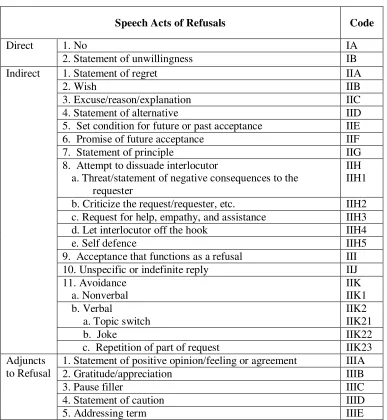
There are also refusal strategies provided by Beebe and Takahashi (1990: 72-73 in Nguyen, 2006:30). They classify the refusal using a sequence of semantic formula. The classification consists of direct strategy, indirect strategy, and adjuncts to refusals strategy.
Speech acts are included in the pragmatic study just like deixis, (at least in part), implicature, presupposition, and aspects of discourse structure (Gazdar, 1979 in Nadar, 2009:5). Besides context, pragmatics covers another aspects of act—the speaker, the hearer (interlocutor), the purpose of utterance, the utterances as the form of action, and the utterance as the product of verbal action (Leech, 1991 in Nadar, 2009:7).
Speech acts are necessary for effective communication in any language. Yule (1996: 47 and 57) defines speech act as the actions performed via utterance. Phonetically, an utterance is a unit of speech bounded by silence. Linguists sometimes use utterance simply to refer to a unit of speech under study (glossary of linguistic terms).
4
perlocutionary act (the impact of the utterance which the speaker said to the listener in one of speech event).
Searle (1975 in Trosborg 1994:14) classifies speech act into five major classes, namely representatives (e.g. acts of stating, asserting, denying, and confessing), directives (e.g. requesting, suggesting, and advising), commissive (e.g. promising, offering), expressive (e.g. thanking, congratulating, and welcoming), and declaration (e.g. appointing, resigning, surrendering).
The purpose of the representatives speech act is that the speaker wants the hearer to believe that his/her utterance is true. Directives speech act tries to get someone do something as uttered by the speaker. By performing commissive speech act, the speaker commits him/herself to a future action. The purpose of expressive speech act is to express the speaker’s psychological state of mind. And, using declarations speech act, there will be a change in the institutional state of affairs: the speaker changes the world via the words.
5
friend titled “Pragmatic Transfer in Refusals: A Comparative Study of Korean and English”, and (4) a study done by Anchalee Wannaruk titled “Pragmatic Transfer in Thai EFL Refusals.”
Since the studies mentioned before were done based on the spoken interaction, the writer is interested in studying the act of refusals in a novel.
The writer chose a novel entitled Ayat-ayat Cinta written by Habiburrahman El Shirazy with certain thoughts which are:
1. It is a best seller novel,
2. It involves two different cultural backgrounds, Indonesian and Egyptian (because the choice of refusal strategies may vary across languages and cultures).
3. It comprises the values of principle and of social in different culture.
B. Problem Statement
Based on the background of this study, the writer wants to find out the realization of the speech act of refusals in the novel, the refusal strategies used in it, and the realization of speech acts of refusals according to power relation.
6
C. Objectives of the Study
Related to the problem statements, the objectives of the study are: 1. To describe the realization of speech act of refusals in the novel. 2. To describe the refusals strategies used in the novel.
3. To describe the realization of speech acts of refusal according to power relation.
D. Significance of the Study
The study is hoped to be significant theoretically and practically.
1. Theoretically, this study would give such contribution to the study of pragmatics specially the analysis of refusal acts and become reference for other studies of the same topic.
2. Practically, this study would be useful for those who are interested in understanding the effectivness of refusal strategy in order to get good interaction between the speaker and the hearer and to gain the purpose of the communication.
E. Scope of the Study
The scopes of the study are as follows.
1. This study analyzes the language use in a novel entitled Ayat-ayat Cinta. 2. The data are all utterances containing refusal responses toward directive
7
3. The data analysis will use the classification of refusals strategies by Beebe and Takahashi (1990: 72-73 in Nguyen, 2006: 30-31) and the performative verb hypothesis.
F. Research Methods
This study used a pragmatic approach because it focuses on the language use for communication in a certain situation. The language meaning is defined in its relation to the speaker or the language user.
Based on the objectives and the data collection, this is a descriptive research because it describes what is. It involves the description, recording, analysis, and interpretation of conditions that exist. It involves some type of comparison or contrast and attempts to discover relationships between existing non-manipulated variables (Best, 1981:25).
Based on the data analysis procedure, this is a qualitative study, because the data collected are in the form of words, pictures, not numbers. The study report will consist of data quotations to give the description of the report presentation (Moleong http://www.scribd.com/doc/53171929).
8
G. Underlying Theory
Pragmatics is the study of how language is used for communication (Parker, 1986:11 in Nadar, 2009:4).
Pragmatics is the study of those relations between language and context that are grammaticalized, or encoded in the structure of language. Such a scope for pragmatics would include the study of deixis, including honorifics and the like, and probably the study of presupposition, and speech acts (Levinson, 1983:9).
Actions performed via utterances are called speech acts such as apology, complaint, compliment, invitation, promise, or request. These descriptive terms for different kinds of speech acts apply to the speaker’s communicative intention in producing an utterance. The speaker normally expects that his or her communicative intention will be recognized by the hearer. Both speaker and hearer are usually helped in this process by the circumstances surrounding the utterance. These circumstances, including other utterances, are called the speech event (Yule, 1996:47).
The concept and theory used to analyze the data of this study is the theory of speech act, the directive speech act, the acts of refusal, the face threatening acts (FTAs), the theory of politeness strategy, the refusal strategy, and the Illocutionary Force Indicating Device (IFIDs).
9
H. Definition of Term
The definitions of terms in this study are:
1. Directive speech act (DSA) is an act which is done by the speaker in order to get the hearer do something as uttered by the speaker.
2. A Refusal is a negative response to an offer, request, invitation, suggestion, etc. Vandervaken (1990:185) defines the speech act of refusal as follows: “The negative counterparts to acceptances and consents are rejections and refusals. A refusal is the illocutionary denegation of the acceptance of a request.
3. Face threatening acts are acts that infringe on the hearers' need to maintain his/her self-esteem, and be respected.
10
CHAPTER II
REVIEW OF LITERATURES
This second chapter explains the related previous study, the theories underlying the study; the theory of speech act, the directive speech act, the acts of refusal, the face threatening acts (FTAs), the politeness strategy, the refusal strategy, and the Illocutionary Force Indicating Device (IFIDs).
A. Previous Study
This part provides studies which have been done related to the study of pragmatics particularly acts of refusal in relation to the politeness strategy, cultural differences, cross-cultural study. Among others are:
1. “The Cross-Cultural Pragmatics: Refusals of Requests by Australian Native Speakers of English and Vietnamese Learners of English” by Nguyen, Thi Minh Phuong (Disertation: TESOL Studies 2006).
The study was done to investigate similarities and differences in refusals of requests between Australian native speakers of English (AEs) and Vietnamese learners of English (VEs) using a modified version of the discourse completion task (DCT).
11
communicated with their interlocutors, VEs were more sensitive to the social power relation and the social distance of the requesters. In addition, and related to differences in culture, AEs and VEs also differed in the ways they say “NO” to their conversational partners. VEs were apt to express refusals more elaborately. They used more statements of regret, more statements of sympathy, more addressing terms and more reason/excuse/explanations in their refusals than AEs. The excuse/reason/explanations given by VEs revealed their reluctance to express their disinclination to comply, in contrast to the AEs.
2. “The Refusals Realizations in Three Different Cultures: A Speech Act Theoretically-based Cross-cultural Study” by Saad Ali W. Al-Kahtani (Journal of Language and Translation, Vol. 18, J. King Saud University, published 2005).
The study aimed to investigate speech acts of refusals in different cultures and problems posed to L2 learners when performing refusals in the target language.
12
ground for increased interaction between native speakers of English and their non-native interlocutors
3. “The Pragmatic Transfer in Refusals: A Comparative Study of Korean and English” by Ji Hyun Kim and Eun Young Kwon (Keimyung University; Department of English Education 2800, Dalgubeoldaero, Dalseo-Gu, Daegu, 704-701, Korea 2010).
The study aimed to examine the practice of pragmatic transfer by Korean learners of English. Interlanguage pragmatic studies had contributed a great deal of evidence which suggests that the pragmatic knowledge of first language (L1) of the second language (L2) learners had a significant impact on their pragmatic performance in the L2. Among other speech acts, a refusal could be pragmatically challenging for L2 learners since it included face-threatening act and this resulted that learners often used L1 strategies to deal with this uncomfortable situation. Koreans had been known to use overt strategies in refusals. The current study examined how such strategies are transferred to their L2 (English).
13
tendency to use their L1 pragmatic strategies in L2. This study suggested the importance of instruction for appropriate pragmatic strategies.
4. “The Pragmatic Transfer in Thai EFL Refusals” by Anchalee Wannaruk (School of English, Suranaree University of Technology Nakhon Ratchasima, Thailand; Regional Language Centre Journal 39.3 © 2008 SAGE Publications, Los Angeles, London, New Delhi, Singapore and Washington DC).
This study investigated similarities and differences between refusals in American English and Thai and incidences of pragmatic transfer by Thai EFL learners when making refusals. The participants of the study included Thai and American native speakers and EFL learners. All of them were graduate students.
14
B. Underlying Theory
The concept and theory used to analyze the data of this study is the theory of speech act, the directive speech act, the acts of refusal, the face threatening acts (FTAs), the theory of politeness strategy, the refusal strategy, and the Illocutionary Force Indicating Device (IFIDs).
1. Theory of Speech Act
Leech (1983:11) mentions that Pragmatics is the study of linguistics communication based on conversational principles and it studies meaning in relation to speech situation, reference to one or more of the following aspects: 1. Addressers and addressees
This will be shorthand for speaker(s)/writer(s) and hearer(s)/reader(s). The use of the abbreviations s and h does not restrict pragmatics to the spoken language. A significant distinction can be made between a receiver (a person who receives and interprets the message) and an addressee (a person who is an intended receiver of the message).
2. The context of an utterance
15
3. The goal of an utterance
A goal or a function of an utterance is a talking about its intended meaning, or someone’s intention in uttering it.
4. The utterance as a form of act or activity: speech act 5. The utterance as a product of a verbal act
John L. Austin proposes the concept of speech acts in his book entitled
How to Do Things with Words (1955:5-6). He mentions that there are two kinds of utterances in communication. They are performative and constative utterances. A performative utterance is an utterance which is used to form an action, for example “I swear I won’t cheat”. Whereas, a constative utterance is an utterance which the verb is expressing something and the truth of the utterance can be proved by using the knowledge of the world, for example “The world is round”.
Austin (1955:120) distinguished three kinds of acts related to the utterances. They are locutionary, illocutionary, and perlocutionary act.
(1) Locutionary Act
16
(2) Illocutionary Act
This act is performed via the communicative force of an utterance. The forms for this act are inviting, promising, ordering, advising, excusing, and apologising. The utterance “It’s too noisy” is not merely a statement. It may be uttered to inform the hearer that the sound of which he is doing is too noisy.
(3) Perlocutionary Act
Perlocutionary act is the impact of the utterance which the speaker said to the hearer in one of speech event. The impact of an indirect speech act “It’s too noisy” uttered by a speaker to the hearer may be to stop making the noise or to turn down something which produces the loud noise.
To indicate the illocutionary force, there is a device which is called IFID (Illocutionary Force Indicating Device). It is indicated by the presence of verbs, which are classified as performative verbs.
Searle (1969) classifies the speech act into five types, representatives, directives, expressives, commissives, and declarations. Levinson (1983:240) explains them as follows:
a. Representative
17
Jaya”. The speaker tries to describe five big islands in Indonesia through his utterance.
b. Directive
These are acts which are attempts by the speaker to get the addressee to do something, such as requesting, quetioning, commanding, inviting, forbidding, suggesting, etc, for example “Be quiet, please!”, “ You’d better see a doctor” Those utterances are acts of commanding which the speaker wants the listener to be silent and of suggesting which the speaker suggests the listener to see a doctor.
c. Expressive
These are acts which express a psychological state of the speaker, such as apologizing, welcoming, thanking, praising, congratulating, regretting, etc, for example “I really do apologyze for my son’s impoliteness”. That is an act of apologizing, which is uttered by a father whose son has been impolite to his guest.
d. Commissive
18
e. Declaration
These are acts which effect immediate changes in the institutional state of affairs and which tend to rely on elaborate extra-linguistic institution, such as ‘declaring war, excommunicating, firing, resigning, etc, for example “I declare you husband and wife”. There is a change of power relation after the priest uttered that act.
Parker (1986) mentions that speech act can be in the form of direct and indirect, literal and non literal. For example, an utterance ”Bring me my coat” is an illocutionary act of begging and it can be categorized as a direct speech act. While, the utterance ”Could you bring me my coat?” is different from the former one. The mood of that illocutionary act is questioning but the function is requesting. The utterance is categorized as an indirect speech act. (in Nadar, 2009:17-19).
The direct and indirect speech acts can be identified from the syntactic form. Nadar explains it as follows:
(1) The world is round; the mood of the utterance is a declarative sentence which functions to give information.
(2) What time is it? The mood of the utterance is an interrogative sentence which functions to ask about something.
(3) Get off my foot! The mood of the utterance is an imperative sentence which functions to ask someone to do something.
19
Since the indirect speech act is an utterance which is different from the sentence mood, the purpose or the intention of the indirect speech act may be different depending on the context. For example:
(4) “Can you move forward?” is an indirect speech act. The mood of the utterance is an interrogative sentence but the purpose is to ask someone to do something.
(5) “I don’t have anyone to go with”. The mood of the utterance is a declarative sentence but the purpose is to ask for someone to go together with the speaker.
2. Directive Speech Act
One of the speech acts classified by Searle (1969) is directive. Yule (1996:54) explains directive as a kind of speech act that speakers use to get someone else to do something. They express what the speakers want. They are commands, orders, requests, suggestions, stc. In using a directive, the speakers attempt to make the world fit the words and the listener is responsible for the realization of the changes.
20
of the three utterances is asking the listener to do something which are sign the paper, take a taxi, and wash hands.
3. Acts of Refusal
Refusing is included in the illocutionary act of commissive, just like rejecting, promising, commiting, threatening, etc. Vandervaken (1990:185) defines the speech act of refusal as follows: the negative counterparts to acceptances and consents are rejections and refusals. A refusal is the illocutionary denegation of the acceptance of a request while rejection is the illocutionary denegation of acceptance of an offer.
Al Kahtani, (2005:37) considered that refusal is a face-threatening act among the speech acts for it threatens the face wants of the speaker and the hearer by running contrary to their face wants. The face of the speaker or listener is risked when a refusal is called for or carried out. Consequently, refusals, as sensitive and high-risk, can provide much insight into speaker’s pragmatics. To perform refusals is highly indicative of one's non-native pragmatic competence. In many cultures, how one says "no" is probably more important than the answer itself. Therefore, sending and receiving a message of "no" is a task that needs special skill. The interlocutor must know when to use the appropriate form and its function depending on each group and their cultural-linguistic values.
21
4. Face Threatening Acts (FTAs)
Goffman in Brown and Levinson (1987:61) defines face as something that is emotionally invested, and that can be lost, maintained, or enhanced and must be constantly attended to in interaction.
Brown and Levinson (1987:61) state that face is the public self-image that every member wants to claim for himself. It consists of two related aspects:
(1) Negative face: the basic claim to territories, personal preserves, rights to non-distraction—i.e. to freedom of action and freedom from imposition. (2) Positive face: the positive consistent self-image or “personality” (crucially
including the desire that self-image be appreciated and approved of) claimed by interactants.
According to Goffman (1967 in Nguyen), there may be several reasons why people want to save their face. They may have become attached to the value on which this face has been built, they may be enjoying the results and the power that their face has created, or they may be nursing higher social aspirations for which they will need this face. Goffman also defines “face work”, the way in which people maintain their face. This is done by presenting a consistent image to other people. And one can gain or lose face by improving or spoiling this image. The better that image, the more likely one will be appreciated. People also have to make sure that in the efforts to keep their own face, they do not in any way damage the others’ face.
22
reminding, threats, warnings, dares, offers, promises, compliments, and expression of strong negative emotions towards the hearer like hatred and anger; and acts which threaten the positive face of the hearer such as disagreements or contradiction, critics, contempt or ridicule, complaints and reprimands, accusation, insults, disapproval, challenges, and so forth (Brown and Levinson, 1987:65).
Brown and Levinson (1987: 74-77) also explains that in its use the FTAs are influenced by three social factors, they are: social distance, relative power, and absolute ranking. The explanation of the three factors is as follows:
1. Distance is a symmetric social dimensions of similarity or difference within which speaker and hearer stand for the purpose of this act. An important part of the assessment of distance will be usually measures of social distance based on the stable social attributes. The reflex of social closseness is, generally, the reciprocal giving and receiving of positive face.
2. Power is an asymmetric social dimension of relative power. That power (speaker and hearer) is the degree to which hearer can improve his own plans and his own self-evaluation (face) at the expense of the speaker’s plans and self-evaluation.
23
5. Politeness Strategy.
Brown and Levinson (1987:60) classify the politeness strategies into five namely bald on record strategy, positive politeness strategy, negative politeness strategy, off record strategy, don’t do the FTAs. The following figure shows strategies that are chosen when a speaker does an FTA to a listener according to Brown and Levinson (1987:69).
a. Bald on Record Strategy
Doing an act baldly, without redress, involves doing it in the most direct, clear, unambiguous and concise way possible (e.g. for doing a request, saying “Do X!). Normally, an FTA will be done in this way only if the speaker does not fear retribution from the addressee, for example, in circumstances where (a) speaker and hearer both tacitly agree that the relevance of face demands may be suspended in the interest of urgency or efficiency; (b) where the danger to hearer’s face is very small, as in offers, requests, suggestions that are clearly in hearer’s interest and do not require great sacrifices of speaker (e.g. “Come in” or “Do sit down”);
24
and (c) where speaker is vastly superior in power to hearer, or can enlist audience support to destroy hearer’s face without losing his own (Brown and Levinson,1987:69).
b. Positive Politeness Strategy
Positive politeness is oriented toward the positive face of hearer, the positive self-image that he claims for himself. Positive politeness is approach based; it “anoints” the face of the addressee by indicating that in some respects, speaker wants hearer’s wants (e.g. by treating him as a member of an in group, a friend, a person whose wants and personality traits are known and liked).
c. Negative Politeness Strategy
Negative politeness is oriented mainly toward partially satisfying (redressing) hearer’s negative face, his basic want to maintain claims of territory and self determination. Negative Politeness, thus, is essentially avoidance based, and realizations of negative politeness strategies consist in assurance that the speaker recognizes and respect the addressee’s negative face wants and will not (or will only minimally) interfere with the addressee’s freedom of action (Brown and Levinson 1987:70).
d. Off Record Strategy
25
speaker wants to do an FTA, but wants to avoid the responsibility for doing it, he can do it off record and leave it up to the addressee to decide how to interpret it.
Such off record utterances are essentially indirect uses of language: to construct an off record utterance one says something that is either more general (contain less information in the sense that it rules out fewer possible states of affair) or actually different from what one means (intends to be understood). In either case, hearer must make some interference to recover what was in fact intended (Brown and Levinson 1987:211).
e. Don’t do the FTA
Don’t do the FTA means that speaker avoids offending hearer at all with this particular FTA. Of course the speaker also fails to achieve his desired communication (Brown and Levinson 1987:72). In short, Don’t do the FTA means giving up refusing.
6. Refusal Strategy
Beebe and Takahashi carried out the research on the refusal speech act using some refusal strategies they provided (1990: 72-73 in Nguyen, 2006:30). The classification of the refusal strategy which uses a sequence of semantic formula consists of direct strategy with two sub-strategies, indirect strategy with eleven sub-strategies, and adjuncts to refusals strategy with five sub-strategies.
cross-26
cultural pragmatics to refer to the same concept. A semantic formula may consist of a word, a phrase, or a sentence that meets a given semantic criterion or strategy. The following is the classification of semantic formula proposed by Beebe (in Nguyen, 2006:30).
I. Direct 1. “No”
In this strategy, the refuser uses a flat “no” which is an FTA. It is usually followed by language softeners, except in a few cases, when people are extremely direct.
2. Statement of unwillingness/inability
This strategy uses some expressions which contain negations such as by using the negative particle “Not”, or by using any word that semantically negates a proposition.
For example: “I don’t need your money.” II. Indirect
1. Statement of regret
The words “sorry” or “regret” is used when someone has made a mistake and feels bad about that.
For example: “I’m sorry for waking you up so early.” 2. Statement of wish
In this strategy, the refuser indirectly refuses the request by indicating a wish. For example: “I wish I could come to the meeting.”
27
The refuser indirectly refuses the request by indicating some reasons, which may be general or specific.
For example:”I am rather busy this week”.
4. Statement of alternative
In this strategy, the refuser suggests an alternative so that the request can be fulfilled.
For example: “I don’t have much time today, how about tomorrow?”
5. Set condition for future or past acceptance
In this strategy the refuser uses a reason which aims to direct the refusal to a situation when it is better if the requester has asked in advance.
For example: “I would be able to correct the paper if I had a day off.”
6. Promise of future acceptance
In this situation, the refuser makes a promise that the requests will be accomplished later, when there is a chance to complete it.
For example: “I’ll treat you next time.”
7. Statement of principle
In this strategy, the refuser sticks to a statement or a rule which has been followed for a long time. Disobeying it means violating the principle. For example: “I will never tell a lie.”
8. Attempts to dissuade the interlocutor
a. Threat/statement of negative consequences
28
For example: “I will never see you again if you hurt me.”
b. Criticize the request/requester, etc.
In this strategy, the refuser criticizes the requester of what has been said or done.
For example: “Don’t call me a chicken!”
c. Request for help, empathy, and assistance by dropping or holding the request.
For example: “Well, I’ll try to think about it.” d. Let the interlocutor off the hook
For example: “Don’t worry! It’ll be fine.” e. Self defence
For example: “I’ve tried hard to get the information but he keeps silent.”
9. Acceptance that functions as a refusal
For example: “Sure, I’ll visit you someday when I am free.” 10. Unspecific or indefinite reply
For example: “I’ll see what I can do.” 11. Avoidance:
a. Nonverbal, silence, hesitation, physical departure For example: “I’m so sorry (sobbing)”.
b. Verbal
29
Repetition of part of request III. Adjuncts to Refusals
These strategies include adjuncts which function as extra modifications to protect the speaker’s positive face.
1. Statement of positive opinion/feeling or agreement For example: “I’d love to help.”
2. Gratitude/appreciation For example: “Thanks!”
3. Pause filler
For example: “Well, let see what I can do,” 4. Statement of caution
For example: “You’d better not smoke.”
5. Addressing terms
For example: “I am really sorry, Sir!”
7. Illocutionary Force Indicating Device (IFIDs)
Illocutionary Force Indicating Devices (IFIDs) is used to indicate the characteristics of illocutionary acts. It is indicated by the presence of verbs, which are classified as performative verbs.
30
with certain illocutionary force, or else that it constitutes the performance of a certain illocutionary act.”
Yule (1996:50) points out, “Most of the time, however, there is no performative verb mentioned. Other IFIDs which can be identified are word order, stress, and intonation”.
The act of refusal must be regarded as the speaker’s inability and unwillingness to perform the request uttered by the requester for some reasons, regardless of whether it is expressed sincerely or insincerely. The conditions include the preparatory condition [P], sincerity condition [S], and illocutionary intention [I]. The act of refusal can thus be defined as an utterance in which:
[P] S is unable and/or unwilling to do A
[I] S intends that Ube a reason for H to believe that S is unable or unwilling to do A
[I] S reflexively-intends that H take U to be a reason to believe that S is unable or unwilling to do A.
A performative verb is one which designates a specific speech act and which, if used appropriately, counts as the performance of the speech act. In his later work, Austin dropped this distinction in favor of a distinction between explicit performatives (like I promise it will never happen again) and primary or implicit performatives (like It will never happen again, functioning as promise). A performative verb in a performative use can typically be accompanied by hereby
(Azis, 2012).
31
moves. A head act is that part of the sequence of [responses] which might serve to realise [a particular] act independently of other elements. The other elements which can occur either before or after a head act are called supportive moves In Indonesian, an explicit refusal is always marked by the negator tidak ‘no’ or its (non-standard) variants such as nggak, ndak, ogah, etc., followed by other supportive moves such as modal auxiliaries mau ‘want’, bisa ‘can’, mungkin
‘maybe’, etc. (Blum-Kulka 1989: 17 in Azis 2012).
Refusals can be seen as a series of the following sequences.
1. Pre-refusal strategies: these strategies prepare the addressee for an upcoming refusal
2. Main refusal (Head Act): this strategy expresses the main refusal.
32
CHAPTER III
RESEARCH METHODS
This chapter presents the research method which aims to explain how this research is carried out. In particular, this chapter shows the research method, technique on the data collection and data analysis.
A. Research Method
This is a field research and the data taken is all utterances in the novel of Ayat-ayat Cinta written by Habiburrahman El Shirazy.
As stated in chapter II, this study used a pragmatic approach because it focused on the language use for communication in a certain situation. The language meaning was defined in its relation to the speaker or the language user. The subjects discussed were in line with the characteristics of pragmatic study: text, context, and meaning. The writer emphasized the analysis on the use of refusal strategy in responding to the directive speech act of request, question, suggestion, order, and invitation. The focus of this study was the speech acts of refusals (SARs).
Based on the objectives and the data collection, this is a qualitative descriptive research. Best states:
33
between existing nonmanipulated variables. The description of observations is not expressed in quantitative terms. It is not suggested that numerical measures are never used, but that other means of description are emphasized (Best, 1981:25 and 156).
B. Data and Data Source
The source of the data in this study is a novel entitled Ayat-ayat Cinta written by Habiburrahman El Shirazy. It was written in 2003 and became a best seller novel in 2006.
The novel consists of 413 pages in thirty three chapters. The writer analyzed all the chapters to get the data of directive speech acts, and then the data were classified into the utterance of request, question, suggestion, order, and invitation.
The data consisted of utterances containing refusal responses to request, question, suggestion, order, and invitation. The data were prepared in line with the analysis technique that would be done by the researcher.
C. Data Collection Method
The data collection method used in this study is simak method. The writer read and paid attention to the language use of the novel as stated by Sudaryanto (1993:133). The simak method was then continued by simak bebas libat cakap
34
D. Instrument
Since the researcher used a simak (observation) method and was continued by
simak bebas libat cakap technique, so the instrument used in this technique was the writer him/herself. Next, the writer used note technique on data sheet and was continued by classification (Sudaryanto 1993:135-136).
E. Data Analysis Technique
Having collected the data of directive acts, the researcher did the analysis based on the aim of the study. She did these four steps; coding, classification, description, and interpretation/explanation. The followings are the explanation of the four steps.
1. Coding
The focus of this study was the speech acts of refusals (SARs). The semantic formula obtained from the data was identified into different SARs. Each SAR was then given a code to ease the process of analysis.
If in the process of coding, some of the semantic formula provided by Beebe and Takahashi (1990 in Nguyen, 2006) were not found in the data gathered, they would be removed from the list of semantic formula.
The classification of refusals proposed by Beebe and Takahashi (1990 in Nguyen, 2006:30-31) was as follows:
I. Direct:
A. Performative
B. Non-performative statement 1. “No”
35 E. Set condition for future or past acceptance F. Promise of future acceptance
G. Statement of principle H. Statement of philosophy
I. Attempt to dissuade interlocutor
1. Threat/statement of negative consequences to the requester 2. Guilt trip
3. Criticize the request/requester, etc.
4. Request for help, empathy, and assistance by dropping or holding the request.
5. Let interlocutor off the hook 6. Self defence
J. Acceptance that functions as a refusal 1. Unspecific or indefinite reply 2. Lack of enthusiasm
c. Repetition of part of request, etc. d. Postponement
e. Hedging f. Ellipsis g. Hint
III. Adjuncts to Refusals
1. Statement of positive opinion/feeling or agreement 2. Statement of empathy
36
Table 1 shows the number of SARs which were found in the data and had been given codes.
Table 1: List of Code of SARs
Speech Acts of Refusals Code
Direct 1. No IA
2. Statement of unwillingness IB
Indirect 1. Statement of regret IIA
2. Wish IIB
3. Excuse/reason/explanation IIC
4. Statement of alternative IID
5. Set condition for future or past acceptance IIE
6. Promise of future acceptance IIF
7. Statement of principle IIG
8. Attempt to dissuade interlocutor
a. Threat/statement of negative consequences to the requester
IIH IIH1
b. Criticize the request/requester, etc. IIH2
c. Request for help, empathy, and assistance IIH3
d. Let interlocutor off the hook IIH4
e. Self defence IIH5
9. Acceptance that functions as a refusal III
10. Unspecific or indefinite reply IIJ
11. Avoidance
c. Repetition of part of request IIK23
Adjuncts to Refusal
1. Statement of positive opinion/feeling or agreement IIIA
2. Gratitude/appreciation IIIB
3. Pause filler IIIC
4. Statement of caution IIID
5. Addressing term IIIE
2. Classification
37
2006:30-31). A semantic formula refers to a word, phrase, or sentence that meets a particular semantic criterion or strategy.
Responses provided by hearers (interlocutors) would be categorized as refusals if the head act of the sequence of the response or the illocutionary point of the response indicated the speaker’s unwillingness to fulfil the request, order, or suggestion addressed to him/her. The head act could, for instance, be realized explicitly by using performative utterances and preceded or followed by supportive moves.
For example, one might produce three separate speech acts of refusals in one response: [regret] + [statement of unwillingness] + [statement of principle] + [wish];
“Maafkan aku Maria. Maksudku aku tidak mungkin bisa melakukannya. Ajaran Al-Qur’an dan Sunnah melarang aku bersentuhan dengan perempuan kecuali dia isteri atau mahramku. Kuharap kau mengerti dan tidak kecewa!”(AAC:133)
“I am sorry, Maria. I mean, I can’t do that. The Holy Quran and the Sunnah forbid me to touch other women but my wife or my-mahram. I hope you understand and are not dissapointed.”
AAC stands for Ayat-ayat Cinta. AAC: 133 means that the data is taken from the novel of Ayat-ayat Cinta page 133. The followings are the examples of unclassified data. The data of inviting acts would be classified based on the code list of SARs (see table 1).
No. Page Utterances
1. 46 Fahri: “Kebetulan saat ini saya sedang menuju masjid Abu Bakar Ash-Shiddiq untuk talaqqi. Kalau ada yang mau ikut menjumpai Syaikh Utsman boleh menyertai saya.”
“Fortunately, I am on the way to Abu Bakar Ash-Shiddiq mosque for talaqqi. If there’s anyone of you wants to meet
38
Passenger: “Maafkan kelancangan kami, Orang Indonesia. Tapi perempuan bercadar ini tidak pantas dibela. Ia telah melakukan tindakan bodoh!”
“Sorry for my being sassy, Indonesian. But, this veiled lady is not worth defending. She’s done stupid thing.”
2. 103 Aisha: “Di rumahnya banyak buku-buku karangan Syaikh An-Nursi.”
“There are many books by Syaikh An-Nursi in his house.”
Fahri: “Ya. Suatu saat aku akan ke sana jika aku perlu data tambahan.”
“Well. Someday I’ll be there when I need more data.”
3. 117-118 Yousef: “Mama ingin membuat pesta ulang tahun kami berdua di sebuah Villa di Alexandria. Kalian satu rumah kami undang. Semua ongkos perjalanan jangan dipikirkan, Mama sudah siapkan.” terang saya sedang menyelesaikan proyek terjemahan dan sedang menggarap proposal tesis. Sampaikan hal ini ranked. The result would be presented as follows.
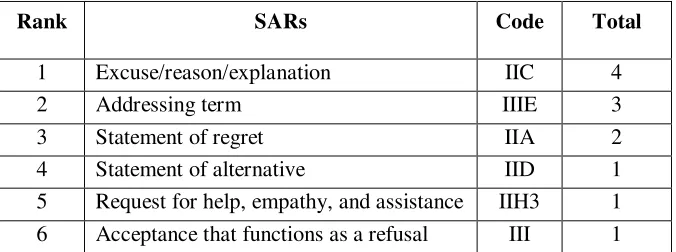
Rank SARs Code Total
1 Excuse/reason/explanation IIC 4
2 Addressing term IIIE 3
3 Statement of regret IIA 2
4 Statement of alternative IID 1
5 Request for help, empathy, and assistance
IIH3 1
39
The number of SARs for each act was calculated in order to compare the differences in refusal strategies across the other directive acts. For example, the researcher counted the number of excuse/reason/explanation used in each directive act to see which act used excuse/reason/explanation the most. After all the data were classified using the refusal strategy by Beebe and Takahashi, the writer then described the response which indicated the speaker’s unwillingness to fulfil the request, order, or suggestion by stating the performative utterance. For example:
Aisha: “Suamiku, izinkanlah aku melakukan sesuatu untukmu!”
Fahri: Response
Refusal-sequences
Strategy
Lebih baik aku mati daripada kau melakukan itu
Head act Indirect refusal
Jadi, kumohon isteriku
jangan kau lakukan itu
Post-refusal Caution
Aku tidak rela, demi Allah, aku tidak rela
Post-refusal Unwillingness
The indirect refusal of the utterance above functioned as the head act or the illocutionary point. The others function to mitigate the effect of the refusal to the hearer. The performative verb used was “threaten.”
The implicit performative: Lebih baik aku mati daripada kau melakukan itu
I’d rather die than let you do that.
40
3. Description
The next step of the analysis was the description of the data classified. The data were described according to situation/context found in the novel including the power relation of the refusers and the refusal strategies used by them.
For example, why were the SAR of excuse/reason/explanation (IIC) used the most in all acts. Giving an excuse/reason/explanation was probably the most commonly used as a refusal strategy in response to requests, questions, suggestions, orders, and invitations.
4. Interpretation/explanation
41
CHAPTER IV
FINDINGS AND DISCUSSION
As stated in the previous chapters, this study will find out the refusal realization in the novel of Ayat-ayat Cinta by Habiburrahman El Shirazy based on the criteria of refusal strategy by Beebe and Takahashi (1990). This chapter will explain the findings of refusal strategy used in response to directive speech act.
The result of the analysis will be described in four sub-chapters. The first sub-chapter will explain the realization of speech act of refusals (hereafter SARs) in the novel. The second sub-chapter will explain the refusal strategies used in the speech acts of requesting, questioning, offering, ordering, and inviting based on the classification of the refusal responses Beebe et al. (1990). The third sub-chapter will explains the realization of speech acts of refusals according to power relation of the refusers, and the fourth sub-chapter will explain the use of performative verbs in the utterances containing refusal response.
A. The Realization of Speech Act of Refusals (SARs)
42
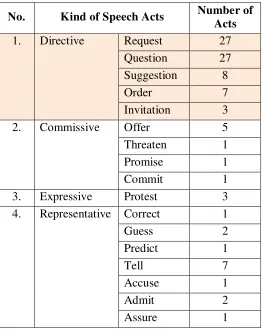
speech act (telling, accusing, admitting, and assuring). Table 2 shows the overall distribution of speech act with refusal response found in the novel.
Table 2: Distribution of Speech Acts with Refusal Responses
No. Kind of Speech Acts Number of study are the directive speech acts of requesting, questioning, suggesting, ordering, and inviting.
The table shows that there are twenty seven acts of requesting, twenty seven acts of questioning, eight acts of suggesting, seven acts of ordering, and three acts of inviting.
43
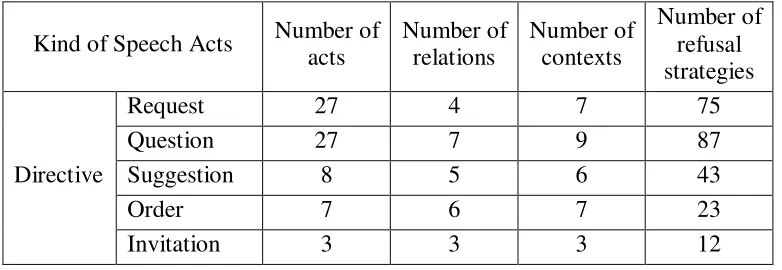
between the requesters and the refusers which are (1) housemates, (2) friends, (3) husband and wife, and (4) neighbours. Those acts happen in eight different contexts which are (1) having dinner, (2) sending SMS (short message service), (3) telephoning, (4) on a metro, (5), at a hospital, (6) at a police station, (7) at the apartment. While the refusal strategy used is seventy five ones. Table 3 summarizes the number of acts, relations, context, and refusal strategies used.
Table 3: Summary of Refusal Strategies
Kind of Speech Acts Number of acts context does. They vary according to the power relation of the requester and the refuser. The followings are examples of how relation and context produce different SARs in refusing a request.
(1) Fahri and Ustadz Jalal are friends but Fahri’s power relation is lower than Ustadz Jalal. He is a lecturer and also Nurul’s uncle who is surely older than Fahri is, so the strategy used by Fahri is indirect refusal. The semantic formula used is [non verbal action] + [wish] + [statement of principle]. Non verbal Wish
(Sobbing) I wish I could turn back the time. Statement of principle
44
”Well, you can help Nurul, can’t you?”
(2) Fahri and Maria are closed friends and are also neighbours. They have equal power relation but Fahri uses indirect strategy. The semantic formula used is [joke] + [statement of caution].
Telephoning Maria; “Uangnya kok tidak diambil, kenapa?”
“Why didn’t you take the money?”
Fahri: “Harganya zero, zero, zero pound. Jadi tak perlu
dibayar.”
45
Hospital Madame Nahed: “Lakukanlah seperti yang diminta dokter. Tolong.”
“Do as the doctor said. Please!” Fahri: “Andai aku bisa Madame, aku tak
bisa melakukannya.”
“I wish I could Madame, I can’t do it.”
(4) Aisha and Fahri are husband and wife. The strategy used is direct refusal because Fahri has a higher power relation. Fahri does not use a specific addressing term but simply call her wife by her name.
The semantic formula used is [flat no] + [addressing term] + [flat no] +
Hospital Aisha “Fahri, menikahlah dengan Maria. Aku ikhlas.”
“Fahri, marry Maria. I am sincere.”
Fahri: “Tidak Aisha, tidak! Aku tidakbisa.”
46
Examples (1) to (4) show that Fahri uses different refusal strategies to his requester. He uses either directly or indirectly refusal strategies. In examples (1) and (2), he refuses Ustadz Jalal’s request by a wish, a statement of principle, and a non verbal action. Meanwhile, he refuses Maria’s request by a joke and a statement of caution. The power relation difference among Fahri, Aisha, Ustadz Jalal, and Maria causes the different strategies used.
B. The Use of Refusal Strategy
According to the data in table 2, each act describes different relation, context, and refusal strategy. There are seventy five SARs from twenty seven acts of requesting, eighty seven SARs from twenty seven acts of questioning, and forty three SARs from eight acts of suggesting, twenty three SARs from seven acts of ordering, and thirteen SARs from three acts of inviting.
This section will explore what SARs are used in each act. The number of each SAR in the act of requesting, questioning, suggesting, ordering, and inviting are calculated and are paid attention to the difference or significant use of SARs. The result is presented in the table based on its rank. The followings are the description of the use of SARs in each act.
1. The Speech Act of Refusal in Response to Request
47
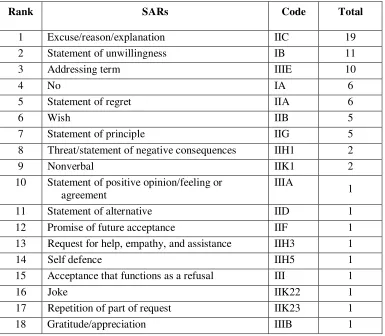
in refusing a request is the number of SARs of excuse/reason/explanation. Table 4 shows the summary use of SARs in response to requests.
Table 4: Summary of SARs in Response to Request
Rank SARs Code Total
1 Excuse/reason/explanation IIC 19
2 Statement of unwillingness IB 11
8 Threat/statement of negative consequences IIH1 2
9 Nonverbal IIK1 2
10 Statement of positive opinion/feeling or agreement
IIIA
1
11 Statement of alternative IID 1
12 Promise of future acceptance IIF 1
13 Request for help, empathy, and assistance IIH3 1
14 Self defence IIH5 1
15 Acceptance that functions as a refusal III 1
16 Joke IIK22 1
17 Repetition of part of request IIK23 1
18 Gratitude/appreciation IIIB 1
48
(5) Fahri: “Apa kau tidak tergerak untuk menolongnya.” (AAC: 75) “Aren’t you encouraged to help her?”
Maria: “Tergerak. Tapi itu tidak mungkin.”
“Si Hitam Bahadur bisa melakukan apa saja. Ayahku tidak mau berurusan dengannya.”
Repetition Statement of unwillingness “I am encouraged. But, that’s impossible.”
Explanation Explanation
“The black Bahadur can do anything. My father doesn’t want to deal with him.
Maria and Fahri are friends and they have equal power relation. Because Maria is younger than Fahri, she uses indirect SARs of repetition (encouraged) and statement of unwillingness (But that’s impossible) to refuse the request to help Noura in example (5). Eventhough this conversation happens via short message service (SMS), Maria tries to mitigate the FTA by giving explanations. (6) Maria: “Sama, aku juga tidak bisa. Kita belajar bersama
pelan-pelan. Mari kita coba! (AAC: 133)
“It’s just the same. I can’t either. We’ll learn together slowly. Let’s try!”
Fahri: “Maafkan aku Maria. Maksudku aku tidak mungkin bisa melakukannya. Ajaran Al-Qur’an dan Sunnah melarang aku bersentuhan dengan perempuan kecuali dia isteri atau mahramku. Kuharap kau mengerti dan tidak kecewa!” terangku tegas.
Statement of regret statement of unwillingness “I am sorry, Maria. I mean, I can’t do that.
Statement of principle
The Holy Quran and the Sunnah forbid me to touch other women but my wife or my-mahram.
Wish
I hope you understand and are not disappointed.”
49
Fahri is but Fahri tries to mitigate the FTA by adding statement of principle and wish. By giving a wish, he hopes that the requester will not be disappointed. (7) Aisha: “Sayang, Dhab Mashrinya dicoba yuk!” (AAC: 294)
I am afraid of becoming a lizard.”
When refusing Aisha (7), Fahri uses indirect SARs of explanation and joke. Since they are new husband and wife and are having honey moon, joke will make the situation more passionate. Moreover, what they are talking about (Dhab Mashr) is a kind of Egyptian remedy for husband and wife. By joking, the requester’s face is saved and will not be insulted.
(8) Saiful: “Kalau ini bukan makan nasi lauk ayam. Ini makan ayam lauk nasi. Nasinya dikit sekali. Mbok ditambah dikit.” (AAC: 71)
“This is not eating rice with chicken but eating chicken with rice. The rice is so little. Give some more.”
Hamdi: “Tujuannya memang kita makan ayam bakar. Nasi pelengkap saja untuk melestarikan budaya Indonesia. Bagi yang mau tambah nasi ambil saja sendiri. Benar nggak Mas?”
Explanation Explanation
“The purpose is eating grilled chicken. Rice is just a complement to preserve the Indonesian culture.
Statement of alternative
Anyone who wants some more rice just gets it yourself. Request for assistance
50
Hamdi and Saiful are Fahri’s housemates. Indirect SARs of explanations initiate the refusal in example (8). But, not to disappoint the requester, Hamdi gives an alternative and asks for assistance from the other housemate (Fahri) for his comfort.
The refusers realize that their refusal will threaten the face of the requesters. The use of explanation is aimed to mitigate the refusal and to emphasize that the requesters are not objected to it.
Another SAR in response to request is an indirect statement of unwillingness. It includes some expressions which contain negations. Negation can be expressed by the negative particle “Not”, or by using any word that semantically negates a proposition. The position of statement of unwillingness is mostly closed to explanation, wish, and regret.
But, there are three uses of statement of unwillingness without any other SARs. The refuser (Maria) does this because the context is late at night and they are talking via SMS. Besides, her father will not like it in case he knows it. They are as follows:
(9) Fahri: “Tidak bisakah kau ajak dia ke kamarmu?” (AAC: 75) “Can you take her to your bedroom?”
Maria: “Aku kuatir Bahadur tahu.”
“I’m worried if Bahadur knows this.”
(10) Fahri: “Kau lebih memungkinkan daripada kami.” “You are more possible than we are.”
Maria: “Sangat susah kulakukan!” “It’s very hard to do.”
(11) Fahri: “Tidakkah kau bisa turun dan menyeka air matanya. Kasihan Noura. Dia perlu seseorang yang menguatkan hatinya.”
51
needs someone to brace her heart.” Maria: “Itu tidak mungkin.”
“That’s impossible!”
In example (9) to (11), Maria shows her refusal using direct SARs of statement of unwillingness. There is not any partikel no but she uses words which semantically negate the propositions such as “I’m worried if Bahadur knows this”, “it’s very hard to do”, and “that’s impossible.”
The use of addressing termsis different depending on the power relation of the refuser. There are respectful addressing terms used by the refusers such as Kak, Mas, and Madame and the rest of the rerfusers use name to address the requester such as Nur, Maria, and Aisha. Kak is used to address a male or female who is older than the speaker, Mas is used to address a male who is older than the speaker, and Madame is a respectful term of address to a woman. Example (12) and (13) show the use of SARs of adjuncts of addressing terms Madame and Kak.
(12) Madame Nahed: “Lakukanlah seperti yang diminta dokter.Tolong.” (AAC:375)
“Do as the doctor said. Please!”
Fahri: “Andai aku bisa Madame, aku tak bisa melakukannya.” “I wish I could Madame, I can’t do it.”
(13) Fahri: “Oh aku paham. Kau tutup saja telponmu. Biar aku yang telpon.”(AAC: 120)
“Oh, I understand. You hang up your phone. Let me call back.”
Nurul: “Bukan pulsa masalahnya Kak.”
“It’s not about the pulse, Kak.”
52
few cases, the refusers are extremely direct. In the data, no is followed by statement of principle and statement of unwillingness to emphasize that the refusers are objected to the request. The reason of the objection is something that is so principle. Example (14) and (15) show how direct no is followed by statement of principle and statement of unwillingness.
(14) Madame Nahed: “Hanya kau yang bisa menolongnya Anakku.
Nyawa Maria ada di tanganmu.” (AAC: 375)
“You are the only one who can help her, my son. Maria’s life is in your hands.”
Fahri: “Bukan aku. Tapi Tuhan.” Flat no Statement of principle “Not me. But the God.”
(15) Aisha: “Fahri, menikahlah dengan Maria. Aku ikhlas.” (AAC: 376) “Fahri, please marry to Maria. I am sincere.”
Fahri: “Tidak Aisha, tidak! Aku tidak bisa.”
Flat no Statement of unwillingness “No, Aisha, no! I can’t.”
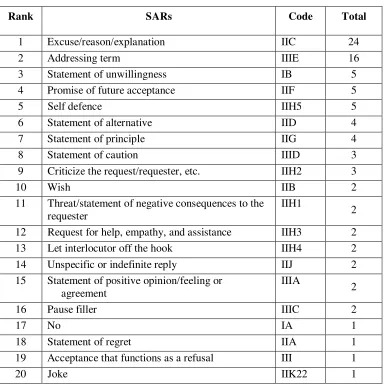
2. The Refusal Strategy in Response to Question
53
Table 5: Summary of SARs in Response to Question
Rank SARs Code Total
1 Excuse/reason/explanation IIC 24
2 Addressing term IIIE 16
9 Criticize the request/requester, etc. IIH2 3
10 Wish IIB 2
11 Threat/statement of negative consequences to the requester
IIH1
2
12 Request for help, empathy, and assistance IIH3 2
13 Let interlocutor off the hook IIH4 2
14 Unspecific or indefinite reply IIJ 2
15 Statement of positive opinion/feeling or agreement
19 Acceptance that functions as a refusal III 1
20 Joke IIK22 1
54
preceeded or are followed by criticize the requester (IIH2) and self defence (IIH5).
(16) Metro passenger: “Apa salah jika kami sedikit saja mengungkapkan kejengkelan kami dengan memberi pelajaran sedikit saja pada orang-orang Amerika itu?!” (AAC: 48)
“Is it wrong if we express our annoyance by giving those Americans a little lesson?!”
Fahri: “Kita semua tidak menyukai tindak kezhaliman yang dilakukan siapa saja. Termasuk yang dilakukan Amerika. Tapi tindakan kalian seperti itu tidak benar dan jauh dari tuntunan ajaran baginda Nabi yang indah.”
Explanation
“We all don’t like the violation done by anyone. Explanation
Including what’s been done by America. Criticize the requester
But, what you’ve done is not right and is far from the beautiful lesson of the Prophet.”
Example (16) shows how the refusal is initiated by indirect SAR of excuse/reason/explanations and followed by criticize the questioner. Eventhough Fahri is talking to a stranger whom he has just known on a metro, he is dare to criticize him. Fahri needs to remind him that what he has done is wrong.
(17) Haj Rashed: “Kau suka menonton film Amerika juga rupanya?” (AAC: 339)
“You apparently like watching the American films, don’t you?”
Fahri: “Sebenarnya tidak juga. Aku menonton film itu karena penasaran pada analisa Profesor Akbar S. Ahmad dalam karyanya Postmodernism and Islam. Dan memang seperti itu ironi yang dibangun Spielberg dalam film ET.
Self defence Reason/Explanation
55
Postmodernism and Islam. Statement of positive opinion
And indeed, that was such an irony built by Spielberg in the film of ET.”
Example (17) shows how the refuser defend himself from a cynical statement of Haj Rashed, his cellmate. Then he explains why he watched the film followed by his statement of positive opinion. Fahri tries to mitigate the FTA by giving reason that Fahri is not pro America.
(18) Aisha: “Apa yang ditulisnya sampai kau menangis?” (AAC: 289) “What did she write till you cried?”
Fahri: “Ah tidak apa-apa. Isinya nasihat. Agar aku menjagamu dengan baik...”
Let the interlocutor off the hook Explanation
“It’s nothing. It’s an advice to take care if you well...”
Example (18) shows that a question doen not always get the answer needed. Fahri lets the interlocutor off the hook by not giving the specific answer. He tries to save her wife’s face because if she knows the content of the letter she will feel bad.
There are sixteen addressing terms used in the SARs in response to question. Four of them are using names as the addressing—Noura, Fahri, Bahadur, Aisha. There is one term of address using the job position of the requester Kapten (captain) because the situation takes place in a police office.
56
A promise of future acceptance is also used as a SAR. The refuser can not do what is asked at the time of speaking but he will accomplish it at later time. The followings are the examples of promises for future acceptance.
(19) Rudi: “Untuk siapa ini Mas? Sudah punya calon rupanya? “ (AAC: 110)
“Who is it for Mas? You’ve got the candidate, haven’t you? Fahri: “Sudahlah Akhi. Aku lagi capek sekali. Nanti habis
maghrib aku jelaskan semua. ....”
Addressing term Explanation Promise for future action
“Come on Akhi. I am so tired. I’ll tell you all after maghrib...” (20) Police: “Bagaimana orang Indonesia? Kau mau mengakui
perbuatanmu? (AAC: 316)
“How is it Indonesian? Will you admit what you’ve done? Fahri: “Aku tidak berubah pikiran. Aku tidak melakukan perbuatan dosa itu. Bagaimana mungkin aku akan mengakuinya. Aku akan buktikan bahwa aku tidak bersalah!”
Statement of unwillingness Self defense
“I won’t change my mind. I didn’t do that sin. Statement of unwillingness Promise for future acceptance
How can I admit it? I will prove it that I am not guilty.”
Example (21) show how the refuser uses adjuncts to refusal of statement of a caution but then he gives an alternative so that he can mitigate the FTA and have chance to save the requester’s face.
(21) Rudi: “Nurul dkk. diundang nggak Mas?” (AAC: 224) “Are Nurul and friends invited, Mas?”
Fahri: “Untuk akadnya tidak usah. Tapi walimahnya ya.” Statement of caution Statement of alternative
57
3. The Refusal Strategy in Response to Suggestion
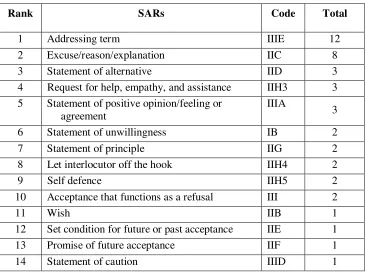
In two previous speech acts (request and question), the indirect SAR of excuse/reason/explanation has the highest rank. While in the act of suggestion, the highest rank of SAR is the use of addressing terms. Table 6 will show the summary use of SARs in response to suggestion.
Table 6: Summary of SARs in Response to Suggestion
Rank SARs Code Total
1 Addressing term IIIE 12
2 Excuse/reason/explanation IIC 8
3 Statement of alternative IID 3
4 Request for help, empathy, and assistance IIH3 3 5 Statement of positive opinion/feeling or
agreement
10 Acceptance that functions as a refusal III 2
11 Wish IIB 1
12 Set condition for future or past acceptance IIE 1
13 Promise of future acceptance IIF 1
14 Statement of caution IIID 1
In the SARs in response to the suggestion, there are also addressing terms by using names such as Fahri and Rud. Another addressing terms are kamu and
kau (you), kita (inclusive we), kalian (2nd person plural), and kapten (captain). The followings are the use of other addressing terms which are rather different. (22) Fahri: “Semestinya memang begitu Syaikh. Tapi saya harus
58
“It should have been like that Syaikh. But, I must commit to the schedule. It’s a promise. Promise to myself and promise to Syaikh Utsman to come.
(23) Aisha: “Sudah kuduga. Kau akan mengatakan demikian. Suamiku, seandainya bukan ibuku yang membeli flat ini...” (AAC: 270)
“I’ve thought that you will say that. My husband, if only my mother hadn’t bought this apartment...”
Syaikh (also spelled Sheik, Shaikh, and Sheikh) is a respected man of more than fifty years of age (example 22). The title Syaikh is especially borne by heads of religious orders, heads of colleges, such as Al-Azhar University in Cairo, etc. It is also applied to learned men, especially members of the class of ulamas
(theologians), and has been applied to anyone who has memorized the whole Qur’an, how young he might be.
Example (23) uses Suamiku as an addressing term to a husband. This term is common in the culture of Indonesia but it is probably not in other cultures, like American or English. Mydarling, honey or baby is used instead of my husband.