Page 53 - 68
Received: September 15, 2016; Revised: November 25, 2016; Accepted: December 5, 2016 State Islamic University (UIN) Syarif Hidayatullah Jakarta
THE INDONESIAN ISLAMIC BANK’S SPIN-OFF:
A STUDY IN REGIONAL DEVELOPMENT BANKS
Ismawati Haribowo
Abstract. he Indonesian Islamic Bank’s Spin-Of: A Study in Regional Development Banks. he Islamic banking spin-of became a major issue after the establishment of the Act No. 21 of 2008. he problem that arises according to this spin-of is the existence of sharia unit that owned by the regional development banks, which is almost the banks has a small size. his paper is going to evaluate the spin-of criteria are regional development banks, besides that this article is going to analyze the spin-of strategy that can use by sharia unit that owned by the regional development bank. he techniques that employed in this paper are ARIMA, simulation, and descriptive-qualitative. he result shows that there is no sharia unit can achieve the 50% share asset of its parents. here are also several strategies that can be used by the sharia unit. he main thing that should emphasize is the Islamic bank's spin-of is only one of the policies that can be taken to develop the Islamic banking industry.
Keywords:spin-of, regional development bank, ARIMA
Abstrak. Pemisahan Bank Syariah di Indonesia: Studi Pada Bank Pembangunan Daerah. Pemisahan unit usaha syariah menjadi bank umum syariah merupakan salah satu hal yang menjadi isu utama setelah lahirnya Undang-undang nomor 21 tahun 2008. Permasalahan yang muncul terkait pemisahan unit usaha syariah ini ialah eksistensi unit usaha syariah yang dimiliki oleh Bank Pembangunan Daerah, dimana sebagian besar bank pembangunan daerah ini ukurannya kecil. Artikel ini bertujuan untuk mengevaluasi kriteria pemisahan unit usaha syariah pada Bank Pembangunan Daerah, serta untuk menganalisis strategi pemisahan yang tepat bagi unit usaha syariah yang dimiliki oleh Bank Pembangunan Daerah. Teknik analisis yang dipergunakan ialah ARIMA, simulasi, dan deskriptif-kualitatif. Hasil yang didapatkan menunjukkan bahwa belum ada satupun unit usaha syariah Bank Pembangunan Daerah yang mampu mencapai proporsi 50% aset dari bank induknya. Terdapat beberapa strategi yang dapat ditempuh oleh unit usaha syariah Bank Pembangunan Daerah. Hal utama yang harus ditekankan ialah pemisahan unit usaha syariah merupakan salah satu kebijakan yang dapat ditempuh untuk mengembangkan industri perbankan syariah.
Introduction
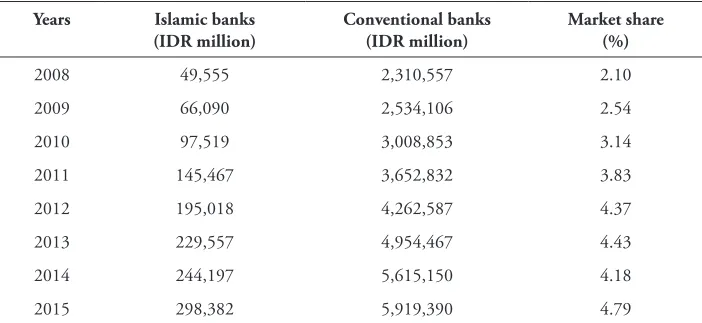
he Development of Islamic banking in Indonesia is quite rapid. It can see that the end of 2015 there have been 12 Islamic full pledge banks, 22 Islamic business unit, and 161 Islamic rural banks. his rapid development still has not been able to reach the market share target by 5%; it can see from Table 1. his 5% target should achieve by the end of 2008. To accelerate the Islamic banking growth in Indonesia, regulators encouraged to established the particular regulation about Islamic banking industry. In 2008, there established the Act of 21 the year 2008 about Islamic banks. One important issue in this act is the obligation for Islamic business unit (UUS) to do the spin-of if they had reached the 50% of the parent’s asset or 15 years after the establishment of this act. After the establishment of this act, there are several Islamic business units that had done the spin-of, either by creating new companies or by using the existing companies. If we are referring to the spin-of’s criteria in the act, there are no Islamic business unit that had been reached the 50% parent’s asset. Al Arif (2015c) said that from 11 sample banks, which contained 5 Islamic business units, 4 spin-of banks, and 2 Islamic full pledge banks subsidiary of conventional banks; none of the sample banks can reach the 50% of its parent’s asset in 2023 (15 years after the establishment of the act).
Table 1. he Development of Indonesian Islamic Banking Industry
Years Islamic banks (IDR million)
Conventional banks (IDR million)
Market share (%)
2008 49,555 2,310,557 2.10
2009 66,090 2,534,106 2.54
2010 97,519 3,008,853 3.14
2011 145,467 3,652,832 3.83
2012 195,018 4,262,587 4.37
2013 229,557 4,954,467 4.43
2014 244,197 5,615,150 4.18
2015 298,382 5,919,390 4.79
Source: Islamic banking statistics, Bank of Indonesia
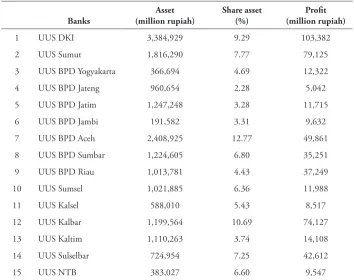
Bank of Jambi that only IDR 191 billion. his fact shows that if the spin-of policy is force to remain in the July 2023, there will be a lot of Islamic business unit owned by regional development banks will be shut-down. Because almost the parents (regional development bank) has a small economic of scale, if they forced to spin-of the Islamic business unit it will make the ineiciency either in parents or subsidiary banks.
he Islamic banking data shows that after the spin-of policy established in 2008, there are still performance luctuations in Islamic banking industry. his is shown by the decreasing in Islamic banking proitability, and the increasing of non performing inancing. his fact is contradicst with the policy objectives. he objectives of the spin of policy is to increase the Islamic banking performance, but the data shows that there are a performance declining in Islamic banking industry.
Table 2. he Asset, Share Asset and Proit of Sharia Unit
Banks
Asset (million rupiah)
Share asset (%)
Proit (million rupiah)
1 UUS DKI 3,384,929 9.29 103,382
2 UUS Sumut 1,816,290 7.77 79,125
3 UUS BPD Yogyakarta 366,694 4.69 12,322
4 UUS BPD Jateng 960,654 2.28 5,042
5 UUS BPD Jatim 1,247,248 3.28 11,715
6 UUS BPD Jambi 191,582 3.31 9,632
7 UUS BPD Aceh 2,408,925 12.77 49,861
8 UUS BPD Sumbar 1,224,605 6.80 35,251
9 UUS BPD Riau 1,013,781 4.43 37,249
10 UUS Sumsel 1,021,885 6.36 11,988
11 UUS Kalsel 588,010 5.43 8,517
12 UUS Kalbar 1,199,564 10.69 74,127
13 UUS Kaltim 1,110,263 3.74 14,108
14 UUS Sulselbar 724,954 7.25 42,612
15 UUS NTB 383,027 6.60 9,547
Source: Bank’s Publication Report
banks. his result raise question if Islamic buisness unit is less eicient than Islamic full pledge banks, how about the eiciency if they had done the spin-of. Al Arif (2015a) shows that the spin-of policy will afect the performance in Islamic banking industry. here is an eiciency declining after the spin-of policy established.
According to the conditions, which is the spin-of policy still can’t give a signiicant efect to the Islamic banking industry development. Besides that, this policy still can’t accelerate the Islamic banking industry to achieve the 5% share asset. his research will analyze the spin-of strategy in Islamic business unit that owned by the regional development banks. Besides that, the regulator such as the inancial service authority has a concern about spin-of policy in regional development banks.
Literature Review
Only a few numbers of research had been conducted regarding the Islamic banking spin-of, because the characteristics of Islamic banking in Indonesia are quite diferent than Islamic banking in other countries. Indonesia splits Islamic bank into two parts; Islamic banks and Islamic business unit (an Islamic business units of conventional banks), while in other countries mostly use windows system that gives no diferences between Islamic banks and conventional banks. In order to reach the Islamic banking market share 5% of the national banking, one method used is to push the occurrence of Islamic business unit spin-of into Islamic full-pledge banks. he efort to push this spin-of is seen on several policies of Bank Indonesia such as PBI No. 12/21/PBI/2010 date October 19th 2010 regarding Bank’s Business Plan, especially on article 12 letter g that puts the Islamic business unit spin-of plan into the bank’s business plan. PBI No. 14/8/PBI/2012, date July 13th 2012 regarding Bank Ownership of Common Shares, especially on article 16 that gives leeway for BUS shareholders as a result of Islamic business unit spin-of to have shares exceeding the maximum limit of shareholding. Islamic banks as a result of the spin-of is given a longer spare time to carry out divestment until 2028 or 5 years longer than the spin-of’s time limit.
Kiswono (2012) categorized each bank based on its capital potential, namely: (i) primary capital is above IDR 2 trillion and Islamic business unit capital is above IDR 500 billion, so its capital requirement has met in provision and is hoped to be able to execute the Islamic business unit spin-of immediately. Banks included in this group are BTN, Bank Permata, CIMB Niaga, and Bank Danamon. (ii) primary capital is above IDR 2 trillion but Islamic business unit capital is still below IDR 500 billion, so it still needs longer time and efort to increase its Islamic business unit capital to reach minimum requirement that is IDR 500 billion. here are 5 banks that have fulilled the criteria, namely: BII, BTPN, OCBC-NISP, HSBC, Bank Jatim. (iii) primary capital is still below IDR 2 trillion but more than IDR 1 trillion, so it still needs more efort because it needs to increase its primary capital to reach IDR 2 trillion, as well as increasing its Islamic business unit capital. Banks included in this category are: BPD Jateng, BPD Banda Aceh, BPD Sumt, Bank DKI, Bank Sinarmas, BPD Riau, BPD Sumsel & Babel, BPD Sumbar, and BPD Jambi. (iv) primary capital is below IDR 1 trillion, so it is quite diicult to fulill the obligation of executing spin-of. Banks included in this category are BPD Kaltim, BPD Kalsel, BPD Kalbar, BPD Sulsel, BPD NTB and BPD DIY.
According to Kiswono (2012), there are some strategies that can be performed regarding the matters above. First, conducting a pure Islamic business unit spin-of into Islamic full-pledge banks; Second, joining other banks; hird, performing acquisition toward conventional banks, then performing conversion on banks that have been acquired as Islamic banks; Fourth, performing conversion on parent conventional banks into Islamic banks.
According to Rizqullah (2013), these are factors that need to be taken into account on spin-of process: First, the company should appoint leadership and strong and solid spin-of teamwork project as well as being capable of carrying out their duties on time. Second, the implementation stage that includes consideration agreement or strategic reason and comprehensive spin-of plan including capital agreement and investor’s identiication to strengthen business plan arrangement after spin-of must be executed well as guidance for spin-of team. Roles and involvement of conventional parent banks at this stage is very crucial because it shows commitment and support to its Islamic business unit spin-of. hird, the spin-of implementation stage that includes the forming of organization of Islamic bank, integration program and legal process are the actual spin-of process. Fourth, technology and infrastructure that includes information and technology system, recording and reporting as well as delivery channel must be prepared well. Fifth, oicialdom that includes oicialdom status change and company cultural change must acquire serious attention in spin-of process. Sixth, the company also needs to pay attention to how the customers’ response about the spin-of. he existence of Islamic bank spin-of is hoped to be supported by citizens by staying as customers.
Siswantoro (2014), in his article, analyzed performance and strategy Islamic banks after spin-of and come up as commercial banks separated from their parent banks. he result of the analysis showed that Islamic banks as the result of spin-of should be able to optimize several funding resources such as capital injections and temporary investment deposit increase. Al Arif (2014) showed that spin-of policy gives diferent inluence toward DPK to Islamic banking industry before and after the spin-of. Similar result had been acquired by Al Arif (2015) that showed spin-of policy does not give any diference in the amount of the distribution of funding on Islamic banks as the result of spin-of between before and after the spin-of is executed.
Hamid (2015) conducted a study that aimed to seek the impact of spin-of policy toward the level spin-of proitability on Islamic banking industry. Variable used is ROA ratio to measure the level of proitability, while the independent variable is dummy spin-of variable, levels of funding problems (NPF), the level of margin deposits 1 month, and eiciency level (BOPO). he result showed that dummy spin-of variables, NPF ratio, and BOPO ratio have inluence toward the level of proitability (ROA). Al Arif (2015) showed that spin-of policy that had been executed gives diference to eiciency level on Islamic banking industry. he result shows that spin-of policy increases BOPO ratio on Islamic banking industry, where this means that level of operational eiciency from Islamic banking industry decreases after the spin-of policy is executed.
banks execute spin-of on Islamic business unit owned, then the Islamic business unit becomes Islamic full pledge bank (BUS) –this matter is known as pure spin-of-, such as Bank of BNI Sharia and Bank of Jabar Banten Sharia. Second, conventional banks that possess Islamic business unit acquire relatively small banks and later convert them into sharia and separate them as well as joining their Islamic business unit with recently converted banks. Islamic full-pledge banks (BUS) from irst approach are: Bank of BRI Sharia, Bank of Bukopin Sharia, Bank of BTPN Sharia. hird, conventional banks that have yet to possess Islamic business unit, acquire relatively small banks and convert them into sharia and later separate them from conventional parent banks. Islamic banks (BUS) from second approach are: Bank of Panin Sharia, Bank of Victoria Sharia, Bank of BCA Sharia, and Maybank Sharia.
Methods
his paper attempts to predict the growth of the Indonesian Islamic banks, particularly to examine whether the Islamic banks of 50% share asset that can be achieved by the Islamic banks. he econometrics tool that used to make the prediction is Autoregressive Integrated Moving Average (ARIMA). his tool is used to estimates whether the 50% share asset can be achieved in the year 2023. he variable that is going to predict is the share asset of Islamic banking units from their conventional parent banks. he research objects of this research are thirteen sharia units namely Bank of Sumatera Utara, Bank of Sumatera Barat, Bank of Riau and Kepri, Bank of Sumatera Selatan and Bangka Belitung, Bank of Yogyakarta, Bank of DKI, Bank of Jawa Timur, Bank of Jawa Tengah, Bank of Kalimantan Timur, Bank of Kalimantan Barat, Bank of Kalimantan Selatan, Bank of Nusa Tenggara Barat, and Bank of Sulawesi Selatan and Barat.
Besides that, this research is also using the descriptive analysis by doing the in-depth interview with the regulators and the bankers. he descriptive analysis is used to support the empirical result of ARIMA. A simulation to predict the asset growth per year that to be achieved by all sample banks if they want to achieve 50% of share asset from their parents is also used in this research. he simulation is using the compound growth assumption.
Result and Discussion
Result
at the level of the irst diference. he test results with test ADF at sample banks showed that the data has been stationary at the current level. After the stationary test is done, we can proceed to the next step.
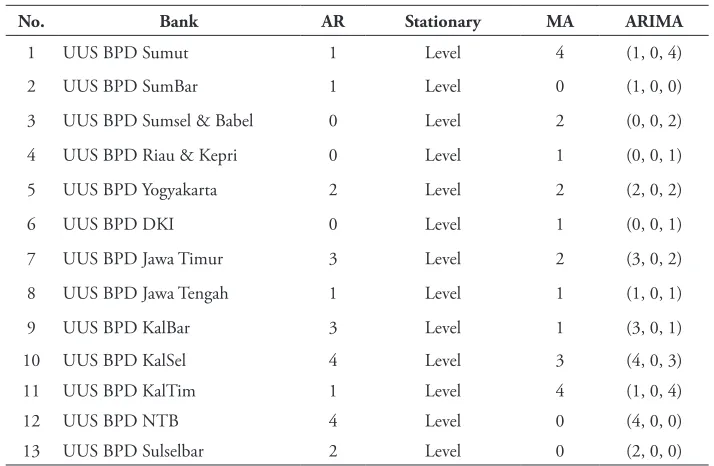
hen, the correlogram will be seen. First, the correlogram of the Auto-Correlation (AC) function will be seen. he lag for Moving Average (MA) model will be got. Next, the correlogram will be seen for the partial auto-correlation (PAC) function. he optimum lag for auto-regressive (AR) model will be got. To get the best model is based on the goodness of it from the model by using the Akaike Information Criterion (AIC) and Schwarz Criterion (SC). After the goodness of it of the model is done, next the ARIMA for prediction is used according to the purpose of this research.
Table 3. he Lag of AR and MA Process
No. Bank AR Stationary MA ARIMA
1 UUS BPD Sumut 1 Level 4 (1, 0, 4)
2 UUS BPD SumBar 1 Level 0 (1, 0, 0)
3 UUS BPD Sumsel & Babel 0 Level 2 (0, 0, 2)
4 UUS BPD Riau & Kepri 0 Level 1 (0, 0, 1)
5 UUS BPD Yogyakarta 2 Level 2 (2, 0, 2)
6 UUS BPD DKI 0 Level 1 (0, 0, 1)
7 UUS BPD Jawa Timur 3 Level 2 (3, 0, 2)
8 UUS BPD Jawa Tengah 1 Level 1 (1, 0, 1)
9 UUS BPD KalBar 3 Level 1 (3, 0, 1)
10 UUS BPD KalSel 4 Level 3 (4, 0, 3) 11 UUS BPD KalTim 1 Level 4 (1, 0, 4) 12 UUS BPD NTB 4 Level 0 (4, 0, 0) 13 UUS BPD Sulselbar 2 Level 0 (2, 0, 0)
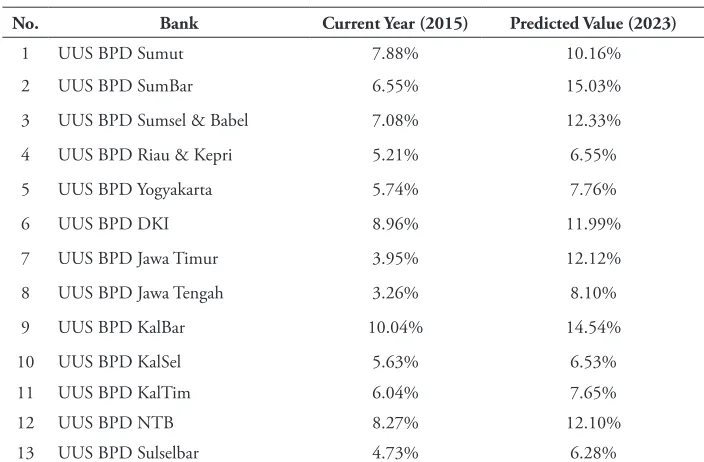
Table 4. Summary of Share Asset
No. Bank Current Year (2015) Predicted Value (2023)
1 UUS BPD Sumut 7.88% 10.16%
2 UUS BPD SumBar 6.55% 15.03%
3 UUS BPD Sumsel & Babel 7.08% 12.33%
4 UUS BPD Riau & Kepri 5.21% 6.55%
5 UUS BPD Yogyakarta 5.74% 7.76%
6 UUS BPD DKI 8.96% 11.99%
7 UUS BPD Jawa Timur 3.95% 12.12%
8 UUS BPD Jawa Tengah 3.26% 8.10%
9 UUS BPD KalBar 10.04% 14.54%
10 UUS BPD KalSel 5.63% 6.53% 11 UUS BPD KalTim 6.04% 7.65% 12 UUS BPD NTB 8.27% 12.10% 13 UUS BPD Sulselbar 4.73% 6.28%
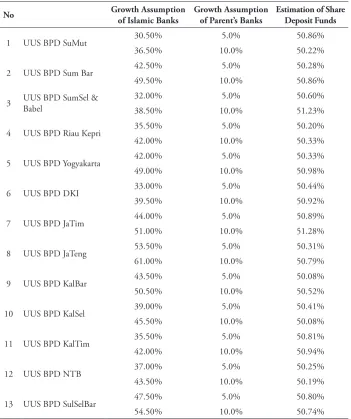
Besides that, a simple simulation had done for deposit funds. Table 6 show that if the Islamic banks want to achieve the 50% of share deposit funds from the parent banks, then they must have an asset growth approximately 39.65% every year (with 5% assumption of parent banks) and must have an asset growth approximately 46.38% every year (with 10% assumption of parent banks). he highest annual growth target is Bank of Jawa Tengah and the lowest annual growth target is Bank of Sumatera Utara. However this growth target is hard to be achieved because of the fact that the average growth of the parent banks is larger than 10% every year.
Discussion
he result on previous part showed that none of the Islamic business units can fulill the criteria for the proportion of assets 50% from the conventional parent bank in 2023. his issue showed that the rules for the spin-of of Islamic business unit into Islamic banks in the form of achievement of 50% proportion of assets from the parent bank must evaluate. his result is similar to what Al Arif had done (2016) with using 11 bank samples that consist of 5 Islamic business units, 4 Islamic banks that had separated after the constitution, and 2 Islamic banks that had separated before the constitution.
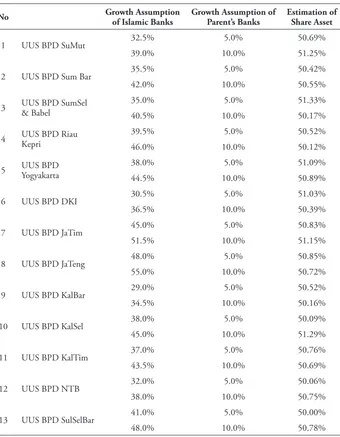
asset growth happens whether in Islamic business unit or conventional parent bank, so that it would be diicult for an Islamic business unit to reach a value 50% asset from its parent bank. Islamic business unit must gain asset growth larger than the conventional parent bank, but if Islamic business unit chases too much growth, it will cause bad impact in the long term.
Table 5. Simulation Result of Asset
No Growth Assumption of Islamic Banks Growth Assumption of Parent’s Banks Estimation of Share Asset
1 UUS BPD SuMut 32.5% 5.0% 50.69% 39.0% 10.0% 51.25%
2 UUS BPD Sum Bar 35.5% 5.0% 50.42% 42.0% 10.0% 50.55%
3 UUS BPD SumSel & Babel
35.0% 5.0% 51.33%
40.5% 10.0% 50.17%
4 UUS BPD Riau Kepri 39.5% 5.0% 50.52% 46.0% 10.0% 50.12%
5 UUS BPD Yogyakarta 38.0% 5.0% 51.09% 44.5% 10.0% 50.89%
6 UUS BPD DKI 30.5% 5.0% 51.03% 36.5% 10.0% 50.39%
7 UUS BPD JaTim 45.0% 5.0% 50.83% 51.5% 10.0% 51.15%
8 UUS BPD JaTeng 48.0% 5.0% 50.85% 55.0% 10.0% 50.72%
9 UUS BPD KalBar 29.0% 5.0% 50.52% 34.5% 10.0% 50.16%
10 UUS BPD KalSel 38.0% 5.0% 50.09% 45.0% 10.0% 51.29%
11 UUS BPD KalTim 37.0% 5.0% 50.76% 43.5% 10.0% 50.69%
12 UUS BPD NTB 32.0% 5.0% 50.06% 38.0% 10.0% 50.75%
Second, prudential aspects in the distribution of funding must take into account. Islamic business unit which conducts accelerated growth of market share asset would try to increase the allocation of funding. To chase big asset growth would make relevant Islamic bank to improve the distribution of funding, distribution of funding who lacks prudential aspects would cause the increase of inancing problems. hird, comparison of the value of assets between Islamic business unit and conventional parent bank is a related matter, so it cannot compare to Islamic business unit and a sharia subsidiary of a large conventional bank with the relatively small conventional bank. Fourth, asset share value does not have any direct connection with the net proit from relevant Islamic bank. If we look at the data, it is seen that Bank of CIMB Niaga whose asset share values is 3.73% able to earn current year proit for IDR 104 billion, where this amount of gain is similar with the net proit of Bank of DKI for IDR 104 billion, but it has shared asset for 9.29%. herefore, factors of the current year proit for the last several years can include as one of the spin-of requirements compared to the asset share value Islamic Business Unit with its conventional parent bank.
oices services in regions that have real business potential; (d) developing the best human resources to lead BUS as the result of the spin-of.
Table 6. Simulation Result of Deposit Funds
No Growth Assumption
of Islamic Banks
Growth Assumption of Parent’s Banks
Estimation of Share Deposit Funds
1 UUS BPD SuMut 30.50% 5.0% 50.86% 36.50% 10.0% 50.22%
2 UUS BPD Sum Bar 42.50% 5.0% 50.28% 49.50% 10.0% 50.86%
3 UUS BPD SumSel & Babel
32.00% 5.0% 50.60% 38.50% 10.0% 51.23%
4 UUS BPD Riau Kepri 35.50% 5.0% 50.20% 42.00% 10.0% 50.33%
5 UUS BPD Yogyakarta 42.00% 5.0% 50.33% 49.00% 10.0% 50.98%
6 UUS BPD DKI 33.00% 5.0% 50.44% 39.50% 10.0% 50.92%
7 UUS BPD JaTim 44.00% 5.0% 50.89% 51.00% 10.0% 51.28%
8 UUS BPD JaTeng 53.50% 5.0% 50.31% 61.00% 10.0% 50.79%
9 UUS BPD KalBar 43.50% 5.0% 50.08% 50.50% 10.0% 50.52%
10 UUS BPD KalSel 39.00% 5.0% 50.41% 45.50% 10.0% 50.08%
11 UUS BPD KalTim 35.50% 5.0% 50.81% 42.00% 10.0% 50.94%
12 UUS BPD NTB 37.00% 5.0% 50.25% 43.50% 10.0% 50.19%
13 UUS BPD SulSelBar 47.50% 5.0% 50.80% 54.50% 10.0% 50.74%
Lindholm-Dahlstrand (2000) showed that the irm’s size becomes one of the factors that inluence the growth of the subsidiary as the result of the spin-of. If this matter associated with the process of Islamic business unit spin-of in Indonesia, then it would be a problem for Islamic business unit spin-of process owned by BPD where most of the BPDs have a small size.
If a conventional bank ultimately decides to execute spin-of to its Islamic business unit into Islamic bank whether it is before or after reaching the period of spin-of according to the constitution, then it must be prepared well. he preparation mentioned here is in addition to the technical development of spin-of, that is a setup for Islamic business unit performance. Klepper and hompson (2010) stated that a company that has a better performance tends to have the performance of post-spin-of. herefore, if conventional banks wish Islamic bank as the result of the spin-of to have better performance, then the performance when it was still Islamic business unit must also have good performance. his matter is intended so that when the Islamic business unit becomes Islamic bank, it would operate independently and no longer depend on its parent bank.
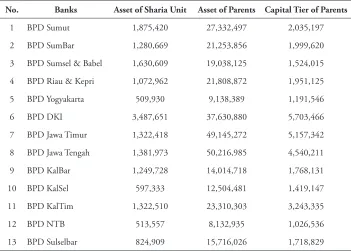
Generally, on Table 7, it can be classiied as (i) Conventional parent banks that categorized in BUKU 3, parent banks’ asset above IDR 30 trillion and Islamic business unit’s asset above IDR 1 trillion. he strategy that can choose is: executing Islamic business unit spin-of into Islamic bank or detaching Islamic business unit to other Islamic banks. Islamic business units that included in this category are Bank of DKI and Bank of BPD Jawa Timur. (ii) Conventional parent banks that categorized in BUKU 2, parent banks’ asset above IDR 10 trillion and Islamic business unit’s asset above IDR 1 trillion. he strategy that can choose is: detaching Islamic business unit to other Islamic banks or degrading the status of Islamic business unit into BPRS. (iii) Conventional parent banks that categorized in BUKU 2, parent banks’ asset ≤ IDR 15 trillion, UUS’s asset below IDR 1 trillion. he strategy that can use is the full conversion of parent bank into Islamic bank or detaching Islamic business unit to other Islamic banks. Islamic business units that included in this category are Bank of BPD Yogyakarta, Bank of BPD Nusa Tenggara Barat (NTB), and Bank of BPD Sulawesi Selatan and Barat (Sulselbar).
business unit itself. Klepper and hompson (2010) stated that corporation that has better performance would performance post-spin-of. herefore, if conventional banks wish Islamic bank as the result of the spin-of to have better performance, then the performance when it was still Islamic business unit must also have good performance. his matter is intended so that sharia subsidiaries as the result of spin-of would operate independently and no longer depend on their parent banks.
Table 7. he Condition of Sharia Unit and Its Parents
No. Banks Asset of Sharia Unit Asset of Parents Capital Tier of Parents
1 BPD Sumut 1,875,420 27,332,497 2,035,197
2 BPD SumBar 1,280,669 21,253,856 1,999,620
3 BPD Sumsel & Babel 1,630,609 19,038,125 1,524,015
4 BPD Riau & Kepri 1,072,962 21,808,872 1,951,125
5 BPD Yogyakarta 509,930 9,138,389 1,191,546
6 BPD DKI 3,487,651 37,630,880 5,703,466
7 BPD Jawa Timur 1,322,418 49,145,272 5,157,342
8 BPD Jawa Tengah 1,381,973 50,216,985 4,540,211
9 BPD KalBar 1,249,728 14,014,718 1,768,131
10 BPD KalSel 597,333 12,504,481 1,419,147
11 BPD KalTim 1,322,510 23,310,303 3,243,335
12 BPD NTB 513,557 8,132,935 1,026,536
13 BPD Sulselbar 824,909 15,716,026 1,718,829
Tubke (2004) said that there are several factors that inluence in spin-of process. First, a factor that is related to business activity, this factor is related to the size of the company and diferences in the corporate sector between the parent company and its subsidiary. Second, a factor that is related to organization and company management. hird, a factor that is related to connection and support. here are three patterns of relationship that can create between a parent corporation and a subsidiary that wish to execute spin-of which is market-relatedness. Fourth, transfer factor or diversion in the form of experience transfer from the parent company to its subsidiary. Fifth, a factor that is related to motivation. Sixth, a factor that is related to the good business environment in the form of the characteristics of the regional business climate or legal framework. Conventional parent bank must treat Islamic bank as the result of the spin-of as part of its group of activities and not as the competitor, so that either parent bank or its subsidiary may grow rapidly.
Conclusion
he forecasting by using ARIMA shown that there is no sharia unit owned by Regional Development Bank can achieve the 50% of the parent bank asset. According to the estimation, the highest forecasting is sharia unit belonging to Bank of Sumatera Barat by 15.03% in 2023. he lowest prediction is sharia unit owned by Bank of Sulawesi Selatan and Barat by 6.28% in 2023. Besides that, by using simulation shows that the largest growth rate to achieve 50% share asset is 37% per year (assumption the parent’s bank growth rate is 5% per year) and 43.38% per year (by assumption the parent’s bank growth rate is 10% per year). On the other side, by using simulation shows that the largest growth rate to achieve 50% share deposit funds is 39.65% per year ( an assumption the parent’s bank growth rate is 5% per year). For the assumption, the parent’s bank growth rate is 10% per year the growth rate is 46.38% per year.
From these result, implies that the spin-of criteria should evaluate because there are no sharia unit can be achieved the 50% share asset in 2023. he spin-of policy is only one activity that can be done by the regulator to accelerate the growth of Indonesian Islamic banking industry. Several strategies can be done either by the regulator or parent’s bank to speed up the development of the Indonesian Islamic banking industry.
References
Al Arif, M.NR. (2015a). Keterkaitan Kebijakan Pemisahan Terhadap Tingkat Eisiensi Pada Industri Perbankan Syariah di Indonesia. Jurnal Keuangan dan Perbankan, Vol. 19 (2): 295-304
Al Arif, M.NR. (2015b). he Efect of Spin-of Policy on Financing Growth in Indonesian Islamic Banking Industry. Jurnal Al-Ulum, Vol. 15 (1): 173-184 Al Arif, M.N.R. (2015c). Impact of Spin-of Policy on he Asset Growth on
Indonesian Islamic Banking Industry. Journal of Islamic Economics, Banking, and Finance, Vol. 11, No. 4: 41-52
Al Arif, M.N.R. (2016). Analisis Pemisahan Unit Usaha Syariah Menjadi Bank Umum Syariah: Kasus Pada Undang-undang No. 21 Tahun 2008. (Unpublished Dissertation). Depok: Universitas Indonesia.
Al Arif, M.N.R. & I. Haribowo. (2016). Tipe Pemisahan dan Pengaruhnya Terhadap Laba Pada Bank Umum Syariah Hasil Pemisahan. Jurnal Keuangan dan Perbankan. Vol. 20 (3): 479-486.
Dewati, H.R. 2015. Pemilihan Metode Spin Of Unit Bisnis Syariah dengan Pendekatan Analisa Faktor (Studi PT BNI Syariah dan PT Bank Syariah BRI). (Tesis Tidak Dipublikasikan). Bogor: Institut Pertanian Bogor.
Hamid, A. (2015). he Impact of Spin-of Policy To he Proitability on Indonesian Islamic Banking Industry. Journal Al-Iqtishad: Jurnal Ilmu Ekonomi Syariah (Journal of Islamic Economics), Vol. 7 (1): 131-140.
Johnson, G, et.al. (1994). he Market Reaction to Voluntary Corporate Spin-Ofs: Revisited. Quarterly Journal of Business and Economics. Vol. 33 (4): 44-57. Kiswono, B. (2012). Spin Of Unit Usaha Syariah (UUS), Kendala dan Strategi
Penyelesaiannya. Working Paper. Jakarta: Bank Indonesia
Klepper, S. & P. hompson. (2010). Disaggrements and Intra-Industry Spinofs.
International Journal of Industrial Organization, Vol. 28(5): 526-538.
Nasuha, A. (2012). Dampak Kebijakan Spin-of Terhadap Kinerja Bank Syariah.
Journal Al-Iqtishad: Jurnal Ilmu Ekonomi Syariah (Journal of Islamic Economics), Vol. 4, No. 2: 241-258.
Rizqullah. (2013). Pemilihan Metode Spin-Of Unit Usaha Syariah Bank Umum Konvensional Menjadi Bank Umum Syariah di Indonesia. (Unpublished Dissertation). Jakarta: IEF Trisakti.
Siswantoro, D. (2014). Analysis of Islamic Bank’s Performance and Strategy After Spin-of as Islamic Full-ledged Scheme in Indonesia. International Conference on Accounting Studies 2014, ICAS, Kuala Lumpur Malaysia.