WEBSITE AS MEDIATION
(STUDY CASE ON LAZADA.CO.ID IN MALANG)
By:
INNO KARSA ANDIKA 135020207121026
MINOR THESIS
Presented in Partial Fulfilment of the Requirements for the Degree of Bachelor of Economics and Business
MAJOR IN MARKETING
INTERNATIONAL UNDERGRADUATED PROGRAM MANAGEMENT FACULTY OF ECONOMICS AND BUSINESS
i
ii
STATEMENT OF ORIGINALITY
I, the undersigned:
Name : Inno Karsa Andika
Student ID : 135020207121026
Department : Management
Faculty : Economics and Business
Address : PCI Blok E 25 no 19-20, Komp. Halmahera , Cilegon ,Banten.
Hereby certify that I am the sole author of the Undergraduate’s thesis the title:
“THE EFFECT OF STORE ONLINE ATMOSPHERE ON PURCHASE INTENTION WITH ATTITUDE TOWARDS WEBSITE AS MEDIATION (STUDY CASE ON LAZADA.CO.ID IN MALANG)”
This thesis has not previously been submitted for a degree in any other University or instituition. I certify that, to be the best of my knowledge. My thesis does not infringe
upon anyone’s copyright and does not violate any proprietary rights that any ideas,
techniques, quotation or any other material from the work of other people included in my thesis.
If my statement is proven to be incorrect, I agree to accept existing academic sanctions. This statement was made under full awareness and consciousness, to be used when necessary.
Malang,10th of January 2018
Inno Karsa Andika
iii
CURRICULUM VITAE
Name : Inno Karsa Andika
Student Number : 135020207121026
Place and Date of Birth : Malang, 17th of January 1994
Sex : Male
Religion : Islam
Address : PCI Blok E 25 no 19 , komp. Halmahera, Cilegon, Banten
Email / phone number : +6282245217999,
Email : [email protected]
EDUCATIONS
2013-Present University of Brawijaya Malang Bachelor Degree, Faculty of economic and business, Majoring in management ( International) , Current GPA : 3,32
2012-2013 University of Diponegoro , Semarang D3 Marketing
2009-2012 Senior High School 2 Krakatau Steel Cilegon
2006-2009 Junior High School, Raudhatul Jannah Cilegon
2000-2006 Elementary School Al-azhar Syifa Budhi YPWKS, Cilegon
ORGANIZATIONAL EXPERIENCES
2015 Management Edutaiment – Event Divison
EXCHANGE PROGRAM
2016 – Exchange Flinders University, Adelaide,Australia
SKILL AND INTEREST
1. Bahasa Indonesia : Fluent
iv
ACKNOWLEDGEMENT
Alhamdullilah, the writer would like to address the most sincere gratitude to the
one and only God, the Almighty Allah SWT for making the completion of the minor
thesis entitled : “The Effect of Store Online Atmosphere on Purchase Intention
Through Attitude Toward Website as Mediation Study Case on website Lazada.co.id”
possible
This minor thesis writing is primarily aimed at meeting the requirement to
achieve the degree of Bachelor of Economics and Business with major in Marketing,
Faculty of Economic and Business, University of Brawijaya.
Therefore, the writer would also like to gratefully acknowledge all the help,
support, and prayers of the following people during the process of completing minor
thesis:
1. Allah SWT. Thank you very much for giving me everything. Faith that you
have built in each person that form me strength and passion to complete this
writing in such a perfect time.
2. Prof. Chandra Fajri Ananda, SE., M.Sc., Ph.D as the Dean of Faculty of
Economics and Business, Brawijaya University.
3. Mrs. Andarwati, SE.,ME.,SCRM as the Head of International Program in
v
4. Mr. Dimas Hendrawan, SE., MM. as the writer‟s supervisor, who has given
his counsel, guidance, support, and motivate, enabling this thesis to be
done.
5. My beloved parents, Raswono Hari Prabowo and Wahyu Dwi Hendrawati,
for all those support that I cannot reply as deep as yours, thank you for the
loving and care.
6. Management International 2013, who gave me support and help me through
many hard times.
7. All those friends and relatives that I cannot mention specifically, I believe
you guys have planted seed of success within myself and I will come back
to pour the water to you guys and we will grow together.
The writer realizes that this minor thesis still needs lot of betterments and
improvements, therefore, he/shewould highly appreciate any suggestion,
comment, and criticism to upgrade our knowledge in the future. Finally, the
writer hopes that this minor thesis can be of much help and benefit for all of us.
Amin
Malang,November 2017
vi
TABLE OF CONTENT
APPROVAL PAGE ... i
STATEMENT OF ORIGINALITY ... ii
CURRICULUM VITAE ... iii
ACKNOWLEDGEMENT ... iv
TABLE OF CONTENT ... vi
LIST OF FIGURE ... xi
LIST OF TABLE ... xii
LIST OF APPENDICS ... xiv
ABSTRACT ... xv
CHAPTER I INTRODUCTION ... 1
1.1 Background of the Study ... 1
1.2 Problems of the research ... 9
1.3 Objective of the Study ... 9
1.4 Significance of Study ... 10
CHAPTER II THEORITICAL FRAMEWORK ... 12
2.1 Previous researches ... 12
2.2 Marketing and Marketing Management ... 15
2.2.1 The definition of Marketing ... 15
vii
2.3 Marketing Mix ... 17
2.3.1 Understanding Marketing Mix ... 17
2.4 Retail ... 18
2.4.1 The definition of Retail Management ... 18
2.5 Internet Marketing ... 18
2.5.1 Seven Stage of Internet Marketing ... 19
2.6 E-commerce ... 27
2.6.1 Category of E-Commerce ... 28
2.7 Store Atmosphere ... 29
2.7.1 Definition ... 29
2.7.2 Elements ... 31
2.8 Online Store Atmosphere ... 31
2.8.2 Dimension of Online Store Atmosphere ... 32
2.9 Attitude Toward Website ... 35
2.9.1 Definition of Attitude ... 35
2.9.2 The Functions of Consumer Attitude ... 36
2.9.3 Factors Affecting Attitude ... 37
2.9.4 Indicator of Consumer Attitudes ... 42
2.9.5 Consumer Attitudes to the Web ... 43
2.10 Purchase Intention ... 45
2.10.1 Definition of Purchase Intention ... 45
2.10.2 Factors affecting Purchase Intention Securities ... 47
2.10.3 Purchase Intention indicator ... 47
viii
2.14 Hypothesis ... 51
2.14.1 Online Store Atmosphere and Attitude towards website ... 52
2.14.2 Online Store Atmosphere and Purchase Intention ... 52
2.14.3 Attitude towards website and purchase intention ... 52
2.14.4 Store Online Atmosphere, Attitude towards website, and Purchase Intention. ... 53
CHAPTER III RESEARCH METHOD ... 54
3.1 Type of Resarch ... 54
3.2 Research Location ... 54
3.3 Data Source ... 55
3.4 Data Collection Method ... 55
3.5 Population and Sample ... 56
3.5.1 Population ... 56
3.5.2 Sample... 56
3.6 Sampling Technique ... 58
3.7 Operational Variable Definition ... 58
3.8 Measurement Scale ... 62
3.9 Research Instrument Test ... 63
3.9.1 Validity Test... 63
3.9.2Reliability Test ... 64
3.10 Classic Assumption Test ... 65
3.10.1 Normality Test ... 66
3.10.2 Linearity Test ... 66
ix
3.11 Determination Coefficient ... 67
3.11.1 Descriptive Analysis ... 68
3.11.2Path Analysis ... 68
3.12 Hypothesis Testing ... 72
3.13 Sobel Test ... 72
CHAPTER IV RESULT AND DISCUSSION ... 74
4.1 General Description of Lazada.co.id ... 74
4.2 Characteristic of Respondent ... 78
4.2.1 Characteristic of Respondent Based on Sex ... 79
4.2.2 Characteristic of Respondent Based by Age ... 80
4.2.3 The Characteristic of Respondent Based on Status Employment ... 81
4.2.4 Characteristic of Respondent Based on Income ... 82
4.2.5 Characteristic of Respondent Based on Educational Background ... 83
4.3 General Overview on Research Variable ... 83
4.3.1 Store Online Atmosphere (X) Variable ... 83
4.3.3 The Attitude Towards Website (Z) Variable ... 85
4.3.4 The Purchase Intention (Y) Variable ... 88
4.4 The Result of Instrument Testing ... 89
4.4.1 Validity Test... 89
4.5 Classical Assumption Test ... 93
4.5.1 Normality Test ... 93
4.5.2 Linearity Test ... 94
4.6 Path Analysis Test ... 95
x
4.7 The Result of Hypothesis Test ... 97
4.7.1 Path Diagram Analysis ... 101
4.8 Sobel Test ... 102
4.9 Discussion ... 102
4.9.1 Effect of Online Store Atmosphere on Attitude Toward website ... 102
4.8.2 Effect on Online Store Atmosphere on Purchase Intention. ... 105
4.8.3 The Effect of Attitude Toward website on Purchase Intention ... 106
4.8.4 Effect of Online Store Atmosphere on Purchase Intention Through Attitude Toward Website ... 108
4.10 Research Implication ... 111
4.11 Research Limitation ... 113
CHAPTER V CONCLUSION AND SUGGESTION ... 115
5.1 Conclusion ... 115
5.2 Suggestion ... 115
BIBLIOGRAPHY ... 126
xi
LIST OF FIGURE
Figure 1.1 Growth of Online Shop Website in Indonesia 2014-2016 ... 3
Figure 2.1 Seven Stages of Internet Marketing ... 38
Figure 2.2 Atmosphere and Purchase Behaviour ... 41
Figure 2.3 Research Framework ... 42
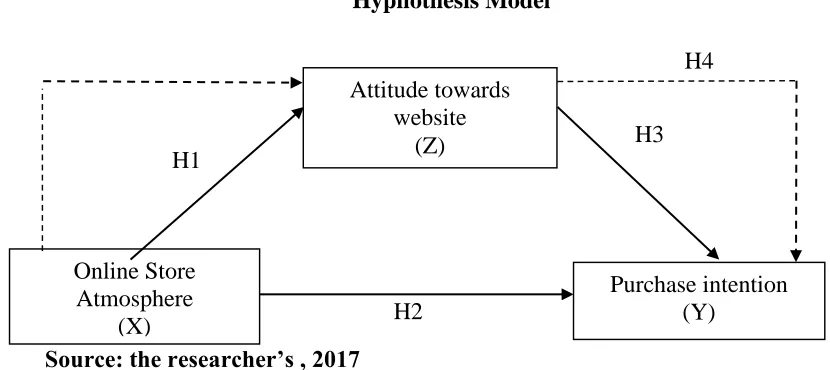
Figure 2.4 Hyphothesis Model ... 43
Figure 3.1 Research Path Diagram Model ... 54
Figure 4.1 Lazada Logo ... 58
Figure 4.2 Lazada Website Design Layout ... 60
Figure 4.3 Lazada Website Design ... 62
Figure 4.4 Lazada Website Layout ... 63
xii
LIST OF TABLE
Table 1.1 Internet Users in Indonesia 2013-2016 ... 3
Table 1.2 The Attitude of Internet Users in Indonesia in 2016 ... 38
Table 1.3 The Growth of Online Shop Consumers in Indonesia ... 41
Table 2.1 Previous Research ... 54
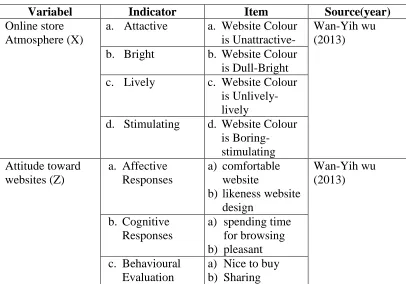
Table 3.1 Definition of Variable ... 58
Table 3.2 Respondents answer score... 60
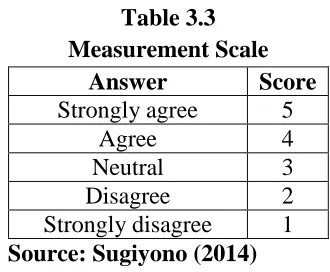
Table 3.3 Measurement Scale ... 62
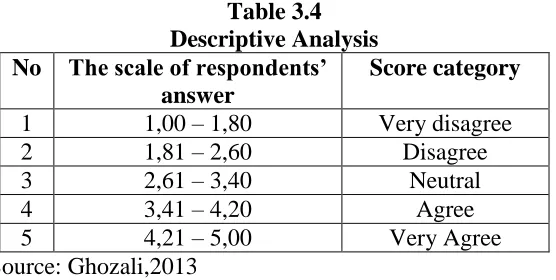
Table 3.4 Descriptive Analysis ... 91
Table 4.1 Characteristic of Respondent Based on Sex ... 90
Table 4.2 Characteristic of Respondent Based by Age ... 91
Table 4.3 Characteristic of Respondent Based on Status Employemenrt ... 93
Table 4.4 Characteristic of Respondent Based on Income... 94
Table 4.5 Characteristic of Respondent Based on Educational Background .... 95
Table 4.6 Store Online Atmosphere distribution Variable ... 96
Table 4.7 Attitude Toward Website distribution Variable ... 98
Table 4.8 Purchase Intention distribution Variable ... 99
Table 4.9 Validity Test Results Variable Atmosphere Online Store ... 100
Table 4.10 Validity Test Result of Attitude Toward Website Variable ... 101
Table 4.11 Validity Test Result of Purchase Intention Variable ... 102
Table 4.12 Reliability Test Result ... 103
xiii
Table 4.14 Result of Linearity Test Result ... 105
Table 4.15 Result of Coefficient Test ... 106
Table 4.16 Result of Determination Test Z Variable ... 107
Table 4.17 Result of Determination Test Y Variable ... 107
Table 4.18 Result of Coefficient Test ... 108
Table 4.19 Hypothesis Testing on Path Coefficient of X variable to Z Variable ... 109
Table 4.20 Hypothesis Testing on Path Coefficient of X variable to Y Variable ... 110
xiv
LIST OF APPENDICES
Appendices 1. Research Questionnaire ... 114
Appendices 2. Validity Test and Reliability Test ... 121
xv
THE EFFECT OF STORE ONLINE ATMOSPHERE ON PURCHASE INTENTION WITH ATTITUDE TOWARDS WEBSITE AS MEDIATION (STUDY CASE ON LAZADA.CO.ID IN MALANG)
By:
Inno Karsa Andika
Faculty of Economics and Business, University of Brawijaya Email: [email protected]
Supervisor:
Dimas Hendrawan, SE., MM.
ABSTRACT
The purpose of this research is to analyze the influence of store online atmosphere on purchase intention with attitude toward website as a mediator in website Lazada.co.id in Malang. The sample in this study was customers of Lazada website in Malang Area. The research is explanatory research which explains the causal relation between the variables through hypothesis testing. The data collection technique of this study uses questionnaires and literature study. This study used 100 samples of Lazada.co.id visitor in Malang. Those samples were taken using a purposive sampling technique. Test instrument that are used for testing the research instrument are validity test, reliability test, and classical assumption test. The analytical methods that were used are path model analysis and hypothesis testing are conducted with t test using SPSS 21The result of this study shows with using testing t is concluded that each of Store online atmosphere has significant and direct effect toward Attitude toward website. Therefore, Store online atmosphere also has significant and direct effect toward purchase intention. Attitude Toward website has significant and direct effect toward purchase intention as well. Moreover, Attitude toward website has positive effect as mediator between store online atmosphere and purchase intention in the study of Lazada.co.id.
xvi
PENGARUH ATMOSFER TOKO ONLINE TERHADAP MINAT BELI DENGAN SIKAP TERHADAP SITUS SEBAGAI MEDIASI (STUDI
KASUS PADA LAZADA.CO.ID)
Oleh:
Inno Karsa Andika
Faculty of Economics and Business, University of Brawijaya Email: [email protected]
Dosen Pembimbing: Dimas Hendrawan, SE., MM.
ABSTRAKSI
Tujuan dari penelitian ini adalah untuk menganalisis pengaruh atmosfer online toko terhadap niat beli dengan sikap terhadap website sebagai mediator di website Lazada.co.id di Malang. Sampel dalam penelitian ini adalah pelanggan situs Lazada di wilayah Malang. Penelitian ini merupakan penelitian explanatory yang menjelaskan hubungan kausal antara variabel melalui pengujian hipotesis. Teknik pengumpulan data dalam penelitian ini menggunakan kuesioner dan studi pustaka. Penelitian ini menggunakan 100 sampel untuk responden pengunjung Lazada.co.id di Malang. Sampel diambil menggunakan teknik purposive sampling. Instrumen uji yang digunakan untuk pengujian instrumen penelitian adalah uji validitas, uji reliabilitas, dan uji asumsi klasik. Metode analisis yang digunakan adalah analisis model jalur dan pengujian hipotesis dilakukan dengan uji t menggunakan SPSS 21. Hasil penelitian ini menunjukkan bahwa dengan menggunakan pengujian t disimpulkan bahwa masing-masing atmosfer online Store berpengaruh signifikan dan langsung terhadap Sikap terhadap website. Karena itu, Store online atmosphere juga memiliki efek signifikan dan langsung terhadap niat beli. Sikap Menuju website berpengaruh signifikan dan langsung terhadap niat beli. Selain itu, Sikap terhadap situs web memiliki efek positif sebagai mediator antara atmosfer penyimpanan online dan niat beli dalam studi Lazada.co.id.
CHAPTER I INTRODUCTION 1.1 Background of the Study
The rapid development of internet in this era of globalization encourages the change
of culture in human life. Currently internet connection becomes one of the reliable
media to seek information, communication, entertainment, and business. There are
various conveniences offered by the internet media, so the internet is a very important
human need for now. Indonesia becomes one of the countries that undergoes significant
increase in each year for internet users (eMarketer, 2017).
Table 1.1
Internet users in Indonesia from 2013-2016
Source : eMarketer, 2017.
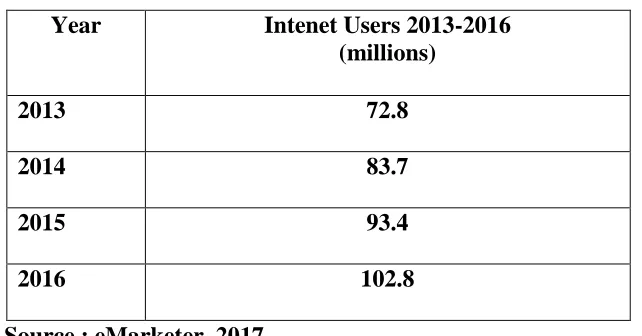
It can be seen on the table 1.1, as the development of technology and
information in each year, internet users in Indonesia increased significantly. In 2013
internet users in Indonesia reached 72.8%. In 2014 internet users continue to increase
by 83.7%, and in 2015 the use of the internet reached 93.4%. Until the year 2016
internet users in Indonesia reached 102.8%. The increase in percentage in internet
Year Intenet Users 2013-2016
(millions)
2013 72.8
2014 83.7
2015 93.4
usage both in the year 2013 and 2016 is a proof of the progress of the digital era in this
globalization era. With the increasing use of the internet then it can have both a positive
impact and also a negative impact for Internet users themselves.The Internet has an
influence on human life. The influence is in the form of positive and negative impact.
The influence depends on the internet users themselves. The negative effects of the
internet are, pornography, cybercrime, prostitution, and gambling. In addition, the
Internet also has a positive impact that can facilitate its users to communicate, send and
receive information.
The positive impact of internet certainly gives a good influence to the pattern of
human life, including patterns of interaction in trade. With regard to business
transactions, there are many business actors from small, medium and large are using
and utilizing the advancement of internet technology as a means to win and advance
their business. This is supported by the fact that internet users in Indonesia often visit
the online shop that is 82.2 million or 62% of the population in Indonesia (APJII, 2016).
Table 1.2
The Attitide of Internet Users in Indonesia in 2016 No Online
visitors
Percentage Most frequently viwebsited Website
1 82,2 millions 62% Online Shop
2 45,3 millions 34,2% Personal Business
3 5 millions 3,8% Others
Source :APJII , 2016
From table 1.2 It can be seen that in 2016, the attitude of Internet users in Indonesia
Seeing that with a high percentage of the use of an Internet then the online shop website
visitors is a very significant thing in the digital era now. Another percentage of 34.2%
indicates that users use the internet to do personal business and the remaining 3.8%
shows that users use the internet for other things like social media and browsing. Online
Shop as a means of e-commerce is needed in today's era as it can give priority to the
convenience of anyone so they can can conduct transactions without having to spend
more money, whether transportation or others anywhere.
E-commerce is an electronic business transaction and internal process used by a
company to support purchases, sales, leasing, planning and other activities (Stair and
Reynolds, 2006). In addition, e-commerce can also be defined as technology-mediated
exchange between parties (individuals or organizations) as well as intra- or
interorganizational-based electronic activities that facilitate such exchanges (Jeffrey &
Bernard, 2004).
Online shop is a process of purchasing goods or services from those who sell goods
or services over the internet which between the seller and the buyer never meet or make
physical contact in which the merchandise is offered through a display with an image
on a website or virtual store (Laudon in Prasetio,2012). The development of online
shop itself have been popping up, to date it reaches 26.2 million online trading websites
(BAPPENAS, 2016). Many people are interested in buying and selling online at online
Table 1.3
The Growth of Online Shop Consumers in Indonesia
Source : World Economic Outlook Internet Services Providers Association, 2016
Table 1.3 shows that the increase of online store expenditure in Indonesia tends to
increase every year. It also follows the number of population in Indonesia which also
increases every year, so the number of consumers for the online store market is
increasing. According to a study conducted by the World Economic Outlook Internet
Services Providers Association, in 2013 it was found out that from 247 million
populations, the online shop consumers reached 4.6 million consumers. The same trend
happenned in 2014 as from 251 million populations in total, there was 5.9 million
consumers of online shop in indonesia. Not far from 2014, in 2015 when the population
reached 255 million people, it was found out that there are 7.4 million online shop
consumers. Last, in 2016 of 258 million population the number of onlinbe shop
consumers reached 8.7 millions. The top increasing numbers of consumers in each year Year The total of population
(million )
The total of Online Shop consumers
(million)
2013 247 4,6
2014 251 5,9
2015 255 7,4
is the Online Shop which is a sale transaction without having to perform direct
transactions as a result of a technological advancement di globalization era.
Lazada.co.id is one of the online trading websites in Indonesia that has been active
in the world of online trading websites from 2012. Lazada.co.id website is a subsidiary
of internet companies in Germany, the Rocket Internet. Lazada.co.id has been
operating in Indonesia since January 2012 (Lazada, 2017). The Lazada.com website
offers a wide range of products ranging from electronics, books, toys, baby gear,
medical supplies, beauty products, household appliances, traveling supplies, and
sports. Whenever and wherever consumers are located, Lazada.co.id offers an easy
solution for consumers who want to buy goods via online. Lazada.com website
provides online shopping experience like in mall, plus Lazada.co.id also provides
convenience such as money back guarantee, free shipping, and COD (cash on delivery),
so, Lazada.co.id website becomes the most popular websites in 2015 and 2016 (W &
S Indonesian Research Marketer, 2017)
Figure 1.1
The most popular Online Shop website in Indonesia on 2014-2016
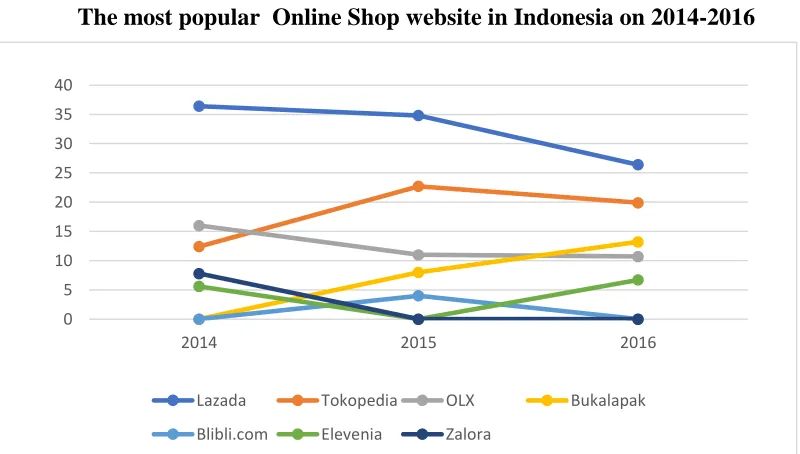
In the period of three years in 2014 to 2016, Lazada.co.id becomes an online
store that occupied in the first position. This can be seen onTable 1.4 chart, from
Popular Brand Index it places Lazada.co.id in 2015 by 34.8 and in 2016 by 26.4. There
is a decrease in 2016 by 8.4 seeing from Popular Brand Index. The decline is due to
the number of e-commerce websites emerging in Indonesia, for example Elevenia
which is formerly that is in 2015 not included in the top five, then in 2016 Elevenia
was ranked the top 5. In that case Lazada.co.id must take steps to set the strategy to
maintain its position in the first rank in a long term.
Related to the situation, marketing strategy becomes the main priority that must
be owned by every company in order to achieve its goals. Basically, the company's
goal embraces the concept of marketing is to provide satisfaction to consumers in
fulfilling their wants and needs. That's why there should be an effective marketing
strategy that is oriented to the main consumer. One of the marketing strategies in online
stores is to establish online store atmosphere.
Online Store Atmosphere is defined as the color used in the website that can
affect the emotions of consumers (Wann et al, 004). The look of an attractive website
and the availability of information that customers need are clearly seen as supporting
the success of an online store (Vrochopoulos, 2010). Part of the online store atmosphere
is the background color, percentage of white spaces, background music, fonts, color
scheme (Mandel and Johnson, 2004). Another design factor that defines store
atmosphere for a web-based store, ie, store front design and information display. Store
front design and information display is a visual factor that is the primary tool for
store atmosphere can enable consumers to attract and trigger purchases by consumers,
creating a certain atmosphere that can then affect how consumer attitudes toward the
website Lazada.co.id.
Attitude is one of the most comprehensive evaluations and allows one to
respond with likes or dislikes to the object being judged (Schifman and Kanuk, 2009).
The attitude towards the website as an emotional evaluation arises after the consumer
visits the website (Wann et al, 2014). In addition, is the expression of feelings that
reflect whether someone likes or dislikes an object, the object can be the look of the
website, brand, or service. To measure consumer attitudes toward the website, it can
be seen how likely someone will make a product purchase on the website (Schifman
and Kanuk, 2004). Attitudes toward the website have a positive relationship with the
intention of buying, it also shows that one's intentions are determined by attitudes
toward the same website and others. Buying intention indicates that consumers are
pursuing experience, the external desire of their environment to gather information
about a product or service (Schifman and Kanuk, 2009). A positive attitude toward the
website in shopping on the internet can increase purchasing intentions (Kim and Park,
2005) In addition, the positive attitude toward website influence can make consumers
intend to make a purchase (Raney et al., 2003)
Buying intention can be defined as a person's intention to purchase a particular
brand he/she has chosen for themselves after evaluating. We can measure purchase
intentions variable eg by considering brand for purchase and expecting to buy the
product in the future (Khan et al., 2012). The intention of online buying is the
where the transaction in question is an information retrieval activity, and purchase of
products that occur through the Internet network (Ling et al., 2010).
Lazada has a web design with a minimalist and modern theme of interest and
distinctive, with a combination of blue sea, orange and white. In addition, the info
provided by Lazada online store is complete, ranging from price, discount, product
description, specifications, and discussion of the product, so consumers get clear
information about the products being sold, and consumers can easily choose and
compare products in Lazada. This creates a store atmosphere in the form of store front
design and information display on Lazada online store to be attractive, because in store
front design is made with the use of attractive colors to make consumers feel interested,
and on information display, complete product information ranging from product
descriptions detailed, and clear product specifications. Store Atmosphere that can be
accepted by the consumer well will create attitudes towards a positive website on the
consumer, so it can create buying interest on the Lazada.co.id website
The development of websites through the internet is growing rapidly, so the
level of competition will be higher. This is because it can easily when a new online
store entered. Lazada must be able to know the behavior of consumers in order to meet
increasing sales, by forming buying interest through the store atmosphere, and attitude
towards the website, so if the consumer behavior of these variables can be created on
online stores, then can compete with other online stores and create a difference with
Based on the aforementioned research background then this research entitles
"THE EFFECT OF STORE ONLINE ATMOSPHERE ON PURCHASE INTENTION
WITH ATTITUDE TOWARD WEBSITE AS A MEDIATION (A CASE STUDY
ON LAZADA.CO.ID IN MALANG )"
1.2 Problems of the research
Based on the introduction explained above, there are four research problems
proposed in this research :
1. Does online store atmosphere has a significant effect on attitude toward websites of Lazada.co.id website?
2. Does the attitude toward website has a significant effect on purchase intention of Lazada.co.id ?
3. Does online store atmosphere has a significant effect on the purchase intention of Lazada.co.id ?
4. Does online store atmosphere has a significant effect on purchase intention through attitude toward Lazada.co.id website ?
1.3 Objective of the Study
Based on problems , then the research was carried out to achieve the following
objectives:
1. To know if the online store atmosphere on online store has significant affect the
attitudes toward Lazada.co.id website
2. To know if the online store atmosphere on online store has significant affect the
3. To know if the attitudes toward website has affect the purchase intention in
Lazada.co.id
4. To know if store online atmosphere has affect purchase intention through
attitude toward website in Lazada.co.id
1.4 Significance of Study
The results of this study are expected to provide many benefits to several parties,
which are :
1.4.1 For practitioners
This research can provide insight to prospective business practitioners to:
1. Run e-commerce to develop the business and find out factors affecting the
purchase intention
2. Develope marketing strategies that can increase purchase intention in
Online shop
1.4.2 For Economic and Business Faculty of Brawijaya University
This research result can be used as :
1. An economic and scientific development, especially related with
e-commerce and retail management.
2. This study can also be used as reference material to increase knowledge and
1.4.3 For scholars
This research result can be used as :
1. This study is beneficial as an evaluation media of the curriculum relevance of
a wide range of majors especially in international program of management.
Generally it contributes a lot to the Faculty of Economics and Business
Brawijaya University.
2. This research is beneficial as a reference for future research studies that have
CHAPTER II
THEORETICAL FRAMEWORK
2.1 Previous researches
To provide further information and clear views, the researcher decided to
discuss and analyze some previous researches. This can help the researcher to get a
clear research framework and basic methods. This study uses 5 journals as the main
guidance derived from Wan-yih Wu, 2013; Manganari and Adam, 2008; Angela and
Jeffrey, 2008; Anis-allagui and Jean-francois, 2007; Febrianto and Jeanne 2012.
The first journal is written by Wan Yih-wu (2013). The study was conducted
by distributing questioner method to 652 students in Taiwan. The results of the analysis
of this study indicate that store layout design has a significant impact on the passion
and emotional attitudes toward the website, and therefore has a positive influence on
purchasing intentions. In addition, the atmosphere has more effect on emotional arousal
than store layout design. The Second Journal of Manganari and Adam, (2008) explains
that all research methods undertaken from 1998 - 2008 provide static results that online
store atmosphere and consumer behavior provide static results that are interconnected
with one another.
Meanwhile, the third journal by Anis-allagui and Jean-francois, (2007) is
about online store store to visitors online shop in France. This study was conducted by
giving a questionnaire of 171 valid questionnaires, the sample consisted of 85 men and
84 women, and the results obtained from the researcher is the online store atmosphere
attitude towards the website which is explained by the online store atmosphere does
not affect purchasing intentions.
The fourth journal is by Angela and Jeffrey, in 2008 which studied 266
respondents with the first two phases classify the sample first by creating two groups:
the first group is the group of people who understand the computer and the second
group is the layman with the computer, the second phase provides a model of testing
form questioner, and the results for the two groups of Web Atmospheric have a positive
impact on affective responses and consumer behavior in the interest of buying an online
shop. In a recent study Febrianto and Jaenne (2012), found that the majority of online
shoppers are women aged 18-21, and the result is having a positive relationship
between online store atmosphere and buying interest with attitude mediation towards
Table 2.1 Previous researches
Source : Secondary Data, 2017
No Name and attitude give significant effect on purchase intention
2 Emmanouela, reference for concise information for the future Research advice for both
Previous research has the same variables, items, theories and methods with this
study as a guidance for completing this study. Although some variables are not covered
in this study. The object of each study is not similar depending on the focus, but most
of the data uses the same way. It is expected that this research can help the writer to
guide the research to have a clear hypothesis to know the variables measured for higher
quality research results.
2.2 Marketing and Marketing Management
2.2.1 The definition of Marketing
Marketing is a process by which a company creates value for customers and
builds strong relationships with customers, with the aim of capturing value from
customers in return. The above understanding shows the existence of an attempt to
meet the needs and the existence of a business directed to obtain these needs by
establishing relationships with other parties. The scope of goods and services as well
as ideas based on exchange and objectives is to provide satisfaction to the parties
involved (Kotler and Armstrong, 2014).
Another definition of marketing is the process of identifying, creating and
communicating values, as well as maintaining relationships that satisfy customers to
maximize corporate profits. Marketing is one of the principal activities undertaken by
entrepreneurs in their endeavors to sustain their survival, to grow and earn profits
Based on the above definition it can be concluded that the marketing has a
broader meaning than sales. Marketing includes business enterprises marked by
identifying consumer needs that need to be satisfied, determining the price of the
appropriate product, determining the promotion and sale of the product. So, marketing
is also an interconnected activity as a system to generate profit.
2.2.2 The definition of Marketing Management
Marketing management is the art and science of choosing target markets and
acquiring, maintaining and growing customers by creating, delivering and
communicating superior customer value (Kotler, 2009). This definition recognizes that
marketing management is a process that includes analysis, planning, implementation
and control of goods, services and ideas; based on exchange and its purpose is to
provide satisfaction for the parties involved. Thus, it can be seen that the task of
marketing management not only offers goods or services that suit their needs and
market demands, establishes effective prices, communications and distribution to
inform, influences and serves the market but it is also influences the level, time and
composition of demand to help the company achieve its goals.
Marketing management is an analysis, planning, implementation and control
program designed to create, build and maintain profitable exchanges with target
markets with a view to achieving profitable goals with target markets with a view to
achieving organizational goals (Djaslim Saladin, 2007 ).
From the above definition it can be seen that marketing management as a
products or services based on exchange and aims to generate satisfaction to the parties
involved.
2.3 Marketing Mix
2.3.1 Understanding Marketing Mix
Marketing has a very important function in achieving corporate success. In
achieving marketing success, every company needs to devise an effective marketing
strategy by combining elements in the marketing mix.
Marketing mix is a collection of tactical marketing tools controlled products,
prices, places, and promotions that the company needs to produce the desired response
in the target market (Kotler and Ketler, 2012). To implement the marketing program
effectively. The general definition of marketing mix is as follows: marketing mix is the
term used to describe the combination of the four major formers of the marketing mix's
core of an organization (Stanton, 2006). The four elements are product / service
offerings, pricing structures, promotional activities, and distribution systems.
Marketing Mix is a combination of variables or activities that are at the core of the
marketing system, variables that can be controlled by the company to influence the
reaction of buyers or consumers (Assauri, 2004). Another definition of marketing mix
is a strategy to mix marketing activities, to find the maximum combination so as to
bring the most satisfactory results (Buchari, 2008).
From some of these definitions, it can be concluded that the marketing mix is
a set of marketing tools conducted by mixing marketing activities, in order to get the
maximum combination to achieve marketing objectives in the target market, so it can
2.4 Retail
2.4.1 The definition of Retail Management
The word retail comes from French, ritellier, which means cutting or breaking
something (Utami, 2012). In addition, retail can be defined as an activity that involves
the sale of goods or services directly to the end consumer for personal and non-business
use. (Kotler cited by Dessyana, 2013). Retail is a business activity selling goods or
services to individuals for the purposes of self, family, or household. (Dunne and Lusch
cited by Abel and Hussein, 2015). Retail is the activity and final step in delivering
goods or services to end consumers (Dunne and Lusch cited by Abel and Hussein,
2015). A retail business is any activity involved in the sale of goods or services directly
to the end consumer for personal use rather than business use. And retail management
is understood as all the efforts undertaken in managing the retail business, which also
includes management related to finance, marketing, resources, and retail business
operations (Utami, 2012).
So from the above theory it can be concluded, Retailing is an activity and the
last step involved in the sale of goods or services directly to the end consumer used for
personal use and not the use of business or the seller.
2.5 Internet Marketing
The definition of internet marketing is web marketing, online marketing, or
marketing of products or services over the internet. In this case, Internet marketing
offers information and transactions more efficiently but not necessarily produce a more
competitive advantage in a sustainable manner. It is very important to note that this is
Internet marketing is traditionally marketing by using the web in developing
long-term relationships with customers, thereby creating a competitive edge for the
company by allowing it to charge higher prices for products and services than its
competitors (Laudon and Traver, 2013)
Internet marketing is the process of building and maintaining customer
relationships through online activities to facilitate the exchange of ideas, products and
services that can satisfy the goals of both parties (Mohammed and Jaworski, 2003)
2.5.1 Seven Stage of Internet Marketing
Internet Marketing has a variety of theories and models. One particular theory
that fits this research is the theory of Seven Stage of Internet Marketing (Mohammed,
fisher & Jaworski, 2003)
Figure 2.1
Seven Stage of Internet Marketing
Source : (Mohammed, Fisher, & Jaworski, 2003)
This stage includes analyzing market opportunities and collecting data from
online and offline systems to create opportunities. Ways of market opportunity analysis
can be seen from the six steps listed below:
1. Investigate Opportunities on the Value of Current System or New System. In this section it is used to identify broadly which areas will be entered into by
new companies and what opportunities can be obtained to enable companies to enter
the market.
2. Identify Unmet Customer Needs
The creation of a new value is based on doing a good job of looking at what the
customer needs by identifying the business processes within the existing company
to see if the current system meets the customer's needs or not.
3. Determining Target Customer Segmentation
Segmentation is the process of grouping customers based on their similarity.
After grouping customers into different segments, the company must determine the
target segment of the company.
4. Assess the Resources Needed to Offer
At this stage, the company must identify the resources that can be offered to
customers as well as that technology
5. Assess the Power of Competition, Technology, and Corporate Finance on Opportunities
6. Assess Go / No Go
At this stage, the final decision-making based on every available opportunity is
2.5.1.2 Phase 2: Formulating the Market Strategy
In the previous stage has been taken Go / No-Go decision, then the next
step is to determine the online marketing strategy. This stage includes three main
components, namely:
1. Segmentation
2. Targeting
3. Positioning
2.5.1.3 Stage 3: Designing the Customer Experience
At this stage we will strive to design the experiences we expect to get from
customers of the company. There are three stages in building customer experience,
namely:
1. Functionality - "Website works well"
These are the factors that determine whether the website created will work
properly or not. These factors are:
a. Usability and Ease of Navigation: it ismeasured by how well a
b. Speed: it refers to the time it takes to display a web page on the user's
screen.
c. Realibility: it describes the degree to which a website experiences a
downtime period, or a time when the user does not have access to the web
by maintenance.
d. Security: customers want to know they can trust a particular website, when
e. Media Accessibility: is the ability of a website to retrieve data on various
media platforms.
2. Intimacy - "They understand me"
At this stage, the customer feels that the company has deeply understood
the needs and desires of those generally embodied in the various customization for
the website look that the customer wants. The customer is obtained by:
a. Customization: an ability of a website to change itself for every user.
b. Communication: it refers to a conversation between the website and its
users.
c. Clearly: Good communication requires high achievement on the online
vendors.
d. Consistency: refers to the degree to which the customer experience on one
website can be repeated over time.
e. Trustworthiness: a hallmark established over time, once users have had
several opportunities to evaluate the company's services.
f. Exceptional Value: the company offers other added value so that the user
will not be easily persuaded by other companies.
g. Shift Consumption to Leasure Activity: customers no longer feel that the
visit to the website is as a task or a burden, but as a visit for pleasure.
3. Evangelism - "I love sharing stories"
At this stage the customer will be the disseminator of information about the
company's website, and indirectly promote the company to relatives, relationships,
a. Taking the Word to the Market: customers are happy to tell each other
about products that they feel are very good.
b. Active Community Membership: characterized by community
participation.
c. The Company Cares About My Opinions: an important key of this stage
is a perception that any company will not be able to process the
experience without the user, or that the user is very open to help the
company.
d. Defender of the Experience: customers who reach this stage are those who
defend their pandanus angle, so they can get very angry when others
disagree or buy competing offers.
2.5.1.4 Stage 4: Crafting the Customer Interface
In designing a good interface, a 7C's Frameworks is used to identify the main
view design faced when implementing a business model. These elements, namely:
1. Context: A web page must be able to capture the aesthetics and function can
see and feel. Its main focus is on an attractive graphical display, colors and
designs, while others have emphasized objectives that can be useful like making
navigation. Three critical factors in the appearance sebuha website, namely:
a) Section Breakdown / Subcomponent
b) LinkingStructure
c) Navigation Tools
2. Content: Content can be affirmed with all the things that are digital in a website.
graphics that can convey the message clearly, including products, services and
provision of information. The four main dimensions in contenct are:
a) Offering Mix
b) Appeal Mix
c) Multimedia Mix
d) Content Type
3. Community: Relationships that are built on the same interest in something,
whether between the customer with the company and the customer with the
customer can attract customers to re-visit the website again.
4. Customization: It is the ability of a website to be modified either by the
company or by each customer.
5. Communication: it is a dialogue involving the website and its users. This
communication can occur in three forms:
a. Company to customer (e-mail)
b. Customers to the company (customer service)
c. Customer to customer (instant message)
6. Connection: a network that connects one website to another.
7. Commerce: The ability of the website in conducting transactions on the sale of
goods, products or services with shopping charts, delivery and payment options,
inspection and order confirmation.
2.5.1.5 Stage 5: Designing the Marketing Program
At this stage is the design of marketing programs is used to aggregate marketing
about the company's products into the commitment phase and ends in the dissolution
stage.
There are four customer relationships, namely:
1. Awareness
The stage in which the customer has basic knowledge information or views
on the company or products offered by the company but it has not started
communication with the company.
2. Exploration / Expansion
The stage in which customers begin to communicate and act is likely to
lead to closer relationships, where customers begin to be interested in exploring the
company's website and look for information in it.
3. Commitment
This stage involves a responsibility to the product or company. Customers
will periodically access the website and provide views and attitudes that reflect
loyalty.
4. Dissolution
This stage occurs when one or both parties (companies and customers)
disconnect.
2.5.1.6 Stage 6: Leveraging Customer Information Through Technology
Companies can use technology help in acquiring, analyzing, and utilizing
information about customers so that the company will better understand and know
customers to know what customers need. This can be done through:
It is a tool that helps a company to understand and fulfill the wishes and
wishes of its customers, which can provide information on the quality and
usefulness of the products and services customers need.
2. Database Marketing
Is a tool consisting of acquiring customer information. Analyzing this
information is useful for estimating customer responses on particular offers,
and making marketing decisions based on expected responses.
3. Customer Relationship Management
It is a tool that establishes long-term profitability from customers and
maintains key customers. Customer information is the power and customer
information system can make the company increase its strength.
2.5.1.7 Stage 7: Evaluating Marketing Program
This last stage evaluates all marketing programs whether it reaches the target
or not. It uses parameters to measure the success of an online marketing program and
whether it matches the objectives of the company. In this phase, it uses the Marketing
Metrics Framework which consists of:
1. Financial Metric: it is used to measure basic results of the overall level.
2. Customer-Based Metrics: it is used to see the performance of marketing in
building customer-oriented assets that will be generated financially.
3. Implementation Metrics: it is used to see how effective and good performance
elements in marketing programs are in terms of building customer-oriented
2.6 E-commerce
Electronic commerce is the buying, selling and marketing of goods and services
through electronic systems such as radio, television and computer network or internet
(Wong, 2010). Then there is another e-commerce understanding of business
transactions and internal processes which are electronically used by companies to
support purchases, sales, leasing, planning and other activities (Stair and Reynolds
2006). E-commerce is the use of internet and web for business transactions formally
and digitally between organizations and individuals (Loundon and Traver, 2012).
There are 8 unique features in e-commerce technology (Loundon and Traver,
2012):
1. Ubiquity: Internet / web technology is available anywhere such as office,
home and other places and can be accessed via mobile devices.
2. Global Reach: Internet / web technology that has been able to reach the
whole world.
3. Universal Standards:A technology standard that is spread by all countries to
the world.
4. Richness: The wealth of information refers to the complexity and content of
a message, such as video, audio and text messages.
5. Interactivit: Technology that enables 2-way communication between sellers
and buyers resulting in transactions.
6. Information Density: Technology in reducing costs in obtaining information
7. Personalization / Customization:Seller may target his marketing to
customers specifically by obtaining customer information such as name,
interests or last purchase.
8. Social Technology: User Content Generation and Social Networking,
Internet and e-commerce have grown to be more open by making it easier
for customers to create and distribute content or information on a web or
social media such as photos, videos, music to the whole community.
2.6.1 Category of E-Commerce
The four general categories of e-commerce include:
1. Business-to-customer (B2C). In B2C companies sell products or services
to individual customers.
2. Business-to-business (B2B). In B2B companies sell products or services
to other companies.
3. Consumer-to-consumer (C2C). In this C2C participants in the online
market can buy and sell goods. Because one party acts as a seller, thus it
is considered as a company. C2C transactions may also fall into the B2C
category.
4. Business-to-government (B2G). In B2G companies sell products or
services to government and government agencies. Therefore B2G is
considered as a part of B2C.
Of the four categories described above, there are two most commonly used
2.7 Store Atmosphere
2.7.1 Definition
Store Atmosphere is the design of the environment through visual
communication, lighting, color, music, and perfume to design an emotional response
and customer perception and to influence customers in buying goods (Utami, 2006).
Atmosphere is a planned atmosphere that suits the target market and which can attract
consumers to buy as store atmosphere causes or affects purchases (Kotler, 2005). Store
Atmosphere is a combination of physical characteristics of stores such as architecture,
layout, lighting, display, color, temperature, music, aroma as a whole will create the
image in the form of consumers (Utami, 2010).
Store Atmosphere can be described as a change to the design of a purchasing
environment that produces special emotional effects that can lead consumers to
purchase actions. A store must establish a planned atmosphere in accordance with its
target market and can attract consumers to buy in the store. Store atmosphere affects
the shopper's emotional state, which then encourages to increase or decrease spending.
Emotional state consists of two dominant feelings (pleasure or passion). The
combination of these elements affects consumers to spend less or more time in the
Figure 2.2
Atmosphere and Purchase Behaviour
Source: Mowen & Michael, 2002
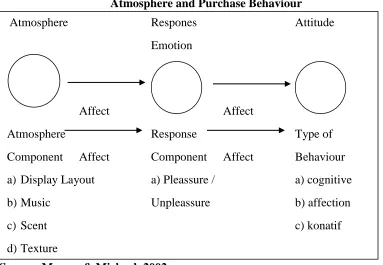
The above picture, explained that when the atmosphere of the consumer is
passionate in a positive way, the buyer tends to spend more time in the store, and
this situation may cause the purchase to increase. Conversely, if the environment is
unpleasant and excites consumers negatively, then the buyer may spend less time
in the store and make a little purchase.
Based on several definitions mentioned above, it can be concluded that store
atmosphere is all the aesthetic and emotional effects created through the physical
characteristics of the store, where everything is related to the five senses (sight) of
consumers and can affect consumer emotions to make a purchase.
Atmosphere Respones Attitude
Emotion
Affect Affect
Atmosphere Response Type of
Component Affect Component Affect Behaviour
a) Display Layout a) Pleassure / a) cognitive
b) Music Unpleassure b) affection
c) Scent c) konatif
d) Texture
2.7.2 Elements
These store atmosphere elements include the exterior of the store, the inside of
the store, the layout of the room, and the display. They are all described further
below (Barry and Evans, 2004) ,:
1. Exterior (outside the store)
Exterior is the outer part design. This exterior usually gives a first impression
on the store because this section is the first seen by visitors.
2. Interior (inside the store)
General Interior is a display of a restaurant that makes visitors feel
comfortable in the restaurant. Good display is able to attract the attention of
consumers and they finally make a purchase.
3. Store Layout
Store Layout is management in terms of location determination. Store
managers must also take advantage of the existing store space as effectively as
possible.
4. Display (Decorative Decoy In Store)
Display is a decor that can provide certain store characteristics and it can
attract consumers. Display has two purposes, namely to provide information to
consumers and to add store atmosphere which can increase sales and stores
profit
2.8 Online Store Atmosphere
Online Store Atmosphere is an overview of buyers and experience in online
positive effects for users to improve responses that benefit both sides (eroglu et al,
2000).
2.8.2 Dimension of Online Store Atmosphere
Unlike conventional store atmosphere, Online store atmosphere has different
dimensions, (Manganari, Siomkos and Vrechopoulos, 2008). which consists of several
dimensions including:
1. virtual layout and design;
a) Grid layout
The grid is a rectangular arrangement of displays and long spaces that
are generally parallel to each other. This is standard in the grocery store.
b) Free form layout
Free form is an asymmetric arrangement and uses various sizes and
styles of look and it is usually located in fashion online store.
c) Racetrack layout
Racetrack is an area that is built around the theme of shopping.
Customers are given the procedure to make a purchase.
2. virtual atmospherics;
a) Background color
The background color is usually the most prominent color on the
website having the most screen area.
Color schemes are arrangements or patterns of color or colored objects
that are understood as the formation of a unified whole. Adapted to the online
context, the object is a visual element on the website. Harmony of color is a
term related to the color scheme. Although the exact definition is not agreed
upon, Burchett (2002) defined it as two or more uniform colors to produce a
satisfying affective response.
c) Percentage of white space
Percentage of white space is used in various types of documents, such
as academic journals. There are spaces at the edges, on each of the four sides;
There is a white space between lines of text. This is for a reason: it gives the
reader a more satisfying reading experience, though it does not affect our
reading or comprehension speed (Bernard et al., 2000; Chaparro et al., 2004).
White space, or sometimes called negative space, is an open space found among
other design elements or objects (Pracejus et al., 2006).
d) Background music
Sound in online stores can be divided into two categories: content and
sound atmosphere (Coorough, 2011; see Fiore and Kelly, 2007). Content refers
to, for example, a music CD clip that gives the consumer a chance to listen to
music before purchasing. The background music can be considered equivalent
to the sound of the atmosphere.
e) Fonts
Font is defined as an important factor that forms the typeface given on
few core fonts as any font can be embedded on the website (Smashing
Magazine, 2009). As this increases the number of fonts that can be used online,
more attention should be paid to the selection of fonts. People assign personality
for typing, such as elegance, candor and friendliness (Brumberger, 2002)
f) Appeal scent
The look of a balanced website in combining different colors.
g) Touch appeal
The appearance of the website allows the researcher to interact (do
click) on each menu
3. virtual theatrics
E-tailers are enabled to make their store look like a "theater" through the
use of images, graphics, animations and icons. Complexity refers to the wealth of
elements in settings (Rosen and Purinton, 2004) and it is often operationalized by
the use of images, graphics and animations. The simpler background of web pages
is generally more effective. The mood resides in retailing the web and attracts rather
than the more complex (Stevenson et al., 2000). For that website with medium
complexity evaluated better than low or high complexity (Martin, 2005).
a) Animation techniques
1) There are animations that match the product characteristics.
2) Animation is proportional and does not interfere with content
b) Image
1) The image size is proportional
c) Vividness
The color of the website is clear / not blurred
d) Interactivity
1) The menus on the website have a clear path
2) The link does not confuse the user
4. Virtual social presence.
The effects of virtual social presence on online consumer responses are not
well documented in the literature to date. Online store atmosphere uses web
counters to communicate consumer preferences to their stores, but no specific
findings support its impact on online consumer behavior (Clark et al, 2004).
a) Web counter
There is a statistic website that shows how many visitors
b) Comment from other visitor
There is a menu to provide comments / suggestions
c) Crowding
The website is easy to access / not heavy despite having many visitors.
2.9 Attitude Toward Website
2.9.1 Definition of Attitude
Everyone has a tendency to behave in a fun or unpleasant way to a particular
object. Attitude is one of the most important concepts that companies use to understand
consumers. Companies are very concerned about consumer attitudes toward their
concerned but recommendations to friends and family will also result in profitable
purchases of the company. Conversely, negative attitudes toward the product will result
in rejection, and this attitude will continue to influence others. Here are some
definitions of attitude:
a. Attitude is a tendency that is exposed in behaving in a fun or unpleasant way to
a particular object. (According to Schiffman and Kanuk in Susanta, 2008) "
b. Attitude is a consumer feeling response that can be a feeling of likes or dislikes
towards a particular object (Sangadji and Sopiah, 2013).
According to Kamus Besar Bahasa Indonesia (KBBI), the consumer is any user of goods and / or services available in the community, whether for self-interest, family,
other people or other living beings and not for trading. classify consumers into two
kinds of individual consumers and consumer organizations (Schiffman and Kanuk
2008). Individual consumers are individuals or individuals who purchase products
(goods, services, or ideas) for self-consumption (eg, electronic notebooks), for home
use, or for consumption with friends. While the consumer organization is defined as an
institution or agency that buys products (goods, services, or ideas) to be traded or for
the benefit of the agency / institution. Based on the above definition it is known that
Consumer Attitudes is a combination of beliefs, feelings, and the tendency to behave
towards an object.
2.9.2 The Functions of Consumer Attitude
There are four functions of attitude (Schiffamn and Kanuk cited by Sumarwan, 2011),
namely:
Someone says his attitude to an object or product because it wants to benefit from
the product or avoid the risk of the product. Attitude serves to guide behavior to
get positive measurements or avoid risk.
2. Maintain Function
Ego Attitude serves to protect a person from a doubt that arises from within
himself or outside factors that may be a threat again himself. Such an attitude
serves to enhance the sense of security of self and overcoming external threats.
3. Value Expression Function
Attitude serves to express the values, lifestyle, and social identity of a person.
Attitude will describe the interests, hobbies, activities, and opinions of a
consumer.
4. Knowledge function
Curiosity is one of the important consumer characters. It is consumers needs to
always want to know about many things
2.9.3 Factors Affecting Attitude
There are several factors that can affect consumer attitude (Kotler 2000),
namely:
1. Cultural factors have the most widespread and profound influence on consumer
behavior. Cultural factors consist of several elements, namely:
a. Culture
Culture is the most fundamental determinant of a person's desires and
behaviors, consisting of a set of values, perceptions, preferences, and
b. Subculture
Subculture is a small part of the culture that gives more specific
identification and socialization of its members. Subcultures include
nationality, religion, racial groups, and geographic areas. Subcultures form
many important market segments and marketers often design products and
marketing-related programs made to meet their needs.
c. Social class
Social classes are relatively homogeneous and fixed parts of a hierarchically
arranged society whose members have similar values, interests, and
behaviors. The social class shows the preference of the product and brand in
a particular field such as clothing, home furnishings, leisure activities and
vehicles.
2. Social factors, Behavior of a consumer is also influenced by social factors such
as:
a. Reference group
The reference group consists of all groups that have a direct or indirect
influence on one's position or behavior. The group in question is the group in
which the person is located or interacting. Most of these groups are primary
groups that tend to be informal like family, friends, neighbors, and co-workers.
The other is a secondary group that tends to be formal like religious groups,
b. Family
The family is the most important consumer buying organization in the
community. Family members are the primary group with the greatest influence.
The intended effect is a more direct influence on the daily buying behavior, for
example in a procreative family consisting of spouses and children. Marketers
are interested in the relative roles and influence of a husband, wife and children
in purchasing various products and services. Their role and influence will vary
across different countries and social classes.
c. Roles and status
Someone participates in many groups throughout his life. A person's
position in each group can be defined in terms of role and status. People will
tend to choose products that communicate their roles and status in society.
3. Personal factors
A buyer's decision is also influenced by personal characteristics such as
the buyer's age and life-cycle stages, occupations, economic circumstances,
lifestyle as well as the personality and personal concepts of the buyer.
a. Age and stage of life cycle
People buy different goods and services throughout their lives. One's
consumption is influenced by the stages in the family life cycle such as the stage