Migrant Women Working at Informal Sectors: Empirical Study in Kuto Batu
Village, Ilir Timur Ii Palembang City
Bambang Bemby Soebyakto
Senior Lecturer in Economics Faculty
Sriwijaya University
Armansyah
Geography Education, Education Faculty, PGRI University
Palembang, South Sumatera Indonesia
Abstract
The aim of this study is to know the cause factor of migrant woman work at informal sectors. The method of research was used through mix methods. This research combined between the qualitative and quantitative researches. The collecting and presenting of data to the quantitative method was done through spreading the questioner to the respondents that analyzed by like scale, the presentation of data itself with frequency analysis, whereas the collecting and presenting of data to qualitative method through interview to informants, then used by the analyses of reduction, display, and conclusion. The location of research is Kelurahan Kuto Batu with the object’s research of migrant woman enter to work at informal sector in that place. These researches are to find out the cause factor of migrant woman work at informal sector in Kelurahan Kuto Batu are a want in helping the income of family, the flexible time of work, and they do not need high education to be workers at informal sector.
Key Words: Informal Sectors, Migrant Woman Enter and Work.
1. Introduction
Background
Palembang is the capital city of South Sumatra Province, where the astronomical between 1-105 ° east longitude and 130-2 ° south latitude with a rather flat topographical heights of between 10-30 m above sea level. Residents Palembang consists of various ethnic groups, in addition to the original Palembang residents are ethnic Arabs, Singapore, India, Pakistan, China and others. In addition to the city of Palembang have diverse ceremonies and traditions. Palembang is also listed as the most advanced development in Indonesia in a decade terakhi. Pivotal moment that triggered the big changes was the introduction of South Sumatra, particularly the city of Palembang, as host National Sport Competion XVI in 2004. The national sports event becomes a trigger for the development of this city is so rapid. Moreover, with the election of South Sumatra as one of the old houses SEA Games XXVI which took place November 2011, making the city attractive to many newcomers as turmoil development constantly carried out. As a Modern Kote, of course Palembang very welcome by all the attributes of modernity. Housing complexes mushrooming everywhere and demand by city residents who already number one and a half million more. Supermarket and minimarket are available to serve the needs of their shopping. Malls and hotels have sprung up here and there. The roads are built and adorned with all the trimmings (Rahman, 2011: 1). It became one of the attractiveness of the city of Palembang.
Lack of information on destinations that offer better employment opportunities become the main attraction for migrants. Therefore, many people who did the in-migration. In-migration is the influx of people into an area where the destination (Munir, 2010: 133).
Palembang is a city that became the destination of migrants entering. Based on data from the 2010 data migration SP Risen in Palembang amounted to 37 people in every 1,000 residents and for the number of lifetime migration is 254.2 per thousand inhabitants, means every 1,000 inhabitants there are 254-255 people who did the in-migration. Table 1.1 shows the five districts in the city of Palembang with the highest number of incoming migrants by gender in 2010.
Table 1: Migrant Population data to 5 District of Palembang in 2010
No District Migrant Population % Migrant
Female
Male Female
1 Kertapati 381 447 54 %
2 Ilir Timur I 1800 1812 50 %
3 Sukarami 580 535 48 %
4 Ilir Timur II 1604 1536 50 %
5 Kalidoni 924 708 44 %
Sources: South Sumatera Central Bureau of Statistics, 2011
The table above showed the District of Ilir Timur I is the highest district population influx of migrant women. After observation in every village, the highest number of migrant women enters in Kuto Batu Village, Ilir Timur II. The following data about number of migran women enter every village in the of Ilir Timur I and II District in 2010
Table 2: the number of Women Migrants per village in the district of Ilir Timur I and II in 2010
No
Ilir Timur I District Ilir Timur II District
Village Migrant Village Enter
Female Female
1 18 Ilir 58 10 Ilir 4
2 16 Ilir 31 11 Ilir 20
3 13 Ilir 63 Kuto Batu 568
4 14 Ilir 54 Lawang Kidul 283
5 15 Ilir 127 3 Ilir 23
6 17 Ilir 53 1 Ilir 7
7 Kepandean Baru 36 Sungai Buah 98
8 20 Ilir I 204 2 Ilir 115
9 Sei Pangeran 334 5 Ilir 107
10 20 Ilir III 378 Duku 36
11 20 Ilir IV 474 9 Ilir 232
12 - - 8 Ilir 43
Total 1812 Total 1536
Sources: South Sumatera Central Bureau of Statistics, 2011
The government also contributed to economic migrants, one of them by setting up a traditional market known as "Kuto Market". The following investigators also obtain data on the number of population by formal and informal sector employment in the Kuto Batu in 2010.
Table 3: the number of people who work in the formal and Informal sector in Kuto Batu in 2010
Village Formal Informal Others
Kuto Batu 156 1002 4233
Total 156 1002 4233
Sources: Kuto Batu Village in 2011
Table 3 showed the number of workers in the informal sector is higher than the formal sector. It was caused by a lack of jobs in the formal sector. According to CBS Palembang of 1002 workers in the informal sector are 49.7 percent of the population who work in the trade sector which amounted to 498 people. The results of observations that have been made, in 2012 in Kuto Batu Village, there are 86 female migrants entering and working in the informal sector, table 4 below showed the number of migrant women workers in the informal sector.
Table 4 Employment of migrant women working in the informal sector in Kuto Batu Village in 2012
No Informal Sectors Migrant Women
1 Services 34
2 Traders 52
Totali 86
Sources: Kuto Batu Village in 2011
Table 4 shows the entry of migrant women in 2012 were all informal sector workers include field service and trade. Informal sector services and trade percentage of women informal workers is greater than the other sectors. This is supported by the wide opening of job opportunities for women in employment and social services trade. The informal sector is more flexible services for women, meaning that in addition to supplement the family income, functions as a housewife is still to do Susilo (1997) in Hakim (2011: 22). In addition to the informal sector such as trade, non educated women can easily carry it out (Supriyadi in Hakim, 2011: 25).
Female workers indeed have gained special attention in the world of employment (Hakim, 2011: 21), it is caused by the complexity of the problems faced by women workers themselves, both in terms of its potential for the development of personal as well as in relation to the life of a family and society at the same time, besides the informal sector workers, women workers still having problems, such as; division of time between work and care of the household, low education, low wages, and well-being unmet. Therefore, with the high number of female workers who work in the informal sector of the government should be able to give special attention to the informal sector women workers as one solution to meet the challenges of the labor force blast especially female workers.
I.
Literature Review
Migration
Migration is all movement of physical space, change of residence (Smith in Standing, 1991: 10). The term also means the migration of population movement with the aim to settle from one place to another place beyond the political/state or administrative borders/boundaries inside a country. Munir in Emalisa (2003: 1) People who migrate called migrants; migrants are those who never moved any length 'since birth' (Standing, 1991: 15). Migration can occur by the presence of the pull factors and driving forces. According to the driving factors and pull factors are (Lee in Nurlina, 2012: 85):
a) The decreasing source of life
b) Employment opportunities are diminishing
c) Political pressure, religion, and ethnicity so disturbing rights
d) Education (those with high education will migrate to places where they are used in good quality), job (either due to change job or a new job that is different from the place of domicile), and because marriage e) Natural disasters such as; earthquake, tsunami, or an outbreak of disease
f) Education, employment
h) Urban activities such as entertainment venues, cultural centers and art, and sports
Based on the above factors on the part of (a - e) is the driving factor, while part (f - h) is a pull factor of people to migrate. In addition to migrating there are 7 (seven) migration law. Seven of the migration law contained in Revenstein paper on migration, entitled "The Law of Mgration" following seven migration laws in theory Ravenstein (in Nurlina 2012; 87), namely:
a. Migration and Distance
- The majority of migrants will move if the distance between the origin and destination short
- Migrants who will move with greater distances will choose big cities as destinations for the reason big cities are the center of trade and industrial center
b. Gradual migration/by stage
- The flow of migration to large cities will generate migration back (return migration)
- Because the city experienced rapid growth, then step by step, tadinnya population migrated from the village will be city dwellers
c. Flow and reverse flow (stream and counterstream) - Every major migration flows cause backflow replacement
d. The differences between rural and urban areas of the tendency to migrate
- In the village is bigger than the city as a result of the villagers to migrate more than city dwellers e. Women migrate short distances than men
f. Technology and migration
- Increased development in trade and industry sectors that contributed to the advancement of technology will lead to labor migration
g. Economic motives is a major boost to migrate.
Based on the opinion on the concept of migration and migration theories over the researcher can conclude that migration is the movement of people from one region to another either by purpose or residing temporarily settled based on the hope of finding a better life opportunities, while in-migration is migration from an origin to destination with the aim of settling or only temporary.
Worker
Workers are defined as those who work (do a job/act, to do something), the person who receives wages for his work; workers, employees, and given a few phrases, namely daily workers, illegal workers, laborers, workers weekly, seasonal workers, factory workers, commercial sex workers and skilled workers. Workers also be interpreted as the people who work to produce goods or services, both for subsistence and for the community. Workers are grouped into formal employment and informal workers according to the category of work, formal or informal sector. CBS differentiate employment status into 7 categories: 1) Trying itself, 2) Employer assisted by temporary workers/unpaid worker, 3) Employer assisted by permanent workers/laborers are paid, 4) Workers/Employees/Officers, 5) Workers in agriculture, including food crops, plantation, forestry, animal husbandry, fishing and hunting, as well as agricultural services, 6) are free in the non-agricultural workers who covers business in the mining sector, industry, electricity, gas and water, construction/building, trade , such as transportation, warehousing and communications, financial services, insurance, leasing of buildings, land and business services, social services sector, social and individual, 7) Unpaid worker, may consist of members of the household of the person being helped, as the wife/children who help him/her father worked in the fields; not members of the household but the family of the person being helped, like family that helps sales in the shop; not members of the household and not the family of the person who helped weave cap on household industries neighbors.
Informal Sector
CBS defines the informal sector as a Non Directories Company and Household Business with a workforce of less than 20 people. Meanwhile, according to Hendri Saparini and M. Chatib Basri from the University of Indonesia (in Nofita, 2010) mentions the characteristics of informal sector workers, namely 1) the labor work on all types of work without any protection to the efforts of state and is not subject to tax, 2) workers do not generate a fixed income, 3) where there is no job security work (job security), 4) where work is no permanent status on the job and business unit or institution that is not incorporated. Definition of the informal sector was first proposed by Keirt Hard (1973) from the University of Manchester said that the informal sector is part of the labor force in the city that is outside the organized labor market. In addition, the informal sector is a term for people who do their own business, the type of employment that are less organized, hard chopped, often forgotten in the official census, terms of employment are rarely accessed by legal rules (Breman, in Manning, 1991). So based on some understanding and opinion on the informal sector, the authors conclude that the informal sector is part of the job that are not bound by the rule of law, does not have a binding and income is not fixed.
II.
Research Methodology
Design Research
This research uses a mixed method which is a combination of quantitative and qualitative approaches simultaneously. This method can be used to reveal the issues in more depth. Research is one of the benefits of this combination is to provide a broader understanding of the problems of research. Cresswell, (2012: 304). This study is also a descriptive study. Descriptive research is research that is intended to gather information about the status of a variable or theme, symptoms or circumstances that exist, namely the state of symptoms according to what it is at the time of the study. Mukhtar and Erna (2000; 15)
Primary Data
This study uses primary data obtained through field survey respondents, followed by distributing questionnaires to the respondents. Then in-depth interviews with informants and observations of empirical phenomena related to migrant women entering and working in the city of Palembang in the informal sector.
Secondary Data
Secondary data is data obtained are processed as written documents and literature. Document review and study of literature, ie by collecting data obtained through written materials such as documents relating to the data entry and migrant women working in the informal sector in The Kuto Batu Village, Ilir Timur II Palembang City.
Population
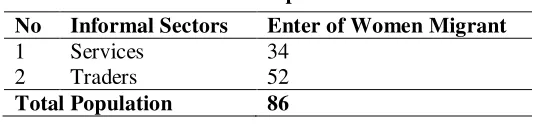
Population of migrant women entering into keluraham Kuto Batu, Ilir Timur II Palembang City amounted to 86 people scattered in villages Kuto Stone. Later, specified number of the population of migrant women entering the work in the informal sector to be selested as sample. Based on observations in the Village of Stone Kuto of 86 migrant women enter the entirely informal sector workers (per 2012) and occupy 100 per cent of the total migrant women into the Kuto Batu Village in 2012.
Tabel 5: Population
No Informal Sectors Enter of Women Migrant
1 Services 34
2 Traders 52
Total Population 86
Sources: Processing Data (2012)
Samples
The samples in this study are based on proportional stratified random sampling method; the population is divided into several sections (subpopulations) in Kuto Batu village based on the number of women migrants entering the region. Nnumber of migrant’s women entering into Kuto Batu Village; Ilir Timur II Palembang City with the sheer number of people, find out of 568 in 2012, and the number of migrant women entering the work in the informal sector is 86 people, divided into:
The samples in the study by using the formula in Yulina Slovin (2012: 5) as follows:
Where as:
N = Numbers of Population d = Degrees of Confidance: 10%
Based on this formula, the required sample is 46 people. Further sampling is done by using the Proportional stratified random sampling, namely by taking a few samples of women migrant workers who work in the informal sector in Kuto Batu Village, Ilir Timur II Palembang City. This method is taken as the type of sampling is acceptable for special situations. Proportional stratified random sampling can also be used to select members elusive. In this study the distribution of the sample based on the type of business is practiced, following data on the number of samples for each group are as follows:
Table 6: Sample
Type of Work Population Sample
Services Traders
34 52
(34/86) x 46 = 18 (52/86) x 46 = 28
Jumlah 86 46
Sources: Processing Data, (2012)
The sampling technique in qualitative research methods by means of purposive sampling, the reason is the way it will be easier to determine informants were considered relevant and competent in this study. An informant to be interviewed consists of several migrant women entered in the Kuto Batu Village. Selected key informants were women migrant entry, especially those working in the informal sector in Sub Kuto Stone. The selection criteria for key informants are as follows:
a. Population of migrant women in the village entrance Kuto Batu Village b. Migrant women entering the work in the informal sector in Kuto Batu Village c. Directly involved in the process and in-migration flows in the Kuto Batu Village.
Furthermore, researchers determine the key information to support search and networking of this information. Key informants are people who know about the state of Kuto Stone Village community, indigenous people or elders in the Kuto Batu Village. Criteria for Selection of key informants are as follows:
a. Community Leaders / Indigenous peoples in Kuto Batu Village b. Serving as an influential public figure in the Kuto Batu Village
c. Understand existing social circumstances and developments in the Kuto Batu Village
The key informants in the study are the Chairman of Indigenous in Kuto Batu Village. The reason this informant chosen because it is a public figure involved directly with the community and know the state of social and community especially in the informal sector are women migrant workers come in, and can explain the policy to address the problems of migrant women workers to enter and work in the informal sector, in addition to the also serves as a consultant companion in planning policy against migrant women entering and working in the informal sector in the city of Palembang.
Validity of Data
This research requires a tool to be able to improve the quality of content penlitian, to the researchers using data validity. The validity of the data used is as follows:
Improve endurance
These stage researchers make the process of understanding the data that has been obtained, by carefully reading the existing data, and interpret meninnjau back sesaui scientific studies are required in this study.
Triangulation
Discussion
The results of this study will be discussed by people who are competent in the fields of research, such as supervisor, lecturer, students and the makers, implementers or policy analysts.
Data Analysis Techniques
Quantitative data analysis techniques in this study using a Likert Scale technique later in the analysis of the frequency (proportion) and a descriptive analysis of the data presentation. Qualitative data analysis techniques with 1) data reduction, a summarizing process or selection of data, where the data is reduced to provide a sharper picture of the results of the study, researchers also make it easier to find the data obtained if necessary. 2) The data display, data presentation, the data that has been summarized or been made in the form of a matrix or table, so you can see the overall picture to the right conclusions. 3) Conclusion drawing/verification. Data conclusion, the preparation of the conclusions in the decision-making results of previous analyzes that adjusted for the formulation of research problems.
III.
Results And Discussion
Findings of the research by using quantitative methods show cause migrant women working in the informal sector. The most dominant factor becomes the cause of migrant women working in the informal sector is the desire to help the family income, flexible working time and do not need special skills. These three factors are based on the results of the analysis of the frequency of 100% means the percentage of all respondents said they agree that the reason they work in the informal sector is due to wanting to help the family income, flexible working time and do not need special skills. The findings of quantitative methods have in common with the qualitative. The fact is based on field interviews factors causing migrant women working in the informal sector entry are due to a desire to help pendapata family, flexible working time and do not need special skills. So the results of this study indicate that the causes of migrant women working in the informal sector in Kuto Batu Village, Ilir Timur II Palembang City because they want to help the family income, and flexible working time. Causes of Women Migrant Working in the Informal Sector
the results of the questionnaire that was distributed to 46 respondents, with calculations using SPSS data on the number and percentage of respondents' answers to the causes of migrant women working in the informal sector can be seen in the table below:
Table: 7 Answering of Causing Factors Enter Migrant Women Working in Informal Sectors in Kuto Batu Village in 2014
Number Variable
Statement
Agree Netral Disagree
Amount % Amount % Amount %
1 Husband Unworker 8 17.4 0 0 38 82.6
2 Increase of Family Income 46 100.0 0 0 0 0.0
3 Relatively Small Capitall 33 71.7 0 0.0 13 28.3
4 Flexibility of Working Time 46 100.0 0 0.0 0 0.0
5 Family/Husband Encouragement 10 21.7 6 13.0 30 65.2
6 Unnecessary of Spesific Skill 0 0 0 0 46 100.0
7 Unnessacary of High Education 44 95.7 0 0 2 4.3
8 Side Job 37 80.4 0 0 9 19.6
9 Security 40 87.0 0 0 6 13.0
Sources: Respondent Data, 2014
Higher education is not a requirement to work in the informal sector it is proved of 46 migrant women who work in the informal sector are 95.7% answered agree that the reason they work in the informal sector because of this sector do not require higher education. Safety in the work makes her entrance in the village migrants Kuto Batu Village chose to work in the informal sector, it is evident from the 46 migrant women entering the work in the informal sector there are 87% who answered that the reason they chose to work in the informal sector because of the security, the freedom to make the time migrant women entering the work in the informal sector makes just as a side apart from taking care of the household. This is evidenced from 46 migrant women enter the answer there is 80.4% agree that the reason they work in the informal sector is just a side job. Relatively small capital as informal sector workers is one reason they chose to work in the informal sector it is evident from 46 migrant women entering the work in the informal sector there are 71.7% answered agree that the reason they chose to work in the informal sector because of capital employed to be workers in the informal sector are not too big.
Most of women informal workers said that they work for their own accord as seen from 46 migrant women entering the work in the informal sector who responded agreed that the reason they work on the encouragement of husband/family percentage of 21.7%. The average woman's husband informal sector workers have jobs but not sufficient for daily needs. Therefore many migrant women entering the said disagree when it is said the reason they work in the informal sector because of a husband who does not work. This is evidenced from the answers 46 migrant women entering the work in the informal sector only 17.4% of those who said they agree that the reason they work in the informal sector because their husbands do not work. Factors do not need any special skills merupkan important factor that must be owned by a migrant women in the informal sector, it became the capital of migrant women to undertake their work. This is evidenced by the statement that 100 percent of respondents did not agree that the cause of migrant women working in the informal sector Due to reasons not need any special skills. The chart below is a portrait of respondents about the causes of migrant women working in the informal sector entered 2014.
The above results indicate that the most dominant factor in the cause of migrant women working in the informal sector is to help the family income, flexible working time. These factors then explore in depth through in-depth interviews on informants, the results showed that of the nine variables, there are several variables that the dominant cause of migrant women working in the informal sector in Kuto Stone Village. The ease in regulating working time in the informal sector makes migrant women free running informal sector businesses. Work in the informal sector provides opportunities for female workers who want to do business in addition to being a housewife. Needed of life that increasing the amount of income is insufficient is another cause that makes migrant women working in the informal sector. The informal sector is the choice of incoming migrant women are merchants (sellers shellfish, fish seller, the seller cakes, perfume seller, herbalist) and services (housekeeper, maid salon, laundry workers, carpenters picking peppers, onion peel artisan).
This is in accordance with Todaro and Smith (2006: 391) stated "In urban areas, the workforce newcomers who very much need to create a job alone or work in small companies belonging to the family. Occupational fields petty as it are very much the opposite. Start of itinerant traders, hawkers on the streets and sidewalks, writing nameplate, knife sharpening services, scavengers and garbage cleaning up firecrackers trade, prostitution, and sale of drugs to the snake dance performances. While those with special skills will make a living as a mechanic, carpenter a small artists, barbers, and personal maid wealthy family".
Based on field findings prove that the theory presented by Todaro and Smith (2006: 391) was right and become a real phenomenon that occurs in women migrants who work in the informal sector as a trader and that the majority of informal sector services. The description of the results of quantitative and qualitative research as follows: Husband Unworking
It was the opposite of the statement Kuto Batu Village said that the cause of many migrant women working in the informal sector either because their husbands do not work. The exact reason is the reason for migrant women desire to help the family income to make ends meet are still not sufficient. Most husbands migrant women working in the informal sector who have erratic working hours with low income. The work performed by migrant woman's husband entered the like, pedicab drivers, builders, fruit vendors, and others. Increased public transport, bentor, a motorcycle taxi was making a pedicab driver becomes deserted subscriber, so that affect family income migrant women entered.
Increase of Family Income
Helping Family income is all the activities that are intended to help meet the needs of migrant women entering family life in Kuto Batu Village, Ilir Timur II Palembang City. Results showed 100 percent of migrant women agreed that the cause of their work in the informal sector because they want to help the family income. Based on the responses of migrant women working in the informal sector in Kuto Batu Village, Ilir Timur II Palembang City, the main cause of their work in the informal sector is to help the family income, This happens because of insufficient family income so that these migrant women have to go to work for help meet the needs of everyday life. Increasing economic needs make the role of migrant women in the family is important. Revenue received from the work that the average husband is non-permanent employees with a salary that is uncertain, in the sense that not sufficient to make women migrants entered in Kuto Batu Village, Ilir Timur II Palembang City had to go to work in the informal sector with the aim of helping her husband and meet the needs of daily life or help the family income. This is supported by the opinion of Manpower of Palembang City which states that the difficulty households economy make migrant women entered in the of Kuto Batu Village should go to work in sectors that are easily accessible, in terms of the objectives of this sector is the informal sector.
Relatively Small Capital
Capital is all capital used/issued to start a business by incoming migrant women in Kuto Batu Village, Ilir Timur II Palembang City. Data shows that 71.7 percent of migrant women agreed that the cause of their work in the informal sector due to the relatively small capital employed, while 28.3 percent said tidaka agree. Capital is a causative factor of migrant women enters the work in the informal sector. Relatively small capital to make businesses in the informal sector is a pull factor incoming migrant women working in the informal sector. The initial capital to make the initial effort in the informal sector is average between Rp 300,000 and Rp 500,000. This capital by migrant women are not too big for just the initial capital when creating the first attempt after the capital employed will continue to decrease, even for incoming migrant women working in the informal sector services such as laundry workers, carpenters peel onions, chili quotation builders do not need to spend capital, just a desire and not feel embarrassed to do the job then incoming migrant women can get a job with the risk of low income. Flexibility of Working Time
Flexible working time is the time that is not bound or free-owned by women migrants enters to work in the informal sector in Kuto Batu Village, Ilir Timur II Palembang City. Based on the results of 100 percent of migrant women agree that the cause of their work in the informal sector is a flexible working time. Working time is not binding, making free incoming migrant women interested in working in the informal sector. The existence of taking care of the household tasks and help make their family income must choose a job that is not binding. The options are the informal sector.
Interviews showed that the causes of migrant women working in the informal sector because of flexible working time. Freedom in regulating working time for migrant women entering is the most beneficial, because they do not need to be supervised, scolde by superiors, because they do his own business and no one will rule or scold them. Their job as a housewife who must take care of all the household affairs as taking care of her husband, children, usher school children, clean the house, prepare dinner for the family. All the work they can do before or after their work. When feeling tired in the work they can go home and rest at home.
Husband Encouragement
Although more women enter the migrants said that they work the informal sector is not caused by factors husband encouragement. Interviews showed that the factor causing them to work in the informal sector is not as husband encouragement but because of their own accord. Concerns see family economic conditions, see the husband works; the future of children is a strong incentive for incoming migrant women to join work to support the family economy. Pengahasilan although they sometimes mediocre just for everyday use but for them it's better than just idle at home. The little income they can use for everyday meals, and the husband's income if there disempan can rest a little for children to school, but it is also informants said that they work for the encouragement husband, income barely make husband initiative to encourage his wife in this case migrant women entered in Kuto Batu Village, Ilir Timur II Palembang City to work in the informal sector. Husband's income that barely made the husband must be willing to send his wife to work for the needed of life together.
Unnecassy of Special Skills
Expertise is all the skills possessed by women migrants in Kuto Batu Village, Ilir Timur II Palembang City. The results showed 100 per cent of women migrants say not agree that the cause of their work in the informal sector because it does not require any special skills. Expertise is not an obstacle in conducting informal sector employment, in the sense not needs special skills in running a business in the informal sector, because everyone can do it as long as there is a will. According to migrant women in this area who work in the informal sector to be informal sector workers do not require special skills pentingada volition and not feel embarrassed then each person can run.
Education
Education is the highest levels of formal education have been followed by the entry of migrant women in Kuto Batu Village, Ilir Timur II Palembang City. Data shows that 95.7 percent of migrant women agreed that the cause of their work in the informal sector because it does not need higher education. Education migrant women entering the work in the informal sector on average had not completed primary school or high school. Lack of education makes women migrants to work in the informal sector. It proved to 89.5% of migrant women agreed that the informal sector to work does not need to have a higher education. Based on the answer to the education of migrant women are not the causes of migrant women working in the informal sector entry
Side Job
Data shows that 80 per cent of migrant women agree that the cause of their work is that the informal sector is a side job. Side job is all the work done to fill spare time migrant women entered in Kuto Batu Village, Ilir Timur II Palembang City. Freedom of time in carrying out the work in the informal sector do not make migrant women who work the informal sector makes his job as a side job. That's because they think that their job is not only no other jobs. Migrant women choose of working in the informal sector because the cause is not it as a side job, but the work is already considered a permanent job that becomes routine to do.
Security
Security is a situation in which migrant women entered in Kuto Batu Village, Ilir Timur II Palembang City who work in the informal sector. Data shows that 87 percent of migrant women agreed that the cause of their work in the informal sector because of their sense of security. Flexible informal sector, is not binding because it does not have to obey the orders of superiors, the security at the time of the informal sector employment as the absence of the ignorant, the disturbing, buyers are kind and courteous to make women feel safe incoming migrants working in the informal sector.
In addition, according to Supriyoko (2011: 25) on informal employment such as trade, educated women without tinggipun can easily carry it out. Safety at work is another factor that led to the informal sector demand by migrant women entered in Kuto Batu Village, Ilir Timur II Palembang City, because in addition to having adequate rest periods incoming migrant women working in the informal sector are free to set their own time without any binding like a boss and so forth. Further capital is not too big to make businesses in the informal sector is one of the causes of migrant women enter the work in the informal sector.
Thus, the previous theory and research that has been done there are similarities that researchers alike indicate that the cause of migrant women working in the informal sector entry is the desire to help the family income, flexible working time, do not need special skills, do not need a college education, capital relatively small, and security. According to the Manpower of Palembang City said that ease into the informal sector makes migrant women entering choose to work in this sector, in addition to the family economic pressure is also forcing them to participate in work to meet the needs of daily life, the husband's income is low making incoming migrant women should helping her husband worked. Poor education and lack of skills make migrant women entering informal sector as a place to work. Chairman of Indigenous of Kuto Batu Village also said that the average family income of migrant women in the village entrance Kuto Batu Village is still low, so that requires them to work, one of the jobs it easy to enter the informal sector of trade and services, because it does not require special conditions. Anyone can do this job as long as there is a will and not ashamed. Unlike the case with the opinion of the Kuto Batu Village who says that most women migrants enter the work in the informal sector due to the husband does not work, so that the incoming migrant women should be the backbone of the family. Based on the research results it is not a causal factor incoming migrant women working in the informal sector. Which is precisely the reason for lack of family economy, so the incoming migrant women have to work to help the family income?
IV.
Conclusions and Suggestions
The results of research using the method mix showed that the causative factors of migrant women working in the informal sector are helping the family income, and flexible working time. The same thing happened with the reason they entered, related to why they should work the informal sector. Because of economic limitations, insufficient income, the average employment of migrant woman's husband is a laborer whose work is seasonal with incomes too low. To sustain the needs of family life, women migrants have to go to work. The informal sector is the answer, it is the informal sector because they have flexible working time, meaning that free is not binding. Women workers were also able to carry out his duties as a housewife taking care of children, and a husband. The reason is what makes the informal sector attractiveness for women migrants who lived in the Kuto Batu Village. Based on the findings of the research that has been done, the researchers suggest the following matters:
Manpower of Palembang City
Increased female workers in the informal sector and the low attention to workers in the informal ector the researchers expect that Manpower of Palembang City pays more attention to women workers in the informal sector. The steps that need to be given as a suggestion of research are as follows:
a. Provide training to the empowerment of women workers in the informal sector.
b. Provide education and socialization of trainings held by official institutions and private institutions to community.
c. Provide capital/revolving fund for women workers who are interested in doing business in the informal sector. Private Sectors
The private sector is part of a development that could help the economy of a region. Hope researchers to the private sector can provide relief funds and incentives to women workers who are scattered in the city of Palembang in particular.
Further researchers
a. Doing research on the characteristics of migrants who worked informal sector and opportunities to earn higher incomes as informal sector workers.
b. Doing research on how parenting women migrant informal sector
References
Adioetomo, Sri Moertiningsih, dan Samosir, Omas Bulan. 2010. Dasar-dasar Demografi. Jakarta Selatan: Salemba Empat
Alkhudri, Tarmiji. 2011. Mudik Sebagai Fenomena Kultural-Kependudukan. Jakarta: Jurnal Sosialita Vol. 9 No. 1 Juni 2011.
Azmi, Ana Shabana. 2011. Negara dan buruh migran perempuan kebijakan perlindungan buruh migran perempuan indonesia masa pemerintahan susilo bambang yudhoyono 2004-2010 (studi terhadap perlindunganburuh migran indonesia di malaysia. Fisip UI
Badan Pemberdayaan Masyarakat dan Pemerintahan Desa Provinsi Sumsel. 2012. Pedoman Penyusunan dan pendayagunaan data profil desa dan kelurahan. Kelurahan Kuto Batu: Palembang
Badan Pusat Statistik. 2010. Sensus Penduduk 2010, BPS Pusat.
Badan Pusat Statistik. 2011. Statistik daerah kota palembang 2011. Palembang
Badan Pusat Statistik. 2012. Indikator tenaga kerja dan kesejahteraan rakyat Kota Palembang tahun 2011 kerja sama BPS Kota Palembang dengan Bappeda Kota Palembang. Palembang
Creswell, J. W. 2012. Research Design Pendekatan Kualitatif, Kuantitatif dan Mixed. Edisi Ketiga. Yogyakarta: Pustaka Pelajar
Emalisa. 2003. Pola dan arus migrasi di Indonesia. USU digital library.
Firnandy. 2002. Study Profil Pekerja di Sektor Informal dan Arah Kebijakan ke Depan.
Hakim, lukmanul. 2011. Perkembangan tenaga kerja wanita di sektor informal: Hasil analisa dan proxy data sensus penduduk. Among makarti, vol.4 no.7, juli 2011.
Handayani, Ria, Puspa, Yusuf. 2007. Penyadaran Peran Wanita sebagai Tenaga Kerja Sektor Informal Dalam Persamaan Jender.
Hatta, Liswarti. Profil Sektor Informal Pedagang Kaki Lima di Jalan Margonda Raya Depok. Perpustakaan Universitas Indonesia. Laporan Penelitian.
Kumari, Anna. Mirza Indah Sari. 2012. Rebo Akhir Tradisi Budaya Palembang. Palembang: Dinas Kebudayaan dan Pariwisata Kota Palembang Edisi: Tahun 2012. Cv. Chacon.
Munir, Rozy. “Dasar-dasar Demografi”. 2010. Lembaga Demografi Fakultas Ekonomi Universitas Indonesia: Depok
Nagib, Laila. 1997. Migrasi Ke Kota Dan Permasalahan Ketenagakerjaan Di Irian Jaya. Jakarta: Buletin Pengkajian Masalah Kependudukan Dan Pembangunan.
Rahman, Saipul. 2011. Sejarah Kota Palembang Nama Kampung, Pasar, dan Nama Jalan. Palembang: Dinas Kebudayaan dan Pariwisata Kota Palembang. Selaras.
Rahman, Saipul. 2011. Adat dan Tradisi Masyarakat Kota Palembang. Palembang: Dinas Kebudayaan dan Pariwisata Kota Palembang. Selaras.
Riyadi. 2012. Paradigma perlindungan terhadap perempuan pekerja Di dunia kerja dan kesehatan reproduksi dalamPerspektif islam, kebijakan negara dan realitas.
Romdiati, Haning. Mita. 2006. Mobilitas Penduduk Antar Daerah Dalam Rangka Tertib Pengendalian Migrasi Masuk Ke DKI Jakarta. Jurnal Kependudukan Indonesia, Vol. 1, No. 1.
Safrida, 2008. Dampak Kebijakan Migrasi Internal Terhadap Perilaku Pasar Kerja Di Indonesia. Bogor: Forum Pascasarjana Vol. 31 No. 2 April 2008.
Saptanto. 2009. Analisis Pola Migrasi dan Konsumsi Rumah Tangga di Daerah Asal Migrasi Terkait Kemiskinan dan Kerentanan Pangan (Studi Kasus Indramayu). Jakarta: Balai Riset Sosial Ekonomi Kelautan dan Perikanan.
Saputra, Daniel. 2013. Pedoman Umum Penulisan Karya Tulis Ilmiah. Universitas Sriwijaya
Setiawan, Iwan. 2010. Migrasi Penduduk Menuju Daerah Pinggiran Kota Bandung Dan Implikasinya Terhadap Kualitas Lingkungan Permukiman. Bandung: Gea, Vol. 10, No. 2.
Standing, Guy. 1991. Konsep-konsep mobilitas di Negara sedang berkembang. Jogjakarta: Pusat Penelitian Kependudukan Universitas Gadjah Mada.
Supriyoko. 2011. Tenaga kerja wanita indonesia latar belakang dan catatannya. Disampaikan dalam forum diskusi panel harkat wanita Indonesia sebagai tenaga kerja wanita di luar negeri Wanita taman siswa cabang sarjana wiyata. Yogyakarta, 21 juli 1990.
Tarmizi, Nurlina. 2012. Ekonomi Ketenagakerjaan. Palembang: Unsri Press 2012 ---. 2012. Tri Matra Kependudukan. Palembang: Unsri Press 2012
Todaro, Michael P. Stephen C. Smith. 2006. Pembangunan Ekonomi Edisi Kesembilan. Jakarta: Erlangga.
Triyono. 2013. Kendala kepesertaan program jaminan Sosial terhadap pekerja di sektor Informal: studi kasus di kota Surabaya. Jurnal Hukum Prioris. Vol. 3 No. 3.
Utomo. Priyo Agung, 2006. Peluang pekerja wanita dalam memilih lapangan pekerjaan Pertanian dan non pertanian di kota batam. Jurnal Organisasi dan Manajemen. Vol. 2 No. 1
Vadlun, Fadlia. 2010. Migrasi Wanita dan Ketahanan Ekonomi Keluarga. Media Litbang Sulteng III. No. (1) Mei 2010