Abusive Supervision and Subordinates’ Organizational
Citizenship Behavior
Kelly L. Zellars and Bennett J. Tepper
University of North Carolina at CharlotteMichelle K. Duffy
University of KentuckyThe relationship between subordinates’ perceptions of abusive supervision and supervisors’ evaluations of subordinates’ organizational citizenship behavior (OCB) was explored among a sample of 373 Air National Guard members and their military supervisors. As predicted, the relationship between abusive supervision and subordinates’ OCB was stronger among subordinates who defined OCB as extra-role behavior (compared with those defining OCB as in-role behavior), and this effect was fully mediated by the interactive effect of procedural justice and OCB role definitions. The study’s implications for theory and research are discussed, its limitations are identified, and directions for future research are suggested.
Recent contributions to the leadership literature suggest that some supervisors perform behaviors that can be characterized as tyrannical (Ashforth, 1994), bullying (Hoel, Rayner, & Cooper, 1999), undermining (Duffy, Ganster, & Pagon, 2002), or abusive (Keashly, Trott, & MacLean, 1994). The term we will use, abusive
supervision, refers to “subordinates’ perceptions of the extent to
which their supervisors engage in the sustained display of hostile verbal and nonverbal behaviors, excluding physical contact” (Tep-per, 2000, p. 178). Behavioral descriptors consistent with this definition include “using derogatory names, engaging in explosive outbursts (e.g., yelling or screaming at someone for disagreeing), intimidating by use of threats of job loss, withholding needed information, aggressive eye contact, the silent treatment, and hu-miliating or ridiculing someone in front of others” (Keashly, 1998, p. 87). Although abusive supervision is a low base-rate phenom-enon, its effects are noteworthy. A small but growing body of empirical research suggests that abused subordinates report greater job and life dissatisfaction, intentions to quit their jobs, role conflict, and psychological distress, compared with their non-abused counterparts (Ashforth, 1997; Duffy et al., 2002; Keashly et al., 1994), and that subordinates’ perceptions of unfair-ness explain their responses to abusive supervision (Tepper, 2000). Hence, abusive supervision represents a source of injustice that has serious implications for organizations and employees (Bies & Tripp, 1998).
An open question concerns subordinates’ behavioral responses to abusive supervision. The issue receives some attention in the-oretical treatments, that is, employees may respond to uncivil behavior with further incivility (Andersson & Pearson, 1999). If these types of behavioral spirals are possible, it is perhaps reason-able to further expect that subordinates of abusive supervisors
reciprocate their supervisor’s hostility in some fashion (e.g., Duffy et al., 2002). Indeed, there is considerable theoretical and empirical support for the notion that individuals who feel threatened (e.g., as the target of abusive behavior) or perceive a loss of control strive to preserve a sense of autonomy (e.g., Brehm, 1966; Wright & Brehm, 1982). As Ashforth (1997) noted, employees are likely to “react (directly or indirectly) against perceived causes of frustra-tion to restore the situafrustra-tion to what was expected” (p. 129). However, characteristics of the supervisor–subordinate relation-ship (e.g., power differentials) suggest that an abusive “tit for tat” spiral may be unlikely as individuals do not ordinarily reciprocate identical actions of a powerful abuser (Lord, 1998). In other words, a subordinate is unlikely to attempt to restore a sense of personal autonomy by engaging in abusive behavior directed at the super-visor. Doing so is unlikely to halt the abuse and may even trigger more intense hostility on the instigator’s part (Tepper, Duffy, & Shaw, 2001).
As such, one purpose of our research was to investigate another way abused subordinates may seek to restore the situation to what is expected— by withholding actions that benefit the organization and its representatives, what the literature refers to as
organiza-tional citizenship behavior (OCB). As originally defined by Organ
(1988), OCB refers to discretionary actions that in the aggregate promote organizational effectiveness. Examples of OCBs include helping coworkers with work-related problems, not complaining about trivial problems, behaving courteously to coworkers, and speaking approvingly about the organization to outsiders. A key component of the OCB definition is that the omission of OCBs is not punishable. Consequently, withholding OCBs should be a safe means by which abused subordinates can respond to abusive supervision. We were also interested in identifying the conditions under which a subordinate might react in this manner and in further exploring why abused employees would withhold OCBs. In particular, we examined the complex roles that procedural justice perceptions and OCB role definitions may play in the relationship between abusive supervision and OCB. In doing so, we integrated theory and research from these domains with the abusive supervi-sion literature to predict mediation and moderation patterns among these variables.
Kelly L. Zellars and Bennett J. Tepper, Department of Management, University of North Carolina at Charlotte; Michelle K. Duffy, Department of Management, University of Kentucky.
Correspondence concerning this article should be addressed to Kelly L. Zellars, Department of Management, Belk College of Business Adminis-tration, University of North Carolina at Charlotte, Charlotte, North Caro-lina 28223. E-mail: [email protected]
In the following sections, we develop a conceptual framework that explains when subordinates may withhold OCBs in response to abusive supervision and why abusive supervision prompts sub-ordinates to withhold OCBs. Specifically, we identify a moderator (OCB role definitions, the extent to which subordinates perceive OCB to be a requirement of the job or beyond job requirements) and a mediator (subordinates’ procedural justice perceptions) of the relationship between abusive supervision and subordinates’ OCB. We then present a test of this model among a sample of 373 members of the U.S. Air National Guard and their military supervisors.
Antecedents of OCB
Organ and his colleagues introduced the OCB construct as part of a stream of research that sought to explain why early studies found modest relationships between employees’ attitudes and work performance (see Brayfield & Crockett, 1955; Iaffaldano & Muchinsky, 1985). Organ (1977) attributed these findings to the notion that situational factors (e.g., technology and work flow processes) constrain the extent to which employees can modify their performance of the kinds of contributions these studies em-phasized—required work activities or in-role behavior. Organ be-lieved that employees’ attitudes are more likely to be expressed in extra-role behaviors—actions over which employees have greater discretion. These ideas were ostensibly supported in empirical studies that found employees who were more satisfied with their jobs performed OCBs with greater frequency (Bateman & Organ, 1983; Smith, Organ, & Near, 1983).
Since that time, researchers have extended Organ’s (1988) ideas to investigate relationships between supervisory practices and sub-ordinates’ OCB (for a review, see Podsakoff, MacKenzie, Paine, & Bacharach, 2000). For example, Hui, Law, and Chen (1999) found that in-group members (i.e., subordinates with whom supervisors exchange valued resources like time, information, and personal support) performed OCBs with greater frequency than out-group members (subordinates whose relationship with their supervisor is characterized by close adherence to contractually established roles). Podsakoff, MacKenzie, Moorman, and Fetter (1990) and Podsakoff, MacKenzie, and Bommer (1996) reported positive correlations between subordinates’ OCBs and transformational leadership behaviors like articulating a vision, role modeling, intellectually stimulating subordinates, and communicating high performance expectations.
Taken together, this research stream suggests that subordinates reciprocate supportive leadership behaviors by performing OCBs and withhold OCBs when supervisors are less supportive. We extended this line of inquiry by exploring whether abusive super-vision is related to subordinates’ OCB. As noted above, abused subordinates often experience frustration along with a diminished sense of personal control (Ashforth, 1997). Reactance theory sug-gests that frustrated individuals engage in behaviors designed to restore their sense of control (e.g., Brehm & Brehm, 1981). One potential way to restore perceptions of control is to exercise autonomy or discretion in one’s behavior (Wright & Brehm, 1982). Thus, in response to abusive supervision, one might choose to enact or not to enact certain behaviors over which one has discretion. Research suggests that abused subordinates are likely to hold their employer somewhat responsible for their supervisor’s behavior (Tepper, 2000). Thus, one way abused subordinates can
restore this sense of autonomy and freedom is by intentionally withholding actions the organization values. To the extent that OCBs involve actions over which employees have some discre-tion, subordinates of abusive supervisors should perform fewer OCBs than their nonabused counterparts.
Hypothesis 1: Abusive supervision will be negatively
associ-ated with subordinates’ OCB.
Moderating Effects of Subordinates’
OCB Role Definitions
Recent theory and research suggest that the characterization of OCB as discretionary may not be tenable, and consequently, research built on that assumption should be interpreted with cau-tion. Critics have argued that the distinction between required behavior (i.e., in-role behavior) and behavior that exceeds one’s jobs requirements (i.e., extra-role behavior) is too ambiguous to identify a subset of behaviors that may be regarded as extra-role across persons, contexts, and time (Graham, 1991; Van Dyne, Graham, & Dienesch, 1994). Morrison (1994) invoked theories of role making, psychological contracting, and social information processing to argue that variance in employees’ OCB role defini-tions should not be unexpected. Research suggests (a) organiza-tional roles in general, and supervisor and subordinate roles in particular, are continuously negotiated and renegotiated (Graen, 1976), (b) employees’ perceptions of their job requirements may differ substantially from those of their employer (Rousseau, 1989), and (c) because job incumbents rely on social cues to cognitively construct their job requirements, individuals holding similar posi-tions may define their roles differently (Salancik & Pfeffer, 1978). Consequently, even with respect to behaviors that most observers would regard as extra-role, there is likely to be some variance in actors’ role definitions. Consistent with these ideas, empirical evidence suggests that many employees perceive OCBs to be part of their job (Lam, Hui, & Law, 1999; Morrison, 1994; Pond, Nacoste, Mohr, & Rodriguez, 1997).
In an effort to address these concerns, Tepper, Lockhart, and Hoobler (2001) recently proposed a role discretion hypothesis, which supports the notion that employees’ role definitions vis-a`-vis OCB moderate the relationship between attitudes and OCB. According to the framework, employees who define OCB as in-role behavior may be willing to reciprocate the treatment they receive by performing OCBs, but the lack of discretion individuals have over in-role behavior prevents them from doing so (Organ, 1977). In contrast, employees who define OCB as extra-role be-havior see fewer situational constraints on their OCB performance and perceive that withholding OCBs is not punishable, thus allow-ing them to modify their OCB upward (in response to favorable treatment) or downward (in response to unfavorable treatment). In support of this, Tepper, Lockhart, and Hoobler (2001) found that role definitions moderated the effects of justice perceptions on two kinds of OCB in one sample and three kinds of OCB in another sample. In the case of each significant interaction, the role discre-tion hypothesis was supported: The reladiscre-tionship between justice and role perceptions was stronger among subordinates who de-fined OCB as extra-role behavior compared with subordinates who defined OCB as in-role behavior.
earlier, subordinates of abusive supervisors should experience considerable resentment and a desire for retribution. To the extent that OCBs represent a workplace contribution that organizations and their representatives value, withholding OCBs appears to be an efficacious means of reciprocating the behavior of an abusive supervisor (Hypothesis 1). However, abused subordinates who define OCB as in-role behavior should be less likely to with-hold OCB compared with abused subordinates who define OCB as extra-role behavior. These arguments yielded the following hypothesis:
Hypothesis 2: Subordinates’ role definitions will moderate
the relationship between abusive supervision and subordi-nates’ OCB such that the association will be stronger among subordinates who define OCB as extra-role behavior com-pared with subordinates who define OCB as in in-role behavior.
Mediating Effects of Procedural Justice
We turn now to an explanation of how abusive supervision and the Abusive Supervision⫻OCB Role Definition interaction in-fluence OCB. Most research on the antecedents of OCB has invoked Organ’s (1988) social exchange-based explanation of OCB performance. Organ’s explanation suggests that employees perform OCBs when they believe that their relationship with the organization is one of social exchange (i.e., relationships that exist outside formal contracts such that the participants’ contributions are unspecified) rather than economic exchange (i.e., relationships in which each party’s contribution is contractually specified; Blau, 1964). Compared with economic exchanges, social exchanges consist of diffuse, informal agreements in which the party’s con-tributions are open to individual interpretation. Organ (1988) ar-gued that organizational practices that engender favorable attitudes incur a sense of obligation to recompense the organization in a manner befitting a social exchange relationship. Moreover, Organ believed that employees reciprocate using OCBs because OCBs lie outside formal role requirements and reward structures and there-fore represent contributions that are structurally similar to the social rewards afforded by a fair system (e.g., feelings of trust, support, and good faith).
Consistent with Organ’s (1988) contention that OCB perfor-mance should be based on conditions of social exchange, research suggests that employees’ OCBs are related to attitudes and per-ceptions indicative of social exchange such as job satisfaction (Smith et al., 1983), trust (Konovsky & Pugh, 1994), organiza-tional support (Moorman, Blakely, & Niehoff, 1998), and justice (Moorman, 1991). In this research, we focused on procedural justice (that is, employees’ perceptions that the organization and its representatives use fair procedures when making allocation deci-sions). Most studies of OCB antecedents have included measures of procedural justice, and the research evidence suggests a robust and reliable positive correlation between procedural justice and OCB.
Further, several studies suggest that justice perceptions transmit the effects of supervisory practices on employees’ perceptions, affective reactions, and performance contributions, including OCBs (Mossholder, Bennett, Kemery, & Wesolowski, 1998; Nie-hoff & Moorman, 1993; Pillai, Schriesheim, & Williams, 1999; Tepper, Eisenbach, Kirby, & Potter, 1998). In the only study that
has examined justice as a mediator of abusive supervision, Tepper (2000) found that subordinates’ procedural justice perceptions explained the effects of abusive supervision on subordinates’ job satisfaction, organizational commitment, and conflict between work and family. One interpretation of these findings is that the behavior of an employee’s supervisor provides information as to whether the employee’s relationship with management is one of social exchange or economic exchange. As the organizational representative with whom employees interact most frequently, one’s supervisor provides a rich source of information regarding the nature of one’s relationship with the organization. Whereas supportive supervisor behaviors communicate to employees that they are highly valued and that their relationship with the organi-zation is one of social exchange, hostile and abusive supervisor behaviors suggest that the organization has little trust that the employee can be counted on to fulfill their contractual agreements, much less make contributions to a relationship involving unspec-ified obligations. Consequently, we expected that an indicator of social exchange, procedural justice, would play a key role in explaining the relationship between abusive supervision and sub-ordinates’ OCB. Abused subordinates are likely to think that their employer does not adequately develop or enforce procedures that discipline abusers or protect targets of abuse and that the relation-ship with the organization is one of economic exchange. Hence, abusive supervision should produce perceptions of procedural un-fairness, which should, in turn, produce less OCB.
However, though procedural justice should be proximal to OCB in the chain of variables connecting abusive supervision and OCB, our review of the role discretion hypothesis suggests that employ-ees’ OCB role definitions will moderate the relationship between procedural justice and OCB such that the relationship is stronger when employees define OCB as extra-role behavior compared with when employees define OCB as in-role behavior (Tepper, Lockhart, & Hoobler, 2001). Taken together, the above arguments suggest the possibility that the mediating effect of procedural justice on the relationship between abusive supervision and sub-ordinates’ OCB will be stronger when subordinates define OCB as extra-role behavior compared with when subordinates define OCB as in-role behavior. That is, subordinates’ procedural justice per-ceptions may interact with OCB role definitions and be the key factor influencing subordinates’ OCB. Thus, we tested the follow-ing predictions:
Hypothesis 3: Subordinates’ role definitions will moderate
the relationship between procedural justice and subordinates’ OCB such that the association will be stronger among sub-ordinates who define OCB as extra-role behavior compared with subordinates who define OCB as in in-role behavior.
Hypothesis 4: The interaction between abusive supervision
and OCB role definitions will be mediated by the interaction between procedural justice and OCB role definitions.
Method
Sample and Procedure
who had supervisory responsibilities at the time of the study (i.e., super-visor survey). Participants completed the surveys during regularly sched-uled group meetings. The subordinate survey contained measures of abu-sive supervision, OCB role definitions, and procedural justice. The supervisor survey contained measures of subordinates’ OCBs. Subordi-nates reported their military identification number, and supervisors were asked to complete their survey using two subordinates as their referents: the subordinate with the numerically highest military identification number and the subordinate with the numerically lowest military identification number. This procedure allowed us to match the responses of the super-visors and subordinates.
Eliminating surveys with missing data or those that could not be matched produced a sample of 373 supervisor–subordinate matches (183 supervisor–subordinate dyads and 95 triads consisting of one supervisor and two subordinates).1Subordinates and supervisors were predominantly
male (93% and 96%, respectively). Most of the subordinates had been with the National Guard for more than 1 year, and most of the military leaders had been with the National Guard for at least 6 years.
Measures
Abusive supervision. Subordinates completed a 14-item scale consist-ing of 8 items from Tepper’s (2000) 15-item measure of abusive supervi-sion and 6 items from Duffy et al.’s (2002) 13-item measure of supervisor undermining. We chose items from the two scales that were relevant to a military context. Respondents used a 5-point scale, ranging from 1 (never) to 5 (frequently, if not always), to indicate the frequency with which their supervisors perform behaviors such as “tells me my thoughts or feelings are stupid,” or “puts me down in front of others.” We averaged the item scores to form total scores for abusive supervision (␣⫽.93).
OCB role definitions. We measured OCB role definitions by asking subordinates to indicate the extent to which they viewed 20 OCBs as part of their job requirements or beyond their job requirements. We used items from Podsakoff et al.’s (1990) scale. The response scale was anchored by the statements definitely exceeds my job requirements (1) and definitely part of my job (2). We defined the anchors as follows: “Behaviors that are part of your job are those that you may be rewarded for doing or punished for not doing” and “behaviors that exceed your job requirements are those that you don’t have to do—you wouldn’t be rewarded for doing them, nor would you be punished if you didn’t do them.” Higher scores indicated the respondent regarded the behavior as in-role, and lower scores indicated the respondent regarded the behavior as extra-role. We averaged the item scores to form total scores for OCB role definitions (␣⫽.92).
Procedural justice. Subordinates completed a 10-item measure of pro-cedural justice originally developed and used by Moorman (1991). Tepper, Lockhart, and Hoobler (2001) adapted these generic items for use in a setting of blue-collar workers in a manufacturing environment. Like Tep-per, Lockhart, and Hoobler (2001), we used Moorman’s items, but adapted them to the specific occupational context we were investigating—military supervisors in the National Guard. The scale had five Likert-type response options with anchors of strongly disagree (1) to strongly agree (5). Sample items are “my organization uses procedures that collect accurate informa-tion to make decisions” and “my organizainforma-tion makes decisions in an unbiased manner.” Higher scores indicate greater perceived procedural justice. We averaged the items to form an overall score of subordinates’ procedural justice perceptions (␣⫽.97).
OCB. Respondents to the supervisor survey reported the extent to which their subordinate referents performed the 20 OCBs from Podsakoff et al.’s (1990) instrument. The items were presented with five Likert-type response options, ranging from strongly disagree (1) to strongly agree (5). We averaged the item scores to determine an overall score for citizenship behavior (␣⫽.91).
Because of space and time limitations we omitted 4 items from Podsa-koff et al.’s (1990) original instrument. To check whether critical infor-mation was lost by omission of those 4 items, we administered the full 24-item scale to 117 employed master’s of business administration students
and calculated the correlation between an OCB scale consisting of the 4 items we omitted and an OCB scale consisting of the 20 items we used in our study. The correlation was .81 ( p⬍.01). The correlation between the 20-item scale and the full 24-item scale was .95 ( p⬍.01). These results provide substantial evidence that the shortened version adequately captures the construct.
Control Variables
On the basis of a review of the literature, we identified six individual variables that could covary with our independent and dependent variables and that we felt should be controlled for in our analyses. These variables were subordinate sex (1⫽male, 2⫽female), age (1⫽18 –24, 2⫽25–29, 3⫽30 –39, 4⫽40 – 49, 5⫽over 49), tenure (1⫽less than 1 year, 2⫽ 1– 6 years, 3 ⫽ 6 –10 years, 4 ⫽ 10 –20 years, 5 ⫽ over 20 years), education (1⫽did not complete high school, 2⫽completed high school, 3⫽attended college, 4⫽completed college, 5⫽advanced degree), and the predisposition to experience negative and positive affectivity (NA and PA, respectively). Both NA and PA are potentially confounding third variables that may influence the perception of social interactions at work as well as employee outcomes (e.g., Duffy et al., 2002; Lakey & Cassady, 1990). We measured NA and PA using an abbreviated version of the Positive and Negative Affect Schedule (Watson, Clark, & Tellegen, 1988). Participants used a 5-point response scale, ranging from 1 (you usually do not feel this way) to 5 (you usually feel this way), to indicate how they generally felt in terms of four positive (i.e., inspired, excited, strong, active) and four negative (i.e., distressed, upset, afraid, jittery) adjectives. Reliabilities for these scales were .88 and .72 for NA and PA, respectively.
Results
Table 1 shows descriptive statistics for, and correlations among, the variables in the study. Internal-consistency reliability coeffi-cients are reported along the main diagonal in the table. The signs on the significant correlations suggest that subordinates performed OCBs with greater frequency when they were higher in PA, when their supervisors were less abusive, when they defined OCB as in-role behavior, and when they held more favorable justice per-ceptions. In addition, subordinates who reported that their super-visors were more abusive were more likely to define OCB as in-role behavior, were higher in NA, and reported less favorable justice perceptions.
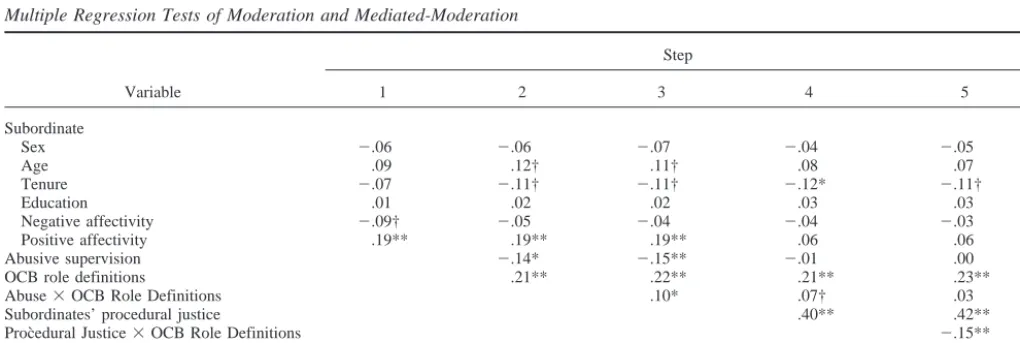
We tested Hypothesis 1 by regressing subordinates’ OCB on abusive supervision after entering the control variables as a block. We also controlled for the effects of subordinates’ OCB role definitions by entering them with abusive supervision at the sec-ond step. Table 2 shows the regression results. Step 1 shows that although the control variables accounted for a significant portion of the variance in OCB (6%), only PA was significantly associated with OCB ( ⫽ .19, p ⬍ .01). Step 2 indicates that abusive supervision and OCB role definitions accounted for an additional 5% ( p⬍ .01) of the variance in subordinates’ OCB. The
stan-1A few supervisors rated two subordinates in our sample, which raises
dardized beta weights associated with abusive supervision and OCB role definitions were both significant (⫽ ⫺.14, p⬍.05;
⫽ .21, p ⬍ .01, respectively). The signs on the beta weights suggest that subordinates performed OCBs with greater frequency when they defined OCB as in-role behavior and when their super-visors were less abusive. Hence, Hypothesis 1 was supported.
We tested Hypothesis 2 by examining the incremental contri-bution of the Abusive Supervision⫻OCB Role Definition cross-product term after controlling for the main effects of abusive supervision and OCB role definitions. Step 3 in Table 2 shows that the moderated interaction term accounted for an additional 1% of the variance in subordinates’ OCB, which was significant (⫽ .10, p⬍.05).
We assessed the nature of this significant interaction by plotting values representing plus and minus 1 standard deviation from the means for abusive supervision and OCB role definitions (Cohen &
Cohen, 1983). The plot of this interaction is shown in Figure 1. As the figure shows, there is a general, negative trend between abu-sive supervision and subordinates’ OCB; however, supporting Hypothesis 2, the relationship between abusive supervision and OCB was stronger among employees who defined OCB as extra-role relative to those who defined OCB as in-extra-role.
We tested Hypothesis 3 by evaluating the incremental contribu-tion of the main effect for procedural justice and an interaccontribu-tion term consisting of the Procedural Justice⫻OCB Role Definitions cross product. Step 4 in Table 2 shows that the main effect of procedural justice accounted for 12% ( p⬍.01) of the variance in subordinates’ OCB beyond that accounted for by the control variables, abusive supervision, OCB role definitions, and the Abu-sive Supervision⫻OCB Role Definitions interaction. Step 5 in Table 2 shows that the Procedural Justice⫻OCB Role Definitions cross product accounted for an additional 2% of the variance in
Table 2
Multiple Regression Tests of Moderation and Mediated-Moderation
Variable
Step
1 2 3 4 5
Subordinate
Sex ⫺.06 ⫺.06 ⫺.07 ⫺.04 ⫺.05
Age .09 .12† .11† .08 .07
Tenure ⫺.07 ⫺.11† ⫺.11† ⫺.12* ⫺.11†
Education .01 .02 .02 .03 .03
Negative affectivity ⫺.09† ⫺.05 ⫺.04 ⫺.04 ⫺.03
Positive affectivity .19** .19** .19** .06 .06
Abusive supervision ⫺.14* ⫺.15** ⫺.01 .00
OCB role definitions .21** .22** .21** .23**
Abuse⫻OCB Role Definitions .10* .07† .03
Subordinates’ procedural justice .40** .42**
Proc`edural Justice⫻OCB Role Definitions ⫺.15**
R2change .06** .05** .01* .12** .02**
F (6, 338)⫽3.43 F (8, 336)⫽5.22 F (9, 335)⫽5.03 F (10, 334)⫽10.52 F (11, 333)⫽10.55
Note. The dependent variable for all equations was subordinates’ organizational citizenship behavior (OCB). For all Fs, p⬍.01. Sex (1⫽male, 2⫽ female); Age (1⫽18 –24, 2⫽25–29, 3⫽30 –39, 4⫽40 – 49, 5⫽over 49); Tenure (1⫽less than 1 year, 2⫽between 1 and 6 years, 3⫽between 6 and 10 years, 4⫽between 10 and 20 years, 5⫽over 20 years); Education (1⫽did not complete high school, 2⫽completed high school, 3⫽attended college, 4⫽completed college, 5⫽advanced degree). OCB role definitions are coded so that higher scores mean respondent perceived OCB as in-role. † p⬍.10. * p⬍.05. ** p⬍.01.
Table 1
Descriptive Statistics and Intercorrelations Among Study Variables
Variable M SD 1 2 3 4 5 6 7 8 9 10
1. Sex 1.08 0.31 —
2. Age 2.07 1.15 ⫺.04 —
3. Tenure 2.58 1.13 .00 .69** —
4. Education 2.77 0.75 .02 .17** .12* —
5. Negative affectivity 2.17 0.83 .00 ⫺.09 .03 .05 (.88)
6. Positive affectivity 2.96 1.06 .01 .06 .10 .13* ⫺.09 (.72)
7. Abusive supervision 1.70 0.73 ⫺.05 .01 .02 ⫺.08 .32** ⫺.10 (.93)
8. OCB role definitions 1.39 0.31 .02 .01 .10 ⫺.08 .01 ⫺.03 .12* (.92)
9. Procedural justice 3.52 0.68 ⫺.04 .11* .10 .05 ⫺.17** .38** ⫺.35** ⫺.03 (.97)
10. OCB 3.52 0.73 ⫺.05 .07 .01 .05 ⫺.13* .20** ⫺.14** .19** .41** (.91)
Note. The alpha internal-consistency reliability coefficients appear in parentheses along the main diagonal. A total of 373 subordinates completed the subordinates’ survey; 278 supervisors completed the supervisor’s survey. Sex (1⫽male, 2⫽female); Age (1⫽18 –24, 2⫽25–29, 3⫽30 –39, 4⫽ 40 – 49, 5⫽over 49); Tenure (1⫽less than 1 year, 2⫽between 1 and 6 years, 3⫽between 6 and 10 years, 4⫽between 10 and 20 years, 5⫽over 20 years); Education (1⫽did not complete high school, 2⫽completed high school, 3⫽attended college, 4⫽completed college, 5⫽advanced degree). Organizational citizenship behavior (OCB) role definitions are coded so that higher scores mean respondent perceived OCB as in-role.
OCB, which was also significant (⫽ ⫺.15, p⬍.01). The plot of this interaction, presented in Figure 2, indicates that the relation-ship between procedural justice and OCB is stronger among em-ployees who defined OCB as extra-role rather than in-role. Thus, Hypothesis 3 is supported.
We tested Hypothesis 4 by following Baron and Kenny’s (1986) guidelines for establishing mediated moderation. First, we calcu-lated the correlation between the Procedural Justice⫻OCB Role Definitions cross product and the Abusive Supervision⫻ OCB Role Definitions cross product. These interaction terms were sig-nificantly and negatively correlated (r⫽ ⫺.30, p⬍.01). Next, we examined the contribution of the Abusive Supervision⫻ OCB Role Definition cross product before and after controlling for the effects of procedural justice and the Procedural Justice⫻ OCB Role Definitions cross product. Step 5 of Table 2 shows that including the Procedural Justice⫻OCB Role Definitions term in the regression equation rendered the Abusive Supervision⫻OCB Role Definitions cross product nonsignificant. We conducted a usefulness analysis to determine the unique amount of variance explained by the Abusive Supervision⫻ OCB Role Definitions term (Darlington, 1968; Shaw, Duffy, Jenkins, & Gupta, 1999). In this procedure, we examined the square of the semipartial corre-lation (i.e., unique change in explained variance due to the inter-action alone) for the interinter-action term at Step 3, Step 4, and Step 5. The analysis suggested that the Abusive Supervision⫻OCB Role Definitions interaction accounted for 1% of the variance in OCB prior to controlling for the main effect of procedural justice ( p⬍ .05), 1% of the variance in OCB after controlling for the main effect of procedural justice ( p⬍.10), and 0% of the variance in OCB after entering the Procedural Justice⫻ OCB Role Defini-tions cross product (ns). Taken together, these findings provide support for Hypothesis 4 —the Procedural Justice⫻ OCB Role Definitions interaction mediated the Abusive Supervision⫻OCB Role Definitions interaction.
Discussion
The results of this research suggest that (a) subordinates of abusive supervisors perform fewer OCBs than their nonabused counterparts, (b) role definitions moderate the relationship be-tween abusive supervision and OCB such that the effect is more pronounced among subordinates who define OCB as extra-role
behavior, and (c) the interaction between abusive supervision and OCB role definitions is accounted for and explained by the inter-action between procedural justice and OCB role definitions. That is, procedural justice mediates the relationship between abusive supervision and subordinates’ OCB, but this mediation relation-ship is stronger when subordinates define OCB as extra-role be-havior compared with when subordinates define OCB as in-role behavior. Our research contributes to the literature by integrating and extending the findings of studies that have explored (a) direct relationships between supervisory practices and OCB (e.g., Hui et al., 1999; Podsakoff et al., 1990, 1996), (b) subordinates’ justice perceptions as a mediator of the effects of abusive supervision on subordinates’ self-reported attitudes (Tepper, 2000), and (c) the moderating effects of subordinates’ OCB role definitions on the relationship between subordinates’ procedural justice perceptions and subordinates’ OCB (Tepper, Lockhart, & Hoobler, 2001). We discuss the study’s implications for theory, research, and practice, identify its limitations, and suggest directions for future research.
Implications for Theory, Research, and Practice
Organization scholars have recently shown great interest in abusive supervision and related behaviors. This research suggests that abusive supervision has a number of deleterious consequences for organizations and their members. Our research expands the domain of deleterious consequences associated with abusive su-pervision to include subordinates’ performance of behaviors that organizations value. Abused subordinates are more likely to with-hold OCBs compared with their nonabused counterparts. This enables the abused subordinate to achieve what Bies, Tripp, and Kramer (1997) referred to as a low-intensity type of revenge. More generally, our research provides support for justice-based views as to how abusive supervision affects subordinates’ behavioral re-sponses. Apparently, the perceived injustices evoked by abusive supervision explain subordinates’ behavioral responses. Hence, our work adds to a growing number of studies that implicate subordinates’ justice perceptions in explaining responses to lead-ership practices (e.g., Mossholder et al., 1998; Niehoff & Moor-man, 1993; Pillai et al., 1999; Tepper et al., 1998).
Interestingly, however, our findings suggest that some abused subordinates continue to perform OCBs because they believe that OCBs are requirements of the job. These employees may feel that, regardless of their supervisor’s behavior, they are normatively
Figure 2. Plot of interaction between procedural justice and organiza-tional citizenship behavior (OCB) role definitions on subordinates’ OCB. In-role is indicated by a diamond; extra-role is indicated by a square. Figure 1. Plot of interaction between abusive supervision and
obligated to perform OCBs or that refusing to be a team player, to help coworkers, or to exhibit positive attitudes reflects on their ability to do the job and reduces their chances of receiving valued rewards. Taken together, these findings contribute to the OCB literature by providing further support for the role discretion hy-pothesis. It may be argued that models of the antecedents of OCB will be underidentified to the extent that actors’ role definitions are excluded. However, though our findings underscore critics’ con-cerns that some employees regard OCB as in-role behavior, the support we obtained for the role discretion hypothesis preserves a key element of Organ’s (1988) theoretical work—that employees’ attitudes and perceptions correlate better with extra-role contribu-tions than with in-role contribucontribu-tions.
Our findings have implications for practice as well. A number of studies have suggested that OCBs benefit organizations in terms of sales, performance quality and quantity, and operating efficiency (Podsakoff & MacKenzie, 1997). Hence, our data suggesting that abused subordinates perform fewer OCBs than their nonabused counterparts provide further motivation for organizations to be concerned about allowing abusive supervision to go unchecked. Many organizations operate in an environment of intense compe-tition with frequent changes and multiple deadlines. The frustra-tion arising from elevated stress levels may cause many supervi-sors to exhibit more abusive behaviors (Spector, 1997). Although such behaviors may intimidate subordinates into meeting dead-lines, they may also reduce subordinates’ citizenship, thereby hurting the “bottom line.”
Limitations and Suggestions for Future Research
Our research is not without limitations. In calling attention to these limitations, we simultaneously suggest directions for future inquiry. First, this study examined perceived abuse and OCB at only one point in time. Further longitudinal work is needed to determine whether abusive supervision is a cause or consequence of subordinates’ OCB. It may be argued that supervisors are more abusive toward subordinates who withhold OCBs, which contrib-ute to favorable morale and work-unit effectiveness. Research designs involving measures of abusive supervision and subordi-nates’ OCB at multiple points in time will help establish whether abusive supervision is a cause, consequence, or cause and conse-quence of subordinates’ OCB.
A second limitation has to do with our interpretation of the relationship between abusive supervision and subordinates’ OCB. It may be argued that abusive supervisors are less inclined to give favorable OCB ratings. That is, our support for Hypothesis 1 could be reinterpreted to mean that abused subordinates had lower levels of OCB not because they withheld OCBs but because their super-visors rated them more harshly. Of course, the support we obtained for the mediated-moderation prediction is consistent with a social-exchange-based explanation as to why abusive supervision is associated with subordinates’ OCB. Nevertheless, a useful direc-tion for future research would be to explore whether abusive supervisors rate their direct reports more harshly than nonabusive supervisors.
A third limitation is that we did not control for other factors that could plausibly be related to subordinates’ OCB. For example, recent theory and research suggest OCB may be motivated by impression management concerns as well as the social exchange motivations emphasized in most OCB research (Bolino, 1999).
Performing OCBs is likely to be image enhancing, and some employees may perform OCBs to cultivate a favorable social image (Eastman, 1994; Fandt & Ferris, 1990; Ferris, Judge, Row-land, & Fitzgibbons, 1994). To the extent that abusive supervisors are more likely to target subordinates who fit a particular profile (Aquino & Bradfield, 2000), it is reasonable to expect that some abused subordinates perform OCBs to be viewed favorably by their supervisor and to either avoid triggering their supervisor’s hostility or to make coworkers look less dedicated by comparison (thereby making others more likely targets for the supervisor’s abuse). It is also conceivable that abused subordinates make a point of defining their jobs more broadly to deflect their supervi-sor’s hostility. Though speculative, this possibility is consistent with our finding that abusive supervision correlated positively with OCB role definitions (i.e., abused subordinates were more likely to define OCB as in-role compared with nonabused subordinates; see Table 1). Future research should explore the role impression man-agement motivations play in OCB performance.
A final limitation of our research is that we did not examine abused subordinates’ explanations for their supervisors’ behavior. As a subjective assessment, abusive supervision is open to multiple interpretations. According to attribution theory, an observer’s ex-planation for an actor’s behavior determines the observer’s emo-tional and behavioral reactions to that behavior (Weiner, 1995). It may be expected, for example, that subordinates will experience greater injustice (and withhold OCBs) when they attribute abusive supervision to internal causes (e.g., the supervisor is a bad or incompetent person) compared with when they attribute abusive supervision to factors beyond the supervisor’s control (e.g., he or she had a bad day or is responding to organizationally imposed constraints). A related factor that we did not explore concerns what the literature refers to as counterfactual reasoning (Folger & Cropanzano, 2001). It may be argued, for example, that abused subordinates do not hold their organization blameworthy (and do not withhold OCBs) when they do not see how the organi-zation could have known about or stopped the abuse. Investi-gation of these factors will help researchers and practitioners understand how subordinates perceive and respond to abusive supervision.
References
Andersson, L., & Pearson, C. M. (1999). Tit for tat? The spiraling effect of incivility in the workplace. Academy of Management Review, 24, 452– 471.
Aquino, K., & Bradfield, M. (2000). Perceived victimization in the work-place: The role of situational factors and victim characteristics. Orga-nization Science, 11, 525–537.
Ashforth, B. (1994). Petty tyranny in organizations. Human Relations, 47, 755–778.
Ashforth, B. (1997). Petty tyranny in organizations: A preliminary exam-ination of antecedents and consequences. Canadian Journal of Admin-istrative Sciences, 14, 126 –140.
Baron, R. M., & Kenny, D. A. (1986). The moderator–mediator distinction in social psychological research: Conceptual, strategic, and statistical considerations. Journal of Personality and Social Psychology, 51, 1173– 1182.
Bies, R. J., & Tripp, T. M. (1998). Two faces of the powerless: Coping with tyranny. In R. M. Kramer & M. A. Neale (Eds.), Power and influence in organizations (pp. 203–219). Thousand Oaks, CA: Sage. Bies, R. J., Tripp, T. M., & Kramer, R. M. (1997). At the breaking point:
Cognitive and social dynamics of revenge in organizations. In R. Giac-calone & J. Greenberg (Eds.), Antisocial behavior in organizations (pp. 18 –36). Thousand Oaks, CA: Sage.
Blau, P. (1964). Exchange and power in social life. New York: Wiley. Bolino, M. C. (1999). Citizenship and impression management: Good
soldiers or good actors? Academy of Management Review, 24, 82–98. Brayfield, A. H., & Crockett, W. H. (1955). Employee attitudes and
employee performance. Psychological Bulletin, 52, 396 – 424. Brehm, J. (1966). A theory of psychological reactance. New York:
Aca-demic Press.
Brehm, J., & Brehm, S. (1981). Psychological reactance: A theory of freedom and control. New York: Academic Press.
Cohen, J., & Cohen, P. (1983). Applied multiple regression/correlation analyses for the behavioral sciences (2nd ed.). Hillsdale, NJ: Erlbaum. Darlington, R. B. (1968). Multiple regression in psychological research and
practice. Psychological Bulletin, 69, 161–182.
Duffy, M. K., Ganster, D., & Pagon, M. (2002). Social undermining and social support in the workplace. Academy of Management Journal, 45, 331–351.
Eastman, K. K. (1994). In the eyes of the beholder: An attributional approach to ingratiation and organizational citizenship behavior. Acad-emy of Management Journal, 37, 1379 –1391.
Fandt, P. M., & Ferris, G. R. (1990). The management of information and impressions: When employees behave opportunistically. Organizational Behavior and Human Decision Processes, 45, 140 –158.
Ferris, G. R., Judge, T. A., Rowland, K. M., & Fitzgibbons, D. E. (1994). Subordinate influence and the performance evaluation process: Test of a model. Organizational Behavior and Human Decisions Processes, 58, 101–135.
Folger, R., & Cropanzano, R. (2001). Fairness theory: Justice as account-ability. In J. Greenberg & R. Cropanzano (Eds.), Advances in organi-zational justice (pp. 1–55). Stanford, CA: Stanford University Press. Graen, G. B. (1976). Role making processes within complex organizations.
In D. Dunnette (Ed.), Handbook of industrial and organizational psy-chology (pp. 1201–1245). Chicago: Rand McNally.
Graham, J. W. (1991). An essay on organizational citizenship behavior. Employee Rights and Responsibilities Journal, 4, 249 –270.
Hoel, H., Rayner, C., & Cooper, C. (1999). Workplace bullying. In C. Cooper & L. Robinson (Eds.), International review of industrial and organizational psychology (Vol. 14, pp. 195–229). Chichester, England: Wiley.
Hui, C., Law, K. S., & Chen, Z. X. (1999). A structural equation model of the effects of negative affectivity, leader–member exchange, and per-ceived job mobility on in-role and extra-role performance. Organiza-tional Behavior and Human Decision Processes, 77, 3–21.
Iaffaldano, M. T., & Muchinsky, P. M. (1985). Job satisfaction and job performance: A meta-analysis. Psychological Bulletin, 97, 251–273. Keashly, L. (1998). Emotional abuse in the workplace: Conceptual and
empirical issues. Journal of Emotional Abuse, 1, 85–117.
Keashly, L., Trott, V., & MacLean, L. M. (1994). Abusive behavior in the workplace: A preliminary investigation. Violence and Victims, 9, 341– 357.
Konovsky, M. A., & Pugh, S. D. (1994). Citizenship and social exchange. Academy of Management Journal, 37, 656 – 669.
Lakey, B., & Cassady, P. B. (1990). Cognitive processes in perceived social support. Journal of Personality and Social Psychology, 59, 337– 343.
Lam, S. S. K., Hui, C., & Law, K. S. (1999). Organizational citizenship behavior: Comparing perspectives of supervisors and subordinates across four international samples. Journal of Applied Psychology, 84, 594 – 601.
Lord, V. B. (1998). Characteristics of violence in state government. Jour-nal of InterpersoJour-nal Violence, 13, 489 –504.
Moorman, R. H. (1991). The relationship between organizational justice and organizational citizenship behaviors: Do fairness perceptions influ-ence employee citizenship? Journal of Applied Psychology, 76, 845– 855.
Moorman, R. H., Blakely, G. L., & Niehoff, B. P. (1998). Does perceived organizational support mediate the relationship between procedural jus-tice and organizational citizenship behavior? Academy of Management Journal, 41, 351–357.
Morrison, E. (1994). Role definitions and organizational citizenship be-haviors: The importance of the employees’ perspective. Academy of Management Journal, 37, 1543–1567.
Mossholder, K. W., Bennett, N., Kemery, E. R., & Wesolowski, M. A. (1998). Relationships between bases of power and work reactions: The mediational role of procedural justice. Journal of Management, 24, 533–552.
Niehoff, B. P., & Moorman, R. H. (1993). Justice as a mediator of the relationship between methods of monitoring and organizational citizen-ship behavior. Academy of Management Journal, 36, 527–556. Organ, D. W. (1977). A reappraisal and reinterpretation of the
satisfaction-causes-performance hypothesis. Academy of Management Review, 2, 46 –53.
Organ, D. W. (1988). Organizational citizenship behavior: The good soldier syndrome. Lexington, MA: Lexington Books.
Pillai, R., Schriesheim, C. A., & Williams, E. S. (1999). Fairness percep-tions and trust as mediators for transformational and transactional lead-ership: A two-sample study. Journal of Management, 25, 897–933. Podsakoff, P. M., & MacKenzie, S. B. (1997). Impact of organizational
citizenship behavior on organizational performance: A review and sug-gestions for future research. Human Performance, 10, 133–152. Podsakoff, P. M., MacKenzie, S. B., & Bommer, W. H. (1996).
Transfor-mational leader behaviors and substitutes for leadership as determinants of employee satisfaction, commitment, trust, and organizational citizen-ship behaviors. Journal of Management, 22, 259 –298.
Podsakoff, P. M., MacKenzie, S. B., Moorman, R. H., & Fetter, R. (1990). Transformational leader behaviors and their effects on followers’ trust in leader, satisfaction, and organizational citizenship behaviors. Leadership Quarterly, 1, 107–142.
Podsakoff, P. M., MacKenzie, S. B., Paine, J. B., & Bacharach, D. G. (2000). Organizational citizenship behaviors: A critical review of the theoretical and empirical literature and suggestions for future research. Journal of Management, 26, 513–563.
Pond, S. B., Nacoste, R. W., Mohr, M. F., & Rodriguez, C. M. (1997). The measurement of organizational citizenship behavior: Are we assuming too much? Journal of Applied Social Psychology, 27, 1527–1544. Rousseau, D. M. (1989). Psychological and implied contracts in
organiza-tions. Employee Responsibilities and Rights Journal, 2, 121–139. Salancik, G. R., & Pfeffer, J. (1978). A social information processing
approach to job attitudes and task design. Administrative Science Quar-terly, 23, 224 –253.
Shaw, J. D., Duffy, M. K., Jenkins, G. D., Jr., & Gupta, N. (1999). Positive and negative affect, signal sensitivity, and pay satisfaction. Journal of Management, 25, 189 –206.
Smith, C. A., Organ, D. O., & Near, J. P. (1983). Organizational citizenship behavior: Its nature and antecedents. Journal of Applied Psychology, 68, 653– 663.
Spector, P. (1997). The role of frustration in antisocial behavior at work. In R. Giacalone & J. Greenberg (Eds.), Antisocial behavior in organiza-tions (pp. 1–17). Thousand Oaks, CA: Sage.
Tepper, B. J. (2000). Consequences of abusive supervision. Academy of Management Journal, 43, 178 –190.
Tepper, B. J., Eisenbach, R. J., Kirby, S. L., & Potter, P. W. (1998). Test of a justice-based model of subordinates’ resistance to down-ward influence attempts. Group and Organization Management, 23, 144 –160.
Tepper, B. J., Lockhart, D., & Hoobler, J. (2001). Justice, citizenship, and role definition effects. Journal of Applied Psychology, 86, 789 –796. Van Dyne, L., Graham, J. W., & Dienesch, R. M. (1994). Organizational
citizenship behavior: Construct redefinition, measurement, and valida-tion. Academy of Management Journal, 37, 765– 802.
Watson, D., Clark, L. A., & Tellegen, A. (1988). Development and validation of brief measures of positive and negative affect: The
PANAS scales. Journal of Personality and Social Psychology, 54, 1063–1070.
Weiner, B. (1995). Judgments of responsibility. New York: Guilford Press. Wright, R., & Brehm, S. (1982). Reactance as impression management: A critical review. Journal of Personality and Social Psychology, 42, 608 – 618.
Received July 5, 2001 Revision received February 12, 2002