The Synergy of Indonesia’s Maritime Power Instrument to Face ... | Christine Anggi Sidjabat | 105 THE SYNERGY OF INDONESIA’S MARITIME POWER INSTRUMENT TO FACE CHINA’S CLAIM OVER
SOUTH CHINA SEA
Christine Anggi Sidjabat1, Amarulla Octavian2 & Budiman Djoko Said3
Universitas Pertahanan, SESKOAL & Defense Study Forum ([email protected])
Abstract– Despite the fact that Indonesia is not one of the claimant states, China’s provocation through its fishing boats escorted by Chinese Coast Guard has been violating Indonesia Exclusive Economic Zone on South China Sea (SCS) which intersects with Nine Dashed Line (NDL). Up to this day, the synergy among Indonesian maritime power instruments to defend Indonesia’s sovereign rights is still weak, thus the problem identified in this research is how the instrument of power authorized in Indonesia’s maritime domain synergizes to face China’s claim over SCS. Synergy analysis is seen from three aspects: perspective, policy, and Rules Of Engangement (ROE) applied to operational. This research uses qualitative method to further explore the research question, with Soft System Methodology technique to approach the problems through comparison between system of thought and real world in a structured manner, as well as supported by NVivo to execute the process of data triangulation. Research results show that Indonesia’s maritime power instrument have not a harmonious perspective on NDL yet. This study also shows that policy created by policy makers and strategic derivatives created by strategy makers of the Government of the Republic of Indonesia have not been in harmony, thus appropriate ROE at operational level to face China's provocation on the SCS has not been formulated by adjusting authority with instrument capability. Overall, the study found that the synergy of Indonesia’s maritime power instruments is not yet reliable to deal with China’s Claims over the territory of Indonesia in the SCS.
Keywords: Synergy, Maritime Power Instruments, Nine Dashed Line, South China Sea, Sovereign Rights
Introduction
he South China Sea (SCS) is a sea lane filled to the brim with strategic interests, not only for the coastal countries that surround it, but also maritime countries whose economic resources come from international trade. China claims sea areas that intersect with the sovereignty and sovereign rights of other countries through the existence of
1 Student of Maritime Security Department Cohort 4. Alumni of International Relations Department of President University, 2015 batch
2 Commander of SESKOAL
3 Lecturer at Maritime Security-Universitas Pertahanan & Vice President of Defense Study Forum
Nine Dashed Line (NDL). Some member countries of the Association of South East Asian Nations (ASEAN) that are involved in conflicts with China are Malaysia, Singapore, Vietnam, Philippines and Brunei Darussalam.
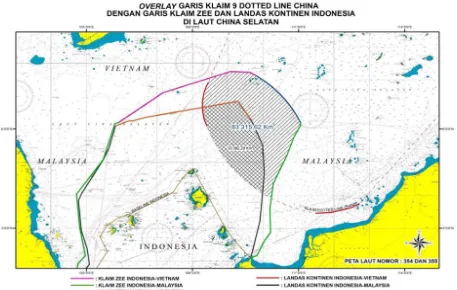
106 | Journal of Defense & State Defense | August 2018, Volume 8 Number 2 illustration of Sea Map No. 354 and 355
made by the Navy Hydrographic and Oceanographic Center (Pushidrosal), the Indonesian EEZ area overlaps with one of the nine dashed lines claimed by NDL. The illustration map shows that there are around 83,315.62 square kilometers of area that overlap with the NDL claim. Legally speaking, Indonesia has stated through Law No. 1 of 1973 concerning the Indonesian Continental Shelf, that the jurisdiction of Indonesia in the north of Natuna that intersects with NDL is the jurisdiction area of Indonesia.4
Although Indonesia's EEZ has been formulated in illustration maps, the government has not legally deposited
Indonesia's maritime boundaries, especially those bordering on neighboring countries according to their zoning, to the UN Secretary General. Indonesia's claim on the EEZ is still only a unilateral claim,5
which makes it difficult for Indonesia to bring the issue of China’s over-claiming and Indonesia's EEZ to the international community and to take action against violations that occurred in the EEZ region. China has carried out several provocations in the EEZ waters which intersect with NDL
4 Surya Wiranto, Conflict Resolution in Facing South China Sea Dispute from International
claims through Chinese fishing boats escorted by the China Coast Guard (CCG). Indonesia is currently carrying out a moratorium on fishing by foreign parties in
Indonesia’s EEZ region, meaning that it
can be ascertained that Chinese fishing boats have committed violations by catching fish in Indonesia’s EEZ. The provocation of China took place from 2010 to 2013 and from 2015 to 2016. On each occasion, the CCG Ship always tried to free Chinese fishing boats captured by the Indonesian Government. The CCG ships even took a dangerous action to release Chinese fishing boats, such as by colliding with Chinese fishing boats being pulled ashore by the MOMAF Supervisory Vessel
to be brought to justice in the 2016 incident.
The lack of harmonization between institutions of national power in the Government of Indonesia can be seen when the Ministry of Maritime Affairs and Fisheries (MoMAF), the Ministry of Foreign Affairs (MoFA) and the Ministry of Defense (MoD) both announced that the instrument would summon the Chinese Ambassador as a form of diplomatic protest over the violation of Indonesian
Law Perspective. (Yogyakarta: Leutika Prio,2008), p. 15.
The Synergy of Indonesia’s Maritime Power Instrument to Face ... | Christine Anggi Sidjabat | 107 EEZ by Chinese fishing boats and
deliberate ship crashes in an effort to release Chinese fishing boats captured by the MOMAF vessel on 19 March 2016.6
The instrument of maritime power shows a weak synergy with the existence of different perspectives on NDL, some see from the perspective of international law and see from the fact that China has made a provocation in the jurisdiction of Indonesia. Indonesia's policy has also not been able to answer the management of
6 Aaron L. Conelly,
Indonesia in south China Sea: Walking alone, (Sydney: Lowy Institute for International Policy, 2017), p. 5
jurisdiction and how the instrument can achieve it in a targeted manner.
Meanwhile, provocation carried out by China with CCG escort have led to events that endanger personnel in the MoMAF Supervisory Vessel (KP), causing Indonesia unable to bring the majority of Chinese fishing boats to maximum legal action.
This study focuses on (1) synergy between maritime power instruments that are reviewed through perspective on
Figure 1.Illustration Map overlaying China’s NDL Claim and Indonesia’s ZEE and Continental
108 | Journal of Defense & State Defense | August 2018, Volume 8 Number 2 SCS disputes, (2) policies made by these
instruments to deal with the development of SCS disputes, and (3) operational response of these instruments when provocations are carried out by China in the jurisdiction of Indonesia that intersects with NDL. The synergy of Indonesia's maritime power instruments will be able to create clarity on the direction of Indonesia's policies and strategies to show the government's firm stance of maintaining Indonesia's sovereign rights in its jurisdiction.
Research Method
This study uses primary and secondary data. Primary data in this study were
obtained from interviews conducted through visits to research subjects and meeting with informants. Interviews with informants are carried out with in-depth interview techniques. The subject of the study was determined based on the relationship of maritime instruments to the SCS issue, especially the instruments mentioned in the Action Plan of Indonesian Maritime Policy7 – Priority
Program A of Maritime Boundaries, Ocean Space, and Maritime Diplomacy set to
7 Presidential Regulation No. 16 of 2017 concerning Indonesian Maritime Policy.
8 Peter Checkland & John Poulter, Learning for
Action: A Short Definitive Account of Soft
preserve Indonesia's interests and affirming of Indonesian sovereignty in the SCS: Coordinating Ministry of Maritime Affairs, Coordinating Ministry for Politics, Law and Security, MoMAF, MoD, MoFA, and Indonesian Navy National Army (TNI AL). The informants selected in this study are based on expertise related to the issue of SCS disputes, NDL, and the synergy of instruments to deal with it. This study divides the role of power instruments in three groups, i.e.: Coordinating Ministry for Maritime AffairsCoordinating Ministry for Politics, Law and Security are included in the regulator group of strategy makers, while the MoMAF, MoD and MoFA are included in the regulator group of policy
makers. The Navy and MoMAF are included in the implementing group that went directly to the field.
Soft System Methodology (SSM) is employed to find comparisons between system of thought and the real world to produce recommendations for improvements to problems.8 A qualitative
approach is employed to discuss and
further explore problem
recommendations to answer research
The Synergy of Indonesia’s Maritime Power Instrument to Face ... | Christine Anggi Sidjabat | 109 questions while finding appropriate
suggestions for the problems under study. There are seven steps of SSM applied in this study, i.e.:
• Step 1: Problem Situation
The first step in SSM is to map information and views related to the problem. This study makes an overall picture of the problems and basic research conducted through books, journals, printed media, internet media, and other secondary sources.
• Step 2: Overview of the situation
This step serves to capture the facts of the problem that will be explored. The overview of situation in the SSM is carried out through Analysis One, i.e.
aspects of intervention, Analysis Two, i.e. social aspects, Analysis Three, i.e. political aspects, and Rich Picture which contains important opinions from all informants regarding the problem.
• Step 3: Root Definition
Root Definition (RD) is a definition formulation of the transformation process to achieve the desired intervention (Lester, 2008). This study formulates three RDs which relate to three research questions about elements of synergy, in accordance with the facts in Analysis One to Three and Rich Picture. The three RDs were
tested with analysis of Customer, Actors, Transformation Process, Worldview (Perspective), Owner, Environmental/External Factors (CATWOE) and analysis of 3E Criteria (Efficacy, Efficiency, Effectiveness).
• Step 4: Conceptual Model
The conceptual model in this study is developed from all three RDs in the system of though, which is a human activity system that contains the ideal steps to realize RD.
• Step 5: Comparison
Comparisons are made in this study to compare between the models that have been made with the actual situation. This step is done to find out
what steps the owners have not taken, while the difference between the ideal model and the real world is called the gap. The range found in this study is used to produce recommendations for improving the problems in the synergy of Indonesia's maritime power instrument to face China's claim to SCS.
• Step 6: Improvement
The next step is to discuss the range found in the comparison step using theory and supported by the results of data analysis.
110 | Journal of Defense & State Defense | August 2018, Volume 8 Number 2 The final step is done by stating which
changes (transformations) can be applied to correct the problem.
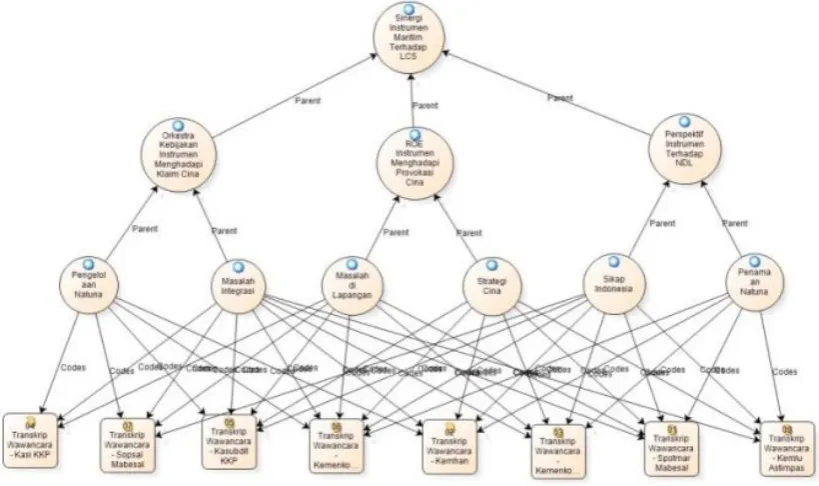
This study is also assisted by the NVivo application as a tool to carry out the coding process, code search, category discovery, data triangulation, and to produce validity testing through data consistency. The hierarchy of code in NVivo uses parent nodes and child nodes to indicate the category or focus of the discussion of the study.9 The relation
model is also generated using NVivo, which is to see the relationship between code or nodes and data sources.
9 Agustinus Bandur,
Qualitative Research: Methodology, Design, and Technical Analysis of
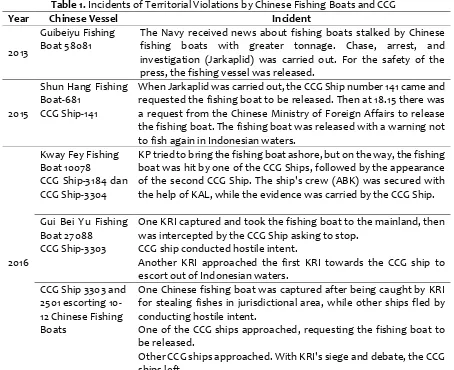
Chinese provocation in the Indonesian jurisdiction occurred in 2013, 2015 and 2016 where Chinese fishing boats entered the Indonesian EEZ to illegally capture fish. The fishing boats were always escorted by CCG ships that consistently try to prevent Indonesian law enforcement vessels from apprehending these fishing boats. Details on the provocation incidents by China can be seen in Table 1.
China's provocation caused unrest among Indonesia's maritime power instruments, the uncoordinated protest between MoMAF, MoFA and MoD became one of the proofs that Indonesia did not
Data using NVivo 11 Plus (Jakarta: Mitra Wacana Media, 2016), p. 23.
The Synergy of Indonesia’s Maritime Power Instrument to Face ... | Christine Anggi Sidjabat | 111 yet have synergies to deal with Chinese
NDL claims which were affirmed by their provocation. Policies formulated by maritime power instruments have also not been able to harmonize instrument steps to show a firm attitude towards Chinese NDL claims, because they are still at the level of each ministry without national policy guidelines.
Some instruments of Indonesian maritime power consider that NDL claims are not a threat because they do not conform to the principles of the United Nations
Convention on the Law of the Sea (UNCLOS), but the assumption that NDL is a threat also arises mainly from instruments that go directly to the field to enforce the law because Chinese provocation actually happened. Chinese NDL claims that intersect with Indonesian jurisdiction become one of the maritime issues which shows that Indonesia's maritime power instrument does not yet have a strong synergy to maintain maritime security in its domain.
Table 1. Incidents of Territorial Violations by Chinese Fishing Boats and CCG
Year Chinese Vessel Incident
2013 press, the fishing vessel was released.
2015
Shun Hang Fishing Boat-681
CCG Ship-141
When Jarkaplid was carried out, the CCG Ship number 141 came and requested the fishing boat to be released. Then at 18.15 there was a request from the Chinese Ministry of Foreign Affairs to release the fishing boat. The fishing boat was released with a warning not to fish again in Indonesian waters.
2016
Kway Fey Fishing Boat 10078
CCG Ship-3184 dan CCG Ship-3304
KP tried to bring the fishing boat ashore, but on the way, the fishing boat was hit by one of the CCG Ships, followed by the appearance of the second CCG Ship. The ship's crew (ABK) was secured with the help of KAL, while the evidence was carried by the CCG Ship.
Gui Bei Yu Fishing Boat 27088
CCG Ship-3303
One KRI captured and took the fishing boat to the mainland, then was intercepted by the CCG Ship asking to stop.
CCG ship conducted hostile intent.
Another KRI approached the first KRI towards the CCG ship to escort out of Indonesian waters.
CCG Ship 3303 and 2501 escorting 10-12 Chinese Fishing Boats
One Chinese fishing boat was captured after being caught by KRI for stealing fishes in jurisdictional area, while other ships fled by conducting hostile intent.
One of the CCG ships approached, requesting the fishing boat to be released.
Other CCG ships approached. With KRI's siege and debate, the CCG ships left.
112 | Journal of Defense & State Defense | August 2018, Volume 8 Number 2 Before discussing further about the
synergy of Indonesia's maritime power instruments, the definition and deepening of synergy needs to be explored. This paper will use Graves’ concept to discuss the synergy of Indonesia's maritime power instruments. Graves defines synergies as follows:
"The interaction of two or more agents, resources or activities such as the product is worth the sum of the component parts (1 + 1> 2).10"
Synergy is where several different entities interact and make better results than when done by an individual entity. The purpose of 1 + 1> 2 above is that if an entity synergizes with one other entity,
the output or result will be greater than the results of the two entities working separately.
"1 + 1" does not always have to produce "2", it can be more than two where bigger than two means greater synergy. Synergy can be in the form of interactions from different inputs, thus there are different types of synergy.
Based on Graves' theory, parameters derived from the synergy elements of maritime power instruments in this study are:
10 Sue Graves, Synergies between Bilateral and
Multilateral Activities. (Copenhagen: Ministry of
a.) Harmonious perspective (organizational synergy)
A harmonious perspective can be seen by looking at the perspective on the threat of Chinese claims over the SCS. This is meant to see whether the instruments of maritime power have different perceptions in view of China's claims over the SCS. This parameter can also be seen from the instrument's perspective on Indonesia's national interests in the Indonesian EEZ on the SCS, the instrument's perspective on Indonesia's position as a non-claimant state, and the instrument's perspective on Indonesia's bilateral
relations with China. The perspective that will be explored from the maritime power instrument in this study will produce a measure of integration of perspectives that is built by the maritime power instrument on the SCS dispute as a non-financial resource to achieve synergy.
b.) Synergized policy (policy synergy) Harmonization is one level in synergy
– higher than coordination, and lower than integration. The most
The Synergy of Indonesia’s Maritime Power Instrument to Face ... | Christine Anggi Sidjabat | 113 appropriate level to form policy
synergies is harmonization, because organizations that formulate policies have their own fields and cannot be integrated. The parameter of the synergized policy is the harmonization of policies, where each instrument will have an individual policy, but the policy does not overlap and is not contradictory. The parameters of a harmonized policy can be seen from the understanding of the maritime power instrument towards its role in maintaining Indonesia's sovereign rights in the SCS. The author also investigates the specific policies of each instrument against SCS disputes
and Chinese provocations on the Indonesian EEZ, to find out the presence or absence of overlaps and contradictions among these policies. c.) A clear and directed ROE (operational
synergy)
The ROE referred to in this study is ROE at the policy level, to see that the instrument of maritime power already knows its role in giving attitude or response, when Chinese provocation occurs in Indonesia's EEZ on SCS. The ROE discussed in this study will then be reduced to ROE at operational level, with the existence of rules when
facing certain opponents at sea, including in the condition of hostile intent and hostile act. ROE is needed so that the Government of Indonesia through its instruments of maritime power has a prompt and appropriate response when the incident of Indonesian EEZ violations (or other incidents related to Indonesia's sovereign rights in the SCS) is carried out once again by the Chinese.
The Perspective of Maritime Power
Instruments on NDL
Perspectives are resources or intellectual assets that ought to be possessed by instruments of maritime power, these
114 | Journal of Defense & State Defense | August 2018, Volume 8 Number 2 a.) Chinese claims are not a threat to
Indonesia because they are not in accordance with international law. Indonesia and China are two countries that ratify UNCLOS, meaning if there is a dispute between the two countries, then the main reference is UNCLOS – not other arguments such as the Traditional Fishing Zone that is not in accordance with International Law.
b.) Chinese Claims Are a Threat Because Chinese Provocation in Indonesian Jurisdictions Is Real. In regards of discussions on Chinese strategy, there is a perspective among the instrument that the provocation carried out by
Chinese fishing boats was part of the Chinese government's strategy. Data and analysis from Sopsal show that Chinese fishing boats that enter Indonesian jurisdiction are always escorted by Corvette to Fregate CCG ships.11 It can be assumed that the
state has a stake in the provocation carried out by China through its CCG ships thus it poses a real threat to
11 Sopsal’s primary data on Indonesian Navy’s operation in Norther Natuna, personal communication, 2017.
Indonesia's sovereign rights in its jurisdiction.
c.) Chinese Claims Could Potentially be a Threat to Regional Stability. The instrument is aware of the fact that the emergence of escalation or spillover conflict will disrupt the stability of the region. Although Indonesia does not recognize the existence of NDL claims on legal basis and is not a claimant state, the claim has stirred reaction out of the claimant states in the region, thus could potentially result in regional instability.12
Threats arising from Chinese claims over Indonesian jurisdictions can be
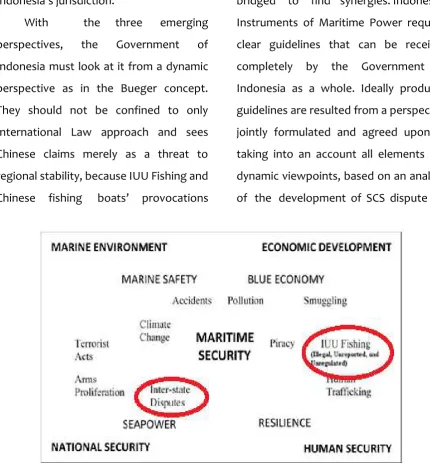
mapped by employing Bueger’s matrix of
threats to Maritime Security.13 This
concept argues that events in the maritime domain can be categorized in more than one threat. China's claim to Indonesia's jurisdiction is a threat of IUU Fishing because Chinese fishing boats illegally fish in Indonesian EEZ but at the same time, it is also a threat of inter-state disputes due to the protest and criticisms thrown by the two countries over
12 Lutfi Rauf, Deputy of Division of Foreign Policy
Coordination, personal communication, 10 October 2017.
13 Christian Bueger, “What Is Maritime Security?”
The Synergy of Indonesia’s Maritime Power Instrument to Face ... | Christine Anggi Sidjabat | 115 overlapping claims in the NDL area. This
mapping shows that China's claim to Indonesian jurisdiction cannot be approached through just one dimension. Economic development, human security, and national security are the dimensions that are the focus for the Government of Indonesia to deal with Chinese claims over Indonesia's jurisdiction.
With the three emerging perspectives, the Government of Indonesia must look at it from a dynamic perspective as in the Bueger concept. They should not be confined to only International Law approach and sees Chinese claims merely as a threat to regional stability, because IUU Fishing and
Chinese fishing boats’ provocations
against sovereign rights are a national threat. At the same time, it should not only focus on the provocation and potential threat of Chinese claims, because it needs to consider bilateral relations with China as a trade and investment partner.
With SSM, this study analyzes how these different perspectives can be bridged to find synergies. Indonesian Instruments of Maritime Power requires clear guidelines that can be received completely by the Government of Indonesia as a whole. Ideally produced guidelines are resulted from a perspective jointly formulated and agreed upon by taking into an account all elements and dynamic viewpoints, based on an analysis
of the development of SCS dispute and
Figure 3.Mapping of Threat Arising from China’s Claim over Indonesia’s
116 | Journal of Defense & State Defense | August 2018, Volume 8 Number 2 Indonesia's position in the current region,
including the measurement of Indonesia's
and China’s strategic strength in around
Northern Natuna.
The absence of guidelines that objectively and comprehensively express attitudes that must be demonstrated in harmony by all instruments of maritime power in Indonesia can telegraph to other countries (especially China) that Indonesia does not have a firm attitude towards the issues at hand. One example is the journal "Indonesia in the South China Sea: Walking Alone" which states that the instrument of power in Indonesia has been walking separately in conducting protest, between the MoMAF, MoFA, and the MoD – all of
which showed a lack of synergy within the Government of Indonesia.14
At national level, a country's guidelines for an issue are usually formally expressed in a policy. The same is also true for guideline on SCS issue – it is necessary for synergizing the perspective and actions of the maritime power instrument to form a policy product. Furthermore, policies will be discussed in the next section.
14 Aaron L. Conelly, Op.cit., p. 6.
15 Peter Halse et al, “Orchestration in Work Environment Policy Programs”. Nordic Journal
The Harmonization of Maritime
Instrument’s Policy in Dealing with China’s Claim over the SCS
Instruments of power categorized as policymakers have formulated policies for SCS disputes including China's claims to SCS, they are the Coordinating Ministry of Politics, Law and Security and the Coordinating Ministry of Maritime Affairs. The problem is that the policy is only applied within the vicinity of ministries under the coordination of each Coordinating Ministry, not nationally applicable and not carried out jointly by the Government of Indonesia and all instruments of maritime power.
A harmonized policy is an emerging
buzzword within the study of public policy and statehood in the Western world. Harmonized policy is a strategy in which different stakeholders and groups of activities are integrated into unified programs aimed at specific target groups.15 Harmonized policy is not
formulated by combining policies but by actively developing policy programs in a coordinated manner so it can coordinate the implementation of activities to achieve the greatest possible result.
The Synergy of Indonesia’s Maritime Power Instrument to Face ... | Christine Anggi Sidjabat | 117 The absence of a harmonized policy
is a loss for the Government of Indonesia. One example is the ambiguity of the order of the President of the Republic of Indonesia concerning sea defense in North Natuna. The President of the Republic of Indonesia ordered to defend the Unitary Republic of Indonesia when visiting North Natuna, then the order came again to not make gunfire, thus creating a dilemma in the field.16 Military institutions are state
tools to carry out defense, and according to their functions must be submissive and obedient to government decisions, which is led by the head of government. It is only natural for the TNI to carry out a political decision. The problem is that the decision
creates a dilemma for the TNI to take decisive action when it comes to dealing with threats on the ground. The ideal government decision is a firm and unambiguous decision, so that it can provide certainty to the instruments of power as implementers in the field – in this case the TNI and MOMAF.
This shows the internal effects of an un-harmonized policy, where policies cannot be translated into coherent and mutually supportive strategies, thus the
16 Colonel (L) Retarto, Paban VI General Staff of
Maritime Potential, personal communication, 26 September of 2017.
instruments of maritime power can only go in accordance to their own perspectives. Instruments that have to go to the field will follow the instructions given by the instrument formulating policies or strategies. The implementing instrument will depend on existing political decisions, even if they have a desire to take different actions to carry out their duties in the field.
Meanwhile, the external effect of an un-harmonized policy is that the Government of Indonesia cannot display a firm attitude towards Chinese claims. This is inferred from the analysis of interview result that the instrument of power going to the field to deal with instruments that
118 | Journal of Defense & State Defense | August 2018, Volume 8 Number 2 message conveyed by the Government of
Indonesia was not effective.17
Comparisons between systems of thought and the real world in this study found that there is no shared understanding among the instruments of maritime power on the necessity of a harmonized policy to safeguard Indonesia's sovereign rights in North Natuna. Indonesian Government’s policy on Chinese claims in the SCS has been formulated by the Coordinating Ministry of Politics, Law and Security and Coordinating Ministry of Maritime Affairs, but without harmonization.1819 These two
policies are still only applied within the Coordinating Ministries and the ministries
under it, without being applied as national guidelines.
China is a country that has consistency in its strategy to occupy the area it claims but with an evolving approach. The Silk Road maritime maps from the Nan Qing Dynasty, to Zheng He's voyage, up to the emergence of the Belt and Road Initiative remain consistent in
17 Arief Indra Kusuma Adhi, Head of Subdivision of PSDKP Fisheries Crime Investigation, personal communication, 11 October 2017.
18 Surya Wiranto, Teaching Materials:“Case Study:
Managing Potential Conflict in The South China
Sea”, (Bogor: Universitas Pertahanan, 2017). 19 Sora Lokita, Head of Division of Maritime
Boundaries Negotiation and Dispute
terms of mapping line for hundreds of years.20
The consistency of Chinese strategy and the evolution of China's attitude must be of greater concern to the Government of Indonesia because China is building a maritime strategy and running it for hundreds of years. If Indonesia does not immediately decide what it wants in managing its maritime domain and does not formulate it in a policy to hold all the instruments of Indonesian maritime power, then Indonesia could potentially be unable to counteract China's hegemony in the region.
The strategy is implemented by the relevant ministry because the strategy
works in a strategic environment that has unique obstacles in it. Strategy makers are considered successful if they understand the circumstances of a complex strategic environment and formulate a consistent strategy. A good strategy maker is the person who has knowledge and abilities in the targeted fields.21
Settlement, personal communication, 27 October 2017.
20 Loc.cit.
21 Harry R. Yarger, Strategic Theory for The 21st
The Synergy of Indonesia’s Maritime Power Instrument to Face ... | Christine Anggi Sidjabat | 119 The development of Natuna
archipelago to show the existence of Indonesia in the border region is one of the policies of choice. The development and management of maritime resources around the waters of Natuna Islands are discussed in the policy formulated by the Coordinating Ministry of Politics, Law and Security and Coordinating Ministry of Maritime Affairs. Developing the area around Natuna Islands in terms of economic, tourism, fisheries, oil and gas services, foreign policy, and defense, requires a strategy from the Ministry of Tourism, MOMAF, Ministry of Economy, MoFA, and MoD.
National Security is realized through
political, economic and military (PEM) strategies that can go together and be mutually supportive. Policies formulated by the Government of Indonesia must be able to respond to China's claims to Indonesia's jurisdiction by analyzing problems and their impact on Indonesia from various dimensions, to realize National Security. A threat to sovereign rights caused by Chinese claims to SCS should not only be seen from the military aspect, because the conditions on the ground indicate that there are economic problems, namely the lack of Indonesian fishing boats that can reach those places,
thus IUU Fishing violations can occur easily. With the development of economic sector in the Natuna archipelago, the welfare of the people of the border region will be built up, hence public awareness to participate in maintaining sovereignty and sovereign rights will be even higher because the community will no longer focus on welfare issues.
The ROE of Indonesian Instruments of
Maritime Power to Deal with China’s
Provocation in Indonesian EEZ
Operational synergy is the synergy of instruments in the field that can be felt directly by implementers but the effect can then be felt by policy makers. In this
study, operational synergies refer to rules of engagement in which the products are regulation of the operation of maritime power instrument when dealing with China's provocation in the Indonesian EEZ that intersects with NDL. If the synergies in the perspective and policy settings can be fulfilled with harmonized policies, then the problems in the field are about how the instruments do what should be done in the face of a provocation.
120 | Journal of Defense & State Defense | August 2018, Volume 8 Number 2 the emergence of an unbalanced force.
The initial threat of the Chinese provocation in the Indonesian EEZ was fishing boats entering Indonesian EEZ and fishing boats entering Indonesian jurisdiction that intersects with the NDL claim. Fishing boats are legally allowed to enter the EEZ if they get permission from the coastal country.
According to UNCLOS 1982, the coastal country has the right to determine Total Allowable Catch (TAC) to prevent over-exploitation. When the catching capacity of a coastal country is less than the TAC, other countries are allowed to enter into EEZs with an agreement or arrangement. The Government of
Indonesia through MOMAF has determined a moratorium on foreign fishing boats (KIA), hence Indonesian Government's license for KIA was not issued to catch fish in Indonesian EEZ.22
KIA that enters the Indonesian EEZ area automatically becomes illegal and must be dealt with by law enforcement instruments.
The main problem of operational law enforcement instrument in Indonesian EEZ that intersects with NDL is the ship given the authority to enforce the law in
22 KKP Regulation No. 56 of 2014 concerning the Moratorium of Permits for Fishing Business in
the EEZ waters of Natuna archipelago, which borders another country, does not have enough strength to balance the ship it must dealt with.
The supervisory vessel (KP) of MOMAF is designed only to deal with KIA that violates the law, meaning the ship does not have large weapons such as cannons. Initial contact with CCG occurred because KP took action on Chinese fishing boats entering jurisdictional waters. When CCG made physical contact with the KP whose position at that time was carrying out law enforcement against Chinese fishing boats, the KP’s strength was nothing compared to CCG which had a large ship similar to battleships. As a
result, harassment was received by the KP which was supposed to be a law enforcement instrument against violations committed by Chinese fishermen.
Indonesia’s power in its EEZ that
deals with foreign power (e.g. CCG) that has bigger ship and weaponries has caused Indonesia to be unable to take firm legal action. Chinese ships also often take actions that ultimately endanger Indonesian law enforcement. The unbalanced power between the
The Synergy of Indonesia’s Maritime Power Instrument to Face ... | Christine Anggi Sidjabat | 121 supervisory vessels of MOMAF dealing
with CCG resulted in Indonesian law against foreign boats cannot be fully enforced. Indonesia's sovereign rights ccannot be maintained when law enforcement does not run optimally.23 The
Article 69 paragraph (4) number 3 of Law No. 45 of 2009 Amendment to Law No. 31 of 2004 concerning fisheries stated that supervisory vessels shall be able to stop, inspect, carry, and detain vessels that commit violations. In reality, the supervisory vessels of MOMAF which patrols without KRI support can only bring the ship's crew (ABK) of Chinese fishing
23 Lutfi Rauf, Op.cit.
boats, because the Chinese fishing boat was hit or brought back by CCG.
The instrument of maritime power that becomes the implementer at operational level cannot fully enforce the law because it must consider the capabilities and weapons of its vessels. In some cases, CCG has conducted hostile act such as by cutting the path. In the end, those law enforcement ships cannot detain boats violating sovereign rights and can only chase them away.24
Due to the lack of instrument’s
capabilities in running its authority, they can only achieve less than optimal result.
24 Sora Lokita, Op.cit.
122 | Journal of Defense & State Defense | August 2018, Volume 8 Number 2
Sopsal’s analysis shows that China often uses battleships for coast guard and fishermen who have been indoctrinated by the Chinese Government. China has consistently affirmed its claim by using the CCG ships to escort its fishing boats that provoke Indonesian sovereign rights in their jurisdiction.
Indonesian EEZ which intersects with the NDL claim is the waters bordering Vietnam and Malaysia. In addition to waters around the Natuna Islands, EEZ in every Indonesian water are separated by a not too broad ocean that borders the waters of another country. Although Indonesian waters do not border with Chinese waters under international law,
China is consistent with its claims on the SCS indicated by the entry of their fishing boats into the NDL claim area even though it is located in the jurisdiction of Indonesia. With the incident in 2016 where the CCG ship crashed into a Chinese fishing boat that was about to be captured by the supervisory ship of MOMAF, the Government of Indonesia must review its ROE in the field. The MOMAF does have the authority to enforce the law, especially in the field of IUU Fishing. But in reality,
25 Lt. Colonel Rasyid Al-Hafiz, Paban II General Staff of Operation of Navy Headquarter, personal communication, 3 November 2017.
the supervisory ship’s capability is nothing
compared to the CCG ships that escort Chinese fishing boats.
As discussed, the consequence of power imbalance is the lack of law enforcement against violations that occur in the jurisdiction of Indonesia. According to the Article 69 paragraph (4) number 3 of Law No. 45 of 2009 Amendment to Law No. 31 of 2004 concerning fisheries, supervisory vessels shall be able to stop, inspect, carry, and detain vessels that commit violations. Due to physical contact with CCG, boats that commit violations cannot be arrested and detained by the MOMAF for further legal measure.
The MOMAF already has a
The Synergy of Indonesia’s Maritime Power Instrument to Face ... | Christine Anggi Sidjabat | 123 The supervisory ships of MOMAF can
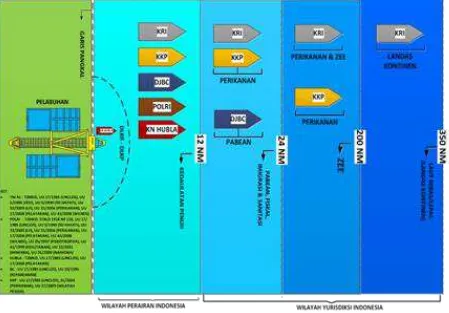
exercise its authority to operate up to the Indonesian EEZ, but it must coordinate with the Navy to get support. If the supervisory ships of MOMAF made another engagement with CCG ship during a law enforcement operation, KRI will be ready to deal with the CCG if they conduct a hostile act or hostile intent against the supervisory ships of MOMAF.
The presence of KRI's support for the supervisory ships of MOMAF which carried out operations up to the Indonesian EEZ could balance the power between Indonesia and China or other countries in the sea. This balance will maximize the law enforcement
procedures carried out by the MOMAF and the Navy to those violating the sovereign rights in the Indonesian EEZ. Indonesia will be able to firmly implement Law No. 45 of 2009 Amendments to Law No. 31 of 2004 concerning Fisheries, by stopping and detaining boats. In that way, Indonesia will be able to telegraph a message to other countries that Indonesia will firmly enforce its sovereign rights in its jurisdictional area.
Conclusion and Recommendation
The findings in this study are that the instruments of maritime power in
Indonesia have not have a harmonized perspective in regard to NDL yet. This perspective must be bridged by looking at the development of SCS and Indonesia's position in it. A harmonized perspective will be obtained if the Indonesian Government already has guidelines for its instruments of maritime power. An effective guideline will be able to integrate perspectives and regulate collaboration in the task of maritime power instruments which will result in a harmonized policy.
The findings in the study indicate that the policy of the policy maker and the derivative strategy of the strategy maker have not been harmonized. The Coordinating Ministry of Maritime Affairs
124 | Journal of Defense & State Defense | August 2018, Volume 8 Number 2 The size and weaponry owned by the
Supervisory Ship of MOMAF is not sufficient to deal with larger ships, especially the CCG ships. The recommendation of this study is that the Government of Indonesia should design the authority and operation area in accordance with the capabilities of the maritime power instrument, so that law enforcement can be carried out optimally. The MOMAF can patrol the fisheries management areas up to the EEZ, but only for EEZ that does not directly border another country. As for the other EEZ, the MOMAF should coordinate with the Navy, because the risk of dealing with coast guard ships and battleships of other
countries is very large.
The recommendations of this study are as follows:
- Research on the synergy of Indonesian instrument of maritime power against Chinese claims on Indonesian EEZ which intersects with NDL in the harmonized policy section can be developed into further new research to find out what the scheme harmonized
Indonesian Government’s policy on China’s claim over the SCS is. Research on the analysis of China's instruments of maritime power on the LCS to find out how China regulates its maritime
power instruments to maintain NDL claims can be an advanced research and complement the discussion in this study.
- The Government of Indonesia, especially its instruments of maritime power, needs to develop harmonized policies for issues that disrupt the defense and security of the Republic of Indonesia, where the Coordinating Ministry of Politics, Law and Security and Coordinating Ministry of Maritime Affairs will formulate and monitor policies of ministries in their fields. - MoFA needs to prioritize Indonesia's
national interests and increase the intensity of communication and
approach with Indonesian instruments of maritime power in order to obtain a comprehensive picture of the problems on the field and to create an effective and targeted diplomacy.
The Synergy of Indonesia’s Maritime Power Instrument to Face ... | Christine Anggi Sidjabat | 125 - The Indonesian government, especially
its instrument of maritime power, needs to rearrange ROE in the field to build compatibility between authority and capability.
References
Books and Journals
Bandur, A. 2016. Penelitian Kualitatif: Metodologi, Desain, dan Teknik Analisis Data dengan NVivo 11 Plus. Jakarta: Mitra Wacana Media.
Graves, Sue. 2008. Synergies Between Bilateral and Multilateral Activities. Copenhagen: Ministry of Foreign Affairs of Denmark.
Wiranto, Surya. 2016. Resolusi Konflik Menghadapi Sengketa Laut Tiongkok Selatan dari Perspektif Hukum Internasional. Yogyakarta: Leutika Prio.
Susmoro, Harjo. 2017. Dibalik Penamaan Laut Natuna Utara. Jakarta: Pushidrosal.
Legal Regulations
Presidential Regulation No. 16 of 2017 concerning Indonesian Maritime Policy.
Minister of Maritime Affairs and Fisheries Regulation No. 56 of 2014 concerning the Moratorium on the Permit of Fishing Business in the Fisheries Management Area of the Republic of Indonesia
Miscellaneous Sources
Wiranto, S. (2017). Teaching Materials: Case Study: Managing Potential