Program Budgeting Manual
For Government of Georgia
Prepared By
Glendal Wright
Table of Content
I. INTRODUCTION...4
A. Introduction to the Program Based Budget Manual...4
1. Purposes of Program Based Budgets...5
2. International Model of Progam Based Budgeting...7
B. Users of the Program Based Budget Manual...9
1. National Level Budget Users...9
2. Subnational Level Budget Users...10
3. Public Users of the Budget...10
C. Use of the Program Based Budget Manual...10
1. Reference for Program Based Budget Preparation...10
2. Increased Capacity for Making Budget Decisions...10
3. Increased Transparency and Accountability of Budget Policies...11
II. PRACTICAL APPLICATION OF PBB ON PROGRAM LEVEL...11
A. Introduction to Developing Program Based Budget...11
1. Overview of Program Based Budget Elements...11
2. Main Terminology of Program Based Budgets...13
3. Basic Features of Program Budgeting...14
4. Number and Size of Programs...15
B. Steps in Developing Program Based Budget...16
1. Step: Identification of Legal Requirements and National Policies...16
2. Step: Define the Mission of the Organization...18
3. Step: Define Programs/Subprograms...20
4. Step: Define Goals/Objectives of the Program...21
5. Step: Develop Activities of the Program/Subprogram...24
6. Step: Place Programs in Organizational Structures...27
7. Step: Determine the Outputs/Outcomes...31
8. Step: Develop Performance Indicators...32
9. Step: Identify the Inputs to the Activities...35
10. Step: Cost the Inputs...36
11. Step: Prepare Program Budget Submission...41
12. Step: Review and Adoption of the Budget...46
13. Step: Execution of the Budget...47
14. Step: Monitor and Evaluate Program Activities/Accomplishments...47
15. Step: Audit the Program...53
III. PROCESS OF PREPARING PROGRAM BUDGET IN GEORGIA...55
A. The Program Budget Cycle...56
B. Legal Framework for Developing the Program Budget...57
1. Budgetary Code of Georgia...57
2. Order of the Minister of Finance #385, July 8, 2008 Tbilisi, On Approving the Program Budgeting Methodology, adopted July 11, 2011...58
C. Developing the Program Budget Process in Georgia...60
1. Planning and Preparation Phase...60
2. Budget Review and Adoption...70
3. Budget Implementation/Execution...73
4. Budget Audit and Program Evaluation...75
I.
Introduction
The Republic of Georgia had undertaken to improve its budget process and to implement a program based budget (PBB) after the Budget Code was adopted in 2009. Since that time the implementation has proceeded with the adoption of a program budgeting methodology and development of key documents, such as the Basic Data and Directions (BDD), which have guided this effort. It is important to realize that this implementation has been implemented as a part of a larger public finance management reform described in the Public Finance Management Reform Policy Vision 2014-2017. The effort to further develop the PBB will continue over the next several years and is enhanced this PBB manual.
A. INTRODUCTION TO THE PROGRAM BASED BUDGET MANUAL
This budget manual is intended to achieve several different purposes for improving the budget process within the central ministries of the Government of Georgia. One of the weaknesses identified in implementing PBB in Georgia has been the lack of a
comprehensive manual that will provide those involved in preparing the PBB with the necessary knowledge and information of the concepts, terminology, advantages and disadvantages of PBB, and the practical and sequential steps in preparing the budget. Therefore, this manual is intended to serve as a guide in the full development over the coming years of the Georgian system of program-based budgeting (PBB). It shall assist officers involved in budget preparation and execution to understand public sector
budgeting based on programs. The manual is intended to assist line ministry officials and budget agencies in their understanding as to how a program-based budget is to be
developed and submitted to the Ministry of Finance. It shall guide Budget Users (budget officers and program managers tasked with the development and implementation of programs) throughout the whole process of preparing budgets using PBB methodology for all levels of government. This includes organizations outside of the government ministries, such as the Parliament and the State Audit Office. The Parliament needs an understanding of the government programs for their budget review and oversight
functions and how the government’s policies have been translated into specific programs and spending levels. The audit institutions need to understand program budgeting methods to ensure that the specific programs have spent funds to accomplish the purpose and objectives of the programs in an efficient and effective manner.
Purposes of Program Based Budgets
Program based budgets have been developed to serve a number of important purposes in the budget process. First, and foremost, it serves the purpose of providing a policy document. The budget should not just show a set of numbers within a budget year timeframe, but should reflect the goals, needs, and priority of choices made by government, with citizen input. Therefore, the budget serves the purpose of a policy document that should highlight the following:
Goals and Objectives: The budget should represent the decisions on what the future should be in terms of what is to be accomplished through budget expenditures and what level of accomplishment is expected.
Recommendations on Policy Issues: The budget should present the financial issues facing the central government and the policy recommendations and proposed legislation to solve these issues.
Financial Policies: The recommendations on policy issues are then translated into financial policies that are reflected in the setting of tax rates, expenditure priorities, and timeframes in which these will be applied.
Secondly, the budget is, of course, a financial plan that presents financial data, such as summaries of revenues, expenditures, and debt for the budget year and subsequent years, as well as identifying operational/recurrent activities and capital improvements, and the financial reports for various accounts the government may have. Since traditional budgets primarily represent a tool for control of expenditures according to limited categories (e.g. services, wages, goods, etc.), they may provide the answers to the questions like “how much did we spend on services, wages, etc.?” But such limited categories cannot answer the questions that can be answered by PBB, such as “how are education program expenditures achieving national education quality standards” or “what is achieved by more expenditures for maternal health.” Public expenditures represent the inputs that are directed at achieving outputs and outcomes that are embedded in the national social values and enumerated in policy documents.
Thirdly, the budget presents an operations guide for its execution by the government ministries and spending units. The budget should reflect policies and strategies of the national and subnational governments. It should identify the functions and responsibilities linked with the implementation of the policies and strategies, establish levels of performance to be achieved by implementation of these policies and strategies and provide an identification of the inputs to support the program objectives.
All of these purposes are achieved in a budget document if it is:
Comprehensive: The budget reports all revenues by sources and expenditures, by function or purpose
Consistent: The budget is presented in a consistent format and structure from year to year and funds are accounted for based on accepted accounting standards.
Comparable: The budget should present revenues and expenditures for several years to allow for comparison and identification of trends; and performance measures are presented for several years for comparison purposes.
Unified: The budget should relate all spending and revenue collecting parts to evaluation criteria.
Exclusive: Only financial matters should be in the budget.
Annual: The budget should be prepared every year for the next year of the organizations operations.
Clear: The budget should describe what is proposed in understandable fashion.
Public: The budget should be done based on the principles of democracy. Such important choices should be made with public input and review.
Results-oriented: The budget defines what is to be accomplished and the measures that indicate the results desired have been achieved.
The Budgetary Code of Georgia enacted in 2009 provides a set of principles for the budget system comparable to the ones identified above. These are identified in Article 4 of the Budget Code in the following box.
Article 4. Main Principles of the Budgetary System of Georgia
1. Any participant in the budgetary system of Georgia at all the stages of the budgetary process shall fulfill the following principles:
a) comprehensiveness – complete reflection of all the changes in the revenues, expenditures and balance in the relevant budgets;
b) transparency – openness of the review procedure of the draft budgets in the representative agencies for the population and mass media; publishing of the reports on the approved budgets and their fulfillment; availability of the information about budgets (except for the secret information) for any physical and legal entities;
c) accountability – responsibilities of all the participants in the budgetary process for carried out activities and for provided budgetary information;
d) independence – independence of the state budget of Georgia, republican budgets of the Autonomous Republics and the budgets of the local self-governing units, which are provided for by their own revenues and balances, and also the right to independently define own taxes in accordance with the legislation of Georgia.
e) unity – usage of common principles defining the basis for the central agencies, Autonomous Republics and local self-government bodies of Georgia, uniform budgetary classification, single accounting system, and state financial control;
specific expenditure. Retaining of the revenues by a budgetary organization for its own purposes shall not be allowed except for the cases when the budgetary organization is represented by a legal entity of public law and/or non-profit (non-commercial) legal entity;
g) consolidation – bringing the revenues at all the budgetary levels within the uniform system of accounting of the state treasury and payment of expenditures within the rule defined by the legislation of Georgia, management of the uniform system of accounting of the state treasury by the State Treasury and their placement within the National Bank of Georgia and/or other banking institutions.
2. International Model of Progam Based Budgeting
In this section, to further develop the awareness and knowledge of the methods and techniques of PBB the main features of program budgeting will be briefly described.
A. Program Based Budgeting
The program based budget form organizes proposed expenditure according to output or contribution to governmental objectives. Programs are constructed on the basis of contribution of those objectives. The focus is neither on what governments buy nor on activities in which the government is engaged, but on, as nearly as can be defined the outputs of government. The budget places together programs, which contribute to a similar objective so that competition for funds occurs among real alternatives. In an ordinary budget, agencies or departments compete for funds, as do programs within agencies or departments, so similar program may receive different treatment simply because different agencies house them. In a program budget, similar approaches for handling a public problem will compete with each other, not with dissimilar programs housed in an administrative agency.
Program budgeting defines the goals of an agency and classifies organization activities contributing to each goal. Grouping is by end product, regardless of the administrative organization functions, to focus competition for resources among objectives and alternative programs for achieving objectives. The program structure identifies agency products; it does not focus on the inputs used by the agency.
Program budgeting requires careful definition of programs. That exercise is the essence of such budgets. While a good understanding of government operations is vital for program classification, the logical criteria for program design may be considered as the following:
2. Programs must include complementary components that cannot function separately. The health programs require doctors, nurses, physical facilities, and the like in appropriate proportions—and those elements must all be in the program.
3. When one part of a government serves several others, separate supporting service programs may be needed. Thus, central electronic data processing, personnel administration, and so forth may permit operating economies not possible if each agency handles them separately. These activities can be handled as programs, even though their outputs are not governmental objectives.
4. Governments may have to have overlapping program structures to achieve their objectives. Many revenue departments, for instance, have structures arranged both functionally and geographically. That approach appears when both regional and national objectives are important.
5. Finally, some activities involving research, development, or long-term investment may be considered as separate subprograms because of the long time span over which the expenditure takes effect. That is because of the uncertainties that preclude reasonably reliable estimates of resource requirements beyond relatively short portions of their life.
Program construction is the identifying feature, but program budgets often have other elements accompanying them. First, budget time horizons expand beyond an annual appropriation to the lifetime of the program. While appropriation remains annual, decision makers are presented the total cost of the program considered, not simply a down payment. Second, steps in preparation induce agencies to consider alternate operating methods and to propose only those that require least cost to achieve the desired results. Because agency administrators traditionally have incentives toward larger budgets for prestige or advancement, such steps are difficult to enforce. Finally, program budgets often include some benefit-cost analysis of the resource use of programs proposed. Programming brings together costs for achieving particular objective, so an important piece of the data needed for such analysis is provided.
1. Advantages/Disadvantages of Program Based Budgeting
Program budgeting has the advantage of focusing the organization on its mission and purpose with a budget structure that clearly identifies these and relates them to develop service delivery Programs. For this reason program based budgeting is a major planning tool.
In case it is not properly applied, this tool can become an administrative burden. There is a tendency to develop a very information intensive effort to support the program based budgets. This is often beyond the present capacities of the staff and information systems to fully develop and apply in the program based budget process. Consequently, much time is spend on developing the information requirements rather than focus on the critical information needs that would support better budget decision making.
Whatever choice is made will emphasize one set of policy choices at the expense of another set.
Second, cost estimates for programs may be less meaningful for public decisions than imagined. There is no scientifically defensible method for allocating the substantial joint costs appearing in agencies. Because most units work with several programs, many resources used by the agency are shared and not clearly attributable to a single program. Furthermore, public decisions require concern for social implications—not simply money out of pocket—while program budgets still focus on agency cost alone. Thus, the program cost data is unlikely to be directly usable for guiding choices.
Finally, program budgets may have little impact on decisions. Legislatures, lobbyists, and governmental departments have experience with the traditional budget format. All are familiar with that construction and have developed general guides for analysis for that format. New presentations require new guides and extra effort by all. Unless the major participants in the budget process actually want the improved presentations, it will be ignored in favour of the format to which they are accustomed.
B. Comparison of Budgeting Methods
In order to illustrate and clarify the differences of these budgeting methods the table below provides some of the main features of each of these methods and orientation for budgeting. The traditional line-item expenditure method is included here to demonstrate the main differences among these methods
Budget Method Characteristics Primary Organization Feature
Budget Focus
Line-Item
Expenditure Budget
Expenditure by commodity or resource purchased
Resources Purchased
Control of Resources
Program Budget Expenditure Related to Public Goals Cost data across organizational lines
Achievements (products or outputs)
Planning
B. USERS OF THE PROGRAM BASED BUDGET MANUAL National Level Budget Users
the requirements of the legal framework provided in the Budget Code and conform to the policy directions identified and described in the Basic Data and Directions document. This manual will provide the detailed sequence and activities that encompass the implementation of program based budgeting in Georgia. The users of the manual will be not only the main central ministries and spending units, but also the Parliament and State Audit Office.
Subnational Level Budget Users
The subnational level budget users, the autonomous regions and the local governments, that are implementing program based budgeting following the lead of the central government will find this manual useful to understand the basic concepts, terminology, and practices of program based budgeting. While their programs and expenditures may differ substantially from the central government, the same basic concepts and practices will apply. In addition, this manual will help them to prepare their budgets in accordance with the central level budget process and ensure there is consistency and accountability between the government spending levels.
Public Users of the Budget
The public, in terms of both citizens and non-governmental organizations, have a great interest in understanding the budget and how it addresses their needs and priorities. For this reason, the budget should also be prepared with the intention of it being a means of providing citizens and their representative organizations with the means to utilize the information in the budget. A clear and concise budget presentation not only serves the public officials, but also the citizens who fund the programs through their taxes and want to see how their money is being use.
C. USE OF THE PROGRAM BASED BUDGET MANUAL Reference for Program Based Budget Preparation
This manual is intended to provide the staff of the Ministry of Finance, the other ministries of the central government, and with subnational units of government in Georgia with a reference source for implementing program based budgeting that complies with the requirements of the relevant budget methodology. It is also intended to provide those using the manual with the methods and techniques of program based budgeting and how it can be implemented within their government organization.
Increased Capacity for Making Budget Decisions
improve this process and ensure that funds received will be expended in a more economical and efficient manner. It will also allow for better methods of prioritizing the competing needs of the citizens on a more rational basis.
Increased Transparency and Accountability of Budget Policies
This manual is also intended to provide for a more transparent and accountable method by which central ministries and spending units makes their expenditure decisions. The inclusion of performance indicators and costs associated with these expenditure decisions should increase the interest of citizens in how these funds are being spent and generate more citizen interest and participation in the public budget process. Transparency and accountability are major reasons for implementing a performance based budget system.
II.
Practical Application of PBB on Program Level
A. INTRODUCTION TO DEVELOPING PROGRAM BASED BUDGET Overview of Program Based Budget Elements
The following diagram provides a picture of the relationships among the main elements and features of program budgeting. Program budgeting is based on a hierarchy of elements and not just a division of programs/subprograms to develop a program based budget.
This hierarchy begins at the mission level, which requires the organization to focus on what it strategic level purpose is in the overall governmental organizational scheme. This mission is then translated into program(s), which require the identification of goals and objectives of that program as it relates to the mission of the organization.
The clarification of the mission of the organization is utilized to define the programs/subprograms that would fulfill the mission statement. A few key points will made here to reiterate the requirements of ensuring that programs/subprograms are properly defined and developed in the program budgeting process.
The development of programs/subprograms should follow a rational relationship from the mission of the organization. If the mission of the organization, such as a ministry of education or ministry of health, is to provide quality services that are accessible to all the people at a economical cost, then the programs must address these areas of quality, accessibility and cost.
MISSION MISSION
GOALS
GOALS PROGRAMPROGRAM OBJECTIV
ES OBJECTIV
ES
OUTCOME OUTCOME
EFFICIENCY EFFICIENCY
OUTPUT OUTPUT INPUT
INPUT
PERFORMAN CEEEEE
PERFORMAN CEEEEE
MEASURES MEASURES
“Budge t”
“Results, “Quality”
“What was done”
Defining programs as they relate to these mission purposes requires some creativity and innovation in the development of the programs/subprograms. The following provides some examples of defining of programs/subprograms under several sectors.
Ministry Mission/Policy Priority
Program Sub-program
Agriculture Increase
Quality &
Access to
Health Diets
Support Dairy Production & Related Products
Milk Production
Education Provide educational opportunities to all citizens
Primary Education
Increase School Enrollment
Health Preventative
Health MalariaPrevention DistributionMalaria of Medicines/Material s
In these examples the relationship of the organization mission and sector priorities provides a basis for determining what programs/subprograms might be envisioned and developed to achieve the mission and priorities. These are developed to the level of activities that would support the programs/subprograms and lead to further definition of the program.
Main Terminology of Program Based Budgets
The confusion over what constitutes program-based budgets is more easily resolved by the understanding the main terminology that is applied in this budget method. The main terminology has been provided in the diagram above. These constitute the following terms with some generally accepted descriptions of what they mean.
Mission: The main purpose of the governmental organization and identifies its main responsibility areas for developing programs.
Program: Generally defined as an organized set of activities directed toward a common purpose, or goal, undertaken or proposed by an agency in order to carry out its
Goal: An observable and measurable end result having one or more objectives to be achieved within a more or less fixed timeframe.
Objective: A specific result that an organization aims to achieve within a time frame and with available resources and is, in general, more specific and easier to measure than goals.
Input: Resources used in the carrying out of activities to produce outputs (for example. labor, equipment, buildings).
Output: A good or service provided by an agency to or for an external party.
Outcome: Changes brought about by public interventions upon individuals, social structures, or the physical environment.
Efficiency: Production of an output at minimum cost while holding quality constant, given prevailing input prices.
Performance Measures: Ratings or quantitative measures that provide information on the effectiveness and efficiency of public programs.
Basic Features of Program Budgeting
The above sections have provided a description of the main features of program budgeting and identified and defined some of the key terminology that is utilized in developing a program-based budget. In this section, the basic features of program budgeting are briefly summarized prior to addressing some critical aspects of developing and implementing program budgeting.
Program budgeting is the planning, authorization and execution of expenditures in terms of programs.
The key to developing the programs is to define a system of expenditure classification and accounts that will be grouped under the program structure. The classification of expenditure allows for the program to be assessed and
prioritized in terms of the allocation of resources to specific problems that the budget is to address.
Program/subprograms will be developed to the activity level where the resource inputs (personnel, materials, and capital expenditures) will be defined to the line-item level that is related to the budget and accounting classification codes.
The prioritization of expenditure resources allows for selection of programs and expenditures within sectors, such as education or health, but not across sectors. The initial prioritization of program expenditures within sectors is decided at the
ministry level where the responsibility and accountability for these decisions and the use of these resources will be evaluated against program goals and objectives. The prioritization of programs and expenditures will be made at the
Number and Size of Programs
One of the first decisions that will need to be made is how many and how large, in terms of financial values, should programs be in the overall program budget structure and organizational entities. There is no hard and fast rule, although for many ministries, three to five programs may be a reasonable number.
A number of factors need to be considered in determining the number of programs. These are:
Number of different sector areas aimed at different client groups
Degree or nature of the government’s policy priorities as defined in the national plans and sector strategies
Ministry’s or agency’s internal management and technical capabilities Immediate to medium-term impacts expected to be achieved
The number and size of programs should be developed in a coordinated approach between the ministry program management and the ministry of finance. The ministry of finance may wish to provide some guidelines on the development of the number of programs and their values.
The determination of how many and how large the programs should be balanced between one or two large programs or having many small programs. Only careful analysis of the organization’s mission and the sectoral areas that must be addressed in the budget can provide some indication of how to achieve this balance. For example, rather than one large education program that covers pre-primary through university education, it would be better to create several programs that cover the various age groups and school grades. This will enable a more refined analysis of the programs and serve as a better basis for budget decision-making as well as program evaluation.
On the other hand, creating too many programs will not serve the purpose of determining the allocation of funds on a broader basis to the social or sector problems that have been identified. It also creates difficulty in requiring more time for preparing the budget, maintaining accountability in program areas, and overly complicates the budget and accounting classification system.
The number of recommended programs has varied from three to five or as many as five to eight for a particular ministry. A ministry with a more narrowly defined mission and scope, such as a ministry of transportation or education, might find the three to five number of programs as reasonable. However, a ministry with a broad mission and scope, such as ministry of education, culture and sport, might have to have as many as five to eight to adequately differentiate the programs in each of these areas.
B. STEPS IN DEVELOPING PROGRAM BASED BUDGET
In the following section, a step-by-step outline for developing a program budget is presented. This is a model for determining what steps are necessary and how these might be accomplished. The implementation of program budgeting takes a number of budget cycles to complete the process and be fully achieved. While the steps are placed in what might be considered a logical order of development, this is not intended to indicate that these must be followed in this sequence. In many cases, some of these steps might be well fully developed and attention to the other steps will require more time and effort to achieve. Therefore, some steps in this process might be rearranged or merged as the particular program budget situation is assessed and implemented.
Step: Identification of Legal Requirements and National Policies
The essential first step is to identify the legal requirements and the national policies that relate to implementing program budgeting. This is really a two phase process within this one step.
Basic Legal Framework
The first phase should be an identification of the existing legal framework, or lack of one, for implementing program budgeting. Program budgeting should be clearly identified and defined in the basic legal framework that relates to the public finance and management system within the government structures.
Step 15: Audit the Program
Step 15: Audit the Program
Step 14: Monitor/Evaluate Program
Activities/Accomplishments
Step 14: Monitor/Evaluate Program
Activities/Accomplishments
Step 13: Execution of the Budget
Step 13: Execution of the Budget
Step 12: Adoption of The Budget
Step 12: Adoption of The Budget
Step 11: Prepare the Program Budget Submission
Step 11: Prepare the Program Budget Submission
Step 10: Cost the Inputs
Step 10: Cost the Inputs
Step 9: Identify the Inputs to the Activities
Step 9: Identify the Inputs to the Activities
Step 8: Develop Performance Indicators
Step 8: Develop Performance Indicators
Step 7: Determine the Outputs/Outcomes
Step 7: Determine the Outputs/Outcomes
Step 6: Place Programs in Organizational Structures
Step 6: Place Programs in Organizational Structures
Step 5: Develop the Activities of the Program/subprogram
Step 5: Develop the Activities of the Program/subprogram
Step 4: Define the Goals/Objectives of the Program
Step 4: Define the Goals/Objectives of the Program
Step 3: Define the Programs/Subprograms
Step 3: Define the Programs/Subprograms
Step 2: Define the Misssion of the Organization
Step 2: Define the Misssion of the Organization
Step 1: Identification of Legal Requirements and National
Policies
Typically, the authority for implementing program budgeting is contained in the Law on Finance or Budget as proposed by the government and enacted by the Parliament. This legislation is often termed the Budget Code that controls the government financial management system. This Budget Code will largely identify the requirements, scope and responsibilities for preparing a program budget as part of the annual budgeting cycle
The budget code will be supported by the issuance of a specific instruction or regulation issued by the Ministry of Finance that will provide more detail on the content and process of developing the program budget. This should provide the basic methodology of the program budget process. This often will be a rather detailed instruction that will be referenced each year for the budget preparation.
The Budgetary Code of Georgia, adopted in 2009, in Article 3 provides the legal basis for the budgetary system with Article 9 specifically identifying Program Budgeting as the basis for developing the budget.
As a further supplement to the implementation of the program budget methodology, the Ministry of Finance will issue annually before the beginning of the budget planning and preparation process a further budget instruction or budget circular that will be specific to the requirements of preparing the forthcoming budget. This will contain in most instances the basic expenditure and revenue projections, the expected increases/decreases in certain expenditure categories, such as personnel salaries, etc., and the basic information and budget submission forms that are to be completed. These activities will largely be determined and developed within the Ministry of Finance and the relevant central ministries budget offices.
The Order of the Minister of Finance #385, adopted July 2011, details the specific components and timeframe in preparing the budget on a program basis.
National Policy Review and Update
This phase of the first step should involve a broad based policy review from the central government political leadership level to the management level of the central ministries. National planning and development policies, sector policies and other guides for the national policy prioritization is involved in this process. This process will be a undertaken at the government cabinet level and ministry levels to review the current national policies, review and prioritize new problems and evaluate prior accomplishments based on the performance indicators. This phase should be guided through policy working groups and even include national organizations and community based groups that wish to bring to the government’s attention some policy problems and needs.
Step: Define the Mission of the Organization
Understanding and defining the mission of the organization will provide a reference point and framework for developing the programs/subprograms that are key to implementing the program budget. Defining the mission of the organization or ministry may not be as simple as is often thought. Ministries may have multiple sector functions as is often the case and these may require the mission of the organization to be defined in very broad terms and more define by goals and objective statements.
Mission statements identify and describe the larger purpose of the organization and the services that it provides and establishes the basis for determining Program and Sub-Programs and their goals and objectives.
Mission statements:
Provide motivation and spirit to employees in the conduct of their work Define why a public organization or Program with its Sub-Programs exists Define what the public organization or Program with its Sub-Programs does Define for whom the public organisation or Program with its Sub-Programs exists
An example of a mission statement for a Ministry of Education might be the following:
The Ministry of Education is charged with the responsibility of ensuring that all Belizeans are given an opportunity to acquire those knowledge, skills, and attitudes required for their own personal development and for full and active participation in the development of the nation. In carrying out its mission, the Ministry of Education shall work in collaboration with all education stakeholders.1
This mission statement is rather simple, but expresses its responsibility (charged with the responsibility of ensuring), its scope of beneficiaries (all citizens), content of its efforts (knowledge, skills and attitudes), and purpose (for their own personal development and for full and active participation in the development of the nation.)
The mission statement is often accompanied by a vision of what is to be achieved through the accomplishment of this mission. For Belize, the following vision relating to the mission of the Ministry of Education, Sports and Youth:
Equitable access to and efficiently delivered quality and relevant education, at all levels, for all Belizeans, founded on the following integrated principles:
Education for Self: to create confidence, self-sufficiency, and excellence in an ever changing environment.
Education for Strength: in preparation to enter, participate, and contribute ethically to an economically strong, socially rich, culturally proud, and politically just society.
Education for Life: Never too old to learn or too old to start. Belizeans of all ages will enjoy educational opportunities as we create a country founded on the intelligence and education of its greatest assets, the people.2
Often, mission statements will be accompanied by identification of strategies to achieve the mission. The following is an example of how mission and strategies can be formulated.
Our mission is to promote good health and reduce illness, ensure access to good and affordable healthcare, and pursue medical excellence. We achieve this through three strategies:
Promote good health and reduce illness
Good health is to a great extent the responsibility of the individual. But the Ministry plays a major role in educating and providing information to the public on how they can maintain a healthy lifestyle. The Ministry also play a key role in reducing illnesses in Singapore through the control and prevention of diseases and ensuring that resources are allocated appropriately to do this.
Ensure access to good and affordable healthcare
The Ministry is responsible for ensuring that healthcare in Singapore is characterized by good clinical outcomes and professional standards, and that services delivered are appropriate to each patient’s needs. While we emphasize the principle of co-payment, we also ensure that healthcare remains affordable to Singaporeans.
Pursue Medical Excellence
Our healthcare system is well regarded and Singaporeans have benefited from it. Increasing number of foreign patients seek treatment in Singapore. We will build on this so that we become even better known for certain areas of healthcare. In the process, we must make sure that healthcare costs continue to remain affordable to Singaporeans.3
As can be seen in the above, the mission statements should be rather simple statements that encapsulate the main scope and responsibility of the organization or ministry. Further detail can be provided in vision or strategies that underpin and clarify in more detail the mission.
The mission statements for the spending units in Georgia are defined in the national strategy plans as well as being developed in the ministry action plans and the program budget submissions.
Step: Define Programs/Subprograms
A. Defining Programs/Subprograms
Properly defining programs and subprograms is often a very difficult exercise in implementing program budgeting. The critical element here is to define the mission of the organization in some broad, but specific terms, and then identify within that mission statement some classification of these purposes of the organization and form these into program/subprogram areas. This classification tends to be directed toward a particular problem or a particular target grouping. As Robinson indicates:
“programs are in some cases defined in terms of both their intended outcome and their target client groups or region. For example, education ministries typically have separate program for primary and secondary education. These programs have the same intended outcome—educated and socialized young people—but they target different client groups (i.e. young people in different age ranges). Similarly, in health treatment services, the government may wish to make explicit decisions about the regional allocation of health budget resources—the result of which may be a program structure in which there is a hospital program which is comprised of regional subprograms.”4
The development of the program/subprogram structure requires a thorough review of the organizational purposes and its organizational structure. There must be compatibility between the beneficiary directed (students, medical patients, farmers, etc.) targets of the program and the organizational delivery structure (centralized, decentralized, or deconcentrated).
One of the main problems of defining programs/subprograms is to mistake the activities as programs/subprograms. This tends to make the program budget a line-item budget focused on what the expenditure is for, rather than for what the expenditure is intended to achieve. Consequently, the program budget becomes more of a management tool rather than a budget decision-making tool.
A well-developed policy development process based on sector strategies and organizational mission statements will identify some of the key problems and resulting program areas that the program budget should be oriented around. These will form the broader goals and objectives that can then be related to specific outputs/outcomes. Once the outputs/outcomes are determined then the activity levels that relate resources and costs to these activities will clarify the budget decisions that must be made.
The following diagram presents the hierarchy of a program structure.
4 Marc Robinson, Performance Based Budgeting Manual, Center for Learning on
The sectoral goals represent the longer-term objectives to be achieved by the ministry as specified in the national planning policy document and the sector strategies.
The programs (outcomes) identify the specific medium-term benefits to be delivered by the ministry to the community and contributing to the attainment of the sectoral goals.
The sub-programs are a group of outputs (products and services) delivered to external clients to achieve the government and ministry goals.
The activities or projects are tasks or a series of connected tasks undertaken to provide goods and services to the community.
In the Georgia program budget development process, the identification of sectoral goals, programs, and subprograms should be done during the initial development of the BDD and the action plans that form the basis of the later budget ceilings and program allocations within the spending units.
Step: Define Goals/Objectives of the Program
A. Developing Program/Subprogram Titles and Objectives
It might be assumed that developing program titles and objectives would be a rather simply and straightforward problem. Unfortunately, this is not always the case. As mentioned above, there is a tendency to make program titles more of an activity description than a simple and clear title of what the program is concerned with.
Sectoral Goals
Programs
(Outcomes)
Sub-programs
(outputs)
B. Developing the Goals/Objectives of the Program
Once the program/subprogram structures are identified, the development of the program objectives should be undertaken. Again, this is not always easy to accomplish. It is important that program objectives be developed with some reference to the program targets/beneficiaries so that the performance indicators and measures may be easily derived. The program objectives should be oriented toward the outcomes of the program and this will often include the target population that will benefit from the program.
There is a natural tendency to define program objectives to be very broad and output oriented that are not easily measurable. Also, there is also the tendency to try to make too many program objectives rather than a more modest and achievable number. While there is no specific rule about the number of objectives it is generally considered that a minimum of three and maximum of five would provide a clear identification of program objectives.
The box below presents some examples of program objective statements in both positive and negative fashion. Note that these program objectives are short and concise sentences that reflect the essence of a program title.
Right and Wrong Ways of Defining Program Objectives Examples of well formulated program objectives are:
“The conservation of biological diversity in healthy eco systems” (Nature Conservation Program),
“Maintenance of territorial integrity and national independence” (Armed Forces Program),
“Increased foreign investment leading to technology transfer and stronger economy” (Investment Facilitation Program)
“Reduced crime and greater security of persons and property” (Crime Prevention Program)
Examples of the wrong approach to defining program objectives are:
“Provision of medical assistance to persons in an emergency” --refers only to outputs.
“Manage the development, implementation, evaluation and maintenance of national policy programs and systems for general education and quality assurance”—refers only to activities.
Source: Marc Robinson, Performance Based Budgeting Manual, Center for Learning on Evaluation and Results, page 57-58.
achieved. There should be only one goal per Sub-Program in order to clarify priorities. Goals should be as stable as possible during the whole subprogram life.
Goals should be stated at a strategic level. They are designed to provide a broader level of attainment of the purpose of the program. These are often stated as strategic goals and illustrated in the following example from the Ministry of Health of British Columbia.
Goal 1: Support the health and wellbeing of British Columbians.
Goal 2: Deliver a system of responsive and effective care services across British Columbia
Source: Ministry of Health, British Columbia: 2014/15-2016/17 Service Plan, February 2014.
Once these goals are stated a number of objectives should be formulated that expands the description of what is to be achieved by the goal statements. For example, the British Columbia Health Ministry goal statements are followed by a number of objectives. These service as a basis for the subprograms that will be created and utilized to achieve the goals.
Goal 1: Support the health and wellbeing of British Columbians.
Objective 1.1 Targeted and effective primary prevention and health care promotion
Goal 2: Deliver a system of responsive and effective care services across British Columbia
Objective 2.1 A provincial system of primary and community care built around inter-professional teams and functions
Objective 2.2 Strengthened interface between primary and specialist care and treatment
Objective 2.3 Timely access to quality diagnostics
Objective 2.4 Renewed role of hospitals in the regional health continuum
Objective 2.5 Increased access to an appropriate continuum of residential care services
Source: Ministry of Health, British Columbia: 2014/15-2016/17 Service Plan, February 2014.
The objectives specify the way that the goal is to be achieved. There are a number of considerations that should be considered in establishing the objectives. The following details some aspects for setting objectives:
An objective should be based in behavioural terms as a guide to action.
A good objective often has intermediate targets and a specific completion date—in terms of the budget year or other time schedule.
An objective should include specific performance criteria, such as how many, what per cent, which site, personnel levels, or costs.
An objective should be both challenging and attainable.
This step should be completed as part of the initial development of the spending unit action plans and the internal program reviews that should form part of the program budget development process.
Step: Develop Activities of the Program/Subprogram
A. The Program/Subprogram Hierarchy
The essence of program budgeting is to create a hierarchy of programs/subprograms that are clear, concise, and communicate in just few words the nature and scope of the program. Typically, there should be a limited number of programs and subprograms so as not to be too vague or over specify the programs and subprograms. The other problem is to ensure that programs/subprograms are not “activities” and relate more to the outputs of the program rather than the beneficiaries or purposes of the program.
An example of a program/subprogram and activities structure for a university education program is presented in the diagram below. The higher level education program is within the education sector, but within this education sector there is also a program level directed toward supporting university level education. There may be other program levels such as pre-primary education, primary education, secondary education, as well as vocational/technical education depending of the mission assigned to the Ministry of Education. As is seen from this example from the Slovak Republic, the education sector is included along with science, research and sport under the organizational mission of the Ministry of Education, Science, Research and Sport. So, this ministry has a broad mission and scope of programs to present in a program budget.
Other programmes of the ministry:
• 021 Policy Formulation and Implementation
• 026 National Program of Sport Development
• 078 National Program of Education, Training and Youth
• 081 Operational Programme Research and Development
Source: Ministry of Education, Science, Research and Sport of Slovak Republic
This hierarchy provides a full picture of the scope of the university education program for the higher-level decision-makers who are more interested in determining the macro level of the university programs.
It also supports the ministry and department level management by presenting the range of subprograms and the activities that will require the identification of outputs/outcomes and the costing of the inputs to achieve these. So, a simple program/subprogram structure can serve all these purposes in a clear, concise and easily communicated form of a program structure diagram.
B. Identifying the Program/Subprogram Activities
At this stage, the activities to be performed in the process of program and its sub-programs implementation have to be identified. They have to be formulated so that they add to achievement of the objective and eventually to accomplishment of the Program goals.
Education
077 University Education, sciences,social suport for university students
07711 Provision of university education and
operation of universities
07712 University science
and technology education development07712 University
07714 Coordination and support, management of activities in university
07715 Social support to university students
Activities: 0771501--Social
Scholarships 0771502 Performance
Scholarships 0771503-- Support for catering accommodation, sport and cultural events
This relationship with program goals and objectives to the activity level is illustrated from the previous example presented for the Ministry of Health of British Columbia. Objective 2.4: Renewed role of hospitals in the regional health continuum is accompanied by several key actions or activities that will be undertaken to achieve this objective.
: Key Actions/Activities for Objective 2.4
M Objective: Improve the link between hospitals, primary care and other care providers in communities.
: Key Actions/Activities:
Explore opportunities to use hospitals more effectively, including shifting to community based delivery of services where appropriate and using outpatient clinics.
Explore patient pathways or services for frail seniors that avoid hospitalization.
Ensure hospitals are operating and managed to meet the changing health needs in the province, including strengthening relationships between health administration, physicians, nurses and allied health and support staff.
Source: Ministry of Health, British Columbia: 2014/15-2016/17 Service Plan, February 2014.
The following presents an example of how this relationship from ministry to mission to program/subprogram and activities can be formulated. There is a direct relationship from the program/subprogram titles to actions or activities that are undertaken to support the organization and its mission.
nets
There is often a tendency to have many activities under a subprogram. While there is no set rule on the number of activities, these should be limited in number. As a general rule, no more than five activities should be grouped under a subprogram. If there are more than five, it is recommended that these be examined and determined if another subprogram can be created to relate to these activities more directly in the program/subprogram structure.
In the Georgia budget development process, this step should be accomplished once the spending unit has been provided with their budget ceilings and the allocations are made to the program areas.
Step: Place Programs in Organizational Structures
A. Reconciling Organizational Structures and Programs
If the determination of the number and size of programs/subprograms proves difficult, it is generally even more difficult to place programs in the organizational structure of the ministry or spending agency. This is not only because of the technical requirements of defining programs/subprograms, but because of the often political and bureaucratic and character that accompanies these decisions.
This issue of reconciling the programs and organizational structures is addressed to some extent in the program budget methodology as issued by the Minister of Finance in Order #385. The relevant sections of this order are provided below.
Order of the Minister of Finance #385 On approving the Program Budget Methodology
2.5.1 Programs
The programs should be formulated based on the competences of spending institutions. One spending institution should be an implementer of one program.
2.5.2 Subprograms/Activities
It is reasonable for the ministries and other spending institutions to formulate their subprograms so that one budgetary organization (or its structural unit) is responsible for implementation of each of them, besides, one budgetary organization may implement several subprograms.
organizational structures to programs proves to be a difficult task to undertake.
The program budget concept is applied most effectively when programs are assigned to one organizational unit and are held responsible for the performance of the program. There are two approaches that are often utilized to reconcile the problem of assigning programs to organizations. The first is that the organizational units are restructured or created around the program areas. This approach works best when the program area is quite narrow and specific to the organizational mission and there is no conflict with other organizations across the government. For example, if the ministry of education is responsible for all education programs and only implemented within the ministry’s organization, there is no problem in holding the ministry responsible. However, other ministries often have education programs and institutions, such as health ministry, agriculture ministry, or the military branches. In this case, the mission of the education ministry may be more narrowly defined to certain segments of the education sector; such as the public schools.
The second approach is to recognize that there will be differences and conflict across the program and organizational structures and accept these as being normal. The reconciliation of these conflicts can be mitigated to some extent by having a proper program budget classification system, which will relate to the sector to the organizational structures, so that at a reporting level, the full scope of the sector programs and spending can be determined and evaluated.
B. Programs and Levels of Government
There is still another level of complexity that needs to be addressed in developing the program budgeting approach in a particular government system. This is how the program budget structure will be incorporated into the different levels of government in a country. One of the elements in this situation is whether the governance system is a federal or unitary system. Under a federal system, there is a much more level of freedom and flexibility for the subnational units to establish their particular program, budget and expenditure classifications that may not be compatible with the national or central government. Under a unitary system, such as Georgia, there is more control over the budget structures and the program and expenditure classifications are more easily controlled from the central government. So, the issue arises in defining the program structures, budget classification and chart of accounts as to how these will be comprised at the central and subnational levels.
It is generally recommended that as much compatibility and complementary as possible is maintained between the levels of government, particularly in transition countries and those that are receiving substantial amount of financial assistance from donors. In some countries, there is a single treasury system, which effectively imposes a standardized budgeting and accounting system from the central to the local governments.
different programs, no matter other factors, from the central to the local level. Local governments will have programs, such as solid waste collection, water, and other services that are particular to the local government level. These programs will require their own program structure, budget and account classifications that would not be practical to adopt from the central level ministries.
The Budgetary Code in Georgia specifies that it applies to the central, the autonomous regions and to the local self-governments in the first two articles as presented below.
Article 1. Objectives of the Code
The present Code defines the principles of creation of the budgetary system of Georgia, regulates the rules for preparation, review, adoption, fulfilment, accounting and controlling the budgets of national, local self-government bodies, and the republican budgets of the Autonomous Republics. Also, it regulates budgetary relations and responsibilities between the central agencies, Autonomous Republics of Georgia and local self-government bodies.
Article 2. Budgetary system of Georgia
Budgetary system of Georgia represents a unity of budgetary relations regulated by normative acts required for mobilizing and usage of the financial resources for the purposes of fulfilment of the functions of the central agencies, Autonomous Republics of Georgia and local self-government bodies.
The budget systems of the three levels of government in Georgia are also detailed in the Budgetary Code of Georgia. Part III relates to the budget process of the State Budget, Part IV relates to local self-government, and Part V relates to the autonomous regions. This connection between the central and subnational levels is carried further in the program budget methodology issued by the Minister of Finance. In this methodology, annex 2 relates to the requirements of the state budget, annex 3 relates to the autonomous regions, and annex 4 to the local self-governments. These annexes give general guidance on the structure and content of the budget that is to be prepared by the different levels. However, it does not specify a particular program coding structure that is to be applied to these levels and, thus, some flexibility and differentiation among these levels for determining their program structures is appropriate.
C. Options for Aligning Organizational Structures to Programs
Once the program/subprograms and activities are identified the process of aligning these to the organizational structure should be undertaken. This is often not as clear or transparent as it would seem. The purpose of placing the programs within defined organizational structures is to ensure there will be placed accountability and responsibility on the appropriate levels of the ministry management levels.
clear the organizational structures of the spending units need to be stable over a longer period without any major organizational transfers of programs.
Organizational structures may be defined based on the service delivered, the product/service, or to the clientele/beneficiaries, students, elderly, etc., that may be incorporated into the department levels of the ministry or spending units. Where these exist it is easier to place the program into the organizational structure.
In some cases, there may be a situation in which the organizational structure combines both output type departments with clientele/beneficiary departments. This is often the case in health, education or social assistance ministries. This might be illustrated as follows:
In a very simplified organizational structure for an Education Ministry, the primary education department might have three sub-departments under the primary education department that focus on different outputs/clients. The student curriculum is a product output that is directed at all primary school teachers/educators. The school facilities sub-department would have a product output as will in the construction of new schools or repair/maintenance of school buildings. A third sub-department directed toward providing students with a school lunch would have as its clients the student population. To the extent possible the products/clients should be identified in the organizational structure to the sub-department level in order that the accountability and responsibility can be more clearly established.
There are, however, instances in which certain departments of the organization serve the other functional departments of the organization, such as the personnel department, the
Education Ministry
Primary Education Departmen
t
Student Curriculum
Product Output
School Facilities
Product Output
School Nutrition
Clients Students University Education Departmen
information technology department, the legal department, etc. This presents a difficult situation with regard to identifying what their programs are as well as placing them in the organization structure. In many cases, a ministry department of administration or support services that combines all of these functions may be created and specific program/subprograms are related to the functional service rather than a client, even though the client in the other ministry departments.
Step: Determine the Outputs/Outcomes
The goal and objectives should provide a clear direction to the types of outputs/outcomes that are envisioned for the program. The outputs/outcomes will support the development of performance measures. This is represented in the diagram below.
Outputsvs.OutcomesandActivities
Itisusefultoclarifyfurthertherelationshipbetweenoutpu
tsandoutcomes.Tobeconsidered
anoutput,anoutputmustbecapableofachievingitsinten
dedoutcome
MISSION MISSION
GOALS
GOALS PROGRAMPROGRAM OBJECTIV
ES OBJECTIV
ES
OUTCOME OUTCOME
EFFICIENCY EFFICIENCY
OUTPUT OUTPUT INPUT
INPUT
PERFORMAN CEEEEE
PERFORMAN CEEEEE
MEASURES MEASURES
“Budge t”
“Results, “Quality”
“What was done”
The outputs are generally rather easy to identify and come from the activities that are support the program delivery of services or products. Outputs are often much more easy to measure as well through the financial/accounting and performance reporting system. Some examples of outputs for a number of program areas are presented below.
Ministry Program Output Outcome
Education Vocational
Education Numbergraduates of theof technical curriculum
Number of students
who find
employment
Health TBC Prevention Number of children
vaccinated Reductionnumber TBC cases in
Transportation Highway Driving
There is often a level of confusion in defining activities as being outputs and making programs a listing of activities with some outputs. It is important that the activities relate to the program/subprogram objectives and that these activities have identifiable and measurable outputs that can be connected to a larger outcome.
This step should be completed once the program ceilings and allocations are known and the programs, subprograms and activities have been properly developed. These should be identified in the program budget submission sheets in order to clearly identify the program areas for which the funds will be expended.
Step: Develop Performance Indicators
A. Types of Program Performance Indicators
development of the outputs/outcomes once the policy and program objectives have been defined provides a basis for determining the most important performance indicators.
Robinson has identified several types of indicators. He identifies three output indicators as follows:
Output Quantity Output Quality
o Timeliness of Output Service
o Client Satisfaction with the Output Service Output Efficiency
Examples of each of these are provided in the box below. As indicated in the box there are different types of indicators within the output and efficiency indicators categories. To the extent possible the performance indicators should be developed within several of these categories. Some of these indicators will be more useful for the policy decision-makers, such as the output quantity and the client satisfaction, while others, such as the efficiency indicators will be more useful to the program management.
Output Quantity
Number of vaccinations carried out Number of malaria prone districts sprayed Number of students taught at seventh grade Number of planning applications determined.
Output Quality
Timeliness Indicators:
Average waiting time of a hospital patient between arrival and treatment Average time for a planning application to be determined
Average response time of the fire brigade to a fire Client Satisfaction Indicators:
Client ratings of the courtesy of the service provider
The percentage of clients who consider that they obtained the service that they were seeking.
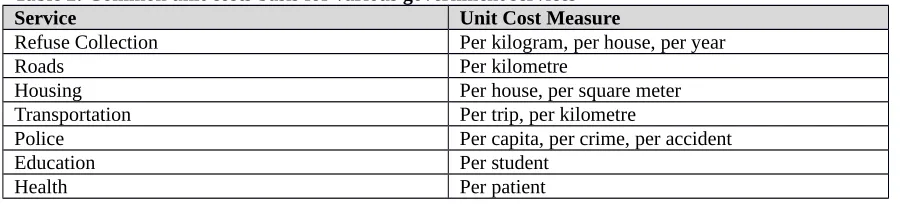
Efficiency Indicators: Unit Cost Indicators:
Cost per vaccination (including delivery) Cost per planning application determined Cost per visa application processed Labor Productivity indicators:
Pension benefit applications processed per staff member Average staff time taken to administer a practical driving test