Governing Indonesia From The Regions
Executive Summary of Indonesia Governance Index 2014
Writers and Editor: Abdul Malik Gismar Lenny Hidayat Inda Loekman
Dadan S. Suharmawijaya Nicolaus Harjanto Hery Sulistio Ahmad Fawaiq S. Arif Nurdiansah
Amalia Fubani Sitanggang Fitrya Ardziyani Nuril Riana Ekawati
Layout dan Design: Zulikar Arief
ISBN: 978-602-1616-29-1
Cetakan Pertama, Oktober 2014 oleh Astana Communication Copyright ©2014
The Partnership for Governance Reform (Kemitraan)
Jl. Wolter Monginsidi No. 3, Kebayoran Baru, Jakarta Selatan 12110 Indonesia
Materi dari publikasi ini dapat diproduksi ulang untuk tujuan non-komersial (silahkan kirim salinan kepada [email protected]). Segala bentuk produksi ulang dengan cara apapun untuk tujuan komersial harus mendapatkan izin dari The Partnership for Governance Reform (Kemitraan).
Published by:
Kemitraan bagi Pembaruan Tata Pemerintahan (The Partnership for Governance Reform)
Jl. Wolter Monginsidi No. 3, Kebayoran Baru Jakarta Selatan 12110 Telp. 021-7279-9566, Fax. 021-7250-260/7204-916
Website: www.kemitraan.or.id; www.kemitraan.or.id/igi
Supported by:
Table of Content
Table of Content...3
List of Graphs, Figures and Photos...3
List of Abbreviations...5
Foreword from the Executive Director...6
Background...8
Public Participation = Government’s Social Capital...9
Analyzing Regional Governance: Benchmarking One Region against Others...10
Unveiling the Regional Governance...10
Seven Recommendations to Govern Indonesia from the Regions...14
1. Evaluation of the Central-Regional Policy Relations...15
2. Maintaining the Balance between Economic Growth and Equal Distribution of Welfare...19
3. Comprehensive Evaluation of the New Autonomous Regions...21
4. Overseeing Performance of the House of Representative/Regional Parliament...23
5. Optimizing E-Government system (in DPRD & Bureaucracy) in the Region...26
6. Budget Synchronization for Welfare...29
7. Strengthening Cooperation between DPRD and the Civil Society...33
Annex I. Average Performance of the Four Regional Actors...37
Annex II. Report on the Performance of 34 Districts/Municipalities...42
Annex III. Score of Gender, Environment and Investment...54
Annex IV. What is Indonesia Governance Index...58
Annex V. List of IGI Indicators for District/City Level...60
List of Graphs, Figures and Photos
List of Graphs Graph 1. Comparison of Average Index...11Graph 2. Length of School Disparity Between Boys and Girls in 34 Districts/Cities 201412 Graph 3.Composition of 2012 Regional Budget (APBD) Realization in 34 districts/cities...16
Graph 4. Ranking of the assessed 34 districts/cities in IGI 2014...17
Graph 5.2011 & 2012 Poor Population vs. 2012 Economic Growth in 34 Districts/Cities...19
Graph 6. IGI 2014 Results in 10 New Autonomous Regions...21
Graph 7. Average Index of Each Arena on 34 Districts/Cities...22
Graph 8. Performance Score of Local Parliament in IGI 2014...24
Graph 9. Budget for poverty alleviation per capita per month in 33 Provinces 2012...30
Graph 11. Budget for Education Per Student Per Month in 34 Districts/Cities...32 Graph 12. Budget for Salary & Beneits of DRPD Members, 34 District/Cities (Million Rupiah)...34
List of Figures
Figure 1. Accessibility of Civil Society’s Work Plan in 34 Districts/Municipalities...27 Figure 2. Accessibility of Bussines Society’s Financial Report in 34 District/
Municipalities...27 Figure 3. Accessibilty of Prolegda in DPRD in 34 Distri cts/Municipalities...28 Figure 4. Accessibilty of Recess Fund of DPRD in 34 Districts/
Municipalities...28
List of Photos
Photo 1. Students riding bicycle to cross the Dutch bridge heritage above the
List of Abbreviations
APBD : Provincial/District Local Budget
DAK : Special Allocation Fund
DAU : General Allocation Fund
DFAT : Department of Foreign Afairs and Trade
DOB : New Autonomous Region
DPR : House of Representatives
DPRD : Council of Regional Representatives EDOB : Evaluation of New Autonomous Region
EKPPD : Performance Evaluation of the Regional Administration
HDI : Human Development Index
IGI : Indonesia Governance Index
IKK : Construction Cost Index
IPM : Human Development Index
Kemendagri : Ministry of Domestic Afair
KPU : The General Elections Commission
KPUD : The Regional General Elections Commission
KRC : Knowledge and Resource Centre
LSM : Non-governmental organization
OMS : Civil Society Organization
PAD : Local Revenues
Parpol : Political Party Pemilu : General Election Pemprov : Provincial Government Pilkada : Regional Election Pilpres : Presidential Election
Prolegda : Regional Legislation Program
PNS : Civil Servant
RI : Republic of Indonesia
SDA : Natural Resources
SDM : Human Resources
Sekwan : Local Parliament Secretariate
SKPD : Local Oice/Agency
SPM : Minimum Service Standard
TTU : North Central Timor
Foreword from the Executive Director
Kemitraan’s mission is to broadly disseminate, promote and institutionalize principles of good and clean governance to government actors, civil society elements, and business community by ensuring the enforcement of human rights, implementation of gender equality, as well as provision of support to marginalized groups and establishment of environmental sustainability.
To achieve this, since its inception at the beginning of Reformasi, Kemitraan has been consistently playing a supervisory role and actively supporting changes and innovations in the transformation of governance in Indonesia. Its national scope, its impartiality and robust network have made Kemitraan an important player in issues related to governance.
Indonesia Governance Index (IGI) is an initiative of Kemitraan which constitutes a tangible contribution to improve governance in Indonesia. IGI was irst initiated in 2007 in an efort to measure the impact of governance reform program in various regions. Assessment at the provincial level in Indonesia has been done both in 2008 and 2012. However, these results have yet represented the complete picture of local governance in Indonesia, as the assessment did not include district level. The decentralization policy and local autonomy applied in Indonesia have positioned districts and municipalities as frontliners in bringing welfare to the people. Considering this huge authority the districts and municipalities bear in managing public services, measuring governance at this level has become an urgent matter.
In an efort to provide a picture that shows the state of governance at district and city level, since the irst semester of 2014, Kemitraan has begun to develop assessment model in 34 districts/municipalities. The indings from this assessment are presented in this executive summary.
I would like to humbly and sincerely express my gratitude to all District Heads/Mayors and all their staf who have helped us in the data collection. I would also thank the team of researchers of IGI and KRC (Knowledge & Resource Center) and our researchers in all research sites who have worked very hard to inalize IGI.
To conclude, it is our hope and wish that the data and information herein presented can provide beneits and reference for us to further improve governance in Indonesia in the future.
Jakarta, October 14, 2014
Wicaksono Sarosa, Ph.D
Background
Decentralization and local autonomy policies which arose pursuant to the 1998 reform have introduced a fundamental change, particularly to the functions and authority of local governments. This policy is expected to bring services closer to the people, while improving the quality. It is expected that local stakeholders will have ample space to intensively participate in the formulation of local policies and regulations.
However, those expectations seem to remain unfulilled. The success rate of decentralization in reality varies from one region to another, depending on the quality of the governance performed by a local government, as well as the capacity of the relevant stakeholders in the respective region. This also afects the level of welfare in the regions, thereby creating relatively wide discrepancy among regions in Indonesia.
Indonesia Governance Index (IGI) was irst initiated by Partnership for Governance Reform (Kemitraan) in 2007, aiming to contribute to the betterment of development governance in this country. IGI helps identify and map aspects of development that need to be put under careful scrutiny. Building a comprehensive governance-related database, IGI helps map key factors determining establishment of social welfare that is well distributed from West to East.
Assessment at the provincial level was conducted by Kemitraan in 2008 and 2012 in all provinces in Indonesia. The indings arising thereof have been used by the government, both at national as well as sub-national level as reference for improvement.
Starting from 2013, Kemitraan started to establish an assessment model for district/city level, recognizing that the true spirit of decentralization is actually embodied within disctricts/municipalities, along with the large authorities they have been mandated with to provide public services.
Applying 125 indicators which consist of 30 public documents, perception-based questionnaires to selected respondents, and researcher’s scoring card on accessibility testing towards various public documents, IGI measures the four arenas’ political oicials, bureaucracy, civil society, and economic society— performance comprehensively. Each arena is assessed against six principles of good governance—participation, fairness, transparency, accountability, eiciency and efectiveness.
Public Participation = Government’s Social Capital
Decentralization has undeniably resulted in the birth of local leaders who have proven to bring development to their own region and to other regions, as well as positioning themselves at top rank quality of governance. Decentralization and democracy can proudly take the credits of having delivered the new generation of state leaders to Indonesia.
Nevertheless, IGI inds that good leaders are not enough, solid parliament and strong civil society are a necessity. Therefore, the success of a region depends very much on how all resources can be managed by the four governance actors who work as one integrated team. Local Parliament makes policies and oversees implementation, while Local Head and its bureaucracies implement the policies. Public, on the other hand, participate and supervise. This is why governance is an integrated issue, not solely attributed to the government.
In reality, IGI Team inds that in the regions, governance was generally perceived as something that existed only within the government domain, not related to public domain. This is due to the perception of the political oicials and bureaucrates that governance issues are their sole “domestic and private afairs” which need to be kept secret, not subject to public disclosure. This inding certainly became a major constraint to the efective implementation of Law on Public Information Disclosure enacted by the national government and acknowledged by local governments.
to say “good news is best news,” instead of “bad news is good news.” With the new landscape of decentralization, all parties should speak on the same page by using their communication on valid information and data. IGI indings revealed the reality of local governance which may have never been disclosed and unraveled before.
Comparative Analysis of Local Governance
IGI 2012 found that provincial governance‘s performance score has improved compare to four years earlier, i.e. in 2008. The average score of 5.1 in 2008 had increased to 5.7 in 2012, showed an increase of 0.6 index point. This shows a general trend that the quality of governance has slightly improved, and this can be as starting point towards something more substantial, i.e. good distribution of welfare.
Using this crucial moment of change, IGI intends to reemphasize each governance stakeholder’s mandates and functions as set forth by laws and regulations. However, in the absence of an assessment tool that can assess comprehensively, it is not easy for both the government and the people to know which functions have been well implemented and which should be reinforced, or where should we start the improvement, as there is no adequate information to conclude. The imbalanced relations between the government and the people that currently prevail reiterate this situation. Relationships which are formed are those transactional, centralized to political elites, closed or even counter productive in nature. With a map, depicting the “anatomy” of the regions, we can identify which point and which actors should be involved when we intend to start implementing changes.
Unveiling the Local Governance
Through 125 indicators, IGI indings in 34 districts/cities shows that in general, governance at this level appeared to be low (with the average score of 4.92, from the scale of 1 to 10). This proves that both government1 and the society2 have not collectively made relection to advance their region3. On the other hand, other elements, such as the Central Government and National Parliament (DPR RI), have
1Government here means all elements of state including elected oicials, i.e. Local Heads and Local Parliaments, and
Bu-reaucracies who implementi policies (SKPD).
2Society consists of civilsociety (i.e. all forms of mass organizations including NGOs, universities, media) and economic
society (business associations).
3Government (DPRD, Regional Head and Bureaucracy) contributed 62% of the governance performance, while the society
also signiicantly contributed to this problem.
Surprisingly, political oice found as the institution actually pulls down the quality of local governance, whether at provincial or district level, mainly the local parliament.
The efect is huge. Local governments have become irresponsive toward the needs of the public, since the oversight and recommending functions (of the local parliaments) are almost non-existence, while their mandate is to ensure suicient budgets can directly reach the public. For example through suicient allocations for basic education, health poverty alleviation at district/city level which can respond to the needs of the people. The absence of efective mechanism of check and balance as the key factor in a democratic system hasled to the poor performance of local governance. This matter should be urgently addressed.
One of the most concerning issues is the widening public service gap. An extreme example is shown in the disparity of length of school between boys and girls in district/ city level. In Sampang, average length of boys’ school is 5 years, while girls only 4 years. On the contrary, the city of Banda Aceh has fully achieved the implementation of 12 years of compulsory education. Similar case also occurs in other sectors througout Indonesia, such as in health, poverty reduction and women empowerment programs.
The above facts have strongly indicated that government and state must be present to ensure that parents are able to put their children to school; people can access good and afordable health services, and women can be properly empowered.
In reality, government often prioritized to build their luxurious oices, vehicles, while bureaucrats are more focusing on how to spend all budget allocation so that they are not punished by budget cuts in the following iscal year. This assumption is based on the ability to spend money rather than quality delivered.
Graph 2. Length of School Disparity Between Boys and Girls in 34 Districts/Cities 2014
Meanwhile, many parliament members seem to be oblivious of what should be their main responsibilities and functions. They prefer travelling to Jakarta, or even overseas to do the so called “comparative study”. Very seldom do they appear among their constituents. This is contradictory to their primary function which is to listen to their people and in return to channel their aspirations. But the question remains, if it is diicult to even meet them, how can constituent be able to have the chance to express their problems to their representatives.
Facing by so many problems in their region, people are often feeling dissatisied. As a result, they express their dissatifaction on street (demonstration). When their demands are not fulilled, they tend to be anarchic which potentially inlicted greater loss to the public. To cool down the situation, oicials usually release a statement and make promises, and by doing so they consider that the problems have been properly addressed. Gradually people forget about their demands because they are simply exhausted and they need to go back to their daily routines.
IGI sees that these cases exist because there are lack of positive interactions and coordinations between government and the people. The four main actors in local governance seem to walk in their own world, having very diferent understanding and level of information. This can be seen, for example, from how voting mechanism is often used to make decisions at the parliament, simply because parliament members tend to see it as the implementation of the the fourth tenet of Pancasila, which says “Democracy lead by the inner wisdom in the unanimity arising out of deliberations amongst representatives” (or in Indonesian: “Kerakyatan Yang Dipimpin oleh Hikmat Kebijaksanaan, Dalam Permusyawaratan dan Perwakilan”). This principle should actually be implemented by optimizing performance and transparency of all members of parliament in serving the people they represent throughout their entire oice term, not only by voting system.
1. Evaluation of the Central-Regional Policy Relations
IGI Findings:
Consequently to decentralization, central government policies signiicantly afect the region’s development capacity. Large number of important afairs which inluence the overall regional performance are highly depend on the national policies. Among the very crucial and urgent issues to evaluate are Law Number 33 of Year 2004 concerning Central-Region Fiscal Transfers4/Budget Transfer (preceded by Law Number 17/2003 regarding State Finance), policy on recruitment of civil servants, mining regulations, and other critical issues. The evaluation of these issues is crucial due to the fact that local fund resources are already tight and could not provide further space to increase their local resources.
The issue of Fiscal transfer is crucial because Local Revenue (PAD) expected to help the development of a region apparently only contribute on average 9-10% of the total APBD5, 90% of which still relies on Central-Region Fiscal Transfer.
The current formula to calculate DAU (General Allocation Fund) is not responsive to the needs of the people as factors taking into account in the formula is merely based on physical capacity of the regions6 without considering regional performance. This tend to make regions to neglect performance improvement and only focusing on increasing the number of civil servants (PNS) to maintain DAU amount. Among the 5 factors, i.e. population, size of area, HDI, economic growth and Construction Price Index (IKK), three factors actually have shown reversed correlations. The higher the HDI and the economic growth are, the lower the DAU will be, and the more populated a region is, more “punishment” in terms of lower DAU will be applied.
As consequence to the above, the only way to maintain the allocation of DAU7 is through recruitment of civil servants. This motivates regions to always recruit and increase the number of their civil servants, without carefully anaylizing workloads, and improving their evaluation and appraisal system. As a result, the increase the number
4 Balance fund is fund transfer from the state budget allocated to the regions to inance the needs of the region in
implementation of decentralization.
5 PAD’s contribution to the budget ranges between 3-18%
6 There are 5 factors in determining formula of DAU and DAK ie population, size of area, HDI, economic growth and
Construc-tion Price Index (IKK). The basic assumpConstruc-tion of the DAU and DAK calculaConstruc-tion formula, agreed upon by all economists Indo-nesia in 2004, is to increase the number of civil servantsthat will increase the market potential in the area. Through market, it enables good investment climate and at the end regions will create incentive to increase local investment and receive revenue (PAD). The ideal benchmark is DKI Jakarta where its local revenue contributed to 70% of the total budget. However seeing , the widening gap, it’s time for DAU formula to be evaluated in accordance with the changing conditions.
of civil servants does not relect the performance of the region. On the other hand, the allocation of development fund depends on the iscal space8.
It was not surprising when IGI found that there were civil servants whose job were only to update and maintain one ile in the Human Resources data while other civil servants who seemed to be responsible for everything. This uneven distribution of workload leads to waste of public money. The necessity to recruit newly employees does not translate into addition of services or goods for the people.
IGI also identiied a rather startling operational spending ratio, as 70% of the piloted districts/cities spent their budget on employees’ expenditures as much as 1-3 times higher to the amount they spent for programs. An analogy would be: to run a program that costs IDR 1,000, human resource expenses of IDR 1,000 to IDR 3,000 are spent. Therefore, it is not surprising to see that funds made available for the delivery of public services are continuously cut of to make room for the evergrowing operational expenditures.
Graph 3. Composition of 2012 Regional Budget (APBD) Realization in 34 districts/cities9
8 Fiscal space is the diference between iscal needs and iscal capacity. One of the indicators to determine iscal needs is the
area coverage or population size. The bigger it is, the higher the allocation will be for balancing funds.
92012 Audited Local Expenditure Reports (APBD Realisasi) and published in December 2013. Some regions, like Gorontalo,
Similar trend also showed in Yogyakarta Province and City even though they are on top of the other 32 provinces10, the city of Yogyakarta spent for their employees twice as much as what they spent for programs. Scorewise, they scored 6.85 out of the maximum 10 for the district/city level. If spending more on operational budget can lead to better performace, Yogyakarta should have gain a higher score than that. This shows that high operational expenses do not guarantee high performance in governance.
Siak is an example of a district which its operational (human resources) expenditures did not exceed 30%. This district was ranked as the ifth best of this local governance index. More importantly, this shows that creativity can promote eiciency. This is an example of a region that can manage itself in such a way that they can control their operational expenses and allocate more funds to promote the region’s welfare.
Graph 4. Ranking of the assessed 34 districts/cities in IGI 2014
Apart from DAU incentives, which can also be provided for regions in the form of Revenue Sharing Fund (DBH) as well as Local Revenue, have triggered the issuance of many mining regulations and other concessions, particularly in regions with rich natural resources. On the other hand, some public services that are still centrally regulated, especially those related to high cost infrastructures, such as energy infrastructure to generate electricity.
Recommendation:
The core of the relations between the national and subnational governments lies in the budgeting policies. To create a condusive atmosphere which can secure good regional governance, evaluation of Law Number 33 of the year 2004 is urgent.
The evaluation can focus on the reviewing of the formula for DAU or DAK, as well as the percentage of distribution of DBH which will signiicantly afect the regional iscal capacity. Governance performance need to be inserted in the formula, accompanied by incentive and punitive schemes based on region’s performance.
The above mentioned policies will afect recruitment practice and human resources management at the regional level. Workload analysis that is conducted on annual basis is required, so that when new civil servants come on board, they will contribute to the improvement of local governance, and not merely function as new customer or market in the region or just to increase population, hence the investors become interested to put in their money. To improve the local human capital is necessary considering that as ten years have passed since the irst application of DAU and DAK formulas, widening gaps remain throughout the regions. This indicates an urgent need to readjust the formula.
On the other hand, the central government policies which relate to natural and energy resources management in the regions, which govern among others mining, marine, and energy activities, are in urgent need for evaluation to fulill the local needs.
2. Maintaining the Balance between Economic Growth and
Equal Distribution of Welfare
IGI Findings:
the balance between economic growth and environment, 42% of the 11 provinces were able to reduce the poverty rate by average of 1.2%.
While the second group of regions which prioritizing economic growth alone (also 11 provinces), only 27% were able to reduce the level of poverty by average of 1 %. For example, Indramayu in West Java indicated that environmental degradation resulted of priority on the economic growth policy was tightly associated with social inequality shown by high income gap ratio (gini ratio = 0.33).
Graph 5. 2011 & 2012 Poor Population vs. 2012 Economic Growth in 34 Districts/Cities
At district/city level, this research pilot is only able to demonstrate that the higher economic growth does not necessarily reduce poverty. In terms of trend, it is indicated by insigniicant correlation between economic growth and poverty rate (r = 0.1).
When the environment and human resource managements are sacriiced, exploitation of natural resources will likely to occur. When a land is sold or cultivated for the beneit of other regions, younger generations tend to leave their village. What is happening now is Indonesia has a deicit of human resources who are willing to become farmers or engage in agricultural sector. Ultimately, this sector is neglected. For example, the regions that have critical land of great size tend to be in the lower rank, such as Bangka Selatan, Timor Tengah Utara, and other regions with similar case.
Recommendation:
Therefore, IGI recommends the government (both central and regional) to balance the economic interest and social equality in policy making, because ultimately social equality actually create greater investment in the long term. The more prosperous the population of a particular region is, the better the supporting conditions for improving the investment.
For regions that are struggling to escape from high-level poverty, boosting the economic sector and sustainable natural resources are absolutely necessary in order to absorb the local workforce. For example, in Indramayu that has poverty rate of 15% with high child and maternal mortality rate, low Human Development Index and an enclave of human traicking, policy on creative and strategic economy touching the region’s potentials should be strongly promoted.
For districts that have potential prosperity, investment should be made in human resource development, infrastructure and technology. Regions, such as Siak, Semarang, Yogyakarta, should be able to move forward to a more strategic policy level by using the social capital that is strong enough to improve the quality of regional development.
3. Comprehensive Evaluation of the New Autonomous Regions (DOB)
IGI Findings:
During 1999-2013, regional expansion was recorded to increase by 220 regions (at the provincial and district/city level), bringing the total number of provinces and districts/ cities throughout Indonesia to 542. Expansion of 102 regions (50%) was an initiative of the House of Representatives, while the rest was upgrading of regional status from administrative to autonomous regions.
Among the 34 samples of regions evaluated by IGI, there are 10 new autonomous regions11. Out of the 10 regions, only two regions had economic growths above the national average, namely Siak and North Lombok District, while the other eight regions
had economic growths below the national average, namely Ternate, Tanjung Jabung Timur, Tanjung Pinang, Pulang Pisau, Seluma, Bangka Selatan, Tangerang Selatan, and Sigi. Most of these regions had been established for more than 10 years, except Sigi and South Tangerang that had only been established for six years. Seluma should also be particularly noted because of its very poor quality and closed governance. The IGI team was not able to make an analysis due to lack of accessibility and availability of data.
Graph 6. IGI 2014 Results in 10 New Autonomous Regions
The latest result of the evaluation of the new autonomous regions was conducted in 2009 by the Ministry of Home Afairs (MoHA). The evaluation results showed that 80% of the new autonomous regions were unable to bring prosperity to their people. MoHA noted that 7% of the new 57 autonomous regions (DOB) evaluated in the period of 2007-2009 obtained relatively poor score. Unfortunately, although the evaluation of these regions showed poor results, the government and the house of representatives were unwilling to reintegrate them to their origin districts/cities as the motivation underlying the establishment of new regions was not to equally distribute the welfare, rather it was for giving out positions, releasing the load of the origin district, and making transactions between regional government and the house of representatives.
Graph 7. Average Index of Each Arena on 34 Districts/Cities
So far the more rigid criteria have been set for local governments. By establishing a new law on Local Government, local governments are expected to make a more thorough preparation for three years, and the establishment of a new autonomous region can be annulled if the new administration does not meet the criteria. Mechanism of punishment is necessary to ensure the efectiveness of public services in the regions.
Recommendation:
Based on the above indings, it can be concluded that regional expansion without proper preparation in terms of human resources and social capital has adversed impacts on people. Interregional disparities are more increasingly widening and public services are inequitable. Therefore, IGI appeals to the government to make evidence-based evaluation on annual basis rather than on a ive-year basis, so the progress can be measured annually. Furthermore, the evaluation results should be accessible by all stakeholders of the relevant regions so that the local people are aware of and understand about the development of their own region.
4. Scrutinize Performance of the House of Representative/
Local Parliament (DPR/DPRD)
IGI Findings:
IGI scores12 for all actors prove that political oice, who is supposedly contribute the most, have the lowest score of performance compare to Regional Head, Bureaucracy and Society.
The main function of political oice is to develop a policy framework by the executive and supervisory function by the House of Representatives. Unfortunately, the national/local parliament has rarely established a strategic and visionary policy, so political reform is what is actually needed. Without political reform, reform of the bureaucracy cannot be accomplished. Current condition shows on the contrary: the competence of bureaucrates is higher than political oicials.
The Region Head which we have so far believed in is apparently not the only key factor of changes, because no matter how good is the quality of the Region Head, s/he is only allowed to lead maximum of 10 years. However there are no regulations that limit the maximum number of times an individual to be re-elected as a member of national/ regional parliaments. Thus it is not suprising if incompetent and corrupt members of national/regional parliament can be re-elected and remain unnoticed by the voters. There have been several cases of mass corruption occurring at the provincial and district/city levels where all members of local parliaments were arrested for corruption, such as Provincial Parliament of Banten and West Papua, and District Parliament of Kutai Kertanegara District (East Kalimantan) and Bolaang Mongondow Timur District (North Sulawesi).
As a result, the working mode of local governments tends to rely on the government’s budgeting cycle and merely answers to the short-term interests (only during the period of holding the power of authority) of political parties. But when their cadres have become members of local parliament, the political parties avoid the responsibilities over their members quality i.e convicted of corruption.
The institution responsible for creating political cadres is political party, because most of the key members of the management board of a political party sit as a legislative
12 IGI shows that the performance of society tend to be better than that of the government. Although in general the scores
member. Conlicts of interest are likely to occur when a legislative member is also a member of political party management board. This condition is seen in almost all levels of legislative institutions.
Graph 8. Performance Score of Local Parliament in IGI 2014
Nevertheless, people rarely demand for accountability of the political parties and none of the institutions in this country can “punish” the political party that has cadres with poor quality.
elections. This shows that there is still a gap in the interactions among institutions, especially in the regions. By scrutinizing the political oicials of local parliament, the society is automatically watching the performance of political parties.
Recommendation:
Scrutinizing political oicials means preventing potential abuse of authority as well as the entry of incompetent cadres in the next election. This change can be promoted by holding one-for-all general elections in all regions, just as we all experienced in the 2014 election, in which all components acted and all functions ran simultaneously.
Therefore, the society should have a reference in voting for and overseeing their representatives. In the context of a democratic society, people holds the sovereignty, but once an individual is elected, the power s/he holds tend to be abused when there is no control at all.
By utilizing assessments that are independent, objective and neutral, the society can provide input, criticism or recommendation that is more comprehensive, thorough and productive. For example, the society can support the creation of an online platform containing the proile of political party cadres.
Overseeing political oicials and one-for-all general elections can reform the political culture and the local society compare to appointing Regional Heads by local parliament. The appointment of Regional Heads must not be in the hand by an allegedly most corrupt institution in this country13. A proposed plan by the current National Parliament to give the authority to the Local Parliament to appoint Regional Heads are too vonishing the Regional Heads without relecting on the Local Parliaments’ performance themselves.
One-for-all local elections will also have an automatic positive impact on the Regional Electoral Commission (KPUD), because until today KPUD rarely keeps the history of the previous elections. It is not a surprise if KPUD produces poor quality of legislative candidates due to poor facilitation process. For example, almost all websites present the election-related regulations but none of them contains the information about the history of KPUD performance until today. For a commission that has a very important mandate, it is unfortunate when the host does not make any documentation at all about the celebration of the people’s democracy happening in their own area.
5. Optimizing E-Government (in DPRD & Bureaucracy) in the Region
IGI Findings:
Four arenas have diferent way of communication and coordination. The governance domain of these four actors is apparently diferent and likely to be in parallel, rarely intersect and are yet synchronized. This resulted in the diferences in development priorities, implementation and public’s expectation. Despite the diferences, there should similar degree of openness which in turn could stimulate interactions among these governance actors. IGI indings show that the annual reports of Regional Heads (LKPJ) never concretely report the progress of targets according to the 5-year development plan (RPJMD).
On the contrary, IGI shows evidence through calculating the correlation between the score of the principles of transparency and the efectiveness of political oicials, which indicated that the more transparent the political oicials, the better their performance are (r = 0.3).
Figure 1. Accessibility to Civil Society’s Work Plan in 34 Districts/Cities
One of the major contributing factors is when the members of DPRD open direct channels with the society. The more DPRD allows public access to their documents and reports, the better the public and their constituents can help them. In other words, when they are not transparent, their performance goes down drastically. The same principle applies to the bureaucracy and its relationship with the public. The inding of IGI shows that the bureaucracy and the (civil and economic) society rarely share their activities or programs.
Concerning the bureaucracy arena, out of 33 provinces and 34 districts/cities, only two provinces (DKI Jakarta and Yogyakarta) have had e-budgeting system. While at district/ city level, only Banda Aceh, City of Yogyakarta, Semarang, Karangsem and Balikpapan have uploaded the summary of local budget (APBD) into the website.
E-budgeting and competent human resources allow the government to run more eiciently and faster. On the other hand, the civil and business societies at districts/cities rarely share information about their inancial reports, programs and institutions that are accessible by the public. In many cases, the civil society also closes their reports as they are bound by the regulations set forth by donors. For the business society, transparency tends to be minimal since they do not feel the need to report to the public and the government.
The Accountability Report of the Regional Heads (LKPJ) only contains percentage of how the budget is spent. For example, 100% of the budget has been achieved, or 200% of the budget has been realized. It does not explain what 100% or 200% means in terms of development results. The report should include the answer of, for example, with the realization of 100% of the budget, how many people are alleviated from poverty? What is the percentage of educational problems that can be solved?, etc. The report should address the issues and needs of the society in a comprehensive manner.
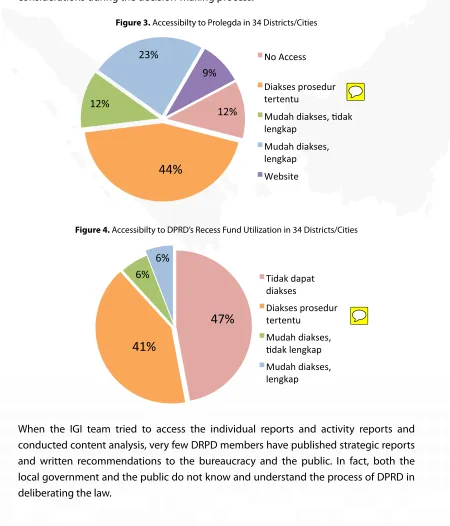
The Secretariat of DPRD tends to be powerless and closed in terms of access to public documents. In all districts, almost none of DPRD Secretariat shares report of any kinds such as ield visit (kunjungan kerja/kunker) or recommendations in a comprehensive manner. There are some copies of Prolegda and several minutes of meetings but they are merely for formality and do not actually show the process of decision-making or considerations during the decision-making process.
Figure 4. Accessibilty to DPRD’s Recess Fund Utilization in 34 Districts/Cities
Figure 3. Accessibilty to Prolegda in 34 Districts/Cities
Recommendations:
IGI recommends the government and the civil society publish their reporting through online system. This will facilitate transparency as reports are opened and uploaded on formal and non formal websites for open access by both.
Therefore, a system which is linked to the payroll system of DPR/D is needed to require reporting on the performance and contributions of individuals and factions to the public. The reports can be prepared by DPRD Secretariat, the Advisory Team or a new unit under DPRD and uploaded to DRPD website and or social media accounts of each member. Incentives could also be given to members of DPR/D who actively upload the report individually and on behalf of the institution.
6. Budget Synchronization for Welfare
IGI Findings:
One of the provincial government’s mandates is to narrow the inter-regional inequality. In terms of social justice, budget allocation for basic services in education and health, poverty and accommodation of women’s rights tend to be minimal.
Photo 2 & 3. Mobile cataract surgery, a car designed to be able to conduct cataract surgery. This car has been moving around the village in the province of Bali, even to the island of Nusa Penida.
For example, in 2012 the West Java provincial government must put special attention to Indramayu which was still far behind compared to other regions on allocation per capita for health and poverty alleviation. The budget allocation was only Rp. 788 per capita/month and Rp. 4,227 per capita/month. This provincial assistance is insuicient to minimize gap of all districts.
When combined with the allocation of the provincial government from the previous year, we found that the budget for the 12-year compulsory education program per child is ranging from Rp300,000 - Rp3,600,000 per year, which means it is Rp20,000 - Rp300,000 per month per child. It is diicult to imagine how to apply equality or even to improve the quality of the curriculum and teachers’ capabilities at districts/cities with that small fund allocation.
Graph 10. Budget for Health per capita per month in 33 Provinces 2012
Graph 11. Budget for Education Per Student Per Month in 34 Districts/Cities
Recommendations:
Therefore, all major items of the budget for SKPD (local oice) should be linked to the substantial analysis via e-monitoring and evaluation of SKPDs. To-date, there has not been any local monitoring and evaluation system conducted in the region that can be accessed even by the head of the relevant region. whereas the quality of governance can be compared by referring to the key indicators (such as in IGI). By doing this, the government or the people can immediately obtain the same information to be taken into account in the decision-making process and public engagement.
Good results in the evaluation not only stimulate the internal improvement in the government but also to provide opportunities for the public to participate in thinking about the progress of each region. Thus, establishing a monitoring and evaluation system not only depends on the sophistication of the tool, technology or complex indicators, but more to whether the information is user friendly, or in other words, how the information enables people of any class to be informed and understand about the condition of their region.
7. Strengthening Cooperation between DPRD and the Civil
Society
IGI Findings:
The absence of the supervisory function causes huge loss for regions. However, the approach of the civil society has only touched the downstream, or new oicials are monitored when they are already elected.
IGI views that this strategy is a short-term strategy. In terms of the budget, of the 34 districts/cities assessed, IGI obtained a range of budget between Rp10 billion – Rp 61 billion allocated to fund the activities of 25-50 members of DPRD per year. It means that on average of each member is given Rp 754 million/year in the form of salary, facilities, beneits and operational costs for the institution. The next question is why there are many demonstrations and protests against the government but never actually able to change the condition. This is caused by the movements of people and media which still tend to be sporadic and carried away by the discourse without synergy.
The most concrete example is the re-elected of corrupt members of DPR and DPRD for 2009-2014 period as members of DPR and DPRD for the subsequent 2014-2019 period. This indicates the absence of performance assessment in parliament members. Becoming DPR and DPRD member is like entering the Bermuda triangle, once entered, they will disappear without a trace.
Currently more than 70 former members of DPR are convicted of corruption, and there are 4 DPRD where all members are allegedly involved in corruption cases, i.e., DPRD of West Papua Province, West Sumatra Province, Bolaang Mongondow Timur District and Kutai Kartanegara District for the 2009-2014 period.
Even worse, 48 who were implicated in corruption cases are re-elected (26 members of District/City DPR, 17 members of Provincial DPR, and 5 will be inagurated as members of the National DPR)14. Based on their legal status, as many as 32 people are suspects of corruption case(s), 15 people have been indicted and one person has been convicted.
Recommendations
While Regional Heads and SKPDs are working, DPRD should carry out strict supervisory function through either a quantitative or longitudinal qualitative research or a community satisfaction survey to monitor the impact of development. They should not merely do a comparative study by visiting other regions that are not relevant to the context of their own region.
This supervisory function can be performed by working with the civil society and the economic society by coordinating the grant from the economic society to assist the supervision.
A concrete example can be seen in what has been done by several Regional Heads such as Head of Siak District who established cooperation with the private sector and NGOs in implementing the development program. However, we have never heard any members of DPR or DPRD establish similar partnerships with universities or community organizations to supervise the development in the region.
DPRD has suicient budget to conduct a comprehensive study or survey that will provide policy recommendations. By using their budget, DPRD can cooperate with universities, media or NGOs to carry out constructive supervision more efectively.
14 Source: Indonesian Corruption Watch (ICW), “ICW: 48 Calon Anggota Legislatif Terpilih Terlibat Korupsi”, 15 September 2014.
ANNEX I
Annex I.
Average Performance of the Four Regional Actors
Performance Proile of Political Oice
Arenas and
Political Oice 3.70 3.80 3.71 2.58 3.38 6.09 3.19
1. Policy
Framework 3.83 3.55 4.92 2.57 4.32 5.70 2.46
2. Budgeting 4.44 4.94 4.22 2.86 5.52 6.91 3.79
3. Supervising 2.48 2.16 2.96 2.49 1.82 4.66 1.59
4. Leadership 4.08 4.76 3.29 2.53 3.21 6.94 6.01
The average score for political oice in 34 districts/cities is the lowest compared to 3 other Arenas. This low score is contributed by the average low scores of each function, which range only from 2.48 – 4.44, in the scale of 1-10. Meanwhile, the average score in this Arena is contributed by 6 governance principles, with the lowest score being attributed to accountability of the oversight function of DPRD (1.82) and the highest to the eiciency function of the leadership of regional head (6.94).
Fairness obtained the lowest score in all political oice’s authorities (between 2.49 and 2.86) in the scale of 1-10. Meanwhile, the highest score is achieved by the eiency of local leadership (6.94). However, because most scores are below 5, this relatively high score cannot increase the general score signiicantly.
Performance Proile of Bureaucracy
Bureaucracy 6.38 2.91 4.29 5.22 5.06 4.96 5.76
1. Public Service 5.13 3.53 4.30 6.51 5.23 4.62 5.15
2. Regional
Income 5.40 2.53 4.04 4.32 5.81 8.73 8.68
3. Regulating
Eco-nomic Activities 3.97 1.82 5.01 1.45 4.90 5.52 5.57
4. Enforcement of
Local Regulation 3.41 2.64 3.67 3.67 4.09 3.08 2.46
Looking at the scores per principle, the lowest is Participation (2.91). This low score was due to the low quality of public complaint handling mechanism provided at all functions in the Arena of Bureaucracy. Meanwhile, the highest score is Efectiveness (5.76). Several performance indicators at outcome level contribute to the high score of efectiveness in this Arena. Some of the outcome indicators applied include among others are economic growth, Human Development Index, gender empowerment and realization of Local Revenue at each district/city.
Performance Proile of Civil Society
Arenas and
Civil Society 5.17 4.53 4.63 6.37 4.87 4.94 6.03
1. Empowerment 5.06 4.76 3.97 7.04 4.54 4.94 5.47
2. Monitoring
and Advocacy 5.30 4.20 5.50 5.61 5.34 4.94 6.81
Quite diferent from most civil society organizations (CSOs) existing at the provincial level and having network that reaches the national level, CSOs at district/city level are limited in nature and only ailiated with important igures of the region. This limitation has led to the lack of transparency in their management, and their accountability is not as good as those at the provincial level. Also, the fact that these CSOs are ailiated with several local key igures have also caused their lack of independence.
Nevertheless, the closeness between CSOs and the local community can explain the high scores given to the principles of fairness and efectiveness. IGI Team indings in several districts shows that most CSOs at the district/city level can respond to the needs of their community. This is shown by IGI indicators which are related to CSO category and issues being addressed by CSO, both community empowerment or monitoring and advocacy. Meanwhile, most Well Informed Person/WIP think that CSOs are adequately efective in doing their empowering and advocating functions at district/city level. However, improvement can be done particularly in the utilization of empirical data to allow implementation of data based advocacy, and network consolidation with CSOs at district, provincial and national level. IGI has proven that the stronger the civil society is in a particular region, the higher the performance of the region will be..
Performance Proile of Economic Society
Arenas and
Community 4.23 4.01 1.12 5.86 5.19 4.60 4.20
1. Protection of Business’ Interest
3.31 1.00 1.16 5.10 5.86 4.04 1.67
2. Economic
empowerment 4.54 4.87 1.11 6.08 4.91 4.84 5.12
ANNEX 2
Annex II.
Performance Proile of 34 Districts/Cities
1. City of Banda Aceh, Aceh Province
Arenas
Oice 5,04 5,82 7,18 3,66 3,25 7,05 2,52
Bureau-cracy 8,26 5,80 8,43 6,24 6,69 5,41 7,04
Civil
Society 6,61 3,73 9,69 6,70 9,74 4,13 5,04
Economic
Society 3,32 3,27 1,00 4,97 3,29 4,31 2,96
2. District of Deli Serdang, North Sumatera Province
Arenas
Oice 3,45 5,36 2,58 1,31 2,74 6,79 1,77
Bureau-cracy 5,47 5,48 1,65 4,92 3,65 4,11 6,64
Civil
Society 4,74 4,35 6,08 1,00 6,62 5,08 5,77
Economic
Society 2,95 3,51 1,00 2,96 4,76 1,78 3,25
3. District of Tanah Datar, West Sumatera Province
Arenas
Oice 3,45 5,36 2,58 1,31 2,74 6,79 2,11
Bureau-cracy 5,47 5,48 1,65 4,92 3,65 4,11 6,50
Civil
Society 4,74 4,35 6,08 1,00 6,62 5,08 5,89
Economic
4. District of Ogan Komering Ulu, South Sumatera Province
Oice 4,72 5,20 2,63 4,53 5,82 6,17 4,65
Bureau-cracy 6,43 2,69 2,80 5,10 5,06 5,52 5,75
Civil
Society 6,01 5,34 4,34 7,43 7,32 5,99 5,97
Economic
Society 4,84 4,23 2,80 5,78 6,03 5,90 4,35
5. District of Siak, Riau Province
Arenas
Oice 5,29 5,27 6,63 3,31 5,17 8,36 3,43
Bureau-cracy 7,27 4,87 6,63 5,57 5,89 6,19 6,02
Civil
Society 5,72 5,17 5,57 7,98 5,26 4,71 5,30
Economic
Society 4,66 4,45 1,50 5,91 5,90 4,95 5,04
6. District of East Tanjung Jabung, Jambi Province
Arenas
Oice 4,10 4,40 2,93 3,47 4,60 6,20 3,22
Bureau-cracy 6,08 1,18 2,11 5,51 6,52 5,00 5,20
Civil
Soci-ety 4,52 4,63 2,38 7,29 2,73 4,63 5,96
Economic
7. District of West Lampung, Lampung Province
Oice 3,69 4,29 4,24 1,85 3,57 5,16 3,75
Bureau-cracy 5,66 1,00 2,74 5,28 5,05 4,01 5,08
Civil
Society 4,60 4,57 2,38 7,12 2,45 5,08 6,95
Economic
Society 4,52 4,40 1,00 5,87 6,63 3,29 5,03
8. District of Tanjungpinang, Riau Island Province
Arenas
Oice 3,54 2,83 2,05 2,20 2,98 8,34 2,28
Bureau-cracy 6,14 2,43 2,12 5,46 5,45 5,83 5,98
Civil
Society 4,89 4,47 3,05 7,45 4,60 4,40 5,51
Economic
Society 3,78 3,62 1,00 5,28 4,96 3,60 3,63
9. District of South Bangka, Bangka Belitung Province
Arenas
Oice 3,37 4,34 2,22 1,57 4,63 4,14 2,86
Bureau-cracy 6,21 2,31 2,50 5,21 5,42 5,78 5,36
Civil
Society 4,87 4,85 3,66 7,43 2,74 5,39 5,73
Economic
10. District of Indramayu, West Java Province
Oice 3,18 4,47 1,98 1,81 2,21 6,98 2,27
Bureau-cracy 6,04 2,31 3,16 4,70 5,78 4,59 5,50
Civil
Society 4,82 4,62 3,80 7,54 2,07 5,54 6,26
Economic
Society 4,54 4,68 1,00 6,53 5,68 3,06 5,09
11. City of Yogyakarta, Yogyakarta Province
Arenas
Oice 4,83 2,77 8,58 1,96 4,53 6,73 4,62
Bureau-cracy 9,08 9,41 9,54 5,54 6,12 6,22 8,28
Civil
Society 7,72 5,92 9,38 7,42 9,48 7,50 7,01
Economic
Society 5,58 6,24 1,00 7,26 6,81 6,05 5,91
12. District of Gunung Kidul, Yogyakarta Province
Arenas
Oice 4,10 2,35 6,51 2,11 3,76 5,72 3,35
Bureau-cracy 8,19 5,01 7,95 4,04 6,46 3,32 6,59
Civil
Society 7,11 4,54 9,33 7,70 8,98 5,54 6,57
Economic
13. City of Semarang, Central Java Province
Oice 5,42 4,89 6,93 2,37 6,65 6,77 5,82
Bureau-cracy 8,11 7,70 8,21 4,75 7,35 5,81 8,21
Civil
Society 6,30 4,98 6,94 7,14 7,05 5,76 6,13
Economic
Society 4,50 4,68 1,00 6,26 5,62 4,48 4,39
14. District of Sampang, East Java Province
Arenas
Oice 2,73 1,41 2,80 1,14 2,22 6,21 1,90
Bureau-cracy 4,95 1,76 2,49 3,22 3,74 4,49 4,99
Civil
Society 4,67 4,27 8,54 1,00 3,73 5,61 5,53
Economic
Society 3,91 4,17 1,00 5,39 4,96 3,26 3,88
15. City of South Tangerang, Banten Province
Arenas
Oice 3,69 5,98 1,15 2,95 3,77 7,04 3,02
Bureau-cracy 6,27 4,19 2,80 3,92 6,74 5,68 5,68
Civil
Society 4,15 3,53 2,74 7,85 2,19 3,50 5,42
Economic
16. District of Karangasem, Bali Province
Oice 4,71 5,31 2,64 4,09 6,31 6,66 5,70
Bureau-cracy 5,59 1,55 3,66 4,49 4,17 3,41 5,26
Civil
Society 4,64 4,35 2,38 6,81 3,79 5,39 6,11
Economic
Society 4,58 4,01 1,00 6,10 5,95 6,51 4,22
17. District of North Lombok, West Nusa Tenggara Province
Arenas
Oice 3,11 1,61 5,99 1,56 1,61 4,70 1,69
Bureau-cracy 7,02 1,00 5,75 6,76 5,04 6,11 4,74
Civil
Society 5,85 4,73 4,03 6,13 8,95 5,99 5,77
Economic
Society 3,96 3,78 1,00 5,85 5,20 1,95 4,56
18. District of North East Timor, East Nusa Tenggara Province
Arenas
Oice 2,94 1,46 3,84 1,82 2,32 6,79 2,60
Bureau-cracy 6,58 2,14 4,23 6,47 4,61 4,72 5,74
Civil
Society 5,48 4,28 2,80 6,23 9,23 4,03 6,31
Economic
19. City of Pontianak, West Kalimantan Province
Oice 2,58 1,77 2,87 1,52 1,53 7,02 1,82
Bureau-cracy 6,78 2,52 6,30 5,43 4,65 5,91 5,56
Civil
Society 5,51 4,64 6,80 4,50 6,05 5,08 6,18
Economic
Society 4,43 3,78 1,00 5,89 4,79 8,09 4,21
20. District of Pulang Pisau, Central Kalimantan Province
Arenas
Oice 2,11 1,41 1,74 1,89 1,32 6,42 2,57
Bureau-cracy 5,49 1,00 3,02 4,97 3,17 4,47 4,77
Civil
Society 4,62 4,42 3,97 6,60 1,99 5,46 6,28
Economic
Society 4,20 3,95 1,00 6,44 5,86 2,27 4,03
21. District of Banjar, South Kalimantan Province
Arenas
Oice 3,48 1,45 2,55 3,34 4,65 6,59 4,66
Bureau-cracy 6,08 1,00 5,45 4,64 4,82 4,88 4,86
Civil
Society 4,28 3,90 2,38 7,17 2,41 3,87 6,50
Economic
22. City of Balikpapan, East Kalimantan Province
Oice 3,32 1,57 3,57 1,73 3,04 7,57 3,07
Bureau-cracy 6,59 1,00 3,99 5,18 4,58 5,72 5,41
Civil
Society 5,74 4,94 4,39 6,19 7,09 5,92 6,58
Economic
Society 4,62 4,73 1,00 6,33 6,38 3,75 4,56
23. City of Tarakan, North Kalimantan Province
Arenas
Oice 4,42 5,90 2,81 4,05 3,79 6,52 3,96
Bureau-cracy 6,04 3,19 2,48 6,17 4,75 6,33 6,05
Civil
Society 4,59 4,22 4,33 7,51 2,07 3,80 5,68
Economic
Society 3,74 3,62 1,00 5,24 4,70 3,03 4,15
24. City of Bitung, North Sulawesi Province
Arenas
Oice 3,95 5,47 3,20 3,07 3,05 6,58 3,20
Bureau-cracy 7,69 4,99 5,15 6,37 8,73 5,56 5,91
Civil
Society 4,80 4,76 3,52 6,98 3,00 4,55 6,35
Economic
25. District of Sigi, Central Sulawesi Province
Oice 3,73 5,20 3,63 2,52 3,95 6,97 4,09
Bureau-cracy 5,14 1,00 2,13 4,35 3,44 4,91 4,70
Civil
Society 4,67 3,90 4,33 5,57 4,19 4,71 5,96
Economic
Society 3,49 3,78 1,00 5,36 4,42 1,74 3,14
26. District of Enrekang, South Sulawesi Province
Arenas
Oice 3,48 3,65 2,05 2,67 4,25 4,48 4,76
Bureau-cracy 5,53 1,00 1,81 5,06 5,25 4,52 4,92
Civil
Society 5,03 4,83 4,33 6,98 3,27 4,78 6,34
Economic
Society 4,88 4,23 1,00 7,24 5,53 6,31 4,86
27. District of Kolaka, South East Sulawesi Province
Arenas
Oice 3,07 2,33 3,10 2,74 3,17 5,58 3,86
Bureau-cracy 5,72 1,55 2,80 4,84 3,61 5,08 6,22
Civil
Society 5,40 4,90 4,03 8,05 4,70 4,93 5,99
Economic
28. District of Mamuju,West Sulawesi Province
Oice 3,24 1,85 3,78 4,04 1,79 4,99 3,54
Bureau-cracy 6,31 4,74 4,15 6,07 5,29 3,99 5,10
Civil
Society 5,18 5,26 4,84 6,35 3,20 5,61 6,29
Economic
Society 4,82 4,51 1,00 6,16 5,23 7,81 5,26
29. District of Gorontalo, Gorontalo Province
Arenas
Oice 3,81 5,39 4,00 2,71 3,59 3,94 3,13
Bureau-cracy 5,53 1,55 4,60 5,57 4,23 4,09 5,75
Civil
Society 3,46 4,55 2,38 1,00 2,08 5,92 6,38
Economic
Society 5,15 4,95 1,00 6,45 6,33 8,57 4,66
30. City of Ambon, Maluku Province
Arenas
Oice 4,00 4,79 4,91 3,36 2,33 6,38 2,38
Bureau-cracy 6,22 4,54 6,14 6,19 2,51 3,43 6,11
Civil
Society 5,35 3,89 4,03 6,90 7,38 4,63 5,59
Economic
31. City of Ternate, North Maluku Province
Oice 3,75 6,38 4,37 2,42 2,25 5,12 2,23
Bureau-cracy 6,29 1,00 6,40 5,41 3,88 3,73 6,11
Civil
Society 5,24 3,73 5,57 7,12 5,36 3,50 6,04
Economic
Society 4,03 3,51 1,00 5,29 4,26 7,94 3,46
32. City of Jayapura, Papua Province
Arenas
Oice 2,56 1,41 1,88 2,34 2,24 5,02 1,76
Bureau-cracy 5,38 1,00 2,60 4,87 3,49 4,28 6,12
Civil
Society 4,10 4,71 2,38 5,13 2,47 4,25 6,04
Economic
Society 3,82 2,95 1,00 5,35 4,23 6,44 3,62
33. District of Manokwari, West Papua Province
Arenas
Oice 2,51 5,03 1,17 2,12 2,59 2,81 2,72
Bureau-cracy 5,05 1,00 1,86 5,02 2,05 4,84 3,94
Civil
Society 4,98 3,52 4,34 7,19 5,97 3,19 5,49
Economic
Society 3,32 2,28 1,00 4,82 3,07 7,37 2,56
ANNEX 3
ANNEX III.
Achievement Scores on Commitment to Gender,
Environment and Investment
III. Ranking of Commitment to Investment
Rata Rata 34
Kab/Kota
ANNEX 4
ANNEX 5
A. List of IGI Indicators for District/City Level
Variety of stakeholders who are involved in the plenary meeting process to formulate local
regulations √
2 P1P2
Variety stakeholders who are involved in public consultation meetings/stakeholders meeting during the process to formulate local regulations.
√
3 P2P1
Variety stakeholders who are involved in public consultation meetings/stakeholders meeting during the process to formulate local Budget regulations at the executive
√
4 P3P1 Public Complaint Handling Mechanism, via online texts, hotline, or website √
5 P3P2
Percentage of local MPs who own outreach channels (social media, website (blog), aspiration house)
√
6 P4P1 Attendance rate of Head of District/Mayor at plenary meetings √
Transparency
7 P1T1 Access to Regional Legislation Documents at DPRD √
8 P1T2 Access to non-budget- local regulations documents and regulations made by Head of District/ Mayor
√
9 P2T1
Access to Regional Development Work Plan (RKPD), Budgeting General Policy (KUA), Financial Note, and Priority and Temporary Budget Ceilings (PPAS)
√
10 P2T2
Access to local regulations documents/Head of Dictrict Regulations regarding Budget Legalization, Revision, and Realization of the District/City
√
11 P2T3 Access to Regional Financial Report (LKPD) √
12 P3T1
Access on the utilization of Aspiration Fund (similar to the US’ Pork Barrel Fund) by members of local parliament
√
13 P3T2
Access to Field Report by members of local parliament, evaluation meetings/Parliamentarian hearings with Local Government Units to oversee the work of DPRD.
No Code Indicator
Access to the results of coordination meetings involving Head of District/Mayor and Head of
Subdistricts and villages √
15 P1F1 Percentage of female representatives at local parliament √
16 P1F2
Number of local regulations and other legal instruments that provide protection for marginalized groups (women, children, people with HIV/AIDS, people with disability)
√
17 P2F1
Budget Allocation for health service per capita (exclude civil servants expenditures), adjusted with construction price index for district/city
√
18 P2F2 Budget Allocation for education per student (exclude civil servants expenditures), adjusted with construction price index for district/city
√
19 P2F3
Budget Allocation for poverty reduction per capita (exclude civil servants expenditures), adjusted with construction expensiveness index for district/city
√
20 P2F4
Budget Allocation for women empowerment per woman (exclude civil servants
expenditures), adjusted with construction price index for district/city.
√
21 P2F5
Budget Allocation for environment and sanitazion per capita (exclude civil servants expenditures), adjusted with construction expensiveness index for district/city
√
22 P3F1
Distribution of Parliament’s Commission work meetings with local government oices (SKPD) (A special form was prepared, documents presented, and IGI’s researchers veriied)
√
23 P3F2 Percentage of female MPs’ representatives in Supervisory Team
(BK, Panwas) √
24 P4F1 Promotion opportunity and recruitment of regional oicials √
Accountability
25 P2A1 Average attendance rate of local MPs in the discussions concerning Local Regulations √
26 P2A2
Percentage of the number of local regulations passed against the set out planned in 2012 Prolegda
√
27 P1A1 Alignment between APBD and KUA/PPAS √
28 P1A2
Ratio of Grant/Subsidies Expenditures and Social Assistance against Goods/Services/
No Code Indicator
Ratio of Amended Local Budget against Finalized Local Budget without changing the
basic assumptions, etc √
30 P3A1
The quality of Activity Report on Work Visits of Parliament Commissions in conducting supervision (non-comparative study)
√
31 P3A2 Percentage of MPs who have submitted their Wealth and Assets Statement
(LHKPN) √
32 P4A1
Fulillment of Targets to Meet Basic Needs as contained in RPJMD against Government’s
annual achievement as stated in LKPJ
(Accountability Report)
√
Prinsip Eisiensi
33 P2I1
Ratio of budget allocated for apparatus (direct and indirect cost) against public expenditures
(goods, services and capital) √
34 P2I2
Percentage of realization of MPs’ business trip expenditures against Total Expenditures Realization of Local Parliament
√
35 P1I1
Average time to inalize drafting of local regulations at local parliament within the previous year
√
36 P1I2 Percentage of Local Parliament Total Budget against District/city’s total budget realization √
37 P1I3
Average time to release Regulation of Head of District/Mayor concerning the implementation of local regulations which have been put into efect.
√
38 P3I1
Percentage of budget for “Absorption of Public Aspirations” against the Total Indirect Expenditure (Work Visit Expenditures and Technical Assistance + operational costs for heads of local parliaments + Expenditures of Absorption of Public Aspirations)
√
39 P4I1 Percentage of Operational Budget for Head of District/Mayor against Local Revenues V
Efectiveness
40 P2E1 Number of Local Regulation Initiatives per year √
41 P2E2
Number of Head of District/Mayor Regulation concerning the implementation of local regulations compared to the number of local regulations passed in 2012
√
No Code Indicator
Ratio of Local Revenue against regional GDRP (Gross Domestic Regional Products) of the
district/city √
44 P1E3 Level of open unemployment at the district/city √
45 P1E4 Poverty level at district/city √
46 P3E1
Ratio of the number of Local Parliament’s Supervisory Activity Report (evaluation meetings /hearings with local government oices) which contain recommendations against total number of Local Parliament’s Supervisory Activity Report (evaluation meetings /hearings with local government oices) within one year.
√
47 P4E1 EKPPD Score √
48 P4E2 Ratio of critical lands against the total coverage Arena (SLHD) √
Bureaucracy
Participation
49 B1P1 Public Complaint Handling Unit for health education, and poverty alleviation sectors. √
50 B1P2 Presence of Health Board, Education Board √
51 B2P1
Public Complaint Handling Unit at Dispenda (Local Revenue Management Oice) of the district/city
√
52 B3P1
Presence of a regular forum involving the district/ citygovernment and the local community to strengthen the investment system, create jobs, and empower people’s economy
√
53 B4P1
Institutionalization of Public Complaint Handling Unit at Oice of Satpol PP/Dinas Tramtib (Local Public Order Enforcement Oice)
√
Transparency
54 B1T1 Access to information regarding HR management in education sector √
55 B1T2
Access to information about costs and procedures to obtain public services (Civil Registration, Education and Health)
√
56 B1T3 Access to SKPD’s inancial documents (RKA SKPD, RKA PPKD, Summary of DPA SKPD & PPKD) √
57 B2T1 Access to Local Potential Revenue √
58 B2T2 Access to detailed actual realization of revenue by district/city at DPKAD √