A panorama of
e-Commerce or
e-business in
Cloud
Computing
Project Report for
MHY 508E
Contents
Contents ...2
Literature Review (about 8-10 pages) ...6
Research Question & Methodology (about one – two pages) ... 15
Abstract
(About 100-150 words)Introduction
Over a decade ago we all take our files and business documents in floppy disk and
then pen drives or flash disk but now a good number of businesses now keep those vitals in
the “cloud”. Cloud here means a set of networked Computing resources that are available for
customers to interact with or modify or collaborate irrespective of the geographical location of
all the parties involved and in real time. The present cloud could be described by its
connection with old or existing computing networks or Internet which includes among more
evolving technological gadgets and basically network computing, grid computing, utility
computing, pervasive computing, and service computing (Lin et al, 2012; Voas & Zhang,
2009)
Cloud Computing provides a type of “electricity grid” paradigm where users or
consumers have access to a variety of computing services for businesses and where the
computing power of computers are of economic benefits. The grid paradigm that is been
followed is like the access to electricity in our homes. We have access to the cloud like “pay
as you go/use” Cloud Computing promises the delivery of IT or IS services just a we need it
and it will reduce the Infrastructure cost particularly for Small and Medium-sized Enterprises
(SMEs).
This high expanding phenomenon and technology from Amazon EC2 and Google’s
Google Compute Engine as some examples of the examples of Cloud Computing services of
Infrastructure as a Service (IaaS) to Microsoft Azure and other examples of Software as a
Service (SaaS) like Microsoft Office 365, Salesforce.com CRM, Gmail, Amazon S3,
DropBox, and Facebook are continuously evolving. One of the promise of Cloud Computing
is to deliver almost in a better way with Application Program Interface (API) on the web all
The emerging Cloud services and its business perspective is increasingly gaining
research works from both the academic world and Business circles but more to it is the
Infrastructure as a Service (IaaS), Software as a Service (SaaS) and Platform as a Service
(PaaS) and other Internet Based Service (IBS). These service models are giving rise to
Business models in the “Cloud” which as whole provides high cost benefits to SMEs and
upcoming e-Commerce businesses (Rajkumar et al., 2009; Marston et al., 2011). With these
facts and issues in mind we do some analysis on the effect on e-business and or e-commerce
emerging firms with the profits involved, threats to survival and opportunities for the future.
1.1
Cloud Computing
–
Definitions
Cloud computing in itself have also undergone a lot of definitions; (JUN and WEI
2011) defined it as a sort of development of Distributed Computing, Parallel Computing, Grid
Computing, which is a super calculating model based on Internet. In a remote data center,
thousands of computers and servers connected to a computer cloud. The definition of cloud
computing is that cloud computing distributes computing tasks into a large number of
resources pools of computer constitute, making different application system according to the
requirements to acquire computing power, storage space and all kinds of software service.
(Vaquero et al. 2009) define it as “a large pool of easily usable and accessible virtualized
resources (such as hardware, development platforms and/or services). These resources can be
dynamically reconfigured to adjust to a variable load (scale), allowing also for an optimum
resource utilization. This pool of resources is typically exploited by a pay-per-use model in
which guarantees are offered by the Infrastructure Provider by means of customized Service
Level Agreements”.
In summary and from reviews of researchers we could quote that Cloud computing has
process so that we have an evolution of everything as a Utility and a utility business model.
This utility business model does have computing capabilities or resources or a general
purpose type technology that employs greatly the tools of web 2.0 and web 3.0 capabilities to
produce application across the Internet for use of several users, firms, SME and corporation in
Literature Review
(about 8-10 pages)2.1
Features and Implication of Cloud Computing on e-commerce and or
e-business
The last 15 years has shown a tremendous increase in both Internet users and
Internet-enabled devices which in turn created the boom of e-commerce and e-business with high-level
of traffic and profit been generated the arrival of Cloud Computing. Cloud Computing is
basically a parallel and distributed computing that are Internet-enable and dynamically
connected real-time to provide all sort of IT services ranging from Software, hardware, Web
2.0 Interfaces, Social Commerce tools that will greatly enhance e-commerce. A simple
example is the Digital versions of all our entertainment Industry contents are already on the
“cloud” as provided as a service by Amazon Web Services.
The basic characteristics of cloud computing are based on existing computing systems
like grid computing, and other online real-time computing that is produces but mostly these
does not include normally Private Clouds. Private Clouds are usually computing
Infrastructure that is available for specifics organization or firms.
2.2
The key advantages of cloud computing for e-commerce
Cloud computing could facilitates e-commerce's Peer-to-peer (P2P) lending. Since the
cloud is available for data resources and analysis from different vendors of providers;
borrowers and lenders could use cloud to do resources analysis even before the final deal is
made. The analysis involves could produce graphs and summary of future results or financial
analysis of the business. Since Cloud computing runs across different domains and platform
then we could have more analysis that will make these types of results to be good and
2.3
The Innovation model for e-commerce over Cloud
Since e-commerce over cloud computing (eCoCC) follows a technology mode or
pattern of M-commerce and Ubiquitous-commerce as shown in (Wu and Hisa 2004), we
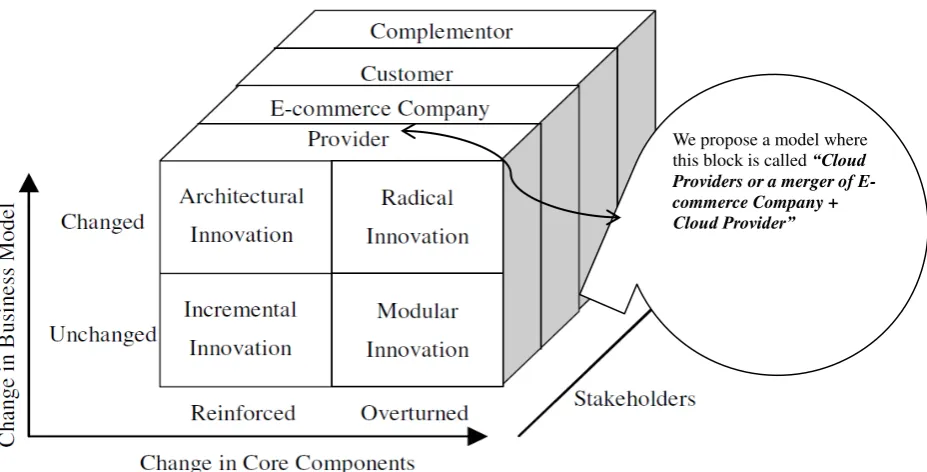
proposed a model where we use the hypercube innovation model as shown in Fig. 1 .
Innovation like cloud computing and emerging enabling technologies will continuously and to
great extent positively have impact on e-commerce. The use of cloud computing not only
increase mobility of users parameters as goods, services but it increases sales like the case of
Amazon. The model evolving from Fig. 1 shows three dimensions with Change in Business
Model, Change in Core Components and Stakeholders. We proposed an upgraded functional
block of Provider as Cloud Providers and or a merger of Provider and E-commerce Company.
Core Components of Cloud for e-commerce like SaaS and PaaS have definite
functions that can be offered to e-commerce applications use and financial forecasting
capabilities. The change in Business model is closely related cloud services components and Fig. 1.The E-commerce over Cloud Computing hypercube innovation model (adapted from Wu and Hisa 2004)
We propose a model where this block is called “Cloud
Providers or a merger of E-commerce Company +
the whole e-commerce business. The changes that have occurred in cloud computing as stated
by (Svantesson and Clarke 2010, Buyya et. al. 2009, Marston et. al. 2011) are of good level in
security, deployment and services that the Innovation is of continual process and this has
generated a good reason for an Innovation model. This Innovation model should not only
possess the capabilities of old commerce but of emerging e-commerce and there are
opportunities that abound like small businesses exploiting high-end applications like ERP
software or business analytics from SaaS that were not available before the advent of this
technology.
2.4
The key architectures for e-commerce over Cloud
Electronic commerce over Cloud Computing(eCoCC) do help in the limitations of
mobile terminals issues with data processing since the users can easily connect to a wide
range of Infrastructure over the Cloud services. The e-commerce operator or user obtains the
computing resource on an on-demand basis and of a high scalability. (Sultan 2011). There
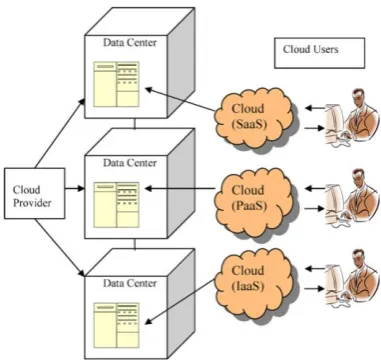
exist in cloud as shown in Fig. 2, a high volume of data storage and processing power and
this is a prove that a parameter measure of ROI in the eCoCC will yield positive result at the
long-run. Nevertheless, numerical analysis needs to be done to show the level or rate of ROI
and so on. The key architecture as noted by (Lackermair 2011) uses Fig 3 and 4 to classify the
e-commerce over cloud computing (eCoCC) as model with respect to an online shopping as
an example where there are specific module of Infrastructure, Platform and Service
2.5
Commercial system for cloud computing
With Google and a number of clouds serving different needs; we could tell of Google
Apps. It is to be noted that this Google Apps is not to be confused with “Google App Engine”
Fig. 3. A high-level system architecture of an online retailer (Lackermair 2011)
which is a Web development environment. But this is a collection of Web-based applications
and file storage that run in a Web browser. The applications include communication tools
(e.g., Gmail, Google Talk, and Google Calendar) and productivity tools (e.g., Google Docs:
text files, spreadsheets, and presentations). Google Apps makes content-sharing simple and
facilitates collaboration and collective generation of knowledge (Sultan, 2011). This tool
could be used in e-commerce not just for collaboration between B2B and also B2C.
Cloud computing is being implemented successfully on a commercial basis and can
easily be used by e-commerce SMEs to make system customization faster and with great
length and time gained. A good example is the Amazon’s Elastic Compute Cloud (EC2) which
can allows e-commerce operators as in B2B or B2C to use Web service interfaces in a virtual
environment with different types of operating systems. These Interfaces could be loaded with
operators' specific applications and then be used to also mange access levels to services or
networks or servers (Marston et. al. 2011).
With the advent of "green" technologies, e-commerce operator will do better to use
Cloud computing by not setting up Infrastructures of different levels. Researchers have quoted
that over 41 percent of IT staffs believe the energy consumptions of back-end servers and
network equipment are high. On this lies the motivation that recycling or the use of cloud will
be of high importance (Marston et. al. 2011, Doong and Ho 2012).
In Fig. 2., a simple representation of the mode that could be used for e-commerce at
different levels of service. As stated earlier, PaaS, SaaS, and IaaS has a huge impact on the
success of the emerging SME e-commerce or e-business to survive with a concise budget. The
Data Center is owned by different vendors or the same vendor of cloud provider in another
see combines different cloud computing services and integrates them into a single service or
application. Amazon's GrepTheWeb is a good example for cloud computing service
compositions within the domain of a single provider (Sultan 2011).
2.6
Cloud Computing as a component of general purpose technology in
e-commerce
As the Mobile has been a Game Changer just as predicted we will have Cloud
Computing to change more the game in e-commerce since the mobility is increase and
enhanced with Cloud computing. As analysts have done their predictions, 2011 was indeed
The Year of Mobile. Not only did mobile sales increase dramatically, with US$6.7 billion in
accelerating online and in-store purchases on the customer’s terms. Mobile has also served as
a catalyst for cross-channel integration. With consumers using mobile Websites and apps in
tandem with other touchpoints, 41 percent of the respondents from online organizations plan
to invest more resources on the front end of mobile user experiences and integrate mobile
with their back-end technology. The success of mobile has not only encouraged organizations
to continue investing in it in 2012 but has also led them to ratchet it up by hiring more
employees with mobile skills and building on existing programs to find new ways to engage
connected consumers. The take-away is that there is a high correlation between mobility and
Cloud computing technology and the success of one is directly proportional to the other. The
use of Cloud technologies will enhance more e-commerce.
2.7
e-commerce over cloud computing
–
a
Strength-Weakness-Opportunity-Threats(SWOT) analysis
Since in an e-commerce over Cloud-based business model, users or operators
will/could pay service/resource providers for consumption of their computing capabilities
similar to the way that basic utilities such as electricity, gas, and water are charged, this is sort
of a win-win or the other way. Then, there exists some level of a market-oriented approach for
managing Cloud resources that is necessary for regulating their supply and demand through
flexible and dynamic pricing. This pricing will engage not only providers or operators but also
to a good extent customers need to get involved so as to produce a more robust structure (Wu
and Wang 2005, Marston et. al. 2011, Doong and Ho 2012).
The concerns and challenges of adopting this new technology may spans from and not
limited as
a) Security issues with respect to users’ or accounting data: Since we have marketing data
companies use to operate the e-business. There is a need to strict rules on the security system
for cloud providers. Thankfully Google, Amazon and Microsoft are taking up the challenge
with respect to this issue
b) Fears of the development stage of the technology
c) Privacy and reliability etc.
Service-centric issues of the cloud architecture need to follow a Internet wide
approach so as to involve the e-commerce system to a great extent. This also gives rises to the
next issue which Quality of Service (QoS), Interoperability and Fault-tolerance of the system.
Basically these determine that ability of e-commerce to be able to finally run without errors
on cloud. Fault Tolerance does show that ability or capability of the system to still produce
good results of computing in the presence of errors and once the fault is detected it is isolated
so that it does not become a system wide issue. As stated by (Hahn et al. 2002), there exist
a need for designing Return- on-Investment (ROI) process for every Cloud Computing
Investment done by e-commerce operators.
This creates a need for a disciplined view of the whole system design since intuition
must not just be used for viewing the outcome of Cloud services usage. So just as the
performance of financial investments can be evaluated, the value of systems design, which is
also a new technology investment, also needs to be measured, assessed and managed via an
ROI system or path. Below are some of the processes for acquiring a full knowledge of ROI:
a) Linking consumer behavior and data in the cloud to business performance will produce some ROI measurement.
b) Cloud computing that is integrated in the Web site evaluation and design.
c) Cloud computing enabled Web servers automatically log all client-server interactions and it can be used to check the number of data interactions.
In conclusion, these report shows simply that as technology moves to take over that is
around us like Internet of Things, it does take over all businesses and e-commerce is
definitely leading and not behind in this case. Furthermore and analytically, the thought of the
customer and respective win-win system must be well analyzed before the evolution of
e-commerce over cloud is fully accepted or roll-out.
The economic behavior in Cloud computing over e-commerce includes pricing
systems and methods and among other issues like boundary and services that need to be given
and at what data rate. The data rate are then given at different Service Level Agreement (SLA)
and using different existing pricing policies like a flat fee, a pay-per-use fee, or a two-tier mix
of flat and pay-per-usage fee, then overall cost is reduced.
E-commerce allows companies to link directly to customers; thereby significantly
reducing transaction, labor, promotion, service and inventory costs. For example, General
Electronic (GE) cut $500–$700 million off its purchasing costs and reduced labor costs by
30% and inventory costs by 5–20% by using the Internet over a threyear period. In
e-commerce, the servicing commissions, advertising revenue, and content subscriptions are the
main profit sources compared with bricks-and-mortar stores. These gives also a more robust
ROI view for emerging e-commerce over cloud as all these processes will be made on the
cloud and firm like GE will more reduce Infrastructure cost and increase performance and
profit in the long-run.
More to the profit to be gained by e-commerce over cloud computing are :
A growing number of tools, technologies, and skill sets, needed, so more job but Human Resources tasks for SME
Reachability to cloud customers on the go and with high mobility.
Good users’ experience seen as the largest opportunity to drive additional revenue.
Research Question & Methodology
(about one – two pages)In the course of the work and research into the work done so far on cloud computing
with e-commerce or e-commerce over cloud computing, there are specifics that need to be
known on this topic so as to have a profitable and viable system. We take on some of them in
this section. Some perspective on this fast evolving Cloud Computing with e-commerce are
but not limited to there are questions that need to be solved so that all parties of e-commerce
and e-business firms will have high benefits and high Return-On-Investment(ROI). The B2B
profit sharing analysis could be another model from the past like EDI or XML, so what will
the new model entails.
• What are the specific profit or cost parameters to measure the ROI and
• What are the basic securities tools that is needed for entering SME to work effectively
and without service disruption? So that they will have sustainability in the new Cloud
Computing with e-business.
• How can we measure ROI effectively
• What are the factors that motivates or otherwise the acceptability of SME in the
e-commerce over cloud computing?
• What are the parameters or tools or system that can be used to encourage or motivate
incoming e-commerce operator or SME to use e-commerce over cloud?
There is need to have a specific guidelines with respect to Service Level
Agreement(SLA) that will work across board for Government, Customers and e-businesses.
Making a constructive case to answer some of these research questions are the only means to
then we will have the full benefits of these technological solutions as “Everything as a Service
(XaaS)”
Fig 6: PROPOSED RESEARCH MODEL FOR eCoCC Actual Use/ACCEPTANCE-
adapted from (Wua and Wanga 2004)
The approach that could be used for the evaluation of the impact of the adoption of
e-commerce over cloud computing is based on macroeconomic theory and macroeconomic data
(Etro 2009a). The methodology to measure the parameters in the research questions ranges
for online surveys and questionnaire for social characteristic like the adoption rate of
e-commerce over cloud by SME or the parameters that motivate the use of e-e-commerce over
cloud. We could use engineering economics to measures the return on Investments (ROI) of
Besides survey and questionnaire, the effect that this innovation has on the cost
structure of the firms investing in e-commerce over Cloud Computing(eCoCC) and
consequently the incentives to create and expand new e-business on macroeconomic
References
BBC News. (2010). Cloud computing for business goes mainstream, 06 May 2010 [Online]. http://www.bbc.co.uk/news/10097450 Accessed 17.03.13.
Buyya, R., Yeo, C. , Venugopal, S., Broberg, J., Brandic, I., Cloud computing and emerging IT platforms: Vision, hype, and reality for delivering computing as the 5th utility, Future Generation Computer Systems, 25, 6, 2009, 599-616.
Doong, S. H., Ho, S., The impact of ICT development on the global digital divide, Electronic Commerce Research and Applications, 11, 5, 2012, 518-533.
Etro, F. The Economic Impact of Cloud Computing on Business Creation, Employment and Output in the E.U., Review of Business and Economics, 54, 2,2009a, 179-208
Hahn, J., Kauffman, R.J., Park, J., Designing for ROI: toward a valudriven discipline for e-commerce systems design, Proceedings of the 35th Annual Hawaii International Conference on System Sciences, 2002. HICSS. 2002, 2663-2672.
JUN, C., WEI, M. Y. The Research of Supply Chain Information Collaboration Based on Cloud Computing. In Proceedings of the 3rd International Conference on Environmental Science and Information Application Technology (ESIAT 2011), 6772, 2011, 292–300.
Lackermair, G. (2011). Hybrid cloud architectures for the online commerce. Procedia Computer Sci-ence, 3, 550-555.
Lin, A., Chen, N. (2012). Cloud computing as an innovation: Percepetion, attitude, and adoption,
International Journal of Information Management, 32, 6, 533-540.
NETWORKWORLD News. (2010). Nonstop cloud computing price war: Amazon, Google both drop rates again , 05 April 2013 [Online]. http://www.networkworld.com/news/2013/040513-cloud-prices-war-268440.html?source=NWWNLE_nlt_daily_am_2013-04-07_testA Accessed 08.04.13.
Marston, S., Li, Z., Bandyopadhyay, S., Zhang, J., Ghalsasi, A., . Cloud computing — The business perspective, Decision Support Systems, 51, 1, 2011, 176-189.
Sim, K., Agent-based Cloud commerce. In Proceedings of the 2009 IEEE International Conference on Industrial Engineering and Engineering Management, 2009, 237–244.
Sultan, N. A., Reaching for the “cloud”: How SMEs can manage, International Journal of Information Management, 31, 3, 2011, 272-278.
Svantesson, D., and Clarke, R. Privacy and consumer risks in cloud computing, Computer Law & Security Review, 26, 4, 2010, 391-397.
Voas, J., & Zhang, J. Cloud computing: New wine or just a new bottle? IT Professional, 11, 2, 2009, 15–17.
Wu, J. H., and Hisa, T. L. Analysis of E-commerce innovation and impact: A hypercube model,
Electronic Commerce Research and Applications, 3, 4, 2004, 389-404.
Wu, J., and Wang, S. What drives mobile commerce? An empirical evaluation of the revised technology acceptance model. International Journal of Information and Management, 42, 5, 2005, 719 - 729.