Final Project Journal | Industrial Engineering Faculty
1
DESIGN AND DEVELOPMENT OF PROGRAMMING LEARNING PLATFORM
BASED ON HEURISTIC APPROACH IN ASSESSMENT MODULE WITH ITERATIVE
AND INCREMENTAL METHOD
1
Dewansyah Adi Saputra,
2Soni Fajar Surya Gumilang,
3Muhammad Azani Hasibuan
1,2,3
Information System Study Program, Industrial Engineering Faculty, Telkom University
1[email protected],
2[email protected],
3[email protected]
Abstract — In general programming learning system there should be a process of measurement. However, acommon measurement process are still many shortcomings and the high level of fraud. So the measurement is not accurate and also there are absence of a continuous learning process. The research aims to develop a platform learning based on heuristic approach focussed on assessment module especially in programming algorithm course. This module used to measure a student's ability more accurately and it will be part of a heuristic based learning process. For this platform development, it will use iterative and incremental methodology. By using the learning platform, lecturer and student can joy experience learn programming algorithm with attractive course.
Abstrak — Pada pembelajaran pemrograman umumnya harus ada yang namanya proses pengukuran. Namun proses pengukuran yang biasa dilakukan masih ada banyak kekurangan dan tingginya tingkat kecurangan sehingga pengukuran tidak akurat dan juga tidak adanya continuous learning process. Pada penelitian ini akan menghadirkan platform berbasis pendekaan heuristic yang fokus pada modul assessment. Modul ini nantinya akan digunakan untuk mengukur kemampuan mahasiswa dengan lebih akurat yang akan menjadi bagian dari proses belajar berbasiskan heuristic. Pada proses pengembangan platform ini, metode yang digunakan adalah metode iterative dan incremental. Dengan menggunakan platform ini dosen dan mahasiswa dapat dengan mudah mempelajari pemrograman.
Index Terms— e-learning, platform learning, assessment, iterative and incremental
I. INTRODUCTION
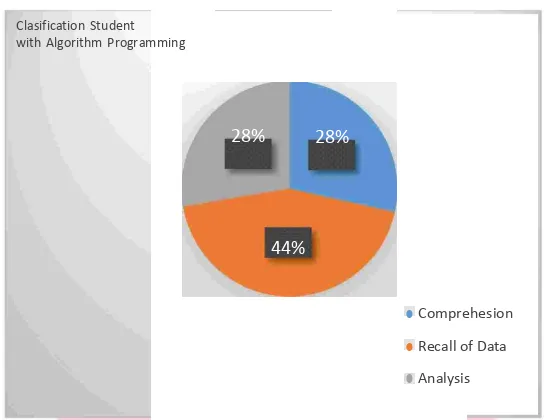
Computer science students are expected to be well familiar on programming skills. (Michael McCracken, 2001). But in fact, Programming algorithm is one skill that is difficult to learned. Some study shows that many of the student can not do a simple programming even they have passed their introductory course. From 216 students in 4 different university, the average of students only get 22.89 of 110 points in that test (Michael McCracken, 2001). In the other survey for 188 students in Telkom University, Information System major. The classification students who take algorithm course is 44 %. Many of student confused to answer the question as shown in Figure 1.
2 Final Project Journal I Industrial Engineering Faculty
Clasification Student with Algorithm Programming
28% 28%
44%
•
Comprehesion•
Recall of Data•
AnalysisFigure I. I Chart of classification student
Ineffective of the current learning system is one of many causes to this issue. In an international survey that takes 500 students and lecturers shows many of student feels that learning by trying it by themselves and doing a course programming is more effective than learning in class (Essi Lahtinen, 2005). This clearly shows that student should try and explore by themselves to learning a programming.
To support the learning system, the assessment mechanism is also the important thing to support the learning system, because this mechanism is the core of the learning system (SR Hamidi, 2013). To assess student ability, usually lecturer gives the practical question of programming in quiz, homework or in practice lab (Kirsti Ala-Mutka, 2004). But in that type assessment, students can't see the result, they don't know about the right answer of the given question. That makes this type of assessment has no learning and improvement services (Hamidreza Mahroeian, 2013). According to Dirk Malzahn, the mechanism of assessment should provide the assessment status, learning and improvement services (Malzahn, 2009). In the lecturer side, the problem is about to get the valid result of the assessment. Because many fraud usually occurred during this common assessment method (Kirsti Ala-Mutka, 2004).
Based on the problem that has been mentioned above, author provide a solution to make a learning platform based on heuristic approach in the assessment module, that can provide the assessment status, learning and improvement services so the lecturers can easily measure the ability of their student and the student also easily evaluate their work.
II. HEURISTIC METHOD AND ASSESSMENT
Heuristic learning method is a method that place the students as the inventor. It could make the students learn more than merely told a lot of things. In heuristic method, students will be placed ad an independent inventor. There are no assistance from the teachers. In this method, teachers will give a problem that will be solved by the students and the teachers will not involved themselves when the students seek for the answer from the problem.
By using heuristic learning method which is based on the important psychological principle of learning by doing, it may help the students to develop their research skills such as habits of neatness and patiently attending to details. Besides that, this method lays stress on individual practical work, careful observations and independent thinking which makes the students more reliant. Since this method lays stress on individual practical work which is pays more attention to skills than on knowledge. In consequence, heuristic learning method could lead to an imparity in learning since this method puts knowledge as secondary consideration.
Since the teachers are not involved when the students solve the problems, the teachers have to give appropriate problems to the students. Moreover, the teachers would be better give the students detailed
3 Final Project Journal | Industrial Engineering Faculty
instructions sheets in order to give the students better understanding. Teachers also have to keep thinking about the age, ability, level of the students and existing facilities.
Assessment is a mechanism that used to quantify the ability of a person. With assessment, someone could know the level of their abilities. There are four types of assessment, formative, summative, adaptive, and diagnostic. Formative assessment is used to give feedback during the learning process. Summative assessment serves to quantify the achievements level, success, and performance of a person in the end of teaching process. Adaptive assessment has changed into progress from assessment themselves. And the last one is diagnostic assessment is the initial step of requirements identification, abilities or readiness of a person.
III. R
ESEARCHM
ETHODOLOGYIterative and incremental method is consists of two words namely: iterative is a step in the cycle of the overall system development and the results can contribute to the project construction scheduling strategy in which part of the system developed is done in time and the level' different. Incremental refers to the growth of the overall project and its results.
1. Inception phase
This phase focuses on the initial creation of applications, publishes business background, draw up a business problem, identify critical risks, define the scope of the project to understand the problem, and make the documents that describe the business problems encountered
2. Elaboration phase.
This phase focuses on the manufacture of high-level analysis and design, publishers basic architecture for projects, making the construction plan that supports the achievement of project objectives.
3. Construction phase
This phase focuses on developing software that is progressive to produce prototype or software products.
4. Transition phase
This phase focuse on the introducing the products to the user, completing beta testing, complete the performance tuning, training for users, and user acceptance testing.
The advantages of iterative and incremental methods are as follows:
Accommodating if there is a change at this stage of development that have been implemented Adjust so that the system can be used during the life of the computer software
Suitable for system development and large-scale software.
Developers and users can more easily understand and react to the risk of each stage because the system continues to work during the process.
Easy to find fault.
The resulting system is more satisfying
A. Functional Requirements
IV. S
YSTEMA
NALYSIS ANDD
ESIGNThese are the 3 main feature of programming learning platform in assessment module :
1. Add assessment question.
Lecturer can add assessment question in course material in this platform.the question divided in three types first is rearrange. In matchmaking, student should arrange the correct anwser to question. The answer is provided like multiple choice. The second is live code, in live code the student should code into the right expected output and compile by the platform itself. Third is rearrange, in this type student should arrange to the correct way to get the right answer.
2. Reporting detail.
Lecturer and Student can able to show reporting result of reporting details. The details is including the progress of the student development such as showing the previous and current ability of student.
3. Assessment review
This feature can make student know where they are going wrong. It shows their answer and the
3
4 Final Project Journal | Industrial Engineering Faculty
Lecture r Question and Answer data
1.Studen 2.Student 3.Question 4.Gra phical
t’s Score ’s Answer and Answer Developmen
t 1.Student’s Scor
2.Review data right answer also their point and their result of that assessment.
B. Core Business Processes
Answer Student
Le cturer Question and Ans we r
Report for all s tude nt Ass essment module system Report
Figure 2 Bussiness Core Process
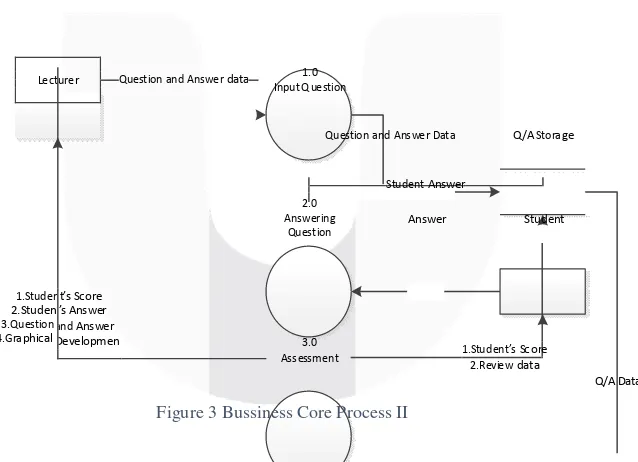
The level 0 DFD only show the core process that running in the system. It shows the process of assessment system.
1.0 Input Q ue stion
Question and Ans we r Data Q/A Stora ge
Student Answer 2.0
Answering Question
Answer Student
3.0
Assessment e
Q/A Data
Figure 3 Bussiness Core Process II
The level 1 DFD reveals more details of every process tht happen inside the assessment system.
C. Application and Technology Architecture
This application is implemented using a client-server system where the Application, MySQL and the java jdk is installed in the server. Applications can be accessed via client computer. Jdk is for compile the live code
4
5 Final Project Journal I Industrial Engineering Faculty
D. Result of Application
The UI of assessment module will be show by the figures below.
Reporting detail on student. By lecturer.
Reporting status Assessment
Student assessment menu
5
6 Final Project Journal I Industrial Engineering Faculty
Student review assessment
Rearrange student assessment
V. IMPLEMENTATION AND TESTING
No Test Expected Result Result Add
Question added to
I Assessment Passed
Question question bank
2 Preview Lecturer can view their Passed Question question
View the
View the student
3 student's
reporting Passed report
Answering Student can answer the
4
the question question
Review of Show the question,
Passed
5
question right answer and Passed student answer
6 Scoring Show score of student Passed
The conclusion for this research is :
VI. CONCLUSION
1. This platform will help the lecturer to measure the ability of their student by seeing the reporting result of the assessment. Lecturer will know what their student answers are and what the right answers are so the lecturer know what their student can do and what they can't do.
2. For student this platform helps their learning process by providing continuous learning and improvement because this platform has review function to help them get through that.
REFERENCES
E.Lahtinen, K.Ala-Mutka, HM.Jarvinen. (2005). A Study of the Difficulties of Novice Programmers.
ACM SIGCSE Bulletin, 14-18.
Dan Turk, R., & Rumpe, B. (2002). Limitations of Agile Software Processes. Third International Conference on Extreme Programming and Flexible Processes in Software Engineering. France ; Germany.
Essi Lahtinen, K. A.-M.-M. (2005). A Study of the Difficulties of Novice Programmers.
6
7 Final Project Journal | Industrial Engineering Faculty
H. J. Lee, et al. (2006). A Strategy to Improve Faculties' LMS Usability in a Blended Learning Environment. SNU Case of Menu Template Development.
Hamidreza Mahroeian, D. M. (2013). An analysis of web-based formative assessment systems used in elearning environment.
Ibrahim Abood Almrashed et. all. (2011). Distance Learning Management System Requirements From Student's Perspective. Journal of Theoretical and Applied Information Technology .
Jenkins, Tony. (2002). On the difficult of learning to program. LTSN-ICS Conference.
Katherine McKeithen, Judith S. Reitman, Henry H. Reuter and Stephen C. Hirtle. (1981). Knowledge Organisation and Skill Differences in Computer Programmers. In In Cognitive Psychology (pp. 307-325).
Kirsti Ala-Mutka, H.-M. J. (2004). Assessment Process for Programming Assignments.
L. Oneto, et al. (2009). Making today’s Learning Management Systems Adaptive. In IWorkshop on Learning Management Systems meet Adaptive Environments Nice. France.
L. Oneto, et al.,. (2009). Making today’s Learning Management Systems. In IWorkshop on Learning Management Systems meet Adaptive Environments Nice. France.
M. mcCracken, V. D.-D. (2001). A multi-national, multi-institutional study of assessment of programming. ACM SIGCSE Bulletin, 125-180.
Malzahn, D. (2009). Assessing - learning - improving,an integrated approach for self assessment and process improvement systems.
Mayer, R. E. (n.d.). A psychology of how novices. In In Computing Surveys (pp. 121-141). Michael McCracken, V. A. (2001). A multi-national, multi-institutional study of assessment of
programming skills of first-year CS students.
Pea, R. (1986). Language independent conceptual bugs in novice programming. In In Educational Computing (pp. 25-36).
Phit-Huan Tan, Choo-Yee Ting, Siew-Woei Ling. (2009). Learning Difficulties in Programming Courses: Undergraduates’ Perspective and Perception. IEEE.
R. Gil, et al.,. (2009). S-Learning: New Web Services in E-Learning . IEEE.
R. Hamidi. (2013). Exploratory Study of Assessment in Teaching and Learning. IEEE. R.S., W. (2005). In Pengantar E-learning dan Pengembangannya.
Schwaber, K. (n.d.). SCRUM Development Process. In Advanced Development Methods. Burlington. Sheung-On Choy, Sin-Chun Ng. (2004). An interactive learning environment for teaching and learning of
computer. IEEE.
Spohrer, J., & Soloway, E. (1986). Novice mistakes: Are the folk wisdoms correct? . Communications of the ACM, 624-632.
SR Hamidi, Z. S. (2013). Exploratory Study of Assessment in Teaching and Learning.