NOx STORAGE IN Pt/
γ
-Al
2O
3CATALYST
Arif Hidayat
Chemical Engineering Department, Faculty of Industrial Engineering University of Islam Indonesia, Yogyakarta
E-mail: [email protected]
Abstract
The effect of key parameters on the characteristics of Pt/γ-Al2O3 catalyst was systematically investigated.
Model Pt/γ-Al2O3 catalysts were prepared and evaluated with respect to NOx storage capacity using
transient flow reactor studies. The objective of the work was to study the amount of storage of NOx during lean phase (oxygen excess). The influence of temperature on NOx storage capacity was studied. Significant
amounts of NOx were found to be stored in the Pt/γ-Al2O3 catalysts. For these catalysts the following
observations were made: (1) On both of catalysts, the Pt/Al catalysts store a large amount of NOx and the
optimum storage temperature occurs at 200oC; (2) the Pt/Al-2 catalyst possesses the highest storage
capacity of the examined catalysts; (3) around this temperature no significant differences between NO and
NO2 on NOx storage capacity could be observed; (3) a slow increase in stored NOx could be observed with
increasing oxygen concentration during the lean phase.
Keywords: NOx storage, Pt/γ-Al2O3 catalyst
INTRODUCTION
Increasing awareness of the need to reduce emissions of carbon dioxide into the atmosphere has led to great pressureon automobile manufacturers to reduce the fuel consumption of their products. One way to improve the fuel economy of gasoline-fueled cars is to use engines that operate at lean conditions, rather than at the normal stoichiometric air/fuel ratios. Depending on driving conditions a lean-burn engine can decrease fuel consumption by up to 30% compared with a stoichiometric engine (1).
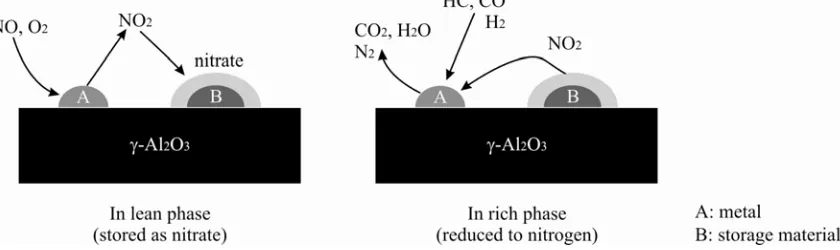
When the exhaust contains a mixture of oxygen and the pollutants hydrocarbons, carbon monoxide, and nitrogen oxides, close to stoichiometric conditions, as is the case for most gasoline-fueled cars today, the pollutants can be almost completely transformed to carbon dioxide, water, and dinitrogen in a three-way catalyst. However, the exhaust from a lean-burn engine contains a large surplus of oxygen which prevents the reduction of nitrogen oxides. This requires the development of new catalytic techniques for reduction of lean-burn engine NOx emissions. Different catalytic systems have been developed for continuous reduction of NOx under lean conditions using specific combinations of reducing agents and catalyst compositions (2–4). A different concept to solve this problem is the NOx storage catalyst (5–7). This catalyst is used in an engine that operates alternatively under lean or rich conditions. During lean operation, the nitrogen oxides in the exhaust are stored in the catalyst. As the NOx storage capacity of the catalyst becomes saturated it is necessary to regenerate the catalyst by turning the engine to rich conditions for a short period whereupon the stored NOx is released and subsequently reduced over noble metal sites. The principle of this methodology is schematically shown in Fig. 1.
Figure 1. The NOx storage and reduction mechanism.
stored NOx in the form of nitrates from IR studies. It was also concluded that the reduction of NOx to N2 during rich conditions takes place on noble metal sites. Bogner et al. (7) investigated the NOx conversion properties of a NOx storage catalyst using bothsynthetic gas mixtures and engine exhaust. They concludedthat their catalyst stores NOx as a surface metal nitrate and that the catalyst becomes fully regenerated under rich conditions.
A model NOx storage catalyst washcoat comprises three essential parts: (i) a high-surface-area substrate material, (ii) noble metals that catalyze oxidation and reduction reactions, and (iii) a NOx storage component. The substrate is normally γ-alumina with a surface area of typically 200 m2/g. The noble metal loading usually includes both platinum for oxidation reactions and rhodium to increase reduction reaction rates. Several metal oxides (mainly alkaline earth metal oxides) have proven effective in forming nitrates with NO2, which decompose at high temperatures (8). This usually produces NO and O2. If these nitrates can
be made to decompose at 300–600oC, the metal oxides may be used for reversible storage of NOx. Examples of such metals are barium and strontium.
The reaction sequence in the NOx storage/release cycle has been discussed in other publications (7, 9). It is generally assumed that oxidation of NO to NO2 is a necessary initial step before NOx storage can
take place during lean conditions. Assuming BaO to be the storing component, the storage would then take place by, e.g.,
NO2(g) + BaO ↔ NO2 – BaO
However, this simple step already includes several uncertainties and, further, may be the sum of several elementary reaction steps. It may be possible to achieve storage directly with NO rather than NO2,
although NO2 is the more likely candidate. Inclusion of atomic oxygen on the left side of reaction [1] is
needed for mass balance reasons but has not been proven experimentally. This would mean a further involvement of Pt as a provider of atomic oxygen. The nature of the barium complex is in reaction [1] assumed to be BaO, though other barium compounds such as hydroxides and carbonates may be present depending on temperature and gas composition. Finally, the nature of the stored NOx–barium complex is not well known. Takahashi et al. (6) report it to be in the form described in reaction [1].
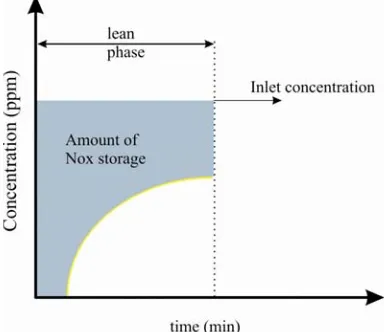
Figure 2. The Storage of NOx at Lean Phase (Oxygen Excess)
The decomposition of the stored NOx during the rich period can be assumed to be the reverse of reaction [1] so that NO2 and NO are released and subsequently reduced over noble metal (essentially Rh)
sites by the reducing agent. Following this assumption, the kinetics of the storage and decomposition will essentially be determined by the rates of reaction [1] and the reverse reaction for the varying conditions (gas composition and temperature).
The objective of this study is to investigate the influence of temperatures on the NOx storage at two different catalysts. We have therefore used model samples containing alumina as substrate and platinum as noble metals. We used a simplified synthetic exhaust gas normally containing oxygen, and nitrogen oxides together with an inert carrier gas. Flow reactor studies were performed under various conditions, normally with the transients experiments.
EXPERIMENTAL SECTION Sample preparation
in Table 1. The preparation method used in the work is described in detail in [9]. Briefly, the catalysts were prepared by impregnating cordierite(2MgO.2Al2O3.5SiO2) monoliths with an alumina slurry containing γ
-Al2O3. The monoliths were immersed in the slurry and the excess liquid was removed by gently blowing air
through the monolith. Thereafter the monoliths were dried in air at 95oC and then calcined in air at 500oC for 2 min. This procedure was repeated until the right amount of alumina or silica was applied. The samples were then calcined in air at 600oC for 2 h. Platinum was added to the catalysts by incipient wetness impregnation. This is done by filling the monolith channels with an aqueous Pt solution and letting the sample dry in air at 80oC for 12 h. After that the sample was calcined in air at 550oC for 2 h. The catalysts with alumina were provided with an aqueous solution of Pt(NO3)2.
Catalyst characterization
The specific surface areas of the samples, determined by nitrogen adsorption at 77 K according to the BET method, are presented in Table 1. The instrument used for this purpose was a Micromeritics ASAP 2010. The N2O dissociation method was performed, in a reactor equipped with a mass spectrometer (Balzer
QME 125), to estimate the Pt dispersion of the catalysts [13]. The Pt dispersions of all samples are presented in Table 1.
Table I. Sample washcoat compositions, BET surface area and platinum dispersion
Sample Washcoat (mg) wt% Pt (%) BET (m2/gwashcoat) Pt dispersion (%)
This study was accomplished by means of the transient of NOx storage. The experiments were performed in a flow reactor consisting of a horizontal quartz tube where the catalyst is placed. All gases except H2O were introduced into the reactor via several mass flow controllers (MFC). The total flow rate was
3500 ml/min in all experiments, which corresponds to a space velocity of 20.210 h-1. Argon was used as the carrier gas in all of the measurements. Two thermocouples connected to a Eurotherm instrument were used to measure and control the temperature. One thermocouple was placed about 10 mm in front of the catalyst and the other was placed inside the catalyst 10 mm from the rear end. An insulated heating wire was used to heat the reactor. The outlet gases are analyzed by a chemiluminiscence NOx detector (CLD 700) and by a gas FTIR (Bio-Rad FTS 3000 Excalibur Spectrometer with a Specac Sirocco series heatable gas cell, P/N 24102, with a 2 m path length and a volume of 0.19 l). The transient NOx storage were performed at 200oC, 300oC and 400oC. The composition of the lean gas mixture was 300 ppm NO and 8% O2 and the rich gas mixture
contained 300 ppm NO and different concentrations of H2.
Results and discussion
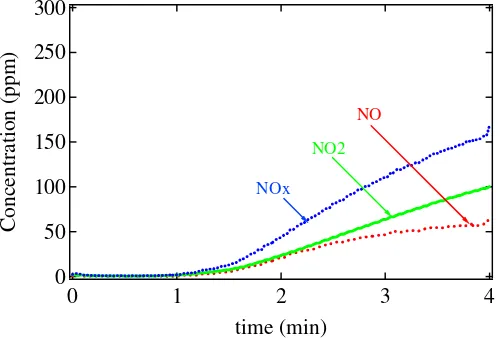
The NO, NO2, and NOx (NO + NO2) outlet concentrations during storage of NOx over Pt/Al-1
catalyst at 200oC are shown in Figure 2. The data were collected during lean phase (t= 4 minutes). NO was measured with chemiluminescence, and NO2 were measured with in situ FTIR. The gas composition of the 4
min lean period was 300 ppm NO, 8% O2, and Ar.
In the figure it can be observed that the NOx signal is zero during the first minute of the lean period. This means that all NOx that enters the catalyst during this period is trapped. After the complete capture of NOx a slow increase of the concentration during the lean period can be observed, which implies that the NOx storage capability decreases due to saturation of the storage sites. During the lean period it can also be seen that NO is oxidized to NO2 on Pt.
In this work, two different catalysts which were prepared by different γ-Al2O3 slurry were studied.
The storage of NOx has been investigated in a wide temperature range for each catalyst, extending from 200 to 400oC. The measured NOx outlet concentrations for each catalyst are shown in Figure 3 and 4.
300
Figure 4. Storage of NOx over Pt/Al-1 catalyst at different temperature
300
Figure 5. Storage of NOx over Pt/Al-2 catalyst at different temperature
From figure 3 and 4, it can be observed that a small amount of NOx can be storage at 400oC which is manifested by the rapid increase of the NO and NO2 outlet concentrations. The best amount of NOx
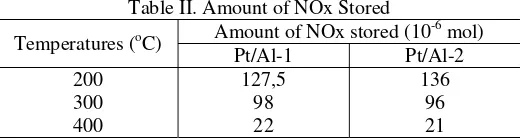
storage was found at 200oC. Both of Pt/Al-1 and Pt/Al-2 catalysts shows a long period of total uptake of NOx compared with another temperatur. A long period of total uptake of NOx indicates a large NOx storage capacity. The amount of stored NOx (in μmol/gwashcoat) for the Pt/Al-1 and Pt/Al-2 catalysts at different
temperatures can be seen at Table 2.
Table II. Amount of NOx Stored
Amount of NOx stored (10-6 mol)
From Table 2 it can observed that both of the Pt/γ-Al2O3catalysts has a significant amount of NOx
temperatures. Several other studies have shown a significant storage on the alumina support [10–12]. Dawody et al. [13] studied the surface morphology of Pt/Ba/Al samples and showed that barium does not cover the entire alumina surface, instead there is a variation in the barium distribution. In addition, since the Pt/Al catalysts store a significant amount of NOx at 200oC and 300oC, it can be assumed that alumina contributes to the overall NOx storage capacity.
CONCLUSIONS
In this study we have compared two different catalysts, Pt/Al-1 and Pt/Al-2 type of NOx storage catalysts. This investigation has shown that:
1. A complete uptake of NOx over the Pt/γ-Al2O3 catalyst is observed during the initial storage period.
2. Measurements on the Pt/γ-Al2O3 catalyst show a significant NOx storage on alumina with the best
storage performance occurring at 200oC.
3. The Pt/Al-2 sample has the best storage capacity of the catalysts examined.
4. The NOx storage capacity of the Pt/Al and the Pt/Ba/Al catalysts decreases with increasing temperature.
REFERENCES
[1]. Heck, R. M., and Farrauto, R. J., 1995.Catalytic Air Pollution Control, Van Nostrand Reinhold, New York
[2]. Shelef, M., , 1995, Selective Catalytic Reduction of NO, with N-Free Reductants, Chemical Reviews, 95, 209-225.
[3]. R. Burch and P. J. Millington, 1995, Selective Reduction of Nitrogen Oxides by Hydrocarbons under
Lean-Burn Conditions using Supported Platinum Group Metal Catalysts, Catalysis Today, Volume
26, Issue 2, Pages 185-206.
[4]. Iwamoto, M., and Hamada, H., 1991, Removal of Nitrogen Monoxide from Exhaust Gases through
Novel Catalytic Processes, Catalysis today, 10, 57-71.
[5]. Miyoshi, N., Matsumoto, S., Katoh, K., Tanaka, T., Harada, J., Takahashi, N., Yokota, K., Sugiura, M., and Kasahara, K., 1995, Development of New Concept Three-Way Catalyst for Automotive
Lean-Burn Engines, SAE Technical Paper Series, No. 950809.
[6]. Takahashi,N., Shinjoh, H., Iijima,T., Suzuki,T.,Yamazaki, K.,Yokota, K., Suzuki, H., Miyoshi, N., Matsumoto, S., Tanizawa, T., Tanaka, T., Tateishi S., and Kasahara, K., 1996, The New Concept
3-Way Catalyst for Automotive Lean-Burn Engine: NOx Storage and Reduction Catalyst, Catalysis
Today, Volume 27, Issues 1-2, Pages 63-69.
[7]. Bogner,W., Kramer, M., Krutzsch, B., Pischinger, S., Voigtlander, D., Wenninger, G.,Wirbeleit, F., Brogan, M. S., Brisley, R. J., and Webster, D. E., 1995, Removal of Nitrogen Oxides from The
Exhaust of a Lean-Tune Gasoline Engine, Applied Catalysis B: Environmental, Volume 7, Issues
1-2, Pages 153-171.
[8]. Machida, M., Yasuoka, K., Eguchi, K., and Arai, H., 1990, NO Removal by Absorption into
BaO-CuO Binary Oxides, Journal of the Chemical Society, Chemical Communications, 1165 – 1166.
[9]. Fridell, E., Skoglundh, M., Johansson, S., Westerberg, B., Torncrona, A., and Smedler, G., 1998,
Investigations of NOx storage catalysts, Studies in surface science and catalysis, 116, 537-548.
[10]. Cantand, N. W., and Patterson, M. J., 2002, The Storage of Nitrogen Oxides on Alumina-Supported
Barium Oxide, Catalysis Today, Volume 73, Issues 3-4, Pages 271-278.
[11]. Anderson, J. A., Bachiller-Baeza, B., and Fernández-García, M., 2003, Role of Pt in Pt/Ba/Al2O3
NOx Storage and Reduction Traps, Physical Chemistry Chemical Physics., 5, 4418 – 4427.
[12]. Prinetto, F., Ghiotti, G., Nova, I., Lietti, L., Tronconi, E., and P. Forzatti, 2001, FT-IR and TPD
Investigation of the NOx Storage Properties of BaO/Al2O3 and Pt-BaO/Al2O3 Catalysts, The Journal
of Physical Chemistry B, 105, 51, 12732 -12745,.
[13]. Dawody, J., Eurenius, L., Abdulhamid, H., Skoglundh, M., Olsson, E., and Fridell, E., Platinum
Dispersion Measurements for Pt/BaO/Al2O3, NOx Storage Catalysts, Applied Catalysis A: General,
Volume 296, Issue 2, 12 December 2005, Pages 157-168.
[14]. Skoglundh, M., Johansson, H., Lowendahl, L., Jansson, K., Dahl, L., and Hirschauer, B., 1996,
Cobalt-Promoted Palladium as A Three-Way Catalyst, Applied Catalysis B, Environmental,