© 2017 AJAST All rights reserved. www.ajast.net
Filler Material Reinforced with Natural Fiber of Mechanical Properties and
Microstructure Analysis for Preparing Perfect Fiber
D.Ramesh Kumar
1and P.Mohanraj
21
Assistant Professor, Department of Mechanical Engineering, Adithya Institute of Technology, India. E-mail: [email protected] 2Assistant Professor, Department of Mechanical Engineering, Adithya Institute of Technology, India. E-mail: [email protected]
Article Received: 23 February 2017 Article Accepted: 06 March 2017 Article Published: 11 March 2017
1.INTRODUCTION
1.1 Green composites
With increasing numbers of applications and mass volume uses, in particular, recording double-digit growth worldwide, disposal of composites after their intended life is already becoming critical, as well as expensive. Because composites are made using two dissimilar materials, they cannot be easily recycled or reused. Most composites end up in landfills, while some are incinerated after use, although there are some efforts to recycle and/or reuse them. Both these disposal alternatives are expensive and wasteful, and may contribute to pollution. In addition, landfills are decreasing in number, making less space available to discard waste. Many applications, e.g. secondary and tertiary structures and those used in consumer products for casing, packaging, etc., do not require the high mechanical properties that advanced composites possess. Since many of the fibers and resins are made using non-degradable, mostly petroleum based materials, once discarded they do not degrade for several decades under normal environmental conditions. This exacerbates the existing ecological and environmental problems.
With concern to the industrial applications, several paths have been undertaken. In short, it can be stated that the most used natural organic filler is wood (either flour or fibers), especially as low cost filler for polyolefins. Wood flour is usually obtained from sawmill waste after a simple sieving treatment; wood fibers are produced from sawmill waste by a wet thermo mechanical process. Already explored industrial applications include window and door frames, furniture, railroad sleepers, automotive panels and upholstery, gardening items, packaging, shelves and in general those applications which do not require very high mechanical resistance but, instead, low purchasing and maintenance costs. Furthermore, it is possible and convenient to use recycled polymers in place of virgin ones, thus assuring improved cost-efficiency and eco-sustainability. Some examples of industrial applications can be easily found on the technical literature and on the Internet; these include, for instance, indoor furniture panels, footboards and platforms, automotive panels and upholstery, noise insulating panels, etc., mainly produced by American, German, Japanese, British and Italian firms.
The mechanical properties of composite materials are known to depend on (i) the type of fiber used, and especially its morphological characteristics (aspect ratio), (ii) the filler content, (iii) the dispersion and orientation of fibers within the polymer matrix, and (iv) the adhesion at the interface between the polymer matrix and fibers, since a good adhesion ensures a good stress transfer from the matrix to the filler. As well described in literature (Bennick, 2002; Papadopoulou and Frazier, 2004; Sarni-Manchado et al., 1999), polyphenol/protein interactions led to expect a good affinity between wheat gluten and lignocellulosic fibers due to the presence of lignin, which is a polyphenolic compound, on the surface of fibers. In this context, Kunanopparat et al. (2008a) studied the effect of
A B S T R A C T
In present scenario natural fibers have received much attention because of their light weight, nonabrasive, combustible, nontoxic, low cost and biodegradable properties. Among the various natural fibers, banana fiber was focused for its pretreatment conditions for preparing perfect fiber. In previously many researchers have found various fibers have been pretreated and they obtain its properties and its applications. In this project banana fiber has been taken as natural fiber and it was pretreated and its properties after pretreatment were obtained. The pretreatment was alkali, sodium hydroxide, potassium permanganate treatment, and bleaching was carried out. Then the composite specimen boards were fabricated by various pretreatment banana fiber, polyethylene and matrix. It undergone to mechanical testing, tensile test, hardness test and also SEM analysis was carried out to check their microstructure. The perfect fiber was found by the obtained results from their properties and bonding nature.
© 2017 AJAST All rights reserved. www.ajast.net
Fiber processing technology like microbial deterioration and system explosion plays an important role in improving the quality of fibers.
The condition reached thereby are decisive for the energy necessary for delignification and fibrillation and thus also for the attainable fiber masses.
To obtain a value gain, the more important is to retain the super molecular structure of the fibers. The traditional microbial deterioration process is one of the most important prerequisite. In new steam explosion method, steam and additives under pressure and with increased temperature, penetrate the space between fibers of the bundle, because of which the middle lamella and the fibers adherent substances are element aroused softly and are made water soluble which can be removed by subsequent washing and rinsing.
SELECTION OF SUITABLE FIBER & FILLER
SELECTION OF SUITABLE RESIN
PRETREATMENT FOR FIBER & FILLERS IN VARIOUS PRETREATMENT CONDITIONS
GENERATE MIXING RATIO FOR FIBER, FILLERS & RESIN, PARTICAL BOARD PREPARATION
STUDY OF FIBER MATERIAL AVAILABILITY IN AND AROUND TAMILNADU
MECHANICAL TESTING - TENSILE TEST, HARDNESS TEST, SEM ANALYSIS
Result and Discussion
© 2017 AJAST All rights reserved. www.ajast.net conventional panel type composites where lingo cellulosics serve as the main ingredient organic building material including natural binders such as lignin and tannins e.g., particle boards, fiber boards and insulation boards; lingo cellulosics- mineral composites based upon inorganic building materials; natural fiber reinforced polymers in which the lingo cellulosics serve as reinforcing fillers within matrix materials such as thermoplastics, thermosets and rubbers and nonwoven textile type composites.
3.1.2 Pretreatment Used For Banana Fiber
a) Alkali treatment
The banana fiber was extracted by an extractor that was varied region to region. The trunk of the banana tree was cut from the tree and it was cut for our necessary length. Then it was send into the extractor inlet and we can get the fiber from the outlet.
3.2.2 Rice Husks
The rice husks is a waste material also it is a Biodegradable material, so it can be decomposed easily. It can be obtained very abundantly in Tamilnadu especially in Thanjavur.
3.2.3 Polyethylene
Polyethylene is obtained by the polymerization of ethylene. Polyethylene is a rigid, waxy, white, translucent, non-polar material exhibiting considerable chemical resistance to strong acids, alkalies and salt solutions at room temperature. It is a good insulator of electricity. Polyethylene is the most common plastic. The annual production is approximately 80 million metric tons. Its primary use is in packaging (plastic bag, plastic films, geomembranes, containers including bottles, etc.). Many kinds of polyethylene are known, with most having the chemical formula (C2H4)nH2. Thus PE is usually a mixture of similar organic compounds that differ in terms of the value of
© 2017 AJAST All rights reserved. www.ajast.net Most LDPE, MDPE and HDPE grades have excellent chemical resistance, meaning that it is not attacked by strong acids or strong bases. It is also resistant to gentle oxidants and reducing agents. Polyethylene burns slowly with a blue flame having a yellow tip and gives off an odour of paraffin. The material continues burning on removal of the flame source and produces a drip. Crystalline samples do not dissolve at room temperature. Polyethylene (other than cross-linked polyethylene) usually can be dissolved at elevated temperatures in aromatic hydrocarbons such as toluene orxylene, or in chlorinated solvents such as trichloroethane or trichlorobenzene.
3.2.4. Mixing Ratio
Fiber - 55%
Filler material - 10%
Resin - 35%
3.3. Pretreatment procedure
Fig.2. Untreated Partical Board
In thiscondition the fiber will not be treated with any conditions. The fiber will undergo directly to the fabrication process.
Fig.3. Strain versus Stress graph for Untreated Partical Board Fiber
© 2017 AJAST All rights reserved. www.ajast.net The fiber, filler material and resin were mixed in a drum. Then the mixture was poured in the mould cavity. The size of the mould cavity is 250mm Length 250mmWide 5mm Height.
Fig.4. Displacement versus Load graph for Untreated Partical Board
Then the mixture was compressed for 24hrs for a load of 1tonne, for obtaining complete bonding between the fiber and filler materials.
Fig.5. SEM image of Untreated partical board 1 mm scale view
© 2017 AJAST All rights reserved. www.ajast.net Fig.6. SEM image of Untreated partical board 50µm scale view
The partical board was undergone SEM (Scanning Electron Microscopy) to find out the microstructure of the partical board. In order to obtain the bonding nature, fiber pull out, holes formation etc., the SEM analysis is carried out.
3.4. Alkali Treatment
The extracted banana fiber was cleaned manually and the unwanted materials were removed. The banana fiber was treated with distilled water at room temperature for 30minutes and dried. The fiber, filler material and resin were mixed in a drum. Then the mixture was poured in the mould cavity. The size of the mould cavity is 250mm Length 250mmWide 5mm Height. Then the mixture was compressed for 24hrs for a load of 1tonne, for obtaining complete bonding between the fiber and filler materials. The Hardness test was conducted using Brinell hardness tester was used to find out the hardness of the specimen in the size of 20mm× 20mm.
© 2017 AJAST All rights reserved. www.ajast.net Fig.7b. Alkali treated Test Specimen for tensile test
Fig.8. Strain versus Stress graph for Alkali treated Partical board
The tensile test was conducted as per ASTM standards the specimen was cut from the partical board and then tensile test was conducted.
© 2017 AJAST All rights reserved. www.ajast.net Fig.10. SEM image of alkali treated partical board 1 mm scale view
Fig.11. SEM image of alkali treated partical board 50µm scale view
The partical board was undergone SEM (Scanning Electron Microscopy) to find out the microstructure of the partical board. In order to obtain the bonding nature, fiber pull out, holes formation etc., the SEM analysis is carried out.
3.5. Sodium Hydroxide Treatment
The extracted banana fiber was cleaned manually and the unwanted materials were removed. The banana fiber was treated with 18% Caustic Soda at room temperature for 30minutes.
The treated sample was washed with cold water, neutralized with Acetic acid and finally washed with cold water and dried at 800C.The fiber, filler material and resin were mixed in a drum.
© 2017 AJAST All rights reserved. www.ajast.net Fig.12. NaOH treated Partical board
Then the mixture was compressed for 24hrs for a load of 1tonne, for obtaining complete bonding between the fiber and filler materials. The Hardness test was conducted using Brinell hardness tester was used to find out the hardness of the specimen in the size of 20mm× 20mm.
Fig.13. Strain versus Stress graph for NaOH treated Partical board
The tensile test was conducted as per ASTM standards the specimen was cut from the partical board and then tensile test was conducted.
© 2017 AJAST All rights reserved. www.ajast.net
Fig.15. SEM image of NaOH treated partical board 1 mm scale view
Fig.16. SEM image of NaOH treated partical board 50µm scale view
The partical board was undergone SEM (Scanning Electron Microscopy) to find out the microstructure of the partical board. In order to obtain the bonding nature, fiber pull out, holes formation etc., the SEM analysis is carried out.
3.6. Potassium Permanganate Treatment
The extracted banana fiber was cleaned manually and the unwanted materials were removed. The banana fiber was treated with 0.125% Potassium permanganate in acetone at room temperature for 1- 2 minutes and dried.
The fiber, filler material and resin were mixed in a drum. Then the mixture was poured in the mould cavity. The size of the mould cavity is 250mm Length 250mmWide 5mm Height.
© 2017 AJAST All rights reserved. www.ajast.net Fig.17. Potassium Permanganate treated Partical Board
The Hardness test was conducted using Brinell hardness tester was used to find out the hardness of the specimen in the size of 20mm× 20mm.
Fig.18. Strain versus Stress graph for KMnO4 treated Partical board
Fig.19. Displacement versus Load graph for KMnO4 treated Partical board
© 2017 AJAST All rights reserved. www.ajast.net Fig.20. SEM image of KMnO4 treated partical board 1 mm scale view
Fig.21. SEM image of KMnO4 treated partical board 50µm scale view
The partical board was undergone SEM (Scanning Electron Microscopy) to find out the microstructure of the partical board. In order to obtain the bonding nature, fiber pull out, holes formation etc., the SEM analysis is carried out.
3.7. Hydrogen Peroxide Bleaching
The extracted banana fiber was cleaned manually and the unwanted materials were removed. The banana fiber was treated with 6% Hydrogen peroxide, 2gm/litre Sodium Silicate at 1000 C for 30 minutes.
The fiber, filler material and resin were mixed in a drum. Then the mixture was poured in the mould cavity. The size of the mould cavity is 250mm Length 250mmWide 5mm Height.
© 2017 AJAST All rights reserved. www.ajast.net Fig.22. Hydrogen Peroxide treated Partical Board
The Hardness test was conducted using Brinell hardness tester was used to find out the hardness of the specimen in the size of 20mm× 20mm.
Fig.23. Strain versus Stress graph for Bleaching treated Partical board
Fig.24. Displacement versus Load graph for Bleaching treated Partical board
© 2017 AJAST All rights reserved. www.ajast.net The tensile test was conducted as per ASTM standards the specimen was cut from the partical board and then tensile test was conducted.
Fig.25. SEM image of Bleached partical board 1 mm scale view
Fig.26. SEM image of Bleached partical board 50µm scale view
The partical board was undergone SEM (Scanning Electron Microscopy) to find out the microstructure of the partical board. In order to obtain the bonding nature, fiber pull out, holes formation etc., the SEM analysis is carried out.
Hardness value was increased in the partical board when the fiber was treated with Sodium Hydroxide. Due to the core diameter of the fiber structure was decreased with the NaOH solution and the hardness was increased.
The Hydrogen peroxide treated fiber gets loosened due to chemical treatment the reaction with the fiber.
Interface crack
Holes
© 2017 AJAST All rights reserved. www.ajast.net Fig.27. Comparison of Hardness Values between fibers
In the alkali treatment the fiber gets slightly softened and hence its hardness value got reduced. . The Potassium permanganate treated fiber the fibers were closely packed with each other and hence its hardness is increased.
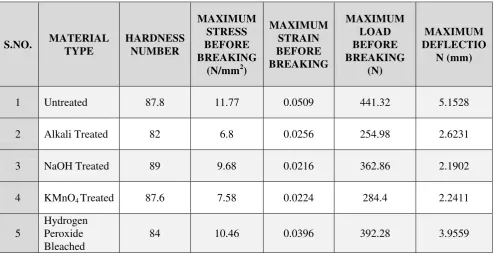
In the untreated fiber the core diameter has decreased gradually but due to holes formation was slightly high during molding the hardness value was reduced than the NaOH treated fiber. The untreated fiber got a hardness value of 87.8 with a maximum stress of 11.77 N/mm2 under a maximum load of 441.32 N with a maximum deflection of 5.1528 mm.
In alkali treated fiber the test result was hardness value obtained is 82. Its maximum stress of 6.8 N/mm2 under a maximum load of 254.98 N with a maximum deflection of 2.6231 mm. The sodium hydroxide treated fiber got a hardness value of 89 and maximum stress of 9.68 N/mm2 under a maximum load of 362.86 N with a maximum deflection of 2.1902 mm.
In Potassium permanganate treated fiber test results shown a hardness value of 87.6. In this case the obtained maximum stress was 7.58 N/mm2 under a maximum load of 284.4 N with a maximum deflection 2.2411 mm.
The Hydrogen peroxide bleaching 84 and it got a maximum stress of 10.46 N/mm2 under a maximum load of 392.28 N with a maximum deflection of 3.9559 mm.
4. RESULTS AND DISCUSSIONS
The partical board was undergone various test like Tensile test, Hardness test and SEM analysis for finding the perfect fiber. Even though the mechanical properties are higher in untreated fiber, sodium hydroxide and potassium permanganate fiber, the alkali treatment is the best treatment for the banana fiber.
© 2017 AJAST All rights reserved. www.ajast.net Table 1.Comparison Statement of obtained Results
5. CONCLUSIONS
The Research main objective is to obtain the perfect fiber. The obtained results were split into two categories, Mechanical properties and Microstructure analysis.
5.1. Mechanical Properties
In the mechanical properties the Tensile test and Hardness test were conducted. The Maximum load, Maximum stress and Maximum deflection were obtained by the Untreated fiber. If the application is to with stand the load means the Untreated fiber can be used. The Sodium Hydroxide treated fiber got the Maximum Hardness value and hence it is harder material in this project.
5.2. Microstructure Analysis
In microstructure property of the fiber, the Alkali treated fiber is the perfect fiber for the applications, because from the SEM analysis, the other partical boards have some defects like Interface crack, debonding, impurities and holes etc. The un-pretreated partical board interface crack and many impurities were found. In hydrogen peroxide treatment interface crack and holes were found. In potassium permanganate treatment there are holes, debonding and interface crack were occurred. In sodium hydroxide treatment many impurities and holes were found. But in Alkali treated fiber there is less number of impurities, good bonding with matrix because of no debonding was found and more importantly there is no crack formation. Hence by microstructure analysis the Alkali treatment is the best pretreatment that suitable for Banana fiber to improve its microstructure.
REFERENCES
[1] Anil N. Netravali and Shitij Chabba ―Composites get Greener‖ (2003)from Materials today.
[2] Aparna Roy, Sumit Chakraborty, Sarada Prasad Kundu, Ratan Kumar Basak, Subhasish Basu Majumder,
Basudam Adhikari ―Improvement in mechanical properties of jute fibres through mild alkali treatment as demonstrated by utilisation of the Weibull distribution model‖ (2011), India.
[3] Bibin Mathew Cherian, Alcides Lopes Leao, Sivoney Ferreira de Souza, Sabu Thomas, Laly A. Pothan, M.
Kottaisamy ―Isolation of nanocellulose from pineapple leaf fibres by steam explosion‖ (2010).
[4] Cui Y, Lee S, Noruziaan B, Cheung M, Tao J. ―Fabrication and interfacial modification of wood/recycled
plastic composite materials‖ (2008)Compos Part A.
© 2017 AJAST All rights reserved. www.ajast.net [5] Hoi-yan Cheung, Mei-po Ho, Kin-tak Lau, Francisco Cardona, David Hui ―Natural fiber-reinforced composites
for bioengineering and environmental engineering applications‖ (2011) China.
[6] Jayamol George, Janardhan R., Anand J. S., Bhagawan S. S., and Sabu Thomas ―Melt rheological behaviour of short pineapple fibre reinforced low density polyethylene composites‖ (1996) Kerala.
[7] Johnston, T. 2003. Banana Paper. The Buzz. Transform Australia. Banana Paper.
[8] Jun Tae Kim, Anil N. Netravali, ―Development of aligned-hemp yarn-reinforced green composites with soy
protein resin: Effect of pH on mechanical and interfacial properties‖ (2011) United States.
[9] Kestur G. Satyanarayana, Gregorio G.C. Arizaga, Fernando Wypych ―Biodegradable composites based on lignocellulosic fibers—An overview‖ (2009) Brazil.
[10] La Mantia F.P. , M. Morreale 2011 ―Green composites: A brief review‖ (2011) Italy.
[11] Lukas Sobczak, Reinhold W. Lang, Andreas Haider, ―Polypropylene composites with natural fibers and wood
– General mechanical property profiles‖ (2011) Austria.
[12] Mohd Edeerozey A.M. and Hazizan Md Akil, Mater. Lett., 61, 2023 (2007).
[13] Rong M.Z., Zhang M.Q., Liu Y., Yang G.C., and Zeng H.M., Compos. Sci. Technol., 61, 1437 (2001).
[14] Susheel Kalia, B.S. Kaith, Inderjeet Kaur ―Pretreatments of Natural Fibers and their Application as Reinforcing Material in Polymer Composites—A Review‖ (2009) Rajasthan.
[15] Uraiwan Pitimaneeyakul, ―Banana Fiber: Environmental Friendly Fabric‖ (2009) King Mongkut’s Institute of Technology Ladkrabang, Thailand.
[16] Xinqi Li, Liping He, Haiye Zhou, Wenjun Li, Wenke Zha, ―Influence of silicone oil modification on properties of ramie fiber reinforced polypropylene composites‖ (2011) China.
[17] Zhao-Tie Liu, Yani Yang, Lili Zhang, Ping Sun, Zhong-Wen Liu, Jian Lu, Heping Xiong, Yuande Peng,
Shouwei Tang ―Study on the performance of ramie fiber modified with ethylenediamine‖ (2007) China.