THE REALIZATION OF THEMATIC ROLES IN PRAMOEDYA ANANTA TOER’SRUMAH KACA
AND ITS ENGLISH TRANSLATION FORMHOUSE OF GLASS
A Thesis Presented to
The Graduate Program in English Language Studies in Partial Fulfillment of the Requirements
for the Degree of
Magister Humaniora (M. Hum) in
English Language Studies
by
Nilam Maharani 036332015
THE GRADUATE PROGRAM IN ENGLISH LANGUAGE STUDIES SANATA DHARMA UNIVERSITY
STATEMENT OF ORIGINALITY
This is to certify that all the ideas, phrases, and sentences, unless otherwise stated, are the ideas, phrases, sentences of the thesis writer. The writer understands the full consequences including degree cancellation if he/she takes somebody else’s idea, phrase, or sentence without a proper reference.
Yogyakarta, June, 21, 2007
ACKNOWLEDGEMENT
The completion of this thesis has made possible by the support of some
incredible people:
I would like to express my sincere gratitude to Dr. B.B. Dwijatmoko, M.A.,
my thesis advisor for his counsels. I am deeply indebted to De. Baskara Tulus
Wardaya, S.J., the Director of PUSdEP and The Graduate Program Director, for
his insightful counsels not only throughout the writing of my thesis, but also
during my study in Yogyakarta.
My heartiest thanks are also due to Tri Subagya, M.A., for his insightful
comments, explanation, and guidance, particularly with respect to the
methodological aspects of my thesis which makes me know better what a good
research is. I am obliged to thank Aryanto, M.A., for his lectures on Semantics,
and Dr. Haryatmoko, S.J., for letting me know what the real meaning of education
is.
My sincere thanks are extended to my soul mate Antonius Dwi Aryanto for
giving prayers and timeless patience, my true friend Nandy Intan Kurnia, and also
M2M of PUSdEP (onoca and Mita) who always be there for sweeping away my
burdens.
Last but not east, my beloved ibu Sri Saryuni and my father Miyono, my
dearest sisters Shinta Nayumi and Fairin Linggar Widhiana, my little brother
Alfin Aulia Tama, my niece Stephnie, deserve my gratitude. Their love, patience,
and encouragement, despite of my hardest time away from home, have been
fundamental moral support that has brought me to the accomplishment of my
TABLE OF CONTENTS
PAGE OF TITLE... i
PAGE OF APPROVAL... ii
PAGE OF DEFENSE APPROVAL ... iii
STATEMENT OF ORIGINALITY... iv
ACKNOWLEDGMENT... v
TABLE OF CONTENTS... vi
LIST OF TABLES ... ix
LIST OF FIGURES ... xi
TYPOGRAPHICAL CONVENTIONS... xii
ABSTRACT... xiii
ABSTRAK... xiv
CHAPTER I INTRODUCTION... 1
1.1 Background ... 1
1.2 Problem Limitation ... 7
1.3 Problem Formulation ... 10
1.4 Research Goals ... 10
1.5 Benefits of the Study ... 11
CHAPTER II THEORETICAL REVIEW... 12
2.1 Thematic Role Theory ... 12
2.2 Theory of Sentence Structure... 29
2.2.1 Definition of Sentence ... 29
2.2.2 Sentence Types ... 31
2.2.3 Element of Clause Structure ... 34
2.3 Theory of Translation ... 43
2.3.2 Catford and The Introduction of the Translation Shifts……….. 47
2.3.3 Baker’s Approach to the Translation Equivalence... 48
2.4 Theoretical Framework ... 49
CHAPTER III RESEARCH METHOLOGY... 53
3.1 Research Data ... 53
3.2 Data Collection ... 54
3.3 Data Analysis ... 56
CHAPTER IV ANALYSIS ... 63
4.1 The Realization of the Thematic Roles in the Indonesian Data... 63
4.1.1 The Realization of the Agent Role in Indonesian ... 64
4.1.2 The Realization of the Author Role in Indonesian ... 66
4.1.3 The Realization of the Instrument Role in Indonesian... 68
4.1.4 The Realization of the Patient Role in Indonesian... 72
4.1.5 The Realization of the Experiencer Role in Indonesian... 75
4.1.6 The Realization of the Benefactive Role in Indonesian... 78
4.1.7 The Realization of the Theme Role in Indonesian... 82
4.1.8 The Realization of the Source Role in Indonesian... 87
4.1.9 The Realization of the Goal Role in Indonesian ... 89
4.1.10 The Realization of the Locative Role in Indonesian... 91
4.1.11 The Realization of the Reason Role in Indonesian ... 94
4.1.12 The Realization of the Purpose Role in Indonesian ... 95
4.1.13 The Realization of the Time Role in Indonesian ... 97
4.1.14 The Realization of the Manner Role in Indonesian ... 98
4.2 The Realization of the Thematic Roles in the English Translated Form ... 101
4.2.1 The Realization of the Agent Role in English ... 101
4.2.2 The Realization of the Author Role in English... 103
4.2.3 The Realization of the Instrument Role in English ... 106
4.2.4 The Realization of the Patient Role in English ... 107
4.2.6 The Realization of the Benefactive Role in English ... 113
4.2.7 The Realization of the Theme Role in English ... 115
4.2.8 The Realization of the Source Role in English ... 119
4.2.9 The Realization of the Goal Role in English ... 121
4.2.10 The Realization of the Locative Role in English ... 124
4.2.11 The Realization of the Reason Role in English ... 126
4.2.12 The Realization of the Purpose Role in English ... 127
4.2.13 The Realization of the Time Role in English... 128
4.2.14 The Realization of the Manner Role in English... 129
4.3 The Thematic Role Shifts ... 133
4.3.1 The Thematic Role Shift of the Agent Role... 135
4.3.2 The Thematic Role Shift of the Author Role ... 136
4.3.3 The Thematic Role Shift of the Instrument Role ... 137
4.3.4 The Thematic Role Shift of the Patient Role ... 140
4.3.5 The Thematic Role Shift of the Experiencer Role ... 145
4.3.6 The Thematic Role Shift of the Benefactive Role ... 148
4.3.7 The Thematic Role Shift of the Theme Role ... 150
4.3.8 The Thematic Role Shift of the Goal Role ... 156
4.3.9 The Thematic Role Shift of the Locative Role ... 157
4.3.10 The Thematic Role Shift of the Purpose Role ... 159
CHAPTER V CONCLUSION ... 165
5.1 The Realization of the Indonesian Thematic Roles ... 165
5.2 The Realization of the English Thematic Roles... 166
5.3 The Thematic role Shifts... 168
5.4 Suggestion ... 169
BIBLIOGRAPHY... 171
LIST OF TABLES
Table 4.1 : The Agent Role Realization in the Indonesian Data 64
Table 4.2 : The Author Role Realization in the Indonesian Data 66
Table 4.3 : The Instrument Role Realization in the Indonesian Data 69
Table 4.4 : The Patient Role Realization in the Indonesian Data 72
Table 4.5 : The Experiencer Role Realization in the Indonesian Data 75
Table 4.6 : The Benefactive Role Realization in the Indonesian Data 78
Table 4.7 : The Theme Role Realization in the Indonesian Data 83
Table 4.8 : The Source Role Realization in the Indonesian Data 87
Table 4.9 : The Goal Role Realization in the Indonesian Data 89
Table 4.10 : The Locative Role Realization in the Indonesian Data 91
Table 4.11 : The Purpose Role Realization in the Indonesian Data 96
Table 4.12: The Indonesian Thematic Roles Realization
in the Syntactic Functions 100
Table 4.13 : The Agent Role Realization in the English Data 102
Table 4.14 : The Author Role Realization in the English Data 104
Table 4.15 : The Instrument Role Realization in the English Data 106
Table 4.16 : The Patient Role Realization in the English Data 108
Table 4.17 : The Experiencer Role Realization in the English Data 111
Table 4.18 : The Benefactive Role Realization in the English Data 113
Table 4.19 : The Theme Role Realization in the English Data 116
Table 4.20 : The Source Role Realization in the English Data 119
Table 4.22 : The Locative Role Realization in the English Data 124
Table 4.23 : The English Thematic Roles Realization
in the Syntactic Functions 131
Table 4.24 : The Indonesian and the English
Thematic Role Realization Hierarchy 132
Table 4.25 : The Indonesian and the English Thematic Role Realization 134
Table 4.26 : Syntactic Reasons in the Thematic Role Shifts 161
LIST OF FIGURES
Figure 2.1 : Stages of Translation 44
Typographical Conventions
Italics : a. foreign words, phrases, clauses, and sentences. b. the emphasized words within sentences which
become the center of the discussion
Single quotation-marks (‘) : a. lexemes and expressions b. the citation of sentences
Double quotation- marks (“) : quotations from other authors
Asterisks (*) : unaccepable sentences
Parentheses (…) : a. showing the words being discussed in a particular sentence
b. numbering the discussed sentences or propositions
c. showing the thematic role discussed within a particular sentence
Square brackets […] : possible extended coordination of a sentence
Initial capital letters : the name of the thematic roles
Notes
1. When an Indonesian term has been furnished with an italics, a single quotation mark containing the English word is directly following to it. 2. In quotations from other authors, the original typographical conventions
ABSTRACT
NILAM MAHARANI. (2007). THE REALIZATION OF THEMATIC
ROLES IN PRAMOEDYA ANANTA TOER’S RUMAH KACA AND ITS
ENGLISH TRANSLATION FORMHOUSE OF GLASS.
Yogyakarta: English Language Studies, Graduate Program, Sanata Dharma University.
Yogyakarta.
Translating a fiction is said to be complicated for it deals not only with bilingual, but also bi- cultural transference as well as dealing with aesthetic conventions, historical and socio- cultural circumstances, authorial style, and the author’s worldview. However, every translation product should be loyal to the message. It does not mean that the translator does not have any rights to change the structure of the Source text (ST) in his translation products since basically translating a text is a meaning transference.
Toer’sRumah Kaca is one of Indonesian fictions which has been translated into twenty languages, and one of them is English. Every language has its own grammatical structures, but the thematic roles remain the same. However, for the sake of the naturalness of the translation product, it is possible for a translator to change the grammatical structure and the main verb which brings a thematic role shift as its result. This thesis focuses on the causes of the shifts of the thematic roles when they are translated into the Target Language (TL). There are three questions to answers. First, how are the thematic roles realized syntactically in the ST? Second, how are they realized in the TT? The third is what may cause the thematic roles shifts?
The first and the second problem are answered by taking the sentences both in the ST and the TT which theoretically can fill the syntactic slots as well as the thematic roles. Quirk et al gives a contribution to the division of the syntactic slots namely subject, object, complement, and adverbial. Frawley’s theory on the thematic roles are used to analyze the thematic roles of the noun phrases filling the syntactic slots. Frawley divides the thematic roles into two big groups namely Participant and Non participant roles. The Participant roles are divided into three: Logical actors (Agent, Author, Instrument), Logical Recipients (Patient, Experiencer, Benefactive), and Spatial roles (Theme, Source, Goal). The Non participant roles are divided into Locative, Reason, and Purpose.
In the ST, Benefactive role is realized in every syntactic function except in the object complement. Time and Manner role are realized only in the syntactic adverbial function. It proves that in the ST, the Benefactive role has the highest position in the syntactic function hierarchy. In the TT, Agent, Patient, Experiencer, Theme, Goal, and Locative have the highest position of the syntactic function hierarchy. Both in the ST and the TT, the Time and Manner role have the lowest position in the syntactic function hierarchy for they are only realized in the syntactic adverbial function. This shows that the Participant role dominates the syntactic functions hierarchy.
relative clauses which shift to the main clauses and the presence of the dummy subject. The thematic role shifts under semantic reasons are potential to change the grammatical pattern, therefore it is said to be obligatory. Since a translator is free to retain the syntactic construction of the ST, the thematic role shifts occur under syntactic reasons can be said to be optional.
A translation product should be loyal to the message as well as giving an
ABSTRAK
NILAM MAHARANI. (2007). THE REALIZATION OF THEMATIC ROLES IN PRAMOEDYA ANANTA TOER’SRUMAH KACAAND ITS ENGLISH TRANSLATION FORMHOUSE OF GLASS.
Yogyakarta: Kajian Bahasa Inggris, Program Pasca Sarjana, Universitas Sanata Dharma.
Menterjemahkan fiksi merupakan hal yang rumit karena menterjemahkan fiksi tidak hanya menyangkut dua bahasa, tetapi juga menyangkut penyampaian dua kultur kebudayaan, konvensi- konvensi estetik, keadaan sosio kultural, gaya pengarang beserta pandangannya. Akan tetapi, setiap produk terjemahan haruslah setia kepada pesan yang hendak disampaikan pengarang. Hal ini bukan berarti bahwa seorang penterjemah tidak mempunyai hak untuk mengubah struktur gramatikal dari bahasa sumber dalam produk terjemahannya, karena pada dasarnya menterjemahkan adalah menyampaikan pesan.
Novel Rumah Kaca karya Pramoedya Ananta Toer merupakan karya fiksi Indonesia yang sudah diterjemahkan ke dalam dua puluh bahasa, dan salah satunya adalah bahasa Inggris. Setiap bahasa mempunyai struktur kebahasaan mereka sendiri- sendiri, akan tetapi peran temantik mereka tetap sama. Akan tetapi, demi kealamiahan sebuah terjemahan, seorang penterjemah bebas untuk mengubah struktur gramatika dari bahasa sumber (SL) ke dalam bahasa sasaran (TL), juga mengubah predikat dari sebuah kalimat. Hal ini berdampak pada berubahnya peran tematik pada suatu frasa kerja. Tesis ini membahas penyebab perubahan peran tematik pada novel tersebut ketika diterjemahkan ke dalam bahasa Inggris. Ada tiga masalah yang hendak dijawab dalam tesis ini: pertama, bagaimana peran tematik diwujudkan secara sintaktis dalam teks sumber (ST)? Kedua, bagaimana peran tematik diwujudkan secara sintaktis dalam produk terjemahan (TT)? Dan yang ketiga, hal apa saja yang mungkin menyebabkan terjadinya perubahan peran tematik dalam proses terjemahan tersebut?
Pertanyaan pertama dan kedua dapat dijawab dengan cara mengambil kalimat- kalimat dari teks sumber maupun produk terjemahan yang memenuhi fungsi sintaksis maupun peran tematik. Quirk et al memberikan sumbangsih teori mengenai pembagian fungsi sintaksis yaitu subjek, object, komplemen dan keterangan. Teori peran semantik yang dirumuskan oleh Frawley digunakan untuk menganalisis peran tematik dari frasa- frasa nomina yang mengisi fungsi sintaktik. Frawley membagi peran tematik ke dalam dua kelompok besar yaitu Participant dan Non Participant. Peran Participant dibagi menjadi tiga yaitu Logical actors (Agent, Author, Instrument), Logical Recipients (Patient, Experiencer, Benefactive), dan Spatial roles (Theme, Source, Goal). Peran Non Participant dibagi menjadi Locative, Reason, dan Purpose.
Locative menempati urutan pertama dalam hirarki fungsi sintaksis. Di dalam teks asli maupun terjemahan, peran Time dan Manner menempati urutan terakhir dalam hirarki fungsi sintaksis mengingat mereka hanya dapat terealisasi pada fungsi keterangan saja. Hal ini membuktikan bahwa peran- peran Participant mendominasi hirarki fungsi sintaksis.
Perubahan peran semantik dalam proses penterjemahan paling banyak terjadi pada peran- peran Participant karena alasan sintaksis dan semantis. Akan tetapi, perubahan peran- peran Participant ke dalam peran- peran Non Participant juga dimungkinkan terjadi. Hal ini disebabkan oleh klausa- klausa relatif yang berubah menjadi klausa- klausa utama dan kehadiran dummy subjek. Perubahan peran tematik yang dikarenakan alasan semantik bersifat keharusan karena mampu mengubah pola gramatikal. Karena seorang penterjemah berhak untuk mempertahankan konstruksi sintaksis dari bahasa sumber, peran- peran semantik yang terjadi karena alasan sintaksis dapat dikatakan bersifat pilihan.
CHAPTER I INTRODUCTION
1.1 Background
Translating a text can be said to be complicated and problematic for the
translators who may not be equally fluent in the Source language (SL) and the
Target Language (TL) , especially when they are dealing with complicated texts.
The reason is that translation does not only deal with lexicon and grammatical
structure, but it takes communication situation and cultural context of the source
language (SL) text as well.
“Once a translator has identified the meaning of the source text, his goal is to
express that same meaning in the receptor language with forms which may be
different from those of the source text (Larson, 1984: ix)”. Larson emphasizes the
importance of the word meaning to the product of a translation. Larson’s idea is in
line with Leech, who says that translating can be defined as finding a synonymous
expression in another language (Leech, 1981: 80).
There is no doubt that word meaning is important to the translation process. A
good translation should consist of meaning transference from the SL into the TL.
“This is done by going from theformof the first language to theformof a second language by way of semantic structure. It is meaning which is being transferred and must be held constant (Larson, 1984: 3).
However, it is unwise to think that the meaning of a sentence is merely the
sum of the meanings of the words and other constituents which compose it
not tell the difference of meaning between My step mother has a brother in law,
My mother in law has a step brother, My step brother has a mother in law, etc.
All of those propositions would have to be regarded as synonymous.
Referring back to the task of a translator, Larson argues that a translator
should not stop his step when he had mastered the word meaning and the
communication value. He will continue the next step that is analyzing the
components he had found and reconstructing his findings using the lexicon and
grammatical pattern which are appropriate in the TL and its culture (Larson, 984:
3-4).
As semantics is the study of linguistic meaning of words, phrases, and
sentences, semantics can be said to give a great contribution to the translation
field (Fromkin and Rodman, 1988: 206). However, what Larson means by
semantics is narrower than the meaning of semantics in general. He refers to
linguistic semantics because he adopts the word ‘structure’ following the word
‘semantics’. Linguistic semantics is the study of literal meanings that are
grammaticalized or encoded. It is a branch of both semiotics, the study of meaning
in general, and semantics, the study of linguistic meaning in particular. “But
linguistic semantics is narrower than either semiotics or semantics, focusing as it
does on meanings that are actually reflected in overt form differences” (Frawley,
1992: 1).
Although in forming a sentence, a certain form takes place, it does not mean
that the sentence is perfect. Sentence (1) is a grammatically perfect sentence, but
a subject (mother) and a verb (cooked). This verb belongs to transitive verb, and
therefore the verb takes an object (stone).
(1) * Mother cooked the stone.
However, sentence (1) is against the semantic rule. The verb cooked needs
something following it, reflecting a cookable thing. In this case, the object
following the verb is not cookable, since it cannot transform to any edible thing.
Translating a text assumes translating sentences; some are complex, some are
not. It is possible that a translator loses the nucleus of a sentence in translating
process only because he pays too much attention to the complicated structure of
the text.
A translator should differentiate sentences from propositions. Sentences can
be long and complex, but proposition can be said to be the nucleus of the
sentences: what an author wants to tell his readers. Proposition is a predication
which can be described as being true or false (Leech, 1981: 155).
(2) Artika Sari Devi won the beauty pageant.
(3) Artika Sari Devi did not win the beauty pageant.
(4) Did Artika Sari Devi win the beauty pageant?
(5) Artika Sari Devi’s winning the beauty pageant
(6) For Artika Sari Devi winning the beauty pageant
Only (2) and (3) are propositions and can be described as being true or false.
Leech argues that there are two conditions for a predication to be called
with a tense form (win, won) which marks it as describing something which
happened at a particular time. The second one is that the predication is in
declarative mood, meaning that it has effect of asserting something, rather than of
asking a question (Leech, 1981: 155). By applying those conditions, therefore (2)
and (3) can be considered as propositions.
Predication, on the other hand, are a common category shared by propositions,
questions, commands, etc (Leech, 1981: 124).
(7) The boy played his music.
(8) Did the boy play his music?
(9) Play your music, boy!
Sentences (7), (8), (9) have a common content which can be expressed in a
kind of Pidgin English: boy played music.
Syntactically, sentences have constituents such as subject, verb, object, and
adverb, but semantically, predications have argument and predicate as their
constituents.
(10) The man helped her.
Syntactically, (10) has the man as the subject, helped as the verb, andher as
the object. However, proposition (10) can be semantically analyzed to have the
man and her as the arguments. The linking element (helped) between the two
arguments (the man andher) is called ‘predicate’ in semantics.
The term ‘thematic roles’ which is also called as semantic case, semantic
roles, thematic relations, and purely perspective theta roles, are semantic relations
connecting arguments to predicates (Frawley, 1992: 97).
(11)Clarasang beautifully.
(12)Caesarlikes orchids.
(13) He killedthe cat.
The argument Clara has an Agent role and sang as the predicate. The
argument ‘Caesar’ in (12) has an Experiencer role and the argument orchids has
an Object role. The argument He in (13) has an Agent role and the argument the
cathas an Object role.
The knowledge of the predicates and arguments enables a translator to
understand the sentences and propositions better. In a translating process, the
translator is capable to enrich the language style he uses in his translation product
without losing the main idea expressed in the original sentences or propositions.
(14) aBerat. Berat bagi Idenburg, dan dengan sendirinya berat bagiku diberi tugas- tugas khusus.
b. It was hard, hard for Idenburg, and of course, hard too for me who receive new and special tasks.
Sentence (14a) consists of two sentences repeating the main proposition that is
berat ‘hard’. In the original sentence, the author is aware of the necessity of the
word berat. Even he builds a brand new sentence using the word berat, the
argumentberatin (14a) does not have any thematic role.
When (14a) is translated in sentence (14b), the translator does not want to
have thematic role when it is translated into it is hard, forit is a dummy subject.
The translator understands that the proposition can still be found in (14b). He does
not need to follow the style of the author, because now he is free to express his
own style without losing the nucleus of the sentence.
This research is dealing with semantics, particularly with thematic roles. It is
going to see the importance of the study of the thematic roles in applied linguistics
that is in translation, by taking the novel written by Pramoedya Ananta Toer
entitled Rumah kaca and its translation form House of Glass translated by Max
Lane.
The first reason of choosing Toer’s Rumah Kaca is that this novel is the last
episode of the Buru Quartet. The translator (Max Lane) said that it is like the key
answer to the three preceding novels in which the political agenda is revealed.
Many sentences and even noun phrases need a ‘special treatment’ to be translated.
Other reason is that, like Toer’s other works, this novel is reflecting Javanese
culture which can ben seen from Indonesian language with strong Javanese
language logics and structure. His thoughts and discourses are well- organized,
which make the readers able to imagine the story vividly as if they were the
characters themselves. “The hardest part for the translator is when he must retain
Toer’s style without losing the strength of the imagery built in the story” (Lane,
2006: informal conversation). Moreover, Lane adds that the point of the
translation process does not rely on the grammatical structure per se, but on how
the translation product gives the equal impact to the readers to imagine the story
voice, shift the thematic roles under a particular syntactic slot to other syntactic
slots, as long as those changes meet the naturalness translation of the TL.
The third reason of choosing Pramoedya Ananta Toer’s work is that Toer’s
novels have been translated into twenty languages (Publisher’s note, 1992). He
also received the PEN freedom- to- write Award in 1988 and the Ramon
Magsaysay Award in 1995. It is to say that his works are famous, and the
translation forms of the works should be qualified. This research is not going to
judge the English translation form of the novel, but it sees the how the thematic
roles theory are realized in the receptor language.
1.2 Problem Limitation
This research deals with thematic roles in Indonesian language when it is
translated into English. Previous studies on thematic roles mostly discussed
thematic roles in English arguments and predicates. As a language, Indonesian
language also has thematic roles that can be compared when they are translated
into English.
This research is descriptive which tries to see how predicates (events) and
arguments (entities) are used in Indonesian by seeing their forms in the Rumah
Kaca. After the novel is translated into different language, in this case is English,
the researcher is going to see any difference of the arguments realization in the
translation form in order to see later the causes of them.
What is meant by realization is not the difference in voice such as active voice
and passive voice, because as a proposition, it is possible for a sentence to have
(15) a. “Unsur modern belum lagi mengubah tata pikir pribumi”, Ia
menerangkan“ (Rumah Kaca, p. 36).
b“The Natives’ way of thinking has not yet been changed by modern
ideas,” he explained. (House of Glass, p. 28).
Sentence (15a) has an active voice with unsur modern as the subject of the
sentence. When it is translated into (15b), the sentence is changed from an active
voice into a passive voice with ‘modern ideas’ as the object of the sentence. In
other words, the sentence has changed syntactically, but not semantically because
there is no difference in thematic roles realization. The argument unsur modern
‘modern ideas’ has an Author role, an argument tata pikir pribumi ‘the Natives’
way of thinking’ has a Patient role.
(16) a “Kursinya kosong?”
b “May I sit here?”
Sentence (16a) has one noun phrase kursinya which has a LOCATIVE role.
When the sentence is translated into (16b), there is still one argument appears: the
noun phrase ‘I’ which has an Agent role. The thematic role shifts from a Locative
role of the noun phrase kursinya to an Agent role in the noun phrase I. This
thematic shift is caused under a pragmatic reason.
The thematic roles shift under a pragmatic reason can be said to be
independent: the translator creates a new sentence which does not have any
relation both semantically and syntactically to the sentence in the ST. Different
reason, sentence (17b) below has a thematic role shift under semantic and
syntactic reasons.
(17) a.…. mereka akan menyemburkan kata- kata yang menyakitkan hati penguasa- penguasa kolonial (Ch 7 no 5)
b. ..their words would have once again given much pain to the colonial
authorities.
Sentence (17a) above has an argument shift from an Agent role (mereka) to an
Instrument role (their words) in sentence (17b). The reason of such shift (from the
Agent role to the Instrument role) is the language efectivity. Sentence (17a) has an
Agent (mereka) and a Theme (kata- kata) in which at the same time is functioned
as an Instrument to do the ‘hidden agenda’ proposed by the Agent that is ‘giving
much pain to the colonial society’. By ellipting the Agent (mereka ‘they’) in
sentence (17a) and replacing it to the Instrument role (their words) in sentence
(2b), the meaning of the sentence is still retained, since the emphasis of the
triggering action is not lying on the Agent role but on ‘the words’ (Instrument
role) which, of course, logically, are produced by human being. This argument
shift, therefore, can be said to obey the redundancy rule under a semantic reason.
The semantic reason causing the thematic role shift has forced the translator to
obey a syntactic rule. Their words as an argument can fill the syntactic subject slot
in sentence (17b). As a consequence, mereka ‘they’ can not fill that syntactic
function any longer. By that construction, the translator has made a deletion to one
argument that is mereka ‘they’ which has an Agent role. The syntactic object
function slot now is filled by ‘much pain’ in order to achieve a grammatical
In order to find the thematic role shifts, the researcher should know the
classification of the thematic roles in each argument appearing in the data, both in
the Indonesian data and in the English data. The cause(s) of the thematic roles
shift(s) can be traced by comparing the thematic roles in the ST and in the TT.
1.3 Problem Formulation
In order to see the thematic roles shifts from the Indonesian data to the English
data, the realization of both thematic roles in Indonesian data and in English data
should be displayed. From the differences appeared, the intention of the translator
in shifting the thematic roles can be traced. The problems to the research are
formulated as follows:
1. How are the thematic roles realized syntactically in Toer'sRumah Kaca?
2. How are they realized in the English translation form?
3. What may cause the thematic roles shift(s)?
1.4 Research Goals
This research is going to find out the thematic roles of the arguments in
Rumah Kaca as well as in its English translation form House of Glass. As noun
phrases, the arguments can fill the syntactic function slots. The roles of the
arguments which are realized in the syntactic subject function, for instance, might
be different from those which are realized in the syntactic object functions. By
knowing the thematic roles realization syntactically both in the Indonesian data
realized in the Indonesian data and the roles which are realized in the English
data. In short, his research tries to find out the way those roles are realized
syntactically in the Source Text (SL) in order to find the way they are realized in
the Target Text (TL) that is the English translation form.
The goal of comparing the thematic roles realization is to have a set of data of
the thematic roles shifts. The thematic roles difference (from the ST and the TT)
must have several reasons. The other goal of the research is to reveal the causes of
the thematic role shifts.
1.5 Benefits of the Study
The theory of semantics gives practical benefit to the process of translating a
text. One of semantic domain, thematic roles, enables a translator to translate a
text with different style without losing the essence of a sentence which is gained
from seeing the propositions. The mastery of the thematic roles theory enables a
translator to enrich his style in the translation process, so that his language style in
his product is not monotonous. He is, therefore, able to explore the richness of the
language used in the story and gain the naturalness of translation in the TL.
In relation to the translation field which equally places the mastery of the word
meaning and sentence pattern, this research can give a contribution to the field by
providing real examples in translation. It is also to say that the benefit is twofold;
it can be used as a model for a translator to translate a text, especially from
Indonesian language into English. The second benefit goes to the linguists and
and structure. The research exposes the sentences gained from the data both from
the semantic and syntactic point of view, meaning to say that linguists and the
students of linguistics are capable to have a better understanding of the relation
CHAPTER II
THEORETICAL REVIEW
This research is to achieve objectives as stated in the previous chapter that is
to see the realization of thematic roles from the SL (in Bahasa Indonesia) to its
English translation form. It is going to see the thematic roles in the original novel
first, and later on, to see the thematic roles in the English text (TT).
In order to achieve those objectives, this research needs some theories to
analyze the data which are relevant and fundamental in answering the problems in
the problem formulation. The theories will be thematic roles theory, sentence
structure theory in Bahasa Indonesia as well as in English, and the theory of
translation.
This chapter will be divided into two divisions. The first one is the theoretical
review in which the writer displays the theories related to the topic, and the
second one is theoretical framework to frame the theories used in the research.
2.1 Thematic Role Theory
Thematic roles are relevant relations between predicates or events and their
arguments or entities (Frawley, 1992: 199). If a person is given the word ‘read’,
and he should produce a perfect sentence using the word, he might produce
(1) a. Mr. John and his son read the letter
b. The letter was read by Mr. John and his son.
Sentence (1a) has the subject namely Mr. John and his son, while the letter
either subject or object in the sentence. In a passive voice, the position of the
subject is changed into an object and vice versa, so that the new sentence hasthe
letteras the subject of the sentence, whileMr. John and his sonis as the object.
However, regarding to the requirements of subject and object position that is
they should be NPs, sentence like (2) below is unacceptable.
(2) a. *The travel warning read the visitors.
b. *The cats read the news in the announcement board.
Grammatically speaking, sentences (2a) and (2b) are perfectly correct. Both of
them have subjects (the travel warning andthe cats) and objects (the visitorsand
the news) as well. The perfection of a sentence, however, is not only determined
by the grammar correctness, but also by semantic values. The verb read
accommodates animate being as the doer of the action. In (2a) the travel warning
is inanimate object, so it is unacceptable to have it as the subject of the verbread.
The cats in (2b) is animate being, however, still it is unacceptable to put is as the
subject. The ability to read is only possessed by human.
From grammatical point of view, the subject in the active voice can be
changed into the object position when it becomes a passive voice. Semantically
speaking, the thematic roles stay the same or remain unchanged. The doer of the
action in the active voice stays to be the doer in the passive voice.
(3) a. The mother prepared the food well.
b. The food was prepared well by the mother.
The verb prepare needs the doer that is the mother, and the object of the
that is why in semantics, they are called as entities. The verbprepare assumes to
be the trigger of the action, so it is called as event. “Thematic roles are thematic
relations connecting entities to events” (Frawley, 1992: 197).
There are some theories on thematic roles proposed by some linguists. One
prominent analyst of this study is Frawley who divided the thematic roles into two
classes: participant roles and non participant ones. The participant roles are the
roles of arguments necessitated by the predication itself, those that generally
answer the question “who did what to whom?” (Frawley, 1992: 210-202).
According to Frawley, there are nine major participant roles which are
grouped into three groups according to their function. The first three concern the
logical actor or doer of the predication; the second three concern the logical
recipient or undergoer of the predication; and the last three have properties of both
and are best understood in spatial terms.
Logical actors are divided into three namely Agent, Author, and Instrument.
The Agent is “The deliberate, potent, active instigator of the predicate: the
primary, involved doer” (Frawley, 1992: 203). Keenan, as quoted by Frawley has
a similar idea that the Agent role is semantically independent, meaning to say that
the Agent role deliberately, intentionally, responsibly, and potently executes and
controls acts. This role generates the effects themselves, making them relatively
independent of those acts (Frawley, 1992: 205).
(4) Evangelicals and Utilitarians joined forces in 1830s and 1840s.
In (4) Evangelicals and Utilitarians stand for the Agent role because
Evangelicals and Utilitarians carries out the act (join) with deliberateness and
primary involvement. In (5) the police represents the Agent role, the active
instigator of the predicatestop, although the form is in a passive construction.
Author which is also called as the effector is the primary executor of an act
which has all the characteristics of an Agent, but is not the direct cause of the act.
If Agent carries out acts for internal reasons to the arguments, Author carries out
acts for non internal reasons, meaning to say that Author is sufficient, but not the
necessary, cause of the predication. Because of this reason, Author is often
understood as the inactive cause (Frawley, 1997: 205-206).
Another difference between Agent and Author is that Agent needs
intentionally and responsibility, whereas Author does not need them. The logical
consequence is that Author is simply the enabler (indirect cause), not the direct
doer.
(6) All human relations shifted from masters to servants.
(7) The ship pitched and rolled.
In the situation represented by (6), the human relation does not carry out the
act. It cannot be paraphrased into *All human relations make a shift from masters
to servants. It happens also in (7) for the ship does not really carry out the act.
Instrument is an argument as means by which a predicate is carried out. It may
look like Agent and Author in a way that the method by which the action is
executed is closely associated with both. The difference is that Instrument must be
source is external to them. In other words, Instrument has no role in the
predication unless it is put into play by other arguments. Fillmore as stated in
Frawley says that Instrument is inanimate forces or objects causally involved, not
causing per se (Frawley, 1992: 208).
(8) Margaret Thatcher sets out her program with forcefulness and conviction.
(9) The axe broke the glass.
(10)The change happened through the forthcoming Commonwealth
Conference in Lusaka.
In the situation of (8)forcefulness andconviction becomes the means used by
the subject (Agent) Margaret Thatcher to do the action that is sets out. In the
situation of (9), the axeseems to be Author instead of Instrument. However, that
sentence can be rewritten as Someone broke the glass with an axe. It is obvious
here thatthe axedirectly performs the act of breaking, and it does so only because
of the action of someone who exerts necessary energy on the instrument.
Sentence (10) displays the external energy source of the verb action (change).
The forthcoming Commonwealth Conference in Lusaka is as means to make the
verbchangepossible to happen.
If in logical actors Agent, Author, and Instrument are the objects of the
discussion, logical recipients also have three objects to discuss: Patient,
Experiencer, and Benefactive.
Patient is the primary recipient as well as an argument which is changed or
directly affected by a predicate. From the terminology used, it is obvious to say
that Patient suffers the situation or comes out changed as a result of the action of
(11) The political thief has stolen the document.
(12) Knowing that it was the wrong document, he just burned it.
(13) We attended a Commonwealth service in Lusaka Cathedral.
In the situation represented by (11), the document undergoes the action of
stealing, and it comes out changed by the act. The result of the act is the document
disappeared; no longer exist.
Similarly, in the situation of (12) the pronounit which refers to the document
is directly affected by the actions of the predicateburn. The result is the document
comes out changed because of the action. It is to say that the action or burning
changes the material of the document from paper into ash. The document suffers
from the action.
Unlike sentence (11) and (12) that can be said to have verbs of high activity
with potent Agents and totally affected and individuated Patients, sentence (13)
does not possess potent action by a volitional doer. The predicate attend has less
high degree of activity compared tostealandburn. The Patient in sentence (13) is
not totally affected by the act; consequently, the object in (11) and (12) more
typically evinces patient hood than does the object in (13).
Sentences (11), (12), and (13) above show Patients which are realized in the
syntactic direct objects . It is not a coincidence at all because according to Givon
which is quoted by Frawley, Patient as the direct objects tends to be the secondary
pragmatic focus of the sentence (Frawley, 1997: 211). Keenan, whose opinion
characteristic of the objects is their lack of autonomy in the predication (Frawley,
1992: 211). It means that Patient which always takes format as the direct objects
always depend on the predication.
(14) a. The boy ate the cake
b. The boy saw the cake.
Sentence (14a) and (14b) have the same direct object that is the cake. They
have the same subject that is the boy. However, only sentence (14a) has a high
activity verb since the object or the Patient is totally affected and comes out
changed by the act. In sentence (14b), there is nothing happen to the object, and
the predication of the sentence does not bring any changes to Patient in any way.
It is to prove that Patient is scalar.
Experiencer is a logical recipient of an action where actions flow into them
which frequently turns out to be human or at least animate for its involvement
ability to perceive and interpret the internal data. In other words, Experiencer is a
role in which the predicate affects the internal state or construction of an argument
(Frawley, 1992: 213-214).
(15) Nobody knew where they were taken.
(16) Every fisherman saw that big ship approaching.
(17) I was glad.
In situation (15) and (16), the subjects do nothing volitionally, but experience
The ‘I’ has ability to feel, to perceive, and to interpret the situation given to him.
He does nothing volitionally; the feeling of gladness just comes up to him.
Sometimes the Experiencer role is implied in possessive structure (genitive
structures) like what is shown in sentence (18) below:
(18) My father’s pipe
The noun phrase (18) is derived from sentenceMy father has a pipe.Here, the
subject (my father) does nothing volitionally; he just experiences the event of
possessing the pipe.
The third kind of logical recipient is Benefactive: it derives actions or entities
from the actions of another. Benefactive is an argument which is inherently
dependent on surrogates, because it typically requires an Agent role elsewhere in
the predication (Fillmore in Frawley, 1992: 216).
(19) The workers work for that big boss.
(20) A member of the committee brought over a chair for the father.
(21) We found her a good daily help.
In (19)the workerscarries out the act expresses:the big bossderives the result
from the surrogate act of the workers. Similarly, in the event of (20), only the
member of the committee carries out the act. The father has a Benefactive role
since hederives a result from the committee’s actions so that the action prevents
the father from doing the act of paying because of the committee’s agency.
Sentences (19) and (20) point an important thing that the Benefactive role relates
Instrument, only where Instrument is secondary Agent, Benefactive is secondary
recipient.
In (21), on one reading, (non Benefactive reading), her is Patient: We found
her as a good daily help. On the other reading, (the Benefactive reading), her
takes the benefit of the surrogate action done by we: We found a good daily help
for her.
The sentences show that the Benefactive role co- occurs with Agent, therefore
the Benefactive role never appears in a stative predicate but in a nonstative one
such as resultative, motional, and transactional predicates.
(22) *She is cold for her husband (stative predicate).
(23) The lady read the fable for the orphans (result).
(24) The child got the walking stick for the old blind man over there (motion).
(25)The executives purchased luxurious cars for their colleagues (transaction).
Benefactive has one condition that is animacy. The reason is that Benefactive
has surrogates. Frawley emphasizes that the individual having a Benefactive role
would have carried out the act themselves which requires potency. This leads to a
conclusion that Benefactive has a characteristic of animacy. This is in contrast to
Instrument which carries out events independently (Frawley, 1992: 217).
(26) I sliced the cake for grandma.
(27) *I sliced the cake for the knife.
Sentence (26) is, therefore, possible since Benefactive requires an animate
being taking the benefit from the surrogate action done by theI. On the contrary,
example (27) is semantically ill because it takes inanimate object as the
The last group of participant roles is spatial roles whose members are Theme,
Source, and Goal. They are included in participant roles because they are often
associated with actors and recipients and frequently surface in the direct
grammatical roles of subject and direct object (Frawley, 1997: 218).
As one of the members of spatial roles, Theme involves movement from some
resting point along a trajectory, often to another resting point. The displaced entity
is the Theme of the predication of displacement.
(28) Being angry, Bobby pushed that boy to the river.
(29) He passed the salt to Marry.
(30) The orphan wiped out his tears.
In the event expressed by (28),the boyis the displaced entity and hence is the
Theme. The same holds forthe salt in the situation of (29). The action of passing
involves a motion from the starting point to the resting point (Marry), therefore
the saltis the displaced entity.
Fillmore in Frawley states that the Theme is much like the Patient in that each
undergoes an act, but the Theme is unchanged (Frawley, 1992: 218). In the
situation represented by (28) for example, the boy is displaced from a starting
point to a resting point (the river) as a result of the act of the Agent, Bobby.
However,the boyis not changed by the act of pushing.
On the contrary, in situation represented in (30), the tears is changed by the
action: the tears are now disappeared. Strictly speaking, in (30), the tears is a
If themes look like patients because of the presence of an external energy
source operating on them to displace them, they may also like agents and
authors if the energy source is contained, that is, if there is
self-displacement (Frawley, 1992: 218).
A language is said to be common to make reference to the point of origin of
displacement. The argument with this thematic role is the source. Critical to the
thematic role of source is a point of origin.
(31) Such a prize was itself a blessing came straight from God.
(32) He took a handkerchief from his pocket.
(33) The resident took out several telegrams from the envelope.
The situation represented by (31), (32), (33) have points of origin: God, his
pocket, and the envelope respectively. Sometimes, the thematic role of Source is
also about the topic of discourse, that is source of information or aboutness.
(34) The committee is going to talk on the problem tomorrow. (about the
problem)
(35) This instrument is made of brass (from brass).
The thematic role of Source obviously has a general function from the source
of motion (such as in situation (32) and (33)), to material and nonmaterial origin
like in situation (35), to the topic of discourse such as in (34).
The thematic role of Goal involves destination or the endpoints of the events.
(36) Barli once went to England.
(37) The wife expressed her anger to her husband.
The sentences above, England, her husband, and God are the noun phrases
with the Goal role because they are the endpoints of the events. In situation (36),
the thematic role is spatial: involving spatial destination. Situation (37) and (38)
express nonspatial conveyance. In (37), it is difficult to see how her husband
becomes the destination of any concrete motion. The absence of motion is
obviously seen in (38), where God becomes the endpoint of the devotion, not
actually move toward it.
Nonparticipant roles which are sometimes called circumstantial roles, are
derived from the semantic context of the predication. Informally, nonparticipant
roles answer questions on where, why, when, and how. On the other hand,
participant roles answer the question “who did what to whom” (Frawley, 1992:
224).
Locative is an role denotes the spatial position of the predicate. It is a fixed
spatial organization of a situation, the site of the predication, or its state position
(Frawley, 1992: 224).
(39) I had already put the photograph inside my house of glass.
(40) The children are playing in the park.
In the situation of (39), my house of glassis the static position of the putting
action. In that of (40),the parkis the site for playing. English propositions such as
in, on, above, over, at, and so on, give numbers of possibilities to become locative
argument.
The thematic role of Reason is the role denoting the prior conditions of a
the contextual level, outside the strict participant involvement in the predication.
Reason role, according to Frawley, is connected to the intentions of Agent and
therefore relies on prior events themselves for their existence. Based on this
logics, Reason can be said to link other events to a predication by means of the
motivation of an Agent (Frawley, 1992: 225).
The following sentences all contain Reason role:
(41) The kidnapped was trembling from fears.
(42) She smiled by reason of happiness.
(43) He will account for his crime.
Sometimes, the Reason role does not necessary initiate or originate the
events.
(44) a. The kidnapped ran from the bushes down to the street (Source)
b. The kidnapped ran from the bushes to hide behind a big tree (Reason)
In (44a) the sentence means the point of origin of the kidnapped’s physical
displacement was the spatial position held by the bushes. While in (44b), with the
Reason role, the sentence means the kidnapped ran because of the motivation to
hide behind a big tree.
The thematic role of Purpose is role which codes the result thematically or
consequence of a predicate (Frawley, 1992: 227).
(45) Grandma saw her dentist for getting the prescription.
(46) She spent many hours in dressing up for grabbing her new friend’s
In the event of (45),getting the prescription is the Goal of the action. In (46)
grabbing her new friend’s attention is the purpose of spending many hours to
dress up.
Although the Purpose role and Reason role seem very much alike, they differ
on the contextual endpoints of predications.
(47) a. Ron got a new car for satisfying his friends (Purpose).
b. Ron got a new car from satisfying his friends (Reason).
In (47a) the satisfaction condition of Ron’s friends is the result of Ron’s
getting the new car. The possession precedes the purpose. On the contrary, in
(47b), Ron is now in the possession of the new car because of his prior actions of
satisfying his friends. It is the possession follows the Reason.
Different from Frawley, Fillmore proposes 1968 and 1971 models of thematic
roles which are based on case form (which belongs to the surface structure) and
case use (which belongs to the deep structure). His claim is that a sentence
consists of a proposition (P) and a modality. Together they form a grammatical
sentence for proposition is a tenseless set of relationships where verbs and nouns
are involved, and modality takes such modalities on the sentence as a whole as
negation, tense, mood, and aspect (Cook, 1989: 3-4).
According to Fillmore, a proposition has a verb and a series of case- marked
noun phrases. In the previous model (1968 model), he proposes seven cases
namely Agentive, Instrumental, Dative, Objective, Locative, Factitive, and
Comitative. In comprehending what Fillmore has proposed of the deep structure,
(48) Indonesians formed the Independence by pen and speech.
S
M P
V O I A
K NP K NP K NP
PAST form The independence with speech and pen by Indonesia
As can be seen from the diagram (48) above, the proposition consists of a verb
form and three case markers namely Agentive (A), Object (O), and Instrument (I).
Each case marker has preposition (K) that can be empty (Ø) or can be realized by
withandby.
The relation of the noun phrase to the event or state is showed by a case
marker. Agentive (A) shows a case of the perceived investigator of the action
which involves his responsibility. Instrument case (I) shows the case of inanimate
force or object which is causally involved in the state or the action. Dative (D)
shows the case of any entities which is affected by the states or the action.
Locative (L) shows the case identifying the location or direction of the state or
(49) Frischboten (A) told (V) the news(O) to them (D).
(50) The nation (O) is formed (V) by blood and sword (I) in Europe (L).
Fillmore also distinguishes Factitive and Comitative case. Factitive shows the
case of the object resulted from the state or action, whereas Comitative shows the
case of an entity describing accompaniment and usually indicates by the
prepositional markerwith.
(51) Frischboten (A) had established (V) the Indies Council (F).
(52) They (O) are (V) with me (C) now.
The development of the seven cases system to nine cases was proposed by
Fillmore in 1971 model. The differences lie on the Dative and Objectives cases
become Experiencer and Object case. The Locative case is divided into three
cases: Location, Source and Goal. The other difference is the omission of
Factitive and Comitative which are changed into Time and Benefactive. The
Agentive and Instrumental cases remain the same.
Experiencer (E) is a case referring to the experience of a psychological event.
Source (S) shows the starting point of motion which is usually marked by
prepositional such as from, away from and out of. The Goal (G) refers to the final
point of a motion, while Time (T) indicates the time at which an object or event is
located. Benefactive (B) shows an entity who gets the benefits from the event or
activity. The sentences below are illustrating the 1971 case model.
(53) His- Excellency the governor-general (E) was anxious (V).
(55) From the top (S) going down (G), there () were (V) bans, opression,
orders (O).
(56) Suurhof (A) gave (V) the letter (O) to the governor- general (B).
Different from Fillmore, Chafe proposed another case- system theory soon
after Fillmore’s 1968 model. Chafe (1n 1970) identifies seven thematic roles:
Agent (A), Patient (P), Experiencer (E), Beneficiary (B), Instrument (I),
Complement (C), and Location (L).
The idea of Chafe’s Patient and Beneficiary are respectively the same as the
idea of Objective and Benefactive role proposed by Fillmore. The idea of
Experiencer in Chafe’s model is about an entity which is affected psychologically
by the verb. Complement is an entity which inherently completes the meaning of
the verb. The sentences below are the exemplifications of the idea above:
(57) I (A) prepared (V) a rope (P) for him (B).
(58) The Algameenee secretary (A) wrote (V) a letter (C).
Another linguist, Cook, also proposes thematic cases which are based on an
argument that the cases spring from the meaning of the verb and they are attached
to the features in the verb (Cook, 1989: 191). Based on this argument, Cook
divides the English verbs into three categories: action, process, and state.
State verbs express a notionally stative situation as expressed by the verb
‘like’ and ’become’. The example s of process verbs are in the verbs die ,and
two, action verbs express a dynamic agentive event. The verb kill and say are of
the examples.
Those three verbs have a distinctive rule. Syntactically, a state verb cannot be
used in a progressive and imperative form. A process verb can only be used in a
progressive form which is a non imperative form. Action verbs can be used both
in a progressive form and in the imperative form. Based on the distinctive features
of English verbs, Cook develops five major thematic roles namely Agent (A),
Experiencer (E), Benefactive (B), Object (O), and Locative (L).
Agentive role shows an entity capable of producing the action while
Experiencer indicates an entity experiencing sensation, cognition or emotion.
Benefactive shows an entity possessing an object or non agentive party in the
transfer of property. Object shows an entity being described or an entity which
undergoes changes. Cook also subcategorized the Object case into two: object of a
state verb (Os) and a regular object of an action or process. The sentences below
are describing the roles:
(59) She (A) moved (V) the glass (O) to the table (L).
(60) The Excellency- the governor general (E) was anxious (V).
(61) The governor (A) explained (V) the letter (O) to the Algameene secretary
(B)
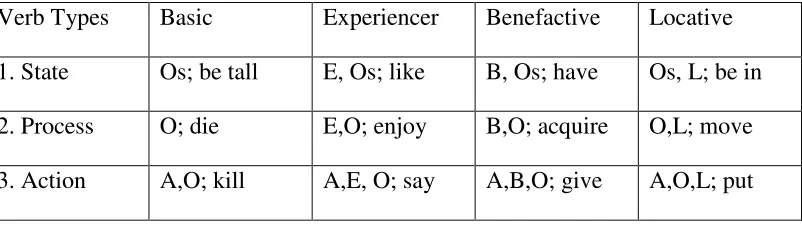
The table below shows the verb types and the thematic roles proposed by
Table 1: Case Frame Matrix (Cook, 1989: 195)
Verb Types Basic Experiencer Benefactive Locative
1. State Os; be tall E, Os; like B, Os; have Os, L; be in
2. Process O; die E,O; enjoy B,O; acquire O,L; move
3. Action A,O; kill A,E, O; say A,B,O; give A,O,L; put
2.2.Theory of Sentence Structure
In order to answer the research problem especially the first and the second
ones on the thematic roles syntactical realization, the theory on the sentence
structure will be the main tool to answer the. The theory of the sentence
structure will be divided into three: the definition of sentence (in which the
classification of a sentence is found), the sentence types (which discuss the
types of sentences), and the elements of clause structure which classifies the
syntactic elements found in a sentence.
2.2.1 Concept of Sentence
A sentence consists of phrases combined together. However, a good sentence
should be both grammatically and semantically correct. Combining words into a
sentence or phrases into a sentence without seeing the grammar in a certain
language will produce a grammatically- ill sentence. Quirk et al proposes that a
sentence has the highest ranking unit of grammar; therefore a well formed
sentence can be produced by combining right phrases in the right sentence
It is usually assumed that the Sentence is the highest- ranking unit of grammar,
and hence that the purpose of a grammatical description of English is to define, by
means of whatever descriptive apparatus may be necessary (rules, categories, etc),
what counts as a grammatical sentence in English (Quirket al,1985: 47).
Quirk et al also suggest that the definition of a sentence above may arise
twofold questions: first, the question on the rank of the sentence and the second
one is on the grammar. Although the terms ‘grammar’ and ‘sentence’ are mutually
defining, but nobody can differentiate which one or how many sentences appear
when a speaker is speaking since it is often to find that there is hardly a boundary
when a sentence ends and another begins. The other aspect is that sentences
without neat grammar will not be judged as a sentence (1985: 47).
In line with Quirk et al, Kruisinga emphasizes that single words like
Splendid!, Disgusting!, orBitch!, which are used in the function of a sentence are
called sentence words. “They naturally have meaning only in a situation or in
connection with another sentence” (1981: 1). Based on the arguments proposed by
Quirk et al and Kruisinga, it is obvious to say that the definition of a sentence
does not only stop at the grammar level.
A sentence is constructed of constituents which contain units themselves and
of a predicate that can take either active verb form or stative verb one (Quirket al,
1985: 38-40)
(1) Tom read a book.
(2) Tom is a school boy.
The three linguistic units above only permit (1) and (2) as sentences for the verbs
they have. Sentence (1) has a full verb (read), whereas (2) has a stative verb
explaining the Subject element which is fulfilled by the Noun Phrase Tom. The
difference between the two and in (3) is that the (3) does not have any verb,
therefore (3) is called a phrase, a Noun Phrase. “A sentence consists of units such
as those which are commonly referred to by the terms Clause, Phrase, word, and
Morpheme” (Quirk et al, 1985: 38). Furthermore, Quirk et al say that sentences
can be divided into two groups namely Simple sentences and Complex or
Compound sentences.
2.2.2 Sentence Types
Quirk et al divided sentences into two big groups, namely simple sentences
and multiple sentences whose members are complex sentences and compound
sentences. Once a person produces a sentence, his product can be categorized
either in simple sentence or in a multiple one.
A simple sentence is a sentence which consists of only one clause. The
illustration in sentence (4) might give an exemplification:
(4) The world war was changing a lot of things in the Indies (Toer, 1992: 316)
The sentence in (4) only consists of one verb phrase (was changing), therefore
it is said that (4) is derived from one clause. Indonesian language applies the same
(5) Dengan suara tersendat- sendat Frischboten berkata pada mereka (Toer:
145)
With voice broken Frischboten told to them
With a broken voice, Frischboten told them
The verb phrase in sentence (5) isberkata. Since it is formed only by a single
verb phrase, sentence (5) is considered as simple sentence.
Different from simple sentences, a complex or compound sentence includes
two or more clauses. Thus while example (4) and (5) are simple sentences,
exhaustively analyzed into single clauses, sentence (6) and (7) are compound
sentences.
(6) He was traveling alone and wearing a new pair of leather sandals (Toer,
1992: 248)
(7) Di atas jejaknya orang ternyata pada berdatangan, dan melalui nya dan
meninggalkan jejak lebih jauh dan lebih banyak lagi(Toer, 2000: 444)
The complex and compound sentence which are often called as multiple
sentence, are formed either through subordination or through coordination. A
subordinated clause is introduced by subordinating conjunction which is parallel
in its function to the adverbial phrase in a sentence. Sentence (6), as well as
sentence (7) in Indonesian language, is using the conjunction and (dan) which
shows its parallelism within the sentence. The conjunction and does not only
automatically bridge two clauses-with two verb phrases-, but also make those
(8) I could not get some sleeps since he left me.
Sentence (8) has sinceas the subordinating conjunction which functions as an
adverbial in the sentence. However, subordination of clauses is not confined to
clauses which are immediate constituents of other clauses. Quirket alpropose that
it is possible to have clauses which are constituents of phrases (Quirk et al, 1985:
40).
(9) Humanitarianism-that ethical duty which he was sworn- was now
confronted by the needs of times (Toer, 1992: 2))
In sentence (9), the ‘which’ (that ethical duty which he was sworn) in sentence
(9) shows how repeated subordination of one relative clause to another leads to
the construction of sentences of ever- increasing length, like another case in
sentences below:
10. a. This is the dining room [that Kayla designed]
b. This is the knife [that cut the apple in the dining room [that Kayla
designed]]
c. This is the plate [that be the place of the apple [that was in the dining
room [that Kayla designed]]] etc
A sentence formed by coordinating conjunction is called a coordinative
sentence construction. It consists of two or more units of the same status on the
grammatical hierarchy which may constitute a single unit of the same kind. “The
most common coordinating conjunction are and, or, and but” (Quirket al, 1985:
46).
(12) He was traveling alone and wearing a new pair of leather sandals (Toer,
1992: 248)
Coordination of propositional phrase:
(13) You can go [[by air] or [by train]]
Coordination of Nouns:
(14) Their [[mother] and [brother]] are leaving now.
The essential principle of coordination is that units and structures may be
duplicated without affecting their position in the grammatical hierarchy. The tree
diagram which is based on Quirket al(1985: 47)ibelow will show the bifurcation
of one unit into two linked units of equal status:
Prepositional Phrase Conjoint
Prepositional Phrase Conjunction Prepositional
by air or by train
A genitive case with coordination will be showed in the tree diagram below:
Noun Phrase
Determiner Noun Conjoint
their
Noun Conjunction Noun