I ntroduction
I ntroduction to Mechanics, Heat, and Sound / FI C 318
• Syllabus and teaching strategy
• Physics
• Introduction
• Mathematical review • trigonometry
• vectors
• Motion in one dimension
Chapter 1
YOGYAKARTA STATE UNI VERSI TY
Lecturer: Dr. Dadan Rosana, Room 212 Phy sics Laborat ory Building, Phone: 081392859303
e- m ail: dansnoera@t elk om .net
Office Hours: Ev ery day 08: 00 Am - 03: 00 PM, on m ain cam pus,
Phy sics Laborat ory Building, Room 212, or by appoint m ent.
Grading: Reading Quizzes 15%
Quiz sect ion perform ance/ Hom ew ork 15%
Best Hour Ex am 20%
Second Best Hour Ex am 20%
Final 30% PLUS: 5% online hom ew ork
Reading Quizzes: I t is im port ant for y ou t o com e t o class prepared!
BON U S POI N TS: Reading Sum m aries
Homework: The quiz sessions m eet once a w eek ; quizzes w ill count t ow ards y our grade.
BON U S POI N TS: online hom ew ork ht t p: / / fisik auny.ac.id
I . Physics: I ntroduction
►
Fundamental Science
foundation of other physical sciences►
Divided into five major areas
Mechanics
Thermodynamics
Electromagnetism
Relativity1. Measurements
►
Basis of
testing
theories in science
►
Need to have consistent
systems of units
for
the measurements
►
Uncertainties
are inherent
Systems of Measurement
►
Standardized systems
agreed upon by some authority, usually a governmental body►
SI -- Systéme I nternational
agreed to in 1960 by an international committee
main system used in this courseSystems of Measurements
►
cgs
-- Gaussian system
named for the first letters of the units it uses for fundamental quantities►
US Customary
everyday units (ft, etc.)Basic Quantities and Their Dimension
►
Length [ L]
►Mass [ M]
►Time [ T]
Length
►
Units
SI -- meter, m
cgs -- centimeter, cm
US Customary -- foot, ftMass
►
Units
SI -- kilogram, kg
cgs -- gram, g
USC -- slug, slug►
Defined in terms of kilogram, based on a
specific Pt-I r cylinder kept at the
Standard Kilogram
Time
►
Units
seconds, s in all three systems►
Defined in terms of the oscillation of
radiation from a cesium atom
2. Dimensional Analysis
► Dimension denotes the physical nature of a
quantity
► Technique to check the correctness of an equation
► Dimensions (length, mass, time, combinations)
can be treated as algebraic quantities
add, subtract, multiply, divide
quantities added/ subtracted only if have same units
► Both sides of equation must have the same
Dimensional Analysis
►
Dimensions for commonly used quantities
Length L m (SI)
Area L2 m2 (SI)
Volume L3 m3 (SI)
Velocity (speed) L/T m/s (SI) Acceleration L/T2 m/s2 (SI)
Example of dimensional analysis
3. Conversions
►
When
units are not consistent
, you may
need to
convert
to appropriate ones
►
Units can be treated like algebraic
quantities that can
cancel each other out
Example 1
. Scotch tape:
Example 2
. Trip to Canada:
Legal freeway speed limit in Canada is 100 km/h. What is it in miles/h?
h miles km mile h km h km 62 609 . 1 1 100
Prefixes
►
Prefixes correspond to powers of 10
►
Each prefix has a specific name/ abbreviation
Power Prefix Abbrev.
1015 peta P
109 giga G
106 mega M
103 kilo k 10-2 centi P 10-3 milli m 10-6 micro µ
10-9 nano n
Example: An aspirin tablet contains 325 mg of acetylsalicylic acid. Express this mass in grams.
Solution: Given:
m = 325 mg
Find:
m (grams)= ?
4. Uncertainty in Measurements
►
There is uncertainty in
every measurement
,
this uncertainty carries over through the
calculations
need a technique to account for this uncertaintySignificant Figures
► A significant figure is one that is reliably known ► All non-zero digits are significant
► Zeros are significant when
between other non-zero digits
after the decimal point and another significant figure
can be clarified by using scientific notation
4 4 4
10
74000
.
1
0
.
17400
10
7400
.
1
.
17400
10
74
.
1
17400
×
=
×
=
×
=
3 significant figures5 significant figures
Operations with Significant Figures
► Accuracy -- number of significant figures
► When multiplying or dividing, round the result to the same accuracy as the least accurate
measurement
► When adding or subtracting, round the result to
the smallest number of decimal places of any
term in the sum
Example: 135 m + 6.213 m = 141 m
meter stick: ±0.1cm
rectangular plate: 4.5 cm by 7.3 cm
area: 32.85 cm2 33 cm2
2 significant figures
Example:
Order of Magnitude
► Approximation based on a number of assumptions
may need to modify assumptions if more precise results are needed
► Order of magnitude is the power of 10 that applies
Example: John has 3 apples, Jane has 5 apples.
Their numbers of apples are “of the same order of magnitude”
Question: McDonald’s sells about 250 million packages of fries
every year. Placed back-to-back, how far would the fries reach?
Solution: There are approximately 30 fries/package, thus:
I I . Math Review:
Coordinate Systems
►
Used to describe the position of a point in
space
►
Coordinate system (frame)
consists of
a fixed reference point called the origin
specific axes with scales and labels
instructions on how to label a point relative toTypes of Coordinate Systems
Cartesian coordinate system
► also called rectangular coordinate system
► x- and y- axes
Plane polar coordinate system
origin and reference line are noted
point is distance r from the origin in the
direction of angle θ, ccw from reference line
I I . Math Review:
Trigonometry
sinside
adjacent
side
opposite
hypotenuse
side
adjacent
hypotenuse
side
opposite
=
=
=
θ
θ
θ
tan
cos
sin
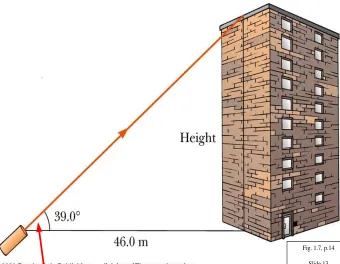
Example: how high is the building?
[image:29.720.28.368.126.390.2]Slide 13 Fig. 1.7, p.14
Known: angle and one side Find: another side
Key: tangent is defined via two sides!
I I . Math Review:
Scalar and Vector
Quantities
► Scalar quantities are completely described by
magnitude only (temperature, length,…)
► Vector quantities need both magnitude (size) and
direction to completely describe them
(force, displacement, velocity,…)
Represented by an arrow, the length of the arrow is proportional to the magnitude of the vector
Vector Notation
►
When
handwritten
, use an arrow:
►
When
printed
, will be in bold print:
A
►
When dealing with just the magnitude of a
vector in print, an italic letter will be used:
A
Properties of Vectors
►
Equality of Two Vectors
Two vectors areequal
if they have the samemagnitude and the same direction
►
Movement of vectors in a diagram
Any vector can be moved parallel to itselfMore Properties of Vectors
►
Negative Vectors
Two vectors arenegative
if they have thesame magnitude but are 180° apart (opposite directions)
► A = -B
►
Resultant Vector
Adding Vectors
►
When adding vectors,
their directions must
be taken into account
►
Units must be the same
►Graphical Methods
Use scale drawings►
Algebraic Methods
Adding Vectors Graphically
(Triangle or Polygon Method)
► Choose a scale
► Draw the first vector with the appropriate length and in the direction specified, with respect to a coordinate system
Graphically Adding Vectors
► Continue drawing the vectors “tip-to-tail”
► The resultant is drawn
from the origin of A to the end of the last vector
► Measure the length of R
and its angle
Graphically Adding Vectors
► When you have many vectors, just keep
repeating the process until all are included ► The resultant is still
Alternative Graphical Method
► When you have only two vectors, you may use the
Parallelogram Method
► All vectors, including the resultant, are drawn from a common origin
Notes about Vector Addition
► Vectors obey the
Commutative Law
of Addition
The order in which the vectors are added
Vector Subtraction
► Special case of vector addition
► I f
A
–B
, then useA
+ (-B
)► Continue with standard vector addition
Multiplying or Dividing a Vector
by a Scalar
► The result of the multiplication or division is a vector
► The magnitude of the vector is multiplied or divided by the
scalar
► I f the scalar is positive, the direction of the result is the
same as of the original vector
► I f the scalar is negative, the direction of the result is
Components of a Vector
► A
component
is a part► I t is useful to use
rectangular
components
These are the
projections of the
Components of a Vector
►
The x-component of a vector is the
projection along the x-axis
►
The y-component of a vector is the
projection along the y-axis
►
Then,
cos
x
A
=
A
θ
sin
y
A
=
A
θ
x y
A
A
=
+
A
More About Components of a
Vector
► The previous equations are valid
on ly if
θ is
m easu r ed w it h r esp ect t o t h e x - ax is
► The components can be positive or negative and will have the same units as the original vector
► The components are the legs of the right triangle whose hypotenuse is
A
May still have to find θ with respect to the positive
x-axis x y 1 2 y 2 x A A tan and A A
Adding Vectors Algebraically
►
Choose a coordinate system and sketch the
vectors
►
Find the x- and y-components of all the
vectors
►
Add all the x-components
This gives Rx:∑
=
xx
v
Adding Vectors Algebraically
►
Add all the y-components
This gives Ry:►
Use the Pythagorean Theorem to find the
magnitude of the Resultant:
►
Use the inverse tangent function to find the
direction of R:
∑
=
y yv
R
2 y 2 xR
R
R
=
+
I I I . Problem Solving Strategy
[image:47.720.16.301.63.478.2]Slide 13 Fig. 1.7, p.14
Known: angle and one side
Find: another side
Key: tangent is defined via two sides!
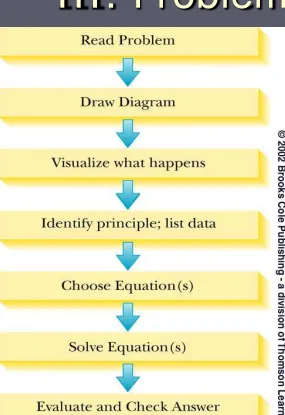
Problem Solving Strategy
►
Read the problem
identify type of problem, principle involved►
Draw a diagram
include appropriate values and coordinate systemProblem Solving cont.
►
Visualize the problem
►I dentify information
identify the principle involved
list the data (given information)Problem Solving, cont.
►
Choose equation(s)
based on the principle, choose an equation or set of equations to apply to the problem
solve for the unknown►
Solve the equation(s)
substitute the data into the equationProblem Solving, final
► Evaluate the answer
find the numerical result
determine the units of the result
► Check the answer
are the units correct for the quantity being found?
does the answer seem reasonable? ►check order of magnitude
Dynamics
►
The branch of physics involving the motion
of an object and the relationship between
that motion and other physics concepts
►
Kin em at ics
is a part of dynamics
I n kinematics, you are interested in thedescription
of motionPosition and Displacement
► Position is defined in terms
of a
frame of reference
Frame A:
x
i> 0
andx
f> 0
Frame B:
x’
i< 0
butx’
f> 0
► One dimensional, so
generally the x- or y-axis
A
B y’
x’ O’
Position and Displacement
► Position is defined in terms
of a
frame of reference
One dimensional, so
generally the x- or y-axis
► Displacement measures the
change in position
Represented as ∆x (if
horizontal) or ∆y (if vertical)
Vector quantity
►+ or - is generally sufficient to indicate direction for
one-dimensional motion
Unit s
SI Met ers ( m )
CGS Cent im et ers ( cm )
Displacement
(example)
Displacement measuresthe change in position
represented as ∆x or ∆y
m
m m
x x
x f i
70 10 80 1 + = − = − = ∆ m m m x x
x f i
Distance or Displacement?
► Distance may be, but is not necessarily, the magnitude of the displacement
Distance
(blue line)
Displacement
Position-time graphs
ConcepTest 1
An obj ect ( say, car ) goes fr om one point in space t o anot her. Aft er it ar r ives t o it s dest inat ion, it s
displacem ent is
1. eit her great er t han or equal t o 2. always great er t han
3. always equal t o
4. eit her sm aller or equal t o 5. eit her sm aller or larger
t han t he dist ance it t raveled.
ConcepTest 1
An obj ect ( say, car ) goes fr om one point in space t o anot her. Aft er it ar r ives t o it s dest inat ion, it s
displacem ent is
1. eit her great er t han or equal t o 2. always great er t han
3. always equal t o
4. eit her sm aller or equal t o 5. eit her sm aller or larger
t han t he dist ance it t raveled.
ConcepTest 1 (answer)
An obj ect ( say, car ) goes fr om one point in space t o anot her. Aft er it ar r ives t o it s dest inat ion, it s
displacem ent is
1. eit her great er t han or equal t o 2. always great er t han
3. always equal t o
4. eit her sm aller or equal t o 5. eit her sm aller or larger
t han t he dist ance it t raveled.
Average Velocity
► I t takes time for an object to undergo a displacement
► The
average velocity
is rate at which the displacement occurs► I t is a vector, direction will be the same as the
direction of the displacement (
∆
t is always positive) + or - is sufficient for one-dimensional motion
t
x
x
t
x
v
average f iMore About Average Velocity
►
Units of velocity:
►
Note:
other units may be given in a problem,but generally will need to be converted to these
Unit s
SI Met er s per second ( m / s)
CGS Cent im et er s per second ( cm / s)
Example:
s m s m t x v average 7 10 70 1 1 + = + = ∆ ∆ = Suppose that in both cases truck
covers the distance in 10 seconds:
Speed
►
Speed is a
scalar
quantity
same units as velocity
speed = total distance / total timeGraphical I nterpretation of Average Velocity
► Velocity can be determined from a position-time graph
► Average velocity equals the slope of the line
joining the initial and final positions
I nstantaneous Velocity
► I nstantaneous velocity is defined as the limit
of the average velocity as the time interval
becomes infinitesimally short, or as the time interval approaches zero
► The instantaneous velocity indicates what is happening at every point of time
t
x
x
t
x
v
f iUniform Velocity
►
Uniform
velocity is
constant
velocity
►
The instantaneous velocities are always the
same
Graphical I nterpretation of I nstantaneous
Velocity
► I nstantaneous velocity is the slope of the
tangent to the curve at the time of interest
► The instantaneous speed is the magnitude of
Average vs I nstantaneous Velocity
ConcepTest 2
The graph show s posit ion as a funct ion of t im e for t w o t rains r unning on parallel t racks. Which of t he follow ing is t r ue:
1. at t im e tB bot h t rains have t he sam e velocit y 2. bot h t rains speed up all t he t im e
3. bot h t rains have t he sam e velocit y at som e t im e before tB 4. t rain A is longer t han t rain B
5. all of t he above st at em ent s are t rue
Please fill your answer as question 3 of General Purpose Answer Sheet
A B
time position
ConcepTest 2
The graph show s posit ion as a funct ion of t im e for t w o t rains r unning on parallel t racks. Which of t he follow ing is t r ue:
1. at t im e tB bot h t rains have t he sam e velocit y 2. bot h t rains speed up all t he t im e
3. bot h t rains have t he sam e velocit y at som e t im e before tB 4. t rain A is longer t han t rain B
5. all of t he above st at em ent s are t rue
Please fill your answer as question 4 of General Purpose Answer Sheet
A B
time position
ConcepTest 2 (answer)
The graph show s posit ion as a funct ion of t im e for t w o t rains r unning on parallel t racks. Which of t he follow ing is t r ue:
1. at t im e tB bot h t rains have t he sam e velocit y 2. bot h t rains speed up all t he t im e
3. bot h t rains have t he sam e velocit y at som e t im e before tB 4. t rain A is longer t han t rain B
5. all of t he above st at em ent s are t rue
Note: the slope of curve B is parallel to line A at some point t< tB
A B
time position
Average Acceleration
► Changing velocity (non-uniform) means an acceleration is present
► Average acceleration is the rate of change of
the velocity
► Average acceleration is a vector quantity
t
v
v
t
v
a
average f iAverage Acceleration
► When the sign of the velocity and the
acceleration are the same (either positive or
negative), then the speed is increasing
► When the sign of the velocity and the
acceleration are opposite, the speed is
decreasing
Unit s
SI Met er s per second squar ed ( m / s2)
CGS Cent im et er s per second squar ed ( cm / s2)
I nstantaneous and Uniform
Acceleration
► I nstantaneous acceleration is the limit of the
average acceleration as the time interval goes to zero
► When the instantaneous accelerations are always the same, the acceleration will be uniform
The instantaneous accelerations will all be equal to the average acceleration
t
v
v
t
v
a
f iGraphical I nterpretation of
Acceleration
► Average acceleration is the
slope of the line connecting the initial and final velocities
on a velocity-time graph
► I nstantaneous acceleration
is the slope of the tangent
Example 1: Motion Diagrams
► Uniform velocity (shown by red arrows
Example 2:
► Velocity and acceleration are in the same direction
► Acceleration is uniform (blue arrows maintain the same length)
Example 3:
► Acceleration and velocity are in opposite directions
► Acceleration is uniform (blue arrows maintain the same length)