Full Terms & Conditions of access and use can be found at
http://www.tandfonline.com/action/journalInformation?journalCode=vjeb20
Download by: [Universitas Maritim Raja Ali Haji] Date: 11 January 2016, At: 19:09
Journal of Education for Business
ISSN: 0883-2323 (Print) 1940-3356 (Online) Journal homepage: http://www.tandfonline.com/loi/vjeb20
A 20-Year Examination of the Perceptions of
Business School Interns: A Longitudinal Case Study
Sherry James Cook, Amy Stokes & Richard Stephen Parker
To cite this article: Sherry James Cook, Amy Stokes & Richard Stephen Parker (2015) A 20-Year Examination of the Perceptions of Business School Interns: A Longitudinal Case Study, Journal of Education for Business, 90:2, 103-110, DOI: 10.1080/08832323.2014.988201
To link to this article: http://dx.doi.org/10.1080/08832323.2014.988201
Published online: 22 Dec 2014.
Submit your article to this journal
Article views: 79
View related articles
A 20-Year Examination of the Perceptions
of Business School Interns: A Longitudinal
Case Study
Sherry James Cook, Amy Stokes, and Richard Stephen Parker
Missouri State University, Springfield, Missouri, USAThe authors examined students’ attitudes toward specific elements of an ongoing internship program. The study sample consisted of 816 student interns from 25 different colleges and universities. Results indicate that despite significant changes in instructional design and the incorporation of new technologies into the learning environment, perceptions have remained relatively constant over the 20-year time frame studied.
Keywords: business, education, internships, student perceptions
Internships, cooperative education, or practicums offered by colleges of business are widely and commonly used and to some degree have become a requirement for finding a job after graduation. Providing student internships is hardly a new practice in business schools as they have been offered and studied for many years. Indeed, it is thought that the first true academic internship may have been offered by the Accounting Department at the University of Cincinnati in 1906 (Henry, Razzouk, & Hoverland, 1988). There can be little doubt that students’ perceived value of an internship has continued to increase, as in 1980 only one of every 36 graduates had completed an internship, whereas by 2008 that number had increased to one out of every two graduating seniors included an internship on their resume (Gardner, 2010).
Many of the advantages of having completed an intern-ship are very obvious. The student is given the chance to gain real-world experience in their chosen profession, the employer has the opportunity to see how a potential employee may fit into the organization, and the university gains credibility when they provide businesses with highly trained individuals as well as connections and contacts with organizations. Given that it would appear all of the partici-pants have considerable investments and much to gain from the internship being a good experience, it would seem vital that the perceptions of interns are fully understood. A longi-tudinal study conducted in 2002 concluded that interns’
perceptions had remained relatively constant over the 10-year reporting period (Cook, Parker, & Pettijohn, 2004). In this study, we have extended this study of interns’ per-ceptions to include a 20-year examination of perper-ceptions relating to the benefits of participating in an internship pro-gram. This extended longitudinal study allows for a contin-uous examination of perceptions so that both universities and businesses have the opportunity to continually adjust their programs as changing insights necessitate.
LITERATURE
Numerous studies examining both the positive and negative aspects of college internships have been conducted over the years. Hite and Bellizzi (1986), using a sample of 441 col-lege students, attempted to determine what the student’s expectations were toward internships in the marketing field. The results of their study stated that students indicated that an internship was a valuable learning experience, which should help supplement required course work. They also believed these internships should give them college credit, should require approximately 15 hours of work per week, should be paid, should be given a grade of pass–fail, and that they should receive direct training and supervision dur-ing their time with a corporation. The study further con-cluded that there are three reasons that an internship may not meet the student’s expectations. These reasons include (a) unclear standards related to the internship, (b) misunder-standing of the merits of the job, and (c) misrepresentation by the firm of the duties related to the internship position.
Correspondence should be addressed to Amy Stokes, Missouri State University, Department of Marketing, 901 S. National Avenue, Spring-field, MO 65897, USA. E-mail: [email protected]
ISSN: 0883-2323 print / 1940-3356 online DOI: 10.1080/08832323.2014.988201
Henry et al. (1988) considered these three areas of possible disappointment and recommended that internships begin in the junior year so the student is in a position to make a more informed academic or career choice, that potential interns be considered based on career goals and aspirations rather than simply grade point, work hours should be flexi-ble, and that an internship coordinator follow the interns’ progress so that problems and concerns are addressed immediately.
By the 1990s internships had become a valuable tool for business and students alike. When placement directors, graduates, and current students where asked what is the most effective recruiting strategy that a student could use, they all agreed the internship was the single best method a graduate could use in gaining employment (Scott, 1992). However, the internship was now being seen as a recruiting tool that may have both positive and negative outcomes. From the student’s perspective, internships offer the ability to see firsthand what is required in the area of business they are considering and if in fact they are suited for the posi-tion. Conversely, while employers agree that an internship gives them the opportunity to evaluate a prospective employee, they are also keenly aware of the cost of provid-ing that internship and the difficulty in designprovid-ing an intern-ship that provides a meaningful experience to the student (Scott, 1992). Other issues such as compensation, work-men’s compensation, unemployment insurance, Equal Employment Opportunity Commission guidelines, and gen-eral liability must also be addressed (Swift & Kent, 1999).
It is important for graduates to understand the traits and abilities those in industry see as being important and how an internship program helps prepare the prospective student for an entry level position. Indeed, it does appear that there are differences between businesses and graduates in terms of the importance of various skill sets. Businesses report that written communication is the most important skill fol-lowed by interpersonal skills and enthusiasm. Conversely, students indicate that oral communication was the most important skill set followed by written communication and interpersonal skills. However, both business leaders and students agreed that internships were the most effective method for obtaining these desired skill sets (Raymond & McNabb, 1993). Interestingly, businesses and students are coming to realize the importance of an internship. From the businesses’ perspective it is important to have an internship program as many of the best students are using this method for finding employment opportunities. Pianko (1996) noted some companies report hiring as many as 70% of their full time entry hires from the ranks of their internship program. It is thought that the company may cut their hiring expense in half while the intern may make as much as $2,000 more in starting salary than a new hire without an internship experience. Cannon and Arnold (1998) also reported that students are using internship programs as a method of gain-ing a competitive edge in the hirgain-ing process rather than
believing the internship program was a method for enhanc-ing their education. Interestenhanc-ingly, those students with lower grade point averages (GPAs) indicate that an internship experience should lead to being offered a full time position and thought that there should be fewer writing assignments associated with the internship experience. It is also interest-ing to note that Cannon and Arnold (1998) reported that those students not having had an internship experience believe more strongly that having an internship is beneficial in obtaining a full time position upon graduation. Cannon and Arnold also found that students see the internship pro-gram as being more of a way to gain employment rather than an experience designed to supplement their academic experiences. The work of Knouse, Tanner, and Harris (1999) supports the notion that those students completing an internship are more likely to find full time employment upon graduation. They suggest students who had completed an internship tended to be White, have higher overall GPAs, were slightly younger, and were more apt to find employment upon graduation than those students not hav-ing completed an internship. It was generally thought that an internship experience not only improved students’ GPAs while they were in school but also improved their chances of gaining immediate employment upon graduation.
It seems very clear that the perceived importance of an academic internship has continued to increase. As noted earlier, Coco (2000) reported the number of students taking advantage of an internship program rose from one in every 36 students in 1980 to three of four students in 2000. It was also reported that 92% of the responding schools offered an internship and that 39% of internships were completed in the senior year with 32% being completed during the junior year. Gauldt, Redington, and Schlagar (2000) reported that those students who participated in the internship program reported they found employment more quickly than those who did not participate in an internship program. Further, they reported that students with internships earned higher salaries and had higher levels of job satisfaction than those students not participating in the internship programs. Per-haps the level of job satisfaction was influenced by the fact that those companies employing interns reported they see these positions as being student-focused and were therefore more of a nurturing position rather than being an adversar-ial relationship (Knemeyer & Murphy, 2001). These authors further report that from the employer’s perspective, the most important benefits to the student involved in an internship program is that internships should develop a student’s job-related skills (94.6%) and communication skills (85%), and enhance the placement opportunity of the intern (90.3%), the student’s classroom instruction (89.3%), and the student’s problem-solving skills (87.1%). Barr and McNeilly (2002) also reported there are benefits that an internship offers that an individual may not learn in a classroom. They found 40% of responding employers indicate skills such as leadership and teamwork are learned 104 S. J. COOK ET AL.
far better in a working situation rather than in a classroom setting. Further, they reported that employers look at extra-curricular activities and work experience as indicators of whether or not a student might possess these skill sets as they require the student to set priorities, develop interper-sonal skills, and manage their time more effectively.
It has been suggested that if there are positive benefits to having completed a voluntary internship program then per-haps it would be wise for all students to be required to com-plete an internship as part of their normal course work (Divine, Linrud, Miller, & Wilson, 2007). Divine et al. sug-gested that if the internship program is left as an optional choice, the less motivated students may choose not to par-ticipate while they may be the ones that need the experience the most. Further, they suggest while there are the obvious benefits to the student, there are also benefits to be had by the academic departments requiring the internship, as well as the employers who participate in the program. The vari-ous academic departments have the opportunity to build a solid reputation by providing their industry partners with quality students, while gaining new business contacts that will serve as future employers of the department’s graduat-ing students. Clearly, the employer benefits from havgraduat-ing a trusted source of qualified and inexpensive labor. Divine et al. also note while there are numerous benefits to all of the stakeholders, there are also challenges that must be addressed if an internship is to be required of all students. These challenges include such things as putting a director in place, finding an adequate number of internship opportu-nities, and providing adequate oversight needed to make sure each member is receiving the benefits of the internship experience. While it would appear that requiring an intern-ship for all students might be a beneficial idea, there remain challenges in providing a gratifying experience. Knouse and Fontenot (2008) found that while the internship experi-ence is generally a beneficial experiexperi-ence in terms of greater employment chances and work related learning experien-ces, often programs could be improved. They recommend both students and employers must be actively involved, expectations must be made very clear, and activities such as mentoring and journaling should be included in the pro-cess. D’Abate, Youndt, and Wenzel (2009) also found when a host company is providing an internship they must be sure the work environment is seen as being a rewarding experience by the intern and that the intern feels good about the actual work he or she is being asked to perform. They also suggest the satisfaction levels students have with an internship is likely to have a substantial impact on their overall collegiate experience, as students feel the internship is a major part of their learning experience. Given the gen-erous amount of information that argues the benefits of an internship program, Weible (2010) suggested that most uni-versities are not getting as much as they could out of their internship programs. Weible found that while 95% of the
respondents in his study reported having some form of internship program, only a small number were gaining the full reward from those programs. He suggested, given the forecast of shrinking enrollments, the internship program serves as a strong attraction to a student as they help build the school’s reputation while providing a greater likelihood of finding immediate employment. These assertions were supported by a survey, which indicated that 81.6% of respondents indicated they would more likely enroll in a university that provided an internship experience and 81.9% of the respondents indicated that the reputation of the university was affected by whether or not they offered an internship experience. Weible concluded that given the perceived importance of offering an internship, support sys-tems need to be implemented that would help build even larger internship programs and would assure all students would have the opportunity to participate in this type of program.
Swanson and Tomkovick (2011) conducted a study of 352 companies providing academic internship experiences. Their main focus was to determine the perceptions that internship providers had of interns in terms of the most important skills and qualifications. The results of this study revealed that the three most important skills required on an intern were good communication skills, a positive attitude, and a strong work ethic or willingness to learn. It is of interest to note that Swanson and Tomkovick reported that an intern’s marketing and sales ability were rated the lowest of the skill sets in question. It was determined that if a student had not acquired the marketing and sales skill set in their academic studies the company would simply cease to hire interns from that uni-versity. They further found that over time intern recruiters tended to build relationships with professors and other uni-versity contacts and relied on these contacts to provide them with high-quality interns. This would seem to indicate that it would be difficult for an academic unit to require internships of all students as the less motivated or less qualified students would tend to damage the relationship that had been estab-lished as intern recruiters would only be interested in taking the best and most motivated students.
The literature paints a very clear picture of a win, win, and win scenario where internships are concerned. The stu-dent wins in that they gain experience working in the field they have chosen, gains experience that can be taken back to the classroom, and makes them more attractive to poten-tial employers. Businesses win as they are afforded the opportunity to hire highly qualified motivated students at a low price and are able to examine the quality of their work before they are actually hired. The university or academic department wins as through the hiring of highly trained stu-dents they continue to make contact with more businesses, are involved in community activities, fosters student recruitment, and builds a reputation for turning out high performing students.
While each of the studies examined in the literature rep-resents the perception of student interns or internship pro-viders at a specific point in time, it is also important to continue to examine these perceptions over time to deter-mine if changes in mindsets are taking place. For example, as the economy has taken a downturn in the last few years, do students now see the internship experience more as an employment tool rather than a learning tool? Our purpose in this study was to continue to examine student attitudes toward specific elements of an internship experience in a longitudinal manner. The results shown in a 20-year study should allow both internship providers and universities to gain a clearer understanding of what students value in an internship and if those feelings have changed or held con-stant over the years.
THEORETICAL BACKGROUND
In applying the knowledge transfer theory to internships, Narayanan, Olk, and Fukami (2010) proposed a model that details the actors involved in internships and distinguishes between internship antecedents, processes, and outcomes. They identified two outcome constructs: project completion and student satisfaction. They found each of their proposed antecedents to be indirectly related to the student satisfac-tion construct. The path most relevant for business peda-gogy included the following constructs: the helpfulness of university studies’ antecedent, student learning process, and ultimately student satisfaction as an outcome. Given business school instructors’ ability to directly influence each construct in this path, it is important to understand their relationship more fully. The results of this longitudinal study help illuminate elements of student satisfaction from the student prospective. This serves to strengthen our understanding of the path from the classroom to student sat-isfaction at the end of the internship experience. Therefore, while looking for changes or consistency across all mea-sured variables, this discussion looks specifically at the var-iables that fit into the previously mentioned path of this theoretical framework.
METHOD
Cook et al. (2004) indicated the most appropriate method of examining interns’ perceptions was to select interns who had participated in an internship program with the same firm, thus holding as many exogenous variables as constant as possible. The data collected for this study were compiled between 1992 and 2012. The company in question tradi-tionally holds an annual student meeting at the end of May with all of its interns from around the country attending. A self-response questionnaire was developed by the intern
coordinator and administered at this meeting. Each intern was given sufficient time to complete the questionnaire and the completed form was placed into a box to insure ano-nymity. As before, each respondent was asked to rate their level of agreement (strongly disagree, disagree, neutral,
agree, strongly agree) on a variety of internship related topics.
Sample
Over the 20-year time frame, the company participating in this study hired a total of 816 interns who worked in various parts of the country. These students represented a total of 25 universities, were considered full time students, were paid, and worked an average of 20 hours per week. Each student was asked a total of eight questions with the responses to these questions being shown in Tables 1–6. The responses for each question are shown as a trend line over the 20-year sample period in the Appendix.
RESULTS
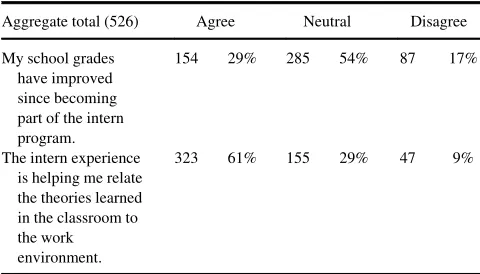
Each intern was asked if they believed the intern experience had provided them with the opportunity to learn to get along with people in work situations. The data in Tables 1 and 2 show that during the first 10-year period 87% indi-cated that they did believe this to be true. The data also shows that during the second 10-year period the positive response rate was 87%, showing a relatively constant belief that the internship was highly valued in this area. Interest-ingly, the level of agreement with the idea that the intern-ship experience helped them mature as a person was not quite as high. However, again each of the 10-year periods in question were very similar with the first 10 time frames, indicating a 78% agreement and the second time frame and showing a 81% agreement level. Overall, the idea that the internship program was a valuable experience saw a slight increase over time. The agreement level with this question in the first 10-year time frame was 89% and increased to 94% in the second 10 year that were examined. Data relat-ing to the academic experience are shown in Tables 3 and 4. Several past studies have indicated that the internship experience may lead to a higher GPA. However, the data collected in this study do not heavily support this notion, although a change has occurred in the timeframe studied. During the first 10-year time frame only 18% of the intern respondents agreed with the idea that internships lead to higher GPAs while the second 10 years showed an increase in agreement to 29%. However, when asked if the intern-ship experience was helping them relate classroom discus-sions to the work environment the trend was actually in the opposite direction. Whereas 66% of the respondents in the first 10-year time frame agreed with this idea, only 61% of 106 S. J. COOK ET AL.
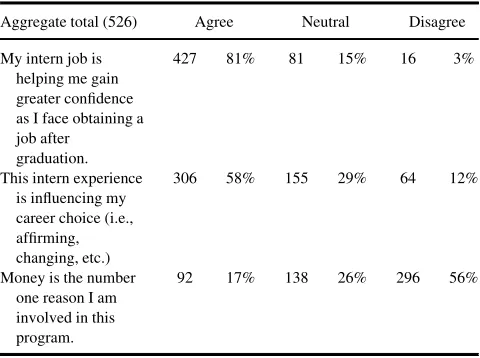
the respondents in the second time frame agreed that intern work experience helped them relate to classroom pedagogy. The data in Tables 5 and 6 provide information that indi-cates the internship has given the students in both time frames more confidence in finding employment after gradu-ation. During the first time frame there was a 78% agree-ment and there was a slight increase during the second time frame as 81% indicated that they had gained more confi-dence in finding employment after graduation as a result of having participated in the internship program. It was also interesting to find that the percentage of interns indicating the experience had influenced their career choice remained relatively constant at 57% in the first 10-year time frame and 58% in the second time frame. This fairly low percent-age is probably based on the fact that most students, coming into this as a junior, had already declared a major and had a fair idea of what type of career they were seeking. Again, the thought that money was a major reason for participating in the internship program was quite low with only 19%
agreeing in the first 10 year and 17% agreeing in the second 10-year period.
DISCUSSION
While the literature clearly points to the fact that a success-ful internship program benefits students, the university, and the company, there can be little doubt that if the program is not seen as being beneficial by the student the program will fail. Thus, determining the views of students is of para-mount importance for a successful program to exist. We believed it is more valuable to examine these student per-spectives in a longitudinal manner rather than simply taking a snapshot during a specific period of time. Many of our results continue to support past studies while some show conflicting data or trends.
The data shown in Tables 1 and 2 relate primarily to the intern’s perception of how he or she might have improved as a person. The data indicate that students’ perceptions agreed with Raymond and McNabb (1993) and Barr and McNeilly (2002) in that the internship has improved social and interpersonal skills in that they indicate they have gained or improved on their ability to get along with
TABLE 2
2002–2012—Intern Agreement Level: Personal
Aggregate totals (526) Agree Neutral Disagree
As a result of my intern experience, I feel that my ability to get along with people in work situations has improved.
457 87% 50 10% 19 4%
My intern experience is helping me mature as a person.
Aggregate totals (351) Agree Neutral Disagree
As a result of my
Aggregate total (351) Agree Neutral Disagree
My school grades
Aggregate total (526) Agree Neutral Disagree
My school grades
coworkers in a real working situation and have, to a degree, helped them become more mature individuals. The end result seems to be an overwhelming agreement that the internship was a very valuable experience. It would appear that the personal growth aspect of the internship is seen as being extremely important to the student. It may be inferred that the student does not perceive they are getting this train-ing or experience through the use of group projects or other social learning activities offered in the classroom experi-ence. If this is the case, from the university’s perspective, classroom activities should provide more focus on interper-sonal skills that the student may see as a valuable selling trait when searching for employment. From the employer’s perspective, the training an individual gets in interpersonal skills could be used as a valuable selling tool to lure a stu-dent into the internship program.
At the academic level the data reveals a mixed result. We did find some areas where the data departed from past work. While Knouse et al. (1999) found that generally the internship experience has some positive impact on grade point, the data reported here indicates that only 18–29% of the respondents agreed with this statement. Perhaps this is the result of many interns being juniors at the time they experience an internship and by that point their grade points are fairly established. Along this same line, when trying to relate the internship with the student’s academic experience the adage of the glass being half empty or half full comes into play. The data indicate that 66% of the respondents in the first 10-year time frame believed the internship helped them relate to the theoretical information presented in the classroom. While that was still a majority of respondents it was not as high as was expected. Further, it is very interest-ing to note that the percentage actually dropped from 66% to 61% during the last 10-year time frame indicating an even greater disconnect between the academic experience and the work experience. This may again mean that faculty should do a better job of connecting academic work to the experiences that interns are having on the job site, particu-larly because Narayanan et al. (2010) identified university studies as one of the antecedents related to student satisfac-tion. Even with heightened access to technologies that make the most up-to-date information available in the class-room, the disconnect between instruction and industry appears to be widening from the student perspective.
Our study does align with past research such as Scott (1992), Pianko (1996), Cannon and Arnold (1998), and Gauldt et al. (2000), showing students indicate that partici-pating in an internship program will be beneficial in finding employment after graduation. Indeed, the percentage of stu-dents indicating that the internship will be important in finding employment rose slightly from 78% in the first 10-year period to 80% in the most recent period. It well may be that the current economic situation is such that students are searching for anything that gives them an advantage in the job search. The importance or lack of importance of money has remained relatively consistent over the 20-year time frame. With only 18–19% of respondents indicating that money was a major reason for accepting an internship, it is relatively clear that companies must continue to focus on providing the student with instruction in interpersonal skills and future employment rather than believing that money is the student’s primary focus.
CONCLUSIONS
The 20-year longitudinal nature of this study provides valu-able insight into student’s perceptions of the internship experience and as such should serve to help both employers and universities design their internship programs so that students gain as much as possible from the experience.
TABLE 5
1992–2002—Intern Agreement Level: Money and Career
Aggregate total (351) Agree Neutral Disagree
My intern job is helping me gain greater confidence as I face obtaining a job after
2002–2012—Intern Agreement Level: Money and Career
Aggregate total (526) Agree Neutral Disagree
My intern job is helping me gain greater confidence as I face obtaining a job after
Perhaps the most important facet of this study is that the vast majority of students realize their internship was a valuable experience, which provided them with valuable improvement in their interpersonal skill set. It would be ideal if, as Devine et al. (2007) suggested, all students were required to participate in an internship thereby improving the interpersonal skills of all students as well as helping them relate real work experience to their classroom instruction. However, the practical limitations of finding hundreds, if not thousands, of quality intern-ships would seem to preclude this as a practical solu-tion. Further, sending less motivated students to valued employers may well damage relationships that have been cultivated over many years.
While the data presented in this study indicate that the perceptions of interns have not changed much over the 20 years in question, it would appear that classroom instruction has not changed much, either, as there still seems to be a disconnect between what is learned in an intern’s work situation and what is being taught in their classroom settings. Perhaps it would behoove university professors to focus more on improving a student’s inter-personal skill set by offering more team related projects, critical thinking activities, oral presentations, and prob-lem-solving activities thereby making the student a more valuable commodity to future employers. In this same vain, it would be useful to present the student with information stressing the importance of sharpening their interpersonal skills and how these skills are seen as being highly valued by industry employers. And, because interns are often seen as most valuable at the junior year level, and most often occur during the junior or senior years, perhaps these types of application ori-ented academic activities should be integrated into the curriculum much earlier and not saved for capstone projects at the end of a student’s academic program. This would also give students the opportunity to begin to develop interpersonal skills they need to get the internship position in the first place.
While the data presented here have been collected from one company it would be beneficial for future researchers to collect data on the perceptions of interns from multiple companies and multiple industries to determine if percep-tions differ across these various areas. Also, as many col-leges and universities focus intently on upgrading technology in the classroom or move to larger classes to reduce costs, more research needs to occur on how these changes impact the university–employer connection–dis-connect. If universities are using upgraded technology to present the same theory based information, or are simply lecturing more, rather than integrating more activities which enhance interpersonal skills related activities, one
may find this serves to misdirected efforts—both in terms of course development and financial resources.
REFERENCES
Barr, T. F., & McNeilly, K. M. (2002). The value of students’ classroom experiences from the eyes of the recruiter: Information, implications, and recommendations for marketing educators.Journal of Marketing Education,24, 168–173.
Cannon, J. A., & Arnold, M. J. (1998). Student expectations of collegiate internship programs in business: A 10-year update.Journal of Education for Business,73, 202–204.
Coco, M. (2000). A try before you buy arrangement.S. A. M. Advanced Management Journal,65, 41–43.
Cook, S. J., Parker, R. S., & Pettijohn, C. E. (2004). The perceptions of interns: A longitudinal case study.Journal of Education for Business, 79, 179–185.
D’Abate, C. P., Youndt, M. A., & Wenzel, K. E. (2009). Making the most of an internship: An empirical study of internship satisfaction.Academy of Management Learning & Education,8, 527–539.
Divine, R. L., Linrud, J. K., Miller, R. H., & Wilson, J. H. (2007). Required internship programs in marketing: Benefits, challenges and determinants of fit.Marketing Education Review,17, 45–52.
Gardner, P. (2010). The debate over unpaid college internships. Intern Bridge Report, 2010. Retrieved from http://www.ceri.msu.edu/wp- content/uploads/2010/01/Intern-Bridge-Unpaid-College-Internship-Report-FINAL.pdf
Gauldt, J., Redington, J., & Schlagar, T. (2000). Undergraduate business internships and career success: Are they related?Journal of Marketing Education,22, 45–53.
Henry, L. G., Razzouk, N. Y., & Hoverland, H. (1988). Accounting intern-ships: A practical framework.Journal of Education for Business,64, 28–31.
Hite, R., & Bellizzi, J. (1986). Student expectations regarding collegiate internship programs in marketing.Journal of Marketing Education,8, 41–49.
Knemeyer, A., & Murphy, P. R. (2001). Logistics internships: Employer perspectives.Transportation Journal,41, 16–26.
Knouse, S. B., & Fontenot, G. (2008). Benefits of the business college internship: A research review.Journal of Employment Counseling,45, 61–66.
Knouse, S. B., Tanner, J. T., & Harris, E. W. (1999). The relation of col-lege internships, colcol-lege performance, and subsequent job opportunity. Journal of Employment Counseling,36, 35–44.
Narayanan, V. K., Olk, P. M., & Fukami, C. V. (2010). Determinants of internship effectiveness: An exploratory model.Academy of Manage-ment Learning & Education,9, 61–80.
Pianko, D. (1996). Power internships.Management Review,85(12), 31–33. Raymond, M. A., & McNabb, D. E. (1993). Preparing graduates for the workforce: The role of business education.Journal of Education for Business,68, 202–205.
Scott, M. E. (1992). Internships add value to college recruitments. Person-nel Journal,71, 59–62.
Swanson, S. R., & Tomkovick, C. (2011). Perspectives from marketing internship providers.Marketing Education Review,21, 163–176. Swift, C. O., & Kent, R. (1999). Business school internships: Legal
con-cerns.Journal of Education for Business,75, 23–26.
Weible, R. (2010). Are universities reaping the available benefits internship programs offer? Journal of Education for Business, 85, 59–63.
APPEN
DIX
INTERN
AGREEM
ENT
LEVEL
20-YEAR
TREND
110
S.
J.
COOK
ET
AL.