• Tidak ada hasil yang ditemukan

The Line of Fit towards ASEAN Connectivity: Focus on the Philippine Political Structure and Processes | J. AGUJA | Jurnal Studi Pemerintahan: Journal of Government and Politics 1951 5597 2 PB

N/A
N/A
Protected

Academic year: 2017

Membagikan "The Line of Fit towards ASEAN Connectivity: Focus on the Philippine Political Structure and Processes | J. AGUJA | Jurnal Studi Pemerintahan: Journal of Government and Politics 1951 5597 2 PB"

Copied!
16
0
0

Teks penuh

(1)

The Line of Fit towards ASEAN

MSU-Iligan Institute of Technology, Iligan City, Philippines email: [email protected]

ABSTRACT

The Hanoi Declaration on the adoption of the Master Plan on ASEAN Connectiv-ity was adopted on 28 October 2010. It calls for a well connected ASEAN in line with the vision to put in place an ASEAN Community by 2015. The Declaration speaks of a three pronged approach for the achievement of the envisioned con-nectivity: Physical connectivity, that is, to connect ASEAN through enhanced physical infrastructure development; Institutional connectivity, that is, effective institutions, mechanisms and processes and; People to people connectivity for an empowered people across the region.The concern of this paper focuses on institutional connectivity that is basically anchored on the political component of the Master Plan. As it stands, various issues currently exist as ‘impediments to movement of goods, services and skilled labor across borders’. Needless to say, these issues are policy concerns requiring political decisions that hinge on the political sphere of every member country. It is on this point that this paper de-rives its relevance. In this regard, the paper argues for some fundamental re-structuring to reconfigure the attendant political processes of the country to better position itself to respond expeditiously to the challenges posed by the emerging regional ASEAN architecture.

Keywords: ASEAN connectivity, structures and processes, fundamental gover-nance principles, institutional connectivity

ABSTRAK

Deklarasi Hanoi yang diadopsi dari Master Plan Konektivitas ASEAN ditandatangani pada tanggal 28 Oktober 2010. Deklarasi ini bertujuan untuk mewujudkan konektivitas ASEAN yang sejalan dengan visi Komunitas ASEAN 2015. Deklarasi ini menggunakan tiga pendekatan yaitu: konektivitas fisik untuk menghubungkan ASEAN melalui peningkatan pembangunan infrastruktur; konektivitas institusional untuk efektivitas institusi, mekanisme dan proses; konektivitas masyarakat untuk memberdayakan masyarakat ASEAN yang lintas negara. Penelitian ini berfokus pada konektivitas institusional yang pada dasarnya berlandaskan pada komponen politik Master Plan. B e r b a g a i m a s a l a h y a n g a d a s a a t i n i m e r u p a k a n ‘ h a m b a t a n

Received 21 February 2016 Revised 13 March 2016 Accepted 17 April 2016

(2)

458

Vol. 7 No. 3 August 2016

bagi pergerakan barang, jasa dan tenaga kerja terampil lintas negara’. Masalah ini adalah masalah kebijakan yang memerlukan keputusan politik yang bergantung pada setiap negara anggota. Penelitian ini bertujuan untuk memberikan masukan dalam restrukturisasi yang mendasar untuk mengatur ulang proses politik oleh aparatur negara untuk memposisikan sehingga dapat menanggapi tantangan yang dihadapi ASEAN dengan lebih cepat.

Kata kunci: konektivitas ASEAN, strucktur dan proses, prinsip fundamental kepemerintahan, konektivitas institusional

INTRODUCTION

The envisioned emergence of an ASEAN community is very well on its way. To concretize the vision, the Hanoi Declaration on the adoption of the Master Plan on ASEAN Connectivity was adopted on 28 October 2010. It calls for a well-connected ASEAN in line with the vision to put in place an ASEAN Com-munity by 2015. While the Master Plan on ASEAN Connectiv-ity laid out with specific details all the various projects that cut across the ASEAN member countries, it is cognizant of the vari-ous issues that currently exist as ‘impediments to movement of goods, services and skilled labor across borders’(ASEAN Master Plan, 2012). Needless to say, these issues are policy concerns re-quiring political decisions that hinge on the political sphere of every member country. As such, it shall be the focus of this in-quiry through a content analysis of the underlying principles of the Master Plan for ASEAN Connectivity and juxtaposing it with the corresponding operative principles undergirding the Philip-pine political processes. It is on this point that this paper derives its relevance.

RESEARCH OBJECTIVES

While in the main, this paper’s major objective is to track the line of fit, or lack thereof, between the envisioned ASEAN Com-munity and the specific policy trajectory of the Philippines as a member state towards ASEAN Connectivity, this paper will look specifically into the following concerns:

(3)

459

JOURNAL OF GOVERNMENT & POLITICS 2. The fundamental organizing principles undergirding the

Phil-ippine Polity.

3. The line of fit between these specific organizing principles; and

4. Policy recommendations to address dissonance, if any.

THE ANALYTICAL FRAMEWORK

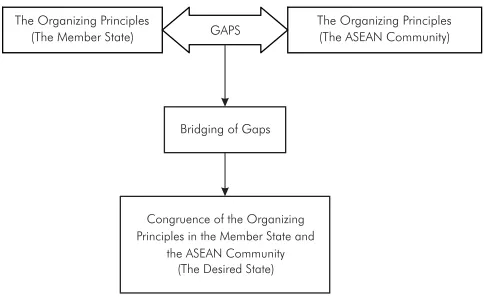
With the effort to create an ASEAN community grounded on a workable ASEAN connectivity architecture, the need to harmonize the organizing principles operative in each member state to that of the emerging ASEAN community architecture becomes a primordial concern. Principles governing the work-ings of the system acquire a particularly significant role in actual operation. There is therefore a need to ascertain whether the pronounced principles are congruent with each other so as to facilitate the ASEAN community building process. Consequently, the dissonance if any, between the organizing principles undergirding each member state and the emerging ASEAN com-munity must thus be identified for possible bridging through policy intervention and advocacy work. The ultimate goal is the institutionalization of a harmonious working relations grounded on commonality of operating principles. The schematic diagram below is adapted as the research framework for analysis.

(4)

460

Vol. 7 No. 3 August 2016

THE ASEAN COMMUNITY: THE ORGANIZING PRINCIPLE

The Hanoi Declaration on the adoption of the Master Plan on ASEAN Connectivity was adopted on 28 October 2010. It calls for a well-connected ASEAN in line with the vision to put in place an ASEAN Community by 2015. The Hanoi Declara-tion bespeaks of a three pronged approach for the achievement of the envisioned connectivity: Physical connectivity, that is, to connect ASEAN through enhanced physical infrastructure de-velopment; Institutional connectivity, that is, effective institu-tions, mechanisms and processes and; People to people connec-tivity for an empowered people across the region.

Of the three pronged approach for the establishment of a well-connected ASEAN, it is the connectivity on the institutional level that appears to be the most defining component of the pack-age. It establishes the necessary legal regime to facilitate the whole process of interconnectedness. As to its coverage, the key ele-ments of institutional connectivity involve the following (ASEAN Master Plan, 2012):

1. Trade liberalization and facilitation

2. Investment and services liberalization and facilitation 3. Mutual recognition agreements /arrangements 4. Cross border procedures

5. Capacity building programmes

The building blocks of ASEAN institutional connectivity is anchored on the principles of liberalization and facilitation of trade, investments and services. These principles are the same operative principles governing the functioning of the General Agreement on Tariff and Trade since 1947 (Irwin,1995) and sub-sequently of the Word Trade Organization since 1995 (Zeiler, 1999).

(5)

461

JOURNAL OF GOVERNMENT & POLITICS through the instrumentalities of the International Monetary Fund

(IMF) and the World Bank. Known as the Bretton Woods twins, these two institutions served as the overseer of the global eco-nomic order through the establishment of the General Agree-ment on Tariff and Trade and eventually the World Trade orga-nization (WTO) in 1995. These are exactly the same organizing principles followed by the ASEAN in its effort to create the ASEAN Community by 2015, thus further requiring some ex-planatory details as to how the system works.

THE BRETTON WOODS SYSTEM: THE INTERNATIONAL

ECONOMIC ORDER

At the end of the Second World War, the United States (US), as the succeeding hegemon, assumed the responsibility and the opportunity to establish and maintain an international economic order that was to characterize the post war trading relations. It was ideologically inclined to a world economy open to trade and investments. The War had greatly enhanced its productive ca-pacity- doubled as a matter of fact- and it was imperative that after the War, she be able to export her industrial surplus with-out restraints, or face a possible return to depression (Lichauco, 1976).

(6)

462

Vol. 7 No. 3

August 2016 the use of controls designed to restrict imports and outflow of capital and maximized exports.

The US believed that to promote free trade on a global basis, it was necessary to create a transnational agency which would assist nations afflicted with deficits in their international trade accounts. The basic rationale for this is that, a nation in deficit is impelled to control and limit imports. Hence, nations in deficit should be given temporary assistance so that they will not be compelled to do anything that would limit their importation of goods; so that they will not think of resorting to import and exchange controls, as they did in the thirties (Lichauco,1976:14). To address these issues, the International Monetary Fund and the World Bank were conceived. These institutions were designed at a conference held at Bretton Woods in the New Hampshire Mountains in 1944. Though these institutions are international agencies, they are likewise controlled by the US which holds enough voting power to dominate decisions (Constantino, 1977: Hudson 2003).

The immediate tactical function of the IMF is to provide tem-porary relief to member countries suffering from a shortage of international currency due mainly to their transactions in for-eign trade. The IMF’s twin, the World Bank, discharges a supple-mental function, which is to promote the mobility and freedom of investments. Thus, The IMF promotes maximum freedom in the international flow of goods and commodities while the World Bank promotes maximum freedom in the international move-ment of investmove-ment capital (Lichauco, 1976:15).

THE UNDERLYING IDEOLOGY OF THE GLOBAL

ECO-NOMIC ORDER

(7)

463

JOURNAL OF GOVERNMENT & POLITICS the ideology clearly reflects the US desire for world economic

order on the basis of free trade and is enshrined in the Charter of the IMF. The second element is the belief in the efficiency of private international capital to undertake the reconstruction and development of the world’s economy and, therefore, the neces-sity to promote foreign investments. This element of the ideol-ogy of the international economic order is embodied in the pur-poses of the World Bank (lichauco, 1976:12).

To concretize the workings of the international economic or-der based on the Bretton Woods principles, the General Agree-ment on Tariffs and Trade (GATT) was first signed in 1947. It was a multilateral agreement regulating international trade. Ac-cording to its preamble, its purpose was the “substantial reduc-tion of tariffs and other trade barriers and the eliminareduc-tion of preferences, on a reciprocal and mutually advantageous basis.” The agreement was designed to provide an international forum that encouraged free trade between member states by regulating and reducing tariffs on traded goods and by providing a com-mon mechanism for resolving trade dispute (Zeiler, 1999). Over the years, GATT evolved through several rounds of negotiations. The last and largest GATT round, was the Uruguay Round which lasted from 1986 to 1994 and led to the creation of the World Trade Organization (WTO) in 1995. Whereas GATT had mainly dealt with trade in goods, the WTO and its agreements has ex-panded GATT coverage and now cover trade in services, and in traded inventions, creations and designs (intellectual property).

THE ORGANIZING PRINCIPLES OF THE PHILIPPINES

POLITY

(8)

Consti-464

Vol. 7 No. 3

August 2016 tution even warns Government officials that “[they] may be

re-moved from office, on impeachment for, and conviction of, cul-pable violation of the Constitution… (ART XI. Section2).

Having in mind the overall governing principles underlying the international economic order (Bretton Woods System) adopted by the ASEAN in its envisioned community through institutional connectivity, it is now appropriate to juxtapose the organizing principles of the Philippine Polity to see the line of fit or lack thereof towards ASEAN connectivity. While the global order and the envisioned ASEAN Community are predicated on the concepts of free trade, openness, internationalization and the like, it is now interesting to see what the Philippine Consti-tution says about these very same organizing principles.

While these days, the buzz words are internationalization and moving beyond borders, the Philippines is still encased in its parochialism, reminiscent of the State System of Westphalia. It still speaks of an educational system that must ‘foster patriotism and nationalism’ (Art. II, section 17). Its pursuit of foreign policy is still grounded on considerations dictated by ‘national sover-eignty, territorial integrity, national interest, and the right to self-determination’ (Art. II, section 7). It still envisions the develop-ment of ‘a self-reliant and independent national economy effec-tively controlled by Filipinos’ (Art. II, section 19).

(9)

465

JOURNAL OF GOVERNMENT & POLITICS Filipino citizens, or corporations or associations at least sixty per

centum of whose capital is owned by such citizens… The State shall protect the nation’s marine wealth in its archipelagic wa-ters, territorial sea, and exclusive economic zone, and reserve its use and enjoyment exclusively to Filipino citizens’… (Art. XII, section 2).

Further, the Constitution mandates the Congress of the Phil-ippines to “reserve to citizens of the PhilPhil-ippines or to corpora-tions or associacorpora-tions at least sixty per centum of whose capital is owned by such citizens, or such higher percentage as Congress may prescribe certain areas of investments. The Congress shall enact measures that will encourage the formation and operation of enterprises whose capital is wholly owned by Filipinos … (Art. XII, section 10).

In the grant of rights, privileges and concessions covering the national economy and patrimony, it gives preference to qualified Filipinos (Art. XII, section 10). This provision goes further by emphasizing that “…the practice of all professions in the Philip-pines shall be limited to Filipino citizens, save in cases prescribed by law (Art. XII, section 14). Still further, the Constitution re-quires that “…the ownership and management of mass media shall be limited to citizens of the Philippines, or to corporations, cooperatives or associations, wholly-owned and managed by such citizens…Only Filipino citizens or corporations or associations at least seventy per centum of the capital of which is owned by such citizens shall be allowed to engage in the advertising indus-try. The participation of foreign investors in the governing body of entities in such industry shall be limited to their proportion-ate share in the capital thereof, and all the executive and manag-ing officers of such entities must be citizens of the Philippines law’ (Art. XVI, section 11).

(10)

466

Vol. 7 No. 3

August 2016 principles of the envisioned ASEAN community. To address this

dissonance is an urgent matter that the Philippines would have to look into; otherwise, the inconsistencies and contradictions in the organizing principles would clash making it difficult to create a sound political and economic architecture that would serve as basis for governance in the ASEAN community. And this, as already noted, would necessitate some changes in the Constitution of the Republic of the Philippines.

PROSPECTS FOR CONSTITUTIONAL REVISION IN THE

PHILIPPINES

That the Philippine Constitution needs to be amended to be attuned with the emerging ASEAN architecture is no longer an issue. The Pulse Asia in a national survey in December 2001 observed that, for the first time in a decade, a slim majority of the people (52%) favored changing the Constitution (Abueva, 2002). Another survey conducted in May 2006 indicated that 64 % of Filipinos favor charter change (Jurado, 2006). Indeed, the time has come to commence the search for an alternative mode of governance in the country. Subsequent surveys likewise validate the increasing receptivity of the people to effect changes in the Charter. What is not clear however, is what changes should be effected in the paramount law of the country.

(11)

467

JOURNAL OF GOVERNMENT & POLITICS On the political front, this dilemma is magnified further by

the political arrangements attendant in a presidential system of government that the country has. With its separation of powers and functions coupled with coequality among the three separate branches of government, the entire government apparatus is prone to deadlocks particularly if different political parties are in control of the separate branches of government.

This particular issue on the structure of government was not substantially looked into by the framers of the Constitution. A former member readily admits that in 1986 when the present Constitution was drafted, ‘emotions were high and the major pre-occupation was how to ensure in the speediest way possible the restoration of the democratic processes…[it] was not the best time to engage in protracted debates, especially about the funda-mental government structure’ (Bernas, 1993). Those who argued for a parliamentary set up lost to those who argued for a presi-dential structure by only one vote (Abueva, 2002). Also on the same vein and by a margin of one vote, it was decided to restore the Senate whose members are elected at large and thereby to return to bicameralism in law-making (Nolledo, 1987). Likewise, if brevity is a virtue, the Philippine Constitution suffers from being ‘one of the longest in the world…[with] infirmity arising from compromises that resulted in more than fifty of its provi-sions, including major ones, requiring enabling laws by Congress before they can be implemented’ (Casiple, 2002). This loopholes subject the Constitution to the prevailing political equation in the legislative department.

(12)

468

Vol. 7 No. 3

August 2016 has swept the world since the collapse of the former Soviet Union. In this rapid modernizing time where democratization is a com-mon feature, only two forms of government are relevant: Presidentialism and Parliamentarism (Sosmeòa, 2001).

CHANGING THE FUNDAMENTAL GOVERNMENT

STRUC-TURE

As to the appropriate political structure to be set in place, political scientists contributed their insights on the matter. Dr. Jose V. Abueva (2002) of the University of the Philippines summed it all when he said: “Political Scientists have concluded that democracies with a parliamentary system are more stable and productive”. For their part, Juan Linz and Anuro Valenzuela (1994) observed that South America, which is the continent of presidentialism, rarely, if ever, produced lasting political democ-racy. They further noted that the most stable democracies of Europe have been parliamentary regimes while most countries with presidential constitutions have been unstable democracies or authoritarian regimes. Professor Fred Riggs of the University of Hawaii also joined the discourse with the observation that the presidential system has not succeeded anywhere except the United States (Sosmeòa, 2001).

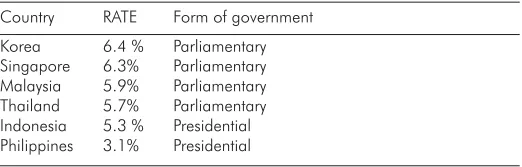
TABLE 130 YEAR AVERAGE GDP GROWTH RATES OF SELECTED ASIAN COUNTRIES AND THEIR FORM OF GOVERNMENT

(13)

469

JOURNAL OF GOVERNMENT & POLITICS Asian countries is also very telling. The table below is indicative

of the correlation between governmental type and economic per-formance. Fast growing Asian economies noticeably have parlia-mentary governments while the slow performing economies have presidential governments.

While the above table shows the link between economic growth and political structures, the table that follows shows the proneness to corruption of certain political structures. It does not come as a surprise to see that the presidential political set up has failed to bring economic growth in countries that has adopted it because it is also the political system that has brought forth the most number of very corrupt leaders in the world.

Contributory to this proneness to corruption is the manner by which the president in the presidential system gets elected. Unlike his counterpart in the parliamentary system who gets elected by members of the parliament, a presidential candidate needs to campaign all over because he is elected at large. And this is no mean feat. In 1998 for instance, a serious presidential candidate in the Philippines was expected to spend at least Php 2 billion for his election that was to land him a job that would pay him Php 693,000 per year or Php 4,158,000.00 for his full term of six years. Two billion pesos are certainly a large sum of money. It is the equivalent of the salaries of the office for 2,886 years! (Enrile, 2002)

If these tabulated statistics is to tell us something, former Prime Minister Lee Kuan Yew of Singapore has become its spokesman. He said: “The Philippines has chosen the most difficult political system to operate, with its checks and balances and gridlocks between the executive and the legislature. If this were the system chosen by South Korea, Hong Kong, Taiwan, or we ourselves, we would not have attained the status that we have now” (Enrile, 2002). One can no longer overemphasize the necessity of chang-ing the structure of government in the Philippines.

(14)

470

Vol. 7 No. 3

August 2016 conducive with the emerging ASEAN regional architecture. In

parliamentary systems, the decision of the parliament binds the entire government, as there is a fusion of the executive and legis-lative assemblies. Decision making is expedited for implementa-tion. In contrast, the presidential set up in the Philippines can keep hostage the other branches on the ground of coequality and separation of powers. If there is disagreement emanating from both the executive and the legislative branches, the likeli-hood of resolution is remote given that the two branches are technically separate and equal. Any branch of government can be at the mercy of the other especially so if political parties of different persuasions are in control of the other branches. This is a structural dilemma that must also be addressed as the coun-try revisits its fundamental law.

CONCLUSIONS AND RECOMMENDATIONS

After surveying the ideological landscape that undergirds the workings of the Philippine polity and that of the envisioned ASEAN Community, the following conclusions are warranted: 1. The ASEAN Community is envisioned to operate on the

(15)

471

JOURNAL OF GOVERNMENT & POLITICS 3. Putting side by side the organizing principles underlying the

creation of the ASEAN Community and the operating prin-ciples governing Philippine polity, one observes lack of con-gruence and harmony in the principles in operation.

4. By way of recommendation, the Philippines is urged to break free of its parochial outlook and inject openness in the eco-nomic provisions in its Constitution so as to enable the gov-ernment to respond to the opportunities and challenges posed by the emerging ASEAN community. Moreover, it is recom-mended that the structure of government be horizontally struc-tured to shift from presidential to parliamentary and verti-cally structured to shift from unitary to a federal set up. These structural changes are proposed to make the Philippine gov-ernment more responsive to the challenges borne by the sweep-ing changes in the global arena.

REFERENCES

Abueva, Jose V. (2002). Towards a Federal Republic of the Philippines with a Parliamen-tary Government by 2010. Marikina: Center for Social Policy and Governance. Bernas, Joaquin G., S.J.(1993). “To Amend or Not to Amend But How?” The Manila

Chronicle, 19 May 1993.

Casiple, Ramon C. (2002). Imperative for Constitutional Reform. A Paper Presented at the All-Parties Conference Technical Working Group, 27 April 2002, ACCEED Center, Asian Institute of Management.

Constantino, Renato. (1977). Insight and Foresight: Selected Excerpts annotated by Luis Mauricio. Quezon city: Foundations for Nationalist Studies.

Coronel, Shiela S., Yvonne T. Chua, Luz Rimban and Booma B. Cruz. (2004). The Rulemakers: How the Wealthy and Well-Born Dominate Congress. Quezon City: Phil-ippine Center for Investigative Journalism.

Enrile, Juan Ponce. (2002). The Presidential System Has Failed Us, Let Us Change It. A paper delivered before the Laban ng Demokratikong Pilipino (LDP) Legislative Agenda Workshop held at the Holiday Inn, Mimosa, Clark, Pampanga. July 19, 2002. Hudson, Michael. (2003). Super Imperialism: The Origin and Fundamentals of U.S. World

Dominance, 2nd ed. London and Sterling, VA: Pluto Press.

Irwin, Douglas A. (1995). “The GATT in Historical Perspective,” American Economic Re-view Vol. 85, No. 2.

Jurado, Emil P. (2006). “Senate Becoming Irrelevant”, Philippine Graphic, Vol.17 No. 5, July 10 2006.

Lichauco, Alejandro. (1976).The International Economic Order and the Pphilippine Expe-rience, a paper prepared for a convocation of the student body of St. Scholastica College, September 3, 1976, Manila Philippines.

(16)

472

Vol. 7 No. 3 August 2016

Nolledo Jose N.(1987). The Constitution of the Republic of the Philippines Explained. First Edition. Manila: National Bookstore.

Sosmeòa, Gaudioso Jr. C. (2001). Philippine Federal Republic: Progression or Retrogres-sion?. A paper Presented to the Strategic Studies Group, National Defense College of the Philippines (NDCP), 29 May 2001.

Villacorta, Wilfredo V. (2002). Fundamental Issues on Changing the Constitution. A Paper Presented at the National Political Summit, Manila Hotel, 3 May 2002.

Gambar

FIGURE 1: THE SCHEMATIC DIAGRAM OF THE ANALYTICAL FRAMEWORK
TABLE 130 YEAR AVERAGE GDP GROWTH RATES OF SELECTED ASIAN COUNTRIES AND THEIR FORM OF GOVERNMENT

Referensi

Dokumen terkait