T
he U.S. Army Corps of Engineersconstructed and now operates and maintains a water infrastructure network across the United States that includes dams, levees and coastal barriers for lood protection; locks and dams for inland navigation; ports and harbors; and hydropower facilities. Historically, the construction of new infra-structure dominated the Corps’ water resources budget and activities. Today, national water needs and priorities increasingly are shifting to operations, maintenance, and rehabilita-tion of existing
infrastructure, much of which has exceeded its design life. For example, approximately 95 percent of the dams operated by the Corps are more than 30 years old, and 52 percent have reached or exceeded the 50-year economic service lives for which they were designed. Since the mid-1980s, dwindling federal
resources have limited funds available for water infrastructure operations, maintenance, and rehabilitation, and there is a considerable backlog of deferred maintenance.
This report is the second in a series of ive reports from the Committee on U.S. Army Corps of Engineers Water Resources Science, Engineering, and Planning, provides
observations and advice in three broad areas related to Corps water resources infrastructure: the federal Water Resources
Development Act process; considering priorities for operations, maintenance, and rehabilitation; and investment options for Congress, the administra-tion, and the Corps.
Corps Mission Areas
The Corps’ irst mission area was to help ensure navigability on the nation’s rivers. In the 1920s and 1930s, the Corps mission areas broadened to include lood control. Over the years, the Corps’ mission areas have further diversiied to include respon -sibilities for ecosystem restoration, hydropower generation, port and harbor maintenance, water supply, hurricane and storm damage reduction, and recreation. Each of these missions differ signiicantly in terms of enabling legislation, taxation and revenue sources, clients, and relations with the private sector. Its distinctive and diverse water infrastructure, speciic roles in the national economy, and clientele and history make the Corps a unique organization. Many potential solutions to operations, mainte-nance, and rehabilitation challenges are, therefore, speciic to the Corps.Over the past century, the U.S. Army Corps of Engineers has built a vast network of water management infrastructure that includes approximately 700 dams, 14,000 miles of levees, 12,000 miles of river navigation channels and control structures, harbors and ports, and other facilities. Since the mid-1980s, federal funding for new project construction and major rehabili-tation has declined steadily. As a result, much of the nation’s water resources infrastructure is now deteriorating and wearing out faster than it is being replaced. This report explores the status of operations, maintenance, and rehabilitation of Corps water resources infrastructure, and identiies options for the Corps and the nation in regard to setting maintenance and reha -bilitation priorities.
Corps of Engineers Water Resources Infrastructure:
Deterioration, Investment, or Divestment?
Figure 1. Crumbling concrete at the U.S. Army Corps of Engineers LaGrange Lock on the Illinois River.
In an earlier era, it was easier to integrate a smaller number of missions, and to share expertise and experience among them. Today, however, the larger number of responsibilities makes agency-wide integration dificult. The Corps faces challenges in its operations, maintenance, and rehabilitation duties given that its roles, partnerships, and successes in one mission area are not transferred easily to other areas or activities.
Greater private sector involvement often is raised as one option for increasing revenues for public agen-cies or works. Opportunities for greater public sector involvement in Corps infrastructure operations and maintenance activities vary by mission area and economic sector. In general, these opportunities are greater for lood risk management, port and harbor maintenance, hydropower generation, and less for inland navigation.
Inland Navigation
The nation’s inland navigation system consists of a network of locks and dams on large rivers that play a key role in interstate commerce. One option for increasing revenue for operations, maintenance, and rehabilitation needs is lockage fees, but fee proposals historically have met strong resistance from users. Parts of the system could be decommissioned and divested, but it is more likely that the lock and dam network will be modiied by gradual deterioration rather than any planned decommissioning.
Flood Risk Management
Reductions in federal funds for constructing new lood control works may necessitate wider use of nonstructural lood risk management options, such as building codes and zoning regulations. Many of these strategies already have been implemented successfully in some parts of the country and may be more efi -cient and less costly alternatives to structural options. Nonstructural lood control options have not always received full consideration because of a historical emphasis on large, engineered civil works for lood protection.
Hydroelectric Power
Hydropower revenues could be increased by
increasing the eficiency of turbines and related power generation facilities at Corps hydropower projects. The Tennessee Valley Authority, for example, imple-mented eficiency improvements in the 1980s and 1990s that increased hydropower generation 34 percent. According to some estimates, hydropower projects could generate at least 20 percent more power with eficiency improvements and current water lows,
providing signiicant new revenues. Because of its revenue-generating potential, hydropower is in a good position to use public-private partnerships to increase capacity and reliability. Some modiication of oper -ating regulations by the U.S. Congress, however, will be needed to realize this potential.
Systematic Asset Management
An up-to-date water resources infrastructure inven-tory, with information on infrastructure conditions, beneits, and risks, would make it easier to prioritize operation, maintenance and rehabilitation projects. The Corps has begun a more systematic approach to infrastructure asset management over the past decade, but progress has been slow. To further promote these efforts, the Corps should continue to develop more comprehensive, publicly-accessible inventories for each of its core mission areas.
Federal Funding for Corps Water Resources
Infrastructure
Funding for Corps water resources infrastructure comes primarily from the federal government, in the form of annual appropriations for operation, mainte-nance, and minor rehabilitation, and periodic legislation for new construction under the Water Resources Development Act (WRDA). Annual appro-priations include some funds for construction related to infrastructure rehabilitation.
The irst Water Resources Development Act was in 1974, and there have been nine subsequent Water Resources Development Act bills. The Corps of Engineers, the executive branch, and the U.S. Congress all play important and distinct roles in the Water Resources Development Act process. The Corps of Engineers conducts studies of potential projects, including beneit-cost analysis and engi -neering and environmental evaluations. Completed Corps reports are reviewed by the Ofice of
Management and Budget, which conducts its own beneit-cost assessment. Subject to approval by the Ofice of Management and Budget, project proposals are forwarded to Congress for possible Water
Resources Development Act authorization.
priorities. Setting a higher priority on these issues will require some reorientation by the Congress and the executive branch from their present, strong focus on Water Resources Development Act.
Economic Principles and Future Investments
Wise infrastructure investments will not necessarily repair Corps infrastructure to the same coniguration that existed in the 1940s or 1950s. Instead, future operations, maintenance, and rehabilitation invest-ments could be guided by principles based on economics of infrastructure investment. A 2003 National Research Council report that studied national freight transport offered the following set of invest-ment and economic principles that meritconsideration. They are summarized as:
•
Economic eficiency, with investments directed to improvements that yield greatest beneits.•
Limit government involvement to circumstances in which market-based outcomes clearly would be highly ineficient. Government also is responsible for managing facilities where it has important historical responsibilities that would not be easily altered, and where institutional complexity neces-sitates government leadership.•
Limit government subsidies and ensure that facility beneiciaries pay the costs.•
Rely more on user revenues, and the “user pays” principle, along with matching funds and strong public-private relations.Options for Corps
Water Resources
Infrastructure
Due to insuficient funding, many portions of the Corps of Engineers’ water infrastructure are not being maintained at acceptable levels of performance and eficiency. There is, however, no single, obvious path forward for alternative funding mechanisms to main-tain or upgrade existing Corps infra-structure. The report’s authoring committee considered the range of options available to the Corps, the U.S. Congress, the administration, and Corps project beneiciaries, identifying several potential future paths that might be taken:Option 1 Business as usual
Funding from the Corps annual budget has been declining steadily and is inadequate to cover all opera-tion, maintenance, and rehabilitation needs. Under the business-as-usual option, the Corps will continue to operate its existing water infrastructure with inad-equate funding for all operations, maintenance and rehabilitation needs. This will entail more frequent infrastructure failure and negative social, economic, and public safety consequences. The potential extent of these negative consequences is not well understood. Barring action from Congress and the administration to allow signiicant changes in current business models and available federal funding, the status quo may be the most likely path forward.
Option 2 Increase federal funding for operations, maintenance and rehabilitation
There has been a long-term declining trend in funding for Corps water resources infrastructure construction and rehabilitation across numerous federal budgets. The future viability of this option is not clear.
Option 3 Divest or decommission parts of Corps infrastructure
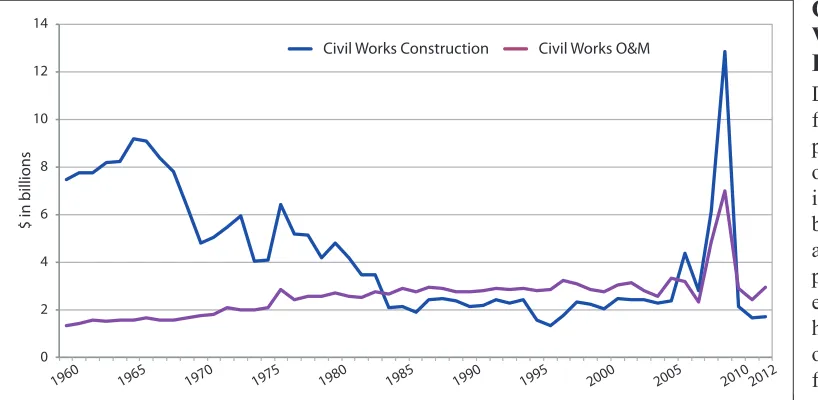
Decommissioning obsolete projects, or divesting of projects of decreased importance to the Corps mission, would help the Corps focus on the highest priority Figure 2. Corps of Engineers appropriations between 1960 and 2012. Since 1960, Corps operations
and maintenance budgets have increased steadily, while construction and rehabilitation budgets have
decreased signiicantly. Exceptions include appropriations for post-Katrina construction activities and
funding through the American Recovery and Reinvestment Act in 2009. Even these one-time increases
in funding were insuficient to reduce substantially the backlog of authorized projects or meet
operations, maintenance and rehabilitation needs. Prices are adjusted to 2012 dollars. Source: U.S. Army Corps of Engineers.
$ in billions
Civil Works Construction Civil Works O&M
2 4 6 8 10 12 14
0
maintenance needs. However, the Corps does not have the authority to do this, and instead seeks to provide safe and eficient operations of all infrastructure, given available resources. Giving the Corps the authority to decommission or divest responsibility for some water infrastructure components would require action by Congress or the administration.
Option 4 Increase revenue from Corps project beneiciaries
Opportunities exist for expansion of revenue capture from water resources infrastructure, especially for inland navigation and hydropower projects. However, legal and other barriers will necessitate congressional action to expand such revenue streams.
Option 5 Expand partnerships
Some components of the Corps water infrastructure entail shared responsibilities and activities with private entities. In some cases the private sector could operate Corps water infrastructure with increased eficiencies or reduced costs. Partnerships between public and private entities could help bring new resources to the operation, maintenance, and rehabilitation of Corps water infrastructure.
The best opportunities for additional public-private partnerships for Corps water infrastructure are not immediately clear. Establishing such partnerships is complicated, may take years to develop, and is affected by many site-speciic, unique circumstances.
Committee on U.S. Army Corps of Engineers Water Resources, Science, Engineering, and Planning: David A. Dzombak (Chair), Carnegie Mellon University; Patrick A. Atkins, ALCOA (ret.), Pittsburgh; Gregory B. Baecher, University of Maryland, College Park; Linda K. Blum, University of Virginia; Robert A. Dalrymple, Johns Hopkins University; Misganaw Demissie, Illinois State Water Survey, Champaign; Terrance Fulp, U.S. Bureau of Reclamation, Boulder City, Nevada; Larry A. Larson, Association of State Floodplain Managers, Madison, Wisconsin; Diane M. McKnight, University of Colorado, Boulder; J. Walter Milon, University of Central Florida, Orlando; A. Dan Tarlock, Chicago-Kent College of Law, Chicago; Peter R. Wilcock, Johns Hopkins University; Jeffrey Jacobs (Study Director), Sarah E. Brennan (Program Assistant), National Research Council.
The National Academies appointed the above committee of experts to address the speciic task requested by the United States Army Corps of Engineers. The members volunteered their time for this activity; their report is peer-reviewed and the inal product signed off by both the committee members and the National Academies. This report brief was prepared by the National Research Council based on the committee’s report.
For more information, contact the Water Science and Technology Board at (202) 334-3422 or visit http://dels.nas.edu/wstb. Copies of Corps of Engineers Water Resources Infrastructure: Deterioration, Investment, or Divestment? are available from the National Academies Press, 500 Fifth Street, NW, Washington, D.C. 20001; (800) 624-6242; www.nap.edu.
Permission granted to reproduce this brief in its entirety with no additions or alterations.
Permission for images/igures must be obtained from their original source.
© 2012 The National Academy of Sciences
Read or purchase this report and locate information on related reports at http://dels.nas.edu/wstb
Given these complexities and uncertainties, an evalua-tion of partnership opportunities would help identify the most immediate, promising prospects. This evalu-ation would be best conducted by an entity outside of the Corps of Engineers with relevant expertise and knowledge of water infrastructure operations and inancing.
Option 6 Some combination of options 2–5
The Need for Federal Leadership
The Corps of Engineers clearly faces challenges in setting priorities for maintenance and rehabilitation projects and in procuring funding for the work. Many of these challenges are rooted in political issues and decisions, and resolving them will require leadership and cooperation from the U.S. Congress and executive branch. The lack of procedures for prioritizing opera-tions, maintenance, and rehabilitation projects limits eficient investments in critical Corps infrastructure, and inhibits the Corps ability to divest or decommis-sion water projects.