IN
DAN BROWN’S
ANGELS AND DEMONS AND ITS BAHASA
INDONESIA VERSION
A THESIS
Presented in Partial Fulfillment of the Requirements for the Attainment of a Sarjana Sastra Degree in English Literature
by :
Rizal Rustoni Maulana
10211144031
ENGLISH LITERATURE STUDY PROGRAM
ENGLISH EDUCATION DEPARTMENT
FACULTY OF LANGUAGES AND ARTS
YOGYAKARTA STATE UNIVERSITY
v
Dedications
I dedicate this thesis to my Parents who always give me
supports, prayer and motivation.
A bunch of thanks is addressed to my beloved
Fia Nurasita Prastiwi
for giving me spirit, support and for being my best
partner in everything.
To all of my friends, I hope our brotherhood will last
forever. I believe someday we will make our dream come
vii
ACKNOWLEDGEMENTS
Bismillahirrohmanirrohim, Alhamdulillah, in the Name of Allah, the most Gracious and the most Merciful. I am willing to express my thanks to everyone who has helped me, especially in finishing this thesis. All of honors are just for Allah Azza Wajalla, the Almighty.
I would not have been possible to finish this thesis without the help and support from my beloved parents, H. Moh Toni and Hj. Rustiningsih. I would like to thank them for the prayers, support, affections, advices, guidance, instruction and help in my life journey. They are my first love. I would also like to express my gratitude to all my beloved family members; my brother Bramanta Hamdi Rustoni and my sister Alisya Rahmawati,
I am deeply grateful to Dr. Faraz Umaya and Prof. Dr. Nahiyah Jaidi Faraz for supporting and giving me so much advice. Their help could never be replaced with anything.
viii
I would also like to express my gratitude to all lecturers of English Literature Study Program, who transferred much knowledge and also for the guidance, inspiration, instruction and help during my study at the university.
I would like to thank my partner, Fia Nurasita Prastiwi, for her support, love and motivation and also for always being at my side whenever I need. I would like to thank my beloved brothers Muhammad Hanif, Oky Aditya, Medy Agung, Editya Noverdian, Aji Widiatmaja, Rizky Nanang Abadi for the friendship and all the cheerful days we spent together.
I would like to express my gratitude to the rest of classmates: Catur, Tria, Winda, Wulan, Qowy, Koko, Aga, Ririn, Amel, Risty for giving me a cheerful and joyful world and beautiful togetherness.
This thesis is far from being perfect, but it is expected that it will be useful not only for researchers, but also for the readers. For this reason, suggestions and criticisms will be appreciated to make this thesis better.
Yogyakarta, December 2016
ix
TABLE OF CONTENTS
Page
TITLE ... i
APPROVAL SHEET ... ii
RATIFICATION ... iii
PERNYATAAN ... iv
DEDICATIONS ... v
MOTTOS ... vi
ACKNOWLEDGEMENTS ... vii
TABLE OF CONTENTS ... ix
LIST OF TABLES ... xii
LIST OF FIGURES ... xiii
LIST OF ABBREVIATIONS ... xiv
ABSTRACT ... xv
CHAPTER I: INTRODUCTION ... 1
A. Background of the Research ... 1
B. Research Focus ... 3
C. Objectives of the Research ... 4
D. Significance of the Research ... 4
CHAPTER II: LITERATURE REVIEW ... 6
A. Theoretical Reviews... 6
1. Translation ... 6
x
3. English Loan Word Adaptation in Indonesian ... 15
a. Definitions ... 15
2. The Adjustment of English Loan Words in the Novel ... 37
3. The Translation Method Used to Translate the English Loan Words ... 37
B. Discussions ... 39
xi
c. Translated Word ... 41
2. The Spelling Adjustment of the English Loan Words in the Novel ... 42
a. Spelling Adjustment of Single Vowel ... 42
b. Spelling Adjustment of Double Vowels ... 45
c. Spelling Adjustment with Single Consonant ... 48
d. Spelling Adjustment of Double Consonants ... 51
e. Adjustment of Affixes ... 54
3. The Translation Method Used to Translate the English Loan Words in the Indonesian Version of Novel ... 55
a. Translation Method Closer to SL ... 55
b. Translation Method Closer to TL ... 56
CHAPTER V: CONCLUSIONS AND SUGGESTIONS ... 57
A. Conclusion ... 57
B. Suggestions ... 59
REFERENCES ... 60
xii
LIST OF TABLE
Page
Table 1: Spelling Adjustment with Single Vowel ... 15
Table 2: Spelling Adjustment with Double Vowels ... 16
Table 3: Spelling Adjustment with Single Consonant ... 17
Table 4: Spelling Adjustment with Double Consonant ... 17
Table 5: Suffixes Adjustment in EYD ... 19
Table 6: Type of English Loan Words ... 37
Table 7: Type of Spelling Adjustment ... 37
xiii
LIST OF FIGURES
Page
Figure 1: Larson’s Model of the Process of Translation ... 9
Figure 2: Types of Translation Method by Newmark ... 21
Figure 3: Novel Angels and Demons English Version ... 26
Figure 4: Novel Angels and Demons Bahasa Indonesia Version ... 26
xiv
LIST OF ABBREVIATIONS
SW : Simple Word
CW : Complex Word
TW : Translated Word
1V : Single Vowel
2V : Double Vowel
1C : Single Consonant
2C : Double Consonant
CC : Consonant Cluster
AFF : Affixes
LT : Literal Translation
FT : Faithful Translation
ST : Semantic Translation
FRT : Free Translation
AD : Adaptation
IT : Idiomatic Translation
xv
SPELLING CHANGES OF ENGLISH LOAN WORDS TRANSLATION
IN DAN BROWN’S ANGELS AND DEMONS ANDITSBAHASA translation in the Indonesian version of the Angels and Demons novel. The aims of the study are: (1) to describe the types of English loan words found in the Indonesian version of Angels and Demons novel, (2) to describe the spelling changes on the English loan words found in the Indonesian version of Angels and Demons novel, and (3) to describe the translation method used to translate the English Loanwords in the Indonesian version of Angels and Demons novel.
The study applies the descriptive qualitative method applying the content analysis technique. The data are taken from the English and Indonesian version of
Angels and Demons novel. Corpuses of the data were in the forms of loan words in Indonesian.
The findings of the research show that: First, there are three types of loan words found in the Indonesian version of the novel, they are English loan word in the form of simple words with 61 occurrences or 61.00%, in the form of complex word has 38 occurrences or 38.00% and in the form of translated word has 1 occurrences or 1.00%. Second, there are six types of spelling adjustment used to translate the loan words in the novel, they are single vowel adjustment with 5 occurrences or 5.00%, double vowels adjustment with 10 occurrences or 10.00%, single consonant adjustment with 42 occurrences or 42.00%, double consonants adjustment with 25 occurrences or 25.00%, consonant cluster with 1 occurrences or 1.00%, and affix adjustment with 17 occurrences or 17.00%. Third, there are only five translation methods used to translate the loan words from SL to TL, they are literal translation method with 97 occurrences or 97.00%, faithful translation method with 0 occurrences, free translation with 0 occurrences, adaptation method with 0 occurrences, and communicative translation method with 3 occurrences or
xvi
1
This chapter explains about four parts, first background of the research,
research focus, objective of the research, and the last significance of the research.
The background of the research describes about information why this research is
conducted. After that, in the focus of the research, the problems are formulated
into specific questions. Furthermore, the research objectives are to define about
the types of loan words, describe about spelling changes of English loan words
and to describe about the translation method used to translate the English loan
words found in the Indonesia version of angels and Demons novel. Finally, the significance of the research describes about benefit of this thesis.
A. Background of the Research
A language plays significant roles in human life. People need a language
to communicate and deliver or express feeling, ideas or thought. A language can
also function as an identity of a nation. Therefore, there are hundreds of languages
that become the identity of all nations in the world.
As a means of communication, the language needs to be mastered in order
to exchange ideas, thought, feeling and many more. The functions of the
language become more important in this modern era. It requires people to master
languages other than their national language or mother tongue. There are some
benefits if people can understand more than one language. The language is the
window of information, knowledge, and culture from other countries as well as a
2
However, not all people are able to speak and understand foreign
languages. This contributes to create some gaps that occur through the
communication in different languages. There are many reasons why people cannot
understand what people say in other languages, such as lack of vocabulary
mastery, lack of translation proficiency, bad listening and bad speaking skills. To
overcome such problems, translation is needed.
Translation process is needed to help those who do not understand or
master foreign languages. A translator translates a source language (SL) or foreign
language into the Target Language (TL) or their own language so that the message
can be understood by people in the target language. However, translation process
is not easy either. A translator may find difficulties when translating a certain term
like religious terms or cultural terms from SL to TL. That is why many translators
using loan words to translate the TL into the SL to achieve the most equivalent
and similar meaning.
The difficulties in translating certain terms are also experienced by the
translator while transferring Angels and Demons into its Indonesian version
Malaikat dan Iblis. The problem that the translator often faces is the unavailability of the exact translation of the English term in the original novel into its Indonesian
translation, such as the term chapel and tabernacle. To translate such terms, the translator uses loan words.
Therefore, the researcher is interested in the way the translator translates
using English loan words procedure from the English version of the novel into its
Indonesian version. The researcher is interested to study more about the use of
happen during the translation processes. The example of English loan word used
in the Indonesian version of a novel is “Kapel”. It is the loanword from the English term “Chapel”. From the comparison Chapel change into Kapel in Bahasa
Indonesia, it can be seen that there are spelling and pronunciation changes in the translation process. So, the researcher is interested to study about this case.
To satisfy the researcher‟s interest, he decides to bring the novel into a
study entitled Spelling Changes of English Loan Words Translation in Dan Brown's Angels and Demons and its Bahasa Indonesia version.
B. Research Focus
Due to time and resource limitation, it is impossible for the researcher to
cover all of problems. Therefore, the researcher focuses only on the spelling
changes of English loan words translation in the Indonesian version of the novel.
The researcher inspects any English loan words that are found in the novel and
checks what the changes are.
Based on the background above, there are some problems that can be taken
into a study. The first problem is related to the vocabulary. Some English words
do not have exact translation in Indonesia. It makes problems when a native
English speaker tries to translate English into Indonesian and vice versa. The
second problem is the structure of the sentence. English has different sentence
structure from Indonesia. The different sentence structure will affect the process
of translating English to Indonesian and vice versa. The third problem is the
spelling. There are some spelling changes that happen when a loan word is
4
Based on the descriptions in the previous part, the researcher formulates
the research problems as follows.
1. What are the English loan words found in the Indonesian version of Angels
and Demons novel?
2. What is the spelling changes happened to the English loan words in the
Indonesian version of Angels and Demons novel?
3. What is the translation method used to translate the English loan words in
the Indonesian version of Angels and Demons novel?
C. Objectives of the Research
Based on the formulation of the problems above, the objectives of the
research are as follows:
1. To describe the types of English loan words found in the Indonesian
version of Angels and Demons novel,
2. To describe the spelling changes of the English loan words found in the
Indonesian version of Angels and Demons novel, and
3. To describe the translation method used to translate the English loan
words in the Indonesian version of Angels and Demons novel.
D. Significance of the Research
In accordance with the formulation of the problems and the objectives of
the research, this study is expected to give contribution to the following parties:
1. Students of the study program of English Language and Literature
majoring in linguistics study. The result of this research will be used as
2. Readers of this study. The result of the research is expected to provide
data, information and examples of the translation technique, specifically
the translation using English loan words.
3. Other researchers concerning on the study of loan word. The result of the
study is expected will be useful as a starting point to conduct a further
6
CHAPTER II
LITERATURE REVIEW
This chapter is consist into four parts, namely theoretical descriptions,
conceptual framework, and analytical construct. The theorecital description covers
the definition of translation, loan words, spelling adjustment, translation method
and summary of Angels and Demons novel. The previous studies part describes brief explanation of studies related to loan words. The conceptual framework
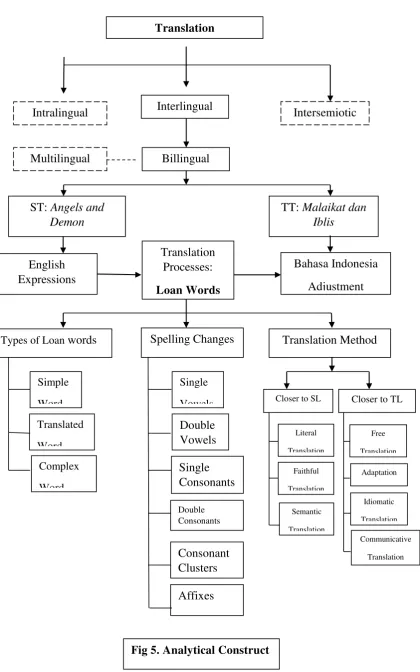
explains the theories applied by the researcher, while the analytical construct
provides a concept map of the theories employed in this thesis.
A.Theoretical Reviews 1. Translation
a. Notions of Translation
Nowadays, there are a number of translation definitions made by
translation experts. Newmark (1988:5) defines translation as transferring the
meaning of the Source Language (SL) text into the Target Language (TL) in the
way that the author intended the text. This idea is the same as what Larson
(1984:3) conveys that translation is basically a change of form from the SL into
the TL that refers to the actual words, phrases, clauses, sentence, and paragraph
etc, which is spoken or written. This means that in translating the text‟s meaning
of the SL must be the same with that in TL.
Another expert, Nida (1991:33) states that translating consists of
message of the source language; both in the term of meaning and style. The
definition made by Nida explains that translator has to be able to preserve the
meaning though the source text consists of cultural message.
From all of definitions above, it can be concluded that basically translation
is a process of transferring the message from one language (SL) into another
language (TL) without changing the meaning. Meaning is the highest priority that
should be concerned in reproducing the message. If the meaning is out of context,
it is not considered as a good translation.
b. Types of Translation
Many scholars have defined translation in various ways. Furthermore,
there are also some classifications of translation types by some experts. Roman
Jakobson. (in Hatim and Mynday, 2004:5) classifies translation into three types
which are put as follows:
1) Intralingual translation or rewording
Intralingual translation interprets verbal signs of language by means of
other signs in the same language. The expressions translated into different
expression or texts in the same language. Paraphrasing sentences, simplifying a
novel, and rendering poems into prose are some examples of intralingual
translation.
2) Interlingual translation or translation proper
Interlingual translation is an interpretation of verbal signs of language by
8
Interlingual translation can be seen in the translation of literary works into
different languages.
3) Intersemiotic translation or transmutation
Intersemiotic translation is an interpretation of verbal signs of language by
means of signs of non-verbal sign systems. It involves the use of signs or signals
to communicate. Intersemiotic translation can be applied in some systems such as
sign language or traffic signs.
c. Translation Process
As stated by Newmark (1988: 19), the translation process begins with
choosing the method of approach. There are two approaches in the process of
translating. First is starting to translate sentence by sentence in order to get
the feel and the feeling tone of the text, and then deliberately sits back,
reviews the position and reads the rest of the SL text. Second is reading the
whole text two or three times, finding the intention, register, tone, marking the
difficult words and passage and starting translating only when a translator has
taken his bearing.
Newmark further adds that the danger of the first method is that it
may leave the translator too much revision to do on the early part, and is
therefore time wasting, while the second method can be mechanical. He
suggests that alternatively, the first method is suitable for the literary text and
the second one is for the technical or an institutional text. It can be resumed that
the first approach is for relatively easy text, while the second one is for the
translator temperament (for the first method) or the translator‟s competence of the
analysis (for the second).
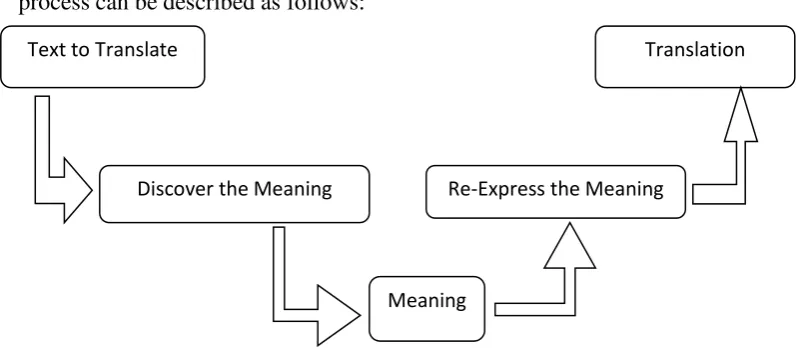
The process of the translation is formulated by Larson (1984: 4). The
process can be described as follows:
Figure 1: Larson’s Model of the Process of Translation
The above figure shows that the process of translation is transferring the
meaning or message of the source language into the target language from the form
of source language to the form of target language by way of semantic structure.
The meaning which is being transferred must be held constant, only the form is
change. The form which the translation is made will be called the SL and the form
onto which it is to be changed will be called the TL.
Translation is not an activity that is simply translating each word or phrase
from the SL into the TL, but it is a complex process since it tries to find the
equivalence of meaning or message in the TL. One of the reasons why there is a
process of translating which becomes the guideline to make an appropriate
translation is about how a translator has to give all his/her effort of capability even
his/her cognitive aspect.
Text to Translate
Meaning
Discover the Meaning Re-Express the Meaning
10
The process of translation itself is not simple. Some factors can influence
this activity, and it turns, they will also influence the final product of translation
process. The factors could be linguistic, cultural and personal factors. Larson
writes:
Translation consists of studying the lexicon, grammatical structure, communication situation, and cultural context of the source language text, analyzing it in order to determine its meaning, and then reconstructing this same meaning using the lexicon and grammatical structure which are appropriate in the target language and its cultural context (Larson, 1984: 3)
Each of these factors can seriously interfere with the translator‟s judgment
and selection, and ultimately materialized in one form or another in the final
translation. A clear systematic understanding of the existence and operation of
these factors may help translator grasps the complicated nature of translating and
design effective strategies to counter negative influences.
2. Loan Words
a. Notions of loan words
There are many theories about loanwords, one of them created by Mona
baker. The phenomenon occurs when use loan words in the source text. The target
language cannot find the equivalence of the terms in the target language. The
source language sometimes has the term whose the concept is unavailable in the
target language. Another difficulty may also occur when the loan word exists in
the target language but has different meaning. It may happen since the term is the
target language develops. For example English has the word “oregano” that has no
Meanwhile, Robins (1989: 235) says loan words are words borrowed
from one language to another. Words are generally loaned when two different
cultures come into contact with each other. This might be because of immigration,
trade, fashions or foods, the arts, technologies, or wars. Robins has pointed out
that:
“Wherever there are culture contacts of any sort between the
speakers different languages, this means virtually everywhere, speakers will make use of words from other languages to refer to things, processes, and ways of behavior, organization, or thinking, for which words or phrases were not available or convenient in their own language hitherto. Some of the foreign words so used by individual speakers pass into general currency in the language, being altered in pronunciation in the process in the direction of the sounds and phonological patterns of the language acquiring them. These are known as loan words (1989:235).
Loan words are also called borrowings. In one of his early works Haugen
(in Sure, 1993: 330) defines borrowing as the attempted reproduction in one
language of patterns previously found in another language.
In language development, Bahasa Indonesia gets some influences from
other languages such as Dutch, Spain, Arabic, French, and especially English.
Sure defines that:
“When in two languages we find no trace of exchange of loan-words, one way or another, we are safe to infer that two nations have had nothing to do with each other. But if they have been in contact, the number of loan-words and still more the quality of the loan-loan-words, if rightly interpreted will inform us of their reciprocal relations, they will show us which of them has been the more fertile in ideas and in what domains of human activity each has been superior to the other.”(1993: 331 -332).
Hence, the effect of the influence that has occurred between Bahasa
12
Indonesia and English. Robins says any prolonged cultural contact, especially
with speakers of a language who enjoy political power or prestige in any sphere,
leads to a considerable amount of borrowing of vocabulary from that language in
spheres concerned (1989: 235). Normally, loan words are assimilated to the
phonetic sound classes and the phonological patterns of the borrowing language,
the original consonants and vowels being replaced by consonants and vowels as
close to them as are available. Thereafter, synchronically as opposed to
historically, they are no longer recognizable by their form as loans.
However, Robins (1989: 236-237) says that in certain cases words
continue to be recognized and treated as foreign in origin, and attempts are made
to pronounce them as such, English coupon and restaurant, when pronounced with
a final nasalized vowel, and rouge and garage, when pronounced with final / ʒ /,
which does not occur finally except in a few loans. There is a tendency for
doublets of such words to appear, assimilated and unassimilated, depending on
the attitude or background of the speaker. He also says loan words occur by audio,
which means by sense of hearing. A stranger says these loan words and then
Indonesian people imitate it, according to what they heard. Because of the English
phonological system is different with Bahasa Indonesia system, the imitations of
their speech sounds based on the ability of tongue to pronounce it. Thus Dutch
domme krach when pronounced as dongkrak, Sanskrit utpatti pronounced as
As previously described, the use of term “real estate” is caused by
Indonesian people thought that there is no equivalent word in Bahasa Indonesia
for its word. It is some common case if there are no equivalent words in Bahasa
Indonesia for some foreign words, so that Indonesian people refer to pronounce
real estate into realestat. The word realestat is commonly used by Indonesian people who work on the field of entrepreneurship or industrial sector. Basically,
the changing form caused by the lenition (the process of weakened articulation of
a consonant that causing the consonant to become lost) of phonemes /e/ in the end
of words, such as accurate, chocolate, and dictate which is pronounced with
akurat, coklat and diktat. For example: Realestat Bumi Serpong translates into
Bumi Serpong Realestat.
Based on the restrictions above, it can be seen that the loan words is the
process of borrowing from another language and less adapted to loan the rules of
language.
b. Types of Loan Words
Samsuri (1994:43) mentioned that there are three types of English loan
words: simple words, complex words, and translated words.
1)Simple Words
The characteristics of English loan words in the form of simple word are:
a. There is no change in the pronunciation of loan words. The only thing which
is adjusted into Indonesian is the spelling. This category can be seen in the
14
b. The pronunciation of English loan words is adapted to Indonesian, while the
spelling is not adjusted to Indonesian. The example is the word „audit‟:
[„ ô : d I t]→ [a u d i t]
The use of English loan word above can also be combined with Indonesian affixes
such as mengaudit from the word audit. 2) Complex Words
Here, both morphemes (letters) and phonems (sounds) of English loan
words are adapted into Indonesian. The examples of this second category can be
seen in the words solusi and relatif. The word solusi which is adapted from English deals with a change both in the spelling (solution→ solusi) and pronunciation:
[s ə „ l u : ∫ n]→ [s o l u s i]
The same thing happens with the word relatif, where there is a change in
the both spelling (relative→ relatif) and pronunciation
[„ r e l ə t I v]→[r é l a t i f]
English loan words in the form of complex words can also be combined
with Indonesian affixes, for example solusinya. 3) Translated Words
Translated word can be defined as English expression which is translated
into Bahasa Indonesia. The example of translated word is strategi bisnis which is translated from English business strategy. The word should be translated based on
the Indonesian grammatical rule which is defined as word modifier that consists
3. English Loan Word Adaptation in Bahasa Indonesia
a. Definitions
Sayogie (2009: 61) says that based on the level of its integration in the
absorption of Bahasa Indonesia, it can be divided into three major categories.
First, the element is no longer needed to change its spelling, such as trailer,
audiogram, unit, etc. Second, the foreign elements that have not been fully
absorbed into Bahasa Indonesia, like shuttle cock, real estate. These elements are
used in Bahasa Indonesia context, but the pronunciation still follows foreign
ways. Third, the foreign elements both of the pronunciation and writing rules were
adapted into Bahasa Indonesia.
b. Types of spelling adjustment
In general the process of adaptation of the English loan words into
Indonesian can be divided into three groups, they are:
1) Adjustment of Spelling
The foreign language spelling is changed as needed, so Indonesian form
can be compared to its original form. For example, synonym becomes sinonim,
ecology becomes ekologi, and syllabus becomes silabus.
The rules of foreign terms absorption in Bahasa Indonesia are described in the tables below (Alwi, 1988: 396 -399).
a) Spelling Adjustment with Single Vowel
Table 1 : Spelling Adjustments with Single Vowel
# Rules English Indonesian
16
2 e which is not pronounced is released phoneme fonem 3 i does not change when appears at the beginning of a word before a vowel ion ion 4 u does not change structure struktur
b) Spelling Adjustment with Double vowels
Table 2 : Spelling Adjustments with Double Vowels
# Rules English Indonesian
c) Spelling Adjustment with Single Consonant 6 t is changed into s, when it appears before vowel i and its pronunciation is
/s/ action aksi
7 v does not change television televisi 8 x does not change when it appears at the beginning of word xenon xenon 9 x at the other position, is changed into ks executive eksekutif 10 y, when its pronunciation is /y/, does not change yangonin yangonin 11 y is changed into i when its pronunciation is /i/ synonym sinonim 12 z does not change zenith zenith
d) Spelling Adjustment with Double Consonants
Table 4 : Spelling Adjustments with Double Consonants
# Rules English Indonesian
18
12 sc before vowels a,o, u, or the consonant is changed into sk scandium skandium 13 sc before vowels e, i, and y is changed into phoneme s scenography senography 14 sch before vowels is changed into sk schema skhema 15 th is changed into t theocracy teokrasi 16 xc before vowels e or i, is changed into ks exception eksepsi 17 xc before vowels a, o, u, and the consonant, is changed into ksk excavation ekskavasi 18 Double consonants are changed into single consonant except when there are
consonants which can make difference in meaning accu aki
2) Adjustment of Consonant Clusters
The adjustment of consonant clusters are not translated and accepted
into Bahasa Indonesia, if possible to maintain its visual form. For example:
3) Adjustment of Affixes
The adjustment of affixes can be classified in two groups; adjustment
of suffix and adjustment of prefix. The adjustment of suffix is absorbed
into Bahasa Indonesia as a part of full words. The words such as
standardisasi (Standar +disasi), implementasi (implement +tasi) and obyektif
(obyek +tif) are full absorbed, instead of standar, implemen, and obyek. The adjustment of prefix is as follows: aberration become aberasi, anemia become
anemia.
Another expert, Kridalaksana, has a statement that the loan words
used in Indonesia must be based on Ejaan yang Disempurnakan (EYD / The Standard Indonesian Spelling System). According to Kridalaksana (1993),
bl- Blastula bl- blastula
cl- Clinic kl- klinik
there are rules of using letter, spelling the letter, spelling the word, spelling
the loan words, and using the punctuation mark. To enable people to
understand the rules of English loan words spelling, there are two theories
that discuss the spelling of English loan words, namely EYD (2001: 40-52)
and Pedoman Pembentukan Istilah (The Guideline of Technical Terms (1990: 1171-1178).
The adjustments of English loan words into Indonesian based on EYD
(2001: 40-52) are divided into two, the first one is the adjustment of spelling
and adjustment of suffixes. In the matter of adjustment of spelling, the EYD
has great similarity to Alwi‟s spelling adjustment describes in the previous
part of this sub chapter above, but it adds more suffixes adjustments. The
suffixes adjustment of English loan words according to EYD is as follows.
20
13 -tion is changed into -si production produksi 14 -ic, -ics, -ique is changed into -ik or -ika. logic, technique logika, teknik 15 -ein does not change casein kasein 16 -ism is changed into -isme terrorism terorisme 17 -ist is changed into -is egoist egois 18 -ive is changed into -if sensitive sensitive 19 -logy is changed into -logi technology teknologi 20 -logue is changed into -log catalogue catalog 21 -oir e is changed into -oar repertoire repertoar 22 -or does not change dictator dictator
Whereas the adaptation of English loan words in Indonesia based on
Pedoman Pembentukan Istilah (The Guideline of Technical Terms, 1990) is as follows:
a. The adjustment of the last consonants:
1. (-ck) is changed into (-k). Example: block → blok
2. (-ct) is changed into (-k). Example: contract→ kontrak
3. (-lf) remains. Example: Golf→ golf
4. (-ns) does not change. Example: ons → ons
5. (-nt) changes into (-n). Example: gradient→ gradien
6. (-rd) remains. Example: fjord→ fyord
7. (-nce) is changed into (-ns). Example: ambulance → ambulans.
b. The adaptation in the bound morpheme of English words:
2. (contra-) is changed into (kontra-) Example:contradiction → kontradiksi
3. (eco-) is changed into (eko-). Example: economy → ekonomi
In this study, the researcher bases the analysis on the English loan word
adjustment theories above. The researcher finds that Alwi‟s explanation on
English loan words is supported and enhanced by the EYD and the Pedoman Pembentukan Istilah.
4. Translation Method a. definition
A common problem of translating deals with whether the translator should
translate the text literally or freely. Newmark (1988: 45-47) classifies the
translation methods in the form of flattened V diagram below.
b. Types of Translation Method
As seen above, Newmark (1988: 45-47) uses eight terms in his
classification. They are word-for-word, literal, faithful, semantic, communicative,
idiomatic, free, and adaptation. Those are further divided into two scopes –the
methods closest to the source language and the methods closest to the target
language. The meaning of the flattened V diagram above is as follows.
Communicative translation
SL Emphasize TL Emphasize
22
1) The methods closest to the source language
a) Word-for-word Translation. The SL is translated word by word.
b) Literal Translation. The SL grammatical forms are converted to their nearest
target language equivalent.
c) Faithful Translation. This method tries to reproduce the precise contextual
meaning of the original within the constraint of the TL grammatical
structures. It transfers cultural words and faithfully follows the SL
grammatical forms.
d). Semantic Translation. This method concerns the aesthetic value-that is the
beautiful and natural sound of the SL text. In addition, the method
compromises on an appropriate meaning.
However, the researcher only uses three out of four methods of translation
suggested by Newmark above. The researcher does not use word-to-word
translation because the data will be too similar to the result of literal translation.
This decision is also suggested by the researcher‟s consultant.
2) The methods closest to the target language
a) Free Translation. Free translation is the translation, which is not, bonded
structure and manner. It produces the TL text without the style, form, or
content of the original.
b) Adaptation. This method is the freest form of translation. It is frequently
c). Idiomatic Translation. Idiomatic translation reproduces the message of the
source text but tend to distort nuances of meaning by preferring
colloquialisms and idioms.
d). Communicative translation. This method attempts to render the exact
contextual meaning of the original in such a way that both content and
language are readily acceptable and comprehensible to the readership.
However, among those methods Newmark (1988: 5) highlights two
effective methods of translation which are the most appropriate to any text,
namely semantic and communicative translation. Both methods fulfill the two
aims of translation; accuracy and style. In addition, generally, semantic
translation is written at the author‟s linguistic level while communicative at the
readership‟s level. A semantic translation is often used for expressive text and
communicative translation used for informative and vocative text.
On the other hand, Larson (1984) divides the translation methods into two
kinds of translation methods. First is Form-based translation or literal translation
which attempts to follow the form of the source language. Second is Meaning-
based translation which tries to convey the meaning of the source language in the
natural forms of the target language is called idiomatic translation.
Additionally, he suggests that literal translation can often be understood if
the two languages are related since the general grammatical form may be similar.
Literal translation sounds like nonsense and has little communication value if it is
used for the speaker of target language who wants the meaning of the source
24
language, both in the grammatical construction and in the choice of lexical items.
A truly idiomatic translation does not sound like translation. It sounds like an
original text.
B. On Novel
1. Definitions of Novel
The word „novel‟ coming from Italian word novella, which means a
fictional prose narrative of considerable length and a certain complexity that deals
imaginatively with human experience through a connected sequence of events
involving a group of persons in a specific setting (Webster 2003:13). Meanwhile
According to oxford dictionary, Oxford Learner’s Dictionary of current English,
Novel isa fictitious prose narrative of book length, typically representing
character and action with some degree of realism.
Science Fiction is one of the types of the novel. According to Oxford
Learner’s Dictionary of current English, Science fiction isstory based on
imagined future scientific or technological advances and major social or
environmental changes, frequently portraying space or time travel and life on
other planets.
2. Angels and Demons Novel
The Angels and Demons novel is a story of the Roman Catholic Church mourns the death of Pope Pius XVI in Rome. Vatican City prepares for the
College of Cardinals‟ papal conclave, which will select the next Pope. Until that
pilot, assumes temporary control of the Vatican. Reporters, nuns, priests, and
other faithful members of the Church crowd into Saint Peter‟s Square, waiting for
the white smoke from the conclave, signaling a successful vote. But the
Illuminati, a 400-year old, underground secret society, kidnap the four most likely
candidates before the conclave enters seclusion. The Illuminati threaten to kill one
every hour, beginning at 8:00 pm, and then destroy the Vatican in a burst of light
at midnight. A stolen security camera shows the missing antimatter vial, which
will catastrophically explode when the vial‟s battery dies and the magnetic
containment field fails.
The Vatican summons symbol expert, Robert Langdon from Harvard
University and Vittoria Vetra from CERN to help them solve the Illuminati‟s
threat, save the four preferiti, and replace the vial‟s batteries. Langdon listens to
the Illuminati message and deduces that the four cardinals will die at the four
altars of the “Path of Illumination”. Since then, Langdon faces the most horrible
hours in his life. He has to race with time to find the antimatter within few hours
26
Fig 3. Novel Angels and Demons English Version
C. Conceptual Framework
In order to ease the study, the researcher needs to make the theoretical
framework. The framework gives the writer boundaries of how far he conducts the
study. Based on the theories above, the researcher in this study discusses the
spelling changes of the loan word used in the bahasa Indonesia version of Dan
Brown‟s novel, Angels and Demons. First of all, after reading the novel, the writer
writes down the data into a table and classified them into Type of Word (Type),
Adjustment of word (Adjustment) and Translation Method. Each data is equipped
with data code that looked like this (79/SL223/TL295) that shows the number of
data, the number of page in original novel and the number of page in translated
novel.
Furthermore, there are more detailed classification such as Simple Word,
Complex Word, Translated Word, Single Vowel, Double Vowel, Single
Consonant, Double Consonant, Affixes, Literal Translation, Faithfull Translation,
Semantic Translation, Free Translation, Adaptation, Idiomatic Translation, and
Communicative Translation.
In the study, the researcher uses loan word theories by Sayogie (2009) and
Samsuri (1994). To analyze the spelling adjustments of the loan word, the
researcher uses spelling adjustment rules by Alwi (1988) and EYD (2001). To
analyze the translation method, the researcher utilizes translation method theory
28
behind every change that happen to the loan words used in the Indonesian novel
version of Angels and Demons.
To make the framework clear, the researcher presents the analytical
D. Analytical Construct
Types of Loan words Translation Method
30
CHAPTER III RESEARCH METHOD
This chapter describes the research methods employed in this study. The
chapter consists of six parts. They are type of the research, data and source of the
data, research instruments, data collection, data analysis, and trustworthiness. The
type of the research on this study is described and followed by the data and data
sources. Then, instruments of the research are explained. Data collection presents
what kind of techniques used to collect the data. Then, data analysis section
describes how the data are analyzed. Finally, in order to achieve credibility the
trustworthiness is used.
A. Type of Research
This research was descriptive qualitative method applying the content
analysis technique. Bogdan and Biklen (2003: 28) state that one of feature of
qualitative research is that it is descriptive and concerns providing description of a
phenomenon that occurs naturally without any intervention of an experiment or an
artificially contrived treatment.
Sutopo (2002: 35) says in qualitative research, the data collected are in the
forms of words, sentences or pictures, which more valuable than number or
frequency. By using descriptive qualitative method, the researcher only collects,
classifies, analyzes the data, and then draws a conclusion.
This research belongs to qualitative research since it does not employ
(2006: 73) say that qualitative research is a research that the findings are not
obtained by means of statistic procedure and calculation.
This research did not incorporate an experiment nor statistic calculation.
The research only collected data in the form of words, classified and described the
data and then drew conclusion. Therefore, this study was a descriptive qualitative
study.
B. Data and Sources of Data
The data of this research were in the form of words. The contexts of the
data were sentences and utterances. Source of data refers to the subject from
which the data are obtained. Sutopo (2002: 50-54) states that source of data in
qualitative research can be informant, event or activity, place, and document,
therefore, the source of data of this research was a novel entitled Malaikat dan Iblis. The novel was the Indonesian version of Dan Brown‟s Angels and Demons
which is published in New York, 2000. It is translated by Ingrid Dwijani
Nimpoeno. The Indonesian version of the novel was published by Bentang
Pustaka in Yogyakarta 2014.
C. Research Instruments
The instruments in this study were the researcher himself, data sheets, and
related references. In this research, the researcher acted as the planner, data
collector, data analyst, data interpreter, and reporter of the analysis result.
Meanwhile, in conducting this study, the researcher used additional instruments,
32
D. Data Collection
The process of data collection in this study used the content analysis
technique. In this process the writer did as follows:
a. Read both the original and translated version of the novel to gain the
data.
b. Collect and record the data from both original and translated version of
the novel.
c. Sort out the data and classify them into criteria.
E. Data Analysis
In doing analysis, the researcher compared some previous studies which
have the similar case as this research. The data were analyzed using content
analysis technique. Krippendorf, (2004: 18) says that content analysis is a kind of
technique used to analysis a certain text to make a valid conclusion. He also says
that content analysis involves special procedures.
Content analysis is a research technique for making replicable and valid inferences from texts (or other meaningful matter) to the contexts of their use. As a technique, content analysis involves specialized procedures. It is learnable and divorceable from the personal authority of the researcher. As a research technique, content analysis provides new insights, increases a researcher's understanding of particular phenomena, or informs practical actions. Content analysis is a scientific tool Krippendorf, (2004: 18).
According to Weber (in Moleong, 2009: 220), content analysis is research
methodology that uses a number of procedures to draw valid conclusions from a
book or document. He adds that that qualitative content analysis goes beyond
classifying large amounts of text into an efficient number of categories that
representing similar meanings.
In analyzing the data, the researcher employed some procedures as
follows.
a. The researcher identified the data and context of the data.
b. The researcher classified the data according to the spelling adjustment rules
as described in chapter II.
c. The researcher applied the trustworthiness of the data to support the data
analysis.
d. The researcher analyzed each datum that had been classified in the data
sheet.
e. The researcher interpreted each datum based on the classification to answer
the research question.
f. The researcher reported the data findings of the research and finally drew the
conclusion.
The data analysis was simplified in the table below:
Code SL
Type Adjustment Translation Method
34
To ease the data analysis, the researcher gives code to each of the loan
word. The coding of the data represents information concerning the number of
data, page of the source language, and page of the target language. The data code
can be seen below:
To ease reading the table data and the adjustment, the writer bold the part of each
data before and after the word is adjusted, and use underlines for the deletion as
example below.
MATRIXMATRIKS
CHROMEKROM_
As the result, the table data may contain the same loan words but each datum
represents different adjustment.
F. Trustworthiness
Lincoln and Guba (1998: 268) state that to achieve to achieve
trustworthiness the data must be checked against four criteria: credibility,
transferability, dependability, and conformability criteria. Thus, to maintain the
data trustworthiness, credibility was applied in this research. Wahyuni (2012: 40)
states that the purpose of qualitative research is to describe or understand the
phenomena of interest from the researcher‟s eyes: the researchers are the only one
who can legitimately judge the credibility of the results. In other words,
qualitative research uses subjectivity of the researcher in describing the
8/SL233/TL295
phenomena under study. Therefore, there must be credibility to ensure the
findings of qualitative research.
To increase credibility of data, triangulation was applied. Triangulation is
a technique which utilizes something outside of the data to check, verify, and
compare the data findings (Moleong, 2009: 330). One of the forms of
triangulation is investigator triangulation which involves using multiple
researchers to interpret the data in order to minimize and understand any
differences/biases the researchers may have (Denzin and Lincoln in Wahyuni,
2012: 41). It was applied by some students of English Language and Literature
majoring in linguistics to verify the collected data or to check whether the
researcher was correct in making the categorization of the data in the data sheet.
36
CHAPTER IV
FINDINGS AND DISCUSSION
In order to answer the problem statements in Chapter I, the researcher has
gathered the data and ready to be discussed further in this chapter. To make the
data discussion easier to be done, the researcher divides this chapter into two
parts. The first part is the findings, in which the researcher discusses the summary
of data gathered and the general analysis. The second part is discussion that
describes and elaborates the data in more detail.
A. Findings
From the novel, the researcher finds 100 data of English loan words in the
Indonesian version of Angels and Demons novel by Dan Brown and he takes all the data into the study. To make the data easier to analyze, the researcher has
classified them into three categories, they are the types of loan word, the types of
loan words adjustment and the translation method used from SL to TL. The
categorization of the data is as follows:
1. The Type of English Loan Words in the Novel
From 101 data obtained from the novel, the English loan words can be
divided into three types; simple loan word, complex loan word and translated loan
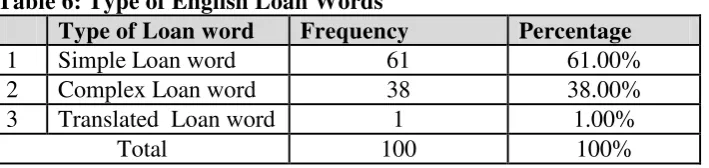
Table 6: Type of English Loan Words
Among 100 data, there are 61 English Loan words (61.00%) in the form of simple
word, 38 English Loan words (38.00%) in the form of complex words, and 1
English Loan words (1.00%) in the form of translated words. So, it can be said
that most of the English Loan words are in the form of simple word.
2. The Adjustment of the English Loan Words in the Novel
The 101 English loan words are used in the Indonesian version of Angels and Demons by undergoing adjustment namely, spelling adjustment, namely single vowel adjustment, double vowels adjustment, single consonant adjustment,
double consonants adjustment, adjustment of consonant cluster and adjustment of
affixes. To make the analysis of the loan words adjustments clearer, the researcher
presents it in the table below:
Table 7: Types of Spelling Adjustment
Types of Adjustment Frequency Precentage
1 Single Vowel 5 5.00%
38
consonant cluster adjustment is used 1 times (1.00%), and affixes adjustment is
used 17 times (17.17%). However, some English Loan words may undergo no
adjustment at all. So, the total frequency of the type of adjustment does not reflect
the total number of data.
3. The Translation Method Used to Translate the English Loan Words
According to the theory in chapter II, the translation method is
differentiated into closer to SL and closer to TL. To make the presentation of
translation method used to translate the English loan words clearer, it is presented
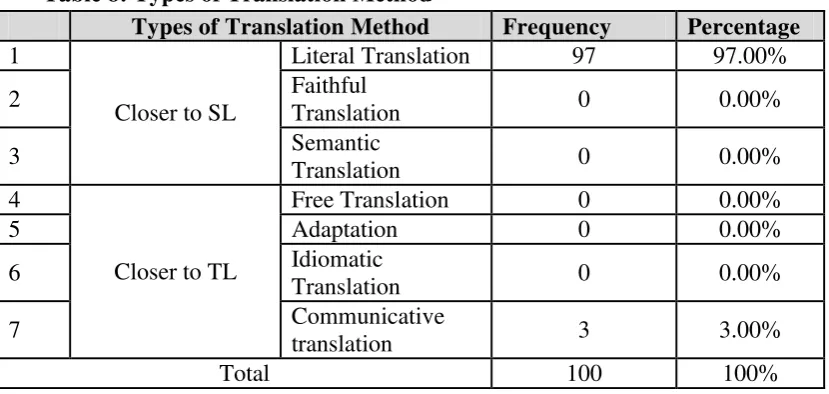
as follows:
Table 8: Types of Translation Method
Based on the table above, it can be seen that literal translation method is
used 97 times (97.00%) and communicative translation method is used 3 times
(3.00%). On the other hands, the faithful translation, semantic translation method,
free translation method, adaptation method and idiomatic translation method are
not used at all.
Types of Translation Method Frequency Percentage
1
Closer to SL
Literal Translation 97 97.00%
B. Discussion
This part is aimed to discuss further about the spelling changes of the
English loan words found in Indonesian version of Angels and Demons novel.
1. The Types of English Loan Word
Based on the finding, there are three types of loan word, they are simple
word, complex word and translated word. To get deeper insight on those types of
English loan words, the researcher conducts the analysis as follows:
a. Simple Word
The first type of English Loan words found in the Indonesian version of
Angels and Demons is English loan words consist of simple word. The characteristic of English loan words in the form of simple word is the adjustment
of the spelling and retain of the pronunciation.
The first example of simple word English loan word is Fossil.
Fossil Fosil
Datum, (10/SL8/TL23)
Fosil is categorized as loan word in the form of simple word because it only occur spelling changes by reducing the double consonants into just a single consonant in
the TL novel and it retains its pronunciation.
The second example of simple word English loan word is the SL Eclectic.
Eclectic Eklektik Datum, (49/SL43//TL678)
40
TL. The spelling adjustment from Eclectic to Eklektik is the adjustment of single consonant C into K (two times) and the adjustment of suffix “c”into “k”.
The third example is the SL Epic which is adapted into the loan word Epik in TL. Epic Epik
Datum, (97/SL474/TL613)
Epic is English loan word in the form of simple word because, the SL Epic only
undergoes spelling adjustment into TL Epik. Epic only change an adjustment of vowel c in SL into vowel k in TL.
b. Complex Word
The second type of English loan word found in the novel is complex word.
The characteristic of English loan word in the form of complex word is the
adjustment of spelling and pronunciation at the same time. However, in this study
the researcher does not discuss about the pronunciation adjustment. The first
example of complex word is the word Music in SL which is translates into musik
in TL.
Music Musik
Datum, (22/SL12/TL28)
Music in the SL is a complex loan word because it determine of two adjustments;
spelling and pronunciation adjustment. The first adjustment is spelling. The
The second example is the word Friksi. The word friction in SL which is translates into friksi in TL.
Friction Friksi
Datum, (36/SL23/TL43)
Friction is a loan word in the form of complex word. It is complex word
because it undergoes two adjustments. First is adjustment in the spelling. The
spelling adjustment of Friction to friksi is the replacement of consonant “c” with
“k” and suffix “ion” becomes “si”.
The third example of complex word is the word phase in the SL which is
translates into fase in the TL.
Phase Fase
Datum, (13/SL9/TL25)
Phase in SL which is adjusted into Fase in TL. The SL Phase undergoes spelling and pronunciation adjustment into TL Fase. The adjustment is double consonants
“ph” becomes “f” and it makes adjustment in the way pronouncing the word too.
c. Translated Word
The third type of English loan word found in the novel is translated word.
Translated word is the SL word which is translated into Indonesian based on the
Indonesian grammatical rule.
The first example of English loan word in the form of translated word is Oak in
SL which is adjusted into Ek in TL. Oak Ek
42
The original word Oak is translated into Indonesian by following Indonesian
grammatical rule. To avoid repetition in the analysis, the analysis types of English
loan word is integrated in the analysis of the adjustment of the English loan word
in the following section.
2. The Spelling Adjustment of the English Loan Words in the Novel
There are 100 English loan words found in the Indonesian version of
Angels and Demons novel. However, to avoid repetition and unused analysis, not all data are taken into analysis. The researcher only takes some of them as the
example of analysis because many of the data found undergo similar spelling
adjustments.
a. Spelling Adjustment of Single Vowel
Below are loan words that contain single vowel adjustment in its
translation process.
1) Espionage is adjusted into spionase
The first English loan word in the novel that is brought into the analysis is
spionase. The loan word “spionase” contains one vowel spelling adjustment from
its original Espionase. The spelling changes of the word Espionage into the loan
words spionase are as follows:
The word espionage undergoes spelling adaptations as follows:
1). E Ø – The vowel E is adjusted by dropping it in the TL.
E S P I O N A G E
Datum 66/SL92/TL129
2). S S – The consonant S is adjusted by keeping its original form in TL.
3). P P – The consonant P is adjusted by keeping its original form in TL.
4). I I – The vowel I is adjusted by keeping its original form in TL.
5). O O – The vowel O is adjusted by keeping its original form in TL.
6). N N – The consonant N is adjusted by keeping its original form in TL.
7). AGE ASE – The suffixes AGE is adjusted into ASE in the TL.
From the analysis it can be seen that the word Espionage is adjusted into spionase
by changing one vowel only, the vowel E in SL is adjusted by dropping it in TL.
The reason for the deletion of vowel E at the end of the word is because that
vowel is not pronounced. Therefore, according to the rule, it should be deleted in
the Indonesian word. The adjustment of SL espionage into spionase in TL is also translates using literal translation.
2). Chrome is Adjusted into Krom
Krom is an English loan word that originally adjusted from SL Chrome and then undergoes single vowel changes in the TL. The spelling changes of
chrome into krom are as follows:
The comparison above can be elaborated as follows:
1). CH K – The double consonants CH is adjusted by changing it into K in TL.
2). R R – The consonant R is adjusted by retaining its original form in the TL.
3). O O – The vowel O is adjusted by keeping its original form in TL
C H R O M E
Datum 55/SL56/TL83
44
4). M M – The consonant M is adjusted by retaining its original form in TL.
5). E Ø – The vowel E is adjusted by dropping it in the TL.
From the comparison above, it can be seen that the word Krom contains single vowel adjustment in its translation process from the SL Chrome. The
Adjustment is the deletion of vowel E in the end of the word. The reason for this
deletion is that according to the rule, vowel E which is not pronounced should be
released. So, the TL becomes Krom. 3). Extreme is adjusted into Ekstrem
The third example of spelling adjustment with single vowel is Ekstrem. This English loan word originally comes from Extreme in SL and undergoes spelling
adjustment with single vowel. The comparison of two words is as follows:
The comparison above can be explained as follows:
1). E E – The vowel E is retained in both the SL and TL.
2). X KS – The consonant X is adjusted into double consonant KS in the TL.
3). T T – T is also retained in the TL.
4). R R – the consonant R is also retained in TL .
5). E E – the vowel E is also retained in TL.
6). M M – The consonant M is used in TL by maintaining its original form.
7). E Ø – The vowel E is deleted in TL .
E X T R E M E
Datum 43/SL32/TL54
From the comparison of the two words, it can be seen that the SL Extreme
undergoes single vowel adjustment before it is used in the TL as Ekstrem. It undergoes the deletion of vowel E. The reason for the deletion of the vowel is
because the /e/ at the end of the Extreme is not pronounced. Therefore, according
to the rules, the vowel should be omitted. During the process to become an
English loan word, the word Ekstrem also translate using literal translation method.
b. Spelling Adjustment of Double Vowels
Spelling adjustment with double vowels is adjustment that happens to
word with double vowels like ae, au, ea, ei, eo, ie, iu, oi, oo, ua, ue, ui, uo, and uu.
The example of spelling adjustment with double vowels is as follows:
1). Nucleus is Adjusted into Nukleus
Nukleus is a simple English loan word. It only undergoes spelling changes from SL to TL. The change during the borrowing process is as follows:
The English loan word Nukleus (TL) is originally from the SL Nucleus. It undergoes double vowels adjustment. The changes are as follows:
1). N N – The consonant N is adjusted by keeping its original form in TL.
2). U U – The vowel U is adjusted by retaining its original form in TL.
3). C K – The consonant C is adjusted by changing it into K in TL.
4). L L – The consonant L is adjusted by retaining its original form in TL
N U C L E U S
Datum 38/SL25/TL45
46
5). EU EU – The double vowel EU is adjusted by keeping its original form in
TL.
6). S S – The consonant S is adjusted by retaining its original form in the TL.
From the analysis it can be said that the SL Nucleus contains spelling adjustment
with double vowels. The double vowel EU in SL is retained in TL as suggested by
theory in chapter II.
The English loan word Nukleus is translated from Nukleus using literal translation process.
2). Jeans is Adjusted into Jins
Jins is an English loan word that undergoes spelling adjustment with double vowels, from its original word, Jeans. The comparison of the two words is
as follows:
The comparison above is explained as follows:
1). J J – the consonant J is retained in the loan word.
2). EA I – the double vowels EA is changed into I in TL.
3). N N – the consonant T is still used in the loan word.
4). S S – the consonant S is also used in the loan word.
From the comparison and also the analysis above, it can be seen that the spelling
adjustment with double vowels happens when the double vowels „EA‟ is adjusted
J E A N S
Datum 4/SL5/TL20