GENDER INFLUENCE ON SLANG USED BY TEENAGERS IN THEIR DAILY CONVERSATION AT SCHOOL
(A Comparative Study on Male and Female Early Teenagers in One of Islamic Boarding Schools, Lembang)
A Research Paper
Submitted to the English Education Departement of FPBS UPI in a Partial Fulfillment of the Requirements for Sarjana Sastra Degree
By
Annisa Salma 0707917
ENGLISH EDUCATION DEPARTMENT
GENDER INFLUENCE ON SLANG USED BY
TEENAGERS IN THEIR DAILY
CONVERSATION AT SCHOOL
(A Comparative Study on Male and Female Early Teenagers in One of Islamic Boarding Schools, Lembang)
Oleh
Annisa Salma
Sebuah skripsi yang diajukan untuk memenuhi salah satu syarat memperoleh gelar Sarjana pada Fakultas Pendidikan Bahasa dan Seni
© Annisa Salma 2013
Universitas Pendidikan Indonesia
Februari 2013
Hak Cipta dilindungi undang-undang.
Skripsi ini tidak boleh diperbanyak seluruhya atau sebagian,
PAGE OF APPROVAL
GENDER INFLUENCE ON SLANG USED BY TEENAGERS IN THEIR DAILY CONVERSATION AT SCHOOL
(A Comparative Study on Male and Female Early Teenagers in One of Islamic Boarding Schools, Lembang)
By: Annisa Salma
Approved by:
Main Supervisor Co-Supevisor
Dra. Sri Setyarini, M.A R. Dian Dia-an M., M. Hum
NIP 19631229 199002 2 001 NIP 19811024 200501 2 001
The Head of English Education Department Faculty of Language and Arts Education
Indonesia University of Education
ABSTRACT
The research entitled “Gender Influence on Slang Used by Teenagers in their Daily Conversation at School” aims to investigate types of slang and gender influence on the use of slang among teenagers. Data were collected from observation, questionnaire, and interview. To analyze the data, the theories proposed by Potter (1975) and Kahn & Illson (1985) were implemented to identify the types of slang among teenagers, whereas Diekman and Eagly’s (2000) theory was applied to investigate the gender influence on the use of slang among them.
The findings show that there were 12 types of slang used by male and female teenagers, such as back, centre, clipping or shortening, blending, compounding, nonsense reduplication, acronyms, loan or borrowing, onomatopoeia, substitution, and two types of slang categorized by Willis (1964). The results of analysis also reveal that gender may affect the use of slang. It can be seen from the total number that slang used by male teenagers (54,3%) tend to be higher than females (45,7%). Therefore, it can be concluded that male teenagers use slang more than females and it can also be understood that the tendency of males to use standard language is to show their machismo.
ABSTRAK
Penelitian berjudul "Gender Pengaruh pada Slang Digunakan oleh Remaja di Harian Percakapan mereka di Sekolah" bertujuan untuk menyelidiki jenis pengaruh bahasa gaul dan gender pada penggunaan bahasa gaul di kalangan remaja. Data diperoleh dari observasi, kuisioner, dan wawancara. Untuk menganalisis data, teori yang diusulkan oleh Potter (1975) dan Kahn & Illson (1985) digunakan untuk mengidentifikasi jenis bahasa gaul di kalangan remaja, sedangkan (2000) teori Diekman dan Eagly diaplikasikan untuk menyelidiki pengaruh gender dalam penggunaan bahasa gaul di antara mereka.
Temuan menunjukkan bahwa ada 12 jenis bahasa gaul yang digunakan oleh remaja pria dan wanita, seperti, back, centre, clipping or shortening, blending, compounding, nonsense reduplication, acronyms, loan or borrowing, onomatopoeia, substitution dan dua jenis bahasa gaul dikategorikan oleh Willis (1964). Hasil analisis juga mengungkapkan bahwa gender dapat mempengaruhi penggunaan bahasa gaul. Hal ini dapat dilihat dari jumlah total bahasa gaul yang digunakan oleh remaja laki-laki (54,3%) cenderung lebih tinggi daripada perempuan (45,7%). Oleh karena itu, dapat disimpulkan bahwa remaja laki-laki menggunakan slang lebih dari perempuan dan juga dapat dipahami bahwa kecenderungan laki-laki untuk menggunakan bahasa standar untuk menunjukkan kejantanan mereka.
i
CHAPTER I INTRODUCTION ……….….…………...1
1.1 Background of the Study ... 1
1.2 Research Questions ... 4
1.3 Purpose of the Research ... 4
1.4 Scope of the Research ... 5
1.5 Clarification of Terms ... 5
1.7 Organization of the Paper... 7
CHAPTER II THEORETICAL FOUNDATION …………...……….……...9
2.1 Theory of Age Grading ... 9
2.2 Language and Language Variation ... 10
2.3 Slang ... 11
2.3.1 Definition of Slang ... 11
2.3.2 Function of Slang ... 12
ii
2.3.4 Types of Slang ... 15
2.3.5 Teenagers and Slang ... 17
2.4 Theory of Gender ... 18
2.5 Language and Gender ... 19
2.6 Previous Research ... 21
CHAPTER III RESEARCH METHODOLOGY ………....…………..23
3.1 Purpose of the Research ... 23
3.2 Method of the Research ... 24
4.1 The Types of Slang Performed by Male and Female Teenagers ... 30
4.1.1 Acronyms Slang ... 34
4.1.2 Loan/Borrowing Slang ... 36
4.1.3 Cockney Rhyming Slang ... 38
iii
4.1.5 Centre Slang ... 40
4.1.6 Clipping/shortening Slang ... 40
4.1.7 Blending ... 42
4.1.8 Compounding ... 43
4.1.9 Nonsense Reduplication ... 45
4.1.10 Onomatopoeia ... 46
4.4.11 The other types of Slang ... 46
4.4.11.1 Substitution ... 47
4.4.11.2 Slang comes or gives new meaning to a standard word... 46
4.4.11.3 New Inventions to the establish words... 46
4.2 Gender Influence on the use of Slang among Male and Female Teenagers ... 58
CHAPTER V CONCLUSIONS AND SUGGESTIONS ………...59
5.1 Conclusions ... 59
5.2 Suggestions ... 60
BIBLIOGRAPHY ... 62
iv
LIST OF TABLES
Table 3.1 Times and Place of Observation
Table 4.1 Findings of the
Table 4.2 Distribution of Types of Slang
Table 4.3 Percentage List of the Types of Slang
Table 4.4 Acronyms
Table 4.5 Loan/Borrowing
Table 4.6 Back
Table 4.7 Centre
Table 4.8 Clipping/Shortening
Table 4.9 Blending
Table 4.10 Compounding
Table 4.11 Nonsense Reduplication
Table 4.12 Onomatopoeia
Table 4.13 Substitution
Table 4.14 Slang comes from or gives New Meaning to Standard Word
v
LIST OF APPENDICES
Appendix I Transcript of the Observation
Appendix II The List of the Questionnaire
Appendix III The List of the Interview
Appendix IV Table of Questionnaire
Appendix V Transcript of the Interview
1
CHAPTER I
INTRODUCTION
The research is concerned with the types of slang and gender influence on
the use of slang among teenagers. This chapter contains the background of the
research, research questions, purposes of the research, scope of the research,
clarification of terms, and organization of the paper.
1.1. Background of the Research
The development of technology and foreign cultures nowadays are very
influential to the life of teenagers‟. With that development their attitudes,
behaviors, and habits are changing not only the way they dress, but also the way
they interact and communicate to another. Thus, the variety of language used by
them may also change.
According to Owen (2006: 1), language can be defined as a socially
acceptable code or conventional system to deliever concepts through the use of
symbols and combinations of the desired symbols that are governed by the
provisions. The opinion above is similar to the statement of Tarin (1989: 4) who
2
be also as a generative system. Second, language is a set of arbitrary symbols
which is expressed by the speaker (as cited in Siroj, Badrus. 2011).
Nowadays, the development of technology and foreign culture in
Indonesia generates a language variation which is raised by certain community
(Wartagunadharma Article, 2011:1). That variation becomes popular and spread
among teenagers. It can also be understood by members of the community. It does
not form a new language, but it develops into slang.
According to Ellis (2005: 53), slang is a variety of language used in certain
contexts by meaning of which people express their sense of belonging to a
particular group within the community which is not specific to any geographic
location. Swan (1996: 22) notes that:
“slang is a word, expressions or special use of language found mainly in very informal speech, especially in the usage of particular groups of people. For
example nick „prison; whitey‟ white men”.
In Indonesia, slang has been popular since 1970 and people started to use
it. This phenomenon is widely spreads among children from the transition‟s age to
teenagers (Wartagunadharma Articles, 2011: 2, line 2-3). Firstly, this language
variation was originally known as the “street language or language thugs” because
it is usually used by gangsters as a code and only understood by their own group.
In addition, this variation is also used by teenagers to follow a number of media
such as from television, radio, movies, magazines, and others, or to convey
3
Slang continues evolving from time to time. There are some words that has
been introduced since 1970s. Those words are still often used, but not a few of
them are replaced by another term to be more “funky”. Later this kind of language
is popular and widely used in everyday conversation by the teenagers
(Meilinawati, 2011).
Basically, there are two main concerns of teenagers those are identity and
recognition (Wartagunadharma Article, 2011:2). Pronunciation and writing the
language with their own style could be the formation of both concerns. Evans
(1968, as cited in Berger, 1968, 8-10) states that teenagers use such inappropriate
language (slang) because there is something they should hide from their parents or
teachers. Furthermore, Thome (2004, cited in WKSU News, 2004: 24) says that
teenagers want to introduce their independence from adults and identity with
unique culture.
Based on Thongkamdee (1998: 3-4) new slang words are always invested
by teenagers. Teenagers use slang in order to make sentences shorter, faster, and
easier to say. Those slang expressions are used in different ways and different
meanings from literal or dictionary meaning. Teenagers classify themselves by
introducing their language use in order to show their group identity.
Wartagunadharma (2011: 3) argues that in every countries teenagers have their
4
Teenagers who are unstable and like to imitate, are easy to catch and use
slang instead of using the right and correct Indonesian. Moreover, they think that
this language is “funky”. So, those who do not use this language will be
considered to be outdated or obsolete. According to Owen (2004), teenagers begin
to sense the words that have double meanings. They like to use metaphor, irony,
and play with many words to express opinions, even their feelings. Sometimes
they create the new expressions that are not standard which is then known by the
term slang (Papalia: 2004).
According to Meilinawati (2011), who is a language observer in one of
universities in Bandung, there are two main reasons of teenagers to use the
language with its own characteristics. First, they establish themselves as a
particular social group namely teenagers. Second, this is a form of resistance
against the dominance of the standard language or the rules of language that has
been established. It means that teenagers are creating the identity of the language
they have made by themselves. Teenagers as the group of ages who are looking
for their self identity have a specific style in written language on social media.
There is a kind of uniformity of style that becomes their way of life (lifestyle).
Based on the above statements the use of slang is more flourishing among
teenagers because they are fragile, easy to replicate and infected by something
5
opportunities for teenagers to obtain slang, either through internet, television, or
another media.
In terms of a language variation in a particular place in a group of a
society, this present study gives a contribution to sociolinguistics. It present the
information of teenage language specifically teenage slang in junior high school
group. Furthermore, this study identified types of slang used by male and female
teenagers in one of Islamic boarding school, Lembang and also investigated
gender influence on the slang performed by them.
1.2. Research Questions
Based on the above statements, there are two research questions that were
investigated by the researcher as follows:
1. What types of slang are used by male and female teenagers at school area
in the Islamic boarding school?
2. Does gender influence the use of slang performed by the teenagers?
1.3. Purpose of the Research
According to the above questions, the purpose of this research are to:
1. Identify the types of slang used by male and female teenagers in the
6
2. Investigate gender influences on the use of slang performed by the
teenagers.
1.4. Scope of the research
The research was conducted in the area of an Islamic boarding school,
Lembang during learning and daily activities. It is limited to identify types of
slang used by male and female early teenagers of 7th grade junior high school.
Early teenagers are them who are in the earliest stage of teenagers‟ in the age of
eleven, twelve, and thirteen years (Douvan and Andelson, 1979). The research
also investigate gender influence on the use of slang among them. To identify the
slang types it applied the theories proposed by Potter (1975) and Kahn & Illson
(1985) while, to investigate gender influence it applied the theory of Diekman and
Eagly (2000).
The subjects were observed to collect the data by giving a questionnaire
containing questions concerning their understanding of slang. They were also
interviewed which was intended to collect the depth information and direct answer
of their understanding on slang that given in the questionnaire. The data of the
research were compared between male and female teenagers.
7
To avoid the possibility of misunderstanding to the problems investigation,
some terms are clarified as follows:
1. Communication
According to Achramm (1983), the word “communication” comes from
Latin word, namely communis. It means common. When people
communicate with others, they try to establish “commoness” with others
and try to share information, an idea, or an attitude (as cited in Hodge,
1983, p.3)
2. Slang
The slang in the present study means an informal words used by male and
female teenagers in their daily conversation. There are some meanings of the term
slang by experts:
a. According to Swan (1995), slang is a very informal kind of
vocabulary, used mostly in speech by people who know each other
well (p.534);
b. Spolsky (1998) defines slang as a special kinds of intimate or in group
speech and associated with peer group and gang speech to obtain some
degree of privacy and to show the solidarity among the members
(p.35)
8
The teenager in the present study menas an early male and female
teenagers in 7th grade students in one of Islamic boarding school, Lembang. It is
suggested by the expert:
a. Douvan and Andelson (1979) distinguish three stages of teenager; they
are early, middle, and late. In the earliest stage include teenager in the
age of eleven, twelve, and thirteen years. In the middle stage is
fourteen, fifteen, and sixteen years, by late stage is seven years and
over (as cited in Coleman, 1980, pp.92-93)
b. Labov (1966) said that the limitation of teenager is young children who
were at up 13 years old.
1.6. Organization of the Paper
The study will be presented into five chapters:
a) Chapter I Introduction
This chapter consists of the introduction of the research problem. It
contains 8 issues, those are Background of the Research, Research
Questions, Purposes of the Research, Scope of the Research, Research
Methodology, Clarification of Terms and Organization of the Paper.
b) Chapter II Theoretical Foundation
This chapter connects the problem with available theories. It contains of
9
c) Chapter III Research Methodology
This chapter describes the process of the investigations. It contains of
Reearch Design, Sample, Data Collection, and Data Analysis.
d) Chapter IV Findings and Discussions of the Research
This chapter describes the findings of the research and discussion.
e) Chapter V Conclussion and Suggestion
This chapter gives the conclussion of the research and give some
28 CHAPTER III
RESEARCH METHODOLOGY
This chapter presents the methodology used in the research. It contains the
purposes of the research, method of the research, data collections, and data
analysis.
3.1. Purpose of the Research
Based on the background of the research and raising problems in Chapter
I, the research is aimed at:
1. Identifying the types of slang used by male and female teenagers in one of
Islamic Boarding School, Lembang.
2. Investigating gender influences on the use of slang performed by the
teenagers.
3.2. Method of The Research
The research applied a descriptive qualitative method to analyse the data
because it gives description of a problem (Vredenbregt, 1984 in TiraSyam, 2009).
The aims of descriptive are to explain, classify, and analyze the data from some
29 judgements instead of numerical form. (M.K.Trochim, 2006). The qualitative
method is used to investigate the social phenomenon.
Alwasilah (2003: 92) states that qualitative research gives value toward
descriptive data objectively. He also says that the descriptive method requires
natural behavior or event to observe the subject. The research applied a qualitative
method that used natural setting to describe the factual phenomenon. Thus, it
investigates the data by conducting observation, questionnaires, and interviews in
order to observe the use of slang among teenagers.
Furthermore, the qualitative method is also a method which applies
interpretive ways by presenting the research in descriptive form. Ratna (2004:
47-48) suggests the most significant characteristics of qualitative method, as follows:
1. Concerning its main subject on meaning and message as in the basics of
objects, which is cultural studies.
2. Concerning more on the process rather than the outcome of the research,
thus meaning always change.
3. There is no gap between the researcher subject and the objects of the
research. The researcher subject functions as the main instrument therefore
there is a direct interaction between them.
4. The research design and framework are temporary, that is why the subject
can be changed.
30 In addition, Maxwell (1996: 3) states,
“Qualitative study is the activities of collecting and analyzing data, developing and modifying theory, elaborating or refocusing the research questions, and also identifying and eliminating validity threats are usually all going on more
or less simultaneously, each influencing all of the others.”
The qualitative method was employed because the data collections were
mostly analyzed in the form of description and explanation. In this present
research, slang and gender are the main issues to investigate. Thus, some relevant
theories are needed to support and validate the researcher’s opinion. Meanwhile
the tables and percentages are merely the complementary things to support the
findings.
3.3. Data Collection
This part consists of the subjects of research and the instruments of the
research, namely observations, questionnaire, and interview.
3.3.1. Subjects of the Research
In the present research, the researcher is interested in studying teenagers
who are growing in a school environment that is restricted from the “outside”
environment that introduces slang more to the teenagers. The subjects of the
31 one of Islamic Boarding School, Lembang. Early teenagers are those who are in
the age of eleven, twelve, and thirteen years old (Douvan & Andelson, 1979). The
reason in choosing the teenagers in this school as the subject of the research is
because the school separates classes between male and female students. Thus, the
researcher chose two classes which involved 36 students. The female class
consisted of 18 students from VII D. While the male class consisted of 18 students
from VII B.
This school implements Islamic modern systems that promote the
learning of belief and behavior for their students. The “sparkling world” for
teenagers in this school is forced to be avoided because it is incompatible with the
principles taught by the school. It can be seen from the location of this school
which is located in the hills area in Cibodas, Lembang and quite far from the
urban atmosphere, so that the interactions with the "outside world" are difficult to
be touched. In addition, a variety of media such as television and the Internet that
are spread in Indonesia nowadays among teenagers, even though they are
available, but they are limited in order to avoid negative things.
Furthermore, there is a restriction between male and female students that
are very well preserved, so it will be a little difficult to have direct communication
between males and females. Based on the problem above, the researcher is
interested in investigating the phenomenon of the slang performance of male and
female teenagers by identifying the types of slang and investigating the gender
32 3.3.2. Instrument of the Research
The research used three instruments, namely, observation, questionnaire,
and interview.
3.3.2.1. Observation
Observation is needed to collect the data such as the slang words
that are oftenly used in the teenagers’ daily conversation. It is aimed at
answering the research questions through elaboration in questionnaire and
interview. The observation was held in 7 days by using recording and
taking a note of the teenagers’ conversation in the Islamic boarding
school’s area, Lembang. The places of the observation were in the school
areas, such as laboratorium, basketball field, cafetaria, library, class, and
dormitory. The elaborations of the observation can be seen in Appendix I.
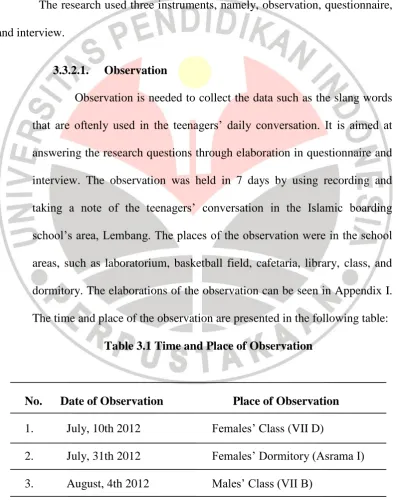
The time and place of the observation are presented in the following table:
Table 3.1 Time and Place of Observation
No. Date of Observation Place of Observation 1. July, 10th 2012 Females’ Class (VII D)
2. July, 31th 2012 Females’ Dormitory (Asrama I)
33 4. August, 7th 2012 Females’ School Area
5. August, 9th 2012 Males’ Dormitory (Asrama III)
6. September, 6th 2012 Male and Females’ Cafetaria
7. September, 8th 2012 Males’ School Area
3.3.2.2. Questionnaire
According to Arikunto (2002: 126), a questionnaire is a sum of
written questions which is used to obtain information from respondents.
The questionnaires were given to the female teenagers on September, 11th
2012, and to the male teenagers on September, 22nd 2012 in the class
during English subjects. It took about 30 minutes long for each class. The
list of the questionnaire can be seen in Appendix II of this paper.
There are some advantages in using a questionnaire that is relevant
to the research. First, the questionnaire can collect the data which has
many components. Second, the respondents feel free to fill the
questionnaire because there is no mental connection between the
researcher and respondents. The last, the data are easy to analyse because
of similar questions (Ali, 1993: 68).
3.3.2.3. Interview
An interview is a dialogue which is conducted by the interviewer to
34 that the function of interview is to cross-check the data from questionnaire
and get the data that are not covered by the questionnaire.
Therefore, the research used interviews as the instrument in
collecting data from the teenagers as respondents after they had answered
the questionnaires completely. The interview was held on September, 11th
2012 to the female teenagers and September, 22nd 2012 to the male
teenagers after they filled the questionnaires. It took about an hour for each
class. The questions were conducted based on the items in the
questionnaire to get clear and depth information (see Appendix III).
3.4. Data Analysis
This part consists of the mode of analysis and analytical framework.
3.4.1. Mode of Analysis
The data were analyzed by following steps. First, the data were transcribed
from the results of the observations, questionnaire, and interview. Second, the data
were reduced because they need to focus on the main topic. Third, the data were
coded by classfying the types of slang based on theories proposed by Potter
(1950) and Kahn & Illson (1985). Fourth, the data were displayed and computed
by calculating the percentage. Fifth, the data were interpreted and discussing the
data. Sixth, the researcher investigated whether gender may affect the use of slang
35 researcher concluded the data by relating the types of slang used by male and
female teenagers to its gender influence.
In order to determine the percentage of each slang classification, the
male and female teenagers in the Islamic boarding school, Lembang? The types
of slang words were categorized into ten groups, namely cockney rhyming, back,
centre, clipping or shortening, blending, compounding, acronyms or abbreviation,
loan or borrowing slang, onomatopoeia, and nonsense reduplication.
To answer the second question, does gender influence the use of slang
performed by the teenagers?, the research used the theory of Diekman and Eagly
(2000) about gender stereotypes. Diekman and Eagly argued that gender
stereotypes refer to stereotype images of males and females. They also assert that
gender stereotypes present a conventionally simplified and standardized
36 domestically and socially. Gender stereotypes discuss characteristics, traits, and
59 CHAPTER V
CONCLUSIONS AND SUGGESTIONS
This chapter presents conclusion and suggestion. This part can be
categorized as the last chapter. Some suggestions are offered to the next
researchers who are interested in finding slang words among teenagers.
5.1. Conclusions
The research investigates slang used by the teenagers in Junior High
School. The research focuses on the slang performed by male and female
teenagers in their daily conversation at the school. It particularly emphasizes on
the types of slang. These types of slang incorporate elaboration from Potter
(1975), and Khan and Illson (1985). It also investigates the gender influence on
the use of slang by the teenagers.
The research used selected sampling (purposive sampling). The sample in
this research was the first year of junior high school at one of Islamic boarding
schools in Lembang. This research used three methods for collecting data;
observations, questionnaire, and interview. It also applied quasi-statistics to help
taking conclusion from the numerical data.
The result found slang among male and female teenagers. There are twelve
60 shortening, blending, compounding, nonsense reduplication, acronyms or
abreviations, loan or borrowing, onomatopoeia, substitution, slang which comes
from or gives new meaning to standard words and new inventions to establish
words (Potter, 1975, and Kahn & Illson, 1985).
From those types of slangs, it can be seen that gender gives influence to
the use of slang. It is shown by male teenagers who tend to use slang more than
females. As said in the theories of Diekman and Eagly (2000), males have typical
characteristics of authoritarian and socialistic behaviour while female are pious,
submissive, and domesticity. It is also supported by the following theory “Men
have been shown to talk more than women in some settings as in spontaneous
conversation” (Soskin and John 1963).
Through the research, there are different types of slang performances
between male and female teenagers, as suggested by Tannen (1990) that women
and men use language differently, they are speaking different dialect, or named as
genderlect. In case of that, they are early teenagers who like to create and
innovate words to be performed in their daily conversations. Wylie (1965, as cited
in Geber, 1968, p. 13) argues that “teenage language is not only vivid and
whimsical, but also clever, highly qualified, quite sly, and lack of grammatical
form.”
61 The present research focuses on the slang used by male and female
teenagers at the first year of Junior High School in their daily conversation at
school. The purposes of the research are to analyze the types of slang performed
by male and female teenagers of 7th grades junior high school in one of Islamic
boarding school, Lembang and analyze the gender influence on the use of slang
performed by the teenagers. The present research is also to discover the teenagers’
comprehension on slang.
The researcher suggests that further research may focus on the use of slang
among teenagers used by different respondents, different scopes, and different
time and setting because slang words will be different from one place to other
places. The use of slang will be different among different users. The present
research only compares the use of slang in male and female teenagers at one
school in a boarding school. The researcher suggests to the next research to
conduct a research on comparison of male and female teenagers in performing
62 BIBLIOGRAPHY
A.Clark, Beverly. (2006). First and Second Language Acquisition in Early
Childhood. [Online].
Retreived:http://www.education.com/reference/article/Ref_first_and_sec
ond_language_acquisition_in_early_childhood/?page=2
Alex. (2009). Victory Manual On Japanese language and culture Language
Exposure: What, How, and Why. [Online]. Retrieved:
http://www.victorymanual.com/language-exposure-what-how-and-why/
[13 April 2012]
Alwasilah, A. Chaedar and Senny Suzanna Alwasilah. (2007). Pokoknya Menulis
(second ed.). Bandung: Kiblat Buku Utama.
Americana Corporation, 1995. Encyclopedia Americana: International Edition.
New York: Grolier Incorporated.
Aprianti, Dewi Selvia. (2008). Gender Roles in Japanese Legends. A Paper of
FPBS UPI Bandung: Unpublished.
Badrus, S. (2011). Teori Pembelajaran Bahasa. [Online]. Retrieved:
http://sastrasantri.blogspot.com/2011/05/teori-pembelajaran-bahasa.html
[13 April 2012]
Baker, S. (1983). A Dictionary of Australian Slang, 3rd Edition. Melbourne:
63 Bowen, Caroline. (1998). Speech and Language Development : In Infants and
Young Children [Online].
Retrieved:http://members.tripod.com/caroline_bowen/devel1.htm
CCLAS. (2008). Chisasibi Child Language Acquisition Study [Online]. Retrieved:
http://www.mun.ca/cclas/
Chavez, Elida. (2012). Slang in the subtiles of Pulp Fiction and The Departed
Movies [Online]. Retrieved:
www.mightystudents.com/essay/slang.206213 [28 February 2013]
Damayanti. (2009). Foreign Languange Anxiety in Junior High School. A Paper
of FPBS UPI Bandung: Unpublished.
Genishi, Celia. (2011). Language Development in Children : Oral Language
Components [Online].
Retrieved:http://www.education.com/reference/article/Ref_Young_Child
rens_Oral/?page=2
Grafura, L. (2007). Bahasa Gaul dalam Film Remaja: Sebuah Kajian Deskriptif
Fenomena Tutur Remaja dalam film Ada Apa Dengan Cinta dan Heart.
[Online].Retrieved:http://library.um.ac.id/free-
contents/index.php/pub/detail/bahasa-gaul-dalam-film-remaja-sebuah-
kajian-deskriptif-fenomena-tutur-remaja-dalam-film-ada-apa-dengan-cinta-dan-heart-lubis-grafura-32915.html [25 July 2012]
Graha, Eku Baruna. (2011). An Analysis of Slang Translation in the Subtitles of
64 Healy, Melissa. (2008). Gender in The Mix [Online].
Retrieved:http://articles.latimes.com/2008/may/19/health/he-capsule19
[28 July 2013]
Holmes, Janet. (2001). Language Variation: An Introduction to Sociolinguistics
(Second ed.). United Kingdom: Longmann.
Joom. (2012). Cockney Rhyming Slang [Online].
Retrieved:http://www.cockney.co.uk/cockney-rhyming-slang [6 Desember
2012]
Kimberly L. Keith. (2011). Language Development in the Elementary Years
[Online]
Retrieved:http://childparenting.about.com/cs/childdevelopment/a/languag
edevelop.htm
Labov, William. (1966). The logic of non-standard English. In Pier Paolo Giglioli
(ed.) Language and Social Context. Harmondsworth: Penguin, pp.
179-215.
M. K. Trochim, William. (2006). Types of Data [Online]. Retrieved:
http://www.socialresearchmethods.net/kb/datatype.php
Malinda. (2010). Usia 14 Disebut Fase Paling Berbahaya. [Online].
Retrieved:http://malindofm.com/mengapa-usia-14-disebut-fase-paling-berbahaya [23 Juli 2012]
Meilinawati, Linda. (2011). Pengaruh Bahasa Gaul (Alay) Terhadap
65
Retrieved:http://wartawarga.gunadarma.ac.id/2011/03/pengaruh-bahasa-
gaul-alay-terhdap-perkembangan-bahasa-indonesia-tulisan-softskill-kedua/ [23 July 2012]
Meilinawati, Linda. (2011). Pengaruh Bahasa Gaul Dalam Perkembangan Bahasa
Indonesia [Online]. Retrieved:
http://wartawarga.gunadarma.ac.id/2011/04/%E2%80%9Cpengaruh-bahasa-gaul-dalam-perkembangan-bahasa-indonesia%E2%80%9D/ [23
July 2012]
Morris, William. (1969). The Heritage Illustrated Dictionary. New York:
American Heritage Publishing Co. Inc and Houghton Mifflin Company.
Novita, Windy. (2011). Kamus Lengkap Bahasa Indonesia. Surabaya: Kashiko.
Quirk, Randolph. (1998). Longman Dictionary of Contemporary English. Essex:
Clays Ltd.
Rahmalida. (2010). Bahasa Gaul Terhadap Bahasa Indonesia. [Online].
Retrieved:http://www.rahmalida.co.cc/2010/09/bahasa-gaul-terhadap-bahasa-indonesia.html [23 July 2012]
Rianti. (2006). Communicative Learning in the Classroom Interaction (A
Descriptive Study on SMP 5 Bandung). Indonesia University of
Education. Unpublished Paper.
Samantha, Lingga M. Samantha. (2010). Gender Reproduction In Gender
Archetyped Children Picture Book. A Paper of FPBS UPI Bandung:
66 Setiawan, Ebta. (2012). KBBI Online (Daring) ver. 1.1 [Online]. Retrieved:
www.kbbi.web.id/ [27 August 2012]
Stewart, Jr., Thomas W. And Nathan Vaillette. (2001). Language and Gender.
Language Files: Materials for an Introduction to Language &
Linguistics (Eight ed.). American National Standard: Ohio State
University Press.
Sugono, Dr. Dendy. (2008). Kamus Besar Bahasa Indonesia (Daring) [Online].
Retrieved: badanbahasa.kemdiknas.go.id/kbbi/ [27 August 2012]
Tannen, Deborah. (1991). You Just Don’t Understand: Women and Men in
Conversation. London: Virago.
Tellis, Winston. (1997). Application of a Case Study Methodology, [Online].
Retrieved:http://www.nova.edu/ssss/QR/QR3-3/tellis2.html
Wells, K. (2010). Australian Slang: A Story of Australian English [Online].