ANTIMUTAGENIC ACTIVITY OF SINTOC BARK (Cinnamomum sintoc Bl.)VOLATILE OIL WITH MICRONUCLEUS METHOD*
Sri Adi Sumiwi, Tiana Milanda, Fazri Prakarsa Departement of Pharmacology, Faculty of Pharmacy
Padjadjaran University
Email: [email protected]
___________________________________________________________________________
Abstract
Sintoc bark (Cinnamomum sintoc Bl.) has many benefits, one of the efficacious compounds from these plants is volatile oil. Sintoc bark volatile oil are known to have antioxidant activity, antimutagenic test is carried out on rats using micronucleus method. The test materials were administered orally at a dose of 0.01 mL/200g, 0.025 mL/200 g, and 0.05 mL/200g. Antimutagenic effect evidenced by a decreasing number of micronucleus polychromatic erythrocytes per 1000 cells in preparations of bone smears.The results showed that volatile oil at all dose tested could reduce the number of micronucleus. Volatile oil dose 0.01 mL/200g decreased by 46.03%, 0.025 mL/200g dose of 38.73%, and a dose of 0.05 mL/200g of 29.21%. The final conclusion sintoc bark volatile oil a dose of 0.01 mL/200g antimutagenic effect best with the greatest reduction in micronucleus.
Key Word: Antimutagenic, Cinnamomum sintoc Bl.
___________________________________________________________________________
* Presented on the 2nd International Seminar on Chemistry 2011 (ISC-2011) in Jatinangor, Indonesia,
INTRODUCTION
Lifestyle and an unhealthy environment can cause a disease. On the environment and
food products there are many compounds carcinogens (cancer-Causing agents) such as UV rays, industrial pollutants, peptisida, food additives, and products tobaco. These carcinogenic compounds can induce cancer by causing mutations that can change the arrangement of DNA. Mutations can be caused by the mutagenesis process of elimination, inversion, duplication, or transfer a particular DNA segment of the chromosome (Russell, 1994). One indicator of mutagenesis can be observed in living organism is micronuleus. Micronucleus is the result of mutations of chromosomes intact a broken / damaged and appears as a small nucleus within a cell. Micronucleus is easily observed in young cells polychromatic erythrocytes (reticulocytes). Number micronuleus in these cells reflect the level of genetic damage in a living system eritropoitic (Subarnas, et al., 2004). Micronucleus test is an in vivo screening procedure to detect any damage or loss of chromosomes (chromosome aberration) caused by mutagenic substances. Besides being used for testing mutagenic effects, micronucleus test can also be used for testing the effect of antimutagenic(Rhamdhani,2003).
Usefulness of plants or herbs as antimutagenic and anticarcinogenic has been widely studied. Some of the natural constituents are believed to have antimutagenic or anticarcinogenic effects that potentially include: antioxidants, vitamins, essential oils, flavonoids, glocusinolat and organic sulfur compounds, tannins, polyphenols, and quinones .
Volatile oil is one of the secondary metabolites produced by higher plants as the plants of the family Laminaceae, Lauraceae, Myrtaceae, and Rutaceae. Cinnamomum sintoc Bl. Essential oil are volatile at room temperature, containing more than one chemical compound and a typical smell. In the volatile oil contained compounds giving odor, fragrant, and typical of most essential oils are (Syafitri, 2006).
second class is specific toxicity test, the test potential, teratogenic test, and carsinogenitas tumoregenitas test, local effects on the skin of the eye, and behavioral test. In previous
studies, toxicity test were conducted subcronic, and teratogenic test of sintoc bark. From the results of these studies, the bark does not give effect sintoc subcronic toxicity (Sumiwi, et al., 2008) and teratogenic effects (Subarnas, et al., 2008). To complement the pharmacological data and adds a sense of security from the use of sintok bark, then tested the carcinogenic or mutagenic in rat using micronucleus method. Based on the background the following problems can be identified whether sintok bark (Cinnamomum sintoc Bl.) volatile oil has antimutagenic activity.
This study aims to determine the antimutagenic activity of sintok bark (Cinnamomum sintoc Bl.)volatile oil as well as knowing the most effective antimutagenic doses of these volatile oil.
MATERIAL AND METHOD Experimental animals
Experimental animals used were white male Wistar rats (200-250 g) ± 2 months, obtained from PAU - ITB. Rats kept in the Laboratory of Pharmacology Faculty of Pharmacy, Unpad for approximately one month in cages with room temperature 23-28 º C, humidity 70-85%, light settings 12 hours of light and 12 hours dark. Rats were fed pellets and drink water
drinking bottles given unlimited (ad libitum).
Materials Chemistry
Antimutagenic activity test used siklofosfamida (N, N-bis (2-kloroetil) tetrahydro-2-1, 2,3, oksazafosforin-2-oxide) obtained from the pharmacy Galenika, Jakarta, and for Giemsa staining method used Merck Giemsa dye Solution obtained from Sakura Medical, Bandung.
Research Tools
Method
Collection of Plant Material and Determination
Material in the form of sintok bark (Cinnamomum sintoc Bl.) obtained in Lembang, West Java. Bark is used as a form of sheets measuring ± 1cm in order to obtain simplisia ready for further processing. Determinations carried out in the Department of Biology Faculty of Mathematics and Natural Sciences Padjadjaran University.
Isolation of Volatile Oil
Isolation of volatile Oils sintok bark in Installation Research Manoko Lembang, by steam distillation of water (water and steam distilation). Simplisia sintokc bark incorporated into the distillation vessel, placed over boiling water using a bulkhead, so that plant material will only be fed with water vapor. The vessel is heated and distillation time is calculated from the first destilat dripping. Volatile oil distillation sintoc bark performed for 8 hours. Volatile oil obtained is collected in brown bottles to avoid direct contact with light.
Antimutagenic Assay
cyclophosphamide administration, the rats were killed and dissected to be taken both his thigh bones. Thigh bone is cleaned and marrow was taken by suction (aspiration). Marrow is
inserted into a centrifuges tube containing physiological NaCl. Tube inserted into the sentrifugator at 1000 rpm for ten minutes. Most of the resulting supernatant removed with a pipette, the rest is mixed back with the resulting sediment. The liquid was then made preparations smear on objects glass and dried. Preparations allowed to stand for one day, then stained with Giemsa dye and covered with cover glass. Preparations were observed under a microscope magnification of 1000 times. For every 200 cells counted the number of micronucleus polychromatic erythrocytes contained in the polychromatic erythrocytes cells. The calculation is done as much as ten times in five different preparations for the rat tested. This means the number of polychromatic erythrocytes cells to be counted as many as 1000 cells to a mouse polychromatic erythrocytes. Criteria for counting cells that contain micronucleus polychromatic erythrocytes consist of: (1) micronucleus-shaped nucleus with a size of 1 / 20 to 1 / 5 the size of the nucleus. (2) Performed on cells that contain micronucleus polychromatic erythrocytes and not the amount of micronucleus in a cell. (3) The cell is calculated polychromatic erythrocytes are in intact (not broken or damaged). Antimutagenic activity of the test preparation is shown by a significant decrease in the number of micronucleus compared with the group.
Results
Collection fo materials and determination of plant
Figure 1. Cinnamomum sintoc Bl.
Figure 2. Cinnamomum sintoc Bl. bark
Volatile Oil Isolation
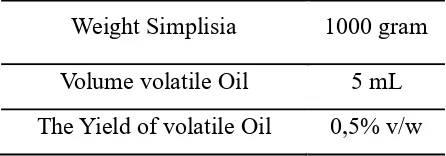
Results of sintok bark volatile oil isolation can be seen in Table 1.
Table 1. Results of Sintoc Bark Volatile Oil Isolation
Weight Simplisia 1000 gram
Antimutagenic Assay
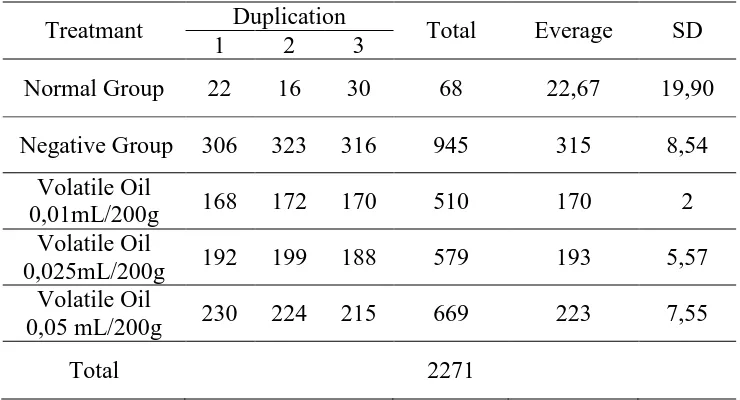
Data obtained from the calculation of the amount contained micronucleus in 1000
polychromatic erythrocytes cells, where the observations are divided into five repetitions, and each time the loop consists of 200 cells polychromatic erythrocytes. Observations can be seen in Table 2.
Table 2. Number of Micronuleus 1000 Erythrocytes Polychromatic Cells
Treatmant Duplication Total Everage SD
1 2 3
Normal Group 22 16 30 68 22,67 19,90
Negative Group 306 323 316 945 315 8,54
Volatile Oil
0,01mL/200g 168 172 170 510 170 2
Volatile Oil
0,025mL/200g 192 199 188 579 193 5,57 Volatile Oil
0,05 mL/200g 230 224 215 669 223 7,55
Total 2271
Number of micronucleus polychromatic erythrocytes per 1000 cells for all Groups treatment can be seen in Figure 3.
Figure 3. Bar graph of micronucleus polychromatic erythrocytes per 1000 cells for all
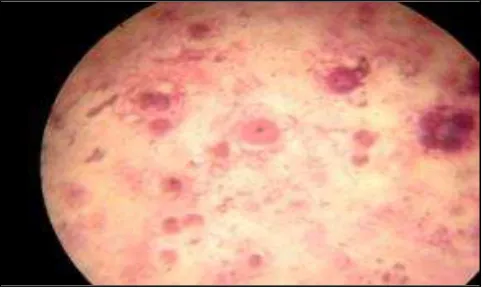
Micronucleus polychromatic erythrocite can be seen in Figure 3.
Figure 3.Micronucleus polychromatic erythrocite can be seen in Figure 3.
Table 2 shows that in each treatment group there are differences in the number of micronucleus polychromatic erythrocytes per 1000 cells. An increasing number of micronucleus occurs in the negative control group due to administration of cyclophosphamide at a dose of 50 mg / kg compared with normal controls. This shows the effect of mutagenesis
induced by cyclophosphamide induction. Cyclophosphamide which has been known as a chemotherapeutic agent for tumor disease can turn into a mutagen in the presence of metabolism in vivo. It has been known that cyclophosphamide need to go through the activation of enzymatic and nonenzimatis to produce its active form in the form of phosphoramide mustard. Cyclophosphamide first hydroxylated to 4-hydroxycyclophosphamide through enzymatic hydroxylation process. The compound 4- hydroxycyclophosphamide in a state of equilibrium with tautomernya, namely aldophosphamide. 4- hydroxycyclophosphamide and aldophosphamide can undergo further metabolism in two lines, namely: changes to be non-toxic metabolites, such as 4-ketosiclophosphamide, carboxyphosphamide, and alcophosphamid; and changes into cytotoxic metabolites, namely acrolein and phosphoramide mustard.
position of the main bonding of the active metabolites of cyclophosphamide occurred in the DNA, which can occur in the process of crossing over that can cause DNA damage.
From Table 2 also can be seen a decrease in the number of micronucleus polychromatic erythrocytes per thousand cells are given volatile oil when compared with negative control. Number of micronucleus in the negative control decreased when given doses of volatile oil with 0.01, 0.025; 0.05 which was originally 315 to 170, 193, and 223. Based on statistical calculations using complete randomized design with 95% degree of confidence or α = 0.05 in Appendix 2, is obtained that the calculated value of f greater than f α tables. It shows that H0 is rejected or there is the influence of the treatment group to decrease the number of micronucleus. Newman-Keuls test results showed any significant treatment where a single treatment with other treatments give different results. Based on these results can be demonstrated that administration of essential oil with a variety of doses have antimutagenic activity
Conclusion
Antimutagenic assay of sintoc bark volatile oil with variation dose using micronucleus method showed antimutagenic activity. This is shown by the decreasing number of micronucleus from 1000 polychromatic erythrocytes cells compared with negative control given cyclophosphamide 50 mg/bw. volatile oils 0.01 mL/200 g, 0.025 mL/200 g, and 0.05 mL/200 g decreased by 46.03%, 38.73%, and 28.21%. If viewed from the decrease in the number of erythrocyte micronucleus per 1000 cells, the volatile oil at a dose of 0.01 mL/200 g
given the best antimutagenic effect with a decrease of 46.03%
References
Heyne, K. 1987. Tumbuhan Berguna Indonesia II. Jakarta : Balai Penelitian dan Pengembangan Kehutanan Departemen Kehutanan. 127-133.
Subarnas, A., Sumiwi, S.A., and Fatati.2008. Uji Teratogenik Ekstrak Etanol Kulit Batang Sintok (Cinnamomum sintoc Bl.) Pada Tikus Galur Wistar. Prosiding Kongres Ilmiah XVI Ikatan Sarjana Farmasi Indonesia. Ikatan Sarjana Farmasi Indonesia. Yogyakarta.297-300.